九州大学学術情報リポジトリ
Kyushu University Institutional Repository
ネパールの野生キノコの生物活性と化学的性質
ソナム, タムラカー
https://doi.org/10.15017/1866356
出版情報:Kyushu University, 2017, 博士(農学), 課程博士 バージョン:
権利関係:
Bioactivities and Chemical Characterization of the Wild
Mushrooms of Nepal
Sonam Tamrakar
2017
Table of contents
Thesis Declaration Acknowledgements List of abbreviations Abstract
Chapter 1. Introduction
1.1 Nepal 1
1.2 Biodiversity of Nepal 2
1.3 Mushrooms of Nepal 4
1.4 Nepal Mushroom Project 7
1.5 Bioactivities and chemical components of mushrooms 9
Chapter 2. Mushroom Samples 2.1 Introduction 11
2.2 Materials and methods 2.2.1 Identification 11
2.2.2 Sample preparation 12
2.3 Result and discussion 2.3.1 Sample identification 12
2.3.2 Sample preparation 13
2.4 Conclusion 13
Chapter 3. Antioxidant activity 3.1 Introduction 20
3.2 Materials and methods 3.2.1 Total phenolic content (TPC) 21
3.2.2 Free radical scavenging assays (ORAC, DPPH and ABTS) 21
3.2.5 Reducing power assay 23
3.2.6 Indicators for antioxidant activity 23
3.2.7 Statistical analysis 23
3.2.8 HPLC analysis 24
3.2.9 LC-MS analysis 24
3.3 Result and discussion
3.3.1 Total phenolic content (TPC) 25
3.3.2 ORAC, DPPH, and ABTS assay 26
3.3.3 Reducing power assay 27
3.3.4 Correlation between TPC and antioxidant assays 28
3.3.5 Determination of EC
50and EC
0.5values 28
3.3.6 HPLC analysis 29
3.3.7 LC-MS analysis 30
3.4 Conclusion 30
Chapter 4 Antibacterial activity 4.1 Introduction 38
4.2 Material and methods 4.2.1 Antibacterial assay 39
4.2.2 Statistical analysis 40
4.2.3 LC-MS analysis 41
4.2.4 NMR analysis 41
4.3 Results and discussion 4.3.1 Percentage inhibition of S.aureus and P.acnes 42
4.3.2 MIC and MBC 43
4.3.3 Partial chemical characterization by LC-MS analysis 44
4.3.4 NMR analysis 46
4.3.5 MIC and MBC of pure compounds 47
4.4 Conclusion 47
Chapter 5 Melanin biosynthesis 5.1 Introduction 55
5.2 Materials and methods 5.2.1 Melanin synthesis assay 55
5.2.2 Cell viability assay 56
5.2.3 Tyrosinase assay 56
5.2.4 LC-MS analysis of melanin biosynthesis inhibiting extracts 57
5.3 Results and discussion
5.3.1 Melanin content and cell viability 57
5.3.2 Tyrosinase assay 59
5.3.3 LC-MS analysis 59
5.4 Conclusion 61
Chapter 6 Anti-allergy activity 6.1 Introduction 73
6.2 Materials and method 6.2.1 Anti-allergy activity 74
6.2.2 Cell viability 75
6.2.3 Determination of IC
50values 75
6.2.4 Statistical analysis 75
6.3 Results and discussion 6.3.1 Anti-allergy activity and cell viability 76
6.3.2 Determination of IC
50values 77
6.4 Conclusion 78
Chapter 7 Anti-cancer activity 7.1 Introduction 82
7.2 Materials and method 7.2.1 Cell viability assay 84
7.2.2 Statistical analysis 84
7.3 Results and discussion 7.3.1 Cell viability assay 85
7.4 Conclusion 87
Chapter 8 In vitro digestion 8.1 Introduction 90
8.2 Materials and method 8.2.1 Fecal sample preparation 91
8.2.2 Colonic fermentation 91
8.2.3 Analysis of bioactivities 92
8.2.4 LC-MS analysis 92 8.3 Result and discussion
8.3.1 Analysis of bioactivities 93 8.3.2. LC-MS analysis 94 8.4 Conclusion 95 Chapter 9 Conclusion and future perspective
9.1 Conclusion 104 9.2 Future perspective 106 References
Appendices
Thesis Declaration
I, Sonam Tamrakar, hereby declare that all the data described in this thesis are results of my work unless otherwise acknowledged or referenced. This thesis is submitted in partial fulfilment of the requirements for the award of Doctor of Philosophy, in the Faculty of Agriculture at Kyushu University.
Acknowledgements
The support, guidance, and kind encouragement of several people has made this research possible. I am highly indebted to everyone who has contributed directly or indirectly for the completion of this dissertation.
Firstly, I would like to thank my supervisor, Associate Prof. Kuniyoshi Shimizu, for his great support and encouragement. His kind advice has been a constant source of inspiration. I would also like to express my deep gratitude to Prof. Atsushi Kume for his fruitful advice and support.
I would like to thank Prof. Katsuya Fukami for spearheading the Nepal Mushroom Project, and for his constant support and advice throughout the duration of my PhD research. Also, I would like to express my heartfelt gratitude to Nepal Agricultural Research Council (NARC), and Mr.
Gopal Parajuli for collecting and providing the mushroom samples from Nepal. The morphological identification of mushroom samples by Dr. Hiroto Suhara is greatly appreciated.
I am very grateful to Prof. Yuji Tsutsumi for accepting me as a PhD student in Shinrinken Laboratory. Also, I would like to express my heartfelt gratitude to all the members of Shinrinken who have guided and supported me tirelessly throughout my research period. I would also like to express my deepest appreciation to the graduated members of Shinrinken including Dr. Tran Hai Bang, who has been mentor to me; Ms. Marina Nishida, who has been an important contributor to the Nepal Mushroom Project; Dr. Yhiya Amen, who has constantly guided and encouraged me for my research; and Dr. Asuka Kishikawa, who has helped me in every way possible.
I would like to thank Associate Professor Jiro Nakayama, and all the donors for providing the fecal samples used in the in vitro digestion experiments.
Last but not the least, I would like to thank the Ministry of Education, Science, Sports and
Culture of Japan (MEXT) for providing me with this wonderful opportunity in the form of PhD
scholarship.
List of abbreviations
NARC: Nepal Agricultural Research Council TPC: Total phenolic content
GAE: Gallic acid equivalent
ORAC: Oxygen radical absorbance capacity
AAPH: 2,2’- azobis(2-amidinopropane) dihydrochloride TE: Trolox equivalent
DPPH: 2,2-diphenyl-1-picrylhydrazyl
ABTS: 2,2'-azino-bis(3-ethylbenzothiazoline-6-sulphonic acid) RP: Reducing power
EC: Effective concentration IC: Inhibitory concentration
HPLC: High performance liquid chromatography LC-MS: Liquid chromatography – mass spectrometry IT-TOF: Ion trap – time of flight
ESI: Electron spray ionization UV-Vis: Ultra violet – visible BPC: Base peak chromatogram
MIC: Minimum inhibitory concentration MBC: Minimum bactericidal concentration NMR: Nuclear magnetic resonance
HMBC: Heteronuclear multiple bond correlation HSQC: Heteronuclear single quantum correlation MC: Melanin content
CV: Cell viability
MTT: [3-(4,5-dimethylthiazol-2-yl)-2,5-diphenyltetrazolium bromide]
BHR: β-hexosaminidase release
Abstract
Mushrooms have been considered a part of a healthy human diet due to its high nutritional benefits and potential medicinal properties. Nepal, is a country rich in biodiversity with abundant natural medicinal resources, including various medicinal mushrooms. However, there is a great lack of scientific research into the bioactivities and chemical characterization of these mushrooms. The present study aims to fill this gap by investigating bioactivities of several wild mushroom species, collected from the forests in different parts of Nepal. Ninety-two samples of wild mushrooms, belonging to 40 different genera were collected from forests in different parts of Nepal (altitudes ranging from 1300 m to 3800m). The samples were dried and sent to Systematic Forest and Forest Product Sciences, Kyushu University, for analysis. The samples were firstly identified based on the morphological characteristics, followed by genetic identification.
The dried samples were ground to a fine powder, and extracted in ethanol and water separately at room temperature for 24 hours. The assays such as total phenol content (TPC), ORAC, DPPH, ABTS, and reducing power were used to test the antioxidant activity. Other tested bioactivities include antibacterial activity against Staphylococcus aureus and Propionibacterium acnes, inhibitory and stimulatory activity towards melanin synthesis in B16 melanoma cells, anti-allergy activity in RBL-2H3 cells, and anti-cancer activity using the cancer cell lines MCF-7, Hela, HCT-116, HepG2, CCD-841, and NHDF.
Although several species were identified as bearing strong bioactivities, the mushrooms belonging to the Hymenochaetaceae family were some of the most prominent samples. Ethanol extract of Inonotus clemensiae showed extraordinarily high values of antioxidant activity (ORAC value 31,966.9 µM trolox equivalent/ g extract), which is one of the highest reported antioxidant activity among food products. Further chemical characterization of this extract by LC-MS and NMR analysis revealed the presence of a highly bioactive compound, “hispidin”.
However, the presence of the compound as a single major compound, encompassing around 70% of the extract is a very unique phenomenon. Some other interesting samples with strong bioactive potential were Cyclomyces setiporus, Phellinus conchatus, and several Ganoderma sp. Compounds such as protocatechualdehyde, protocatechuic acid, homovanillic acid, and vanillin were identified from Cyclomyces setiporus.
The next step was to focus on the in vitro digestion of the bioactive compound hispidin, to confirm the maintenance of bioactivity upon consumption. A two-step process involving the enzymatic and fecal microbial digestion was performed to analyze the effect on the compound.
Further experiments are being conducted to clarify this effect and explore the possibilities of
biotransformation. Overall, the present research is expected to highlight the bioactive potential
of the wild mushrooms of Nepal, opening possibilities to create economic benefits for the local
farmers.
1
Chapter 1 Introduction 1.1 Nepal
Nepal, is a landlocked country nestled between two huge countries India and China. With an area of 147,181 km
2[1], Nepal occupies less than 0.1% of the world land mass. It is located between latitudes 26°22’ and 30°27’ N and longitudes 80°40’ and 88°12’ E[2]. However, the relatively small area of the country must not be mistaken for lack of geographic and biological diversity. The altitudinal variation ranges from 67 meters above sea level to 8848 meters above sea level (Mt. Everest), which also is the highest point in the world. The southern part of the country is made up of tropical alluvial plains, whereas the northern part is occupied by permafrost Himalayas. The entire country is divided into 5 physiographic zones from north to south: the high Himalayas, high mountains, middle mountains, Siwalik hills, and the Tarai plains[3]. With the huge variations in altitudes and the physiographic regions, the climatic conditions also varies from the alpine cold climate in the northern Himalayan region to the tropical climate in the southern Tarai region.
Physiographic regions of Nepal (Source: Soil Science Division, NARC)
2
1.2 Biodiversity of Nepal
Due to the sharp variations in altitudes and climatic conditions, Nepal is gifted with one of the richest biodiversity in the world. Another important contributing factor is that the country lies in the unique transitional area between two major biogeographic regions, the Indo-Malayan to the south, and the Palearctic to the north. Also, the changes in precipitation, humidity, temperature, and slope effect are some others parameters affecting the diversity within a particular habitat. As a result, Nepal boasts a total of 118 ecosystems, which includes 112 forest ecosystems, 4 cultivation ecosystems, 1 water body ecosystem, and 1 glacier/snow/rock ecosystem[3]. Some researchers argue that due to the utterly complex physiographic and climatic zones, the clear categorization of the vegetation types in Nepal remains extremely difficult; and therefore is still a matter of debate and careful consideration[4]. Nonetheless, broadly the southern lowlands are covered with Shorea robusta forests and tall grasslands; the eastern part of Nepal is covered with several species of oak and rhododendron; the western region is dominated by pine forests; and the northern Himalayan region consists of the broadleaved trees and conifers, depending on the altitudes.
Species diversity is an important asset of the country. Although, Nepal occupies only 0.1% of the total land mass in the world, it is home to 2% of the flowering plants, 3% of the pteridophytes, and 6% of the bryophytes of the world flora; and 3.9% mammals, 8.9% birds, and 3.75 of butterflies of the world fauna[4]. There are several flora and fauna that are endemic to Nepal, which includes 284 flowering plants, and 160 animal species. The genetic diversity of the flora and fauna of Nepal has not been explored extensively. The wide-ranging diversity in geographic conditions and species richness all indicate a potentially rich genetic diversity.
Some initiatives have been made to study and conserve this diversity, such as the establishment
of the gene bank in 2010 at Nepal Agricultural Research Council (NARC).
3
Despite the prevalence of an extremely rich biodiversity, including several rare, endangered, and endemic species, the biodiversity of Nepal is under serious threat. The 5
thNational Report to Convention on Biological Diversity of Nepal, has outlined the major risks to the biodiversity as: i) ignorance of the value of biodiversity in government, ii) poverty and lack of other livelihood opportunities, iii) population growth and migration, iv) weak forest governance, v) inadequate awareness, and vi) climate change to name a few[3].
Several conservation efforts are also being made by various governmental, non-governmental,
and international organizations. Currently, 23.23% of the total area of the country has been
designated as protected areas, including national parks, wildlife reserves, hunting reserves,
conservation areas, and buffer zones. Community forestry is another major initiative [5] to
protect the biodiversity and increase sustainability of forest resources. Since 2010, 133,579
hectares of forest areas have been designated as protected forest, to enhance biodiversity as
well as the livelihoods of the local people[3]. Also, several awareness, education, and research
programs are conducted to conserve and strengthen the biodiversity of the country. Nepal has
also committed to “Aichi Targets”, which is a set of 20 targets for biodiversity conservation,
that were developed in the 10
thmeeting of Conference of Parties’ (COP-10) in Aichi, Nagoya,
Japan[6].
4
1.2 Mushrooms of Nepal
The richness of the fungal diversity of Nepal is a mere reflection of its opulent biodiversity.
The mycobiota of Nepal has been studied and recorded by researchers from Nepal as well as several other parts of the world [7]. Major part of the research conducted so far has focused on taxonomy, ethnomycology, ecological distribution patterns, mycorrhizal asscociation, and toxicity. Some 608 genera and 2025 species of Nepalese mycobiota have been reported. Among them, 270 genera and 1150 species (157 species in Ascomycota and 993 species in Basidiomycota) have been recorded as mushrooms. Thirty two species of these mushrooms are known to be endemic to Nepal. The mushroom species have been further classified into around 147 edible species, nearly 100 poisonous species, and 73 medicinal species. Furthermore, some 20 species have also been documented for aesthetic or decorative purposes[7]. However, it must be noted that extensive exploration of mushrooms all over Nepal is still an ongoing process. Most of the research so far seems to be concentrated on the central region of Nepal.
So, further investigations shall elucidate the species diversity even more elaborately.
The macrofungal population is immensely affected in terms composition and diversity by the
surrounding environment such as nutrients, moisture, forest type, climatic conditions, and
season. Baral et al. [8] studied the diversity of macrofungi in the Shorea robusta forests in the
mid-hill region of central Nepal. Within the study area, they found Polyporaceae to be the most
abundant family, followed by Clavariaceae. Coltricia cinnamomea, Cantharellus leucocomus,
Laccaria laccata, and Russula aurora were some of the most common species. Also, some
researchers have identified 69 species of wild mushrooms from Sagarmatha National Park, in
the northeastern region of Nepal[9]. Among them, the most abundant number of species
belonged to Boletaceae family, followed by Russulaceae family.
5
The collection, consumption and trade of mushrooms has deep rooted ties with several ethnic communities in Nepal. In some communities it is an important resource for livelihood[10], whereas in some communities it is denounced and a subject of taboo [11]. Few reports can be found on the ethnic use of mushrooms in various parts of Nepal. Devkota [12] identified 44 species of mushrooms, including 5 medicinal species such as Morchella conica, Morchella esculenta, Morchella elata, Lycoperdon pyriforme, and Cordyceps sinensis from the mid- western highlands of Dolpa district in Nepal. Some other ethno-medicinal uses of mushrooms in Nepal have been reported by Adhikari et al. [11], which includes the use of Grifola frondosa and Ramaria botrytis to relieve muscle pain; and Coriolus hirsutus, Lycoperdon pyriforme and other species to treat wounds. Christensen et al. [13] documented the use of 228 species of wild edible mushrooms in Nepalese households, across different ethnic groups. They have identified Boletus edulis, Cantharellus cibarius, Craterellus cornucopioides, and Lactarius deliciosus as species with international trade potential.
Apart from the consumption and use of the mushrooms available in the wild, some species are
also cultivated and are a good source of income for local farmers. Some of the most widely
cultivated and marketed species include Agaricus bisporus, Pleurotus ostreatus, and Lentinula
edodes[14–16]. Since 2004, NARC has also conducted several research related to the
cultivation of Ganoderma lucidum[17].
6
Cultivation of Ganoderma lucidum at NARC
7
1.3 Nepal Mushroom Project
Mushrooms have been a part of the human diet since a very long time. Recently, they have attracted a lot of attention as a reservoir of bioactive compounds. The therapeutic benefits of mushrooms have been realized and documented since ancient times in several parts of Asia, mainly in China, Japan, and Korea[18, 19]. However, with increasing research showing promising potential, there has been a global surge in the cultivation and mass production of a specialized group of mushrooms, popularly termed as “medicinal mushrooms”.
Nepal’s unique geographic location, and climatic conditions has contributed to its very rich biodiversity, including some rare natural medicinal resources. Despite, the availability of huge amount of genetic resource, the lack of research and awareness poses a threat to their sustainability; and subsequently to the recognition of their bioactive potential. Nepal is home to more than a 1000 documented species of mushrooms[7], many of them growing in the extreme environmental conditions in the Himalayas. However, the bioactive potential of these mushrooms remain largely unknown.
From an agricultural point of view, the market for mushrooms in Nepal is still in its infancy.
Apart from a handful of species including Agaricus bisporus and Pleurotus ostreatus that are used for consumption, there is a severe lack of variety in the Nepalese mushroom market.
Therefore, an in depth research into the therapeutic potential of the mushrooms can contribute to highlight the extremely rich genetic resources in the country, as well as make way for the artificial cultivation of those mushrooms, to enrich the agricultural resources of the local farmers. Consequently, expanded usage of Nepalese mushrooms can be explored, not only for consumption, but also as a source of functional food or functional food ingredients.
Considering the above mentioned situation, the “Nepal Mushroom Project” was planned. All
necessary procedures required to collect and analyze Nepalese genetic resources were
8
implemented, before the initiation of the project. Kyushu University and the Ministry of Science and Technology of the Government of Nepal signed a Memorandum of Understanding (MoU) as prior informed consent (PIC) in 2010. Subsequently, Kyushu University signed a joint research agreement with Nepal Agricultural Research Council (NARC) consisting of mutually agreed terms (MAT) according to the spirit of the international treaty “Convention on Biological Diversity” in July 2011. The project was then started with the aim to search for new usage of Nepalese mushrooms, including development of functional foods, leading to economic benefit in Nepal.[20].
Until now, Nepal has been famous as one of the exclusive habitat for the most sought after
mushroom Ophiocordyceps sinensis. This has led to the over harvesting of the species
threatening its sustainability in the long run [21]. However, the results of the current project
could be useful in highlighting the fact that Nepal possesses several other equally if not more
therapeutically potent mushroom species. The research papers that have been published so far
from the results of this project have shown that Nepalese wild mushrooms have very promising
antioxidant and antibacterial properties[22–24]. Moreover, strong effects on melanin
biosynthesis, anti-allergy activity, and anti-cancer activity has been observed for various
samples. The recognition of the therapeutic as well as the economic potential of the Nepalese
wild mushrooms as functional food resources has just begun. We hope that our research will
continue to shed more light into the unparalleled capabilities of these mushrooms.
9
1.4 Bioactivities and chemical components of mushrooms
Mushroom is defined as “a macro fungus with a distinctive fruiting body, which can be either hypogeous or epigeous, large enough to be seen with the naked eye and to be picked by hand”[25]. Taxonomically, mushrooms mainly belong to the class basidiomycetes, with only a few species belonging to ascomycetes. An estimated 140,000 mushroom species exist in world, with a mere 22,000 known species[26]. The history of mushroom consumption, and its usage as traditional medicinal products can be traced back to ancient times. Fruiting bodies of around 200 species are known to be consumed worldwide. The nutritional composition of mushrooms generally comprises of 200-250 g/kg dry matter of proteins, 20-30 g/kg dry matter of lipids, and the remaining dry matter is composed of carbohydrates, minerals, and other constituents[27]. Apart from the basic nutrient contents, higher fungi such as mushrooms are known to produce a wide array of secondary metabolites, as a self-defense and survival tool.
Bioactive compounds which are produced as secondary metabolites in mushrooms have proven to be important sources of therapeutic agents[28].
A number of different bioactivities have been attributed to various mushrooms over the years[26, 29–33], with more beneficial effects being discovered as research progresses.
Antioxidant, antimicrobial, anti-viral, anti-cancer, anti-hypertensive, anti-diabetic activities are some of the health promoting effects described for mushrooms[34, 35]. This has led to the recognition of a special class of mushrooms, popularly known as “medicinal mushrooms”[36].
Roupas et al.[37] have summarized the studies on edible mushrooms and their components
claiming health benefits, with a special focus on human trials. They concluded that the health
benefits of mushrooms are mostly related to stimulation or modulation of natural cellular
immunity; and many of these immunomodulatory effects arise from the polysaccharide content
of mushrooms. Quang et al. have described a wide range of bioactivities including antioxidant,
10
antimicrobial, nematicidal, anti-human immunodeficiency virus from the bioactive metabolites originating from 22 species of inedible mushrooms[38].
Beta glucans, such as those isolated from Lentinus edodes and Grifola frondosa; and polysaccharide protein complexes from Trametes versicolor were found to inhibit the proliferation of cancer cells[39], and have also been used as adjuvants in cancer therapy[40].
Phenolic compounds are the main source of antioxidants in mushrooms[27]. Moreover, the phenolic compounds along with terpenes, organic acids, and various proteins are also known to contribute for bioactivities like antibacterial activities[41]. Antibacterial activity of mushroom extracts, fractions, and isolated compounds could be detected against several bacteria causing nosocomial infections such as Pseudomonas aeruginosa, Staphylococcus aureus, Klebsiella pneumonia; as well as multi-drug resistant bacteria[41]. The triterpenoids and related compounds isolated from mushrooms like Ganoderma lucidum (Reishi in Japanese), have shown cytotoxic activity against various cancer cells. The fruiting bodies, mycelia, and spores of this species alone has been a source of more than 130 highly oxygenated and pharmacologically active lanostane-type triterpenoids[28]. Apart from the several therapeutic benefits, the commercial potential of mushrooms as cosmetic agents has also been explored by several researchers[42–44].
Therefore, the enormous therapeutic and commercial potential of mushrooms, and the stark
lack of research of the bioactivities of mushrooms from Nepal, a country touted as an important
biodiversity hotspots, necessitates an in depth research.
11
Chapter 2 Mushroom Samples 2.1 Introduction
Mushrooms which developed basidiomata were collected from the forests in different parts of Nepal. In this study 92 samples were investigated. The botanical origin, location and habitat of the samples are provided in Table 2.1 (a – d). The pictures of the dried samples are also provided as supplementary data in Appendix Fig A2.1.
2.2 Materials and methods 2.2.1 Identification
The samples were identified on the basis of morphological features and/or genetic analysis.
The dried fungal material were mounted in 3% (w/v) KOH or Melzer’s reagent and
measurements of spore, basidia, cystidia, and other tissue features were made for each
specimen using Nikon Eclipse E600 stereomicroscope. For genetic analysis, the DNA was
extracted following the procedure described by Hosaka and Castellano [45], with slight
modifications. The internal transcribed spacer (ITS) region was amplified by polymerase chain
reaction (PCR) using the primers ITS1 and ITS4B primers [46, 47]. Amplifications were
performed with KOD-Plus-Neo polymerase (Toyobo Co. Ltd., Japan). The PCR products were
purified using Illustra Exo ProStar kit (GE Healthcare, UK). Both PCR reactions and
purification steps were performed in accordance with the manufacturer’s protocol. The purified
samples were sequenced by the Hokkaido System Science Co, Ltd. The sequences were
subjected to a Basic Local Alignment Search Tool (BLAST) search via the National Center for
Biotechnology Information. The ITS sequence of the samples that were successfully sequenced,
were deposited in the International Nucleotide Sequence Database Collaboration (INSDC) or
12
DNA Data Bank of Japan (DDBJ). The scientific names and their taxonomic positions used in the present study were described in accordance with the descriptions of the Mycobank.
2.2.2 Sample Preparation
The samples were firstly air dried and then dried in an air ventilated oven at 35 °C for 10 hours followed by 45 °C for 1 hour. The dried samples were ground to a fine powder, and extracted in ethanol. The extractions were performed by shake flask method in an orbital shaker at 200 rpm, for 24 hours at room temperature, and then filtered. Water extracts were freeze-dried and the ethanol extracts were rotary evaporated at 45 °C, and reduced pressure. The extract yield was calculated as the percentage of dried extract obtained from the dry weight of ground mushroom used for extraction. The dried extracts were used for all the analyses.
2.3. Result and discussion 2.3.1 Sample identification
The mushroom samples were identified up to species or genus level on the basis of morphological and/or genetic analyses. The scientific names of the samples, along with the families to which they belong, location, and habitat are listed in Table 2.1 (a - d). The INSDC/
DDBJ accession number of the genetically identified samples are also provided. The 92 samples collected were identified as belonging to 40 different genera. The identity of one of the sample could not be confirmed by both genetic and morphological analyses.
The samples have been grouped into 4 groups depending on the taxonomic order:
Hymenochaetales, Polyporales, Agaricales, and the few remaining miscellaneous samples were
grouped as “Others”. The highest number of samples belonged to Polyporales with 40 samples,
followed by Hymenochaetales with 20 samples, Agaricales with 18 samples, and Others with
14 samples.
13
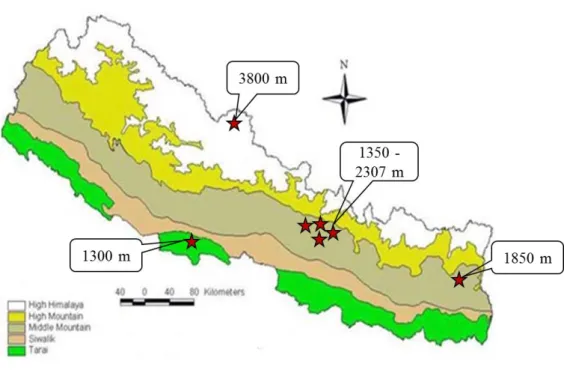
The samples were collected from locations ranging from 1300 m to 3800 m from different parts of Nepal. The sample collection sites are shown in Fig. 2.1. The habitat of the samples were mainly wood from living, dead and decayed trees, and also some samples were collected from soil, fallen leaves and branches. The habitat and other environmental conditions of the mushrooms are very important, since it can greatly influence the difference in production of secondary metabolites even within the same strains [48].
2.3.2 Sample preparation
The extract yield of the ethanol extracts have been provided in Table 2.1 (a - d). The extract yields varied from 0.7% to 16.89% for Hymenochaetales; 0.69% to 17.00% for Polyporales;
2.94% to 13.23% for Agaricales; and 2.40 to 14.61% for Others. The wide variations in the extract yield with each group suggests that the amounts of compounds that can be dissolved in ethanol are not dependent on the taxonomic order.
2.4 Conclusion
Mushrooms samples representing the mycoflora of different parts of Nepal were identified and
extracted for further investigations. Although the samples consisted of a small fraction of the
very rich mushroom diversity of Nepal, this study is the first attempt of its kind to make a
concerted study on the mushrooms across Nepal. Further collection and investigation of
mushrooms from other parts of the country would be necessary for a deeper understanding of
their potential.
14
Fig. 2.1 Sample collection sites (Map source: Soil Science Division, NARC)
15
Table 2.1 (a – d): Botanical origin, location, habitat and yield% of ethanol (EtOH) extracts of 92 wild mushrooms from Nepal
a. Hymenochaetales
S.N. Scientific name Family Location Altitude Habitat INSDC/DDBJ
No.
Yield%
EtOH 1 Inonotus andersonii Hymenochaetaceae Lalitpur,Mt.Phulchoki 2765 m Soil AB811856 3.04
2 Inonotus clemensiae Hymenochaetaceae Kathmandu,Dawachok 1500 m stump - 16.89
3 Inonotus cuticularis Hymenochaetaceae Lalitpur,Mt.Phulchoki 2307 m wood - 5.19
4 Inonotus sp. 1 Hymenochaetaceae Lalitpur,Mt.Phulchoki 2765 m Living tree - 4.73
5 Inonotus sp.2 Hymenochaetaceae Lalitpur,Mt.Phulchoki 2765 m Decayed wood - 1.49
6 Inonotus sp. 3 Hymenochaetaceae Lalitpur,Mt.Phulchoki 2765 m Decayed wood AB811865 6.03
7 Inonotus sp. 4 Hymenochaetaceae Lalitpur,Mt.Phulchoki 2307 m oak wood - 1.73
8 Inonotus sp. 5 Hymenochaetaceae Lalitpur,Mt.Phulchoki 2307 m oak wood - 1.90
9 Phellinus gilvus Hymenochaetaceae Lalitpur,Mt.Phulchoki 2765 m Decayed wood AB811862 4.05 10 Phellinus conchatus 1 Hymenochaetaceae Bhaktapur, Nagarkot 2500 m Decayed wood AB811863 0.81 11 Phellinus conchatus 2 Hymenochaetaceae Bhaktapur, Nagarkot 2500 m Decayed wood AB811864 0.50
12 Phellinus sp. 1 Hymenochaetaceae Makwanpur,Chitlang 2200 m wood - 1.25
13 Phellinus sp. 2 Hymenochaetaceae Mustang,Jomsom 3800 m dead wood - 2.10
14 Phellinus adamantinus Hymenochaetaceae Kathmandu,Dawachok 1501 m. dead wood LC149611 0.72
15 Cyclomyces setiporus 1 Hymenochaetaceae Makwanpur,Chitlang 2200 m wood - 1.91
16 Cyclomyces setiporus 2 Hymenochaetaceae Lalitpur,Mt.Phulchoki 2307 m wood - 1.96
17 Cyclomyces setiporus 3 Hymenochaetaceae Makwanpur,Daman 2320 m wood - 0.64
18 Cyclomyces setiporus 4 Hymenochaetaceae Makwanpur,Chitlang 2200 m dead wood - 1.11
19 Cyclomyces setiporus 5 Hymenochaetaceae Makwanpur,Chitlang 2200 m dead wood - 1.20
20 Oxyporus sp. Schizoporaceae Lalitpur,Mt.Phulchoki 2307 m dead wood - 6.14
16
b. Polyporales
S.N. Scientific name Family Location Altitude Habitat DDBJ / INSDC
Accession No.
Yield%
(EtOH)
21 Ganoderma australe 1 Ganodermataceae Mustang 3150 m Decayed wood AB811849 2.52
22 Ganoderma australe 2 Ganodermataceae Lalitpur,Mt.Phulchoki 2765 m Decayed wood AB811850 1.18 23 Ganoderma australe 3 Ganodermataceae Lalitpur,Mt.Phulchoki 2765 m Decayed wood - 2.88 24 Ganoderma australe 4 Ganodermataceae Kathmandu, Dawachok 1500 m Decayed wood AB811852 1.05
25 Ganoderma lingzhi 1 Ganodermataceae Lalitpur,Mt.Phulchoki 2307 m wood - 3.43
26 Ganoderma lingzhi 2 Ganodermataceae Makwanpur,Chitlang 2200 m dead wood LC149597 4.90 27 Ganoderma lingzhi 3 Ganodermataceae Lalitpur,Mt.Phulchoki 2765 m Decayed wood AB811848 5.02
28 Ganoderma endochroum Ganodermataceae Makwanpur,Chitlang 2200 m dead wood - 3.01
29 Ganoderma multipileum Ganodermataceae Rupandehi,Lumbini 1300 m dead wood LC149613 2.19 30 Ganoderma carnosum Ganodermataceae Lalitpur,Mt.Phulchoki 2765 m Decayed wood AB764438 5.00
31 Ganoderma sp.1 Ganodermataceae Lalitpur,Mt.Phulchoki 2307 m wood - 1.39
32 Ganoderma sp.2 Ganodermataceae Bhaktapur,Nagarkot 2,195 m wood - 6.89
33 Amauroderma calcigenum Ganodermataceae Lalitpur,Mt.Phulchoki 2307 m wood - 2.53
34 Trichaptum biforme Polyporaceae Lalitpur,Mt.Phulchoki 2307 m dead wood - 1.23
35 Trichaptum abietinum Polyporaceae Lalitpur,Mt.Phulchoki 2307 m wood - 1.22
36 Trametes versicolor1 Polyporaceae Lalitpur,Mt.Phulchoki 2765 m Decayed wood AB811855 1.42 37 Trametes versicolor2 Polyporaceae Lalitpur,Mt.Phulchoki 2765 m Decayed wood AB811857 0.69 38 Trametes versicolor3 Polyporaceae Lalitpur,Mt.Phulchoki 2765 m Living tree AB811860 5.00 39 Trametes versicolor4 Polyporaceae Lalitpur,Mt.Phulchoki 2765 m Decayed branch AB811867 3.85 40 Trametes versicolor5 Polyporaceae Lalitpur,Mt.Phulchoki 2765 m Decayed branch AB811868 1.34 41 Microporus xanthopus1 Polyporaceae Lalitpur,Mt.Phulchoki 2307 m dead wood LC149598 1.11 42 Microporus xanthopus2 Polyporaceae Lalitpur,Mt.Phulchoki 2307 m dead wood LC149595 1.08
17
Polyporales (contd.)
S.N. Scientific name Family Location Altitude Habitat DDBJ / INSDC
Accession No.
Yield%
(EtOH)
43 Polyporus arcularius Polyporaceae Lalitpur,Mt.Phulchoki 2307 m wood LC150016 5.28
44 Postia stiptica Fomitopsidaceae Kathmandu, Dawachok 1500 m Decayed wood AB811853 17.00
45 Phlebia tremellosa1 Meruliaceae Lalitpur,Mt.Phulchoki 2765 m Soil AB811854 5.10
46 Phlebia tremellosa2 Meruliaceae Lalitpur,Mt.Phulchoki 2307 m wood LC149601 2.23
47 Lenzites betulina Polyporaceae Lalitpur,Mt.Phulchoki 2765 m Soil AB811866 1.04
48 Rigidoporus sp. Meripilaceae Bhaktapur, Surya Binayak 1400 m Decayed wood - 4.70
49 Laetiporus versisporus 1 Polyporaceae Lalitpur,Mt.Phulchoki 2307 m dead wood LC150014 4.53
50 Laetiporus versisporus 2 Polyporaceae Makwanpur,Chitlang 2,200 m dead wood - 7.36
51 Laetiporus montanus Polyporaceae Lalitpur,Jawalakhel 1,970 m dead wood - 5.68
52 Mycorrhaphium sp. Meruliaceae Lalitpur,Mt.Phulchoki 2307 m dead wood - 0.79
53 Grifola frondosa Meripilaceae Lalitpur,Godawari 1515 m. dead wood - 4.95
54 Lentinus sp. Polyporaceae Kathmandu,Dawachok 1500 m. dead wood - 4.68
55 Bjerkandera adusta Meruliaceae Lalitpur,Mt.Phulchoki 2307 m dead wood LC150020 2.63 56 Antrodiella zonata 1 Phanerochaetaceae Makwanpur,Chitlang 2,200 m wood LC149604 1.05 57 Antrodiella zonata 2 Phanerochaetaceae Lalitpur,Mt.Phulchoki 2307 m wood LC149607 1.61
58 Antrodiella zonata 3 Phanerochaetaceae Lalitpur,Mt.Phulchoki 2307 m wood - 3.49
59 Fomes fomentarius Polyporaceae Lalitpur,Mt.Phulchoki 2307 m oak wood LC149605 4.26
60 Abortiporus biennis Meruliaceae Bhaktapur,Nagarkot 2195 m wood LC149599 2.93
18
c. Agaricales
S.N. Scientific name Family Location Altitude Habitat DDBJ / INSDC
Accession No.
Yield%
(EtOH)
61 Lentinula edodes1 Marasmiaceae Makwanpur,Daman 2320 m oak wood LC149603 3.98
62 Lentinula edodes2 Marasmiaceae Lalitpur,Mt.Phulchoki 2307 m oak wood LC149606 2.94
63 Pleurotus ostreatus1 Pleurotaceae Lalitpur,Mt.Phulchoki 2307 m wood LC150018 3.66
64 Pleurotus ostreatus2 Pleurotaceae Dhankuta,Rajarani 1850 m wood - 4.84
65 Pleurotus ostreatus3 Pleurotaceae Dhankuta,Rajarani 1850 m wood - 4.94
66 Pleurotus ostreatus4 Pleurotaceae Lalitpur, Khumaltar, 1350 m straw LC149608 4.16
67 Pholiota nameko1 Strophariaceae Makwanpur,Daman 2320 m wood LC149602 7.75
68 Pholiota nameko2 Strophariaceae Lalitpur,Mt.Phulchoki 2307 m wood LC149600 5.02
69 Marasmius mavium Marasmiaceae Lalitpur,Mt.Phulchoki 2307 m wood - 8.16
70 Marasmius sp. Marasmiaceae Makwanpur,Chitlang 2200 m dead wood - 8.75
71 Panellus edulis Mycenaceae Lalitpur,Mt.Phulchoki 2307 m wood LC150017 13.23
72 Panellus sp. Mycenaceae Lalitpur,Mt.Phulchoki 2765 m Decayed wood - 6.20
73 Inocybe sp. 1 Inocybaceae Lalitpur,Mt.Phulchoki 2765 m Soil - 5.35
74 Inocybe sp.2 Inocybaceae Lalitpur,Mt.Phulchoki 2307 m dead wood LC150015 6.08
75 Collybia peronata Tricholomataceae Bhaktapur, Nagarkot 2500 m Fallen leaves - 3.89
76 Tricholoma caligatum Tricholomataceae Lalitpur,Mt.Phulchoki 2765 m Soil - 12.32
77 Mucidula mucida Physalacriaceae Lalitpur,Mt.Phulchoki 2307 m dead wood LC149596 5.19
78 Gymnopus sp. Marasmiaceae Lalitpur,Mt.Phulchoki 2307 m dead wood LC149609 4.41
19
d. Others
S.N. Scientific name Family Location Altitude Habitat DDBJ / INSDC
Accession No.
Yield%
(EtOH) 79 Heterobasidion lingzhiense 1 Bondarzewiaceae Bhaktapur, Surya Binayak 1400 m Living tree AB811859 4.36 80 Heterobasidion lingzhiense 2 Bondarzewiaceae Lalitpur,Mt.Phulchoki 2765 m Living tree AB811861 2.40
81 Lactarius hatsudake Russulaceae Mustang 3150 m Soil - 6.04
82 Lactarius sp. Russulaceae Lalitpur,Mt.Phulchoki 2307 m dead wood LC150021 3.60
83 Russula brevipes Russulaceae Bhaktapur,Surya Binayak 1955 m dead wood - 7.67
84 Engleromyces goetzii Xylariaceae Bhaktapur,Surya Binayak 1955 m dead wood - 6.54
85 Xyloborus princeps1 Stereaceae Lalitpur,Mt.Phulchoki 2307 m dead wood LC150019 3.67
86 Xylobolus princeps2 Stereaceae Lalitpur,Mt.Phulchoki 2307 m wood - 2.65
87 Xylobolus princeps3 Stereaceae Makwanpur,Daman 2320 m wood - 2.56
88 Xylobolus princeps4 Stereaceae Lalitpur,Mt.Phulchoki 2307 m dead wood - 2.80
89 Pseudomerulius curtisii Tapinellaceae Kathmandu,Dawachok 1502 m dead wood LC149612 14.61 90 Cantharellus ferruginascens Cantharellaceae Bhaktapur,Surya Binayak 1955 m dead wood - 4.08 91 Neolentinus lepideus Gloeophyllaceae Mustang,Jomsom 3800 m dead wood LC149610 5.41
92 Stereum sp.* Stereaceae Lalitpur,Mt.Phulchoki 2307 m Dead wood - 3.00
*identification unconfirmed
20
Chapter 3 Antioxidant Activity 3.1 Introduction
Free radicals such as the reactive oxygen species (ROS) are formed as a byproduct of normal metabolic processes such as electron transport chain reactions [49]. Under normal conditions a fine balance is maintained between the production of the ROS and its elimination by the anti- oxidative system of the body [50]. However, certain conditions such as excessive exercise [51], chronic inflammation, exposure to pollutants and other xenobiotic substances cause a disturbance in this balance [52]; leading to a condition commonly known as oxidative stress.
Oxidative stress can have detrimental effects on cellular lipids, proteins, and DNA;
consequently leading to a number of diseases like diabetes, Alzheimer’s, cancer, and other cardiovascular and neurological diseases [53].
Dietary antioxidants can play an important role to mitigate the unfavorable effects of oxidative stress [54]. Moreover, due to the ambiguity in the use of synthetic antioxidants such as butylated hydroxyanisole (BHA) and butylated hydroxytoluene (BHT) for being potentially carcinogenic [55], the prominence of the natural antioxidants from food sources has been heightened even further.
One of the potential sources of dietary antioxidants is mushrooms. Mushrooms have been valued not only for their nutritional properties [27, 56] but also for various medicinal benefits [26, 30, 57]. In recent years a lot of research has been directed towards elucidating the therapeutic capabilities of a wide variety of mushrooms; antioxidant properties being one of the most important among them.
Nepal possesses a rich resource of a wide variety of mushrooms, in different parts of the
country [7]. However, apart from consumption of a few species, and some traditional medicinal
uses [13], the therapeutic value of Nepalese mushrooms remains largely unexplored. The
21
present study aims to unveil the antioxidant potential of the wild mushrooms of Nepal; to promote their usage as therapeutic agents or nutraceuticals.
3.2 Materials and method
3.2.1 Total Phenolic Content (TPC)
The total phenolic content was determined by the Folin Ciocalteau method [58], with some minor modifications. In a 1.5 mL microfuge tube, 50 µL of the sample solution or standard or sample solvent (blank) and 100 µL of 10% Folin Ciocalteau reagent was mixed thoroughly.
After 2-3 minutes, 400 µL of 7.5% Na
2CO
3was added, and vortexed for a few seconds. The reaction mixture was incubated at room temperature for 60-90 minutes, and then centrifuged at 6000 rpm for 2 minutes. Two hundred microliters of the supernatant was transferred to the respective wells in a 96-well plate, and the absorbance was read at 765 nm using Molecular Devices FlexStation 3 Microplate Reader. Gallic acid was used as the standard; and the results are expressed as mg gallic acid equivalent (GAE)/g of extract.
3.2.2 Free radical scavenging assays (ORAC, DPPH, and ABTS)
The ORAC assay measures the fluorescence degradation of the fluorescein compound due to
the peroxyl radicals generated by the heat treatment of AAPH solution. Antioxidants protect
the fluorescein from this oxidative degradation. The method described by Ou et al. was
followed with some minor modifications [59]. The extracts were dissolved in 75 mM phosphate
buffer (pH 7.4). In a 96 well plate, 20 µL of the sample solution, phosphate buffer (blank), and
trolox (standard) solutions were added into the respective wells. Two hundred microliter of
fluorescein solution was then added to each well, and the plate was incubated at 37°C for 10
minutes. After incubation, 75 µL of pre-warmed AAPH solution was added, and the
fluorescence degradation was measured over a period of 90 minutes at 30 seconds interval
using Molecular Devices Flex Station 3 Microplate Reader. The excitation and emission
22
wavelengths were 485 nm and 535 nm, respectively. After the fluorescence degradation, the values for area under the curve (AUC) were obtained from SoftMax® Pro Data Acquisition &
Analysis Software. The AUC value of the blank was reduced from that of the samples as well as the standards. Standard curve was prepared using 0 to 25 µmol trolox solutions. The results are expressed as µmol Trolox Equivalent (TE)/g extract.
The ability of the samples to scavenge the DPPH radicals was determined by following the method described by Miliauskas [60], with some minor modifications. A 1 mL portion of DPPH solution (60 µM), freshly prepared in methanol, was mixed with 33 µL of the methanolic sample solution or methanol (blank). Sample concentration of 2.5 mg/ mL ethanol extract was used. The reaction mixture was then incubated at 37 °C for 20 minutes, in dark condition. The decolorization was monitored by checking the absorbance using a spectrophotometer (UVmini- 1240, Shimadzu, Kyoto, Japan) at 515 nm. The inhibition percentage was calculated using the following equation
Inhibition % = [(A
b-A
s)/ A
b] x 100 ……… (1)
where A
band A
sare the absorbance of the reaction mixtures containing the blank and the samples respectively.
The free radical scavenging ability of the mushroom extracts was also tested using the ABTS
assay, following the method described by Zhu et al [61]. The ABTS radical cation (ABTS
•⁺)
was generated by reacting 5 mL of aqueous ABTS solution (7 mM) with 88 µL of potassium
persulfate (K
2S
2O
8), followed by incubation for 12-16 hours at room temperature in dark
condition. The working solution was then prepared by adjusting the absorbance at 0.7 ± 0.02
at 734 nm. A 1 mL portion of the working solution was mixed thoroughly with 10 µL of the
sample solution or sample solvent (blank). Sample concentration of 2 mg ethanol extract/ mL
23
was used. After 4 minutes incubation at 30 °C, the absorbance was read at 734 nm. The percentage of inhibition was calculated by the above formula in equation (1).
3.2.3 Reducing power (RP) assay
The reducing power of the extracts were tested by the method described by Oyaizu [62], with minor modifications. In a 1.5 mL microfuge tube, 100 µL of the sample solution or sample solvent (blank) was mixed with 100 µL of phosphate buffer (200 mM; pH 6.6) and 100 µL of 1% potassium ferricyanide solution. Sample concentration of 1 mg/mL ethanol extract was used. The reaction mixture was placed in a water bath at 50 °C for 20 minutes, followed by rapid cooling in ice bath, and addition of 100 µL of trichloroacetic acid solution (10%). It was then centrifuged at 3000 rpm for 10 minutes. A 100 µL portion of the supernatant was added to the respective wells in the 96 well plate and mixed with 100 µL of ultrapure Milli-Q water, and 20 µL of 0.1% FeCl₃ solution. It was then incubated at room temperature in dark condition for 10 minutes, after which the absorbance was measured at 700 nm using the Molecular Devices Flex Station 3 Microplate reader. The reducing power is expressed as the absorbance reading.
3.2.4 Indicators for antioxidant activity
The top 10 samples with the highest TPC were selected for the determination of the EC
50values for DPPH, and ABTS assays; and EC
0.5for RP assay. The sample concentration resulting in 50% inhibition in DPPH and ABTS assays, and 0.5 absorbance value in RP assay were considered as EC
50values and EC
0.5, respectively [63]. The inhibition percentage for the DPPH and ABTS assays and the absorbance for RP assay were plotted against various sample concentrations, and the equations thus obtained were used to calculate the EC
50and EC
0.5values.
3.2.5 Statistical analysis
24
All the assays were conducted at least 3 times, and the results are expressed as mean ± standard deviation. Significant differences between sample groups, grouped on the basis of their taxonomic order, were analyzed by Kruskal Wallis test followed by Dunn-Bonferroni test.
Correlation between the total phenolic content and the antioxidant assays were calculated by Spearman’s rank correlation. The statistical analyses were performed using SPSS statistics Version 23. The p-value less than 0.05 were considered statistically significant.
3.2.6 HPLC analysis
The HPLC analysis was done for the top ten samples with the highest TPC, using the 1220 Infinity LC system, Agilent Technologies, equipped with diode array detector, and fitted with YMC Triart C18 column (250 mm x 4.6mm i.d, 5 µm particle size). The method described by Kim et al. [64] was followed after some modifications. The solvent system comprised of water with 0.15% formic acid as solvent A and acetonitrile with 0.15% formic acid as solvent B. The analysis was carried out at room temperature with a flow rate of 1 mL/min. The gradient flow of the mobile phase was set as: 0 – 12 min, 5 - 15% B; 12 – 18 min, 15 - 17% B; 18 – 20 min, 17 - 20% B; 20 – 35 min, 20 - 25% B; 35 – 40 min, 25 - 40% B; 40 – 60 min, 40 - 42% B; 60 – 68 min, 42 - 90% B; 68 – 70 min, 90 - 100% B; 70 – 72 min, 100% B; 72 – 75 min, 100 – 5% B; and 75 to 85 min, 5% B. The preferred wavelength of detection was 280 nm and the UV-Vis spectra were recorded from 190 to 400 nm. The peaks obtained from the ethanol extracts of mushrooms were compared to the chromatogram of 21 standard phenolic compounds with respect to the retention time and UV-vis spectra. Phenolic compounds present in extracts were quantified by the preparation of standard curves for each standard compound.
3.2.7 LC-MS analysis
LC-MS analysis was done to elucidate the unknown compounds from the HPLC analysis. LC-
MS-IT-TOF, Shimadzu, Tokyo was used for the analysis. All the chromatographic conditions
25
were the same as for HPLC analysis, apart from the flow rate which was reduced to 0.5 mL/min to maintain pressure within permissible limits of the device. For MS, ESI source was used in positive and negative ionization mode with m/z values of 100-2000 for MS and 50-1500 for MS/MS. A probe voltage of ± 4.5 kV, nebulizer gas flow of 1.5 L/min, CDL temperature of 200 °C, and heat block temperature of 200 °C were used.
3.3 Result and discussion
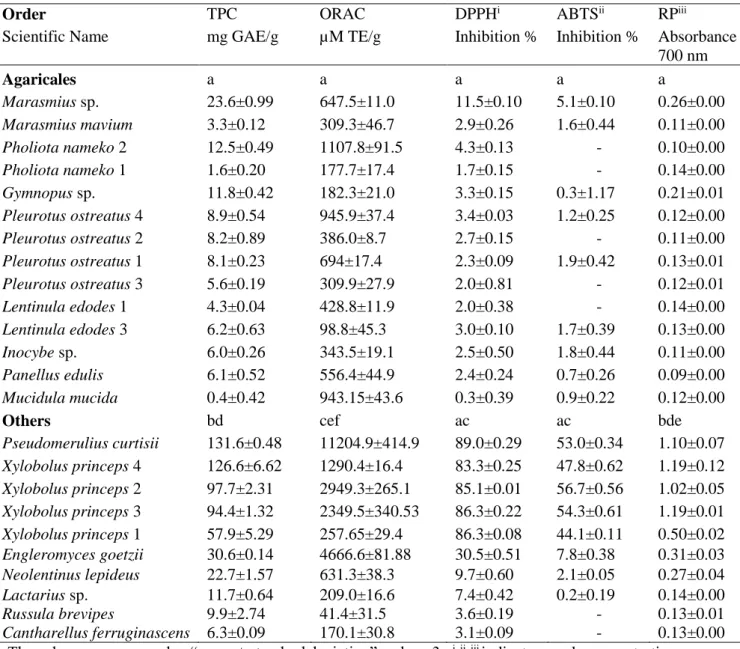
Ethanol extracts of the sixty two samples were tested for their anti-oxidative activity by using four kinds of assays based on the radical scavenging and reducing capabilities. The samples were grouped into four groups, based on their taxonomic order: Hymenochaetales, Polyporales, Agaricales and Others. Since the majority of the samples belonged to the first three groups, the few remaining samples were grouped as “Others”. The results for all the assays are listed out in Table 3.1
3.3.1 Total phenolic content
The total phenolic content was measured using the Folin-Ciocalteau method. Samples in the
Hymenochaetales group showed a significantly greater phenolic content compared to the other
3 groups. However, Oxyporus sp. was a notable exception in this group with the TPC value of
only 7.9 mg GAE/g extract. Oxyporus sp. is the only sample that does not belong to the
Hymenochaetaceae family, within this order. Although there is a lack of detailed research into
this mushroom, the major compounds are reported to be sterols and triterpenes in Oxyporus
populinus [65]. The highest phenolic content was seen for Inonotus clemensiae with 643.2 mg
GAE/g extract. The TPC of Inonotus clemensiae was higher than that reported for the ethanol
extract of Inonotus obliquus from Thailand with 590.87 mg GAE/g extract [66], which is one
of the highest phenolic content reported for mushrooms. The Ganoderma species exhibited the
highest TPC values within Polyporales group. The lowest phenolic content was seen in
Agaricales, with Mucidula mucida showing the least TPC value of 0.4 mg GAE/g extract. Some
26
samples in the Others group, such as Pseudomerulius curtisii and Xylobolus princeps 4 showed a relatively high phenolic content of 131.6 mg GAE/g extract and 126.6 mg GAE/g extract respectively.
The major antioxidant compounds found in mushrooms belong to the phenolic group [67].
Reducing agents like ascorbic acid are sometimes known to contribute for the seemingly elevated values [68]. However, total phenolics continue to thrive to be good indicators of the anti-oxidative activity.
3.3.2 Free Radical scavenging assay (ORAC, DPPH, and ABTS)
The radical scavenging capacity of the extracts was studied using the ORAC, DPPH and ABTS assays. Again, Hymenochaetales group showed a much higher ORAC activity compared to Polyporales and Agaricales. The highest ORAC value was shown by Inonotus clemensiae (31966.9 µM TE/g extract), which outperformed the previously reported highest ORAC value [22] for Inonotus andersonii (21015 µM TE/g extract). Significant differences between groups were not seen for Polyporales, Agaricales and Others. In the Others group Pseudomerulius curtisii showed a very high ORAC value of 11204.9 µM TE/g extract. The ORAC assay is one of the few assays that monitors the free radical scavenging from the time of sample addition, throughout regular intervals, until the completion of reaction. This enables complete assessment of the reaction providing information about the inhibition time as well as degree of inhibition [69].
The Hymenochaetales group also outperformed the rest of the groups in the DPPH and ABTS
assays. However, Oxyporus sp. remained as a notable exception within the group, with
negligible DPPH and ABTS radical scavenging activity. In the Polyporales group, several
Ganoderma species showed high DPPH inhibition percentage, with Ganoderma sp.1 showing
the highest inhibition percentage of 90.9%. Agaricales showed the least DPPH inhibition. In
27
the Others group, a very high DPPH inhibition percentage was seen in Pseudomerulius curtisii (89.0%) and Xylobolus princeps (4,2,3,1) (83.3 to 86.3 %).
In the case of ABTS assay, Inonotus clemensiae showed the highest inhibition percentage of 92.2%. However, other Inonotus sp. could not show comparable activity. Also, considerable variations were seen among the Ganoderma sp. of the Polyporales group (6% to 63.2%). In the Others group, high ABTS activity was observed for Pseudomerulius curtisii (53.0%) and Xylobolus princeps (4,2,3,1) (44.1 to 56.7 %).
The DPPH and ABTS assays are known for its reproducibility, ease of application, and low cost [53]. However, attempts to check the activity at maximum dissolved concentration were hindered due to sample color interference, especially for highly pigmented samples. Although reports for the phenomenon of color interference with regard to mushrooms could not be found, it has been reported for plant extracts [70, 71], especially for DPPH assay. While performing these assays for extracts with unknown composition, it has been recommended to avoid using sample concentrations greatly exceeding the concentrations of DPPH and ABTS solutions [72].
3.3.3 Reducing power (RP)
The ability of the extracts to reduce the ferricyanide complex to its ferrous form was measured by the reducing power or sodium nitroprusside assay. Significant differences were seen between Hymenochaetales, Polyporales and Agaricales groups. In the Hymenochaetales group, Cyclomyces setiporus (1,2,3,4,5) along with Inonotus clemensiae showed the highest RP values (1.64 to 2.20). Among Polyporales, Ganoderma sp.1 exhibited the highest RP value (1.22).
Also, in the Others group Pseudomerulius curtisii and Xylobolus princeps showed relatively
high RP values (1.02 to 1.19). A very low variation was seen in the reducing power values
among all samples. This could be due to the lower sensitivity of the method compared to other
28
anti-oxidative assays. The reducing power of mushrooms has been attributed to their ability to donate hydrogen atoms thereby pacifying the free radicals [73].
3.3.4 Correlation between TPC and the antioxidant assays
In order to illustrate the relationship between the anti-oxidative activity and the phenolic content, the anti-oxidative assays were correlated with the TPC values for each group, using the Spearman’s rank correlation. Table 3.2 shows the correlation coefficient between TPC and each of the anti-oxidative assays for all four groups. Significant correlations were observed for all the assays in Hymenochaetales, Polyporales, and Others. The highest degree of correlation was seen in Others group, followed by Polyporales and Hymenochaetales. However, in Agaricales only DPPH and TPC could correlate significantly. The major bioactive compounds in Agaricales are known to be ergosterol, lectin, terpenes, and β-glucans [74]. Also, it must be considered that the translation of the phenolic compounds into anti-oxidative activity is dependent on several factors such as the availability of hydroxyl group, and the synergistic, additive or antagonistic activities in the sample matrix [75].
3.3.5 Determination of EC
50and EC
0.5values
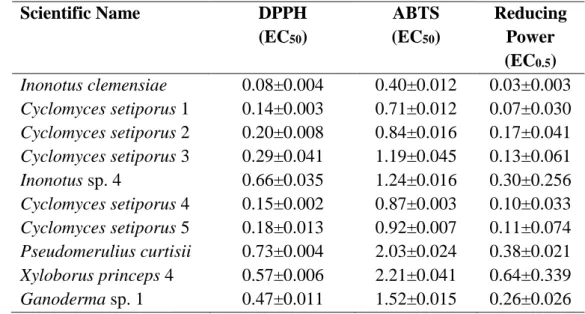
To further clarify the activity of the mushroom samples showing the highest TPC, the EC
50values (for DPPH and ABTS assays) and EC
0.5values (for reducing power assay) were determined. Table 3.3 shows the EC
50and EC
0.5values expressed as sample concentration in mg/ml for DPPH and ABTS, and reducing power assays respectively. The lower EC
50/ EC
0.5values indicate stronger anti-oxidative activity. Inonotus clemensiae required the least sample
concentration to obtain the EC
50values for both DPPH and ABTS assays, as well as EC
0.5value
in reducing power assay; with 0.081 mg/mL for DPPH assay, 0.409 mg/mL for ABTS assay,
and 0.031 mg/mL for reducing power assay.
29
All of the antioxidant assays tested revealed a very high activity for the Hymenochaetales group.
Although commonly studied species such as Inonotus obliquus have been extensively reported for their antioxidant and other biological activities, the antioxidant activities of Inonotus clemensiae and Cyclomyces setiporus, have not been reported previously. Within the Polyporales group samples of Ganoderma species exhibited a relatively higher activity than other members. The Others group contained a mixture of samples from different orders.
However, antioxidant assays and the TPC correlated well in this group. Also, Pseudomerulius curtisii and Xylobolus princeps (4,2,3,1) consistently showed high activity for almost all the assays tested. Parallels can be observed between the pattern of anti-oxidative activity in the previous study of the antioxidant activities of 29 wild mushroom samples of Nepal [22], where Inonotus sp., Phellinus sp., and Ganoderma sp. had the most predominant anti-oxidative activity. These findings elucidate the presence of high antioxidant activity in previously unreported mushroom species, in Nepal.
3.3.6 HPLC analysis
In order to identify and quantify the phenolic compounds present in the ethanol extracts of top
ten samples with the highest TPC values, HPLC analysis was performed. Twenty one phenolic
compounds, reported to be commonly found in mushrooms [67], (5-sulfosalicylic acid, gallic
acid, pyrogallol, 3,4-dihydroxybenzoic acid, chlorogenic acid, (+)-catechin, p-hydroxybenzoic
acid, vanillic acid, caffeic acid, vanillin, rutin, p-coumaric acid, ferulic acid, veratric acid,
naringin, benzoic acid, abscisic acid, quercetin, trans-cinnamic acid, naringenin, and
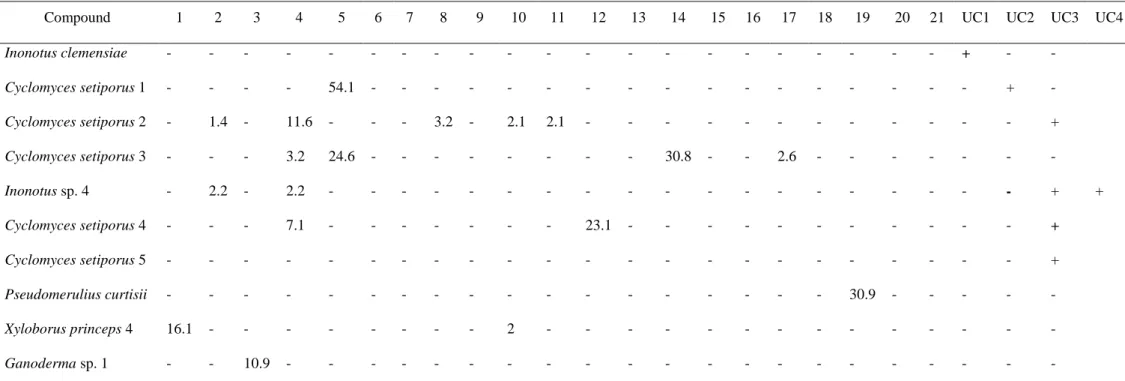
kaempferol) were used as standards. Table 3.4 shows the list of the standard compounds, and
the amount present in the respective samples. Also, the HPLC chromatograms of the standards
and the samples are provided as supplementary data as appendix in Fig. A3.1 (a to k).
30
The 10 selected samples showed the presence of 12 out of 21 standard phenolic compounds.
Flavonoids such as (+)-catechin, naringin, quercetin, naringenin, kaempferol, along with some other phenolic compounds commonly found in mushrooms such as p-hydroxybenzoic acid, benzoic acid, caffeic acid, and ferulic acid were not detected in any of the samples. Also, the presence of some unknown compounds (UC 1 – 4) were found to be in high abundance as indicated by the peak intensity in HPLC chromatograms. The presence of such major unknown compounds in the respective samples are provided in Table 3.4. The compound UC 3 was detected in 4 of the tested extracts, Inonotus sp. 4, Cyclomyces setiporus (3,4,5).
3.3.7 LC-MS analysis
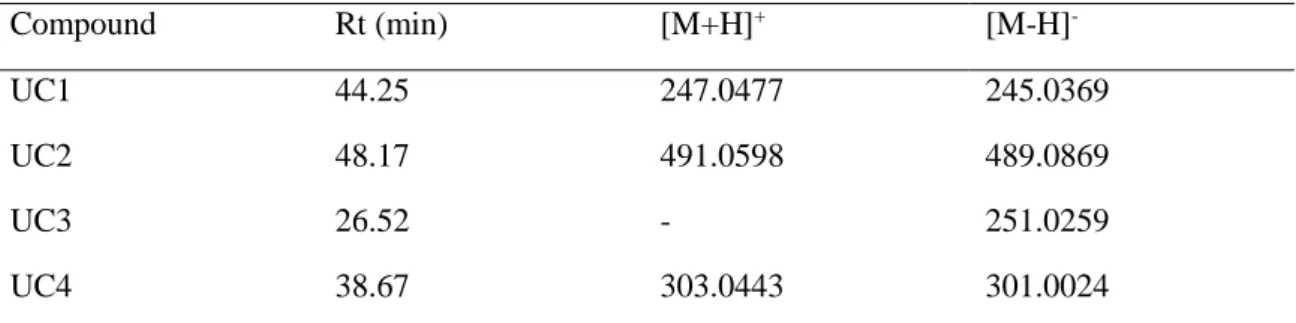
The major compounds present in some of the samples did not match with the standards used in the HPLC analysis. Therefore, LC-MS analysis was performed to elucidate the unknown compounds (UC 1 – 4). The retention time and molecular ion m/z values are shown in Table 3.5. Although clear fragmentation patterns could not be obtained, the molecular ion peaks provided some hint for the tentative identification of the unknown compounds. High anti- oxidative activity of mushrooms belonging to Inonotus sp. have been largely attributed to styrylpyrone-class compounds, such as hispidin, inoscavin, phelligridin and others [76].
Therefore, it can be predicted that UC 1 with m/z value of 247.0477 in positive mode and 245.0369 in negative mode, is hispidin (exact mass 246.0528 g/mol) [77] . The molecular ion m/z values of the rest of the unknown compounds were detected as follows: 491.0598 in positive mode and 489.0869 in negative mode for UC2, 251.0259 in negative mode for UC3, and 303.0443 in positive mode and 301.0024 in negative mode for UC4.
3.4 Conclusion
A wide range of anti-oxidative activities were observed among the various orders of wild
mushrooms species of Nepal. Hymenochaetales was the most active group, which included the
31