九州大学学術情報リポジトリ
Kyushu University Institutional Repository
東地中海堆積物の地球化学および微古生物学分析に 基づく後期第四紀の北アフリカにおける水循環変化
ハレッド, サイェド シヌーシ モハメド
https://doi.org/10.15017/1931716
出版情報:Kyushu University, 2017, 博士(理学), 課程博士 バージョン:
権利関係:
LATE QUATERNARY HYDROLOGICAL CHANGES IN NORTH AFRICA BASED ON GEOCHEMICAL AND MICROFOSSIL ANALYSES IN
SEDIMENTS FROM THE EASTERN MEDITERRANEAN SEA
by
Khaled Sayed Sinoussy Mohamed
B.A., Alexandria University (2006)
M.Sc., Alexandria University (2012)
SUBMITTED IN PARTIAL FULFILLMENT OF THE REQUIREMENTS FOR THE DEGREE OF
DOCTOR OF PHILOSOPHY
At the
DEPARTMENT OF EARTH AND PLANETARY SCIENCES GRADUATE SCHOOL OF SCIENCE
KYUSHU UNIVERSITY
FEBRUARY 2018
Signature of Author: _______________________________________________________
Department of Earth and Planetary Sciences Graduate School of Sciences, Kyushu University, February 2018
Certified by: ______________________________________________________________
Thesis supervisor
Abstract
Aim of this thesis is to understand the hydrological cycle system effect of the North African monsoon since the Last Glacial Maximum (LGM) on terrestrial ecosystems and effect of humid periods on marine ecosystems of the Eastern Mediterranean Sea (EMS). In particular, the focus is placed on the drastic regime shift from arid conditions of LGM to the humid and vegetated conditions of the mid- Holocene in North Africa. The timing of this regime shift is investigated in order to determine the hydrological cycle and expansion of C4 plants in North Africa showed a covariance with processional cycle or millennial scale. In order to achieve this objective, variations in compound-specific hydrogen and carbon isotopes of sedimentary n-alkanes of ODP site 967B are scrutinized. δDn-alkanes, a proxy for precipitation, ranging from -199‰ to -127‰, co-varied with insolation change response to orbital forcing. Depleted δDn-alkanes were found from deglaciation to middle Holocene, suggesting increased precipitation during the African Humid Period (AHP) from 15 ka to 5 ka caused by northward migration of the Intertropical Convergence Zone (ITCZ). On the contrary, lower precipitation was inferred by enriched δDn-alkanes during LGM and late Holocene. δ13Cn-alkanes at Site 967 did not show a trend in harmony with δDn-alkanes but exhibiting millennial-scale variations ranging from -25.9‰ to - 33.2‰. These δ13Cn-alkanes values are consistently C4 grass dominated environment in the watershed area of River Nile since LGM even during AHP. The greening of Sahara Desert was dominated by C4 plants during AHP coupled with formation of Sapropel layers in EMS fueled by African monsoon changes in North Africa. Discharge of freshwater into EMS via Nile River and Wadi connective system could alter marine ecosystems in EMS. Both planktic and benthic foraminiferal assemblages in sediment core from Nile deep-sea fan were examined together with Globigerinoides ruber (a planktic foraminiferal species living in surface water) δ13C and δ18O analysis. Isotopic excursions on both δ13C and δ18O of Globigerinoides ruber were observed during sapropel S3 and S4 layers. These isotopic excursions are interpreted as signature of enhanced freshwater discharge caused by increased precipitation and terrigenous input in watershed area of Nile River. Increased %Globigerina bulloides, a high productivity indicator, suggest nutrient rich condition during then. Benthic foraminiferal assemblages were employed to reconstruct oxygen (O2) conditions in pore water. Notable species turnover to deep infauna species, dysoxic indicator, were observed in sapropel layers. Low species diversities of both planktic and benthic foraminifera are likely due to thermocline shallowing by enhanced freshwater discharge and dysoxic bottom water caused by high productivity during sapropel layer formations.
Acknowledgement
This thesis would not have been possible without the support, patience, and guidance of many, many people. Firstly, I would like to thank my supervisor Prof. Yusuke Okazaki for his continuous guidance and support. During my time at the Kyushu university, he always found time to answer my questions, often with a good sense of humor. Thank you for encouraging my research and for allowing me to grow as a research scientist. Your advice on research have been helped me come up with the thesis topic. For that I am very thankful. I would also like to thank my second supervisor Prof. Hiroshi Naraoka for his guidance, support and teaching me biomarkers and specific compound isotopes techniques. It was he who in the first instance allowed me the possibility of entering the field of specific compound isotopes and biomarkers. He let me to work liberally in his laboratory, for all of that I am very thankful. Also, thanks go to Prof. Osamu Seki who helped me in compound specific isotopes and welcomed me at his laboratory, Hokkaido University. Additional thanks go to the members (both past and present) of the Paleoclimate group for the many discussions events, group meetings, and other special events. Finally, I also want to thank my family and my friends for encouraging and supporting me for difficult times.
Table of contents
Abstract 2
Acknowledgement 3
Table of Contents 4
List of Figures 6
List of Tables 8
Chapter 1. Introduction 9
1.1. The Eastern Mediterranean Sea 1.2. The Nile System
1.3. Geology of the Nile 1.4. Evolution of the Nile 1.5. Present African Climate
1.6. Monsoon and Astronomical Theory 1.7. African Humid Period
1.8. Sapropels References
Chapter 2. Hydrological and vegetation changes in Northeast Africa over the past 23,000 years based on compound-specific δD and δ13C variations of n-alkanes in sediments from the eastern
Mediterranean Sea 17
Abstract
2.1. Introduction
2.2. Material and Methods 2.2.1. Samples
2.2.2. Age Model
2.2.3. n-Alkane Analyses 2.3. Results
2.3.1. Molecular Distribution of n-Alkanes
2.3.2. Compound-Specific Carbon and Hydrogen Isotope Compositions of n- Alkanes 2.4. Discussion
2.4.1. n-Alkane Transport and Source
2.4.2. Relationship between Vegetation and Precipitation
2.4.3. Paleovegetation and Hydroclimate Changes during the Last 23 kyrs
2.4.3.1. LGM (23 - 19 ka) 2.4.3.2. AHP (15 - 5 ka)
2.4.3.3. Middle to Late Holocene (Last 5 kyrs) 2.5. Conclusions
References
Chapter 3. North African paleo-hydrological variations influence on paleoecology and microhabitat of foraminifera in eastern Mediterranean sediments during sapropel depositions
48 Abstract
3.1. Introduction
3.2. Material and Methods 3.2.1. Age Model
3.2.2. Sediment Samples Analyses 3.3. Results
3.3.1. TOC analyses
3.3.2. Foraminiferal assemblage and stable isotopes 3.4. Discussion
3.4.1. Sedimentary characteristics of sapropels
3.4.2. Response of foraminiferal assemblages to sapropel depositions 3.5. Conclusion
References
Chapter 4. Conclusions 76
List of Figures Chapter 2.
Figure2.1.Modern vegetation transitions and precipitation of present Africa.Black lines indicate the Intertropical Convergence Zone (ITCZ) during July-August and January
(Nicholson, 1996). The northeastern Sahara is a major source of aeolian dust to the present EMS (Dayan et al., 1991).
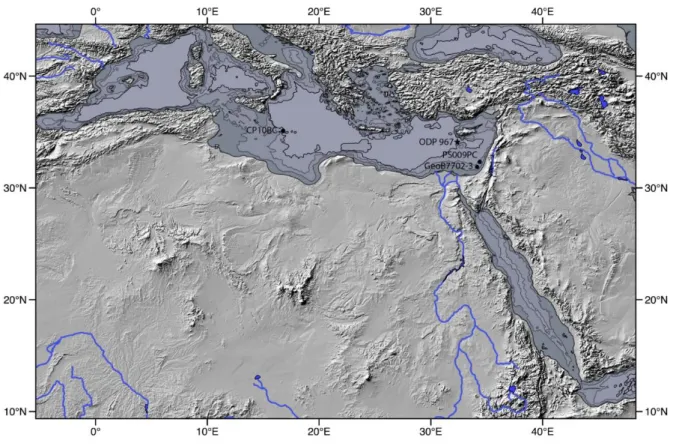
Figure 2. 2. Shaded relief map of North Africa and ODP Site 967 locationwith black star in the eastern Mediterranean Sea (black star) in the path of the Nile River outflow. The approximate locations of cores GeoB7702-3 (Castañeda et al., 2016), CP10BC (Wu et al. 2016) and PS009PC (van Helmond et al., 2015).
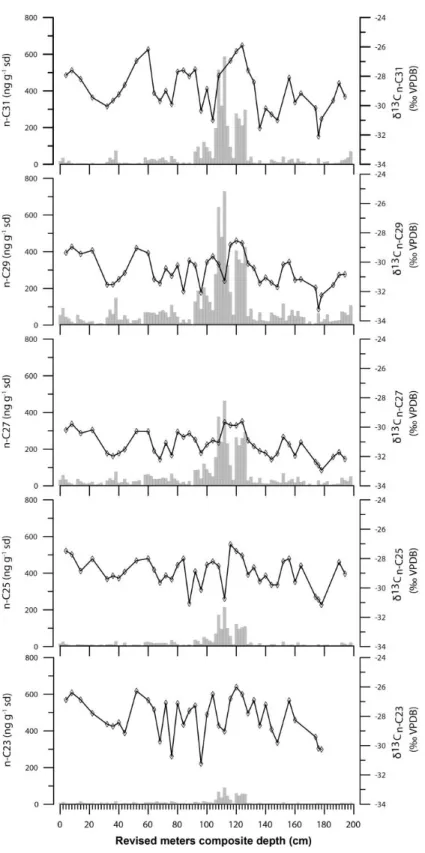
Figure 2. 3. n-alkanes concentrations (histogram) and δ13C (line) at ODP Site 967 (versus revised meters composite depth for ODP site 967, Sakamoto et al., 1998).
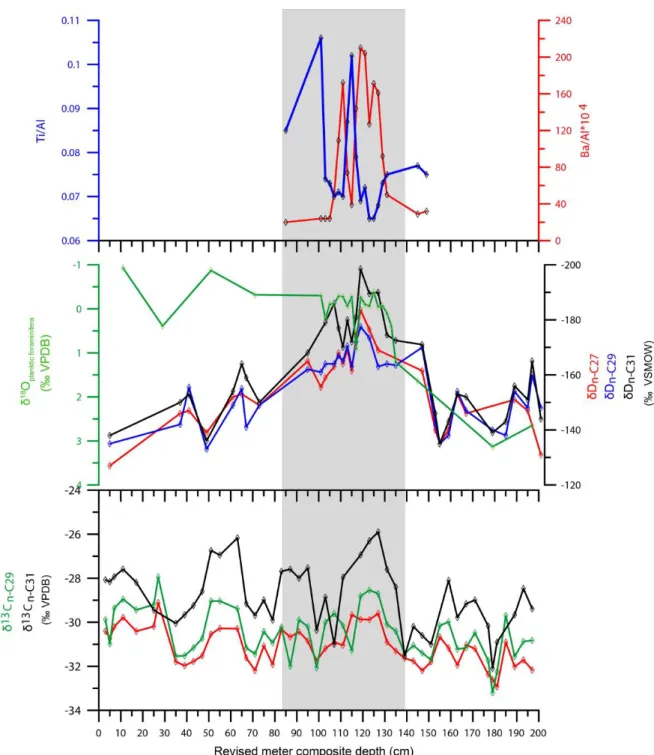
Figure 2. 4. Downcore profiles of ODP Site 967 (versus core depth): (A) Ti/Al ratio (Azrieli-Tal et al., 2014); (B) Ba/Al ratio (Azrieli-Tal et al., 2014); (C) planktic foraminiferal δ18O (Emeis et al., 1998); (D) δD of n-alkanes (n-C27, n-C29, n-C31) and (E) δ13C of n-alkanes (n-C27, n-C29, n-C31) Figure 2. 5. Downcore profiles of ODP Site 967 (versus age): (A) %C4 annual grasses; (B) planktic
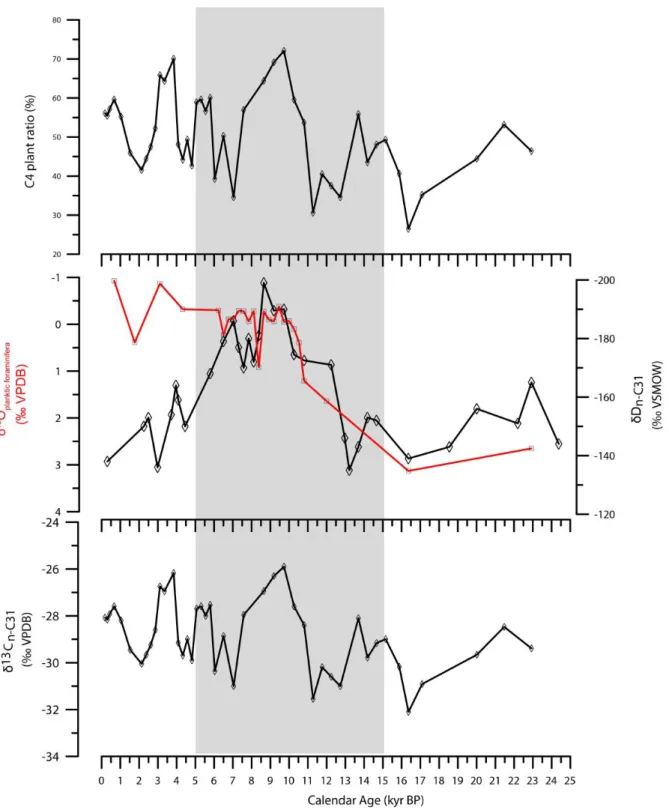
foraminiferal δ18O (Emeis et al., 1998); (C) δD of n-alkanes (n-C27, n-C29, n-C31) and (D) δ13C of n-alkanes (n-C31)
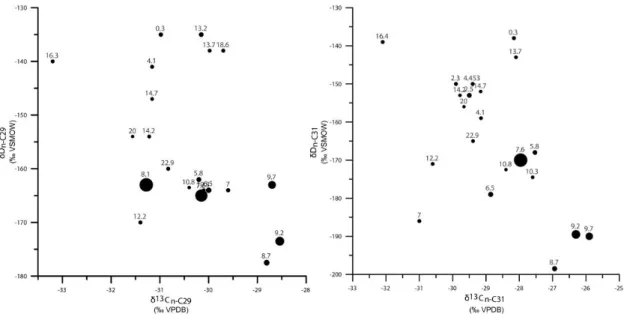
Figure 2. 6. Relationship between δ13C and δD of individual n-alkanes n-C29 and n-C31 since the past 23 ka. The volume of circles related to the concentration n-alkanes n-C29 and n-C31.
Chapter 3.
Figure 3. 1. Map of EMS and its surrounding area with bathymetric and topographic information.
Black square indicates the study site of M70b-St#822. Map drawn by Ocean Data View (Schlitzer, R., Ocean Data View, http://odv.awi.de, 2015).
Figure 3. 2. Down core profiles of total organic carbon (TOC, wt%), planktic foraminiferal (Globigerinoides ruber) δ18O (‰ VPDB) and δ13C (‰ VPDB), total planktic and benthic foraminifera abundances (individual/g) and Shannon index of planktic and benthic foraminifera at core M70b-St#822. Sapropel layers (gray color) are indicated.
Figure 3. 3. Relative abundance of planktic foraminiferal species at core M70b-St#822. Sapropel layers (gray color) are indicated.
Figure 3. 4. Absolute abundance of planktic foraminiferal species at core M70b-St#822. Sapropel layers (gray color) are indicated.
Figure 3. 5. Relative abundance of benthic foraminiferal species at core M70b-St#822. Sapropel layers (gray color) are indicated.
Figure 3. 6. Absolute abundance of benthic foraminiferal species at core M70b-St#822. Sapropel layers (gray color) are indicated.
Figure 3. 7. SEM photographs of selected foraminifera species (scale bar = 200 µm for Figs. 1-10; 13- 14, and = 150 µm for Figs. 11-12, 15). 1-2 Globigerinoides ruber (D'Orbigny), 1839, 420 cm. 3-4 Globigerinoides obliquus Bolli 1957, 450 cm. 5-6 Globigerina bulloides D'Orbigny, 1826, 450 cm. 7-8 Globigerina calida Parker 1962, 440 cm. 9-10 Globorotalia truncatulinoides (d'Orbigny), 1839, 410 cm. 11-12 Globigerinoides immaturus Le Roy 1939, 420 cm. 13-14 Turborotalia clarkei Rogl and Bolli 1973, 410 cm. 15 Orbulina universa D'Orbigny, 1839, 430 cm.
Figure 3. 8. SEM photographs of selected foraminifera species (scale bar = 200 µm for Figs. 1-7, 9- 14, and = 150 µm for Figs. 15-16, and = 100 µm for Fig. 8). 1-2 Globigerinita glutinata (Egger), 1895, 410 cm. 3-4 Gyroidina soldanii d'Orbigny, 1826, 410 cm. 5-6 Gyroidina orbicularis d'Orbigny, 1826, 410 cm. 7 Bulimina costata d'Orbigny, 1852, 340 cm. 8 Uvigerina mediterranea Hofker, 1932, 370 cm. 9 Bolivina acuminata (Natland), 1946, 380 cm. 10 Bolivina advena Cushman var. striatella Cushman, 1925, 380 cm. 11-12 Cassidulina crassa d'Orbigny, 1839, 380 cm. 13-14 Cassidulina laevigata d'Orbigny, 1826, 200 cm. 15-16 Hoeglundina elegans d'Orbigny, 1826, 380 cm.
List of Tables Chapter 2.
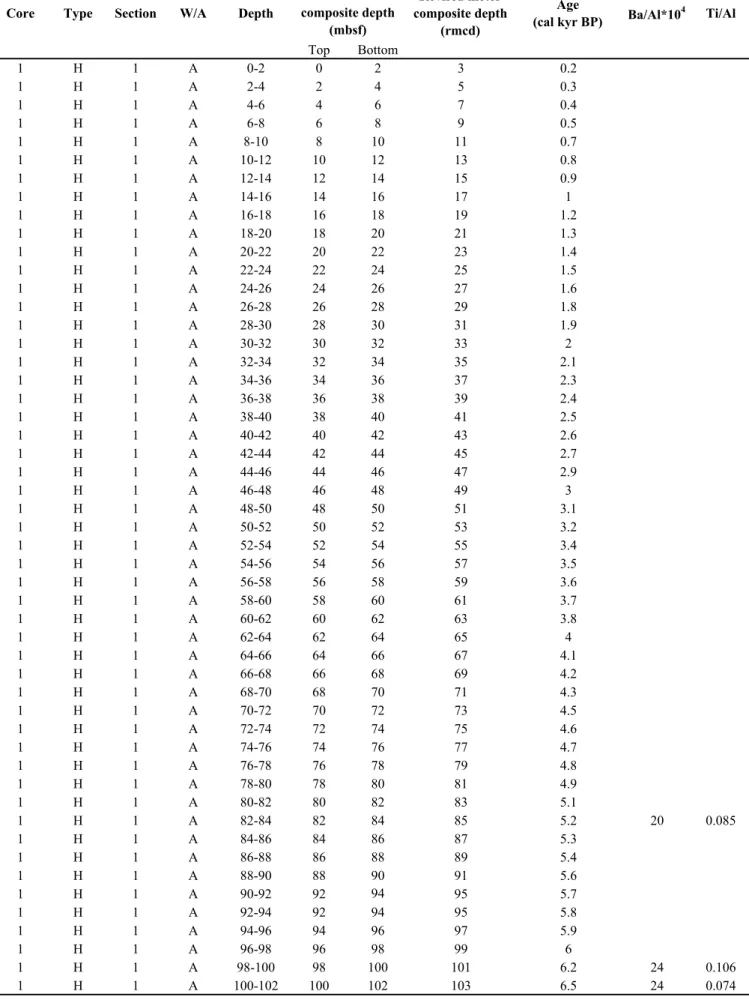
Table 2. 1. Core ID, onboard core composite depth (mbsf, Shipboard Science Party, 1996), revised core composite depth (rmcd, Sakamoto et al., 1998), age model (cal. kyr BP), Ba/Al ratio (Azrieli- Tal et al., 2014) and Ti/Al ratio (Azrieli-Tal et al., 2014) at ODP 967.
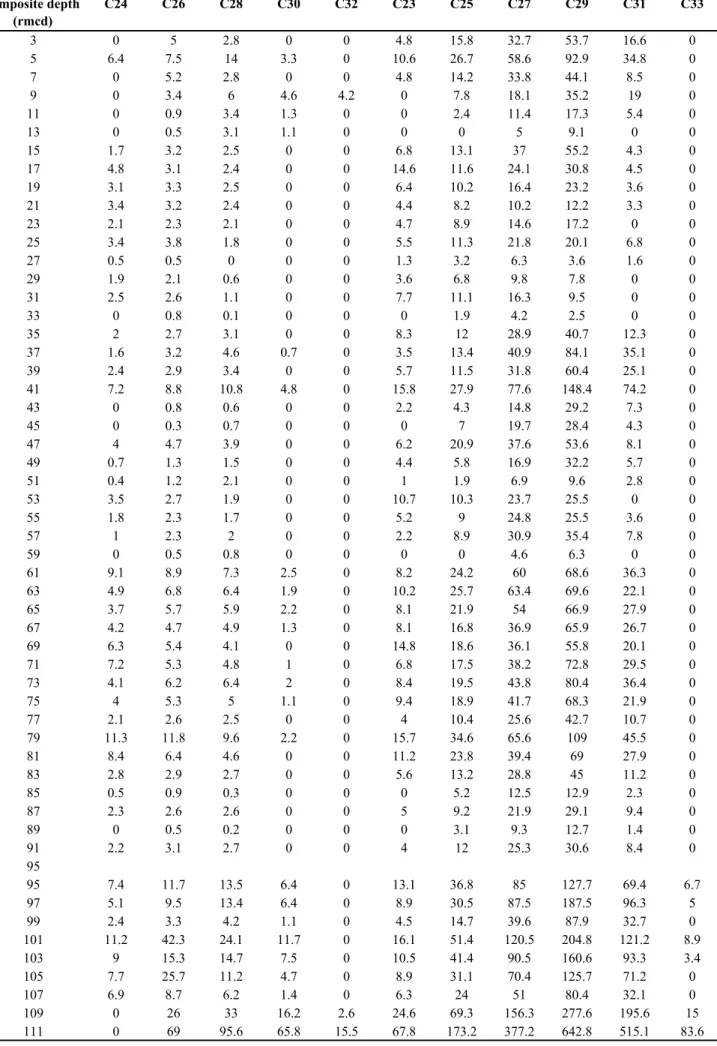
Table 2. 2. n-Alkane concentrations (ng g-1) at ODP 967. Revised meter composite depth (rmcd) is by Sakamoto et al. (1998).
Table 2. 3. Carbon and hydrogen isotope ratios of n-alkanes at ODP 967. Revised meter composite depth (rmcd) is by Sakamoto et al. (1998).
Chapter 3
Table 3. 1. Core depth, calendar age, total organic carbon content, and carbon and oxygen isotope ratio of Core M70b-St#822.
Table 3. 2. List of foraminiferal species in Core M70b-St#822
Table 3. 3. Count, relative abundance (%) and absolute abundance (No. g-1 sediment) data of planktic foraminifera at Core M70b-St#822.
Table 3. 4. Count, relative abundance (%) and absolute abundance (No. g-1 sediment) data of benthic foraminifera at Core M70b-St#822.
Chapter 1. Introduction 1.1. The Eastern Mediterranean Sea
The Eastern Mediterranean-Levant region is located at the convergence of the Eurasian continent, the Saharan-Arabian desert and the Mediterranean Sea. The almost land locked Mediterranean Sea maintains its sole connection to the Atlantic Ocean via the Gibraltar Strait. As a result, sea surface conditions are diverse with west to east salinity and sea surface temperature (SST) increases and a corresponding productivity decrease (Antoine et al., 1995; Malanotte-Rizzoli et al., 1999; Pinardi and Mosetti, 2000). Precipitation over the Levantine Basin is mainly originated in the northeast Atlantic Ocean, passing over Europe and the Mediterranean Sea (Eshel, 2002; Rindsberger et al., 1983); sporadically, sub-tropic warm air over the southern Mediterranean resulted in precipitation over the Levantine basin (Dayan, 1986). Cold dry Arctic air that penetrates into the eastern Mediterranean region results in an increase in surface water density, leading to the formation of the Levantine Intermediate Water (LIW) off the island of Rhodes (Malanotte-Rizzoli et al., 1999;
Pinardi and Mosetti, 2000). The African monsoonal system is associated with the low-latitude rainfall system (Rossignol-Strick, 1985) that directly influences the North Africa vegetation cover and indirectly influences the hydrography of the Levantine Basin. This system fluctuates in time, and is at its highest strength during periods of June maximum insulation in the Northern Hemisphere that coincide with elevated River Nile discharge (Haynes Jr, 1987; Rossignol-Strick, 1985; Rossignol- Strick et al., 1982). The River Nile was recognized as an important source of freshwater during Sapropel layer deposition in EMS (Kholeif, 2010; Scrivner et al., 2004) besides, rainfall on the entire Mediterranean Sea from Atlantic sources (Kallel et al., 1997; Bar-Matthews et al., 2000). Beside freshwater discharge from River Nile, several studies discussed rainfall effect over the entire Mediterranean Sea and the influx of Black Sea water during periods of sapropel formation (Almogi- Labin et al., 2009, refrence are theirin). The Nile deep-sea system is the largest sedimentary accumulation in EMS, and one of the largest modern deep-sea turbidite systems. It is more than 600 km wide and 300 km long, and consists of a mud-rich sediments delivered by Nile River (Reading and Richards, 1994). Since the late Miocene the accumulation of the Nile deep-sea sediments began to form above mobile Messinian evaporites (Gaullier et al., 2000; Loncke et al., 2006).
1.2. The Nile System
The Nile Delta is a delta located in the northern Egypt where the Nile River flowing into the EMS. The Nile Delta is formed where the supply of pluvial sediment has been abundant, and wave and current action have not been sufficient to disperse it. Of the numerous tributaries of the Nile that once existed, the Rosetta Branch to the west and the Damietta Branch to the east, are now present. The
Nile River crosses equatorial Africa (White Nile), tropical areas (Blue Nile and Atbara River) and areas with arid climates (Main Nile) to discharge into EMS through a large arcuate delta. Most of the discharge from the Nile River is originated from the Ethiopian Highlands and the Blue Nile system which influenced strongly by wet summer monsoon (seasonal flood) (Said, 1981; Williams et al., 2000). The steep Ethiopian Highlands generate abundant terrigenous particles and 70% of the present- day water discharge. Conversely, Sudd swamps (White Nile) act as a sediment filter. Fine-grained Nile sediment originate from alumina and iron-rich soil of Ethiopia, and have particular depositional features distinct from those of other soils of the Mediterranean region (Manohar, 1981). The main clay minerals are montmorillonite (smektite), illite, and kaolinite, which form most of the fluvial load and are spread on the outskirts of the Nile cone and in the south-eastern corner of the Levantine Basin. The coarse fraction, which is mostly composed of quartz, also originates in Ethiopia and in Sudan, mainly from eroded Nubian sandstones. These sands used to arrive mainly during the June to September Nile floods. Additional sands originate in the Eastern and Western Desert of Sudan and the numerous Egypt wadis but very irregularly. These sediments averaged about 80–160 million tons per year before completion of the Aswan High Dam in 1964 but were then reduced significantly. Reduction in sediment supply began with the building of the Delta Barrages, completed in 1881, and the Aswan Dam completed in 1902. The Aswan High Dam has a big impact on the reduction of sediment supply to the Nile Delta. These include severe erosion along the delta coastline and penetration of saline water from the sea into river mouths, lagoons, and groundwater. The Nile Deep Sea Fan is the largest deep- sea sedimentary basin of EMS, and it differs from most other large subsea fans as being developed in a relatively small, enclosed sea (Stanley and Maldonado, 1977). Deposited sediments in the Nile Deep Sea Fan are expected to be recorded not only EMS paleoceanographic changes but also North African climatic histories. Therefore, sedimentary data from the Nile Deep Sea Fan is important to understand a role of Nile River flow modulated by the African monsoon and corresponding changes in ocean circulation and stratification in EMS (Kholeif and Ibrahim, 2010).
1.3. Geology of the Nile
Average flow of the Nile River at its mouth is 2800 m3 per second or 84 × 106 m3 per year, which is very low compared to its length (6825 km) or area of its watershed (2.87 million km2). This deficit is due mainly to the fact that much of the basin is subjected to an arid climate and therefore that the water undergoes high evaporation (Ducassou et al., 2006). The Main Nile, north of 18°N and whose total load is 230 ± 20 × 106 tons per year (Garzanti et al., 2006), receives its water from three main sources: The White Nile, which flows through a part of equatorial Africa, the Blue Nile and the Atbara River, which lie at the Ethiopian highlands. The White Nile, which rises in Lake Victoria contributes
nearly one third of the total load, but only for a minor proportion of sediment as the White Nile has a very low liquid flow. Indeed, its course through the bush and the Sudan savannah is with little slope and many marshes. Sediments of the White Nile found in the deep basin and the delta are almost devoid of pyroxene (3%). On the other hand, abundant amphibole (97%) are derived from erosion of land metamorphic granites (Foucault and Stanley, 1989). The Blue Nile, which originates at Lake Tana in the Ethiopian highlands, contributes more than half the total load the main Nile (56%) (Foucault and Stanley, 1989) and its sediment load us 140 ± 20 × 106 tons per year (Garzanti et al., 2006). This tributary brings pyroxenes, but also alkali feldspar and hornblende (Ca amphibole). Proportion of the hornblende is 79% against 21% for pyroxenes (Foucault and Stanley, 1989). Water discharge of the Blue Nile is 1620 m3 per second on annual average and increases up to 5000 to 6000 m3 per second during floods. The Atbara River contributes a small portion of the total load of the Nile River (82 ± 10
× 106 tons per year), carrying numerous fragments of volcanic rocks as well as olivine and augite from basaltic rocks (Garzanti et al., 2006). Pyroxenes (91%) are more abundant than amphibole (9%) (Foucault and Stanley, 1989). Differential flow for the three tributaries is based on the difference of surface of their respective drainage area and the variation of precipitation. Indeed, the Blue Nile and the Atbara River have a term shorter than the White Nile, but with a slope gradient greater, and draining rain water in the Ethiopian highlands that are subject to intense rainfall at the monsoons summer.
Therefore, the Blue Nile and the Atbara River contribute a significant role in sediment load of the main Nile.
1.4. Evolution of the Nile
During the Neogene, the Nile River has undergone various trips through the arid expanses of the Sahara. Since the incision of the valley in the late Miocene, the river has experienced four major episodes: the Eonile, the Paleonile, the Prenile, and Neonile (Said, 1993, 1981). The Neonile was set up during the Holocene. With increased equatorial African lake levels, caused the addition of Lakes Victoria and Albert in the drainage basin of the Nile River. During 12 to 10 ka, widened Nile River caused a realignment of silt deposited by previous Neonile. Since 10 ka, rainfall on the Ethiopian highlands and the south of Egypt had significantly increased for 6 kyrs. Because of increased flow from the Ethiopian highland and equatorial African lakes, the present Nile River regime has been established.
1.5. Present African Climate
As a part of the Hadley cell circulation, trade winds from both hemispheres blow from the subtropics toward the tropics. Because warm dry air carried by the trade winds passes over the tropical
ocean, water vapor continuously evaporates from the sea surface. The region near the equator where the trade winds from both hemispheres meet is called the intertropical convergence zone (ITCZ) (Meehl and van Loon, 1979). Water vapor carried by the trade winds rises and contributes abundant rainfall along the ITCZ. Position of the ITCZ is near the equator in winter whereas migrates northward in summer. Warm and moist winds blow from the Indian Ocean in summer. The westward deflection of wind due to Coriolis effect provides part of the moisture-laden air currents over the Ethiopia. Upon reaching the Ethiopian highlands, they are forced to rise and condense to form precipitation. As a result, the Ethiopian highland, a Nile River source, receives long rainy season from July to September (Nicholson, 1996).
1.6. Monsoon and Astronomical Theory
Astronomical theory of paleoclimate explains the glacial-interglacial cycles during the Quaternary (e.g., Loutre and Berger, 2005). Climate is sensitive to both the total amount and the latitudinal and seasonal distribution of solar radiation onto the earth’s surface. Three astronomical cycles are of relevance to these aspects: the eccentricity (cyclicity of 100 ka and 400 ka), the obliquity (cyclicity of 41 ka), and the precession (cyclicity of 19 and 23 ka), which are denoted as ‘Milankovitch cycles’. Tuenter et al., (2003) suggests that both precession and obliquity mainly responsible for an intensity of the African summer monsoon and the signals are recorded in EMS sediments throughout the Pleistocene as a consequence of changes in Nile River discharge (Rossignol-Strick, 1985). Glacial- interglacial climatic oscillations had a large influence on the Mediterranean environments (Rose et al., 1999). Wet and dry periods are called ‘pluvial’ and ‘arid’ periods, respectively have been evidenced in Nile River (Said, 1993; Williams et al., 2000) and EMS (Weldeab et al., 2002) deposits. The Nile River floods in pluvial periods are responsible for supplying organic rich sediments (Kidd et al., 1978).
1.7. African Humid Period
North Africa was subjected to a wetter and warmer period between 15 ka and 5 ka known as African Humid Period (AHP, Barker et al., 2004; deMenocal et al., 2000; Junginger and Trauth, 2013).
Numbers of marine core sediments (deMenocal et al., 2000; Ehrmann et al., 2017), lake core sediment (Berke et al., 2012; Tierney et al., 2008) and archaeological sites (Kuper and Kröpalin, 2006; Stanley et al., 2003) documented that AHP peaked between 9 ka and 6 ka when sapropel S1 deposited in EMS (Ritchie et al., 1985). Summer insolation paced by precessional cycle plays a principal role in greening and desertification of the Saharan Desert through precipitation in North Africa (deMenocal et al., 2000).
1.8. Sapropels
Sapropel is a dark-colored sediment with rich in organic matter. Numbers of sapropel layers are found in EMS sediments and have been the subject of numerous studies on the geographical distribution, age and formation (Casford et al., 2003; Cramp and O’Sullivan, 1999; Kallel et al., 2000a, b; Kroon et al., 1998). Saporpel layers in EMS may be laminated or bioturbated depending on their thickness and sedimentation rate: homogeneous (S1), color banded (S3, S5, S7 and S9) or composite (S4, S6 and S8). These black deposits may contain near the coast, macroscopic plant debris of continental origin. Sapropel layers contain planktic foraminifera, but are almost devoid of benthic foraminifera (Casford et al., 2003). The absence of benthos and excellent preservation of organic matter are strong evidences for anoxia bottom water. Sapropels formed both in interglacial periods and glacial periods, suggesting no direct relationship to glacial and interglacial cycle although most sapropels were formed during interglacial periods except for sapropel S6 during marine isotope stage (MIS) 6. Quantitative estimation for each sapropel duration is difficult because organic matter on sediment surface is oxidized when anoxia conditions cease. In addition, bacterial activity may degrade in situ organic matter in sapropel deposited 200 kyrs ago (Coolen et al., 2002). Two major hypotheses to form sapropels: (1) biological process by enhanced biological productivity linked to riverine nutrient supply (Calvert et al., 1992); and (2) physical process by water stagnation and oxygen deficiency in bottom water leading to organic matter preservation. Enhanced freshwater discharge leads to a reduction of surface water density, which hampers intermediate and deep water ventilation (Ducassou, 2006). Sapropels in EMS have been correlated across the basins and their timings are well dated based on radiocarbon dating for sapropel S1 (6.1-10.2 ka) (De Lange et al., 2008) and astronomical tuning dating for the rest of the sapropels (Cita et al., 1977; Emeis and Sakamoto, 1998). However, existence of sapropel 2 is not certain (Cita et al., 1977).
References
Almogi-Labin, A., Bar-Matthews, M., Shriki, D., Kolosovsky, E., Paterne, M., Schilman, B., Ayalon, A., Aizenshtat, Z., Matthews, A., 2009. Climatic variability during the last ∼90 ka of the southern and northern Levantine Basin as evident from marine records and speleothems. Quat. Sci. Rev.
28, 2882–2896. doi:10.1016/j.quascirev.2009.07.017
Antoine, D., Morel, A., André, J.-M., 1995. Algal pigment distribution and primary production in the eastern Mediterranean as derived from coastal zone color scanner observations. J. Geophys. Res.
doi:10.1029/95JC00466
Barker, P.A., Talbot, M.R., Street-Perrott, F.A., Marret, F., Scourse, J., Odada, E.O., 2004. Late Quaternary climatic variability in intertropical Africa, in: Past Climate Variability through Europe
and Africa. Springer Netherlands, Dordrecht, pp. 117–138. doi:10.1007/978-1-4020-2121-3_7 Casford, J.S.L., Rohling, E.J., Abu-Zied, R.H., Fontanier, C., Jorissen, F.J., Leng, M.J., Schmiedl, G.,
Thomson, J., 2003. A dynamic concept for eastern Mediterranean circulation and oxygenation during sapropel formation, in: Palaeogeography, Palaeoclimatology, Palaeoecology. pp. 103–119.
doi:10.1016/S0031-0182(02)00601-6
Cita, M.B., Vergnaud-Grazzini, C., Robert, C., Chamley, H., Ciaranfi, N., D’Onofrio, S., 1977.
Paleoclimatic record of a long deep sea core from the eastern Mediterranean. Quat. Res. 8, 205–
235. doi:10.1016/0033-5894(77)90046-1
Coolen, M.J.L., Cypionka, H., Sass, A.M., Sass, H., Overmann, J., 2002. Ongoing modification of Mediterranean pleistocene sapropels mediated by prokaryotes. Science (80-. ). 296, 2407–2410.
doi:10.1126/science.1071893
Cramp, A., O’Sullivan, G., 1999. Neogene sapropels in the Mediterranean: A review. Mar. Geol. 153, 11–28. doi:10.1016/S0025-3227(98)00092-9
Dayan, U., 1986. Climatology of Back Trajectories from Israel Based on Synoptic Analysis. J. Clim.
Appl. Meteorol. 25, 591–595. doi:10.1175/1520-0450(1986)025<0591:COBTFI>2.0.CO;2 De Lange, G.J., Thomson, J., Reitz, A., Slomp, C.P., Speranza Principato, M., Erba, E., Corselli, C.,
2008. Synchronous basin-wide formation and redox-controlled preservation of a Mediterranean sapropel. Nat. Geosci. 1, 606–610. doi:10.1038/ngeo283
deMenocal, P., Ortiz, J., Guilderson, T., Adkins, J., Sarnthein, M., Baker, L., Yarusinsky, M., 2000a.
Abrupt onset and termination of the African Humid Period:: rapid climate responses to gradual insolation forcing. Quat. Sci. Rev. 19, 347–361. doi:10.1016/S0277-3791(99)00081-5
deMenocal, P., Ortiz, J., Guilderson, T., Adkins, J., Sarnthein, M., Baker, L., Yarusinsky, M., 2000b.
Abrupt onset and termination of the African Humid Period: Rapid climate responses to gradual insolation forcing, in: Quaternary Science Reviews. pp. 347–361. doi:10.1016/S0277- 3791(99)00081-5
Ducassou, E., 2006. No Evolution du système turbiditique profond du Nil au cour du Quaternaire récentTitle. http://www.theses.fr. Bordeaux 1.
Emeis, K.-C., Sakamoto, T., 1998. The sapropel theme of leg 160, in: Proceedings of the Ocean Drilling Program. pp. 29–36. doi:10.2973/odp.proc.sr.160.058.1998
Eshel, G., 2002. Mediterranean climates. Isr. J. Earth Sci. 51, 157–168. doi:10.1560/DMG1-06P2- 908U-WDYY
Foucault, A., Stanley, D.J., 1989. Late Quaternary palaeoclimatic oscillations in East Africa recorded by heavy minerals in the Nile delta. Nat. (London, United Kingdom). doi:10.1038/339044a0 Garzanti, E., Andò, S., Vezzoli, G., Ali Abdel Megid, A., El Kammar, A., 2006. Petrology of Nile River
sands (Ethiopia and Sudan): Sediment budgets and erosion patterns. Earth Planet. Sci. Lett. 252, 327–341. doi:10.1016/j.epsl.2006.10.001
Gaullier, V., Mart, Y., Bellaiche, G., Mascle, J., Vendeville, B.C., Zitter, T., 2000. Salt tectonics in and around the Nile deep-sea fan: insights from the PRISMED II cruise. Geol. Soc. London, Spec.
Publ. 174, 111–129. doi:10.1144/GSL.SP.1999.174.01.07
Haynes Jr, C.V., 1987. Holocene migration rates of the Sudano-Sahelian wetting front, Arba’in Desert, eastern Sahara, in: Prehistory of Arid North Africa : Essays in Honor of Fred Wendorf. pp. 69–84.
Junginger, A., Trauth, M.H., 2013. Hydrological constraints of paleo-Lake Suguta in the Northern Kenya Rift during the African Humid Period (15-5kaBP). Glob. Planet. Change 111, 174–188.
doi:10.1016/j.gloplacha.2013.09.005
Kallel, N., Duplessy, J.C., Labeyrie, L., Fontugne, M., Paterne, M., Montacer, M., 2000a.
Mediterranean pluvial periods and sapropel formation over the last 200 000 years. Palaeogeogr.
Palaeoclimatol. Palaeoecol. 157, 45–58. doi:10.1016/S0031-0182(99)00149-2
Kallel, N., Duplessy, J.C., Labeyrie, L., Fontugne, M., Paterne, M., Montacer, M., 2000b.
Mediterranean pluvial periods and sapropel formation over the last 200 000 years. Palaeogeogr.
Palaeoclimatol. Palaeoecol. 157, 45–58. doi:10.1016/S0031-0182(99)00149-2
Kholeif, S.E.A., 2010. Holocene paleoenvironmental change in inner continental shelf sediments, Southeastern Mediterranean, Egypt. J. African Earth Sci. 57, 143–153.
doi:10.1016/j.jafrearsci.2009.08.001
Kholeif, S.E.H., Ibrahim, M.I., 2010. Palynofacies Analysis of Inner Continental Shelf and Middle Slope Sediments offshore Egypt, South-eastern Mediterranean. Geobios 43, 333–347.
doi:10.1016/j.geobios.2009.10.006
Kroon, D., Alexander, I., Little, M., Lourens, L.J., Matthewson, A., Robertson, A.H.F., Sakamoto, T., 1998. Oxygen isotope and sapropel stratigraphy in the Eastern Mediterranean during the last 3.2 million years. Proc. Ocean Drill. Program, Sci. Results 160, 181–189.
doi:10.2973/odp.proc.sr.160.071.1998
Loncke, L., Gaullier, V., Mascle, J., Vendeville, B., Camera, L., 2006. The Nile deep-sea fan: An example of interacting sedimentation, salt tectonics, and inherited subsalt paleotopographic features. Mar. Pet. Geol. 23, 297–315. doi:10.1016/j.marpetgeo.2006.01.001
Loutre, M.F., Berger, A., 2005. Insolation, CO2, et précipitations en période interglaciaire. Comptes Rendus - Geosci. 337, 69–78. doi:10.1016/j.crte.2004.07.009
Malanotte-Rizzoli, P., Manca, B.B., D’Alcala, M.R., Theocharis, A., Brenner, S., Budillon, G., Ozsoy, E., 1999. The Eastern Mediterranean in the 80s and in the 90s: The big transition in the intermediate and deep circulations, in: Dynamics of Atmospheres and Oceans. pp. 365–395.
doi:10.1016/S0377-0265(99)00011-1
Manohar, M., 1981. Coastal processes at the Nile Delta Coast. Shore and Beach 49, 8–15.
Pinardi, N., Mosetti, E., 2000. Variability of the large-scale general circulation of the Mediterranean Sea from observations and modelling: a review. Palaeogeogr, Palaeoclim. Palaeoecol. 158, 153–
174. doi:http://dx.doi.org/10.1016/S0031-0182(00)00048-1
Reading, H.G., Richards, M., 1994. Turbidite Systems in Deep-Water Basin Margins Classified by Grain Size and Feeder System 1. Am. Assoc. Pet. Geol. Bull. 78, 792–822.
Rindsberger, M., Magaritz, M., Carmi, I., Gilad, D., 1983. The relation between air mass trajectories and the water isotope composition of rain in the Mediterranean Sea area. Geophys. Res. Lett. 10, 43–46. doi:10.1029/GL010i001p00043
Ritchie, J.C., Eyles, C.H., Haynes, C. V., 1985. Sediment and pollen evidence for an early to mid- Holocene humid period in the eastern Sahara. Nature 314, 352–355. doi:10.1038/314352a0 Rossignol-Strick, M., 1985. Mediterranean Quaternary sapropels, an immediate response of the
African monsoon to variation of insolation. Palaeogeogr. Palaeoclimatol. Palaeoecol. 49, 237–
263. doi:10.1016/0031-0182(85)90056-2
Rossignol-Strick, M., Nesteroff, W., Olive, P., Vergnaud-Grazzini, C., 1982. After the deluge:
Mediterranean stagnation and sapropel formation. Nature 295, 105–110. doi:10.1038/295105a0 Said, R., 1993. The river Nile : geology, hydrology, and utilization. Pergamon.
Said, R., 1981. The Geological Evolution of River Nile. Springer New York. doi:10.1007/978-1-4612- 5841-4
Scrivner, A.E., Vance, D., Rohling, E.J., 2004. New neodymium isotope data quantify Nile involvement in Mediterranean anoxic episodes. Geology 32, 565–568. doi:10.1130/G20419.1 Stanley, D.J., Maldonado, A., 1977. Nile cone: Late quaternary stratigraphy and sediment dispersal.
Nature 266, 129–135. doi:10.1038/266129a0
Tuenter, E., Weber, S.L., Hilgen, F.J., Lourens, L.J., 2003. The response of the African summer monsoon to remote and local forcing due to precession and obliquity. Glob. Planet. Change 36, 219–235. doi:10.1016/S0921-8181(02)00196-0
Williams, M.A.J., Adamson, D., Cock, B., McEvedy, R., 2000. Late Quaternary environments in the White Nile region, Sudan. Glob. Planet. Change 26, 305–316. doi:10.1016/S0921- 8181(00)00047-3
Chapter 2
Hydrological and vegetation changes in Northeast Africa over the past 23,000 years based on compound-specific δD and δ13C variations of n-alkanes in sediments from the eastern
Mediterranean Sea
Abstract
Hydroclimate variation and vegetation changes of the Nile River watershed area in northeast Africa since the Last Glacial Maximum (LGM) were reconstructed based on n-alkane molecular distributions and their carbon isotope ratios (δ13Cn-alkanes) and their hydrogen isotope ratios (δDn-alkanes) in sediments from Ocean Drilling Program (ODP) Site 967 in the Eastern Mediterranean Sea (EMS). δDn-alkanes, a proxy for precipitation, ranging from -199‰ to -127‰, co-varied with insolation change response to orbital forcing. Depleted δDn-alkanes were found from deglaciation to middle Holocene, suggesting increased precipitation during the African Humid Period (AHP) from 15 ka to 5 ka caused by northward migration of the Intertropical Convergence Zone (ITCZ). On the contrary, lower precipitation was inferred by enriched δDn-alkanes during LGM and late Holocene. δ13Cn-alkanes at Site 967 did not show a trend in harmony with δDn-alkanes but exhibiting millennial-scale variations ranging from –25.9‰ to –33.2‰. These δ13Cn-alkanes values are consistently C4 grass dominated environment in the watershed area of River Nile since LGM even during AHP.
2.1. Introduction
Present hyperarid Sahara Desert is the largest dust source of the Earth surface (Ginoux et al., 2012) transported over the Atlantic Ocean by easterly trade wind and over the Mediterranean Sea by cyclones mainly during Spring and Summer (e.g., Moulin et al., 1997, and references therein). The Sahara Desert is subjected to significant paleohydrological variations between 15-5 ka BP (Barker et al., 2004; Junginger and Trauth, 2013). This period is known as the African Humid Period (AHP) characterized by almost complete vegetation cover with annual grasses and shrubs in the present Sahara Desert so-called Green Sahara (e.g., COHMAP MEMBERS, 1988; deMenocal et al., 2000;
DeMenocal and Tierney, 2012). AHP peaked between 9 ka and 6 ka when sapropel S1 deposited in the Mediterranean Sea (Ritchie et al., 1985). Summer insolation paced by precessional cycles plays a principal role in greening and desertification of Saharan Desert through precipitation in North Africa (deMenocal et al., 2000).
Stable hydrogen isotope (δD) of sedimentary n-alkanes biomarkers are employed to reconstruct past hydroclimate variations (Eglinton and Eglinton, 2008; Sachse et al., 2012) which, the δD of lipids track the δD of environmental waters (Sauer et al., 2001) and hence, it reflects the local precipitation
(Sachse et al., 2012 and references therein). Accordingly, the δD of lipids are potentially quantitative proxy for δD precipitation. δDn-alkanes values are significantly correlated with the δD signature of source water (leaf and xylem water) originated from precipitation (Sachse et al., 2012 and references therein).
In the tropics, the “amount effect” is main controlling factor for δD in rain water and n-alkanes of terrestrial plants, δD values decreased with precipitation intensities (Dansgaard, 1964; Feakins and Sessions, 2010; Kahmen et al., 2013).
Compound-specific carbon isotope of n-alkanes reflect carbon fixation pathway during photosynthesis (Huang et al., 2001; Street-Perrott et al., 1997). During photosynthesis, plants discriminate against the carbon-13 isotope (13C) and preferentially fix the carbon-12 isotope (12C) of carbon dioxide (CO2) to an extent that is correlated with the stomatal conductance of plant cells (Delucia et al., 1988). This discrimination against 13C is more pronounced in C3 plants (Farquhar et al., 1989). Basically, 90% of plant species, including all trees, most shrubs, and cool-season grasses and sedges, use a photosynthetic pathway to produce a three-carbon molecule, 3-phosphoglyceric acid, in a process called carboxylation that is catalyzed by the enzyme ribulose 1,5-bisphosphate carboxylase-oxygenase (Rubisco). In the carboxylation reaction, CO2 is fixed by combining it with ribulose-1,5-bisphosphate (RuBP) (Jensen and Bhar, 1977; Sage, 2001, 2004). δ13C records in C3 plants range from −30‰ to −42‰ (Rommerskirchen et al., 2006; Vogts et al., 2009). C4 plants (including hot-region grasses) use the Hatch-Slack cycle, in which CO2 is initially fixed in a compound that contains four carbon molecules (Hatch and Slack, 1966). In C4 plants photosynthetic processes occur in two types of cells: mesophyll cells and bundle-sheath cells (Brown, 1975; Kadereit et al., 2003; Muhaidat et al., 2007). In bundle-sheath cells, CO2 is concentrated before being fixed by Rubisco. Consequently, the organic carbon of C4 plants is less depleted in 13C, and their δ13C values range between −18‰ and −26‰ (Rommerskirchen et al., 2006; Vogts et al., 2009). The contribution of CAM plants to the n-alkanes in sediments is negligible because of the low contribution of CAM plants to biomass production (Lüttge, 2004).
Present distribution of vegetation in North Africa (Figure 2.1) is determined by climate, mainly precipitation and temperature (White, 1983). Evergreen rainforest occurs in the most humid regions of West Africa around the equator, where woody plants account for most of the vegetation structure and phytomass (White, 1983), with >80% of the cover being woody (Good and Caylor, 2011). Woodlands characterized by open stands of trees (deciduous and semi-deciduous forests) are confined to tropical and subtropical regions on the periphery of the evergreen rainforest and extend from the Atlantic Ocean coastline toward the African Great Lakes. The dominance of woody cover (40–80%, Good and Caylor, 2011), with heliophilous grasses as a secondary constituent, distinguish the woodlands from other types of vegetation (White, 1983). A grassland ecosystem with <10% woody cover (Good and Caylor,
2011) occurs on the periphery of the Sahara Desert (White, 1983), and wooded-grasslands are confined to the woodland and grassland ecosystems with 10–40% woody cover (Good and Caylor, 2011). In the Sahara Desert ecosystem, which occupies most of North Africa, plants suffer from water scarcity owing to very small precipitation and high evaporation rates (White, 1983).
Several studies have reported origins of sedimentary n-alkanes in terms of plant species and types ( e.g., Cranwell, 1973; Ficken et al., 2000; Michener and Lajtha, 2007; Nott et al., 2000; Zech et al., 2009). Submerged aquatic plants primarily produce n-alkanes shorter than n-C23; n-C23 to n-C25 are indicative of floating aquatic plants (Ficken et al., 2000; Nott et al., 2000; Zech et al., 2009); n-C27 to n-C29 are generally derived from trees and shrubs; and n-C31 to n-C33 are major constituents of grasses (Cranwell, 1973; Michener and Lajtha, 2007; Zech et al., 2009). Previous studies have reconstructed paleovegetation and paleohydrological variations of Africa by using δ13Cn-alkanes and δDn-alkanes obtained from the Atlantic Ocean (Dupont et al., 2013; Kuechler et al., 2013; Maslin et al., 2012; Niedermeyer et al., 2010; Vogts et al., 2012; Zhao et al., 2003), and the Gulf of Aden (Feakins et al., 2007). However, hydroclimate studies based on δ13Cn-alkanes and δDn-alkanes in EMS, the catchment areas of Nile River, are still limited. Menzel et al. (2004) reconstructed vegetation cover in North Africa during Sapropel S5. At ODP Site 967, Rose et al. (2016) reconstructed changes in northeast African vegetation between 3.05 and 1.75 Ma during Plio-Pleistocene sapropel cycles. Castañeda et al. (2016) reported significant hydroclimate variability in EMS for past 28 kyrs multi-proxy records including δ13Cn-alkanes and δDn- alkanes. Because the sediment sample core GeoB7702-3 was obtained from the continental slope off Israel, Mediterranean vegetation and precipitation also might have influence on the sedimentary δ13Cn- alkanes and δDn-alkanes. Therefore, it is worth investigating hydroclimate change in Nile Basin in offshore region. Site ODP 967 is located on a seamount south of Cyprus where less influenced by direct terrigenous input from the Mediterranean Basin. Paleoceanographic studies at Site ODP 967 have been performed to reconstruct sea-surface temperature (Emeis et al., 1998; Kroon et al., 1998), aeolian dust input (Larrasoana et al., 2003) and redox condition (Azrieli-Tal et al., 2014) since LGM. However, hydroclimate change has not yet been revealed. Here we present n-alkane molecular distributions and their compound-specific isotope records in sediments from Site ODP 967 to reconstruct hydroclimate and vegetation variabilities in North Africa, watershed area of River Nile.
2.2. Material and Methods 2.2.1. Samples
Marine sediment cores used in our study were obtained at Site 967 from EMS during ODP Leg 160 (Emeis et al., 1996). Site 967 is located on the northern slope of the Eratosthenes Seamount south of Cyprus (34° 04´N, 32° 43´E, water depth: 2555 m, Fig. 2.2). Sediment samples taken from the top
2 m of Hole 967B (Core 1H-1 and 1H-2) were used to measure n-alkane concentrations and its carbon and hydrogen isotopes. The sediments from Core 1H-1 and 1H-2 were hemipelagic bioturbated nannofossil oozes and nannofossil clays with a 21-cm-thick sapropel S1 layer (Emeis et al., 1996). The measured intervals were converted to a revised meters composite depth scale (Sakamoto et al., 1998). 2.2.2. Age Model
Age model for the uppermost part of sediment cores at Site 967 was established by Larrasoana et al. (2003) based on linear interpolation of Ba/Al ratios data versus sapropel layer S1, together with planktic foraminiferal oxygen isotope stratigraphy (Emeis et al., 2000; Kroon et al., 1998). In addition, top and bottom ages of sapropel layer S1 were well constrained by radiocarbon dating of planktic foraminifera from a number of sediment cores in EMS (10.8 ± 0.4 to 6.1 ± 0.5 cal. kyr BP; De Lange et al., 2008). The top 2 m of Hole 967B are corresponding to the past 30 kyrs.
2.2.3. n-Alkane Analyses
Ninety-eight consecutive samples (10 cc) were taken from top 2 m cores of Hole 967B at depth intervals of 2.0 cm (Table 2.1). The samples were freeze-dried with an EYELA FDU-1200 freeze dryer combined with a ULVAC GLD-051 oil-sealed rotary vacuum pump. The fore-line trap of the ULVAC OFI-200 suction filter was equipped to prevent the counter flow of diffusion oil into the freeze dryer. The freeze-dried samples were weighed and homogenized with a porcelain mortar and ultrasonically extracted with 15 ml of dichloromethane/methanol (2/1 by volume) three times for 20 min each time. The combined extracts were rotary evaporated and dried with a gentle stream of N2. The total extract was re-dissolved in a small amount of hexane and separated by silica gel column chromatography. Glass columns (50 mm 7 mm i.d.) were filled with silica gel that had been previously heated at 450°C for 3 hours followed by deactivation with 5 wt% H2O. The extract was eluted with n-hexane to separate alkane fraction from polar fraction. n-Alkanes were identified and quantified by gas chromatography/mass spectrometry (GC/MS) using a Hewlett Packard model HP6890 GC/MSD5972A system. A DB-5MS capillary column (30 m 0.25 mm i.d. film thickness 0.25 m) was held at 50°C for 2 minutes, programmed to 120°C at 30°C/
minutes, then to 310°C at 5°C/minutes, and finally held at 310°C for 17.67 minutes. Helium was used as the carrier gas.
Stable carbon isotope (δ13C) measurements of n-alkanes were conducted following to Seki et al. (2010) on 48 samples taken from the top 2 m of Hole 967B (Table 2.3). The δ13C analyses were carried out by gas chromatography/combustion/isotope ratio mass spectrometry (GC/C/IRMS) using a HP 6890 GC equipped with a DB-5 fused silica capillary column (30 m 0.32 mm i.d., film thickness 0.25 m) and an on-column injector, a combustion interface (Finnigan GC combustion III), and a
Finnigan MAT Delta Plus mass spectrometer. The combustion was performed in a microvolume furnace with CuO and Pt at 840°C (Hayes et al., 1990). The GC-IRMS equipment was calibrated daily by a mixture of C15 to C36 n-alkanes standards with known isotopic values (Vienna Pee Dee Belemnite, VPDB).
Compound-specific hydrogen isotope (δD) of n-alkanes were determined following to Seki et al.
(2010) using a GC/thermal conversion/ IRMS system consisting of a HP 6890 GC connected to a Finnigan MAT Delta Plus XL mass spectrometer. Capillary GC column conditions are (30 m 0.32 mm i.d., film thickness 0.25 m). Pyrolysis (thermal conversion) of n-alkanes to H2 was achieved at 1450°C in a microvolume ceramic tube. C21 n-fatty acid methyl ester, as an internal isotopic standard with isotopic values δ13C = -26.2‰ and δD = -227‰ for carbon and hydrogen compound specific isotopes were injected between measurements to check instrumental condition. A laboratory standard containing C16–C30 n-alkanes was analyzed daily with analytical error 5‰. δD values are given in per mil (‰) notation relative to Standard Mean Ocean Water (SMOW).
A binary mixing equation was used to calculate relative contribution of C3 and C4 plants from δ13Cn-alkanes in sediments from Hole 967B:
%C4 = (Xs- Xc3) / (Xc4-Xc3) × 100
Where Xs is δ13Cn-alkanes of sediment samples in Hole 967B. Xc3 and Xc4 are end member data for δ13Cn-alkanes of C3 and C4 plants, respectively: Xc3 for δ13Cn-C31 is -35.7±2.8‰ and Xc4 for δ13Cn- C31 is -22.1±2.1‰ (Rommerskirchen et al., 2006; Vogts et al., 2009).
2.3. Results
2.3.1. Molecular Distribution of n-Alkanes
In Site 967 sediments, high-molecular-weight n-alkanes were characterized by a predominance of C27, C29, and C31 homologues, and weight of the n-alkanes ranged from 2.5 to 728.7 ng/g dry- sediment (Fig. 2.3; Table 2.2). In general, n-alkane concentrations at Site 967 were relatively low (<10 ng/g) at samples below 160 cm core depth and high (>10 ng/g) at samples above 160 cm core depth (Fig. 3). Significantly high n-alkane concentrations (>100 ng/g) were observed in sapropel S1 layer.
2.3.2. Compound-specific carbon and hydrogen isotope compositions of n-alkanes
δ13C values of C23–C31 n-alkanes in the top 2 m of Hole 967B were shown in Figure 2.4. For the past 23 kyrs, δ13C values of n-C23, n-C25, n-C27, n-C29 and n-C31 showed millennial-scale fluctuation within a range between –31.2‰ and –26.1‰, –31.2‰ and –27‰, –32.9‰ and –29.6‰, –33.2‰ and –28.5‰ and –32.1‰ and –25.9‰, respectively. Among them, δ13Cn-C27 values generally more
depleted than the other n-alkanes homologues (Fig. 2.4). No clear long-term trend in δ13Cn-alkanes was observed from LGM to Holocene. In addition, δ13Cn-alkanes did not show notable change during sapropel S1 layer where significantly high n-alkane concentrations were found.
δD values of C27-C31 n-alkanes in the top 2 m of Hole 967B were shown in Figure 2.4. The δDn- alkanes showed similar pattern co-varied with summer insolation change at 20°N (Fig. 2.4). δDn-alkanes
ranged from -199‰ to -127‰ for the past 23 kyrs with negative shift during AHP including sapropel S1 layer.
The δ13Cn-C31 data showed a large range in values (-32.1 to -25.9 ‰). These signatures are mainly controlled by the relative contribution of C3 and C4 plant waxes. Time-series changes in relative contribution of C4 plants are shown in Fig. 2.5. The relative contributions of %C4 plant ranged from 26 to 72%. The expansion of C4 plants showed millennial scale variations and no harmony with processional orbital forcing.
2.4. Discussion
2.4.1. n-Alkane Transport and Source
The Sahara Desert is a present dust source of EMS. Sedimentary hematite content derived from magnetic properties and Ti/Al ratios in EMS are proxies for aeolian dust supply from the Sahara Desert (Azrieli-Tal et al., 2014; Larrasoana et al., 2003). Larrasoana et al., (2003) have suggested that titanium is transported as aeolian dust to marine sediment, whereas aluminum is derived from both aeolian (kaolinite) and fluvial sources (smectite). Hence, the Ti/Al ratio in sediments at Site 967 is interpreted as an indicator of relative contribution of aeolian (Saharan dust) and fluvial (Nile discharge) sources.
Both temporal changes in Ti/Al ratios and hematite content at Site 967 co-varied with Northern Hemisphere insolation at 20°N, suggesting distinct dust minima coincided with Northern Hemisphere insolation maxima during AHP (Larrasoana et al., 2003). African monsoon strength driven by summer insolation change are closely linked to the changes in humidity in North Africa (COHMAP MEMBERS, 1988; deMenocal et al., 2000). Summer insolation change is modulated by precession cycle (Fontugne and Calvert, 1992; Rohling, 1994; Rossignol-Strick, 1985). During pluvial/wet periods, summer African monsoon penetrates more northward beyond the central Saharan watershed.
This leads to a greening of the Sahara and reduces input of Saharan aeolian dust into EMS. On the contrary during arid/dry periods, summer African monsoon shifts southward. This converts the Saharan region to a barren ecosystem and increases input of aeolian dust into EMS (Brovkin et al., 1998; Claussen et al., 1998).
Mechanisms that transport terrestrial biomarkers (e.g., C23–C33 n-alkanes) into marine sediments are primarily fluvial inputs in coastal regions (Hinrichs and Rullkotter, 1997) and aeolian
fallout in the open ocean (Pagani et al., 2000). The Nile deep-sea fan system plays a major role in sediment accumulation in EMS (Reading and Richards, 1974). Contribution of Nile particulate matter to the surface sediment south of Cyprus in EMS is inferred to be 40–50% based on 87Sr/86Sr isotopic ratios (Krom et al., 1999). At Site 967, the maxima in n-alkanes concentrations coupled with aeolian dust minima during sapropel S1 deposition in AHP (Larrasoana et al., 2003). Subsequently, at Site 967, mechanism of n-alkane transport is assumed to be fluvial during pluvial period whereas aeolian during dry period. Negative shift of δDn-alkanes suggests enhanced freshwater discharge by high rainfall in North Africa and Mediterranean region during AHP (Fig 2.4). The Mediterranean region also experienced increasing precipitation during sapropel deposition (Bar-Matthews et al., 2003, 2000, Kallel et al., 2000, 1997; Magny et al., 2002; Rossignol-Strick, 1999). Wu et al. (2016) measured Sr- Nd isotopes of detritus in sediment core CP10BC obtained off western Libya in EMS and concluded that origin of the detritus in sapropel S1 during AHP was mainly from fossil river/wadi systems along the Libyan-Tunisian margin. In contrast, during LGM and late Holocene, minima in n-alkanes concentrations at Site 967 coincided with aeolian dust maxima. This suggests an enhanced contribution by aeolian transport of n-alkanes and weaken riverine input during LGM and late Holocene. This scenario is consistent with low precipitation based on positive δDn-alkanes and abundant hematite content (Larrasoana et al., 2003) at Site 967 during LGM and late Holocene.
Origins of sedimentary n-alkanes are related to plant species and plant habitats: C23, submerged aquatic plants; C23 to C25, floating aquatic plants; C27 to C29, trees and shrubs; and C31 to C33, grasses (Cranwell, 1973; Ficken et al., 2000; Michener and Lajtha, 2007; Nott et al., 2000; Zech et al., 2009).
Sinninghe Damsté et al. (2011) have reported that rainforest (mostly C3) n-alkanes are dominated by C29. C3 savanna trees and shrubs and annual C4 grasses have a maximum at C31, whereas annual C4 grasses also tend to produce higher amounts of C33. In Site 967 sediments, carbon chain lengths of n- alkanes ranged from C23 to C33 (Fig. 2.3). Among the n-alkane homologues, C27, C29 and C31 were relatively abundant at Site 967. Lignin analyses at Site 967 revealed that plant wax vegetation source was grass-dominated vegetation in both wet (sapropel) and dry (nannofossil ooze) periods and mainly originated from North Africa (Rose et al., 2016).
2.4.2. Relationship between Vegetation and Precipitation
Change in δ13Cn-alkanes at Site 967 showed a different trend from the δDn-alkanes. The δ13Cn-alkanes
fluctuated at millennial scale whereas δDn-alkanes exhibited clear long-term trend at orbital scale.
Relative contribution of C4 plants based on the δ13Cn-alkanes at Site 967 were 26% - 72%, suggesting considerable C4 plants cover throughout the past 23 kyrs including AHP. δDn-alkanes at Site 967 co- varied with summer insolation change at 20°N, exhibiting negative shift during AHP. Such trend is
common in North and Central Africa: EMS off Israel (Castañeda et al., 2016); Congo Basin (Schefuß et al., 2005); Gulf of Aden (Tierney and de Menocal, 2013); Lake Tanganyika (Tierney et al., 2008);
and Lake Victoria (Berke et al., 2012). All of these δDn-alkanes data suggest high precipitation and strong moisture advection in the regions of watershed area of Nile River during AHP. Vegetation influences on available amount of precipitation by modulating surface evaporation so called vegetation- precipitation feedback (e.g., Ruddiman, 2001). For instance, surface evaporation increases when vegetation replaces grasses with trees (Liu et al., 2010). During AHP, less negative δ13Cn-alkanes and highly depleted δDn-alkanes at Site 967 suggest an expansion of vegetation cover in watershed areas of Nile River with predominant C4 annual grasses. Savanna-like ecosystem with annual grasses and shrubs is a feature of “Green Sahara” during AHP (Hoelzmann et al., 1998; van Helmond et al., 2015). This implies weak vegetation-precipitation feedback in watershed areas of Nile River even during AHP.
2.4.3. Paleovegetation and Hydroclimate Changes during the Last 23 kyr 2.4.3.1. LGM (23 - 19 ka)
Enriched δDn-alkanes at Site 967 and many places in and around North Africa (Castañeda et al., 2016) indicated aridity and low precipitation in the watershed areas of Nile River during LGM. Under arid environment with weak precipitation, atmospheric moisture source is depending on local evaporation (Trenberth, 1999). Ancient sand dune distributions suggest that the Sahara Desert extended hundreds of kilometers further south than at present, the result being an equatorward contraction of vegetation zones (Hooghiemstra et al., 1992) because of southward migration of ITCZ by weakened summer monsoon (Brovkin et al., 1998). Increased aeolian dust transport from the Sahara Desert into the eastern Mediterranean Sea is also suggested by the abundant hematite content at Site 967 (Larrasoaña et al., 2003). A major retreat of rainforest during the LGM occurred; during that time, the rainforest was replaced by savanna and grassland vegetation (Runge, 1996). Annual precipitation in the eastern Congo Basin during the LGM is estimated to be 1000 mm, significantly lower than the current annual precipitation of 2000–2400 mm (Runge, 1996). Lakes Victoria and Albert, sources of the Nile River, recorded low lake levels due to extreme aridification during the LGM (Talbot and Laerdal, 2000; Williams et al., 2006). Pollen records at Core 9509 from EMS imply low arboreal pollen and abundance of C4 grasses, mainly Chenopodiaceae, Amaranthaceae (Artemisia monosperma), and Ephedra distachya, which represent steppe, saline desert, littoral sand belt, and marshy ecosystems (Langgut et al., 2011). These results suggest that the desert and semi-arid savanna ecosystems expanded during the LGM (Rommerskirchen et al., 2006).
On the contrary, glacial δ13Cn-alkanes at Site 967 showed relatively negative values compared to the other period and estimated C4 plants contribution were ranging from 44% to 53% (Fig. 2.5).
These data suggest a significant contribution of C3 plants for n-alkanes in sediments at Site 967 during LGM. A possible explanation is that considerable portion of n-alkanes were transported from the up- stream region of the Nile River.
Last glacial termination is characterized by millennial-scale abrupt climate events such as Heinrich event I, Bølling-Allerød warming, and Younger Dryas event. Castañeda et al. (2016) summarized δDn-alkanes records in and around North Africa since LGM and indicated aridity during Heirinch Stadial I (HS1) and Younger Dryas (YD) based on pronounced positive shifts of δDn-alkanes. Our Site 967 data also indicates the pronounced two δDn-alkanes peaks (Fig. 2.4 and 2.5), likely to be corresponding to HS1 and YD regardless of lack of age control point.
2.4.3.2. AHP (15 - 5 ka)
As the monsoon intensified during the early Holocene insolation maximum, precipitation in North Africa increased with northward migration of ITCZ after HS1. This period is known as AHP (deMenocal et al., 2000) and was characterized by almost complete vegetation cover with annual grasses and shrubs in the present Saharan Desert (e.g., COHMAP Members, 1988; deMenocal et al., 2000; deMenocal and Tierney, 2012). The transition from dry to humid conditions archived in lake level in Lake Tana (Lamb et al., 2007) and Lake Victoria (Talbot and Laerdal, 2000). Drastic negative shift of δDn-alkanes (>40‰) were observed at Site 967 after YD, marking AHP peak when Sahara Desert was greening under humid condition (i.e., increasing of rainfall amount and migration of ITCZ more northward). Such large negative shift of δDn-alkanes denotes strong precipitation and moisture advection from far distance.
AHP peak from 11 ka to 7 ka identified by the most depleted δDn-alkanes is coincident with sapropel S1 layer formation. Sapropels (organic carbon–rich sediments) deposited periodically within Plio-Pleistocene sediments of the Mediterranean Sea are paced by the precessional cycle of Earth (e.g., Cramp and O’Sullivan, 1999). Freshwater discharge from North Africa into the Mediterranean Sea, fueled by an intensified monsoon, plays a crucial role in sapropel formation (Rohling et al., 2015).
Sapropel S1 is the most recent sapropel layer deposited during the early-to-middle Holocene. The age of the top and bottom of the sapropel S1 layer is well determined (10.8 ± 0.4 to 6.1 ± 0.5 ka; De Lange et al., 2008). At Site 967, n-alkane concentrations were notably high during the sapropel S1 interval, and there were two concentration peaks (Fig. 2.3). Onset of the sapropel S1 layer formation started at 135 cm at Site 967, followed by the first n-alkane concentration peak at 130 cm. Significantly high
sedimentary concentrations of n-alkanes suggest optimal preservation of biomarkers (Menzel et al., 2003).
During AHP peak, δ13Cn-alkanes at Site 967 showed relatively positive values and estimated C4 plants contribution were ranging from 55 to 72% (Fig. 2.5), suggesting flourishing of C4 plants. Pollen assemblage at Core 9509 indicated that total trees increased since 15 ka, reaching a maximum of 20%
from several percent (Langgut et al., 2011). Regardless of the increase in tree pollens, majority of pollen assemblages at Core 9509 was grasses such as Cyperaceae. Pollen records at core PS009PC also suggest abundant annual C4 grasses during AHP (van Helmond et al., 2015). The predominant C4 plants during AHP peak indicates an expansion of savanna grassland ecosystems in North Africa and suppresses a mobilization of Saharan dust. Low Ti/Al ratio and hematite contents (Larrasoaña et al., 2003) as well as elevated Ba/Al ratio (Azrieli-Tal et al., 2014) at Site 967 support a deflation of aeolian dust during AHP peak due to migration of ITCZ more northward.
During the termination of AHP since 7 ka, δDn-alkanes signature gradually enriched, suggesting onset of aridification in North Africa as a result of southward migration of ITCZ and decreasing of rainfall amount. Pollen records (van Helmond et al., 2015) and increases in Ti/Al ratios and hematite contents (Larrasoaña et al., 2003) also indicate less wet environments. Compared to AHP peak, contribution of C4 plants decreased, suggesting shrink of green Sahara with flourished C4 grasses.
This leads to a formation of today’s arid Sahara Desert (Gasse, 2000).
2.4.3.3. Middle to Late Holocene (Last 5 kyrs)
Gradually enriched δDn-alkanes at Site 967 suggest progressive aridification in catchment areas of Nile River since 5 ka. Decline of lake level and long-term drying were reported in Lake Tana (Marshall et al., 2009), African Sahel (Said, 1993), and East Africa rift valley lakes (Grasse and Van Campo, 1994). Majority of tropical and subtropical African regions were shifted to a drier condition owing to the change of precipitation regimes and increase of evaporation (Marchant et al., 2004). In Kenya, pollen assemblages in sediments from Lake Bogoria, Mount Kenya, and Mount Elgon since ~5 ka have been more drought-adapted species than high-altitude forest species (Hamilton, 1982; Street- Perrott and Robert, 1983; Vincens, 1986). Slightly increased Artemisia (Langgut et al., 2011) and increased Ti/Al ratios and hematite contents (Larrasoaña et al., 2003; Konijnendijk et al., 2014) are consistent with dryer conditions in North Africa by comparing with AHP.
δ13Cn-alkanes at Site 967 fluctuated at millennial timescale during the last 5 kyrs. The δ13Cn-alkanes
record was inconsistent with progressive aridification suggested by enriched δDn-alkanes. Estimated C4 plants contribution was ranging from 42 to 70% (Fig. 2.5), suggesting that an origin of n-alkanes in sediments at Site 967 were approximately equally contributed by C3 and C4 plants. With prevailing
desertification in North Africa, transition of vegetation from green Sahara with C4 annual grasses (i.e.
savannah-like ecosystem) to present barren Sahara Desert has been occurred. Since Middle-Holocene, ITCZ shifted southward with millennial and sub-millennial-scale oscillations (Haug et al., 2001;
Fleitmann et al., 2007). Marriner et al. (2012) demonstrated that development of the Nile’s catchment has been controlled by a precipitation change in East Africa driven by a millennial-scale southern displacement of the ITCZ. Although our age model for sediment core at Site 967 is unable to constrain the detailed timings, source of the δ13Cn-alkanes must have been influenced by the latitudinal shift of ITCZ. When desertification proceeds in North Africa, upstream region of the Nile watershed area such as the Ethiopian Highland becomes an important source of n-alkanes source. Consequently, δ13Cn-alkanes
change at Site 967 was not in harmony with the δDn-alkanes.
2.5. Conclusions
Hydroclimatic and vegetation changes of watershed areas of the Nile River in northeast Africa during the past 23 kyr BP were reconstructed based on n-alkane molecular distributions and their hydrogen and carbon isotopes in ODP 967 sediments from the EMS. δDn-alkanes, a proxy for precipitation co-varied with precessional orbital forcing, while the δ13Cn-alkanes showed millennial-scale variation and no harmony with orbital forcing. During LGM, the watershed areas of Nile River were arid but considerable portion of n-alkanes in sediments at Site ODP 967 was derived from C3 plants.
This suggests that the major source of the n-alkanes was in the up-stream region of the Nile River.
During AHP peak, δ13Cn-alkanes at Site 967 showed relatively positive values suggesting greening of Sahara Desert prevailed by C4 plants as a result of increased rainfall by northward migration of ITCZ.
Since AHP termination at ~7 ka, gradually enriched δDn-alkanes signature indicated progressive aridification in North Africa. The δ13Cn-alkanes record during the last 5 kyrs fluctuated at millennial and sub-millennial timescale, inconsistent with enriched δDn-alkanes. When desertification proceeds in North Africa, upstream region of the Nile watershed area such as the Ethiopian Highland becomes an important source of n-alkanes source. Consequently, δ13Cn-alkanes change at Site 967 was not in harmony with the δDn-alkanes.
References
Azrieli-Tal, I., Matthews, A., Bar-Matthews, M., Almogi-Labin, A., Vance, D., Archer, C., Teutsch, N., 2014. Evidence from molybdenum and iron isotopes and molybdenum-uranium covariation for sulphidic bottom waters during Eastern Mediterranean sapropel S1 formation. Earth Planet. Sci.
Lett. 393, 231–242. doi:10.1016/j.epsl.2014.02.054
Bar-Matthews, M., Ayalon, A., Gilmour, M., Matthews, A., Hawkesworth, C.J., 2003. Sea - land