Bridging The Gaps In Community Participation In The Sudanese Village Organization Process
A Critical Analysis Of Participation Practice In Community Development Projects
JULY 2012
Graduate School of Creative Science and Engineering Waseda University
Major in Architecture, Research on Urban and Environmental Design
BAHRELDIN Ibrahim Zakaria
BAHRELDIN Ibrahim
I
Abstract And Executive Summary
On account of the recent massive migration and urban growth in the city of Khartoum, public sector efforts through the Village Organization Program (introduced in 1985) to reduce the gap in basic services provision have not made a significant or large-scale impact. Plans and Projects often been expensive require massive expenses or inadequately designed and planned. As results, these approach yields in meager benefits are reached at enormous financial, social and cultural cost. Thus, communities in many areas in the capital region found themselves responsible of sustaining these services and infrastructure by themselves. Community initiative driven by a traditional form of community participation known as “Nafeer” helped in sustaining those services.
This approach gets wide recognition among villages and informal settlements communities. The existence of those two approaches of community participation practiced in relation to basic service provision in urban villages, together with the success of “Nafeer-driven projects in the villages surrounding Khartoum represent an important phenomena that deserve to be studied and evaluated.
The problems investigated by this dissertation in general terms are a question of how to improve the process of community participation in the basic service provision in Village Organization Projects in the Sudanese Capital region. Thus, this research is set to answer two main questions identified, as; 1) whether citizens’-initiated and traditional forms of community participation practiced before the re-planning process are effective and sustainably countable. Our second question “questions” 2) whether "Nafeer" and traditional forms of community participation represents efficient gap-filler of the community participation shortcomings arises from the legislative planning in the village organization process.
The objectives of this research are of five-folds; 1) To explore the concept of the community participation with reference to the existing local Planning Tradition through documenting some of these activities; 2) To emphasis on the importance of the traditional community participation on the development of the urban villages in the capital region of Sudan. This implies to emphasize on the importance of a traditional form of Sudanese community participation named as “Nafeer”; 3) To develop a set of criteria and measures that are capable of conducting a reliable evaluation of community participation in development of basic infrastructure in low-income communities; 4) To develop a research approach that allows for applying these criteria to evaluate both the traditional “Nafeer-driven” and the legislative “government-initiated” forms of community participation and ; 5) To
BAHRELDIN Ibrahim
identify and understand the Pros and Cons of each type of the two community participation approaches mentioned above.
For the purpose of this research we adopted a research strategy that is based on; 1) A theoretical exploration of the community participation as a concept as well as an evaluation approaches. This step is believed to provide a contextual understanding of the basic knowledge of community participation in Sudan as well as worldwide. This step will also assist in developing our contextually driven evaluation framework and; 2) A case study approach by which our research hypotheses are testified and benchmarked. The two case studies used in this research (Al- shigla and Al-salama) were carefully chosen and selected based on Pattons's 1990s Purposive Sampling. As a result, several criteria were implemented in order for the case study to qualify for selection.
In this research, special emphasis was assigned to qualitative information of the study area. Supported when necessary by quantitative approach. Techniques used range from interviews, observations and document analysis. Participatory Rapid Appraisal Workshops (PRAs) were also used both as a research data collection as well as analysis tool. To increase the level of data validity in this research and to look at the issues investigated from different point of view, we adopted the Triangulation or cross-examination approach (Denzin, 2006).
In this research we also employed two correlated, yet different analysis techniques. We used the Tangible/
theoretically based evaluation framework a long with intangible analysis approach based on our observations in the case studies selected. Having understood the necessity of using a contextually driven evaluation framework that was stated by several theorist and policy-makers, our evaluation framework attempts to answer two important questions related to participation evaluation. These questions are "what to measure? And; How to measure?” In this regard, this framework humbly answered the two questions by developing a five elements framework that is driven by both community participation theory and results of researches and experiences on community participation. While we understand this framework as “representatives, not necessarily comprehensive”, our major focus is more towards measuring the procedural aspects of participation.
Through studying development projects in Al-shigla and Al-salama, this research identified the spectrum of the different stakeholders participated in each project, the relationships among them, between them and the physical space (the projects). This research also investigated the capacities and resources of all stakeholders along with their social, cultural and financial capacities. The level of control of each stakeholder is also discussed and critically evaluated. Last not least, the community participation culture was also evaluated in the various projects selected in the two case studies.
BAHRELDIN Ibrahim
III
As a result, the Pros and Cons of both participation approaches “Nafeer-driven and legislative planning” were traced and spotted. This dissertation thus identified the shortcomings necessarily to be bridged in order to attain authentic community participation in the Village Organization Programs.
This research concludes by critically summarize the Pros and Cons of the two typologies identified above. As a result, and based on the findings of the two cases studied, this research also concludes by providing an alternative definition of Nafeer ideology that dominates traditional community participation approaches. The research thus, shows that Nafeer has been generally underestimated and inappropriately defined by encapsulating its procedure in the "physical participation form".
With the outcomes of the New Khartoum Structure Plan (2008-2023) around the corner, through which an extended Village Organization Program will be triggered, this dissertation suggests shifting approach of community participation in the Village Organization process. Especially with the large number of villages that will be re-planned/organized accordingly.
This research shows that, Planning Tradition in Sudan (Planning bylaws, planners' perceptions and planning practice) needs to be improved to allow for authentic participation. The analysis of the procedural aspects of community participation as seen in this research do not allow for genuine participation practice. However, it should be understood that this dissertation is not suggesting completely different and new community participation approach as much as shifting approach to more blended Socio-cultural oriented typology through learning from Nafeer. Nonetheless, changing approach as suggested by this research requires a comprehensive, yet, inclusive community participation Model. For this to happen more researches are needed
BAHRELDIN Ibrahim
博 士 論 文 概 要
ハルツーム市では、「村落部組織化プログラム」を通じて基本的行政サービス提供の格差を狭めようと する取り組みが公共部門によって推進されている。しかし、昨今の大規模な人口移動と都市成長が原因 で、その成果は不十分なものに留まっている。こうした計画やプロジェクトは、時に過大な費用を必要 としたり、または設計や企画が不十分で、その結果、膨大な金融的・社会的・文化的コストに対して、
得られた利益はわずかなものとなっている。
このため、首都圏の多くの地域コミュニティでは、サービスやインフラを自らの手で維持せねばならな くなっている。そんな中、「ナフィー」と呼ばれる伝統的な住民参加の形式によってコミュニティのイ ニシアティブが機能し、行政サービスの維持に関して重要な役割を果たしている。このアプローチの特 長は、村や集落のコミュニティにおいて幅広い支持を得られる点にある。
本研究では、ハルツーム周辺の都市部村落を対象地として、基本的行政サービスの提供を目標として行 われたコミュニティ参加の形式に関して、これら 2 つのアプローチの存在と、「ナフィー」主導プロジ ェクトの成功に着目し、調査と評価を行った。
この論文の主眼は、スーダンの首都圏における「村落部組織化プログラム」の基本的行政サービス提 供に関する住民参加のプロセスを改善する方法を模索することにある。従ってこの研究は、以下の2つ の主要な問題への回答を意図している。第一に、「村落部組織化プログラム」に際して行われる、市民 主導による伝統的な住民参加が、効果的かつ持続的であるか否か。第二に、村落部組織化プロセスにお ける法定計画への住民参加の欠如に関して、「ナフィー」と住民参加の伝統的な形式は、効率的なギャ ップフィラーたりえる否か、である。
本研究の目的は以下の5段階をなす。1)地域におけるプランニングに関して、既存のプランニング習 慣のもとでの住民参加の活動実態を文書化し、その概念を整理する。2)スーダンの首都圏での都市農 村開発に関する伝統的な社会参加の事例として、「ナフィー」と呼ばれるスーダンの伝統的な住民参加 形式に着目し、その重要性を示す。3)低所得地域での基本的なインフラ開発への住民参加の信頼性評 価に関して、評価基準と手法を開発する。4)これらの基準を用いて、伝統的な「Nafeer主導型」の住 民参加形態と、法的な「政府主導」の住民参加形態を評価するために、適切な研究アプローチを開発す る。5)上記2つの住民参加アプローチに関して、各タイプの長所と短所を明らかにする。
本研究では以下の2つのアプローチを用いる。a)概念としての住民参加とその評価手法にかんする理 論的分析。このステップは、スーダンおよび世界における地域社会参加についての基礎的知見に関して
、文脈的理解を提供する。また、文脈的に設定される評価フレームワークの設定に役立つ。b)ケース
BAHRELDIN Ibrahim
V
スタディによって、我々の研究仮説を証明しベンチマークするというアプローチ。本研究で用いた 2 つ のケーススタディ(アルーシグラとアルーサラマ)は、Pattons の 1990 年代の意図的サンプリングに 基づいて、慎重に選択された。結果として、基準の一部は、ケーススタディの選定に関する条件付けを 目的として導入された。
本研究では、定性的情報を特に重視しつつ、必要に応じて定量的なアプローチで補完している。使用さ れた手法は、インタビュー、観察、文書解析にわたる。また、参加型の簡易評価ワークショップが、研 究データの収集のみならず、分析ツールとしても使用された。本研究ではデータの妥当性のレベルを高 めるため、また調査する問題を別の観点から見るために、「トライアンギュレーション」または「反対 尋問式」と呼ばれる手法(Denzin、2006)を採択した。
また本研究では、2 つの関連した、しかし異なる分析技術を採用している。選択されたケーススタディ における観察に基づいて、物理的あるいは理論的な評価フレームワークとともに、非物理的な分析アプ ローチを用いた。複数の理論家や政策立案者が述べるところの、文脈的な評価フレームワークを用いる ことの必要性を念頭に、我々の評価フレームワークでは、参加の評価に関して「何を計測するのか?」
「どのようにして計測するのか?」という重要な疑問点への回答を試みる。本研究ではこの疑問点に関 して、コミュニティ参加理論と、住民参加の研究と経験から導かれた、5 要素からなるフレームワーク を開発することで、控えめな回答を与えた。我々はこの枠組みを「代表的だが必ずしも包括的でない」
ものと理解しているが、我々の主要な焦点は、むしろ参加の手続きに関する側面の測定に置かれている
。
本研究ではアルーシグラとアルーサラマの開発プロジェクトの研究を通じ、それぞれのプロジェクトに 参加する様々な利害関係者の範囲、彼らの関係、そして物理空間(プロジェクト)との関係を明らかに した。この研究ではまた、社会的・文化的・経済的能力を含め、全ての利害関係者の能力とリソースを 調査した。各ステークホルダーのコントロールのレベルについても議論し、批判的に評価した。最後に
、2 つのケーススタディで選択した様々なプロジェクトにおける、住民参加の文化に関しても評価を行 った。
結果として、「Nafeer 主導型」「法定計画型」それぞれの参加アプローチの長所と短所を明らかにし た。これに伴って、「村落部組織化プログラム」における本格的な住民参加を達成するうえで、補完さ れる必要のある欠点が明らかになった。本研究ではさらに、上記で識別された参加アプローチごとの長 所と短所を批判的に要約して結びとした。これに加えて、調査対象である 2 例から得られた知見を基に
、伝統的な住民参加のアプローチを支配するナフィーイデオロギーの新たな定義を行った。また、
Nafeer は「物理的な参加形態」に手続きが押し込められる中で、一般的に過小評価され、不適切に定 義づけられている事を示した。
BAHRELDIN Ibrahim
こうしたことから本論文では、さらに拡張された「村落部組織化プログラム」の引き金となるであろう
「新ハルツーム構造計画(2008-2023)」の成果を目前に控え、再計画/再編成される多くの村では特 に、村落部組織化プロセスにおける住民参加のアプローチを転換すべきと提言する。
本研究では、本格的な参加を可能にするためには、スーダンにおけるプランニング習慣(条例の起草、
プランナーの認識と計画の実践)を改善する必要があることを示す。この研究に見られる住民参加手続 きの分析は、実際の参加慣習を考慮したものではない。しかし、この論文で提案しているのは、ナフィ ーに見られるより融和的で社会文化的指向の類型論へのアプローチであって、完全に異なる新しい住民 参加のアプローチではない。いずれにせよ、本研究で提案するようなアプローチの変更には、コンプリ ヘンシブな(物理的指向の)参加と、インクルーシブな(社会文化的指向の)参加を両立しうる、包括 的な住民参加のモデルを必要とするが、これには、さらに相当量の研究蓄積を要すると言えよう。
BAHRELDIN Ibrahim
VII
Acknowledgements
A work of this magnitude cannot be completed without assistant. I am very grateful to many people and organizations –too numerous to list individually without over-taxing my memory. I would like to thank all those who participated in realizing this work, for the time, support and encouragement you provided.
Your insights have always guided me. I extend my appreciation to Ministry of Culture, Education, Sport Tourism and Science in Japan. Without their four years support as a MEXT Scholars this work might have been difficult to achieve.
To Prof. Omer Seddig for his continuous support and comments. To My research Advisor, Prof. Takashi Ariga, I offer my thanks and appreciation for your guidance in the development of this dissertation. To my parents and family, I offer my thanks for the effortless encouragement you provided.
I’m greatly in debt to all volunteers involved in the distribution and collections of the questionnaires and structured interviews. Special thanks goes to community leaders and members of Peoples’ Committees in Al-salama and Al-shigla in Khartoum. To my friends and colleagues in the Ministry of Planning and Public Utilities (Khartoum State) and University of Khartoum, your support has truly facilitated this work.
Last but by no means the least, special thanks goes to Satoshi Nagano and Yamamura Shu for their continuous assistance and support. Finally, I extend my appreciation to my friends, my lab-mates and loved ones for all the encouragement you have provided me through this research trip.
BAHRELDIN Ibrahim Zakaria Tokyo, July 5th 2012
BAHRELDIN Ibrahim
Dedication
Dedicated to all disadvantaged people in my country.
BAHRELDIN Ibrahim
IX
Authorship Declaration
I undersigned declare that this work has not previously been submitted for a degree or a diploma in any university. To the best of my knowledge and belief, this dissertation contains no material previously published or written by another person except where due reference is made in the dissertation itself.
BAHRELDIN Ibrahim Zakaria Date: July 5th, 2012
BAHRELDIN Ibrahim
sss
i
CONTENTS
Abstract And Executive Summary ... I 博 士 論 文 概 要 ... IV
Acknowledgements ... VII Dedication ... VIII Authorship Declaration ... IX
List of Figures ... vii
List of Tables ... xi
CHAPTER ONE; PROLOGUE AND RESEARCH OVERVIEW
1. Section 1; Research Overview ... 11.1. Introduction to research ... 1
1.2. Background of the problem ... 1
1.3. Statement of the problem and opportunity ... 8
1.4. Aims an objectives of this research ... 8
1.5. Research hypothesis ... 9
1.6. Research strategy ... 10
1.7. Significance of this research ... 10
1.8. Expected contributions of this research ... 11
1.9. The structure of the study ... 12
2. Section 02; Research design and Approach ... 15
2.1. The rationale beyond the use of case study methodology; ... 16
2.2. The boundaries of the case study ... 18
2.3. Research techniques ... 18
2.4. Phases of this research ... 19
2.5. Case study selection and the their significance ... 20
2.5.1. Location of the two case studies ... 23
2.6. Data/evidence collection approaches ... 23
2.6.1. Strategies for Data/ evidences analysis ... 23
CHAPTER TWO; CONTEXTUAL OVERVIEW OF PLANNING AND C.P IN SUDAN
1 Section one; Sudan; a general introduction ... 25
1.1 Population and Urbanization in the Sudan ... 26
1.2 Wars and conflicts in Sudan ... 27
1.3 Urban Impacts of the wars and conflicts ... 28
1.4 The Sudanese Economy ... 28
1.5 The structure of the Sudanese Planning System ... 29
1.5.1 First level: National ... 29
1.5.2 Second level: Regional (States or Wilayat) ... 30
1.5.3 Third level: Local Level (Mahaliyat) ... 31
1.6 Challenges faced by Sudanese Planning System ... 34
1.7 The state of community participation in Sudan ... 36
1.7.1 Introduction ... 36
1.7.2 The state of literature in of C.P in Sudan ... 37
1.7.3 Summary and conclusions ... 39
2 Section Two; Planning Mandates and Community Participation in Sudan; ... 41
2.1 Introduction ... 41
2.2 Legal and policy framework of C.P in Sudan ... 41
2.3 Community participation between 1986 and 2000 ... 43
2.3.1 Urban Planning Act, 1986 (UPA-1986) ... 44
2.3.2 Urban Planning and Land Disposal Act, 1994 (UPLD-1994) ... 45
2.3.3 How C.P is mandated in the Sudanese Physical Planning Mandates ... 47
2.3.4 How participation is mandated ... 48
2.3.5 Conclusions ... 51
3 Section Three; Planners’ Perception Towards Community Participation in Sudan ... 54
3.1 Introduction ... 54
3.2 Questionnaire results ... 54
3.2.1 Conclusions and summary ... 58
4 Section Four; The Concept of NAFEER ... 60
4.1 Some examples of Nafeer-driven exercises in urban Villages ... 63
5 Section Five; Village development and improvement; a Worldwide vision ... 65
5.1 The Saemaul Undong Ideology in Korea ... 65
5.1.1 Objectives of SMU ... 66
5.1.2 The Structure of SMU process ... 66
iii
5.2 The Ujamaa Concept in Tanzania ... 71
5.2.1 The Pros and Cons of Ujamaa application in Tanzania ... 72
5.3 Summary and conclusion ... 73
CHAPTER THREE; COMMUNITY PARTICIPATION; AN EVALUATION FRAMEWORK
1 Introduction ... 752 The dilemma of community participation evaluation ... 75
3 The Importance of evaluation, challenges, and evaluation typologies ... 76
4 Challenges and issues with Community Participation Evaluation C.P.E ... 76
5 Evaluation framework, structure and definitions ... 79
5.1 The structure of our C.P framework ... 80
5.2 Synthesis of our C.P framework ... 81
5.2.1 First; Traditional community participation theory and literature ... 81
5.2.2 Second; Third world oriented C.P literature ... 84
5.2.3 Third; contemporary community participation theories and ideals ... 91
6 Limitations of this framework ... 103
7 Conclusions ... 104
CHAPTER FOUR; AL-SHIGLA CASE STUDY
1 Section One; back ground of Al-shigla case study and location information ... 1051.1 Introduction ... 105
1.2 The significance of Al-shigla case study ... 106
1.2.1 Population characteristics in Al-shigla ... 107
1.2.2 Physical problems ... 107
1.3 Descriptive analysis of the existing situation (features) ... 108
1.3.1 Land use in Al-shigla ... 108
1.3.2 Open and public spaces ... 111
1.3.3 The state of basic services in Al-shigla ... 111
1.4 Al-shigla before the re-planning process ... 112
2 Section 2; Research approach in Al-shigla ... 115
2.1 Research design in Al-shigla case study ... 115
2.2 Research modules and approach ... 116
2.2.1 Module one ... 116
2.2.2 Module two ... 116
2.2.3 Module three ... 117
2.2.4 Module four ... 117
3 Section 3; Data Collection Process ... 118
3.1. Data collection process and procedures ... 118
3.1. Module 01, the community mapping process and basic community information ... 118
4 Section 3; Projects spectrum and information ... 130
4.1 Module 02 projects spectrum and community participation ... 130
4.1.1 Community participation in development projects Before the Re-P.P ... 131
4.1.2 Summary of community participation In projects before The Re-P.P ... 137
4.1.3 Community participation in development projects in Al-shigla after the Re-P.P ... 139
5 Section 4; Synthesis of community participation ... 143
5.1 Community leaders and citizens’ evaluation (CLE and UBE) ... 143
5.1.1 Module 03, synthesis of C.P in the selected projects and interviews results (CLE) ... 143
5.1.2 Module 04, the questionnaire results (UBE). ... 145
CHAPTER 5; AL-SALAMA CASE STUDY
1 Section One; The Location of Al-salama case study and basic information ... 1521.1 Introduction ... 152
1.2 How does Al-salama evolve? ... 152
1.3 The significance of Al-salama case study ... 153
1.4 Population characteristics in Al-salama ... 153
1.5 The Socioeconomic factors in Al-salama ... 155
1.5.1 Education ... 155
1.6 The State of Basic Services in Al-salama ... 156
1.6.1 Drinking Water supply ... 156
1.6.2 Electricity ... 157
1.6.3 Surface drainage ... 157
1.6.4 Solid waste ... 158
1.7 Descriptive Analysis of the existing situation (features) ... 159
1.8 Land use in Al-salama ... 159
1.9 Open & public spaces ... 162
1.9.1 Vegetation cover ... 162
v
2 Section 2-a; Research approach in Al-salama case study and Data collection ... 164
2.1.1 Module one ... 164
2.1.2 Module two ... 165
2.1.3 Module three ... 165
2.1.4 Module four ... 165
3 Section 2-b; Data Collection Process ... 167
3.1 Module One, the community mapping process & basic community information ... 167
3.1.1 Community mapping of Al-Salma after the re-planning process ... 167
3.1.2 Community in Al-salama before the re-planning process ... 173
3.2 Module Two Projects Spectrum and community participation ... 177
3.2.1 Community participation in development projects in Al-salama before the Re-P.P ... 178
3.2.2 Community development Projects ... 181
3.2.3 Community participation in development projects in Al-salama after the Re-P.P ... 185
3.2.4 Community development projects ... 185
3.2.5 Service delivery projects ... 187
3.3 Module Three, the Participatory Rapid Appraisal PRA workshops ... 189
3.3.1 Stakeholders Involved and their relationship ... 189
3.3.2 Stage of participation ... 189
3.3.3 Role in participation: ... 190
3.3.4 Method of participation: ... 190
3.3.5 The PRA Workshops results and findings ... 191
3.4 Module Four; The questionnaire results; Data Triangulation and Questionnaires Results ... 206
CHAPTER 6; Benchmarking Our Case Studies, The Application Of Our Five Elements’ Framework (Case studies Analysis)
1 The Five Framework Elements ... 2091.1 The communication factor ... 210
1.2 The spectrum of stakeholders and projects factor ... 213
1.3 The capacities and resources of participants factor ... 214
1.4 The level of control factor ... 216
1.5 The factor of participation culture ... 217
2 Summary of the benchmarking process ... 221
3 Concluding remarks ... 221
CHAPTER 7; CONCLUSIONS
1 The five elements evaluation framework ... 225
2 The case studies ... 226
3 The patterns/typologies of community participation observed in this reserach ... 227
4 Nafeer ideology ... 230
5 Testifying our research objectives and hypothesis ... 233
6 Contributions of this research, recommendations for further research and research limitations ... 234
6.1 Research contribution ... 234
6.2 Research recommendations ... 235
6.3 Research limitations ... 237
6.4 Future development and recommendations for further research ... 238
vii
LIST OF FIGURES
Chapter one
Figure 1 the Physical Growth of the Capital region from 1898 to 1994. Note the fast changes observed
after the year 1970 Source: compiled by author from different sources ... 3
Figure 2 Components of the Village Organization Program (VOP) Source Bannaga, 2000; Scale unspecified. North Direction is up-ward ... 4
Figure 3 Non-participation Problem Cycle ... 5
Figure 4 Villages that will be incorporated as part of Khartoum New Structure Plan 2008-2033 ... 7
Figure 5 Research and thesis conceptual structure ... 14
Figure 6 Research design and general framework ... 16
Figure 7 Location of the six case studies in the capital region of Sudan; the cases selected for this dissertation are marked with Red ... 21
Chapter Two
Figure 8 Political map of Sudan as of 2012, Source; United Nations, Department of field Support ... 25Figure 9 Relationship between different government institutions and planning organizations at different government levels. Source: Developed by Author ... 33
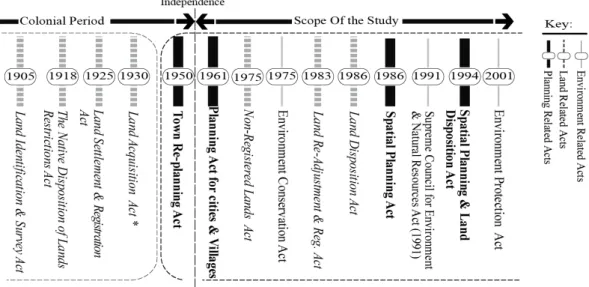
Figure 10 the sphere of legislative planning in Sudan since pre-colonial era ... 43
Figure 11 the scope of community participation in Sudanese planning mandates (1986-2000) ... 48
Figure 12 Framework of how C.P is mandated in the Sudanese planning mandates, the re-planning arrangement on top (1.a and 1.b) and planning arrangement at the bottom. ... 51
Figure 13 Previous Experience in Community participation in planning ... 55
Figure 14 Area of planning in which community participation was achieved ... 55
Figure 15 Correlation between participants' age and application of community participation in practice ... 56
Figure 16 Planning stages of which most of the participation programs take place ... 56
Figure 17 the importance of each stakeholder in the planning projects ... 56
Figure 18 tools and techniques of participation used ... 57
Figure 19 Level of community demands integration into the plans ... 57
Figure 20 level of planners' satisfaction related to level of coordination exhibited ... 57
Figure 21 preferred stage of involvement as understood by planners ... 58
Figure 22 photos of some of Nafeer practices in Sudan. The left photo is courtesy of Dr. M. A. Zakaria , the one in the right is courtesy of Dr. O. Elkheir. ... 63
Figure 23 some photos of Korean village communities during SMU projects; Source: (The National Council of Saemaul Undong Movement in Korea, 2003) ... 69
Chapter Three
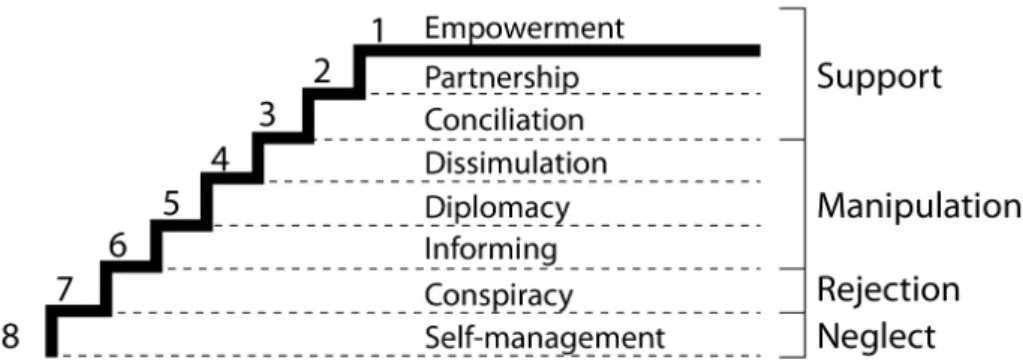
Figure 24 ladder of citizen’s participation. Source; (Arnstein, 1969) ... 82Figure 25 Nafeer benchmark against Arnstein’s Ladder of Citizen Participation ... 83
Figure 26 A ladder of community participation for underdeveloped countries as seen in (Choguill, 1996) ... 85
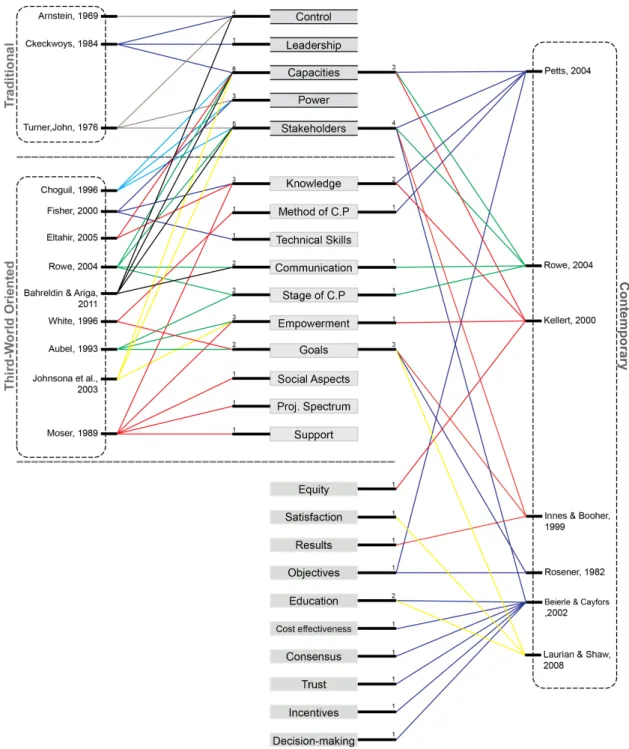
Figure 27 The spectrum of evaluation provided by different literature studied. ... 98
Figure 28 Breakdown of each literature category on the development of participation evaluation agenda ... 99
Figure 29 breakdown of each literature category on the development of participation evaluation agenda ... 100
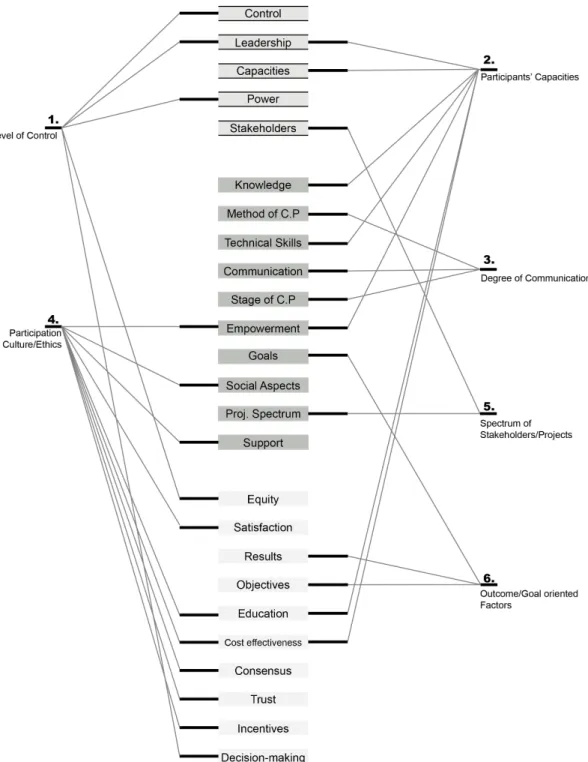
Figure 30 The six elements of evaluation based on literature studied ... 102
Figure 31 The five-element evaluation framework as composed from literature and theories studied ... 103
Chapter Four
Figure 32 location of Al-shigla case study and its surroundings ... 106Figure 33 some of the major socioeconomic and policy changes contributed to the change in Al-shigla ... 106
Figure 34 Some of the major challenges and problems observed in Al-shigla ... 108
Figure 35 Land use map of Al-shigla as per the field survey in 2009; A1 defined Al-shigla west while A2 identifies Al-shigla Wasat. ... 109
Figure 36 surface drainage and solid waste challenges in Al-shigla neighbourhood ... 112
Figure 37 Al-shigla land uses before the re-planning process based on community leaders-modified map as in 1991 ... 113
Figure 38 House Plan of Al-shigla before the re-planning process (North is facing down) ... 114
Figure 39 Research approach in Al-shigla case study and the different research modules ... 116
Figure 40 Community mapping of Al-shigla after the Re-P.P (original map obtained from MPPU) ... 121
Figure 41 Community mapping of Al-shigla before the re-planning Process (Source MPPU, partially completed by community leaders) ... 126
Figure 42 the Scope of the projects selected for evaluation ... 130 Figure 43 Area coverage of the water supply (to the right) and power supply projects in Al-shigla before
ix
Figure 44 procedural arrangements and consensus building procedure for the Water provision project ... 134
Figure 45 the locations of the projects selected for the evaluation before the re-planning process. Based on Al-shigla as in 1991/2. ... 137
Figure 46 procedural arrangements for the water supply project after the Re-P.P ... 140
Figure 47 the locations of the major projects selected for the evaluation after the re-planning process, based on Al-shigla as in 2010 ... 142
Figure 48 Sysnthesis of C.P in Al-shigla projects ... 144
Figure 49 Basic questionnaire Data ... 145
Figure 50 the UBE of community participation in the different projects categories ... 146
Figure 51 the UBE of their level of partciapation on the projects selected ... 146
Figure 52 community participation matrix in Al-shigla case study ... 148
Chapter Five
Figure 53 The location of Al-salama Case study ... 152Figure 54 ethnic affiliation and age groups of the sample selected for this case study ... 155
Figure 55 the level of education of questionnaire respondents ... 156
Figure 56 the f garbage collection and storm water drainage challenges observed in Al-salama ... 158
Figure 57 surface and storm water drainage challenges in Al-salama, power supply system is seen at the background ... 158
Figure 58 Land use map of Al-salama after the Re-P.P as in 2011 ... 160
Figure 59 the plan of House No. 147 in Al-salama (Note the male and the female domain (A & B) separation) ... 161
Figure 60 General overview of the main open/public square in Al-salama. The four primary schools are seen in the background. ... 162
Figure 61 Research approach in Al-salama case study and the different research modules ... 164
Figure 62 Community mapping in Al-salama After the Re-planning Process (based on 2011 fieldwork) ... 169
Figure 63 Community mapping of Al-salama before the re-planning process ... 174
Figure 64 the scope of projects identified by community leaders as priority projects ... 177
Figure 65 the general layout of the Shifa-khana building before the re-planning process ... 182
Figure 66 the general layout of the school building before the re-planning process. ... 184
Figure 67 General view of the schools complex (Top), bottom left and bottom right is the main entrances of both El-Imam Anas Bin Malik and El-Bara Bin Malik primary Schools. ... 185
Figure 68 general photos of the Primary Health care Unit ... 186
Figure 69 results of the two PRA workshops (community development projects) ... 192
Figure 70 results of the two participatory workshops (service delivery projects) ... 193 Figure 71 synthesis of the PRA Workshops outcomes ... 196 Figure 72 synthesis of the PRA Workshops outcomes ... 197 Figure 73 the coding process of participation activities and relationships ... 199 Figure 74 the results of the coding process of the main stakeholders as well as their relationship ... 200 Figure 75 A graphical representation of the two-community participation typologies observed in Al-
salama ... 200 Figure 76 a Matrix of community participation in development projects in Al-salama ... 202 Figure 77 the state of basic services in Al-salama before and after the Re-P.P ... 207 Figure 78 Citizens’ participation in different development projects in Al-salama ... 208
Chapter Six
Figure 79 the community participation matrix in Al-shigla ... 210 Figure 80 the community participation matrix in Al-Salama ... 211 Figure 81 level of Municipal Government control over projects and types of arrangements conducted in
Al-shigla (Note: symbols and abbreviations are the same as that of figure 14) ... 217 Figure 82 level of Community Groups’ control over projects and types of arrangements conducted in Al-
shigla (Note: symbols and abbreviations are the same as that of figure 14) ... 217 Figure 83 level of Community Groups’ control over projects studied in Al-salama ... 217 Figure 84 levels of Public Authorities control over projects studied Al-salama ... 217
Chapter Seven
Figure 85 the structure of the two community participation patterns observed in the Village Organization
Process, ... 229 Figure 86 the three Nafeer typologies as re-defined by this research ... 231
xi
LIST OF TABLES
Chapter One
Table 1 Results of the Purposive sampling applied for the case study selection ... 23
Chapter Two
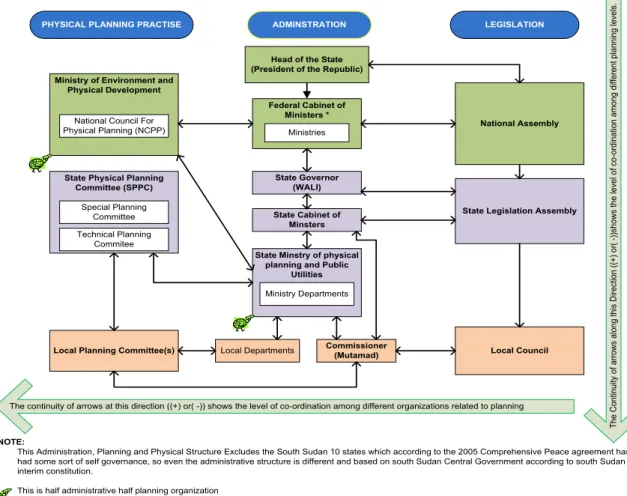
Table 2 administrative structures and planning implementation in Sudan; Source (Suleiman et al., 2008)). Please note that Village Organization program (VOP) though mandated at the
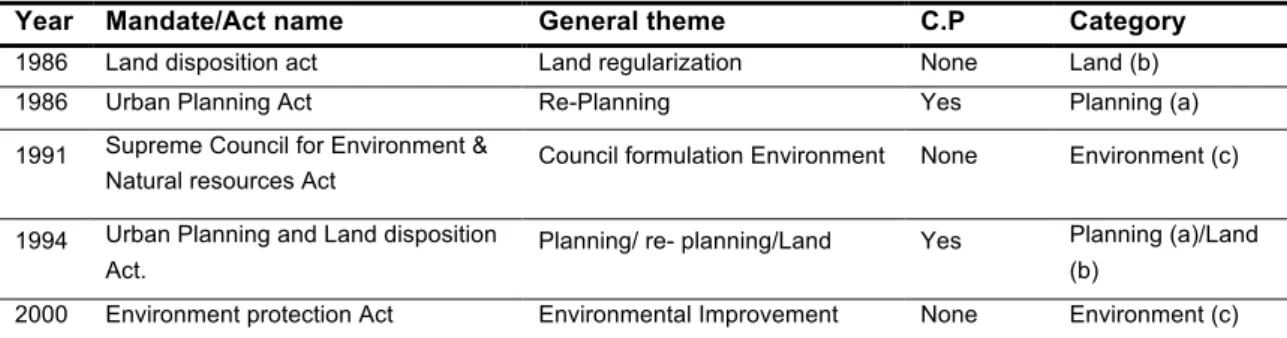
National/Federal level its application is generally restricted to Khartoum state. ... 32 Table 3 planning levels and type of rrangments in Sudan ... 34 Table 4 the general themes of planning mandates in Sudan between 1986-2000 ... 44 Table 5 The application of the three dimensions on planning Mandates/bylaws ... 49 Table 6 the stages of development of SMU movement in Korea; Source; (The National Council of
Saemaul Undong Movement in Korea, 2003) ... 69 Table 7 a simple comparison among different community participation ideologies/policies adopted in
other countries. ... 74
Chapter three
Table 8 the three categories of literature and theory used to construct our anticipated evaluation
framework ... 81 Table 9 summaries of the how C.P is understood in Traditional C.P theories and Literature ... 84 Table 10 Aubel’s Blueprint and learning Process approaches to participation program evaluation ... 86 Table 11 Table 4 White’s four factors of participation Source: (White, 1996) ... 88 Table 12 Summary of the how C.P is understood in third-world oriented C.P theories and Literature ... 90 Table 13 Summary of the how C.P is understood in contemporary C.P theories and Literature ... 96
Chapter Four
Table 14 Population of Al-shigla case study ... 107
Table 15 Percentages of Land uses in Al-shigla case study (based on Al-shigla West) ... 110 Table 16 Type of built spaces in Al-shigla (based on Al-shigla West) ... 110 Table 17 Community-mapping of Al-shigla after the re-planning process ... 122 Table 18 Community-mapping of Al-shigla before the re-planning process ... 127 Table 19 Summary of the power supply and drinking water projects’ main projects features ... 132 Table 20 Sumary of basic projects data ... 141 Table 21 Summary of the C.P changes observed in Al-shigla case study ... 151
Chapter 5
Table 22 types of built spaces in Al-salama ... 161 Table 23 community mapping process in Al-salama after the re-planning process ... 170 Table 24 Community mapping of Al-salama before the re-planning process ... 175 Table 25 general details of the pre-re-planning process projects ... 184 Table 26 summary of the projects implemented after the re-planning process ... 188 Table 27 summaries of changes in the community participation before and after the re-planning process ... 205
Chapter Six
Table 28 the breakdown of our five elements framework into its 26 sub-components ... 209 Table 29 the Five Elements Evaluation Framework application on community participation findings in the
Case study Areas (highest values are highlighted with grey). ... 219
Chapter One;
Prologue and Research Overview
This part of research provides a background and states research problems, challenge as well as it is significance. Research hypothesis as well as approach is also explained in this part. The second section of this part expresses research rational and research design.
Chapter one; Prologue and Research Overview
1
Prologue and Research Overview 1. Section 1; Research Overview
1.1. Introduction to research
The cultural values of the Sudanese local communities exhibited in rural areas as well as urban villages signifies an interesting, efficient as well as a contextually driven planning approach and support system. These features as observed in different planning, architecture and management levels, include several arrangements that range from land-use development/planning and community development to infrastructure provision and improvement.
On the contrary, government initiated planning (legislative planning) practiced within the urban fringes of the capital region of Sudan (Khartoum) emphasizes a very central bureaucratic and less-participatory approach (Ahmad, 1992; Dennis A. Rondinelli, 1981; Hamdan, 1960). Not-to-mention the socio-cultural as well as physical consequences associated (Eltahir, 2005, 2008).
Through formal and informal planning arrangement, the two approaches exhibited above have strong existence in the Sudanese planning tradition. They also tend to spatially occur at different magnitudes, often within a short period of time. While legislative planning has been under focus and attention due to the State power exercised throughout its different arrangements, community-driven planning is less known and hardly studied in the academic literature and researches.
Nonetheless, the process of community participation in the two approaches has not been adequately approached and studied. This was evident in the lack of researches that have tackled this issue at the Sudanese local level.
In fact lack of proper evaluation of community participation is not an issue that is observed only in third-world.
(Beierle, 1998) had already argued that participation evaluation is less common among researchers worldwide, thus it still lags behind.
The recent importance assigned to the community participation as a planning tool signifies the importance of studying community participation in both approaches (community driven and government initiated). Studying as well as evaluating those approaches is essential step towards improving future practices. Learning from our past experiences is generally the first step to pursue our prosperous-to-be future of planning.
1.2. Background of the problem
In settlement regulation and re-planning, community participation is a key principle (Hamdi & Goethert, 1997).
Participation is a rich concept that means different things to different people in different settings. For some, it is a matter of principle; for others, a practice; and for still others, an end in itself. All these interpretations have
Chapter one; Prologue and Research Overview
created a great ambiguity for a very important issue for most if not all planning institutions worldwide. It is therefore important to understand the meaning of participation/community participation for the fact that this meaning has been misused and abused in many projects claiming to have community participation as a project component.
Community participation in human settlements development and improvement of basic services provision is substantial in Developing World and low-income communities. Participation in general must be viewed against the background of several phenomena. United Nations Centre of Human Settlements (Habitat) has listed three of these phenomena as; the enormous growth of population, the Rapid urban growth, the economic issues and budgetary constrains in developing countries (UNCHS/HABITAT, 1991).The three issues listed above do have roots in the Sudanese urban practice.
For instance, although the capital region (Khartoum state) is one of the 26 states that comprise Sudan, the State area which counts only about six percent of the country area (22,142 square kilometers) contains more than 17.5% of the estimated population of the country. The average population density in Khartoum State is more than twenty times that of Sudan at large, exhibiting a state of high population concentration (Bannaga, 2000).
Unprecedented population growth, escalated by persistent regional phenomena including the civil conflicts and drought 1988 floods had aggravated this even further (ibid). The high waves of displaced population from the South and the West of the country contributed to the growth of Khartoum up to seven folds in twenty years period (see Figure 1). As a result, the already poor socio- economic as well as physical infrastructure of Khartoum has been deteriorating.
Chapter one; Prologue and Research Overview
3
Figure 1 the Physical Growth of the Capital region from 1898 to 1994. Note the fast changes observed after the year 1970 Source: compiled by author from different sources
The City thus developed had to deal with the incompatibilities between different land uses (Bannaga, 2000).To cope with these issues, the options availed by the local authorities was to incorporate these villages into the urban fabric as well as re-planned illegal settlements emerged.
By 1980s, the growth of squatter settlements as well as villages’ expansion was unprecedented. The capital region authorities have to opt for immediate action. Accordingly, in 1985, the Village Organization Department (VOD) was established1. The department was empowered by the 1985 Urban Planning mandates to tackle the growing challenges resulted from the increasing number of squatters villages around the city (Bannaga, 2000). In 1991, the Organization of Villages in the capital region commenced. By the end of 1996, the total number of villages organized reached fifty in number (ibid).
During the Village Organization Program (VOP), though government resources were limited, Bannaga, 2000 argues that the support from the beneficiaries and the community at large was substantial insuring the progress of the organization process at a reasonable rate.
1 Village Organization Department was established to cope with the growing sprawl and squatters in around the capital region. Its mandates are referenced to 1986 Spatial Planning and Land disposition Act.
Chapter one; Prologue and Research Overview
During its first six years VOP managed to regulate more than seventy village as well as re-planning sixteen subdivisions. A total of 190.000 families (this count for at least 1.300.000 people) were generally affected (ibid).
This number reports about twenty percent of the capital region at that time. The Minister of Planning during this period argued “ a new villagers' generation is engaged in urban activities. Consequently village economy is gradually changing from rural to urban ” (Ibid).2
Figure 2 Components of the Village Organization Program (VOP) Source Bannaga, 2000; Scale unspecified. North Direction is up-ward
On account of the massive migration and urban growth in the city of Khartoum (see Figure 2), public sector efforts (through planning experts and local councils) to reduce the gap in basic services provision have not made a significant or large-scale impact. Plans and Projects often been expensive require massive expenses or inadequately designed and planned. Many projects were actually planned but never been implemented. Others
2 Interesting readings regarding this issue are the two books authored by the Minister of Planning during the nineties of the past
Chapter one; Prologue and Research Overview
5
were planned but have taken tremendously long-time to be implemented during which these plans might need to be updated. Even others have created major conflicts and problems rather than solving them. This practice/approach resulted in meager benefits are reached at enormous financial, social and cultural cost. Those projects have rarely satisfied and provided communities with the standard-level of basic services they wished.
Recent literature argues that, this problem, which is further illustrated in Figure 3, can be tackled through legitimate community participation(Fisher, 2001; Judith Innes & Booher, 2000).
Figure 3 Non-participation Problem Cycle
Although public authorities believe that the Village Organization Program process was successful as well as participatory (see (Bannaga, 1996, 2000). Research shows that various VOPs resulted in disastrous and negative socio-cultural activities (Bahreldin & Ariga, 2011a; El-Kheir, 1991; Eltahir, 2005; M. E. Abu Sin, 1984). In fact, some researchers argued that the Village Organization Program was nothing more than a neat demarcation of the streets (Geoffroy, 2005). While most of the researches mentioned above focused in the re-planning processes within Village Organization Program process, few had stressed on community participation before and after the program.
The poor performance of Village Organization Program (VOP) was manifested in the inability to provide and re- arrange village infrastructure. Communities in many areas in the capital region found themselves responsible of sustaining these services and infrastructure by themselves. Community initiative driven by a traditional form of
Chapter one; Prologue and Research Overview
community participation known as “Nafeer”3 helped in sustaining those services. This approach gets wide recognition among village and informal settlements communities.
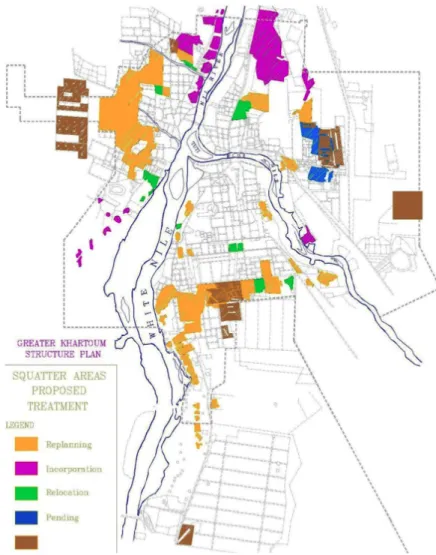
The existence of those two approaches of community participation practiced in relation to urban development, together with the success of “Nafeer-driven projects in re-planning contexts represent an important phenomena that deserve to be studied an evaluated. This is especially important with the approval of Khartoum New Structure Plan KNSP 2008-2033, in which a major program of village incorporation and development is integrated (see Figure 4 and Figure 2).
3 A traditional form of community participation that is observed in most of the Sudanese villages and some urban area. Some
Chapter one; Prologue and Research Overview
7
Figure 4 Villages that will be incorporated as part of Khartoum New Structure Plan 2008-2033
Chapter one; Prologue and Research Overview
1.3. Statement of the problem and opportunity
Village communities around Khartoum have strongly contributed to the development of their settlements.
Unfortunately, what is considered by authorities as un-planned is actually community planned (M. E. Abu Sin, 1984).. According to this, the re-planning process of those settlements has contributed to the negative cultural and social consequences in those areas (Eltahir, 2005) resulting in a level of community participation that is restricted to mobilization (Fahal Abureidah, 1987) through a one way information dissemination to citizens (Bahreldin & Ariga, 2011b).
Indeed with such large negative socio-cultural consequences in the participation behavior of those communities, the process of community participation evaluation becomes necessary and vital. Against this background, the research problem in general terms is a question of how to improve the process of community participation that shapes both urban village as well as their infrastructure. The specific term of the problem addressed in this research is described in three arrangements as follows;
a. Having created significant changes in the villages surrounding Khartoum, the “ the Village Organization Program ” has affected settlements structure, people’s culture and most importantly community participation behavior. The participatory processes availed before and after the Village Organization Process “re-planning process” is necessary to be evaluated to improve future practice.
This is especially valid after the approval of the New Khartoum Structure Plan 2008-2033, by which not less than 280 villages are going to be regulated “ re-planned “and organized (see Figure 4).
b. Determining “what community participation technique work best and how” in specific conditions emphasize the importance of adopting certain community participation typology that fits and sync nicely with local communities culture and prevailing conditions. At this point community participation evaluation comes practical and worthwhile.
1.4. Aims an objectives of this research The main questions raised by this dissertation are;
a. “Whether citizens’-initiated and “traditional” forms of community participation practiced before Villages Organization Program and government-initiated planning are effective and sustainably efficient.”
This question directly leads to the second enquiry raised by this research, which is based on
Chapter one; Prologue and Research Overview
9
b. “Does Nafeer and traditional forms of community participation represent efficient gap-filler of the C.P shortcomings arises from the legislative planning approaches in VOP?”… Can the opposite of this
question be true?
This research addresses these questions through both qualitative as well as quantitative approach (see research design in section two of this chapter).
The aim of the study is to contribute to the understanding of pros and cons of community participation practiced before and after the VOP and informal settlements treatment, this includes both traditional concept of community participation practiced generally before settlement integration or re-planning and the legislative planning.
The objectives of this research, which are set to help answering the previous questions, are of five-folds:
1. To explore the concept of the community participation with reference to the existing local planning tradition through documenting some of these activities.
2. To emphasis on the importance of the traditional community participation on the development of the urban villages in the capital region. This implies to emphasize on the importance of a traditional form of Sudanese community participation named as “Nafeer”.
3. To develop a set of criteria and measures “a conceptual framework” necessary to conduct reliable evaluation of community participation in development of basic infrastructure in low-income communities.
4. To develop a research approach that allows for applying criteria mentioned above to evaluate both the traditional Nafeer-driven and the legislative government-initiated forms of community participation in “a re-planned area and villages in the Sudanese capital region.
5. To identify and understand the Pros and Cons of each type of the two community participation approaches mentioned above.
1.5. Research hypothesis
In this dissertation, three hypotheses are tested against the two case studies selected to contribute to this research. Our three hypotheses, which are drawn from our research questions, are:
1. In villages’ basic infrastructure delivery, the current often called “modern” legislative planning system doesn’t fit the purpose of genuine participatory approach; this system is incapable to tackle community urgent planning issues.
2. The quality/quantity of community participation practiced prior to the re-planning/village incorporation process is higher than that conceived after the same process.
Chapter one; Prologue and Research Overview
3. Legislative planning as well as community-driven (Nafeer-driven) if combined can produce an authentic quality of community participation for low-income communities.
The hypotheses raised here are valid under certain assumptions related to the subject of this dissertation. These assumptions are necessary to defined limits and boundaries of our evaluation. These assumptions include
− The term “Non-legislative” Nafeer-driven/Community-driven as used here should be understood as a “community-Based” participation rather than planning that doesn’t respond to planning legislations and guidance 4.
− This hypothesis is based on looking at the non-legislative planning as a complementary approach that could contribute to the maturity of the legislative planning rather than a replacement of the latter arrangements.
− Community participation process is not and ends by itself, it is rather a series of inputs that evolve over time.
1.6. Research strategy
According to the research objectives stated above, we opt to adopt a research strategy that can satisfy those objectives. As a result, our strategy is based on
a. A theoretical exploration of the C.P as a concept as well as an evaluation approaches. This step is believed to provide a contextual understanding of the basic knowledge of C.P in Sudan as well as worldwide. This step will also assist in developing our contextually driven evaluation framework.
b. A case study approach by which our research hypotheses above are testified and benchmarked.
1.7. Significance of this research
In contrast to the common understanding of community participation notion, which is generally characterized as extensively studied and researched (Beierle, 1988; Beierle & Cayford, 2002; Caroline & Moser, 1989 and Bahreldin & Ariga, 2011a), many researchers have noted that; community participation “evaluation” has not been covered efficiently (Laurian & Shaw, 2008; Beierle, 1998). As a matter of fact community participation evaluation is still very new research theme and has slightly been touched (Beierle, 1998). In the same regard, literature on community participation in Sudan though very limited, it generally focus on legislative and state-driven community participation
4
Chapter one; Prologue and Research Overview
11
On the other hand, albeit traditional planning is highly observed in rural and sub-urban Sudan, community participation is generally touched within the mainstream perspective i.e. urban community participation practices as well as participation in government-initiated projects. We believe that this research provide an off-stream point of view by focusing on issues that are barley touched. According to the above-mentioned statements, the general rationale of this research is to;
a. Develop a research that addresses problems that the current community participation literature does not adequately address.
b. The current research will add to the scares knowledge available on community participation evaluation worldwide, with specific emphasis to third world context.
c. Whilst community participation in village incorporation and service provision in Sudan has been taking place for the last three decade, to date, empirical evidence of its effectiveness and influence on urban conditions and decision-making has remained scant. Furthermore, this research also reports on the results of applying the anticipated evaluation framework (see research objectives) in to two of the re- planning and village organization case studies in the capital region of Sudan. Results may also be of interest for other developing countries with comparable contexts, including e.g. South Sudan, Chad and Ethiopia.
d. The sort of research exhibited by this dissertation is also quite rare in the field of academic research in Sudan. In fact the field of community participation evaluation (C.P.E) in legislative planning in Sudan is a topic that has hardly been touched or studied, this field of research is very essential to develop guidance to the next round of planning i.e. the Village Incorporation Program availed by Khartoum New Structure Plan (2008-2033). To our knowledge, this theme has never been addressed at the context of this study (Sudan).
1.8. Expected contributions of this research
There have been several attempts to develop evaluation frameworks of C.P such as the work of Frame, Gundun and Day (2004), (Conley & Moote, 2003), and (J. Innes & Booher, 1999). The contribution of the above mentioned work has been described as “largely theoretical and have resulted in the absence of rich analytical evaluations of actual examples…” (Bereielri, 2000). A part from that, most of those attempt i.e. Inness and day focused completely in the evaluation of C.P within the theme of the Communicative Planning Theory. Thus the contextual as well as the theoretical differences suggest the in-applicability of their approaches in developing world where literacy, income level, ethnicity and governance places several challenges. At this point developing a locally inspired evaluation framework comes handy and practical. Such framework has never been developed within similar contexts in C.P practice in Sudan.
Chapter one; Prologue and Research Overview
In general, there are very few, yet limited evaluation has taken place in C.P in Sudan. Accordingly, the case studies analyzed in this research provide a depth of information of the opportunities and limitations presented by the recent and current C.P practices in the country. Those shortcomings/ findings are the most crucial step in building a C.P model to be used in the Village incorporation process in Khartoum.
Last not least, the importance of the Community Participation Evaluation as conducted in this study is that it facilitates effectiveness and problem-solving measurement to be undertaken by respective authorities and stakeholders. It also facilitates systematic way of learning from experience. Plan evaluation is largely and growingly is becoming understood as essential part of the plan development.
We understand that the third world metropolis is regarded as “the engine which will pull the rest of the country into the twenty-first century” (UNCHS/HABITAT, 1991) . According to this notion, third world cities should learn from its past to peruse its foreseen future. In this regard, to insure that history will not repeat itself, and that the Village Incorporation process related to the implementation of KNSP 2008-2033 will not results in the same meager benefits at enormous costs seen at its predecessor (The Village Organization Program of 1985 (see Figure 2)). This dissertation, which includes evaluation of the previous community participation approaches, comes handy and practical.
1.9. The structure of the study
This dissertation can be seen to comprise seven parts. Part one is a general view of this study and its reasoning and structure. Part two of this study provides general contextual background information about Sudan and planning practice in Sudan as well. Community participation tradition in Sudan is also covered in this part. Part three is in depth study and synthesis of community participation evaluation methodologies. This part concludes by suggesting a five elements evaluation framework. Part four and five are multi-level investigation through case study. Part six includes further analysis related to the application of our five elements framework. And chapter seven illustrates our conclusions and recommendations.
Part one provides a background and states research problems, challenge as well as it is significance. Research hypothesis as well as approach is also explained in this part. The second section of part one expresses research rational and research design.
Part two of this research generally exhibits background information of Sudan, planning structure and framework in Sudan and most importantly how community participation understood within the planning tradition (planning bylaws and planners perception). This part also illustrated how community participation literature in Sudan
Chapter one; Prologue and Research Overview
13
interprets the concept of community participation. The process of community participation in Sudan from both legislative and community-driven point of view is generally explained here.
Part three of this research signifies challenges observed while conducting community participation evaluation.
This part also draws a context oriented evaluation framework of community participation by which participation activities will be benchmarked against.
Part four and five comprise the two case studies selected for the evaluation. Each section exhibits specific case study research approach as well as empirical findings related to that specific case study.
Part six provides benchmark of our findings in the two case studies against our evaluation framework developed in chapter three. Thus this chapter includes further analysis related to the two case studies selected.
The last part is a summary of the research findings. This part summarizes conclusions of the two case studies, the general research conclusions as well as further recommendations for future research.
The arrangements provided in this thesis are structured to transit this dissertation from an overall picture to a detailed view. This was maintained through narrowing the scope of our research from general to specific. The conceptual structure of this research and dissertation are shown in Figure 5.
Chapter one; Prologue and Research Overview
Figure 5 Research and thesis conceptual structure