H
et er ogenei t y of l i nk w
ei ght and t he evol ut i on
of c ooper at i on
著者
I w
at a M
anabu, Aki yam
a Ei z o
j our nal or
publ i c at i on t i t l e
Phys i c a. A, St at i s t i c al m
ec hani c s and i t s
appl i c at i ons
vol um
e
448
page r ange
224- 234
year
2016- 04
権利
( C) 2015. Thi s m
anus c r i pt ver s i on i s m
ade
avai l abl e under t he CC- BY- N
C- N
D
4. 0 l i c ens e
ht t p: / / c r eat i vec om
m
ons . or g/ l i c ens es / by- nc - nd/ 4
. 0/
U
RL
ht t p: / / hdl . handl e. net / 2241/ 00138515
Heterogeneity of link weight and the evolution of
cooperation
Manabu Iwataa,∗
, Eizo Akiyamaa
aGraduate School of Systems and Information Engineering, University of Tsukuba, 1-1-1
Tennoudai, Tsukuba, Ibaraki 305-0006, Japan
Abstract
In this paper, we investigate the effect ofheterogeneity of link weight,
heterogene-ity of the frequency or amount of interactions among individuals, on the
evolu-tion of cooperaevolu-tion. Based on an analysis of the evoluevolu-tionary prisoner’s dilemma
game on a weighted one-dimensional lattice network withintra-individual
het-erogeneity, we confirm that moderate level of link-weight heterogeneity can
fa-cilitate cooperation. Furthermore, we identify two key mechanisms by which
link-weight heterogeneity promotes the evolution of cooperation: mechanisms
for spread and maintenance of cooperation. We also derive the corresponding
conditions under which the mechanisms can work through evolutionary
dynam-ics.
Keywords: Evolution of cooperation, Prisoner’s dilemma, Heterogeneity of
link weight, One-dimensional lattice network, Game theory
1. Introduction
The evolution of cooperation, which plays a key role in natural and social
systems, has attracted much interest in diverse academic fields, including
bi-ology, socibi-ology, and economics [1, 2]. The prisoner’s dilemma (PD) is often
used to study the evolution of cooperation in a population consisting of selfish 5
∗Corresponding author at Graduate School of Systems and Information Engineering, Uni-versity of Tsukuba, 1-1-1 Tennoudai, Tsukuba, Ibaraki 305-0006, Japan. TeL: +81 29 853 5571.
Email addresses: [email protected](Manabu Iwata),[email protected]
individuals [3, 4]. In the PD game, two individuals simultaneously decide to
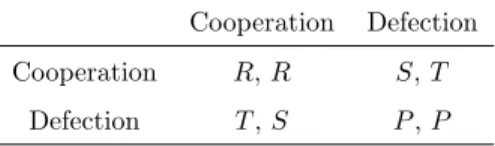
cooperate or defect. A payoff matrix of the PD game is given in Table 1.
Cooperation Defection Cooperation R,R S,T
Defection T,S P,P
Table 1: Payoff matrix for the prisoner’s dilemma (PD) game. In this game, two individuals
decide simultaneously to cooperate or defect. Mutual cooperation provides them both with
a payoffR, whereas mutual defection results in a payoffP. If one individual cooperates and
the other defects, the former obtains a payoffT, and the latter a payoffS. These values are
assumed to satisfy the conditionsT > R > P > Sand 2R > S+T.
If either individual wishes to maximize his/her personal profit in this game,
he/she will choose to defect regardless of the opponent’s decision, despite mutual
cooperation being better than mutual defection for both individuals. According 10
to the evolutionary dynamics of the PD game where an individual is paired with
a randomly chosen opponent in a well-mixed population, cooperators become
extinct whereas defectors eventually dominate in the population [5].
However, in a dilemma situation in the real world, we often see that altruistic
behaviors exist among unrelated individuals. Nowak [6] proposedfive rules as 15
the mechanisms enabling the evolution of altruism: kin selection [7], direct
reciprocity [4, 8], indirect reciprocity [9, 10], network reciprocity [11, 12, 13, 14,
15, 16, 17, 18, 19], and group selection [20].
In this study, we focus on network reciprocity, which is a mechanism
pio-neered by Nowak and May [11, 12] that enables the evolution of cooperation 20
when each individual is likely to interact repeatedly with a fixed subset of the
population only. In Nowak and May’s model, individuals are placed on nodes in
a two-dimensional lattice and play the PD game repeatedly with their directly
connected neighbors only. The authors show that the spatial constraint of
in-teractions among individuals in the lattice network can facilitate the evolution 25
of cooperation. Although Nowak and May’s model assumes that the
recently been shown that many real-world networks are identified as complex
networks. Well-known examples of complex networks are the small-world
net-work [21] and the scale-free netnet-work [22], in whichthe number of links (degree) 30
that each individual has differs. Recently, it has been confirmed by Santos and
Pacheco [13] thatheterogeneity of the number of links in complex networks can
enhance the evolution of cooperation. There have been following studies that
investigate the evolution of cooperation on networks with heterogeneous number
of links [14, 15]. This heterogeneity is also known to contribute to the efficiency 35
of collective action [23, 24]. Additionally, it has been shown that the mixing
pattern of link degree can affect the emergence of cooperation [16]. See [17, 18]
for detailed reviews of evolutionary and coevolutionary games on graphs. Also
see [19] for a thorough survey of the evolutionary dynamics of group interactions
on various types of structured populations. 40
The aforementioned studies, however, assume that individuals interact with
one another with the same frequency or amount; that is, all the link weights
between individuals in the society are identical. On the contrary,
individu-als in real-world networks, such as scientific collaboration networks, phone call
networks, email networks, and airport transportation networks, have heteroge-45
neous intentions in their relationships [25, 26, 27]. There is substantial interest
among researchers in knowing how heterogeneity of the strength of relationships
(that is, link weight) among individuals influences human behavioral traits (e.g.
sociological studies such as [28, 29, 30]).
In particular, researchers have recently investigated whether the heterogene-50
ity of link weight between individuals promotes the evolution of cooperation.
For example, Du et al. [31] constructed a simulation model in which individuals
are placed on a node in a scale-free network and connected to other
individu-als with heterogeneous link weights. In their model, individuindividu-als interact more
frequently with neighbors connected by links with large weights and less fre-55
quently with those connected by links with small weights. Du et al. found that
cooperative behavior can be more facilitated when the link weights shared by
model, interaction networks have two kinds of heterogeneity: heterogeneity of
thenumber of links and that of link weight. Note also that each link weight is 60
determined according to the number of links of individuals; that is, link weight
is a function of the degrees of the two individuals at either side of the focal
link. Therefore, in the Du et al. model it is difficult to ascertain which factor
enhances cooperation: heterogeneity of the number of links or heterogeneity of
link weight. 65
Additionally, Ma et al. [32] employed a two-dimensional square lattice with
individuals placed on its nodes. In their model, individuals play the PD game
with their immediate neighbors connected by links with heterogeneous link
weights. Ma et al. arranged three populations, where the link weights in
the population follow either power-law, exponential, or uniform distribution 70
patterns. They confirmed that a network with a power-law distribution of link
weights better facilitates the evolution of cooperation than one with link weights
conforming to one of the other two probability distributions.
Because a two-dimensional square lattice is used in their model, each
indi-vidual has the same number of links (i.e., four). Thus, their result clearly shows 75
thatheterogeneity of link weight can bring about a cooperative state even
with-out heterogeneity of the number of links. However, in their model, the sum
of link weights of an individual, which we call the link-weight amount of the
individual, differs from those of others. That is, not only each of the links
pos-sessed by an individual can have a different weight, but the individual can also 80
have a different link-weight amount from other individuals. We call the former
intra-individual heterogeneity and the latterinter-individual heterogeneity.
When inter-individual heterogeneity exists, some individuals play the PD
game more frequently than others (link-weight amount is heterogeneous among
individuals). That is, there isheterogeneity of the interactions among
individ-85
uals. It has already been shown [13, 14, 15] that heterogeneity of interactions
among individuals due to heterogeneity of the number of links among
individ-uals and not to inter-individual heterogeneity can facilitate the evolution of
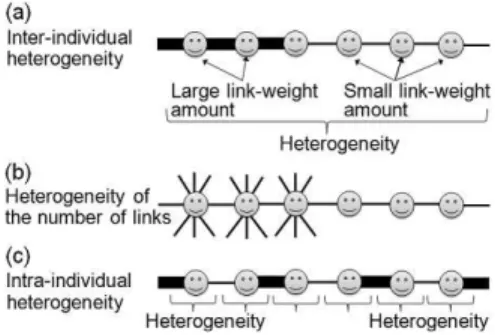
Fig. 1: Examples of a one-dimensional lattice with three kinds of heterogeneity: (a)
inter-individual heterogeneity, (b)heterogeneity of the number of links, and (c) intra-individual
heterogeneity. Thick and thin lines between individuals denote links with large and small
weights, respectively.
Fig. 1 shows three examples of a one-dimensional lattice having, respectively, 90
intra-individual heterogeneity, inter-individual heterogeneity, and heterogeneity
of the number of links. Fig. 1(a) shows an example of inter-individual
hetero-geneity, where individuals on the left-hand side have large link-weight amounts
and those on the right-hand side have small link-weight amounts. In this case,
individuals on the left-hand side interact more frequently with others than those 95
on the right-hand side; that is, there is heterogeneity of interactions between
individuals. Heterogeneity of the number of links is shown in Fig. 1(b), where
individuals on the left-hand side have a large number of links and thus more
opportunity to interact than those on the right-hand side. Bothinter-individual
heterogeneityandheterogeneity of the number of linksbring about a similar type 100
of heterogeneity of interactions among individuals in the sense that either can
cause link-weight amount heterogeneity. Finally, Fig. 1(c) shows an example
ofintra-individual heterogeneity, where each individual has both a large-weight
link and a small-weight link, but all individuals have an equivalent link-weight
amount. That is, intra-individual heterogeneity does not involve the hetero-105
geneity of the link-weight amount among individuals but involves the
hetero-geneity of the weight of links of each individual. Thus, it should be noted that
different types of heterogeneity.
The literature [31, 32, 33, 34, 35, 36, 37, 38, 39, 40, 41, 42, 43, 44, 45, 46, 47, 110
48] has investigated the effect of heterogeneity on the evolution of cooperation
from variety of viewpoints1. Especially, Du et al. [31] and Ma et al. [32] have
clearly shown, as mentioned in the above, that the existence of link-weight
het-erogeneity facilitates the evolution of cooperation. However, we cannot reject
the possibility that the evolution of cooperation in the models of Du et al. and 115
Ma et al. might be facilitated by the effect of link-weight amount
heterogene-ity, whose effect on the evolution of cooperation has already been confirmed by
Santos and Pacheco [13]. This is because the link-weight heterogeneity in their
models involves not onlyintra-individual heterogeneity but alsointer-individual
heterogeneity. Whether heterogeneity of link weight without heterogeneity of
120
link-weight amount, intra-individual heterogeneity alone, can promote the
evo-lution of cooperation or not is the remaining question to be solved. Detailed
investigation of this question would enable us to understand the underlying
mechanism of the evolution of cooperation caused by the heterogeneity of
inter-actions among individuals. 125
To answer this question, we introduce the simplest possible model of a
weighted network, withintra-individual heterogeneityand withoutinter-individual
heterogeneity. First, we employ a weighted one-dimensional lattice as the
sim-plest network model and investigate the effect of link-weight heterogeneity on
the enhancement of cooperation. Second, we examine when and how such het-130
erogeneous link weight gives rise to the evolution of cooperation; that is, we
in-vestigate the mechanism by which heterogeneity enables cooperation to evolve.
1
For example, Cao et al. [35] focused on the dynamics (change over time) of the magnitude
of the link-weight heterogeneity. Chen and Perc [38] examined the effect of the heterogeneity
in incentives for rewarding individuals in the public goods game on promoting cooperation.
Szolnoki et al. [41], Perc and Szolnoki [42], and Santos et al. [43] examined diversity of
individ-uals. Perc [44] introduced the random variations to the payoff of individuals and invetigated
the effect of it on the evolution of cooperation. Brede [47] and Tanimoto [48] analyzed the
Specifically, we identify the conditions under which link-weight heterogeneity
enables society to become cooperative, through analytical calculation and
com-puter simulation. 135
2. The model
In this study, we develop a model of a spatial evolutionary game with
link-weight heterogeneity based both on the PD cellular automaton model proposed
by Nowak and May [11, 12] and the weighted network model employed by Du
et al. [31, 33], Ma et al. [32], Buesser [34], and so on. We construct a lattice 140
network model in which each individual occupies one node and is connected to
his/her neighbors by links with heterogeneous weights. Each individual has two
links, one shared by the individual to his/her left and one to his/her right. We
assume periodic boundary conditions for the network we employ.
There are two types of heterogeneity of link weight in a network: (i)
intra-145
individual heterogeneity: the heterogeneity of link weight between the links of an
individual; that is, an individual can have a large-weight link with one neighbor
and a small-weight link with another; and (ii)inter-individual heterogeneity: the
heterogeneity of link weight between individuals; that is, an individual can have
many large-weight links whereas another can have many small-weight links. In 150
this research, we focus on the former type of heterogeneity to begin our
investi-gation on the effect of link-weight heterogeneity on the evolution of cooperation
using the simplest form of heterogeneity.
Because we consider a network withintra-individual heterogeneityonly (i.e.,
withoutinter-individual heterogeneity), the sums of the link weights of all the 155
individuals are roughly equivalent. Let the weight of a link (large-weight link)
of an individual be w1 and the weight of the other link (small-weight link)
be w2 (w1 > w2 > 0). Because we assume that there is no inter-individual
heterogeneity(the sum ofw1andw2is the same for all individuals) and that an
individual’s right (left) link is shared by the right (left) neighbor, all individuals 160
Hereafter, we assume a large link weight to be w1 = 1.0 +w and a small
weight to be w2 = 1.0−w to express w1 and w2 using only one parameter,
w∈ [0,1]. The larger the value of w, the more heterogeneous the link weight
becomes. Whenw= 0, link weight in the lattice network is completely homo-165
geneous.
To investigate the evolution of cooperation in weighted networks, we consider
the situation where each individualiplays the PD game with his/her immediate
neighbors in a weighted lattice network as described above. We assume an
individual i has a strategy si ={C, D} that determines whether to cooperate
170
with or defect from all of his/her neighbors. That is, each individual can either
be a cooperator who always cooperates with all his/her opponents or a defector
who always defects. According to the literature [11, 12, 13, 14, 15, 16, 17,
18, 31, 32, 33, 35, 41, 42, 47], we rescale the game to be drawn using a single
parameter. For the PD game, we letT =b,R= 1, andP =S= 0 2 to rescale
175
the payoff matrix using one parameterb. This parameter represents the payoff
of a defector when exploiting a cooperator, and is constrained by the interval
1.0 < b < 2.0. In each generation, all pairs of connected individuals play the
PD game. After playing the game, each individual obtains the payoffmultiplied
by the value of the weight of the link with his/her opponent. The weight of 180
the link between individuals i and j is defined as wij, and the payoff of an
individuali with strategy si, when playing with an individualj with strategy
sj, is represented asπsisj. The total payoff an individualireceives is expressed
as Πi =∑j∈Viπsisjwij, whereVi is the set of neighbors of individuali. In the
first generation, each individual’s strategy, which is either to cooperate or to 185
defect, is randomly determined with a 50 percent probability. We define the
score of each individual in a generation as the sum of the payoffs received from
2
As Nowak and May [11] noted, simulation results are typically not affected by whether
the payoff matrix involvesP =S or P > S, thus, we assumeP = S in our study. This
assumption enables the payoff matrix to be expressed and controlled only by one parameter
all the games with his/her neighbors.
After all individuals have played the PD game with all their neighbors, each
individual imitates the strategy of the individual with the maximum score 190
among all his/her neighbors including him/herself. An individual does not
change his/her strategy if he/she is one of those with the maximum score. If an
individual has more than one neighbor, excluding him/herself, with the
max-imum score, he/she chooses one of them randomly. Individuals update their
strategies simultaneously, after which one generation is completed. 195
For the evolutionary simulation, we set the network size N=10,000 and set
b(the temptation to defect from a cooperator) such thatb∈(1.0,2.0) in steps
of 0.01. We assume that w ∈ [0,1.0] in steps of 0.01, and therefore, 1.0 +w
denotes a large weight (strong link) and 1.0−w corresponds to a small weight
(weak link). 200
3. Simulation results and discussion
To examine how heterogeneity of link weight affects the evolution of
cooper-ation, we analyzed how the degree of link-weight heterogeneity,w, affected the
resultingfrequency of cooperationin the population. The frequency of
coopera-tion in each generacoopera-tion was calculated as the ratio of the number of cooperators 205
to the total population size. We defined the frequency for a simulation run
as the average of the frequency of cooperation over 100 generations after the
2,000th generation. We adopted this definition because, although we wished to
estimate the frequency at the convergent state, we found that this state
some-times did not converge to a fixed state but went to a periodic state. (We checked 210
that the frequency of cooperation could reach a steady or periodic state within
2,000 generations.) We performed 100 runs of the computer simulation for each
parameter setting and calculated the average of the frequency of cooperation
for all the runs3, which hereafter, we refer to asthe frequency of cooperation.
3
For each parameter setting, all individuals followed the payoff matrix in which parameter
3.1. Overview of the effect of link-weight heterogeneity on the evolution of
co-215
operation
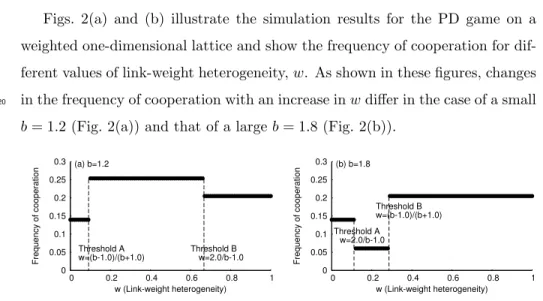
Figs. 2(a) and (b) illustrate the simulation results for the PD game on a
weighted one-dimensional lattice and show the frequency of cooperation for
dif-ferent values of link-weight heterogeneity,w. As shown in these figures, changes
in the frequency of cooperation with an increase inwdiffer in the case of a small 220
b= 1.2 (Fig. 2(a)) and that of a largeb= 1.8 (Fig. 2(b)).
0 0.05 0.1 0.15 0.2 0.25 0.3
0 0.2 0.4 0.6 0.8 1
Frequency of cooperation
w (Link-weight heterogeneity) (a) b=1.2 Threshold A w=(b-1.0)/(b+1.0) Threshold B w=2.0/b-1.0 0 0.05 0.1 0.15 0.2 0.25 0.3
0 0.2 0.4 0.6 0.8 1
Frequency of cooperation
w (Link-weight heterogeneity) (b) b=1.8
Threshold A w=2.0/b-1.0
Threshold B w=(b-1.0)/(b+1.0)
Fig. 2: Frequency of cooperation for different values of link-weight heterogeneity, w, in a
weighted one-dimensional lattice: (a) case with a smallb(b=1.2) and (b) case with a large
b (b=1.8). The horizontal and vertical axes represent the degree of w, which reflects the
magnitude of the heterogeneity of link weight and frequency of cooperation, respectively.
As shown in Fig. 2(a), the frequency of cooperation when the link weight is
heterogeneous (w >0) is always greater than that in the case of homogeneous
weight (w = 0). Fig. 2(b) shows that the frequency of cooperation when the
link weight is heterogeneous is smaller than that in the case of homogeneous 225
weight. If the value of w increases further, however, the magnitude of
coop-erative behavior in the case of heterogeneous weight is greatly enhanced and
exceeds that in the case of homogeneous weight. In both cases (a) and (b), the
cooperation frequency reaches the maximum at some value of w(> 0) (when
there is some degree of link-weight heterogeneity). Both of these figures show 230
that the frequency of cooperation does not change with an increase inwuntilw
reaches a certain threshold; that is, the change in the frequency is not gradual,
butstepwisewith an increase inw. As shown in Figs. 2(a) and (b), there are two
coopera-tion frequency jumps up or down. These thresholds arew= (b−1.0)/(b+ 1.0) 235
andw= 2.0/b−1.0, the derivations of which are provided later.
We have shown that moderate level of link-weight heterogeneity
(intra-individual heterogeneity) can enhance cooperation and that there are some
thresholds in w (a parameter that represents the degree of heterogeneity) at
which the cooperation frequency changes in a stepwise manner. We checked 240
that these results are robust against both the difference of the network size and
the existence of the decision error. (See Appendix A of Iwata and Akiyama
(2015) [49] for detail.)
3.2. Analysis of small population case — When and how does the heterogeneity
of link weight facilitate cooperation?
245
In the following, we explore why the heterogeneity of link weight brings about
the evolution of cooperation and why the frequency of cooperation changes in
a stepwise manner with an increase in link-weight heterogeneityw. To answer
these questions, we consider a much simpler model composed of six
individu-als only, and investigate in detail how the heterogeneity of link weight affects 250
evolutionary dynamics.
In the case of a lattice network with six individuals, possible configurations
of the strategies chosen by the six individuals are: “−C≡C−C≡C−C≡C−,”
“−C≡C−C≡C−C≡D−,” “−C≡C−C≡C−D≡C−,” ..., “−D≡D−D≡D−D≡D−,”
where “C” and “D” denote cooperator and defector, respectively, “≡” represents 255
a link with a large weight 1.0 +w, and “−” indicates a link with a small weight
1.0−w. The total number of possible configurations is 26=64.
Starting with each of the 64 initial configurations, we investigated how the
configuration changed over time resulting from updates of the six
individu-als’ strategies and identified the attractors of the evolutionary dynamics of the 260
strategy configurations over generations, which were either steady states or
pe-riodic cycles. Next, we estimated the cooperation frequency in the attractor of
evolutionary dynamics by taking an average of the data derived from the last
configurations that reached different cooperative states depending on the value 265
of link-weight heterogeneity w. Next, we classified these configurations into
three types: Type (i): configurations that lead to a higher cooperation level
when w > 0 than that with a homogeneous link weight (w = 0). Type (ii):
configurations that lead to a lower cooperation level when w > 0. Type (iii):
configurations leading to the same level of cooperation. (See Appendix A for 270
the classification of the initial strategy configurations into these three types.)
Because we are interested in cases where the heterogeneity of link weight has
an effect on the evolution of cooperation, in the following, we focus on strategy
configurations of the first and second types.
There are six strategy configurations that belong to Type (i) (seeAppendix
275
A), which shows that higher heterogeneity (largew) causes an increase in
coop-eration frequency. These six configurations have a common pattern, as shown
in Figs. 3(a) and (b). Similarly, there are three strategy configurations that
be-long to Type (ii), where the magnitude of cooperation frequency decreases with
higher heterogeneity. These three configurations have a common configuration 280
pattern as shown in Fig. 4.
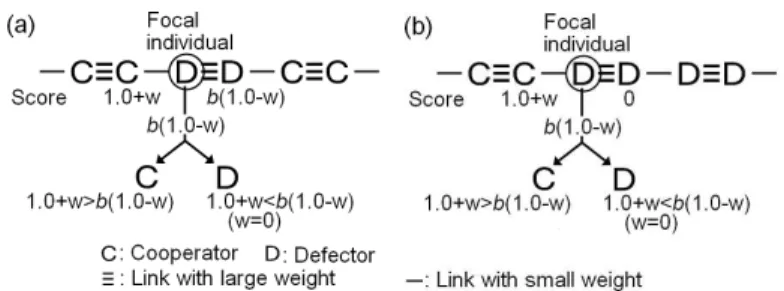
First, we consider the evolutionary dynamics, starting from the strategy
con-figuration pattern in Figs. 3(a) and (b). Here, we focus on the third individual
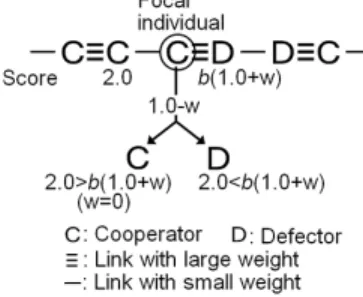
from the left in each of both figures, who we simply call the focal individual.
When starting from the strategy configuration pattern shown in these figures, 285
the focal individual chooses cooperation in the next step for a large w. For
a smallw, however, the focal individual does not change his/her strategy and
keeps the strategy of defection. In short, this configuration pattern enables the
spread of cooperation if heterogeneity of link weight exists. We now investigate
in detail why this spread of cooperation occurs. 290
Figs. 3(a) and (b) show the strategy configuration patterns for Type (i),
where the heterogeneous link weight (w >0) achieves a higher cooperation
fre-quency than the homogeneous one (w= 0). Of the 64 strategy configurations,
there are six configurations where greater link-weight heterogeneity enables a
Fig. 3: Strategy configuration patterns for type (i), where heterogeneous link weight (w >0)
achieves higher cooperation frequency than the homogeneous one (w = 0). “C” and “D”
denote cooperator and defector, respectively, “≡” represents a large-weight link, and “−”
indicates a small-weight link. Whether the strategy of the focal individual changes from
defection to cooperation depends on the value of link-weight heterogeneityw. The change
in strategy of thefocal individual after one generation (interactions and strategy updates) is
indicated by the arrow in the lower part of each figure.
“−C≡C−C≡C−D≡D−,” “−C≡C−D≡D−D≡D−,” “−D≡D−D≡D−C≡C−,”
and “−D≡D−C≡C−D≡D−.” Considering the periodic boundary condition,
the first three configurations are equivalent to “−C≡C−D≡D−C≡C−,” which
is shown at the top of Fig. 3(a). Similarly, the latter three configurations are
equivalent to “−C≡C−D≡D−D≡D−,” which is shown at the top of Fig. 3(b). 300
We define two cooperators connected by a large-weight link as “C≡C cluster,”
two defectors connected by a large-weight link as “D≡D cluster,” and one
coop-erator and one defector connected strongly as “C≡D cluster” or “D≡C cluster.”
When “C≡C cluster,” “D≡D cluster,” and “C≡C or D≡D cluster” are adjacent
as shown in Figs. 3(a) and (b), there is the possibility that the focal individual 305
(the third individual) updates his/her strategy from defection to cooperation
depending on the value ofw(link-weight heterogeneity). We call this
configu-ration pattern thespread pattern strategy configuration.
Given that there exists aspread pattern strategy configuration, we investigate
the actual conditions under which the focal individual (the third individual) 310
updates his/her strategy from defection to cooperation. Because each individual
obtains the payoff of the PD gamemultiplied by the value of the weight of the link
obtained by playing PD games with his/her neighbors, the score of the third
individual isb(1.0−w). The fourth individual obtains a score of b(1.0−w) if 315
the fifth individual is a cooperator (see Fig. 3(a)), else 0 if the fifth is a defector
(see Fig. 3(b)). Thus, in either case, the score of the focal individual (the third
individual) is greater than or equal to that of the fourth individual. Because
the focal individual is assumed to imitate the strategy of the individual with the
maximum score, it is sufficient for the focal individual to compare his/her score 320
with that of the second individual to ascertain whose strategy to imitate. The
focal individual imitates the second individual’s strategy and changes his/her
strategy from defection to cooperation only if the second individual’s score is
higher than the focal individual’s own score. Because the score of the focal
individual isb(1.0−w) and that of the second individual is 1.0+w, the condition 325
under which the focal individual imitates the strategy of the second individual
is 1.0 +w > b(1.0−w); that is,w >(b−1.0)/(b+ 1.0) for a givenb.
Thus, if the population involves the spread pattern strategy configuration
composed of three adjoining clusters, namely, “C≡C cluster,” “D≡D cluster,”
and “C≡C or D≡D cluster,” whether the focal individual changes his/her strat-330
egy from defection to cooperation depends on the link-weight heterogeneity;
that is, he/she becomes a cooperator if the link weight satisfies the condition
w >(b−1.0)/(b+ 1.0). We refer to the inequality ofwmentioned above as the
condition for the spread of cooperation. To summarize, if this condition is
sat-isfied in thespread pattern strategy configuration, cooperative behavior spreads 335
from the second to the third individual.
Next, we look at the evolutionary dynamics starting from the strategy
con-figuration pattern in Fig. 4. As in the case of Figs. 3(a) and (b), we focus on
the third individual from the left in this figure and call him/her thefocal
indi-vidual. When starting from the strategy configuration pattern shown in Fig. 4, 340
the focal individual chooses defection in the next step for sufficiently large
val-ues ofw. For a smallw, however, the focal individual does not change his/her
strategy and retains a cooperative state. In short, this configuration pattern
following, we investigate in detail why this maintenance of cooperation occurs. 345
Fig. 4: Strategy configuration pattern for type (ii), where heterogeneous link weight (w >0)
reduces cooperation frequency more than homogeneous link weight (w= 0). Here, “C” and
“D” denote cooperator and defector, respectively, “≡” represents a large-weight link, and
“−” indicates a small-weight link. Whether the focal individual changes his/her strategy
from cooperation to defection is dependent on the value of link-weight heterogeneityw. A
change in the strategy of thefocal individual after one generation (including interactions and
strategy updates) is depicted by the arrow in the lower part of the figure.
Fig. 4 shows the strategy configuration pattern in the case of Type (ii), where
homogeneous link weight (w = 0) achieves higher cooperation frequency than
heterogeneous weight (w > 0). Of the 64 strategy configurations, there are
three configurations where a small heterogeneity promotes further cooperation:
“−C≡C−C≡D−D≡C−,” “−C≡D−D≡C−C≡C−,” and “−D≡C−C≡C−C≡D−.” 350
Considering the periodic boundary condition, these configurations are
equiva-lent to “−C≡C−C≡D−D≡C−,” as shown at the top of Fig. 4. When “C≡C
cluster,” “C≡D cluster,” and “D≡C cluster” are adjacent, as shown in this
fig-ure, there is a possibility that the focal individual (third individual) updates
his/her strategy from cooperation to defection depending on the value of w
355
(link-weight heterogeneity). We call this configuration pattern themaintenance
pattern strategy configuration.
Given that there exists a maintenance pattern strategy configuration, we
investigate the condition under which the focal individual (third individual)
does not update his/her strategy from cooperation to defection and retains the 360
strategy of cooperation. In this case, the focal individual (third individual) has
ofb(1.0 +w). So the focal individual does not imitate the fourth individual’s
strategy (defection) but imitates the second individual’s strategy (cooperation),
only if 2.0> b(1.0 +w); that is,w <2.0/b−1.0 for a givenb. 365
Therefore, if the population is subject to amaintenance pattern strategy
con-figuration composed of three adjoining clusters, namely, “C≡C cluster,” “C≡D
cluster,” and “D≡C cluster,” whether the focal individual can refrain from
changing his/her strategy from cooperation to defection depends on link-weight
heterogeneity; that is, he/she remains a cooperator if the heterogeneityw sat-370
isfies the condition w < 2.0/b−1.0. We call the inequality of w given above
thecondition for maintenance of cooperation. If this condition is satisfied in the
maintenance pattern strategy configuration, defective behavior does not spread
from the fourth to the third individual. Otherwise, defection spreads.
Thus far, we have derived the condition for the spread of cooperation w >
375
(b−1.0)/(b+1.0)4and that for the maintenance of cooperationw <2.0/b−1.0 for
one individual in a small population. These obtained conditions are illustrated
in Fig. 5.
The parameter space for the temptation payoff, b, and link-weight
hetero-geneity,w, is divided into four regions, namely, region I, where both conditions 380
are satisfied, region II, where only the spread condition is satisfied, region III
where only the maintenance condition is satisfied, and region IV where neither
condition is satisfied.
4
In fact, the conditionw >(b−1.0)/(b+ 1.0) is not only the spread condition of
coop-eration but also is the maintenance condition, under which cooperator avoids from changing
his/her strategy to defection; that is, cooperation can be maintained. However, this fact does
not change our results in which the intermediate level of the magnitude of heterogeneity can
enhance cooperation and that heterogeneity has several thresholds at which cooperation
fre-quency changes in a stepwise manner. Thus, we omit the fact thatw >(b−1.0)/(b+ 1.0)
0 0.2 0.4 0.6 0.8 1
1.1 1.2 1.3 1.4 1.5 1.6 1.7 1.8 1.9
w (Link-weight heterogeneity)
b (Temptation to defect from a cooperator) Region I
(Both condition) Region II (Spread condition)
Region III
(Maintenance condition)
Region IV (None) w=(b-1.0)/(b+1.0)
w=2.0/b-1.0
Fig. 5: Two conditions under which link-weight heterogeneity enables the spread/maintenance
of cooperation in a small population. These conditions are determined and illustrated here
using a combination of link-weight heterogeneitywand payoffb. The horizontal and vertical
axes represent the payoffband the value ofw.
3.3. Simulation analysis on a large population
The two conditions identified in the previous subsection are based on the 385
analysis of a small population (six nodes); nevertheless, whether these two
con-ditions can control the spread/maintenance of the frequency of cooperation in a
large population as well, remains to be seen. As mentioned, Figs. 2(a) and (b)
depict the simulation results for a large (10,000 node) one-dimensional lattice
showing how link-weight heterogeneityw affects the frequency of cooperation. 390
By comparing Figs. 2(a) and (b) with Fig. 5, we can see whether the condition
for the spread of cooperation w > (b−1.0)/(b+ 1.0) and that for the
main-tenance of cooperationw <2.0/b−1.0 identified in the small population, also
hold in a large population.
For example, when b = 1.2, the phase shifts in Fig. 5 through regions III 395
(maintenance condition holds), I (both conditions hold), and II (spread
condi-tion holds), as parameterwincreases. After an increase inw, it will be on the
boundary between regions III and I where w = (b−1.0)/(b+ 1.0) holds. As
mentioned, in Fig. 2(a), ifwhas a value satisfyingw= (b−1.0)/(b+1.0),wis at
Threshold A, at which point the cooperation frequency increases in a stepwise 400
manner. If the value ofwsatisfies (b−1.0)/(b+ 1.0)< w <2.0/b−1.0,
cooper-ation frequency is at its highest value in Fig. 2(a), and whenb= 1.2, (w, b) is in
atThreshold B at which point the cooperation frequency starts to decrease in
a stepwise manner in Fig. 2(a), and (w, b) is located at the boundary between 405
regions I and II in Fig. 5. Similarly, also in the case whereb = 1.8, the phase
shifts in Fig. 5 through regions as an increase in the value of wcorrespond to
the changes in the cooperation frequency seen in Fig. 2(b).
We have found that the two conditions identified in the small group can
explain the effect of link-weight heterogeneity on the level of cooperation fre-410
quency in a large population. However, so far we have confirmed this only in
the cases with b = 1.2 and b = 1.8. Next, we examine the possibility of an
application of the two obtained conditions forw to an increase or decrease in
the cooperation frequency in a stepwise manner for several thresholds ofwover
the whole parameter range ofb∈(1.0,2.0) (in steps of 0.01). 415
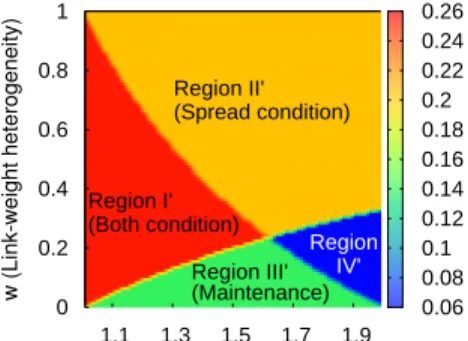
1.1 1.3 1.5 1.7 1.9
b (Temptation to defect from a cooperator)
0 0.2 0.4 0.6 0.8 1
w (Link-weight heterogeneity)
0.06 0.08 0.1 0.12 0.14 0.16 0.18 0.2 0.22 0.24 0.26 Region I’ (Both condition) Region II’ (Spread condition) Region III’ (Maintenance) Region IV’
Fig. 6: Simulation results for the PD game showing the relationship between the frequency of
cooperation andb−wparameter combination. The horizontal and vertical axes denote
temp-tation payoffband link-weight heterogeneityw. Here, color coding represents the magnitude
of the frequency of cooperation, as shown on the sidebar. We denote the region with the
high-est cooperation frequency (red) as region I’, that with the second highhigh-est frequency (orange)
as region II’, that with the third highest (green) as region III’, and the lowest frequency region
(blue) as region IV’.
Fig. 6 illustrates the frequency of cooperation for different values of the
located in region I (both conditions hold) in Fig. 5, the same point is placed in
region I’ in Fig. 6, at which point the cooperation frequency has its highest value.
In addition, if the combination of b and w denotes a point that is located in 420
region II (spread condition holds) in Fig. 5, the same point is placed in region II’
in Fig. 6 and the magnitude of the cooperation frequency is the second highest.
It is observed that the two linesw = (b−1.0)/(b+ 1.0) and w= 2.0/b−1.0
in Fig. 5 coincide with the lines dividing the parameter space into four regions
(region I’, II’, III”, and IV’) in Fig. 6. This coincidence implies that the two 425
conditions for link-weight heterogeneitywidentified in the small population also
hold for the spread/maintenance of cooperation in the large population across
the entire parameter range ofb.
4. Conclusion
Much research has been conducted to analyze the factors that promote the 430
evolution of cooperation in natural and social systems. Recently, several
re-searchers [31, 32, 33, 34, 35, 36, 37, 38, 39, 40, 41, 42, 43, 44, 45, 46, 47, 48] have
examined the effect of heterogeneity on the evolution of cooperation. Especially,
Du et al. [31] and Ma et al. [32] have clarified that link-weight heterogeneity can
facilitate cooperation. However, they investigated heterogeneity of interactions 435
among individuals, which includes bothintra-individual heterogeneityand
inter-individual heterogeneity, to the best of our knowledge. Inter-individual
hetero-geneity leads to heterogeneity of the link-weight amount, which causes
hetero-geneous interactions similar to those caused by theheterogeneity of the number
of links, and the effect of the heterogeneity of the number of links on the pro-440
motion of cooperation has already been established in the literature [13, 14, 15].
Therefore, the effect of link-weight heterogeneity on the evolution of
coopera-tion may be given only byinter-individual heterogeneity whose effect is similar
to that of theheterogeneity of the number of links. To investigate whether
link-weight heterogeneity within each individual alone can promote cooperation, it is 445
inter-individual heterogeneity. Additionally, it has not been fully resolvedwhen and
how promotion of cooperation based on the heterogeneity of link weight takes
place.
To address these issues, we constructed a simple model of one-dimensional 450
lattice with heterogeneous link weight, on which individuals play the
evolution-ary PD game. We assumed that the sum of the link weights of each individual
was equal, to remove the effect ofinter-individual heterogeneity on the
promo-tion of cooperapromo-tion, thereby focusing only onintra-individual heterogeneity.
By performing calculations and analyses, we obtained the following two re-455
sults. First, we clarified that the moderate magnitude ofintra-individual
het-erogeneity of link weight can facilitate cooperation and that there are some
thresholds in the range of the heterogeneity level, at which the change in the
cooperation frequency occurs in a stepwise manner. This result suggests that,
even when there is no heterogeneity of link-weight amount that causes a sim-460
ilar effect to that of heterogeneity of the number of links as in Santos and
Pacheco [13], heterogeneous link weight within each individual alone can
pro-mote cooperation. Second, we found the key mechanisms whereby link-weight
heterogeneity facilitates the evolution of cooperation, the mechanisms for the
spread and maintenance of cooperation. We also derived corresponding condi-465
tions for the both mechanisms to work through evolutionary dynamics, which
have not been clarified before.
Because the simulation model used is very simple, it may appear to be
some-what unrealistic. However, this simplicity enabled us to examine the effect of
heterogeneous link weight (intra-individual heterogeneity) and the aforemen-470
tioned mechanisms. We believe that our discovery of these mechanisms can
form the basis of future researches on link-weight heterogeneity. It would be
interesting to investigate the effect of heterogeneity of link weight on the
evo-lution of cooperation and its mechanism using a mathematical model with a
a one-dimensional lattice to a two-dimensional one5, or so-called complex
net-works such as small-world and scale-free netnet-works, would be attractive matter
to be worked on as a future work. Another interesting avenue for future research
would be to identify the mechanisms by which link-weight heterogeneity that
includes bothintra-individual heterogeneity andinter-individual heterogeneity, 480
such as link-weight heterogeneity in the real world, promotes cooperation.
Al-though we found in this paper the mechanism by which intra-individual
het-erogeneity alone can facilitate cooperation, there may be a specific mechanism
for the evolution of cooperation caused by the interplay between intra- and
inter-individual heterogeneities. 485
Acknowledgements
This work was supported by JSPS KAKENHI Grant Numbers 26350415,
26245026, 26289170, 25242029.
References
[1] C. Darwin, The Origin of Species, Harvard University Press, 1859. 490
[2] L. Buss, The evolution of individuality, Princeton University Press, 1987.
[3] J. von Neumann, O. Morgenstern, Theory of Games and Economic
Behav-ior, Princeton University Press, 1953.
[4] R. Axelrod, The Evolution of Cooperation, Basic Books, New York, 1984.
[5] J. W. Weibull, Evolutionary game theory, MIT Press, 1995. 495
[6] M. A. Nowak, Five rules for the evolution of cooperation, Science 314
(2006) 1560–1563.
5
Preliminary analyses on a two-dimensional lattice are given in Iwata and Akiyama
[7] R. A. Fisher, The Genetical Theory of Natural Selection, Clarendon Press,
Oxford, 1930.
[8] R. Trivers, The evolution of reciprocal altruism, Q. Rev. Biol 46 (1971) 500
35–57.
[9] R. D. Alexander, The Biology of Moral Systems, Aldine de Gruyter, New
York, 1987.
[10] M. A. Nowak, K. Sigmund, Evolution of indirect reciprocity by image
scoring, Nature 393 (1998) 573–577. 505
[11] M. A. Nowak, R. M. May, Evolutionary games and spatial chaos, Nature
359 (1992) 826–829.
[12] M. A. Nowak, R. M. May, The spatial dilemmas of evolution, Intl. J. Bifur.
& Chaos 3 (1993) 35–78.
[13] F. C. Santos, J. M. Pacheco, Scale-free networks provide a unifying frame-510
work for the emergence of cooperation, Phys. Rev. Lett 95 (2005) 098104.
[14] Y. S. Chen, H. Lin, C. X. Wu, Evolution of prisoner’s dilemma strategies
on scale-free networks, Physica A 385 (2007) 379–384.
[15] N. Masuda, K. Aihara, Spatial prisoner’s dilemma optimally played in
small-world networks, Phys. Lett. A 313 (2003) 55–61. 515
[16] Z. Rong, X. Li, X. Wang, Roles of mixing patterns in cooperation on a
scale-free networked game, Phys. Rev. E 76 (2007) 027101.
[17] G. Szab´o, G. F´ath, Evolutionary games on graphs, Phys. Rep 446 (2007)
97–216.
[18] M. Perc, A. Szolnoki, Coevolutionary games - a mini review, Biosystems 520
[19] M. Perc, J. G´omez-Garde˜nes, A. Szolnoki, L. M. Flor´ıa, Y. Moreno,
Evolu-tionary dynamics of group interactions on structured populations: a review,
J. R. Soc. Interface 10 (2013) 20120997.
[20] V. C. Wynne-Edwards, Animal Dispersion in Relation to Social Behavior, 525
Hafner Publishing Company, Inc., New York, 1962.
[21] S. Milgram, The small world problem, Psychology Today 2 (1967) 60–67.
[22] A.-L. Barab´asi, R. Albert, Emergence of scaling in random networks,
Sci-ence 286 (1999) 509–512.
[23] C. Liu, W.-B. Du, W.-X. Wang, Particle swarm optimization with scale-free 530
interactions, PloS one 9 (2014) e97822.
[24] Y. Gao, W.-B. Du, G. Yan, Selectively-informed particle swarm
optimiza-tion, Scientific reports 5 (2015).
[25] M. E. Newman, The structure of scientific collaboration networks, Proc.
Natl. Acad. Sci. USA 98 (2001) 404–409. 535
[26] A. Barrat, M. Barth´elemy, R. Pastor-Satorras, A. Vespignanii, The
ar-chitecture of complex weighted networks, Proc. Natl. Acad. Sci. USA 101
(2004) 3747–3752.
[27] J.-P. Onnela, J. Saram¨aki, J. Hyv¨onen, G. Szab´o, M. A. de Menezes,
K. Kaski, A.-L. Barab´asi, J. Kert´esz, Analysis of a large-scale weighted 540
network of one-to-one human communication, New J. Phys 9 (2007) 179.
[28] M. S. Granovetter, The strength of weak ties, Am. J. Soc 78 (1973) 1360–
1380.
[29] Y. Bian, Bringing strong ties back in: Indirect ties, network bridges, and
job searches in china, Am. Sociol. Rev 62 (1997) 366–385. 545
[30] V. Yakubovich, Weak ties, information, and influence: How workers find
[31] W.-B. Du, H.-R. Zheng, M.-B. Hu, Evolutionary prisoner’s dilemma game
on weighted scale-free networks, Physica A 387 (2008) 3796–3800.
[32] Z.-Q. Ma, C.-Y. Xia, S.-W. Sun, L. Wang, H.-B. Wang, J. Wang, Heteroge-550
neous link weight promotes the cooperation in spatial prisoner’s dilemma,
Int. J. Mod. Phys. C 22 (2011) 1257–1268.
[33] W.-B. Du, X.-B. Cao, L. Zhao, H. Zhou, Evolutionary games on weighted
newman-watts small-world networks, Chin. Phys. Lett 26 (2009) 058701.
[34] P. Buesser, J. Pena, E. Pestelacci, M. Tomassini, The influence of tie 555
strength on evolutionary games on networks: an empirical investigation,
Physica A 390 (2011) 4502–4513.
[35] L. Cao, H. Ohtsuki, B. Wang, K. Aihara, Evolution of cooperation on
adaptively weighted networks, J. Theor. Biol 272 (2011) 8–15.
[36] P. Buesser, M. Tomassini, Supercooperation in evolutionary games on 560
correlated weighted networks, Phys. Rev. E 85 (2012) 016107.
[37] C. Lei, T. Wu, J.-Y. Jia, R. Cong, L. Wang, Heterogeneity of allocation
promotes cooperation in public goods games, Physica A 389 (2010) 4708–
4714.
[38] X. Chen, M. Perc, Optimal distribution of incentives for public coopera-565
tion in heterogeneous interaction environments, Front. Behav. Neurosci 8
(2014).
[39] M. Perc, Does strong heterogeneity promote cooperation by group
inter-actions?, New J. Phys 13 (2011) 123027.
[40] M. Perc, Z. Wang, Heterogeneous aspirations promote cooperation in the 570
prisoner’s dilemma game, PLoS ONE 5 (2010) e15117.
[41] A. Szolnoki, M. Perc, G. Szab´o, Diversity of reproduction rate supports
cooperation in the prisoner’s dilemma game on complex networks, Eur.
[42] M. Perc, A. Szolnoki, Social diversity and promotion of cooperation in the 575
spatial prisoner’s dilemma game, Phys. Rev. E 77 (2008) 011904.
[43] F. C. Santos, F. L. Pinheiro, T. Lenaerts, J. M. Pacheco, The role of
diversity in the evolution of cooperation, J. Theor. Biol 299 (2012) 88–96.
[44] M. Perc, Coherence resonance in a spatial prisoner’s dilemma game, New
J. Phys 8 (2006) 22. 580
[45] M. Perc, Chaos promotes cooperation in the spatial prisoner’s dilemma
game, Europhys. Lett 75 (2006) 841–846.
[46] M. Perc, Double resonance in cooperation induced by noise and network
variation for an evolutionary prisoner’s dilemma, New J. Phys 8 (2006)
183. 585
[47] M. Brede, Playing against the fittest: A simple strategy that promotes the
emergence of cooperation, Europhys. Lett 94 (2011) 30003.
[48] J. Tanimoto, Simultaneously selecting appropriate partners for gaming
and strategy adaptation to enhance network reciprocity in the prisoner’s
dilemma, Phys. Rev. E 89 (2014) 012106. 590
[49] M. Iwata, E. Akiyama, Heterogeneity of link weight and the evolution of
Appendix A. Classification of strategy configurations
In this appendix, we show the classification of the initial strategy
configura-tions for a convergent state of cooperation frequency in a small one-dimensional 595
lattice consisting of six individuals. Of the 26=64 initial strategy configurations,
we focus on those configurations that, through evolution, reach different
coop-erative states depending on whether the link weight is heterogeneous (w >0) or
homogeneous (w = 0) as a result of the evolution of strategies. As mentioned
in Section 3.2, the initial strategy configurations are classified into the follow-600
ing three types: Type (i) in which heterogeneous link weight (w >0) leads to
higher cooperation frequency than the homogeneous one (w= 0); Type (ii) in
which heterogeneous weight suppresses cooperation; and Type (iii) where both
heterogeneous and homogeneous link weights lead to the same magnitude of
cooperation. The initial strategy configuration types are listed in Table A.16.
605
6
Six strategy configurations are classified as both Type (i) and (ii), where, whether the
heterogeneous link weight (w >0) achieves a higher cooperation frequency through evolution
than the homogeneous weight (w= 0) depends on the value ofb. Our purpose was to identify
the mechanisms whereby link-weight heterogeneity enhances cooperation and to derive the
conditions for the mechanisms to work. Therefore, we investigated the strategy configurations
Initial strategy configuration Classification type
−C≡C−D≡D−C≡C−,−D≡D−C≡C−C≡C−, Type (i): Heterogeneous link
−C≡C−C≡C−D≡D−,−C≡C−D≡D−D≡D−, weight (w >0) promotes
−D≡D−D≡D−C≡C−,−D≡D−C≡C−D≡D− further cooperation
−C≡C−C≡D−D≡C−,−C≡D−D≡C−C≡C−, Type (ii): Homogeneous link
−D≡C−C≡C−C≡D− weight (w= 0) promotes further cooperation
−C≡C−C≡C−C≡C−,−C≡C−C≡D−C≡D−, Type (iii): Heterogeneous
−C≡C−D≡C−D≡C−,−C≡C−D≡C−C≡D−, weight (w >0) and
−C≡D−C≡C−D≡C−,−C≡D−C≡D−C≡C−, homogeneous weight
−C≡D−C≡D−D≡C−,−C≡D−C≡C−C≡D−, (w= 0) achieve the
−C≡D−C≡D−C≡D−,−C≡D−C≡D−D≡D−, same level of cooperation
−C≡D−D≡C−D≡C−,−C≡D−D≡D−D≡C−,
−C≡D−D≡C−C≡D−,−C≡D−D≡C−D≡D−,
−C≡D−D≡D−C≡D−,−C≡D−D≡D−D≡D−,
−D≡C−C≡C−D≡C−,−D≡C−C≡D−C≡C−,
−D≡C−C≡D−C≡D−,−D≡C−C≡D−D≡C−,
−D≡C−C≡D−D≡D−,−D≡C−D≡C−C≡C−,
−D≡C−D≡C−D≡C−,−D≡C−D≡C−C≡D−,
−D≡C−D≡C−D≡D−,−D≡C−D≡D−C≡D−,
−D≡C−D≡D−D≡C−,−D≡C−D≡D−D≡D−,
−D≡D−C≡D−C≡D−,−D≡D−C≡D−D≡C−,
−D≡D−C≡D−D≡D−,−D≡D−D≡C−D≡C−,
−D≡D−D≡D−D≡C−,−D≡D−D≡C−C≡D−,
−D≡D−D≡C−D≡D−,−D≡D−D≡D−C≡D−,
−D≡D−D≡D−D≡D−
Table A.1: List of initial strategy configurations and classification thereof into three types.
The first row represents the initial strategy configurations; the second row shows the three
classifications of the configurations in which greater link-weight heterogeneity w promotes
more cooperation, higherwreduces cooperation frequency, and different values ofw do not
have any effect on the magnitude of the cooperation level, respectively. In the table, “C”
and “D” denote cooperator and defector, respectively, while “≡” indicates a link with a large