after the Conclusion of the Treaty of Nerchinsk
MATSUURA Shigeru
Introduction
The Qing
淸dynasty began to extend its influence along the banks of the Amur in the middle of the seventeenth century. Russians too were advancing into the Amur region around the same time, and the two sides clashed violently over possession of the region. It was only in Kangxi
康 煕28 (1689), when the two countries signed the Treaty of Nerchinsk, that peace was restored in the Amur basin.
The following year, the Qing sent several survey parties to the left bank of the Amur. The aim of the survey parties was to survey the border with Russia and erect boundary stones near the border, and by this means not only did the Qing put the Treaty of Nerchinsk into concrete effect, but it was also able to dramatically expand its geographical knowledge of the left bank of the Amur. This survey was of great significance in the history of the Amur region.
But in spite of its importance, there has until now been virtually no se- rious research on this 1690 survey of the Sino-Russian border. The reason for this is obvious: there exists no material on the survey parties in exist- ing written sources. Nonetheless, Yoshida Kin’ichi
吉田金一discovered a map produced by Langtan, which was one of the outcomes of the survey, and used this to advance research on the subject.
1)But there are limits to the usefulness of Langtan’s map alone for shedding light on the survey as a whole, and it was absolutely essential to discover new written sources.
Research on the Amur region during the Qing has made enormous
strides since the 1980s. This is because the study of archival sources pre-
served in China began around this time, and it has since then become
common practice to utilize them. In 1995 I had the opportunity to exam-
ine Manchu archives in China, and on this occasion I discovered that a
large quantity of material on the border survey conducted immediately
after the Treaty of Nerchinsk was contained in the Heilongjiang jiangjun ya- men dang’an
黑龍江將軍衙 䈕案(Archives of the Office of the General of Heilongjiang).
2)Since then I have been engaged in collecting and sorting through this material, and I have now finally managed to gain an over- view of the relevant issues. In this article I shall accordingly first describe the survey conducted in 1690 and then clarify the Qing’s interpretation of the border with Russia.
I. The Formation of Parties to Survey the Left Bank of the Amur
In Kangxi 28 (1689), a peace conference was held between China and Russia at Nerchinsk, on the Shilka River, starting from the 8th of the sev- enth month. As a result of this conference, the two countries succeeded in establishing their border in the Amur region from the Gorbitsa River to the Sea of Okhotsk, thereby bringing to an end the state of war that had existed between them and establishing diplomatic relations. This was the famous Treaty of Nerchinsk, and it was an important event in world his- tory, for Russia was prevented from advancing southwards into the Amur basin and instead accelerated its advance into the Kamchatka Peninsula.
The question of how much knowledge the Chinese of the early Qing possessed about the left bank of the Amur is not necessarily clear from past research. But in my view, prior to the Treaty of Nerchinsk the Qing did not have any accurate knowledge of this region, and the scant knowl- edge that it did possess was even less reliable than that of the Russians.
This is because the strategy adopted by the Qing when advancing into the
Amur region was characterized by the suppression of ethnic minorities
along the main course of the Amur. Consequently the Qing had consider-
able knowledge of the Amur basin as far as its upper reaches, and it was
the Qing side that first proposed at the peace conference that small left-
bank tributaries of the Amur such as the Chernaia and Gorbitsa be desig-
nated as the border.
3)But the area inland from the left bank lay virtually
neglected by the Chinese. There are almost no records of Manchurians
or Chinese having entered this area, and only twice, in Kangxi 22 (1683)
and 23, did Qing troops belonging to the Eight Banners advance into this
region to attack the Russians. On both of these occasions some of the
Qing troops went up the Zeia River, while another squadron went up the
Amgun’ River as far as the valley of the Tugur River,
4)but they immedi-
ately turned back without conducting any surveys of these areas. This lack
of information also had an effect on negotiations at the peace conference,
and the Qing representatives were unable to make any concrete proposals based on accurate knowledge regarding the border on the left bank of the Amur. It is said that the map used by the Qing showed the upper reaches of the Amur only as far as Albazin,
5)and there is a strong possibility that the area on the left bank was blank. A survey to ascertain the border was a pressing issue for the Qing which took precedence over all else.
The Qing embarked on its survey of the left bank of the Amur to- wards the end of Kangxi 28. According to the Heilongjiang jiangjun yamen dang’an 10 (Kangxi 29/1/4), Sabsu, general of Heilongjiang, submitted the following memorial:
On checking our troops, there are some who are familiar with Mer-
ilken along the Ergune (Argun’) River and the overland route [to get
there], and so it would be possible to send them on a survey via one
route. If one seeks among the troops some knowledgeable about the
area from the mouth of the Ergune River as far as Merilken along its
upper reaches and the area along the ridges of the Hinggan [Range],
where no grass grows, in the upper reaches of the Gerbici (Gorbitsa)
River on the opposite bank of the Sahaliyan Ula (generally the Amur,
but here the Shilka, one of its upstream affluents) as far as the sea,
there is no one knowledgeable about these areas. Now, the Oroncon
and Solon, who are under the jurisdiction of Mabudai, Commandant
of the Solon
索倫總管, graze animals and hunt in the area from the
mouth of the Ergune River as far as Merilken along its upper reaches
and in the headwaters of the Jingkiri (Zeia), Silimdi (Selemdzha), Nio-
man (Bureia), and other rivers that rise in the North Hinggan and join
the Sahaliyan Ula, and therefore I wish to take the liberty of asking
by which routes Mabudai and his associates should go on surveys
once they have searched [among these tribes] for people familiar with
the geography [of this region]. The headwaters of the Kimnin (Bira),
Kuru, Gerin (Goriun), Henggun (Amgun’), and other rivers that rise
in the North Hinggan from the confluence of the Sahaliyan and Sung-
gari Ula (Sungari) as far as the sea and flow into the Sunggari Ula are
inhabited by the Kiler, under the jurisdiction of Tungboo, General of
Ningguta, and therefore I wish to take the liberty of asking by which
routes Tungboo and his associates should go on surveys once they
have searched [among these tribes] for people familiar with the geog-
raphy [of this region]. (Here and below, names in parentheses repre-
sent the present-day designations.)
It goes without saying that Sabsu sought people among his troops fa- miliar with the geography of the upper reaches of the Amur and the area inland from its left bank because they were needed for a border survey that was being planned. The exact date of Sabsu’s memorial is not known, but since it was submitted to the Kangxi emperor by princes of the De- liberative Council on Kangxi 28/12/8, planning for the survey must have begun prior to this.
The plans included, in addition to a survey of the geography of the re- gion, the erection of stone monuments along the border with Russia. The erection of stone monuments had been a predetermined policy of the Chinese already before it attended the peace conference. The Qing rep- resentative raised this issue on the first day of the conference,
6)and once negotiations had been concluded, the Chinese went so far as to have men- tion of the erection of stone monuments, to be inscribed in Manchu, Rus- sian, and Latin, explicitly added at the very end of the text of the treaty.
7)According to an entry in the Qing shilu
淸實錄for Kangxi 28/12/14 (bingzi
丙子), the Qing officially decided at this time to erect boundary stones inscribed in Manchu, Chinese, Russian, Latin, and Mongolian beside the Gorbitsa River and elsewhere along the border.
Sabsu’s memorial elicited the following response from the princes of the Deliberative Council:
It is in our view important to examine the area that was made the border. … We will immediately send from here two officials, one to General Sabsu and Commandant Mabudai and one to General Tung- boo, who will together seek out people familiar with the terrain, and after we have had them submit memorials once they have carefully determined by which routes to conduct surveys or whether to go on surveys in formation, and after we have had memorials submitted about the people to be dispatched from the competent government agencies, we intend to await the emperor’s decision.
Five days after the memorial had been submitted by the princes, on the 13th of the twelfth month, the Kangxi emperor granted his approval, and in accordance with this decision the princes sent bureau vice-director Da- lai to visit Mabudai and Sabsu, commandant of the Solon and general of Heilongjiang respectively, and bureau secretary Sartu to visit Tungboo, general of Ningguta, so as to hold talks with them.
8)The results of the discussions held by Sabsu, Tungboo, and others
with Dalai and Sartu upon their arrival from Beijing had reached the princes by the start of the second month of the following year (Kangxi 29).
According to the Heilongjiang jiangjun yamen dang’an 10 (Kangxi 29/3/5), Dalai and Sabsu proposed six survey routes.
(1) The area from the town of Mergen as far as Merilken along the Ergune River could be surveyed by an overland route in the eighth month in autumn.
(2) The area from the mouth of the Ergune River as far as Merilken could be surveyed by river.
(3) The source of the Jingkiri River could be reached in just over a month by horse if one left Mergen around the eighth month in autumn, and from there it took one day to reach the ridge of the Hinggan Range.
This was a route that could be surveyed on horseback.
(4) The mouth of the Yengken (Inkan) River, the source of the Silimdi River, could be reached in just over a month by horse from Sahaliyan Ula i Hoton if one went around the eighth month in autumn. It was not possible to go beyond the mouth of the Yengken River by horse, but if one went on foot it took four or five days to reach the ridge of the Hinggan Range. This was one possible survey route.
(5) It was possible to travel from the mouth of the Gerbici River to its source in just over ten days if one went by horse around the eighth month in autumn, but there were places where there was no grass for horses to eat. One could not go any further either on foot or by horse because there was nothing but crags and rocks.
(6) The mouth of the Olonki (Niman) River, the source of the Nioman River, could be reached in just over a month if one went by canoe from Sahaliyan Ula i Hoton, but one could not go any further either on foot or by horse because there was nothing but crags and rocks.
Sartu and Tungboo, meanwhile, proposed the following routes:
There is no one who knows of any overland route to the Hinggan
Range. Since the Gerin, Henggun, and other rivers flow down from
the Hinggan Range, once the ice melted, surveys could be conducted
by boat or canoe via three routes along (7) the Gerin, (8) the Heng-
gun, and (9) the seacoast.
Following deliberations by the princes, these plans were conveyed more or less as they stood to the emperor on the 14th of the second month, although with regard to routes (5) and (6), both of which were said to become impassable after a certain point by both foot and horse because of crags and rocks, the wording was altered to the effect that if there were places that could be reached, they should go there, but if they were unable to get past the crags and rocks, they should turn back. The emperor gave his approval of these plans on the 17th of the same month and also ordered the Ministry of War to put forward nominations for se- nior officials to accompany the surveys.
The Ministry of War promptly set about selecting personnel for the survey parties and submitted its selection to the emperor on the same day.
The emperor then chose the following eleven people from among those who had been recommended and informed the Ministry of War of his choices on the 22nd.
9)Langtan (commander-in-chief of the Manchu Plain White Banner), Joosan (vice-commander of the Manchu Plain Red Ban- ner), S
ˇanahai (vice-commander of the Chinese Bordered Yellow Banner), and Anjuhπ (commandant of the Solon) were assigned to the three parties setting out from Mergen (1–3); Mutu (captain-general of the vanguard of the left wing), Nomin (third-grade duke and commander-in-chief of the Mongol Plain Yellow Banner), Hπwas
ˇan (vice-commander of the Mongol Bordered Red Banner), and Nacin (lieutenant-general of Heilongjiang) were assigned to the three parties setting out from Sahaliyan Ula i Hoton (4–6); and Bahai (commander-in-chief of the Mongol Bordered Blue Ban- ner), Suhe (vice-commander of the Chinese Bordered White Banner), and Balda (lieutenant-general of Girin Ula [Jilin]) were assigned to the three parties setting out from Ningguta (7–9).
Among the above eleven officials selected for the surveys, Langtan
was a grandson of Urikan, who had distinguished himself in the battle at
Gure in 1593, which became a historical watershed. Langtan himself had
fought at the forefront of the Qing troops during the battle for Albazin,
and during the border negotiations held in the previous year with Russia
he had acted as the Qing representative along with Songgotu.
10)Joosan
rose to the position of vice-director of the Bureau of Arrests in Kangxi 32,
but nothing more is known about him because he was dismissed from of-
fice in Kangxi 34.
11)As for S
ˇanahai, it is known that he later served succes-
sively as lieutenant-general of Bedune and general of Ningguta and then
in Kangxi 40 succeeded Sabsu as general of Heilongjiang, but further de-
tails about him are not known.
12)Anjuhπ was a military commander who
had earlier distinguished himself when he was lieutenant-general of Girin Ula and Ningguta by relocating members of ethnic minorities who had only recently been organized into new Manchu companies (niru) from the lower valley of the Sungari River to various localities in the northeast, on account of which he was promoted to the position of general of Mukden in Kangxi 17 (1678). But subsequently the emperor took exception to him, and he was dismissed from office. However, he was later reinstated as commandant of the Solon owing to his services during the campaign along the Tugur River in Kangxi 23 and during the battle for Albazin in the following year.
13)Among the senior officials leading the three parties that were to set out from Sahaliyan Ula i Hoton, Mutu had participated in the suppres- sion of the Rebellion of the Three Feudatories, rising to the position of captain-general of the vanguard of the left wing, but he died shortly after the survey of the left bank of the Amur.
14)Nomin was the son of Tuhai, who had earlier served successively as commander-in-chief of the Man- chu Plain Yellow Banner, general-in-chief who pacifies distant lands
撫 遠大將軍, and grand secretary of the Hall of Central Harmony and was enfeoffed as a third-grade duke, and after Tuhai’s death Nomin inherited his ducal title. In Kangxi 26 Nomin was appointed commander-in-chief of the Mongol Plain Yellow Banner, a position which he held until his death in Kangxi 32.
15)There are virtually no leads on the career of Hπwas
ˇan, while Nacin belonged to the Manchu Plain Red Banner but is said to have originally been of Korean descent.
16)Bahai, who surveyed the lower Amur, bore the heavy responsibility of defending the northern frontier region in his capacity as general of Ningguta, a post which he held from Shunzhi
順治16 (1659), when he succeeded his father S
ˇarhπda who had died of illness, until his discharge from office in Kangxi 22 (1683). After leaving the post of general of Ning- guta, he assumed in Kangxi 23 the position of commander-in-chief of the Mongol Bordered Blue Banner.
17)Details of the careers of Suhe and Bal- da are not known.
The composition of the survey parties was also decided on around
the same time, in which regard the Ministry of War submitted a memo-
rial on the 25th of the second month. According to this memorial, the
parties travelling overland were to be each composed of three officers
(janggin) and fifty soldiers, while the parties travelling by water were to
be each composed of three officers and fifty soldiers and boatmen, and
the parties were all of roughly the same size. Officers and soldiers of the
Solon and Dagπr tribes were to be assigned to the three parties setting out from Mergen, while officers and soldiers from the Eight Banners due to complete their tour of duty in Sahaliyan Ula i Hoton and return to Girin Ula during this same year were to be assigned to the three parties setting out from Sahaliyan Ula i Hoton, and the three parties starting out from Ningguta were to be composed of officers and soldiers of the Eight Ban- ners stationed in Girin Ula and Ningguta and of boatmen from the same regions.
18)However, the Kangxi emperor had some misgivings regarding this memorial and ordered the Ministry of War to submit a fresh memorial after enquiries had been made of Russians in Beijing about routes to the Hinggan Range.
19)During the earlier period of intense conflict with the Qing, there had been some Russians who had surrendered of their own accord or who had been taken captive and still remained in China. Kangxi had assembled them in Beijing, organized them into companies, and even granted some of them official posts.
20)Since these Russians had formerly been active along the left bank of the Amur, they were considered to be more familiar than Chinese with the geography of this region.
The Ministry of War accordingly questioned the Russians residing
in Beijing, but it became clear that they too were not familiar with the
geography of the region in question. They all said that they knew nothing
about the three routes setting out from Mergen, the two routes starting
out from Ningguta for the Goriun River and the coast, and the route set-
ting out from Sahaliyan Ula i Hoton for the upper reaches of the Bureia
River. Some of them had, however, previously travelled along the other
three routes. For instance, Lasari (Lazar’) said that he had reached the
Selemdzha River from Albazin by boat in a little over a month. Sergeant
Oliksi (Aleksei) described how it had taken eleven days to travel by foot
from the mouth of the Gorbitsa River to its source and how, with snow
covering the ground because it was winter, they had skied across the steep
and rocky sections beyond and reached the Tugur River on the seventh
day. But he had not heard the name Hinggan. The most detailed testi-
mony was provided by sergeant Situban (Stepan), according to whom a
twenty-day trip by canoe up the Amgun’ River from its mouth brought
one to the Nimelen River, and after ascending this river for five days, one
could reach the Tugur River in a further four days by travelling overland
on foot. A further twenty-five days by foot brought one to the Uda River,
but there were only trees and moss, and no grass, en route. The valleys of
the Amgun’ and Uda were inhabited by the Kiler and Oroncon, and there
were many mountain tracks, but he had not heard of Hinggan.
21)(Names in parentheses are the presumed Russian equivalents of the Manchu spell- ings.)
Having waited for the responses of the Russians, the Ministry of War submitted another memorial on the 27th of the second month. According to this memorial, among the nine routes that had initially been planned, routes (1) to (4) would be surveyed in accordance with these initial plans since the general of Heilongjiang had already reported that they had checked the routes to the border and the time required. As for the re- maining five routes, since both generals were looking for guides familiar with the terrain and, in addition, one of the Russians had travelled from the Amgun’ as far as the Uda, the survey parties would be sent as planned and, asking local Kiler and Oroncon about the Hinggan, would go to the summit if at all possible, and in the event that they found themselves un- able to go any further, they would then turn back.
22)The Kangxi emperor basically endorsed this memorial from the Min- istry of War and also gave orders for one Russian to accompany each of the survey parties from Beijing. They left Beijing in the middle of the third month,
23)and it would appear that Anjuhπ, commandant of the Solon, and Nacin, lieutenant-general of Heilongjiang, joined them at Mergen and Sahaliyan Ula i Hoton respectively, while Balda, lieutenant- general of Girin Ula, joined them at Ningguta. The survey parties also included stone masons for erecting the boundary stones and painters for drawing maps, and attendants and servants of the senior officials came from Beijing.
24)Bahai, who had been chosen as a member of one of the survey parties, submitted a memorial asking whether Russia would be informed of the plans to survey the border. By the 25th of the second month it had been decided that this matter would be discussed by the Ministry of War and the Court of Colonial Affairs,
25)and it would appear that in the end the Qing decided to inform Russia of its intentions. Later in the same year G.
Lonshakov, who was heading for Beijing with a letter from F. A. Golovin,
encountered at Cicihar a Qing envoy hastening to Nerchinsk with a mis-
sive notifying the Russians of the border surveys. Lonshakov resided in
Beijing from the 21st of the fourth month (19 May [Julian calendar]) to
the 24th of the fifth month (20 June), when he started on his return jour-
ney to Russia, and on his way back he learnt that the Qing survey parties
had departed for the area on the left bank of the Amur.
26)Lonshakov’s
account is in complete agreement with the Qing records.
II. A Summary of the Surveys of the Left Bank of the Amur
It was expected that the party made up of Langtan, Joosan, S
ˇanahai, Mutu, Nomin, Hπwas
ˇan, and others would reach Mergen at the start of the fifth month and Sahaliyan Ula i Hoton shortly afterwards.
27)During this time the selection of officers and soldiers to accompany the survey parties and various other preparations, including the boats to be used for the surveys, got under way at Mergen and Sahaliyan Ula i Hoton, which would serve as bases for the survey parties. However, two missives from the Ministry of War that arrived on the 1st and 14th of the third month announced substantial changes to the plans that had initially been dis- cussed by Sabsu, Mabudai, and Dalai.
28)Among the six routes proposed by them, it had initially been planned to use boats for only two routes—(2) from the mouth of the Argun’ to Merilken and (3) from the mouth of the Bureia to the mouth of the Niman, its source—but the missives from
Table 1. Composition of survey parties and survey content Survey Area Composition of Survey Party Survey Content (1) Merilken → mouth of
Argun’
(2)
Langtan (commander-in-chief of Manchu Plain White Banner) Joosan (vice-commander of Manchu Plain Red Banner)
Stone monument erected at mouth of Argun’
(3) Headwaters of Zeia →
Hinggan Sˇanahai (vice-commander of Chinese Bordered Yellow Banner)
Anjuhπ (commandant of the Solon)
Initially intended to go by river to Bahana and then by horse, but these plans were changed because most of the horses died before reach- ing Bahana
(4) Selemdzha → mouth
of Yengken → Hinggan Mutu (captain-general of vanguard of left wing)
(5) Mouth of Gorbitsa →
headwaters Duties shared by Nomin (third-grade duke and commander-in-chief of Mon- gol Plain Yellow Banner), Hπwasˇan (vice-commander of Mongol Bordered Red Banner), and Nacin (lieutenant- general of Heilongjiang)
Stone monument erected on east bank of mouth of Gorbitsa
(6) Bureia → mouth of Olong- ki (Olonki) → Hinggan (7) Goriun → headwaters
of Amgun’ Suhe (vice-commander of Chinese
Bordered White Banner) Subjugation of 8 house- holds at Uleji
(8) Amgun’ → Nimelen →
Tugur Bahai (commander-in-chief of Mon-
gol Bordered Blue Banner) Stone monument erected on Mt. Uyeken
(9) Coasts of Sakhalin and
Sea of Okhotsk Balda (lieutenant-general of Girin
Ula) Subjugation of 53 house-
holds on Sakhalin
Duki
Map 1. Left-bank tributaries of the Amur and routes taken by the survey parties
Beijing informed them that boats were to be used by all six parties. In addition, the survey parties had originally been scheduled to set out for their respective destinations in the eighth month, but according to the new instructions from the Ministry of War this too had been changed, and a start was to be made as soon as the senior officials arrived from Beijing.
This was because, with boats being used for the surveys, they would have wanted to complete the surveys before the rivers froze over in winter.
Only the party setting out from Sahaliyan Ula i Hoton to ascend the Gor- bitsa was to be divided into two groups, one going by boat and compris- ing two officers and thirty soldiers, boatmen, etc., and the other going on foot and comprising one officer and twenty soldiers. They arrived in Mergen by the early part of the fifth month and awaited the arrival of the senior officials.
29)As for Bahai and Suhe, who set out around the same time for Ning- guta, details of their movements are not known since no relevant records have been preserved in the Ningguta fu dutong yamen dang’an
寧古 副都統 衙 䈕案(Archives of the Office of the Lieutenant-General of Ningguta).
But they too rendezvoused with Balda at Ningguta and then set out for their survey areas as planned (see Table 1 and Map 1).
I now wish to retrace the routes taken by each survey party. First, the party that set out in the direction of Merilken was under the command of Langtan and Joosan, who were accompanied by the Russian lieutenant Ogefan (Agafon) as well as stone masons, painters, and so on.
30)Initially it had been planned that two separate parties, one travelling by land and the other by river, would survey the area around Merilken, but in the event it would appear that the two parties joined forces, with Langtan and Joosan acting in concert. In Langtan’s biography in the Baqi tongzhi chuji
八旗通志初集153, the survey party’s course of action is described in the following manner:
In the third month of [Kangxi] 29, [Langtan] went by imperial decree
together with Vice-Commander Joosan to the mouth of the Ergune
(Argun’) River and erected a boundary stone. On the 15th of the fifth
month he passed through the town of Mergen and crossed the Hing-
gan Range. There were still about a dozen Russian houses, and they
saw crops covering the land.… Langtan had the houses destroyed,
reimbursed the Russians, and allowed them to harvest their crops
and take them with them. The Russians joyfully paid their respects
and departed over the mountains. On the 21st they reached the Er-
gune, erected a tablet on top of a stone wall by the river mouth, and engraved it in five scripts—Manchu, Chinese, Russian, Mongolian, and Latin—whereupon they turned back.
If one considers this account in conjunction with the Heilongjiang jiang- jun yamen dang’an, the third month would have been when Langtan and his associates set out from Beijing upon receiving their orders, while the 15th of the fifth month would have been the date when they left Mergen for Merilken. Judging from the above passage, it would seem that Lang- tan’s party arrived in Merilken after crossing the Da Xing’an Range
大 興安嶺on foot. Then, having evicted from Chinese territory the Russian inhabitants who remained on the right bank of the Amur, they had ad- vanced by the 21st as far as the mouth of the Argun’, where they erected a tablet (i.e., boundary stone) inscribed in five scripts on a nearby bluff.
31)It is to be surmised that Langtan’s party travelled by boat from Merilken to the mouth of the Argun’ and then down the Amur. It is recorded that this party carried one month’s provisions.
32)The survey party led by S
ˇanahai and Anjuhπ headed up the Zeia River towards the Hinggan. They carried four months’ provisions and set out together with a Russian sergeant and painters. The “Wang Yanxu An jiangjun xingzhuang”
王燕緖安將軍行狀appended to Anjuhπ’s biography in the Jilin tongzhi
吉林通志87 includes the following passage:
Later, he established the border with Russia. His Excellency reached the Zeia River together with Vice-Commander S
ˇanahai.
The survey of the Zeia basin is described in concrete detail in the Heilongjiang jiangjun yamen dang’an. The entry for Kangxi 29/6/28 in vol.
13 gives the content of an interim report which S
ˇanahai and Anjuhπ sent
to Sabsu, etc., from Bahana on the banks of the Zeia. According to this
report, S
ˇanahai and his associates had made detailed plans at Mergen
prior to their departure in consultation with their guides. It happened to
be the rainy season, and not only were the roads muddy, but there were
also large numbers of horseflies and mosquitoes, making it difficult to
travel by horse. The survey party accordingly left Sahaliyan Ula i Hoton
on small boats and arrived at Bahana on the 9th of the sixth month. They
had intended to swap their boats for horses at Bahana, but more than
170 of the 190 horses they had sent on ahead to Bahana had caught an
infectious disease en route and died. S
ˇanahai and Anjuhπ consequently
changed their plans:
We have given up travelling on horseback from Bahana to the Hinggan and will go as far upstream as possible by boat, birch boat, plank boat, and canoe in search of the Hinggan. Once we are unable to go any fur- ther by boat or canoe, we will go on foot if it is possible to proceed on foot.
If by chance it happens to be a year of drought, there will be no water, and so we will be unable to approach the Hinggan by boat or canoe, and we may also be unable to proceed on foot. In that case, we will turn back with the intention of coming [again] around the eighth month in autumn.
As soon as he received this report, Sabsu immediately wrote to the Ministry of War to inquire whether he ought to provide S
ˇanahai’s party with fresh horses and have them set out once again in the eighth or ninth month. The Ministry of War submitted a memorial to the emperor on the 21st of the seventh month in which it was stated that, in the event that the survey party was unable to reach the Hinggan, it was hoped to reorganize the party and send it off once again with the aim of reaching its destination at all costs. However, the Kangxi emperor gave an unexpected response:
Why go there time and again? Forget about places that cannot be reached.
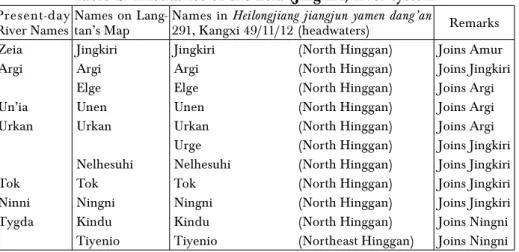
33)As will be discussed below, a map thought to have been produced by Langtan after the completion of the surveys shows the Zeia river system in considerable detail and gives the names of a total of nine tributaries, in- cluding the Tok, Argi, and Ninni Rivers.
34)The furthest upstream among these tributaries was the Nelhesuhi, and it is to be surmised that this was about as far as S
ˇanahai’s survey party went (see Table 2).
The headwaters of the Selemdzha, a tributary of the upper reaches of the Zeia were surveyed by Mutu’s party. They too were accompanied by a Russian and some painters, and they set out from Sahaliyan Ula i Hoton with four months’ provisions.
35)Their guide was an Oroncon hala i da (head of clan) by the name of Libdingge.
36)Langtan’s map shows four rivers flowing into the Selemdzha, includ- ing the Yengke and Nara Rivers. The Yengke is today known as the Inkan, and Mutu’s party conducted their survey with this river as their goal (see Table 3).
As for the two remaining parties, it is known that the twenty soldiers
who went on foot up to the headwaters of the Gorbitsa River were given one month’s provisions at Sahaliyan Ula i Hoton, with additional supplies being provided at Mergen after the arrival of the senior officials.
37)But the all-important matter of who led this party is unclear. The Qing author- ities had from the outset planned to erect a boundary stone on the banks of the Gorbitsa as well as the Argun’, and the survey party that headed for the Gorbitsa was presumably charged with this task, but no records con- cerning this have survived. However, judging from other instances, such as Langtan’s party, it is to be supposed that the party which surveyed the Gorbitsa would also have included personnel for this purpose and that they would have erected a boundary stone of about the same size as that erected beside the Argun’.
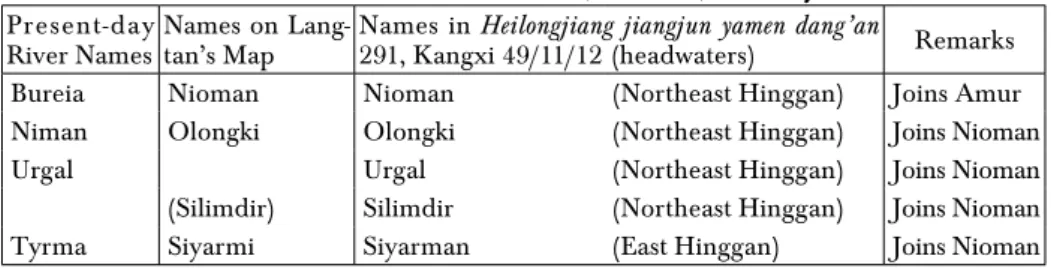
No details are known about the party that surveyed the headwaters of the Bureia River either. Langtan’s map gives only two tributaries, the Si-
Table 2. Tributaries of the Zeia (Jingkiri) river system Present-day
River NamesNames on Lang-
tan’s Map Names in Heilongjiang jiangjun yamen dang’an
291, Kangxi 49/11/12 (headwaters) Remarks
Zeia Jingkiri Jingkiri (North Hinggan) Joins Amur
Argi Argi Argi (North Hinggan) Joins Jingkiri
Elge Elge (North Hinggan) Joins Argi
Un’ia Unen Unen (North Hinggan) Joins Argi
Urkan Urkan Urkan (North Hinggan) Joins Argi
Urge (North Hinggan) Joins Jingkiri
Nelhesuhi Nelhesuhi (North Hinggan) Joins Jingkiri
Tok Tok Tok (North Hinggan) Joins Jingkiri
Ninni Ningni Ningni (North Hinggan) Joins Jingkiri
Tygda Kindu Kindu (North Hinggan) Joins Ningni
Tiyenio Tiyenio (Northeast Hinggan) Joins Ningni
Table 3. Tributaries of Selemdzha (Silimdi) river system Present-day
River NamesNames on Lang-
tan’s Map Names in Heilongjiang jiangjun yamen dang’an
291, Kangxi 49/11/12 (headwaters) Remarks Selemdzha Silimdi Silimdi (North Hinggan) Joins Jingkiri
Inkan Yengke Yengken (North Hinggan) Joins Silimdi
Ormolko Ormolakπ (Northeast Hinggan) Joins Silimdi
Byssa Bisˇa (Northeast Hinggan) Joins Silimdi
Nora Nara Nara (North Hinggan) Joins Silimdi
Mamyn Mumin (Northeast Hinggan) Joins Silimdi
Ungge Ungge (Northeast Mt. Sukduliki) Joins Silimdi
yarmi and Olongki. The Olongki, which was the party’s goal, corresponds to today’s Niman (see Table 4).
Next, I wish to give an outline of the surveys conducted by the survey parties that headed towards the lower Amur. Until now the sole source of information on their movements has been the Liubian jilüe
柳邊紀略(fasc.
1) by Yang Bin
楊賓, according to which:
Weiyike’alin
威伊克阿林is a large mountain in the far northeast.
There are no trees on top, and only moss grows there. The moss is al- ways three to four feet thick. In the cyclic year gengwu
庚午of Kangxi’s reign (Kangxi 29), the border with Russia was demarcated, and the Son of Heaven ordered Bahai, Commander-in-Chief of the Bordered Blue Banner, and others to split into three parties and go to inspect the border. One party entered from the Amgun’ River, one entered from the Goriun River, and one went around from the North Sea.
They all saw the same places, and in the end they erected a stele on top of the mountain. The stele was inscribed in the Manchu, Russian, and Khalkha scripts.
The author Yang Bin travelled to Ningguta during the Kangxi era in order to visit his parents, for his father Yang Yue
楊越had been sent there in exile as punishment, and the Liubian jilüe is a valuable work in which he recorded his experiences in detail. Hitherto the precise date of his departure had been unknown, but according to the Yang Dapiao xiansheng zawen cangao
楊大瓢先生雜亣殘稿, he set out for Ningguta in the second half of Kangxi 28.
38)He remained in Ningguta until the following year and appears to have witnessed Bahai’s survey from beginning to end. His testimony tallies perfectly with the survey party’s route described above.
Next, I wish to retrace the routes taken by the three survey parties in the lower Amur with reference to the Ningguta fu dutong yamen dang’an. Un-
Table 4. Tributaries of Bureia (Nioman) river system Present-day
River NamesNames on Lang-
tan’s Map Names in Heilongjiang jiangjun yamen dang’an
291, Kangxi 49/11/12 (headwaters) Remarks
Bureia Nioman Nioman (Northeast Hinggan) Joins Amur
Niman Olongki Olongki (Northeast Hinggan) Joins Nioman
Urgal Urgal (Northeast Hinggan) Joins Nioman
(Silimdir) Silimdir (Northeast Hinggan) Joins Nioman
Tyrma Siyarmi Siyarman (East Hinggan) Joins Nioman
fortunately the section for Kangxi 29 is missing and not a single document pertaining to their surveys has survived. All that has survived is fragmen- tary passages quoted in later documents, and I shall therefore proceed by using these as leads. An entry for Yongzheng
雍正12/1/26 in vol. 29, for example, gives the following account of the two survey parties other than that of Bahai:
Commander-in-Chief Suhe of the Chinese Banners said that he went to survey the Gerin (Goriun) in accordance with imperial orders and that when he crossed the Henggun (Amgun’) from the Gerin and went up towards its headwaters, he reached a place called Uleji (Ulike) and wished to deliver to the competent authorities eight sable pelts that he had collected after subjugating eight households who had not been paying tribute, including Gπrbada. In the same year Balda, Lieutenant-General of Ningguta, etc. (Girin Ula), …submitted a memorial, according to which he went to investigate the location of the border in the region of the Henggun and so on, subjugated the Cuweni clan and Dobononggo clan living on an island in the sea and the Kuye clan and Oroncon clan living on the shores of the East Sea, 53 households in all, and had collected 53 sable pelts, one from each household.…
First, as regards the party led by Suhe, it is to be surmised that they went up the Goriun and reached the middle reaches of the Amgun’, prob- ably via the Dosmi River from Lake Evoron. It would seem that they then headed up the Amgun’ and surveyed its headwaters and the water divide.
The village of Uleji that Suhe’s party is said to have subjugated is thought to have been the village of Ulike on the banks of the Kur River,
39)and so they probably went back down the Amgun’ and entered the Kur valley.
Balda’s party travelled from the mouth of the Amur northwards along the coast by sea. The “island in the sea” mentioned in the above quotation refers to Sakhalin. The Cuweni clan corresponds to the Chfinung clan of the Nivkh people who lived in villages on the northwest coast of Sakhalin such as Cuwene (near the Chifunai River) and Bisike (Puisuki).
40)Details about the Dobononggo clan are not known, but they too probably lived on the coast in northwest Sakhalin.
As for the Kuye and Oroncon clans said to have lived on “the shores
of the East Sea,” in the Ningguta fu dutong yamen dang’an 42 (Qianlong
乾 隆7/10/28) there is a reference to “65 villages and 268 households of the
Kuye, Oroncon, and so on on an island in the sea,” while in the Ningguta fu dutong yamen dang’an 59 (Qianlong 19/1/24) it is stated that “people of the Kuye, Oroncon, Kadaye, Warul, Coril, Dobononggo, Cuweni, Puniyahπn, S
ˇulungguru, and other clans live on an island in the East Sea.”
Judging from these references, these clans would appear to have lived not on the mainland, but on an island. Among the clans mentioned in the latter passage, it has already been noted that the Cuweni clan belonged to the Nivkh people, who lived on Sakhalin. Likewise, the Puniyahπn (Pniag’an) clan was also a clan of the Nivkh people living in the village of Bomodo (Pomuido) on the northern tip of Sakhalin.
41)It is to be sur- mised, therefore, that the references to “an island in the sea” or “an island in the East Sea” all refer to Sakhalin and that it was Sakhalin where the two groups known as the Kuye and Oroncon also lived. The Kuye were probably Ainu living to the north of the central part of the west coast of Sakhalin,
42)while the Oroncon are thought to have been members of the Uilta people, the only people on Sakhalin to raise reindeer, who were liv- ing in northeastern Sakhalin. It might be noted in passing that Kuyedao
庫頁島, the Chinese name for Sakhalin, derives from “Kuye.”
The fact that Balda’s party went from the mouth of the Amur as far as Sakhalin can also be inferred from Jesuit records. For instance, according to J. F. Gerbillon’s journal, on 24 January 1691 (Gregorian calendar) after he had delivered a lecture in the presence of the Kangxi emperor, the lat- ter remarked, “This year I have sent people to the mouth of the Amur in the east, and they have reported that although it was July, the sea beyond the river mouth was still frozen and no one at all was living in the nearby area.”
43)The date 24 January 1691 corresponded to Kangxi 29/12/26, and so “this year” was Kangxi 29. July in the Gregorian calendar coin- cided with the period from the 25th of the fifth month to the 26th of the sixth month, and so there can be little doubt that the people sent by the emperor were Balda and his party. Further, a map produced in Kangxi 29 by the Jesuit A. Thomas, who was residing in Beijing at the time, shows a large island in the sea slightly to the south of the mouth of the Amur, and it bears the name “Regnu’ Huye.”
44)Huye is a corruption of Kuye and refers to Sakhalin. Thomas thus already knew of Balda’s survey and promptly incorporated his findings in his own map.
The main party under Bahai took the route up the Amgun’ River.
Like Langtan, Bahai reported the results of his investigations in the form
of a map after the conclusion of the survey. The Heilongjiang jiangjun ya-
men dang’an 290 (Kangxi 49/8/23) includes the following passage concern-
ing the Office for the Unified Gazetteer (Yitongzhiguan
一統志館), which was compiling the Da Qing yitong zhi
大淸一統志(Unified Gazetteer of the Great Qing) and had been checking place-names near the border with Russia:
Furthermore, if one looks at the Amba nirugan (Great Map) and the map that Bahai drew and brought back, there is the Duki River to the west of the Henggun (Amgun’) River to the northeast of the town of Cicigar (Cicihar). This river flows from west to east into the Henggun River. The eastern source of the Henggun River is called the Hemen River. This river flows from northwest to southeast and becomes the Henggun River. To the north of the Henggun River there is the Gerbi (Kerbi) River. This river flows from southwest to northeast and enters the Imile (Nimelen) River. To the northeast of the Imile River there is the Amal (Omal) River. This river heads from northeast to southwest and pours into the Imile River. To the northeast of the Imile River there is the Si mur River. This river flows from northeast to southwest and enters the Imile River. To the south of the Henggun River there is the Imu River. This river heads from southwest to northeast and joins the Henggun River. To the north of the Henggun River there is the Luku (Dzhuk) River. This river flows from north to south and pours into the Henggun River. On the northern side of the Heng- gun River there is the Samnin (Somnia) River. This river heads from north to south and joins the Henggun River. Between the two Wergi (Uigi) and Asarni (Assyni) Rivers there is the Niowakta River. This river flows from northwest to southeast and enters the Tuhuru (Tu- gur) River. Between the two Asarni and Munike (Munikan) Rivers there is the Talin River. This river flows from northwest to southeast and enters the Tuhuru River. Between the two Talin and Munike Rivers there is Mt. Miyoo wan (Mevandzha). On the northern side of the Munike River there is the Miyemile River. This river heads from north to south and pours into the Munike River. To the east of the Munike River there is the Elgeken River. This river flows from north to south and enters the Tuhuru River. (The original has “Hengkun,”
but I have emended this to “Henggun.”)
This passage describes the Amgun’ and Tugur river systems. The
names in parentheses are the names to be found on modern Russian
maps. Setting aside questions concerning compass directions, the names
of the rivers and mountain mentioned here are extremely accurate when compared with present-day names. It may be assumed that this is because Bahai’s party actually traversed this region and conducted a thorough survey.
What was the final point reached by Bahai’s survey party? Here I wish to return to the Liubian jilüe, which stated that Bahai’s party erected a stele inscribed in Manchu, Russian, and Khalkha (Mongolian) at Weiyike’alin, which probably refers to Mt. Uyeken (Uyeken alin) mentioned in the Hei- longjiang jiangjun yamen dang’an.
45)According to the map discovered by Yoshida, there is a river called the Uyeken in the upper reaches of the Kilfi River, a tributary of the Toron (Torom) River, and to the west of the Uyeken River there stands a mountain. This mountain is thought to be Mt. Uyeken.
46)As will be further discussed below, both Bahai and Lang- tan considered the chain of mountains dividing the Tugur and Torom river systems to mark the border with Russia, and therefore Mt. Uyeken was a mountain forming part of this mountain range. It is to be surmised that Bahai erected a boundary stone at the foot of Mt. Uyeken near a pass on the route leading from the Tugur to the Torom, but it had already fallen to the ground by the start of the Yongzheng era.
47)Langtan’s map shows the Toron and Kilfi Rivers to the north of Mt. Uyeken, but Bahai’s survey party would probably have gone only as far as the vicinity of the boundary stone near Mt. Uyeken.
Now, according to a missive sent on the 10th of the seventh month by Ondai, lieutenant-general of Heilongjiang, to Sabsu, general of Heilongji- ang, the parties that had gone to survey the Hinggan were then returning one after another to Sahaliyan Ula i Hoton.
48)The surveys of the left bank of the Amur would have come to a provisional end around this time.
III. Langtan’s Map and Questions Concerning the Border