The Language of the Taita in Southeast Kenya
Volume
Ⅲ:
:
Verbs, Adverbs, Prepositions
and Conjunctions
SAKAMOTO, Kunihiko
Abstract
This paper aims to analyze grammatical features of Kidawida which is spoken among the Taita of southeast Kenya. The language of the Taita can be divided into three groups: Kidawida, Kisaghala and Kikasighau. The major one of them called Kidawida is spoken mainly in the Taita Hills. It has the common characters of the Bantu languages: noun classes, prefix concordance, and etc.
In the first volume of ‘An Introduction to Kidawida,’ I analyzed nouns, adjectives and numerals of Kidawida. Nouns in Kidawida can be classified into eight classes. The struc-ture of nouns and adjectives is similar to the Swahili language, although numerals in Ki-dawida are different from Swahili. In volume Ⅱ, I discussed six features of pronouns: personal pronouns, possessive pronouns, reflexive pronouns, demonstrative pronouns, relative pronouns, and interrogatives. Pronouns in Kidawida are similar to the Swahili language in their structure. In this volume, I’ll analyze verbs, adverbs, prepositions and conjunctions.
要 約
ケニア東南部、タンザニアとの国境近くに位置するタイタヒルズには、15 万人ほどのバ ントゥ系山地農耕民であるタイタ人が暮らしている。彼らが話しているタイタ語に関する 初期の研究としては、1890 年代に英国聖公会宣教協会の派遣によるアルフレッド・レイが まとめたものが残っている(Wray, J.A.. An Elementary Introduction to the Taita Language,
Contents
Volume Ⅰ 1. Introduction (1) Pronunciation (2) Stress (3) Word Order 2. Nouns (1) Classifications (2) Location 3. Adjectives (1) Regular Adjectives (2) Ways of Forming Adjectives (3) Comparison of Adjectives (4) Arabic Adjectives 4. Numerals (1) Cardinal Numbers (2) Ordinal Numbers (3) Adverbial Numbers Volume Ⅱ 5. Pronouns (1) Personal Pronouns (2) Possessive Pronouns (3) Reflexive Pronouns (4) Demonstrative Pronouns (5) Relative Pronouns(6) Interrogatives and other pronouns Volume Ⅲ
6. Verbs
(1) The Kinds of Verbs (2) The Tense
(3) The Negative Conjugation (4) Derivative Verbs
(5) Auxiliary Verbs (6) To Be and To Have 7. Adverbs
8. Prepositions and Conjunctions (1) Prepositions
(2) Conjunctions Acknowledgment Reference
Verbs
(1)The Kind of Verbs
The Kidawida verb is a complex structure of three parts, as in Swahili: the verb prefixes, the root, the suffixes. The verb root is the part of the verb which cannot be further reduced morphologically. Some Bantu scholars, like Whitely (1969) , prefer to call it “the minimum radical”.
With the exception of a few verbs borrowed from Arabic, all verb stems in Swahili end in -a (M.A. Mohammed: 71). This is the same as in Kidawida.
The common order of the particles denoting per-son, tense, etc., is as follows:
1. The subjective personal prefix, which denotes subject, person, and number.
2. The tense prefix.
3. The objective prefix, which denotes object, person, and number, as:
Nichachighua. I will buy it.
This word when taken to pieces will be found to contain.
1. Ni-, prefix denoting personal pronoun, subjec-tive case, first person singular.
2. -cha-, tense prefix denoting of future time. 3. -chi-, prefix agreeing with the third class of nouns, denoting objective case, the third person singular.
4. -ghua, verb (minus the sign of the infinitive ku-) meaning buy.
The past perfect is denoted by a change in the ter-mination of the verb, as:
Nachighue. I bought it.
1. Na-, prefix denoting subject, first person singu-lar. 部である。総合政策研究紀要第 6 号(2003 年 9 月)では、ダヴィダ語の名詞、形容詞、数 詞について分析し、総合政策研究紀要第 10 号(2005 年 9 月)では、代名詞の構成を取り上 げた。本稿では、動詞、副詞、前置詞、接続詞を取り上げる。今後は、タイタ語のコーパ ス全体を明らかにすることが必要になってくると考えられる。 Key words
2. -chi-, prefix denoting object agreeing with nouns of the third class, third person singular. 3. -ghu-, verb (minus the sign of the infinitive ku-, and the stem -a) , meaning buy.
4. -e-, tense prefix, denoting the object of the sen-tence follows the verb, thus:
Nachighue kidu. I bought the mortar. The imperfect tense is denoted by the word -wa-, as:
Nawalima. I am hoeing.
1. Na-, prefix denoting subject, first person singu-lar.
2. -wa-, tense prefix denoting a continuous state. 3. -lima, verb (minus the infinitive ku-) , which denotes hoe.
The immediate future has no tense prefix, but the pronominal prefixes which it take at the begin-ning denote both subject and state, as:
Nighulima(mughunda) . I will hoe it (the garden).
Here we get ni-, subjective prefix and tense sign combined, followed directly by the objective sign agreeing with a noun of the second class.
①The Infinitive
The infinitive is made in all cases by prefixing ku-to the simple root of the verb. The infinitive form of most verbs in Kidawida ends in -a, as:
kuseka to laugh kughenda to go kukaba to beat kujisha to feed kufwa to die kudamba to travel
The infinitive is frequently used as a verbal noun, as:
kuseka laughing kukaba beating kuseka kwako your laughing ②The Imperative
The simplest form of the verb, as in English, is found in the second person singular of the imper-ative form, as:
Seka! Laugh!
Kuida! Kukaba! Kusima! Beat! Lima! Cultivate!
Lisha! Feed!
The second person plural is formed by changing the final a of the singular into e, and adding -nyi, as:
Sekenyi! Laugh you!
Idenyi! Kabenyi! Simenyi! Beat you! Limenyi! Cultivate you!
Lishenyi! Feed you!
In the presence of an objective prefix, the final letter -a is changed into -e, as:
Mwide! Mkabe! Msime! Beat him! Kukabe! Beat yourself! Mseke! Laugh at him! Nijishe! Feed me!
The subjunctive is often used as an imperative both in the singular and plural, as:
Mkotie! You ask him! Mwide! Mkabe! Msime! You beat him! Mumfunge! Bind you him! Mughudeme! Cut it (tree) down! ③The Subjunctive
The subjunctive is formed by prefixing the same set of personal pronouns as those used in the fu-ture indicative, and changing the final letter -a of the verb into -e, as:
nikunde. that I may love. It may be made to express a variety of meanings. 1. As an imperative, thus,
Sigha nighende. Let me go.
This is the only form in which it can be used in the first and third persons.
2. As a subjunctive, thus,
niende. that I may go. 3. Interrogatively by adding -ba, thus,
Banighende? May I go?
4. As an interrogative by adding on wada, thus, Nighende wada? How may I go?
5. As an interrogative by adding the word aki. This word requires the appropriate pronominal prefix, thus,
Nighendabonyaki aho?
What am I going to do there?
(2)The Tense ①Present Tense
This is formed by prefixing the syllable denoting the personal pronoun in the subjective case. This answers to our common English present, I come, I love, etc.
This tense is also used as a perfect tense denoting a complete action at the present time, thus namko-tia may mean, I ask him, or I have asked him; nalola may mean, I seek, or I have sought.
②Imperfect Tense
The characteristic mark of this tense is -wa-, and it is formed by prefixing the sign of the personal
pronoun, followed by the word -wa-, thus na-wa-ghenda, I am going. This denotes an action going on at the time of speaking, as:
Nawalima. I am hoeing, that is, I am in the act of hoeing.
This form is sometimes used to express a future. ③Perfect Tense
There are two perfects denoting a finished action. 1. A present perfect answering to the English with have, as:
Naghenda. I have gone.
2. A past perfect denoting an act finished some time ago, as:
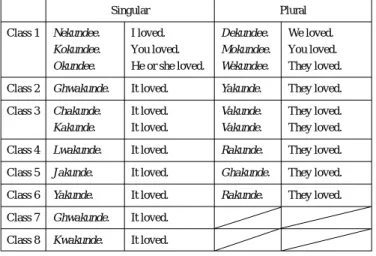
Naghendie. I went.
There are two forms of the present perfect; the
Table 16: Present Tense.
Class 1 Class 2 Class 3 Class 4 Class 5 Class 6 Class 7 Class 8 Nakunde17. Kwakunde. Wakunde. Ghwakunde. Chakunde. Kakunde. Lwakunde. Jakunde. Yakunde. Ghwakunde. Kwakunde. Singular Plural Dakunde. Mwakunde. Wakunde. Yakunde. Vakunde. Vakunde. Rakunde. Ghakunde. Rakunde. We love. You love. They love. They love or like. They love or like. They love or like. They love or like. They love or like. They love or like. I love. You love. He or she loves. It loves or likes. It loves or likes. It loves or likes. It loves or likes. It loves or likes. It loves or likes. It loves or likes. It loves or likes.
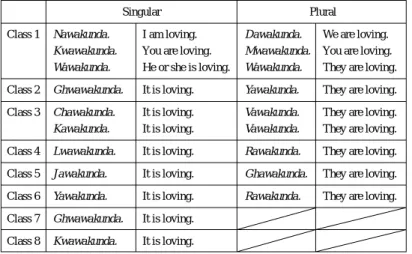
Table 17: Imperfect Tense.
Class 1 Class 2 Class 3 Class 4 Class 5 Class 6 Class 7 Class 8 Nawakunda. Kwawakunda. Wawakunda. Ghwawakunda. Chawakunda. Kawakunda. Lwawakunda. Jawakunda. Yawakunda. Ghwawakunda. Kwawakunda. Singular Plural Dawakunda. Mwawakunda. Wawakunda. Yawakunda. Vawakunda. Vawakunda. Rawakunda. Ghawakunda. Rawakunda. We are loving. You are loving. They are loving. They are loving. They are loving. They are loving. They are loving. They are loving. They are loving. I am loving.
first is the same as the present tense, as: Naghenda. I have gone.
The second present perfect is formed by prefixing the sign of the personal pronoun followed by the word -cha-, as:
Nachalima. I have hoed. ④Past Perfect Tense
There are two forms of the past perfect. The first is formed by changing the final letter -a of the verb into -ie-, as:
Neghendie. I went.
Verbs ending in -ra make their past perfect by changing the final letter -a into -e or -ee, as:
Nemghorie. I told him.
The second past perfect is formed by prefixing
the sign of the personal pronoun followed by the word -che or -cha, as:
Wachelima They cultivated.
The full form of this tense would be Naecheghen-da, but the -a of na- is absorbed by -e.
⑤Future Tense
There are two future tenses ― the mediate and the immediate. The mediate signifies an action that will take place at some future time; the im-mediate signifies an action that will take place without delay.
The mediate future is formed by prefixing the personal pronoun followed by the syllable cha or -che- to the verb, as ― nichalima, I will cultivate. The immediate future is formed by the use of the
Table 18: Present Perfect Tense.
Class 1 Class 2 Class 3 Class 4 Class 5 Class 6 Class 7 Class 8 Nachakunda. Kwachakunda. Wachakunda. Ghwachakunda. Chechakunda. Kechakunda. Lochakunda. Jechakunda. Yachakunda. Ghwachakunda. Kochakunda. Singular Plural Dachakunda. Mwachakunda. Wachakunda. Yachakunda. Vechakunda. Vechakunda. Rechakunda. Ghechakunda. Rachakunda. We have loved. You have loved. They have loved. They have loved. They have loved. They have loved. They have loved. They have loved. They have loved. I have loved.
You have loved. He or she has loved. It has loved. It has loved. It has loved. It has loved. It has loved. It has loved. It has loved. It has loved.
Table 19: Past Perfect Tense (1).
same pronominal prefixes as in the mediate fu-ture, but without the syllable -cha-, and slightly throwing the accent on the final syllable of the verb, as:
Nilima(a) . I will cultivate.
The final -a of this tense is often changed into agha, as:
Nilimagha. I will cultivate. ⑥Narrative Tense
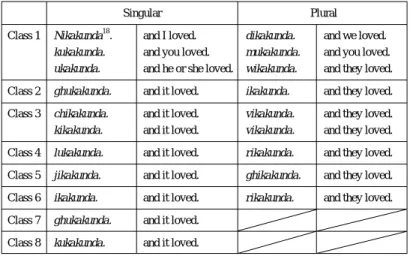
The narrative tense is formed by inserting -ka- af-ter the pronominal prefix. This -ka- has the power of the English and, as: nikaghenda, and I went. This tense takes the same prefix as the future tense.
⑦Conditional Tenses
The imperfect conditional is formed by inserting -ki immediately after the subjective personal pro-noun, as:
niki. as I was.
This takes the same subjective personal pronoun as the future indicative.
nikighenda. as I was going.
The present conditional is formed by inserting -ki immediately after the subjective personal pro-noun, as:
nikilola. / nikizighana. as I looked.
This takes the same subjective personal pronoun as the future indicative.
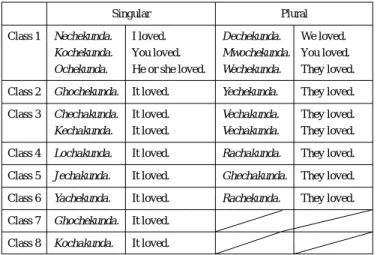
The perfect conditional is formed by the word iji, Table 20: Past Perfect Tense (2).
Class 1 Class 2 Class 3 Class 4 Class 5 Class 6 Class 7 Class 8 Nechekunda. Kochekunda. Ochekunda. Ghochekunda. Chechakunda. Kechakunda. Lochakunda. Jechakunda. Yachekunda. Ghochekunda. Kochakunda. Singular Plural Dechekunda. Mwochekunda. Wechekunda. Yechekunda. Vechakunda. Vechakunda. Rachakunda. Ghechakunda. Rachekunda. We loved. You loved. They loved. They loved. They loved. They loved. They loved. They loved. They loved. I loved. You loved. He or she loved. It loved. It loved. It loved. It loved. It loved. It loved. It loved. It loved.
Table 21: Mediate Future Tense.
Class 1 Class 2 Class 3 Class 4 Class 5 Class 6 Class 7 Class 8 Nichakunda. Kuchakunda. Uchakunda. Ghuchakunda. Chichekunda. Kichekunda. Luchekunda. Jichekunda. Ichakunda. Ghuchakunda. Kuchekunda. Singular Plural Dichakunda. Muchakunda. Wichakunda. Ichakunda. Vichekunda. Vichekunda. Richekunda. Ghichekunda. Richakunda. We will love. You will love. They will love. They will love. They will love. They will love They will love. They will love. They will love. I will love.
placed before the full form of the present indica-tive, as:
iji nivikagha. as I arrived.
This is formed by the word iji placed before the full form of the future indicative, as:
iji neghendie. while I went, or having gone.
The future conditional is formed by placing the word iji before the subjunctive, as:
iji nachaghenda. when I shall go. There are two present conditional tenses:
This is made by inserting the syllable -ka- imme-diately after the subjective personal pronoun. This takes the same subjective personal pronoun as the future indicative, as:
nikaghenda. if I go.
This is formed by repeating the verb twice, first in the future, and then in the subjunctive, as:
kamba (or kamanya) nighendagha nisighe nighende. if I go, then let me go. There are three future conditional tenses:
This is formed by placing the word iji before the present indicative, as:
iji (or kamanya) naenda if I shall go.
This is formed by placing the word kasikira be-fore the present indicative, as:
kasikira naghenda. if I shall go.
This is formed by placing the word hata before the narrative tense, as:
hata kukaghenda. even if you go. Table 22: Immediate Future Tense.
Class 1 Class 2 Class 3 Class 4 Class 5 Class 6 Class 7 Class 8 Nikundagha. Kukundagha. Ukundagha. Ghukundagha. Chikundagha. Kikundagha. Lukundagha. Jikundagha. Ikundagha. Ghukundagha. Kukundagha. Singular Plural Dikundagha. Mukundagha. Wikundagha. Ikundagha. Vikundagha. Vikundagha. Rikundagha. Ghikundagha. Rikundagha. We will love. You will love. They will love. They will love. They will love. They will love They will love. They will love. They will love. I will love.
You will love. He or she will love. It will love. It will love. It will love. It will love. It will love. It will love. It will love. It will love.
Table 23: Narrative Tense.
Class 1 Class 2 Class 3 Class 4 Class 5 Class 6 Class 7 Class 8 Nikakunda18. kukakunda. ukakunda. ghukakunda. chikakunda. kikakunda. lukakunda. jikakunda. ikakunda. ghukakunda. kukakunda. Singular Plural dikakunda. mukakunda. wikakunda. ikakunda. vikakunda. vikakunda. rikakunda. ghikakunda. rikakunda. and we loved. and you loved. and they loved. and they loved. and they loved. and they loved. and they loved. and they loved. and they loved. and I loved.
⑧Contingent Tense
The present is formed by placing the word ngera before the present indicative, as:
ngera nekundeghe. did I, or if I did love. Nakunda kumangu ngera nedeka oho.
I wish I were you. (3)The Negative Conjugation
Verbs by use of proper prefixes may be made neg-ative. The characteristic letter of the negative con-jugation is si or nde, which always stands first.
①Present Tense
This tense is formed by prefixing the negative sign
si or nde to the future form of the affirmative. The negative imperfect is not used.
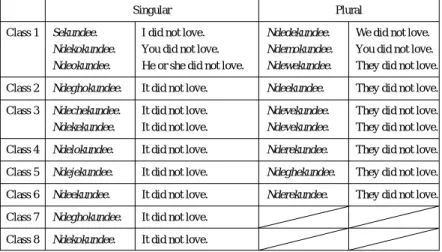
②Negative Past
There is but one negative past tense. This is formed from the past affirmative by prefixing the proper negative prefix, as in the present negative.
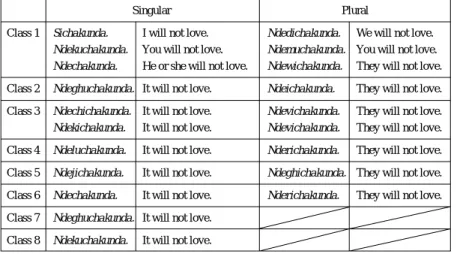
③Negative Mediate Future
The negative mediate future is formed from the affirmative by prefixing the proper negative signs as in the present.
④“Not yet” Tense Present
This tense denotes that the action has taken place
Table 24: Negative Present.
Class 1 Class 2 Class 3 Class 4 Class 5 Class 6 Class 7 Class 8 Sikundagha. Ndekukundagha. Ndekundagha. Ndeghukundagha. Ndechikundagha. Ndekikundagha. Ndelukundagha. Ndejikundagha. Ndeikundagha. Ndeghukundagha. Ndekukundagha. Singular Plural Ndedikundagha. Ndemukundagha. Ndewikundagha. Ndeikundagha. Ndevikundagha. Ndevikundagha. Nderikundagha. Ndeghikundagha. Nderikundagha. We do not love. You do not love. They do not love. They do not love. They do not love. They do not love. They do not love. They do not love. They do not love. I do not love.
You do not love. He or she does not love. It does not love. It does not love. It does not love. It does not love. It does not love. It does not love. It does not love. It does not love.
Table 25: Negative Past.
Class 1 Class 2 Class 3 Class 4 Class 5 Class 6 Class 7 Class 8 Sekundee. Ndekokundee. Ndeokundee. Ndeghokundee. Ndechekundee. Ndekekundee. Ndelokundee. Ndejekundee. Ndeekundee. Ndeghokundee. Ndekokundee. Singular Plural Ndedekundee. Ndemokundee. Ndewekundee. Ndeekundee. Ndevekundee. Ndevekundee. Nderekundee. Ndeghekundee. Nderekundee.
We did not love. You did not love. They did not love. They did not love. They did not love. They did not love. They did not love. They did not love. They did not love. I did not love.
up to the time of speaking, implying that it may some day come to pass. It is formed by prefixing the proper personal pronoun to the word dua, the verb expressing the action taking the infinitive mood, as:
Nadua niseghendie. I have not yet gone. Chadua chisesirie. It is not yet finished. Wadua wisechee. They have not yet come. ⑤“Not yet” Tense Past
This tense is intended to denote that the action had not taken place at the time that another hap-pened.
Sereibonyereghe. I had not yet done (it) . Ndeghoreghwieghe. It (tree) had not yet fallen. Ndekoreswiieghe. It had not yet become dark. ⑥Negative Conditional Tenses
Most of the affirmative conditional tenses may be made negative by prefixing the usual negative sign;
Ngera odeghenda, seimunekagha.
If he had gone, I would not have given (it) to him. Ikakuwa nisem’mbonagha, simkimbiagha.
If I shall not see him, I will not run away from him. Nimeria kum’mbona, neghenda mzinyi.
After I saw him, I went home.
⑦Negative Imperative
There are three ways of expressing the negative imperative.
1. By the word sigha, followed by the verb in the infinitive mood, as:
Sigha kumkaba! Do not beat him! 2. By the verb in the infinitive mood followed by the word mbai, as:
Kuseka mbai! Do not laugh! 3. By the negative subjunctive, as:
Kusebonye! Do not do (it) ! Museghende! Do not (you) go! ⑧Negative Subjunctive
The negative subjunctive is made from the affir-mative by using the usual negative signs.
Table 26: Negative Mediate Future.
Class 1 Class 2 Class 3 Class 4 Class 5 Class 6 Class 7 Class 8 Sichakunda. Ndekuchakunda. Ndechakunda. Ndeghuchakunda. Ndechichakunda. Ndekichakunda. Ndeluchakunda. Ndejichakunda. Ndechakunda. Ndeghuchakunda. Ndekuchakunda. Singular Plural Ndedichakunda. Ndemuchakunda. Ndewichakunda. Ndeichakunda. Ndevichakunda. Ndevichakunda. Nderichakunda. Ndeghichakunda. Nderichakunda.
We will not love. You will not love. They will not love. They will not love. They will not love. They will not love. They will not love. They will not love. They will not love. I will not love.
(4)Derivative Verbs
There are seven derivative forms which may be constructed out of most Kidawida verbs.
①The Frequentative Form
This form is used to express an action that is be-ing done continually. It is formed by changbe-ing the final letter of the verb into -agha, as:
Daibonyagha. We do (it) continually. Walimagha. They do cultivate, or they
are in the habit of cultivating. Ghwavagha. It bears from time to time. Narijagha. I am in the habit of eating
them. ②The Applied Form
This form is used where in English a preposition would be employed to connect the verb with the object. It is formed by changing the final letter of the verb into -ia or -era, as:
kubonyera to do for kujishira to feed for kulimia to hoe for kuochia to roast for kuredia to bring for kuenjera to take to, or for ③The Causative Form
This form is made by changing the final letter of the verb into -sa, or -isha.
kududugha to run kududughisha to cause to run kughala to go home kughalisha to cause to go home kujoka to climb
kujosa to cause to climb When the syllable ends in -ka, the -sa is substitut-ed for the -ka, as in kujoka, to climb.
④The Quasi-passive Form19
This is formed by changing the final letter of the verb into -ka, or -oka.
kuchikanya to break kuchika to be broken kughorua to straighten kughoroka to be straightened kughalua to turn kughaluka to be turned ⑤The Reflexive Form
This is formed by inserting -ku- between the pronominal prefix and the verb, after which, the word -moni with the appropriate prefix is added;
kunona to spoil kukunona ini moni to spoil oneself kukunda to love kukunda kumoni to love oneself kudunga (na ndagha) to stab kukudunga moni to stab oneself Table 27: Negative Subjunctive.
Class 1 Class 2 Class 3 Class 4 Class 5 Class 6 Class 7 Class 8 Nisekunde. Kusekunde. Usekunde. Ghusekunde. Chisekunde. Kisekunde. Lusekunde. Jisekunde. Isekunde. Ghusekunde. Kusekunde. Singular Plural Disekunde. Musekunde. Wisekunde. Isekunde. Visekunde. Visekunde. Risekunde. Ghisekunde. Risekunde.
May we not love. May you not love. May they not love. May they not love. May they not love. May they not love. May they not love. May they not love. May they not love. May I not love.
⑥The Reciprocal Form
This is made by changing the final -a into -ana, or -anya;
kukunda to love
kukundana to love each other kulwa to fight
kulwana to fight each other kughenda to go
kughendanya to go together kureda sere, kusesa to make peace
kusesanya to make peace with one another
⑦The Strengthened Form
This form gives the idea of thoroughness, by dou-bling the verb.
kurashua to cut
kurashua-rashua to cut to pieces kubara to split
kubara-bara to split in pieces (kulola) kusaka to seek
kusaka-saka to seek well kukalia to deceive kukalia-kalia to deceive much (5)Auxiliary Verbs
In grammatical description of the verb phrase, auxiliary verbs are used to refer to the set of verbs subordinate to the main lexical verb (ibid. 80) . The verbs used as auxiliaries are as follows:
kukaia to be kuwuria to continue kutua to finish kumeria to finish kucha to come kudima to be able kuwadana, kufwana to become one kusigha to leave kulegha to refuse
Kukaia, with its various parts, is used to express continuity; it is followed by the infinitive:
Wandu wose wakunde kukaia panana. All people like to be well. Ini nadapoilwa kukaia sere.
I like to stay peaceful.
Kuwuria is used to express the idea of repetition; it is followed by the verb in the infinitive:
Nighenda (sena) kuwuria.
I will go again. Siwuriagha kuseka. I will not laugh again. Nawuria chienyi, sivikie aho.
I returned halfway, I did not reach there.
Kutua is used to express the end. Nicha kutua kwa mori ughu.
I will come at the end of this month.
Kumeria is used to strengthen the present perfect: Nameria kureda. I have finished to bring. Nameria kukama. I have finished to milk. Kucha is used as an auxiliary to form the present and past tenses:
Wachacha. They have come. Wechecha. They came or had come. ‘Can’ is expressed by the appropriate tenses of kudima:
Nadima kurumaghia. I am able to bear (it) . ‘May’ and ‘might’, where they imply a purpose, are expressed by the subjunctive:
Nineke machi ninyo. Give me water that I may drink.
Where they imply lawfulness, by laghelaghe, bad; karakara, right; and kurighida, to forbid, as:
Nikawaya tindi rako ni laghelaghe?
If I pluck your tomatoes, is it wrong?
or we should say, Is it wrong for me to pluck your tomatoes? Kuiwa, ni karakara? To steal, is it right? Kukora mudi ughu, kwadarighidwa.
To burn this wood is for-bidden.
Where they imply power, by kudima, with the in-finitive.
‘Ought’ is expressed by kufwana, to behove, to concern.
(6)To Be and To Have ①To Be
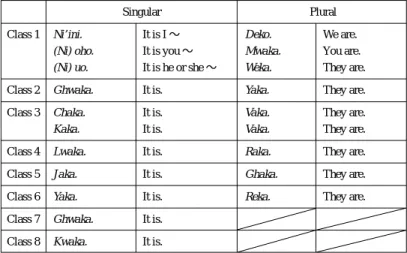
First form. Present Tense
For the other classes of nouns see present tense, indicative mood.
Second form. Present Tense
Ni’ini narughua20mnyango.
It’s I who has opened the door.
Table 28: “To Be” in Present (1).
Class 1 Naka. Kwaka. Waka Singular Plural Daka. Mwaka. Waka We are. You are. They are. I am. You are. He or she is.
Table 29: “To Be” in Present (2).
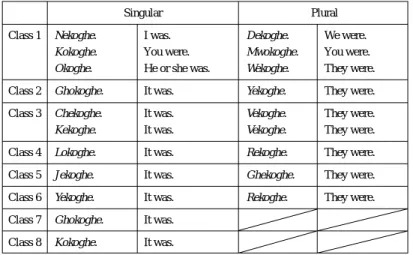
Past Tense
Immediate Future
Mediate Future
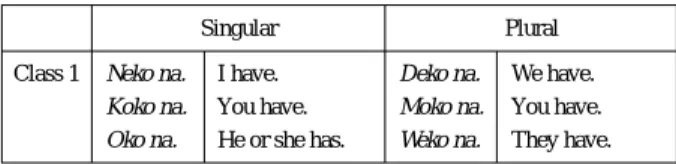
②To Have
By the verb “to be” followed by na, as: Neko na. I am with, i.e. I have. When the object must be added to na-, as:
Neko nacho. I have it. Neko navo. I have them. Nekoghe najo. I had it.
Table 30: “To Be” in Past.
Class 1 Class 2 Class 3 Class 4 Class 5 Class 6 Class 7 Class 8 Nekoghe. Kokoghe. Okoghe. Ghokoghe. Chekoghe. Kekoghe. Lokoghe. Jekoghe. Yekoghe. Ghokoghe. Kokoghe. Singular Plural Dekoghe. Mwokoghe. Wekoghe. Yekoghe. Vekoghe. Vekoghe. Rekoghe. Ghekoghe. Rekoghe. We were. You were. They were. They were. They were. They were. They were. They were. They were. I was. You were. He or she was. It was. It was. It was. It was. It was. It was. It was. It was.
Table 31: “To Be” in Immediate Future.
Class 1 Nikagha. Kukagha. Ukagha Singular Plural Dikagha. Mukagha. Wikagha We will be. You will be. They will be. I will be.
You will be. He or she will be.
Table 32: “To Be” in Mediate Future.
Class 1 Nichaka. Kuchaka. Uchaka Singular Plural Dichaka. Muchaka. Wichaka We will be. You will be. They will be. I will be.
Present Tense
Past Tense
The negative of these tenses is formed by pre-fixing the usual negative sign.
Adverbs
Adverbs generally follow the words they qualify: ghora nicha speak properly
mbaa nandighi very big
Nouns are sometimes made to serve as adverbs by the use of the preposition kwa or na, as:
kwa kidali purposely kwa ndighi by force na iseghe quickly
Some nouns expressing quality may be used ad-verbially:
Kwaghora loli. You speak truly. Chanuka (choroni) laghelaghe. It smells badly.
The English adverb ‘very’ may be expressed by the words nandighi:
Lala nandighi! Sleep very much! Ghora (deda) nandighi!
Speak very loudly! ‘Ever’ is expresed by matuku ghose, every day, ngelo rose, and jingi, to continue, as:
Mwasongoda ngelo rose. / Mwadeda ngelo rose. You are always talking. ‘Never’ is expressed by na jingi, as:
Na jingi sikunekagha. I will never give you. Kukawuria ndekucham’mbona jingi.
If you continue, you shall not see him.
Jingi siwonie kisuka. I’ve never seen a ghost.
Prepositions and Conjunctions
(1)Prepositions
There are some prepositions in Kidawida;
kwa to, for
na or ni with kavui near, beside
ya of
angu or
hata until
andenyi inside
ko upon, of time
Kwa means ‘to’ or ‘for’ as in:
Ghenda kwa aba (apa) go to my father Na or ni denotes instrument or object with and by:
Mkabe na rungu. Beat him with a club. Nabwaghilo ni njala. I am killed with hunger.
(= I am hungry.) Kavui means ‘near’ or ‘beside’, as in:
kavui na nyumba near the house kavui ya mudi ughu beside this tree
Ya or -a with the appropriate prefix is nearly
al-Table 33: “To Have” in Present.
Class 1 Neko na. Koko na. Oko na. Singular Plural Deko na. Moko na. Weko na. We have. You have. They have. I have. You have. He or she has.
Table 34: “To Have” in Past.
ways translated by of, as:
mundu wa ndighi, “mwandighi” a man of strength Prepositions are frequently expressed by the ap-plied form of the verb, as:
kulima to hoe kulimia to hoe for ‘Or’ is expressed by angu as:
Ni oho kwabonya huwu angu ni mundu mzima? Are you the one who has done this or another person? ‘From’, of time, is expressed by kufuma, to come out, as:
kufuma icho hata linu
from the other day until today
‘From’ is also expressed by the subjunctive, as: kufuma ni-chee hata linu
from the time I came until now
Kwachee kufuma lii? From when did you arrive? ‘Until’, ‘as far as’, of time and space, are ex-pressed by hata, as:
Ghenda hata kwake. Go as far as his place. M’mbesere hata uche. Wait until he comes. Andenyi means ‘inside’, as:
andenyi ya nyumba inside the house Ko is used to express ‘in’, ‘on’, ‘upon’, of time:
ko-imbiri in the beginning ko-icho upon the other day (2)Conjunctions
There are some conjunctions in Kidawida. They are chiefly these:
na and
ela but
angu or
saki however
Na is often dispensed with by the use of the ka tense, as:
nikaghenda. and I went. Ela means ‘but’, as:
Nawaenda ela simanyire ngera ni wuya. I’m going but I don’t know if I will return.
Angu means ‘or’, as:
Ni oho kwabonya huwu angu ni mundu mzima?
Are you the one who has done this or another person? Saki means ‘however’, as:
Deko na waghenyi sena saki ni vika Wundanyi. We have visitors, however, I shall go to Wundanyi.
Acknowledgements
I express deep appreciation to Dr. Chris L. Wanjala who introduced me to anthropological studies in Taita. I can never extend my thanks enough to my research partners, feu Mr. Ben-jamin Mwakughu and Mr. Harrison A. Mwachala, who taught me their cultures, and thanks also to the Taita people. My research was supported by the Japan Society for the Promotion of Science. I am grateful to JSPS for the research grant, 2004 to 2006, by the Grant-in-Aid for Scientific Re-search.
Notes
17 Kukunda means ① to love, ② to want, ③ to read. To translate kunda into English one would have to apply the appropriate meaning (①-③) to make a logical, sensible sentence. eg. Mdi ghokunda kudemwa. (A tree needed to be cut.) We cannot say “A tree loved to be cut!”
18 Sometimes they add na to the narrative tense; na nikakunda.
19 The passive voice is formed from the active by simply changing the final vowel of the verb into ilo, elo, as: Nakaba. (I beat.) Nakabilo. (I am beaten.) Dawonie. (We saw.) Dawonelo. (We were seen.) Nighora. (I will tell.) Nighore-lo. (I will be told.)
20 Roghua means greet (salimia in Kiswahili.) Rughua means open (fungua in Kiswahili.)
References
Co., The Hague.
Greenberg, J.H. (ed.)1966b. Universals of Lan-guage Report. Cambridge, Mass: M.I.T. Press. Guthrie, M. 1948. The Classification of the Bantu
Languages. Oxford University Press, London. Institute of Kiswahili Research. 1996.
English-Swahili Dictionary. University of Dar es Salaam.
Inter-Territorial Language Committee for the East African Dependencies. 1939, 2002. A Standard Swahili-English Dictionary. Oxford University Press.
Inter-Territorial Language Committee for the East African Dependencies. 1939, 2000. A Standard English-Swahili Dictionary. Oxford University Press.
Mangat, A.W. 2001. Swahili for Foreigners. Ken-way Publications, Nairobi.
Ministry of Finance and Planning, and Institute of African Studies, University of Nairobi (MFP & IAS) 1984. The District Socio-Cultural Profiles Project. A Joint Research and Training Pro-ject, Taita-taveta District, Draft Report. Nairo-bi.
Perrott, D.V., 1951, 2003. Teach Yourself SWAHILI. Hodder and Stoughton. United Kingdom. Sakamoto, K., 2003. An Introduction to Kidawida:
The Language of the Taita in south-east Kenya, Volume Ⅰ: Nouns, Adjectives and Numerals.,
Bulletin of Policy Studies, No.6.,Shobi Universi-ty.
―――――, 2005. An Introduction to Kidawida: The Language of the Taita in south-east Kenya, Volume Ⅱ:Pronouns., Bulletin of Policy
Stud-ies, No.10.,Shobi University.
―――――, 2006. Language Policy Develop-ments in Kenya, Shobi Journal of Policy Stud-ies. No. 5. Shobi University.
Taasisi ya Uchunguzi wa Kiswahili, 1981. Ka-musi ya Kiswahili Sanifu. Oxford University Press, Dar es Salaam.
Whitely, W.H.(ed.).1974. Language in Kenya. Oxford University Press.
Wilson, P.M.1970. Simplified SWAHILI. Kenya Literature Bureau, Nairobi.