Fukushima Medical University
This document is downloaded at: 2021-11-08T00:00:55Z
Title Is preoperative period associated with severity and unexpected death of injured patients needing emergency trauma surgery?
Author(s) Ono, Yuko; Yokoyama, Hideyuki; Matsumoto, Akinori;
Kumada, Yoshibumi; Shinohara, Kazuaki; Tase, Choichiro
Citation Journal of anesthesia. 28(3): 381-389
Issue Date 2014-06
URL http://ir.fmu.ac.jp/dspace/handle/123456789/468
Rights © Japanese Society of Anesthesiologists 2013. The final publication is available at link.springer.com
DOI 10.1007/s00540-013-1727-0
Text Version author
Is preoperative period associated with severity and unexpected death of injured patients needing emergency trauma surgery?
Yuko Ono1,2, Hideyuki Yokoyama1, Akinori Matsumoto1, Yoshibumi Kumada1, Kazuaki Shinohara1, Choichiro Tase2
1Department of Anesthesiology, Ohta General Hospital Foundation, Ohta Nishinouchi Hospital, Koriyama, Japan.
2Emergency and Critical Care Medical Center, Fukushima Medical University Hospital, Fukushima, Japan.
*Corresponding Author:
Yuko Ono, MD
Department of Anesthesiology, Ohta General Hospital Foundation, Ohta Nishinouchi Hospital 2-5-20 Nishinouchi, Koriyama, Fukushima 963-8558, Japan
Tel: +81-024-925-1188, Fax: +81-024-925-7791, E-ma
Keywords: Delaying factor · Emergency surgery · Preoperative period ·Trauma · Unexpected trauma death.
Word count: 3,150words Number of tables: 5 Number of figures: 1
Abstract
Purpose
Early operative control of hemorrhage is the key to saving the lives of severe trauma patients. We investigated whether emergency room (ER) stay time (time from the ER to the operating room [OR]) is associated with trauma severity and unexpected trauma death (Trauma and Injury Severity Score [TRISS] method-based Probability of survival [Ps] ≥0.5 but died) of injured patients needing emergency trauma surgery.
Methods
We performed a retrospective review of call trauma patients requiring emergency surgery and all patients with pelvic fractures requiring transcatheter arterial embolization at our hospital from January 2002 to December 2012. We analyzed the relationships among injury severity on ER admission (Injury Severity Score [ISS]; Revised Trauma Score (RTS); Ps; Shock Index (SI);
American Society of Anesthesiologists Physical Status [ASA-PS]); mortality rate; unexpected trauma death rate; and ER stay time.
Results
ER stay times were significantly shorter for patients with life-threating conditions (RTS <6.0 [p<0.01], Ps <0.5 [p<0.001], SI ≥1.0 [p<0.01], and ASA-PS ≥4E [p<0.001]). In particular, ER stay time was inversely related to injury severity up to 120 minutes. The risk of unexpected trauma death significantly increased as ER stay time increased over 90 minutes (p<0.01).
Conclusions
Our results suggest that every medical staff should work together effectively on high-risk patients in the ER, bringing them immediately to the OR according to their level of risk. If injured patients need emergency trauma surgery, ER stay times should be kept as short as possible to reduce unexpected trauma death.
Introduction
The “golden hour”is a key concept in trauma care [1], as time plays a crucial role in saving the lives of severe trauma patients. Any delay in definitive control of hemorrhage can result in hypovolemic shock and coagulopathy [2],requiringgreater amounts of volume replacement and blood transfusion; and increased risks of systemic inflammatory response syndrome (SIRS), acute respiratory distress syndrome (ARDS) [3,4], sepsis [5],and multiple organ failure (MOF) [5]; all of which can adversely affect outcomes. Early operative control of hemorrhage is vital for trauma patients, so preoperative period is considered an important trauma care parameter [6]. Is preoperative period associated with severity and unexpected trauma death (Trauma and Injury Severity Score [TRISS] method-based Probability of Survival [Ps] ≥0.5 but died) of injured patients needing emergency trauma surgery, and if so, by how much? We conducted this study to provide answers, which the medical literature does not provide, to these questions. We
hypothesized that: (1) preoperative period will be in inversely related to injury severity because every medical staff works together on high-risk patients, bringing patients immediately to the operating room (OR) according to their level of risk; and (2) any delay in a necessary operation can adversely affect outcome, so the risk of unexpected trauma death will rise in proportion to increase in preoperative period. We also tried to reveal the delaying factors of emergency trauma surgery and areas for improvement. We believe this study provides both an understanding of the chain of events in survival in trauma care and essential information that can be used to improve trauma practice.
Materials and methods
Ohta Nishinouchi General Hospital is a teaching hospital and a tertiary referral medical center located in the city of Koriyama, Fukushima, approximately 200 km north of Tokyo. Over 1,400 trauma patients per year with injuries of varying severity are brought to the hospital from areas within a 50-km radius, which corresponds to a Level I trauma center in the United States (US). We
performed a retrospective review of all trauma patients requiring emergency open reduction with internal fixation (ORIF) for open fractures of extremities, laparotomy, thoracotomy, and craniotomy who were brought directly from the emergency room (ER) to the OR and all patients with pelvic fractures requiring transcatheter arterial embolization (TAE) who were brought directly from the ER to the catheterization room from January 1, 2002, to December 31, 2012. Data were collected from prehospital records, medical records, and anesthesia records. We analyzed how preoperative period and mortality rate were affected by differences in surgical interventions and injury severity (Injury Severity Score [ISS], Revised Trauma Score [RTS], and Ps based on the TRISS method;
Shock Index [SI; heart rate/systolic blood pressure]; and American Society of Anesthesiologists Physical Status [ASA-PS]). RTS and SI were calculated based on vital signs measured immediately after ER admission. ISS, RTS and Ps were scored by a trauma director at the authors’ institution (author KS), and ASA-PS was scored by attending anesthesiologists. Preoperative period was subdivided into the following: Prehospital time (time from emergency call to ER arrival); ER stay time (time from ER arrival to OR); and total time to OR (time from emergency call to OR). OR arrival time was defined as the anesthesia start time documented in anesthesia records. For TAE, it was defined as the catheterization room arrival time documented in nursing records. We categorized severity scales into the following groups: ISS, >25 and ≤25; RTS, <6.0 and ≥6.0; Ps, <0.5 and ≥0.5;
SI, ≥1.0 and <1.0; ASA-PS, ≥4E and <4E, and compared preoperative period between severely injured (ISS>25, RTS <6.0, Ps <0.5, SI ≥1.0, and ASA-PS ≥4E) and moderately injured patients (ISS≤25, RTS ≥6.0, Ps ≥0.5, SI <1.0, and ASA-PS <4E). We also investigated the relationships among injury severity; mortality rate; unexpected trauma death rate (Ps ≥0.5 but died /all trauma death × 100 [%]); and preoperative period at intervals of every 30 minutes. We also created a logistic regression model of the probability of death on the basis of SI, prehospital time, and ER stay time. Statistical analyses were performed using SPSS software version 17.0 (IBM, Tokyo, Japan). Multiple comparisons of preoperative period among different types of surgical interventions were assessed using one-way analysis of variance (ANOVA), followed by Tukey’s honestly
significant difference tests for post-hoc analysis. Interval scales were assessed using the Mann–
Whitney U test, and categorical data were assessed using the chi-square test. P values < 0.05 were considered statistically significant.
We also tried to detect the cause of delay by reviewing all prehospital, medical, and anesthesia records of patients with total time to OR greater than the 3rd-quartile value. The timetables of all operations were also reviewed. This study was approved by the institutional review board at the authors’ institution.
Results
During the study period, 15,654 trauma patients were brought to the ER, of whom 722 required emergency surgery and TAE (4.6% of trauma patients; 520 males and 202 females, age 46.7±22.2 years, ISS 18.5±14.7, ASA-PS 2.7±1.0E). The distribution of emergency surgeries was 111 TAEs for pelvic fractures (15.4%); 471 ORIFs for open fractures (65.2%); 109 laparotomies (15.1%); 9 thoracotomies (1.3%); and 22 craniotomies (3.0%). Of the 15,654 trauma patients, 10,967 (70.1%) had minor injuries with ISS<9 and 921 (5.9%) had major injuries with ISS>25. Of the 722 trauma patients requiring emergency operation, 154 (21.3%) had minor injuries with ISS<9 and 202 (28.0%) had major injuries with ISS>25.
Table 1 presents differences in preoperative period and mortality rates by type of surgical intervention. An average of 48.2±23.6 min had already elapsed before ER arrival. ER stay times from shortest to longest were for thoracotomy (106.4±58.0 min), TAE (120.8±59.2 min), laparotomy (128.5±65.8 min), craniotomy (148.2±54.6 min), and ORIF (152.1±72.3 min).
One-way ANOVA and post-hoc analysis using Tukey’s honestly significant difference tests
revealed significant differences in ER stay times between TAE and ORIF (p<0.001) and laparotomy and ORIF (p<0.05).
Table 2 presents comparisons of preoperative period and mortality rate between severe injured and
moderately injured patients. The Mann–Whitney U test revealed ER stay times to be significantly shorter for the severely injured group (RTS<6, 130.0±81.3 min versus ≥6, 144.9±68.1 min: p<0.01;
Ps <0.5, 120.4±81.8 min versus ≥0.5, 145.3±68.3 min: p<0.001; SI ≥1.0, 129.4±68.1 min versus
<1.0, 146.8±70.1 min: p<0.01; ASA-PS ≥4E, 129.4±73.8 min versus <4E, 146.6±68.5 min:
p<0.001).
Table 3 presents the relationships among the injury severity; mortality rate; unexpected trauma death rate; and prehospital time at 30- minutes intervals. Prehospital time was not associated with injury severity for the interval of 7–90 minutes, and injury severity significantly increased beyond 91 minutes. This pattern suggests that most severe trauma patients were transported to our trauma center, even from distant places, according to a trauma bypass principle and that physician delivery systems (physician-staffed ambulance and physician-staffed helicopter emergency medical service) were frequently activated for severely injured patients, then a stay-and-play approach (i.e., a focus on comprehensive care at the scene, as opposed to the scoop-and-run approach, which favors basic care at the scene and an emphasis on quick transport of a trauma patient to the hospital) was initiated at the scene. Mortality rate and unexpected trauma death rate were not associated with prehospital time.
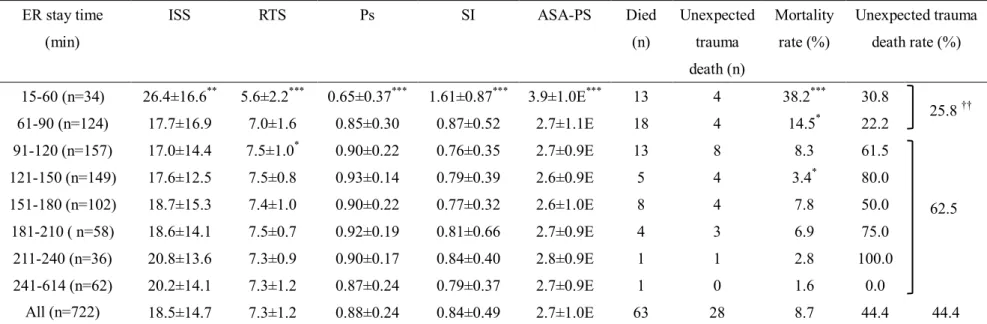
Table 4 presents the relationships among injury severity; mortality rate; unexpected trauma death rate; and ER stay time at 30-minute intervals. There was a- inverse relationship between ER stay time and injury severity and mortality rate up to 120 minutes, a relationship that weakened beyond 120 minutes. This pattern suggests that patients with life-threatening injuries were brought from the ER to the OR immediately according to their level of risk up to 120 minutes, after which point there was a bias toward low risk- patients and further delays. We also found that the risk of unexpected trauma death significantly increased as ER stay time increased over 90 minutes (ER stay time 15–90 minutes, 25.8%; versus 91–614 minutes, 62.5% [p<0.01]). The reasons for 28 unexpected trauma deaths were: hypovolemic shock in 18 patients (64.3%); 4 MOF due to
hemorrhagic complication including SIRS, ARDS, and coagulopathy in 4 patients (14.3%); sepsis in 4 patients (14.3%); severe brain injury in 1 patient (3.4%); and massive pulmonary embolism after femoral and pelvic fractures in 1 patient (3.4%). The main contributors to unexpected trauma death were hemorrhage and hemorrhagic complications.
Table 5 presents a logistic regression model of the probability of death on the basis of SI, prehospital time, and ER stay time. There was a significant negative correlation between the probability of death and ER stay time but no significant correlation between the probability of death and prehospital time. This pattern implies that patients with life-threatening trauma were quickly moved from ER to OR according to their risk of death.
Figure 1 presents the causes of delay for patients with emergency call to OR times greater than the 3rd-quartile value (225 min). Approximately a quarter of delays were associated with prehospital factors (“prolonged extrication time [>30 min],” 14.8%; “prolonged transportation time [> 60 min],”
10.4%). The reasons for prolonged transportation time included mountain rescue, long-distance transportation by ambulance, and inability to admit the patient after inquiring at multiple hospitals.
Approximately a quarter of delays were due to personnel and equipment shortages after ER admission (“operating room occupied,” 16.5%; “staff shortage,” 6.6%), and approximately 20% of delays were due to patient responses to treatment and to human factors (“failure of nonoperative management,” 10.4%; “long examination time,” 2.8%; “long preoperative treatment time,” 1.6%;
“other reasons,” 2.8%). The definition of “failure of nonoperative management” was the failure, due to hemorrhage and/or deterioration of vital signs, of conservative management and included 5 TAE cases, 8 laparotomy cases, 1 thoracotomy case, and 5 craniotomy cases. The reasons for “long examination time” were 4 upper gastrointestinal endoscopies and/or upper gastrointestinal imaging series for upper tract injuries and 1 diagnostic peritoneal lavage for diaphragmatic injury. Each of the 3 cases categorized as “long preoperative treatment time” was associated with airway
management. One patient, a 10-year-old boy with Pierre Robin syndrome, had a difficult airway
requiring a long time to achieve endotracheal intubation; 1 patient, a 42-year-old male with airway obstruction due to severe facial bone fracture with copious bleeding from the mouth, underwent cricothyrotomy followed by open standard tracheostomy in the ER; and 1 patient, a 61-year-old male with massive hemoptysis due to severe right pulmonary injury, underwent differential lung ventilation. “Other reasons” included extended time required for preoperative consent from patients or patients’ families, arrival of unconscious patients’ families, and acquisition and preparation of special surgical instruments.
Discussion
The idea of rapid transport of trauma patients to definitive care facilities has its roots in military medicine. The importance of time in trauma care has been widely recognized since World War II [7]and the concept of “the golden hour”is one of the most important trauma care principles [1].
The time between injury and a necessary operation should be kept as short as possible, especially in active bleeding cases. Clarke et al. [8] reported that for patients with hemorrhagic shock requiring emergency trauma laparotomy, the probability of death increased by as much as 1% for each 3 minutes’ delay in the ER up to 90 minutes.
Risk stratification of a trauma care team
This study reveals that ER stay time was significantly shorter for severely injured patients (RTS<6, Ps <0.5, SI ≥1.0, ASA-PS ≥4E) than for moderately injured patients (ISS≤25, RTS ≥6.0, Ps ≥0.5, SI
<1.0, and ASA-PS <4E) and that ER stay times, from shortest to longest, were for thoracotomy, TAE, laparotomy, craniotomy, and ORIF. Because massive bleeding can collect in the thoracic, pelvic, and abdominal cavities, emergency interventions must be performed as soon as possible in these spaces. This study also reveals that ER stay time was inversely proportional to injury severity up to 120 minutes. The logistic regression model also reveals a significant negative correlation between the probability of death and ER stay time but no significant correlation between the probability of death and prehospital time. These results suggest that all medical staff should work
together on high risk patients in the ER, bringing them immediately to the OR according to their level of risk. We believe this risk stratification is one of the most important functions of a trauma care team.
ER stay time over 90 minutes can increase unexpected trauma death.
This study also reveals that the risk of unexpected trauma death significantly increases as ER stay time increases over 90 minutes and that the main contributors to unexpected trauma death were hemorrhage and hemorrhagic complications. This result suggests that any delay in definitive control of hemorrhage can cause unexpected trauma death. Early operative control of hemorrhage is a key factor in saving the lives of trauma patients. If injured patients need emergency trauma surgery, we must make every effort to keep ER stay times as short as possible. It is therefore very important to investigate the delaying factors of emergency trauma surgery and areas for
improvement. Based on Figure 1, we discuss this matter, subdivided into ER delay and prehospital delay, as follows.
Delay in ER phase
ER stay time is affected mainly by the trauma care team’s performance in detecting trauma etiology during initial resuscitation and making critical decisions. The ER stay time in this study was longer than that reported by others. For all emergency trauma surgery, this study showed a median ER stay time of 143.0 min, while in the United Kingdom (UK), McNicholl and Dearden [9] reported 117 and 111 min for each of the 2 years studied at their institution and in the US, Lowe et al. [10]
reported 136 min. For patients requiring emergency trauma laparotomies, the present study showed a median ER stay time of 128.5 min, while in the UK, Henderson et al. [6] reported 54 min at their institution and 115 min in the UK national database. Trauma care systems and circumstances in Japan are quite different from those in other countries, and it is difficult to make a simple
comparison. However, we should make every effort to improve our performance, mitigate delays in initial treatment, and attain the levels seen in other reports. In this study, 34.1% of the delays in OR
admissions were classified as “reason undetected.” We speculate that most of these were delays in initial treatment in the ER phase not revealed by the review process.
ER stay time is also affected by the availability of hospital resources such as personnel and equipment. Our findings reveal that approximately a quarter of the delays in OR admissions were due to shortages of personnel and OR availability. One reason for the shortage of medical resources is inappropriate prehospital triage. A patient with ISS <9 is considered to have too minor an injury to be treated at a level I trauma center [11, 12]. This study showed that of all trauma patients brought to our ER during the study period, 70.1% had minor injuries with ISS<9, and of trauma patients requiring emergency operation, 21.3% had a minor injury with ISS<9. Inappropriate triage can cause a chronic shortage of medical resources in a level I trauma center. A certain amount of over-triage is deemed necessary to reduce under-triage; according to the American College of Surgeons, an under-triage rate of 5–10% is considered unavoidable and is associated with an over-triage rate of 30–50% [13]. In this context, the over-triage (transportation of trauma patients with ISS <9 to our ER) rate of 70.1% in this study is quite high. The most common reason for over-triage was inability to admit the patient to a hospital corresponding to a level II or level III trauma center. It will be necessary to educate paramedics and establish good cooperation between hospitals to achieve efficient triage, enable the choice of an appropriate hospital for the severity of a patient’s injury, mitigate the chronic shortage of medical resources in level I trauma centers, and reduce preoperative period.
Delay in prehospital phase
This study also showed that approximately a quarter of delays were associated with prehospital factors. The many mountainous and medically isolated areas in Fukushima prefecture sometimes caused extended transportation times. This study showed prehospital times of 48.2±23.6 min, while a US meta-analysis of trauma patients [14] showed prehospital times of 43.17 min in rural areas, 30.97 min suburban areas, and 30.96 min in urban areas. Several studies [15–18] found that a
decrease in prehospital time resulted in improved patient survival. Medical administrative
approaches are needed to expand the trauma transportation system in Japan and reduce prehospital time.
As mentioned, delays in OR admissions were multifactorial. To reduce emergency call to OR time will require not only improvement in the performance of trauma medical teams, but also the efforts of various fields to improve the performance of paramedics, bring about good cooperation between level II and III trauma centers, and expand the trauma transportation system. We will continue to evaluate the growth of the trauma care system using preoperative period as one of the parameters.
Limitations
This study has several limitations. First, this is a retrospective observational study at a single institution, and the delaying factor review process was not audited by experienced outsiders; both of which can increase the risk of bias. Second, our hospital is located in a suburban area of Japan, so results may not necessarily apply to rural and urban areas of Japan or to other countries. Trauma care systems may differ greatly according to local factors, so each trauma care system should investigate its causes of delay and make efforts to mitigate these. Additional studies with larger sample sizes that include urban, suburban, and rural areas are necessary for further analysis.
Despite these limitations, this report reveals the relationship between preoperative period and severity of injured patients needing emergency trauma surgery, elucidates the risk of unexpected trauma death, clarifies delaying factors to the OR, and provides important information that can improve the quality of trauma care.
Conclusion
In summary, ER stay time is inversely related to injury severity because medical staff members work together on high-risk patients and bring patients immediately to the OR according to their level of risk. The risk of unexpected trauma death significantly increases as ER stay time increases
over 90 minutes. Therefore, ER stay times are kept as short as possible to reduce unexpected trauma death. We found delays in OR admissions to be multifactorial and related to prehospital factors, shortage of personnel and OR availability, and patient responses to treatment and human factors. To reduce the preoperative period, improvement in the performance of trauma care teams as well as in multidisciplinary approaches is needed.
Acknowledgments
The authors wish to thank our colleagues at Ohta Nishinouchi General Hospital for data acquisition and for their contribution to this study. The authors also wish to thank Nozomi Ono for her
assistance with reviewing the manuscript.
Competing interests
The authors have no competing interests to declare.
References
1. Cowley RA, Hudson F, Scanlan E, Gill W, Lally RJ, Long W, Kuhn AO. An economical and proved helicopter program for transporting the emergency critically ill and injured patient in Maryland. J Trauma. 1973;13:1029–38.
2. Hess JR, Brohi K, Dutton RP, Hauser CJ, Holcomb JB, Kluger Y, Mackway-Jones K, Parr MJ, Rizoli SB, Yukioka T, Hoyt DB, Bouillon B. The coagulopathy of trauma: a review of
mechanisms. J Trauma. 2008;65:748–54.
3. Gong MN, Thompson BT, Williams P, Pothier L, Boyce PD, Christiani DC. Clinical predictors of and mortality in acute respiratory distress syndrome: potential role of red cell transfusion.
Crit Care Med. 2005;33:1191–8.
4. Hudson LD, Milberg JA, Anardi D, Maunder RJ. Clinical risks for development of the acute respiratory distress syndrome. Am J Respir Crit Care Med. 1995;151:293–301.
5. Huβmann B, Lefering R, Taeger G, Waydhas C, Ruchholtz S; Sven Lendemans and the DGU Trauma Registry. Influence of prehospital fluid resuscitation on patients with multiple injuries in hemorrhagic shock in patients from the DGU trauma registry. J Emerg Trauma Shock.
2011;4:465–71.
6. Henderson KI, Coats TJ, Hassan TB, Brohi K. Audit of time to emergency trauma laparotomy.
Br J Surg. 2000;87:472–6.
7. Haacker LP. Time and its effects on casualties in World War II and Vietnam. Arch Surg. 1969 Jan;98:39–40.
8. Clarke JR, Trooskin SZ, Doshi PJ, Greenwald L, Mode CJ. Time to laparotomy for intra-abdominal bleeding from trauma does affect survival for delays up to 90 minutes. J Trauma. 2002;52:420–5.
9. McNicholl BP, Dearden CH. Delays in care of the critically injured. Br J Surg. 1992;79:
171–3.
10. Lowe DK, Hedges JR, Marby DW, Mendelson D. An assessment of time following trauma resuscitation: the transitional evaluation and monitoring phase. J Trauma. 1991;31:1265–9.
11. Baxt WG, Moody P, Cleveland HC, et al. Hospital-based rotorcraft aeromedical emergency care services and trauma mortality: a multicenter study. Ann Emerg Med. 1985;14 859–64.
12. Cunningham P, Rutledge R, Baker CC, Clancy TV. A comparison of the association of helicopter and ground ambulance transport with the outcome of injury in trauma patients transported from the scene. J Trauma. 1997;43:940–6
13. American College of Surgeons. Resources for the optimal care of the injured patient. Chicago, IL: American College of Surgeons, 2006.
14. Carr BG, Caplan JM, Pryor JP, Branas CC. A meta-analysis of prehospital care times for trauma. Prehosp Emerg Care. 2006;10:198–206.
15. Spaite DW, Tse DJ, Valenzuela TD, Criss EA, Meislin HW, Mahoney M, Ross J. The impact of injury severity and prehospital procedures on scene time in victims of major trauma. Ann Emerg Med. 1991;20:1299–305.
16. Feero S, Hedges JR, Simmons E, Irwin L. Does out-of-hospital EMS time affect trauma survival? Am J Emerg Med. 1995;13:133–5.
17. Birk HO, Henriksen LO. Prehospital interventions: on-scene-time and ambulance-technicians' experience. Prehosp Disaster Med. 2002;17:167–9.
18. Gonzalez RP, Cummings G, Mulekar M, Rodning CB. Increased mortality in rural vehicular trauma: identifying contributing factors through data linkage. J Trauma. 2006;61:404-9.
Figure Legends
Figure 1. Causes of delays in cases of emergency call to OR time greater than the 3rd-quartile value. OR, operating room.
Table 1. Differences in preoperative period and mortality rate by surgical intervention
Prehospital time
(min) ER stay time
(min) Total time to OR
(min) Died
(n) Mortality Rate (%)
TAE (n=111) 52.2±26.4 120.8±59.2*** 173.0±62.2* 27 24.3
ORIF (n=471) 46.9±22.8 152.1±72.3 199.0±75.1 4 0.8
Laparotomy(n=109) 51.3±24.3 128.5±65.8* 179.8±65.8 21 19.3
Thoracotomy(n=9) 44.4±20.1 106.4±58.0 150.9±62.4 6 66.7
Craniotomy(n=22) 41.0±22.8 148.2±54.6 189.3±49.7 5 22.7
All (n=722) 48.2±23.6 143.0±70.0 191.2±71.9 63 8.7
ER, emergency room; OR, operating room; ORIF, open reduction with internal fixation; TAE, transarterial embolization.
*p<0.05 compared with ORIF. ***p<0.001 compared with ORIF
Table 2. Comparison of preoperative period and mortality rates among severely injured and moderately injured patients
ISS RTS Ps
>25
(n=202) ≤25
(n=520) <6
(n=90) ≥6
(n=632) <0.5
(n=67) ≥0.5
(n=655) Prehospital time (min) 50.7±25.9 47.2±22.6 48.3±25.1 48.2±23.4 50.8±25.8 48.0±23.4
ER stay time (min) 149.3±76.8 140.6±67.0 130.0±81.3** 144.9±68.1 120.4±81.8*** 145.3±68.3 Total time to OR (min) 200.0±79.3 187.8±68.5 178.2±80.9* 193.0±70.3 171.3±80.6*** 193.2±70.7
Died (n) 50 13 38 25 35 28
Mortality rate (%) 24.8*** 2.5 42.2*** 4.0 52.2*** 4.3
SI ASA-PS
≥1.0
(n=157) <1.0
(n=565) ≥4E
(n=152) <4E (n=570) Prehospital time (min) 50.2±25.3 47.6±23.1 52.1±26.5* 47.2±22.7
ER stay time (min) 129.4±68.1** 146.8±70.1 129.4±73.8*** 146.6±68.5 Total time to OR (min) 179.6±70.9* 194.4±71.9 181.5±75.1 193.8±70.8
Died (n) 24 39 59 4
Mortality rate (%)) 15.3*** 6.9 38.8*** 0.7
ASA-PS, American Society of Anesthesiologists Physical Status; ER, Emergency Room; ISS, Injury Severity Score; OR, operating room; Ps, Probability of survival; RTS, Revised Trauma Score; SI, Shock Index.
*p<0.05, **p<0.01, ***p<0.001
Table 3. Relationships among injury severity; mortality rate; unexpected trauma death rate; and prehospital time at 30-minute intervals
Prehospital time (min)
ISS RTS Ps SI ASA-PS Physician
delivery system activated (%)
Died (n)
Unexpected trauma death
(n)
Mortality rate (%)
Unexpected trauma death rate
(%) 7-30 (n=183) 18.4±16.0 7.1±1.4 0.86±0.26 0.86±0.55 2.7±1.1E 11(6.0***) 21 12 11.5 57.1
31-60 (n=367) 16.9±13.1 7.4±1.1 0.91±0.20 0.81±0.44 2.6±0.9E 96(26.2) 22 8 6.0 36.4
61-90 (n=131) 21.0±15.2 7.1±1.4 0.85±0.27 0.81±0.49 2.8±1.0E 77(58.8***) 15 6 11.5 40.0 91-162 (n=41) 25.4±18.2** 7.0±1.5 0.82±0.28** 1.03±0.56** 3.1±0.9E** 34(82.9***) 5 2 12.2 40.0
All (n=722) 18.5±14.7 7.3±1.2 0.88±0.24 0.84±0.49 2.7±1.0E 218(30.2) 63 28 8.7 44.4
ASA-PS, American Society of Anesthesiologists Physical Status; ISS, Injury Severity Score; Ps, Probability of survival; RTS, Revised Trauma Score; SI, Shock index.
*p<0.05 compared to overall average, **p<0.01 compared to overall average, ***p<0.001 compared to overall average.
Table 4. Relationships among injury severity; mortality rate; unexpected trauma death rate; and ER stay time at 30-minute intervals
ASA-PS, American Society of Anesthesiologists Physical Status; ER, Emergency Room; ISS, Injury Severity Score; Ps, Probability of survival; RTS, Revised Trauma Score; SI, Shock Index. *p<0.05 compared with overall average, **p<0.01 compared with overall average, ***p<0.001 compared with overall average. ††p<0.01 compared with ER stay time beyond 90 minutes.
ER stay time (min)
ISS RTS Ps SI ASA-PS Died
(n)
Unexpected trauma death (n)
Mortality rate (%)
Unexpected trauma death rate (%)
15-60 (n=34) 26.4±16.6** 5.6±2.2*** 0.65±0.37*** 1.61±0.87*** 3.9±1.0E*** 13 4 38.2*** 30.8
61-90 (n=124) 17.7±16.9 7.0±1.6 0.85±0.30 0.87±0.52 2.7±1.1E 18 4 14.5* 22.2
91-120 (n=157) 17.0±14.4 7.5±1.0* 0.90±0.22 0.76±0.35 2.7±0.9E 13 8 8.3 61.5
121-150 (n=149) 17.6±12.5 7.5±0.8 0.93±0.14 0.79±0.39 2.6±0.9E 5 4 3.4* 80.0
151-180 (n=102) 18.7±15.3 7.4±1.0 0.90±0.22 0.77±0.32 2.6±1.0E 8 4 7.8 50.0
181-210 ( n=58) 18.6±14.1 7.5±0.7 0.92±0.19 0.81±0.66 2.7±0.9E 4 3 6.9 75.0
211-240 (n=36) 20.8±13.6 7.3±0.9 0.90±0.17 0.84±0.40 2.8±0.9E 1 1 2.8 100.0
241-614 (n=62) 20.2±14.1 7.3±1.2 0.87±0.24 0.79±0.37 2.7±0.9E 1 0 1.6 0.0
All (n=722) 18.5±14.7 7.3±1.2 0.88±0.24 0.84±0.49 2.7±1.0E 63 28 8.7 44.4 44.4
25.8 ††
62.5
Table 5. Logistic regression model of the probability of death on the basis of Shock Index, prehospital time, and ER stay time.
Explanatory variables β Odds ratio 95% CI P value
SI 1.572 4.815 3.046-7.613 <0.001
Prehospital time -0.004 0.996 0.985-1.008 0.559
ER stay time -0.010 0.990 0.984-0.996 <0.001
ER, emergency room; SI, Shock Index.
n=182