Inside the Muchnik Degrees II: The Degree Structures induced by the Arithmetical Hierarchy of Countably
Continuous Functions
K. Higuchi
Department of Mathematics and Informatics, Chiba University, 1-33 Yayoi-cho, Inage, Chiba, Japan
T. Kihara
∗School of Information Science, Japan Advanced Institute of Science and Technology, Nomi 923-1292, Japan
Abstract
It is known that infinitely many Medvedev degrees exist inside the Muchnik degree of any nontrivial Π
01subset of Cantor space. We shed light on the fine structures in- side these Muchnik degrees related to learnability and piecewise computability. As for nonempty Π
01subsets of Cantor space, we show the existence of a finite- ∆
02-piecewise degree containing infinitely many finite-( Π
01)
2-piecewise degrees, and a finite-( Π
02)
2- piecewise degree containing infinitely many finite- ∆
02-piecewise degrees (where ( Π
0n)
2denotes the di ff erence of two Π
0nsets), whereas the greatest degrees in these three
“finite- Γ -piecewise” degree structures coincide. Moreover, as for nonempty Π
01subsets of Cantor space, we also show that every nonzero finite-( Π
01)
2-piecewise degree in- cludes infinitely many Medvedev (i.e., one-piecewise) degrees, every nonzero countable-
∆
02-piecewise degree includes infinitely many finite-piecewise degrees, every nonzero finite-( Π
02)
2-countable- ∆
02-piecewise degree includes infinitely many countable- ∆
02-piecewise degrees, and every nonzero Muchnik (i.e., countable- Π
02-piecewise) degree includes in- finitely many finite-( Π
02)
2-countable- ∆
02-piecewise degrees. Indeed, we show that any nonzero Medvedev degree and nonzero countable- ∆
02-piecewise degree of a nonempty Π
01subset of Cantor space have the strong anticupping properties. Finally, we ob- tain an elementary di ff erence between the Medvedev (Muchnik) degree structure and the finite- Γ -piecewise degree structure of all subsets of Baire space by showing that none of the finite- Γ -piecewise structures are Brouwerian, where Γ is any of the Wadge classes mentioned above.
Keywords: Π
01class, Medvedev degree, Borel measurable function, countable continuity
2010 MSC: 03D30, 03D78, 03E15, 26A21, 68Q32
∗Corresponding author
Email addresses:[email protected](K. Higuchi),[email protected] (T. Kihara)
1. Summary 1.1. Introduction
This paper is a continuation of Higuchi-Kihara [29]. Our objective in this paper is to investigate the degree structures induced by intermediate notions between the Medvedev reduction (uniformly computable function) and Muchnik reduction (nonuni- formly computable function). We will shed light on a hidden, but extremely deep, structure inside the Muchnik degree of each Π
01subset of Cantor space.
In 1963, Albert Muchnik [46] introduced the notion of Muchnik reduction as a partial function on Baire space that is decomposable into countably many computable functions. Such a reduction is also called a countably computable function, σ -computable function, or nonuniformly computable function. The notion of Muchnik reduction has been a powerful tool for clarifying the noncomputability structure of the Π
01subsets of Cantor space [57–59, 61]. Muchnik reductions have been classified in Part I [29] by introducing the notion of piecewise computability.
Remarkably, many descriptive set theorists have recently focused their attention on the concept of piecewise definability of functions on Polish spaces, in association with the Baire hierarchy of Borel measurable functions (see [43, 44, 55]). Roughly speaking, if Γ is a pointclass (in the Borel hierarchy) and Λ is a class of functions (in the Baire hierarchy), a function is said to be Γ -piecewise Λ if it is decomposable into countably many Λ -functions with Γ domains. If Γ is the class of all closed sets and Λ is the class of all continuous functions, it is simply called piecewise continuous (see for instance [32, 36, 45, 50]). The notion of piecewise continuity is known to be equivalent to the ∆
02-measurability [32]. If Γ is the class of all sets and Λ is the class of all continuous functions, it is also called countably continuous [44] or σ -continuous [54]. Nikolai Luzin was the first to investigate the notion of countable-continuity, and today, many researchers have studied this concept, in particular, with an important dichotomy theorem (see [51, 64]).
Our concepts introduced in Part I [29], such as ∆
02-piecewise computability, are indeed the lightface versions of piecewise definability. This notion is also known to be equivalent to the e ff ective ∆
02-measurability [50]. See also [5, 19, 38] for more information on e ff ective Borel measurability.
To gain a deeper understanding of piecewise definability, we investigate the Medvedev- and Muchnik-like degree structures induced by piecewise computable notions. This also helps us to understand the notion of relative learnability since we have observed a close relationship between lightface piecewise definability and algorithmic learning in Part I [29].
In Part II, we restrict our attention to the local substructures consisting of the de- grees of all Π
01subsets of Cantor space. This indicates that we consider the rela- tive piecewise computably (or learnably) solvability of computably-refutable problems.
When a scientist attempts to verify a statement P, his verification will be algorithmi-
cally refuted whenever it is incorrect. This falsifiability principle holds only when P is
represented as a Π
01subset of a space. Therefore, the restriction to the Π
01sets can be re-
garded as an analogy of Popperian learning [11] because of the falsifiability principle.
From this perspective, the universe of the Π
01sets is expected to be a good playground of Learning Theory [31].
The restriction to the Π
01subsets of Cantor space 2
Nis also motivated by several other arguments. First, many mathematical problems can be represented as Π
01subsets of certain topological spaces (see Cenzer and Remmel [15]). The Π
01sets in such spaces have become important notions in many branches of Computability Theory, such as Recursive Mathematics [23], Reverse Mathematics [60], Computable Analysis [65], E ff ective Randomness [21, 48], and E ff ective Descriptive Set Theory [42]. For these reasons, degree structures on Π
01subsets of Cantor space 2
Nare widely studied from the viewpoint of Computability Theory and Reverse Mathematics.
In particular, many theorems have been proposed on the algebraic structure of the Medvedev degrees of Π
01subsets of Cantor space, such as density [13], embeddability of distributive lattices [3], join-reducibility [2], meet-irreducibility [1], noncuppability [12], non-Brouwerian property [28], decidability [16], and undecidability [56] (see also [30, 57–59, 61] for other properties on the Medvedev and Muchnik degree structures).
The Π
01sets have also been a key notion (under the name of closed choice) in the study of the structure of the Weihrauch degrees, which is an extension of the Medvedev degrees (see [6–8]).
Among other results, Cenzer and Hinman [13] showed that the Medvedev degrees of the Π
01subsets of Cantor space are dense, and Simpson [57] questioned whether the Muchnik degrees of Π
01subsets of Cantor space are also dense. However, this question remains unanswered. We have limited knowledge of the Muchnik degree structure of the Π
01sets because the Muchnik reductions are very di ffi cult to control. What we know is that as shown by Simpson-Slaman [62] and Cole-Simpson [17], there are infinitely many Medvedev degrees in the Muchnik degree of any nontrivial Π
01subsets of Cantor space. Now, it is necessary to clarify the internal structure of the Muchnik degrees.
In Part II, we apply the disjunction operations introduced in Part I [29] to understand the inner structures of the Muchnik degrees induced by various notions of piecewise computability.
1.2. Results
In Part I [29], the notions of piecewise computability and the induced degree struc- tures are introduced. Our objective in Part II is to study the interaction among the structures P/F of F -degrees of nonempty Π
01subsets of Cantor space for notions F of piecewise computability listed as follows.
• dec
<ωp[ Π
01] also denotes the set of all partial functions on N
Nthat are decompos- able into finitely many partial computable functions with Π
01domains.
• dec
<ωd[ Π
01] denotes the set of all partial functions on N
Nthat are decomposable into finitely many partial computable functions with ( Π
01)
2domains, where a ( Π
01)
2set is the di ff erence of two Π
01sets.
• dec
<ωp[ ∆
02] denotes the set of all partial functions on N
Nthat are decomposable
into finitely many partial computable functions with ∆
02domains.
• dec
ωp[ ∆
02] denotes the set of all partial functions on N
Nthat are decomposable into countably many partial computable functions with ∆
02domains.
• dec
<ωd[ Π
02] denotes the set of all partial functions on N
Nthat are decomposable into finitely many partial computable functions with ( Π
02)
2domains.
• dec
<ωd[ Π
02]dec
ωp[ ∆
02] denotes the set of all partial functions on N
Nthat are decom- posable into finitely many partial ∆
02-piecewise computable functions with ( Π
02)
2domains, where a ( Π
02)
2set is the di ff erence of two Π
02sets.
• dec
ωp[ Π
02] denotes the set of all partial functions on N
Nthat are decomposable into countably many partial computable functions with Π
02domains.
The relationship among these notions is summarized as follows.
— P/dec<ωd [Π02] —
P/dec<ωp [Π01] — P/dec<ωd [Π01] — P/dec<ωp [∆02] P/dec<ωd [Π02]decωp[∆02] — P/decωp[Π02]
— P/decωp[∆02] —
In Part I [29], we observed that these degree structure are exactly those induced by the ( α, β|γ )-computability.
• [C
T]
11denotes the set of all partial computable functions on N
N.
• [C
T]
1<ωdenotes the set of all partial functions on N
Nlearnable with bounded
mind changes.
• [C
T]
1ω|<ωdenotes the set of all partial functions on N
Nlearnable with bounded
errors.
• [C
T]
1ωdenotes the set of all partial learnable functions on N
N.
• [C
T]
<ω1denotes the set of all partial k-wise computable functions on N
Nfor some k ∈ N .
• [C
T]
<ωωdenotes the set of all partial functions on N
Nlearnable by a team.
• [C
T]
ω1denotes the set of all partial nonuniformly computable functions on N
N(i.e., all functions f satisfying f (x) ≤
Tx for any x ∈ dom( f )).
As in Part I [29], each degree structure P/ [C
T]
αβ|γis abbreviated as P
αβ|γ. Then, we have the following relationship among these notions.
— P<ω1 —
P11 — P1<ω — P1ω|<ω P<ωω — Pω1
— P1ω —
We will see that all of the above inclusions are proper. Beyond the properness of
these inclusions, there are four LEVELs signifying the di ff erences between two classes
F and G of partial functions on N
N(lying between [C
T]
11and [C
T]
ω1) listed as follows.
1. There is a function Γ ∈ F \ G.
2. There are sets X , Y ⊆ N
Nsuch that F has a function Γ
F: X → Y, but G has no function Γ
G: X → Y.
3. There are Π
01sets X , Y ⊆ 2
Nsuch that F has a function Γ
F: X → Y, but Γ
Ghas no function Γ
G: X → Y.
4. For every special Π
01set Y ⊆ 2
N, there is a Π
01set X ⊆ 2
Nsuch that F has a function Γ
F: X → Y, but G has no function Γ
G: X → Y.
The LEVEL 1 separation just represents F ⊈ G. Clearly, 4 → 3 → 2 → 1. Note that the LEVEL 2 separation holds for no Σ
01sets X , Y ⊆ N
N, since Π
01is the first level in the arithmetical hierarchy which can define a nonempty set S ⊆ N
Nwithout computable element. Such a Π
01set is called special, i.e., a subset of Baire space is special if it is nonempty and contains no computable points. As mentioned before, Simpson-Slaman [62] (see Cole-Simpson [17]) showed that the LEVEL 4 separation holds between [C
T]
11and [C
T]
ω1, that is, every nonzero Muchnik degree a ∈ P
ω1contains infinitely many Medvedev degrees b ∈ P
11.
In section 2, we use the consistent two-tape disjunction operations on Π
01subsets of Cantor space introduced in Part I [29] to obtain LEVEL 3 separation results.
• ▽
nis the disjunction operation on Π
01sets induced by the two-tape Brouwer- Heyting-Kolmogorov-interpretation with mind-changes < n.
• ▽
ωis the disjunction operation on Π
01sets induced by the two-tape Brouwer- Heyting-Kolmogorov-interpretation with finitely many mind-changes.
• ▽
∞is the disjunction operation on Π
01sets induced by the two-tape Brouwer- Heyting-Kolmogorov-interpretation permitting unbounded mind-changes.
By using these operations, we obtain the LEVEL 3 separation results for [C
T]
11, [C
T]
1<ω, [C
T]
1ω|<ω, and [C
T]
<ω1. We show that there exist Π
01sets P , Q ⊆ 2
Nsuch that all of the following conditions are satisfied.
1. (a) There is no computable function Γ
11: P ▽
2Q → P ▽
1Q;
(b) There is a function Γ
1<ω: P ▽
2Q → P ▽
1Q learnable with bounded mind- changes.
2. (a) There is no function Γ
1<ω: P ▽
ωQ → P ▽
1Q learnable with bounded mind- changes;
(b) There is a function Γ
1ω|<ω: P ▽
ωQ → P ▽
1Q learnable with bounded errors.
3. (a) There is no function Γ
1ω|<ω: P ▽
∞Q → P ▽
1Q learnable with bounded er- rors;
(b) There is a 2-wise computable function Γ
<ω1: P ▽
∞Q → P ▽
1Q.
The above conditions also suggest how does degrees of di ffi culty of our disjunction operations behave.
In contrast to the above results, in section 3, we will see that the hierarchy be-
tween [C
T]
1<ωand [C
T]
<ω1collapses for homogeneous Π
01subsets of Cantor space 2
N.
In other words, the LEVEL 4 separations fail for [C
T]
1<ω, [C
T]
1ω|<ω, and [C
T]
<ω1. For
other classes, is the LEVEL 4 separation successful?
To archive the LEVEL 4 separations, we use dynamic disjunction operations de- veloped in Part I [29].
1. The concatenation P 7→ P
⌢P of two Π
01sets P ⊆ 2
Nindicates the mass problem
“solve P by a learning proof process with mind-change-bound 2”.
2. Every iterated concatenation along a well-founded tree indicates a learning proof process with an ordinal bounded mind changes.
3. The hyperconcatenation P 7→ P ▼ P of two Π
01sets P ⊆ 2
Nis defined as the iterated concatenation of P along the corresponding ill-founded tree of P.
These operations turn out to be extremely useful to establish the LEVEL 4 separa- tion results. Some of these results will be proved by applying priority argument inside some learning proof model of P.
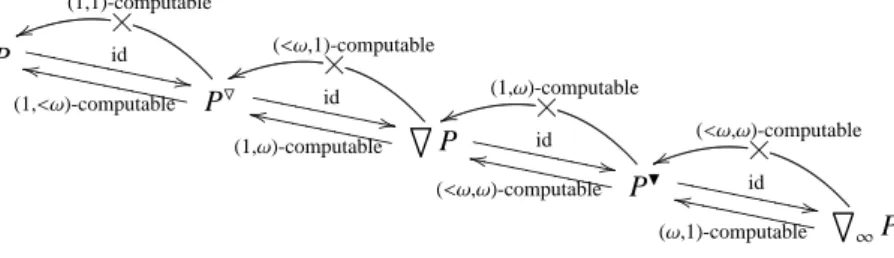
1. The LEVEL 4 separation succeeds for [C
T]
11and [C
T]
1<ω, via the map P 7→ P
⌢P.
2. The LEVEL 4 separation succeeds for [C
T]
<ω1and [C
T]
1ω, via the map P 7→ ∪
m∈N
(P
⌢P
⌢. . . (m times) . . .
⌢P
⌢P) .
3. The LEVEL 4 separation succeeds for [C
T]
1ωand [C
T]
<ωω, via the map P 7→ P ▼ P.
4. The LEVEL 4 separation succeeds for [C
T]
<ωωand [C
T]
ω1, via the map P 7→
Deg(P), where d Deg(P) denotes the Turing upward closure of P. d
The method that we use to show the first and the third items also implies that any nonzero a ∈ P
11and a ∈ P
1ωhave the strong anticupping property, i.e., for every nonzero a ∈ P , there is a nonzero b ∈ P below a such that a ≤ b ∨ c implies a ≤ c. Indeed, these strong anticupping results are established via concatenation
⌢and hyperconcatenation ▼ .
1. P
11| = ( ∀ a , c) (a ≤ (a
⌢a) ∨ c → a ≤ c).
2. P
1ω| = ( ∀ a , c) (a ≤ (a ▼ a) ∨ c → a ≤ c).
In section 5, we apply our results to sharpen Jockusch’s theorem [33] and Simp- son’s Embedding Lemma [58]. Jockusch showed the following nonuniform com- putability result for DNR
k, the set of all k-valued diagonally noncomputable functions.
1. There is no (uniformly) computable function Γ
11: DNR
3→ DNR
2. 2. There is a nonuniformly computable function Γ
ω1: DNR
3→ DNR
2.
This result will be sharpened by using our learnability notions as follows.
1. There is no learnable function Γ
1ω: DNR
3→ DNR
2.
2. There is no k-wise computable function Γ
<ω1: DNR
3→ DNR
2for k ∈ N . 3. There is a (uniformly) computable function Γ
11: DNR
3→ DNR
2▼ DNR
2. Hence,
there is a function Γ
<ωω: DNR
3→ DNR
2learnable by a team of two learners.
Finally, we employ concatenation and hyperconcatenation operations to show that
neither D
1<ωnor D
<ω1nor D
<ωωare Brouwerian. Hence, these degree structures are not
elementarily equivalent to the Medvedev (Muchnik) degree structure.
1.3. Notations and Conventions
For any sets X and Y, for convenience, we say that f is a function from X to Y (written f : X → Y) if the domain dom( f ) of f includes X, and the image of X under f is included in Y. We also use the notation f : ⊆ X → Y to denote that f is a partial function from X to Y, i.e., the image of dom( f ) ∩ X under f is included in Y.
For basic terminology in Computability Theory, see Soare [63]. For σ ∈ N
<N, we let |σ| denote the length of σ . For σ ∈ N
<Nand f ∈ N
<N∪ N
N, we say that σ is an initial segment of f (denoted by σ ⊂ f ) if σ (n) = f (n) for each n < |σ| . Moreover, f ↾ n denotes the unique initial segment of f of length n. let σ
−denote an immediate predecessor node of σ , i.e. σ
−= σ ↾ ( |σ| − 1). We also define [ σ ] = { f ∈ N
N: f ⊃ σ} . A tree is a subset of N
<Nclosed under taking initial segments. For any tree T ⊆ N
<N, we also let [T ] be the set of all infinite paths of T , i.e., f belongs to [T ] if f ↾ n belongs to T for each n ∈ N . A node σ ∈ T is extendible if [T ] ∩ [ σ ] , ∅ . Let T
extdenote the set of all extendible nodes of T . We say that σ ∈ T is a leaf or a dead end if there is no τ ∈ T with τ ⊋ σ .
For any set X, the tree X
<Nof finite words on X forms a monoid under concatenation
⌢
. Here the concatenation of σ and τ is defined by ( σ
⌢τ )(n) = σ (n) for n < |σ| and ( σ
⌢τ )( |σ| + n) = τ (n) for n < |τ| . We use symbols
⌢and ⊓
for the operation on this monoid, where ⊓
i≤n
σ
idenotes σ
0⌢σ
1⌢. . .
⌢σ
n. To avoid confusion, the symbols × and ∏
are only used for a product of sets. We often consider the following three left monoid actions of X
<N: The first one is the set X
Nof infinite words on X with an operation
⌢: X
<N× X
N→ X
N; ( σ
⌢f )(n) = σ (n) for n < |σ| and ( σ
⌢f )( |σ| + n) = f (n) for n ∈ N . The second one is the set T (X) of subtrees T ⊆ X
<Nwith an operation
⌢
: X
<N× T (X) → T (X); σ
⌢T = {σ
⌢τ : τ ∈ T } . The third one is the power set P (X
N)
of X
Nwith an operation
⌢: X
<N× P (X
N) → P (X
N); σ
⌢P = {σ
⌢f : f ∈ P } .
We say that a set P ⊆ N
Nis Π
01if there is a computable relation R such that P = { f ∈ N
N: ( ∀ n)R(n , f ) } holds. Equivalently, P = [T
P] for some computable tree T
P⊆ N
N. Let {Φ
e}
e∈Nbe an e ff ective enumeration of all Turing functionals (all partial computable functions
1) on N
N. Then the e-th Π
01subset of 2
Nis defined by P
e= { f ∈ 2
N: Φ
e( f ; 0) ↑} . Note that { P
e}
e∈Nis an e ff ective enumeration of all Π
01subsets of Cantor space 2
N. If (an index e of) a Π
01set P
e⊆ 2
Nis given, then T
e= {σ ∈ 2
<N: Φ
e( σ ; 0) ↑}
is called the corresponding tree for P
e. Here Φ ( σ ; n) for σ ∈ N
<Nand n ∈ N denotes the computation of Φ with an oracle σ , an input n, and step |σ| . Whenever a Π
01set P is given, we assume that an index e of P is also given. If P ⊆ 2
Nis Π
01, then the corresponding tree T
P⊆ 2
<Nof P is computable, and [T
P] = P. Moreover, the set L
Pof all leaves of the computable tree T
Pis also computable. We also say that a sequence of { P
i}
i∈Iof Π
01subsets of a space X is computable or uniform if the set { (i , f ) ∈ I × X : f ∈ P
i} is again a Π
01subset of the product space I × X. A set P ⊆ N
Nis special if P is nonempty and P has no computable member. For f , g ∈ N
N, f ⊕ g is defined by ( f ⊕ g)(2n) = f (n) and ( f ⊕ g)(2n + 1) = g(n) for each n ∈ N . For P , Q ⊆ N
N, put P ⊕ Q = ( ⟨ 0 ⟩
⌢P) ∪ ( ⟨ 1 ⟩
⌢Q) and P ⊗ Q = { f ⊕ g : f ∈ P & g ∈ Q } .
1In some contexts, a functionΦis called partial computable if it can be extended to someΦe. In this paper, we identify each partial computable function with such aΦe.
1.4. Notations from Part I 1.4.1. Functions
Every partial function Ψ : ⊆ N
<N→ N is called a learner. In Part I [29, Proposition 1], it is shown that we may assume that Ψ is total, and we fix an e ff ective enumeration {Ψ
e}
e∈Nof all learners. For any string σ ∈ N
<N, the set of mind-change locations of a learner Ψ on the informant σ is defined by
mcl
Ψ( σ ) = { n < |σ| : Ψ ( σ ↾ n + 1) , Ψ ( σ ↾ n) }.
We also define mcl
Ψ( f ) = ∪
n∈N
mcl
Ψ( f ↾ n) for any f ∈ N
N. Then, #mcl
Ψ( f ) de- notes the number of times that the learner Ψ changes her / his mind on the informant f . Moreover, the set of indices predicted by a learner Ψ on the informant σ is defined by
indx
Ψ( σ ) = {Ψ ( σ ↾ n) : n ≤ |σ|}.
We also define indx
Ψ( f ) = ∪
n∈N
indx
Ψ( f ↾ n) for any f ∈ N
N. We say that a partial function Γ : ⊆ N
N→ N
Nis identified by a learner Ψ on g ∈ N
Nif lim
nΨ
e(g ↾ n) converges, and Φ
limnΨe(g↾n)(g) = Γ (g). We also say that a partial function Γ is identified by a learner Ψ if it is identified by Ψ on every g ∈ dom( Γ ). In Part I [29, Definition 2], we introduced the seven notions of ( α, β|γ )-computability for a partial function Γ : ⊆ N
N→ N
Nlisted as follows:
1. Γ is (1 , 1)-computable if it is computable.
2. Γ is (1 , < ω )-computable if it is identified by a learner Ψ with sup { #mcl
Ψ(g) : g ∈ dom( Γ ) } < ω .
3. Γ is (1 , ω| < ω )-computable if it is identified by a learner Ψ with sup { #indx
Ψ(g) : g ∈ dom( Γ ) } < ω .
4. Γ is (1 , ω )-computable if it is identified by a learner.
5. Γ is ( < ω, 1)-computable if there is b ∈ N such that for every g ∈ dom( Γ ), Γ (g) = Φ
e(g) for some e < b.
6. Γ is ( < ω, ω )-computable if there is b ∈ N such that for every g ∈ dom( Γ ), Γ is identified by Ψ
efor some e < b on g.
7. Γ is ( ω, 1)-computable if it is nonuniformly computable, i.e., Γ (g) ≤
Tg for every g ∈ dom( Γ ).
Let [C
T]
αβ(resp. [C
T]
αβ|γ) denote the set of all ( α, β )-computable (resp. ( α, β|γ )-
computable) functions. If F be a monoid consisting of partial functions under com-
position, P ( N
N) is preordered by the relation P ≤
FQ indicating the existence of a
function Γ ∈ F from Q into P, that is, P ≤
FQ if and only if there is a partial func-
tion Γ : ⊆ N
N→ N
Nsuch that Γ ∈ F and Γ (g) ∈ P for every g ∈ Q. Let D/F and
P/F denote the quotient sets P ( N
N) / ≡
Fand Π
01(2
N) / ≡
F, respectively. Here, Π
01(2
N)
denotes the set of all nonempty Π
01subsets of 2
N. For P ∈ P ( N
N), the equivalence
class { Q ⊆ N
N: Q ≡
FP } ∈ D/F is called the F -degree of P. If F = [C
T]
αβ|γfor
some α, β, γ ∈ { 1 , < ω, ω} , we write ≤
αβ|γ, D
αβ|γ, and P
αβ|γinstead of ≤
F, D/F and P/F .
The preorderings ≤
11and ≤
ω1are equivalent to the Medvedev reducibility [41] and the
Muchnik reducibility [46], respectively.
In Part I [29, Theorem 26 and Proposition 27], we showed the following equiva- lences:
P
1<ω= P/ dec
<ωd[ Π
01] P
1ω|<ω= P/ dec
<ωp[ ∆
02] P
1ω= P/ dec
ωp[ ∆
02] P
<ω1= P/ dec
<ωd[ Π
02] P
<ωω= P/ dec
<ωd[ Π
02]dec
ωp[ ∆
02] P
ω1= P/ dec
ωp[ Π
02] Here, for a pointclass Λ , a function Γ : ⊆ N
N→ N
Nis finite (countable, resp.) Λ -piecewise computable if there is a finite Λ -cover { X
i}
i<ω(a uniform Γ -cover { X
i}
i∈ω, resp.) of dom( f ) such that Γ ↾ X
iis computable for any i ∈ N , and the set of all finite (countable, resp.) Λ -piecewise computable functions is denoted by dec
<ωp[ Λ ] (dec
ωp[ Λ ]). We denote by dec
<ωd[ Π
0n] the set of all finite Π
0n-layerwise computable func- tion (see Part I [29, Section 2.5]), which is equivalent to dec
<ωp[( Π
0n)
2], where ( Π
0n)
2is the complexity of the di ff erences of two Π
0nsets.
This observation allows us to think of each degree structure P
αβ|γas a piecewise- degree structure in the following sense.
1. P
11is the Medvedev degrees of Π
01sets.
2. P
1<ωis the finite-( Π
01)
2-piecewise degrees of Π
01sets.
3. P
1ω|<ωis the finite- ∆
02-piecewise degrees of Π
01sets.
4. P
1ωis the countable- ∆
02-piecewise degrees of Π
01sets.
5. P
<ω1is the finite-( Π
02)
2-piecewise degrees of Π
01sets.
6. P
<ωωis the finite-( Π
02)
2-countable- ∆
02-piecewise degrees of Π
01sets.
7. P
ω1is the Muchnik degrees (or equivalently, the countable- Π
02-piecewise degrees) of Π
01sets.
1.4.2. Sets
To define the disjunction operations in Part I [29, Definition 29], we introduced some auxiliary notions. Let I ⊆ N be a set. Fix σ ∈ (I × N )
<N, and i ∈ I. Then the i-th projection of σ is inductively defined as follows.
pr
i( ⟨⟩ ) = ⟨⟩, pr
i( σ ) =
pr
i( σ
−)
⌢n , if σ = σ
−⌢⟨ (i , n) ⟩, pr
i( σ
−) , otherwise.
Moreover, the number of times of mind-changes of (the process reconstructed from a record) σ ∈ (I × N )
<Nis given by
mc( σ ) = # { n < |σ| − 1 : ( σ (n))
0, ( σ (n + 1))
0}.
Here, for x = (x
0, x
1) ∈ I × N , the first (second, resp.) coordinate x
0(x
1, resp.) is denoted by (x)
0((x)
1, resp.). Furthermore, for f ∈ (I × N )
N, we define pr
i( f ) =
∪
n∈N
pr
i( f ↾ n) for each i ∈ I, and mc( f ) = lim
nmc( f ↾ n), where if the limit does not exist, we write mc( f ) = ∞ .
In Part I [29, Definition 33, 36 and 55], we introduced the disjunction operations.
Fix a collection { P
i}
i∈Iof subsets of Baire space N
N. 1. ⟦ ∨
i∈I
P
i⟧
Int= { f ∈ (I × N )
N: (( ∃ i ∈ I) pr
i( f ) ∈ P
i) & mc( f ) = 0 } .
2. ⟦ ∨
i∈I
P
i⟧
LCM[n]= { f ∈ (I × N )
N: (( ∃ i ∈ I) pr
i( f ) ∈ P
i) & mc( f ) < n } . 3. ⟦ ∨
i∈I
P
i⟧
CL= { f ∈ (I × N )
N: ( ∃ i ∈ I) pr
i( f ) ∈ P
i} .
As in Part I, we use the notation write(i , σ ) for any i ∈ N and σ ∈ N
<N. write(i , σ ) = i
|σ|⊕ σ = ⟨ (i , σ (0)) , (i , σ (1)) , (i , σ (2)) , . . . , (i , σ ( |σ| − 1)) ⟩.
This string indicates the instruction to write the string σ on the i-th tape in the one / two- tape model. We also use the notation write(i , f ) = ∪
n∈N
write(i , f ↾ n) = i
N⊕ f for any f ∈ N
N.
In Part II, we are mostly interested in the degree structures of Π
01subsets of 2
N. As mentioned in Part I [29], the consistent disjunction operations are useful to study such local degree structures. The consistency set Con(T
i)
i∈Ifor a collection { T
i}
i∈Iof trees is defined as follows.
Con(T
i)
i∈I= { f ∈ (I × N )
N: ( ∀ i ∈ I)( ∀ n ∈ N ) pr
i( f ↾ n) ∈ T
i}.
Then we use the following modified definitions. Fix a collection { P
i}
i∈Iof Π
01subsets of Baire space N
Nand n ∈ ω ∪ {ω} .
1. [ `
n
]
i∈I
P
i= ⟦ ∨
i∈I
P
i⟧
LCM[n]∩ Con(T
Pi)
i∈I. 2. [`
∞
]
i∈I
P
i= ⟦ ∨
i∈I
P
i⟧
CL∩ Con(T
Pi)
i∈I.
Here T
Piis the corresponding tree for P
ifor every i ∈ I. If i ∈ { 0 , 1 } , then we simply write P
0▽
nP
1, P
0▽
ωP
1, and P
0▽
∞P
1for these notions. In Part II, we use the following notion.
Definition 1. Pick any ∗ ∈ N∪{ω}∪{∞} . For each disjunctive notions ▽
∗and collection { P
i}
i∈Iof subsets of N
N, fix the corresponding tree T
Pi⊆ N
<Nof P
ifor every i ∈ I and we may also associate a tree T
∗with (the closure of) P
0▽
∗P
1. Then the heart of P
0▽
∗P
1is defined by T
∗♡= {σ ∈ T
∗: ( ∀ i ∈ I) pr
i( σ ) ∈ T
extPi
} .
Note that every σ ∈ T
∗♡is extendible in T
∗, since T
∗♡⊆ {σ ∈ T
∗: ( ∃ i ∈ I) pr
i( σ ) ∈ T
Pexti
} .
Let L
Pdenote the set of all leaves of the corresponding tree for a nonempty Π
01set P (where recall that such a tree is assumed to be uniquely determined when an index of P is given). Then the (non-commutative) concatenation of P and Q is defined as follows.
P
⌢Q = P ∪ ∪
ρ∈LP
ρ
⌢Q .
We also write T
P⌢T
Qfor the corresponding tree of P
⌢Q. Moreover, the commutative concatenation P ▽ Q is defined as (P
⌢Q) ⊕ (Q
⌢P). Let P and { Q
n}
n∈Nbe computable col- lection of Π
01subsets of 2
N, and let ρ
ndenote the length-lexicographically n-th leaf of the corresponding computable tree of P. Then, we define the infinitary concatenation and recursive meet [3] as follows:
P
⌢{ Q
i}
i∈N= P ∪ ∪
n
ρ
n⌢Q
n, ⊕
−→i∈N
Q
i= CPA
⌢{ Q
i}
i∈N.
Here, CPA is a Medvedev complete set, which consists of all complete consistent ex- tensions of Peano Arithmetic. The Medvedev completeness of CPA ensures that for any nonempty Π
01subset P ⊆ 2
N, a computable function Φ : CPA → P exists.
In Part I, we studied the disjunction and concatenation operations along graphs.
For nonempty Π
01subsets P and Q of 2
N, the hyperconcatenation Q ▼ P of Q and P is defined by the iterated concatenation of P’s along the ill-founded tree T
Q, that is,
Q ▼ P =
∪
τ∈TQ
⊓
i<|τ|
T
P⌢⟨τ (i) ⟩
⌢T
P
.
Note that, after writing this paper, Kihara [37] gave e ff ective topological interpre- tations of some of these constructions.
Remark. Recall from Section 1.3 that a corresponding tree of a Π
01set is assumed to be uniquely determined when an index of the Π
01set is given. Indeed, most of our above definitions obviously depend on our choice of indices (hence, corresponding trees) of given Π
01sets, that is, most of operations introduced above are defined on subtrees of
N
<Nrather than subsets of N
N. Although there is no e ff ective well-defined map from
the Π
01sets into the indices, it does not really matter what we chose, if we only focus on the degree-theoretic behavior. Formally, the reader should replace the words “for any (there exists a) Π
01set” in this paper with “for any (there exitsts an) index of a Π
01set”, or simply, the reader may suppose the definition of “a Π
01set” to mean a structure P consisting of a pair of a Π
01set P and its index e (or equivalently, its corresponding tree T
P). We will frequently use index-dependent definitions in order to simplify our notations, but in each case, one can easily ensure that it cause no problems at all.
Contents
1 Summary 2
1.1 Introduction . . . . 2
1.2 Results . . . . 3
1.3 Notations and Conventions . . . . 7
1.4 Notations from Part I . . . . 8
1.4.1 Functions . . . . 8
1.4.2 Sets . . . . 9
2 Degrees of Di ffi culty of Disjunctions 12 2.1 The Disjunction ⊕ versus the Disjunction ∪ . . . . 13
2.2 The Disjunction ∪ versus the Disjunction ▽ . . . . 13
2.3 The Disjunction ▽ versus the Disjunction ▽
ω. . . . 15
2.4 The Disjunction ▽
ωversus the Disjunction ▽
∞. . . . 16
2.5 The Disjunction ⊕
versus the Disjunction `
∞. . . . 17
3 Contiguous Degrees and Dynamic Infinitary Disjunctions 20
3.1 When the Hierarchy Collapses . . . . 20
3.2 Concatenation, Dynamic Disjunctions, and Contiguous Degrees . . . 24
3.3 Infinitary Disjunctions along the Straight Line . . . . 28
3.4 Infinitary Disjunctions along ill-Founded Trees . . . . 31
3.5 Infinitary Disjunctions along Infinite Complete Graphs . . . . 34
4 Applications and Questions 37 4.1 Diagonally Noncomputable Functions . . . . 37
4.2 Simpson’s Embedding Lemma . . . . 39
4.3 Weihrauch Degrees . . . . 40
4.4 Some Intermediate Lattices are Not Brouwerian . . . . 42
4.5 Open Questions . . . . 45
Bibliography 46
2. Degrees of Di ffi culty of Disjunctions
The main objective in this section is to establish LEVEL 3 separation results among our classes of nonuniformly computable functions by using disjunction operations in- troduced in Part I [29, Sections 3 and 5]. We have already seen the following inequali- ties for Π
01subsets P , Q ⊆ 2
Nin Part I [29, Section 5.1].
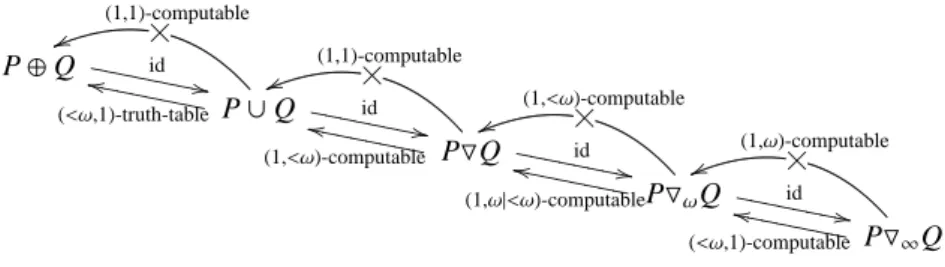
P ⊕ Q ≥
11P ∪ Q ≥
11P ▽ Q ≥
11P ▽
ωQ ≥
11P ▽
∞Q .
As observed in Part I [29, Section 4], these binary disjunctions are closely related to the reducibilities ≤
11, ≤
<ωtt,1, ≤
1<ω, ≤
1ω|<ω, and ≤
<ω1, respectively. We employ rather exotic Π
01sets constructed by Jockusch and Soare to separate the strength of these disjunctions. We say that a set A ⊆ N
Nis an antichain if it is an antichain with respect to the Turing reducibility ≤
T. In other words, f is Turing incomparable with g, for any two distinct elements f , g ∈ A. A nonempty closed set A ⊆ N
Nis perfect if it has no isolated point.
Theorem 2 (Jockusch-Soare [35]). There exists a perfect Π
01antichain in 2
N.
A stronger condition is sometimes required. For a set P ⊆ N
Nand an element g ∈ N
N, let P
≤Tgdenote the set of all element of P which are Turing reducible to g.
Then, a set A ⊆ N
Nis antichain if and only if A
≤Tg= { g } for every g ∈ A. A set P ⊆ N
Nis independent if P
≤T⊕D= D for every finite subset D ⊂ P.
Theorem 3 (see Binns-Simpson [3]). There exists a perfect independent Π
01subset of 2
N.
On the other hand, in Section 3.1, we will see that our hierarchy of disjunctions
collapses for homogeneous sets, which may be regarded as an opposite notion to an-
tichains and independent sets.
2.1. The Disjunction ⊕ versus the Disjunction ∪
We first separate the strength of the coproduct (the intuitionistic disjunction) ⊕ and the union (the classical one-tape disjunction) ∪ . This automatically establish the LEVEL 3 separation result between [C
T]
11and [C
tt]
<ω1. Recall that a set P ⊆ N
Nis special if it is nonempty and it contains no computable points.
Lemma 4. Let P
0, P
1be Π
01subsets of 2
N, and let Q be a special Π
01subset of 2
N. Assume that there exist f ∈ P
0and g ∈ P
1with Q
≤Tf⊕g= Q
≤Tf∪ Q
≤Tgsuch that Q
≤Tfand Q
≤Tgare separated by open sets. Then Q ≰
11(P
0⊗ 2
N) ∪ (2
N⊗ P
1).
Proof. Suppose that Q ≤
11(P
0⊗ 2
N) ∪ (2
N⊗ P
1) via a computable functional Φ . Then f ⊕ g ∈ (P
0⊗ 2
N) ∪ (2
N⊗ P
1). By our choice of f and g, Φ ( f ⊕ g) must belong to Q
≤Tf⊕g= Q
≤Tf∪ Q
≤Tg. By our assumption, Q
≤Tfand Q
≤Tgare separated by two disjoint open sets U , V ⊆ 2
N. That is, Q
≤Tf⊆ U, Q
≤Tg⊆ V, and U ∩ V = ∅ . Therefore, either Φ ( f ⊕ g) ∈ Q ∩ U or Φ ( f ⊕ g) ∈ Q ∩ V holds. In any case, there exists an open neighborhood [ σ ] ∋ Φ ( f ⊕ g) such that [ σ ] ⊆ U or [ σ ] ⊆ V. Without loss of generality, we can assume [ σ ] ⊆ U. We pick initial segments τ
0⊂ f and τ
1⊂ g with Φ ( τ
0⊕ τ
1) ⊇ σ . Then ( τ
0⌢0
N) ⊕ g ∈ (P
0⊗ 2
N) ∪ (2
N⊗ P
1), and it is Turing equivalent to g. However this is impossible because Φ ( τ
0⌢0
N⊕ g) ∈ [ σ ], and [ σ ] ∩ Q
≤Tg⊆ U ∩ Q
≤Tg= ∅ . □ Corollary 5. 1. There are Π
01sets P , Q ⊆ 2
Nsuch that P ∪ Q <
11P ⊕ Q.
2. There are Π
01sets P , Q ⊆ 2
Nsuch that P ≡
<ωtt,1Q and P <
11Q.
Proof. (1) Let R be a perfect independent Π
01subset of 2
N. Set P = 2
N⊗ R and Q = R ⊗ 2
N. Note that P ⊕ Q ≡
11R. Pick f , g ∈ R such that f , g. Then R
≤Tf= { f } , R
≤Tg= { g } , and R
≤Tf⊕g= R
≤Tf⊔ R
≤Tg= { f , g } . Since 2
Nis Hausdor ff , two points f and g are separated by open sets. Thus, P ⊕ Q ≡
11R ≰
11P ∪ Q by Lemma 4. (2)
P ⊕ Q ≡
<ωtt,1P ∪ Q <
11P ⊕ Q. □
Remark. One can adopt the unit interval [0 , 1] as our whole space instead of Cantor space 2
N. Then, P
0† P
1: = (P
0× [0 , 1]) ∪ ([0 , 1] × P
1) is connected as a topological space. If P
0⊆ [0 , 1] is homeomorphic to Cantor space, then the connected space P
0† P
0is sometimes called the Cantor tartan. The above proof shows that every perfect independent Π
01set R ⊆ [0 , 1] is not (1 , 1)-reducible to the obtained tartan R † R, while these sets are ( < ω, 1)-tt-equivalent. Note that the tartan plays an important role on the constructive study of Brouwer’s fixed point theorem (see [10]).
2.2. The Disjunction ∪ versus the Disjunction ▽
We next separate the strength of the union ∪ and the concatenation (the LCM dis- junction with mind-change-bound 2) ▽ . Moreover, we also see the LEVEL 3 separation between [C
tt]
<ω1and [C
T]
1<ω.
Lemma 6. Let P
0, P
1be Π
01subsets of 2
N, and let Q be a special Π
01subset of 2
N.
Assume that there exist f ∈ P
0and g ∈ P
1such that any h ∈ Q
≤Tfand Q
≤Tgare
separated by open sets. Then Q ≰
11P
0⌢P
1.
Proof. Suppose that Q ≤
11P
0⌢P
1via a computable functional Φ . By our choice of f ∈ P
0⊆ P
0⌢P
1, there must exist an open set U ⊆ 2
Nsuch that Φ ( f ) ∈ Q ∩ U and Q
≤Tg∩ U = ∅ . Since U is open there exists a clopen neighborhood [ σ ] ∋ Φ ( f ) such that [ σ ] ∩ Q ⊆ U. We pick an initial segment τ ⊂ f with Φ ( τ ) ⊇ σ . Since f ∈ P
0holds, we have that τ ∈ T
P0, and we pick ρ ∈ L
P0extending τ . Then ρ
⌢g ∈ P
0⌢P
1, and ρ
⌢g is Turing equivalent to g. So, if Q ≤
11P
0⌢P
1via Φ , then Φ ( ρ
⌢g) must belong to Q
≤Tg. However this is impossible because Φ ( ρ
⌢g) ∈ [ σ ], and [ σ ] ∩ Q
≤Tg⊆ U ∩ Q
≤Tg= ∅ . □ Corollary 7. There are Π
01sets P , Q ⊆ 2
Nsuch that P
⌢Q <
11P ∪ Q <
11P ⊕ Q.
Proof. Assume that R be a perfect Π
01antichain of 2
N. Set P = 2
N⊗ R and Q = R ⊗ 2
N. Pick f , g ∈ R such that f , g. Then R
≤Tf= { f } and R
≤Tg= { g } since R is antichain. Therefore, (P ∪ Q)
≤TX⊆ ( { X } ⊗ 2
N) ∪ (2
N⊗ { X } ) for each X ∈ { f , g } . For h = h
0⊕ h
1∈ (P ∪ Q)
≤Tf, we have h
0, g and h
1, g. Thus, h < (2
N⊗ { g } ) ∪ ( { g } ⊗ 2
N), and note that (2
N⊗ { g } ) ∪ ( { g } ⊗ 2
N) is closed. Then, there is an open neighborhood U ⊆ 2
Nsuch that h ∈ U and U ∩ (P ∪ Q)
≤Tg= ∅ , since P ∪ Q is regular, and (P ∪ Q)
≤Tg⊆ (2
N⊗ { g } ) ∪ ( { g } ⊗ 2
N). Namely, any h ∈ (P ∪ Q)
≤Tfand (P ∪ Q)
≤Tgare separated by some open set. Consequently, by Lemma 6, we have P ∪ Q ≰
11P
⌢Q. □ One can establish another separation result for the concatenation. Recall from [12]
that a closed set P ⊆ N
Nis immune if T
Pextcontains no infinite c.e. subset. In [12] it is shown that the class of non-immune Π
01subsets of Cantor space is downward closed in the Medvedev degrees P
11. This property also holds in a coarser degree structure. In Part I [29, Section 2.4] we have seen that P
<ωtt,1is an intermediate structure between P
11and P
1<ω.
Lemma 8. Let P and Q be Π
01subsets of 2
N. If P is not immune, and Q ≤
<ωtt,1P, then Q is not immune.
Proof. Let V be an infinite c.e. subset of T
Pext. Assume that Q ≤
<ωtt,1P holds via n truth- table functionals {Γ
i}
i<n. Note that every functional Γ
ican be viewed as a computable monotone function from 2
<ωinto 2
<ω. Let V
kbe the c.e. set V ∩ ∩
i<k