Analysis Instruments in the Life Sciences
There is a need to make effective use of new, advanced measurement and analysis instruments to exploit innovations in life sciences. The Science and Technology Foresight Center conducted a written survey and held a workshop for experts to study Japanese researchers’ awareness of the use of advanced measurement and analysis instruments.
The survey found that in life sciences, the degree of dependence to foreign countries, especially to the United States, for advanced measurement and analysis instruments in Japan is much higher than in other research fields. The state-of-the- art instruments supplied by foreign companies are standardizing over the domestic products. Japanese researchers tend to actively utilize the foreign-made instruments to collect high-quality data for international publications. Approximately 40% of the survey respondents feel the price gap between the instruments provided by Japanese and foreign manufacturers, especially the U.S., companies.
The main subject of discussion at the workshop was the domestic-overseas price gap. Total costs of producing the foreign-made instruments are composed of diverse fixed and variable costs. Among them, costs for the import procedures, the maintenance and inspection and so on, help Japanese researchers purchase and use these instruments efficiently. The first thing Japanese researchers need to do in order to narrow the domestic-overseas price gap is for many of them to recognize that there is indeed a price gap between the instruments made in Japan and foreign countries. Furthermore, we need to create a market to compete with foreign-made instruments, such as by stimulating the used instruments market and accelerating the development of Japanese-made instruments.
(Original Japanese version: published in July/August 2012)
Figure : How do instrument prices in Japan compare to other countries?
Compiled by the Science and Technology Foresight Center 11
6 20
25
22 5
9 14
13 13
6 8
2 3 2
51 72
64 53
vs U.S.
vs Asia vs Europe vs U.S.
nc e Li fe S ci en ce
Considerabl y Expensive 20-30%
More Expensive Roughly Same 20-30%
Cheaper
9 7
15 23
13 14
4 3
59 53
0% 20% 40% 60% 80% 100%
vs Asia vs Europe
N on -L ife S ci en
Considerabl y Cheap No Answer
Distribution of Responses Given (%)
Life Science: n=64
Non-Life Science: n=164
3
Japanese Researchers' Awareness Concerning the Use of Advanced Measurement and Analysis Instruments in the Life Sciences
Kazuhito Akasaka, Yasuko Hayashi and Hiromi Omoe
Life Innovation Unit
Introduction
Measurement and analysis are an important key technology to produce world-leading, original findings. In the scientific community, the memory of a Nobel Prize awarded for the research and development of a mass spectrometer is still fresh in our minds.
In the field of the life sciences, dramatic performance advances in next-generation sequencers now allow us to map enormous amounts of genomic data and identify the genetic causes of diseases. The future will see a need to make effective use of new, advanced measurement and analysis instruments—in accordance with research goals—in order to expand research and development and spur innovation in the life sciences.
In 2003, the Science and Technology Foresight Center (STFC) conducted a survey on the use of life science instruments. The results indicate that a relevant issue is the reliance on foreign-made (i.e. non- Japanese) instruments.
[1]Later on, in 2011, Professor Masashi Yanagisawa at university of Tsukuba raised a question on a newspaper in terms of the price gap between instruments provided in Japan and the United States, which conducted an another written survey on the use of foreign-made instruments in Japan.
The STFC then held a workshop, to which it invited experts with a wide range of perspectives concerning the instruments. After the STFC presented with the results of the latest survey, the participants discussed the current state and issues of use of the instruments and the direction to take in the future.
The main purpose of this report is to present the content of this workshop. Chapter 2 compiles the content of the written survey report, while Chapter 3 summarizes the workshop discussions that revolved around its results. The reader should note that some of
1 the discussions also touched on an interview survey
conducted after the workshop.
Result of the written survey
First, the STFC utilized its network of experts to conduct a written survey on the use of foreign-made instruments and the prices in Japan.
2-1 Written Survey Overview
The registrants in the network, as of March 2011, are 2,196 experts who work in science and technology for industry, government and academia, allowing the STFC to collect a broad range of opinions over the internet. The survey was conducted March 10- 25, 2011. There were 228 respondents, making for a response rate of 10.4%.
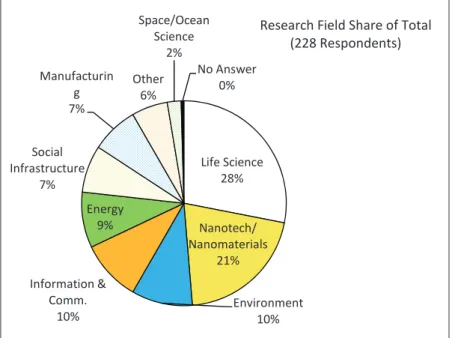
Sixty-four respondents had main backgrounds in life sciences, accounting for 28% of all respondents.
Following life sciences, the major research sectors included nanotechnology/nanomaterials (21%), the environment (10%) and information and communications (10%). The characteristics of the responses in life sciences, were basically highlighted by comparing it with those given from whole research sectors except for life sciences.
It should be noted that the term “instrument” in this report refers to advanced measurement and analysis equipments such as electron microscopes, mass spectrometers, X-ray analyzers, nuclear magnetic resonance spectrometers, DNA amplifiers, DNA sequencers and SNP analyzers. Instruments provided by companies based in the U.S. are called “American instruments.” Likewise, instruments supplied by companies based in Europe, Asia (excluding Japan) and Japan are called “European instruments,” “Asian instruments” and “Japanese instruments,” respectively.
2
Figure 1 : Written Survey Respondent Field of Research Breakdown Compiled by the Science and Technology Foresight Center
In the 2003 survey,
[1]the share of Japanese instruments used was lower in the life sciences compared to other fields of research such as nanotechnology/nanomaterials, indicating heavy usage of foreign-made instruments.
When respondents were asked whether the proportion of foreign-made instruments they use had changed in the past five years, 41% of those in life sciences answered it had “increased considerably” or
“increased somewhat.” By contrast, only 18% gave these responses in other fields, while 72% stated that their usage was unchanged (see Figure 2). These data shows that it tends to use foreign-made instruments
2-3 Particularly Heavy Use of American Instruments
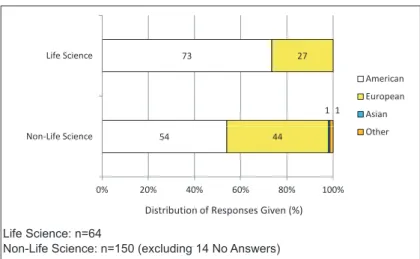
When asked which foreign-made instruments (“American,” “European,” “Asian” or “other countries’”), the results showed that “American”
instruments were used the most by 73% of respondents who work in the life sciences, followed by “European” at 27%. No respondents acknowledged using “Asian” or “other countries’” instruments more than any others. Outside of the life sciences, on the other hand, “American” instruments were most likely to be used the most by respondents, at 54% (see Figure 3). These data suggests that life sciences make
Life Science 28%
Social Infrastructure
Manufacturin g 7%
Other 6%
Space/Ocean Science
2%
No Answer 0%
Research Field Share of Total (228 Respondents)
28%
Nanotech/
Nanomaterials 21%
Environment 10%
Information &
Comm.
10%
Energy 9%
7%
3 38 55 5
Life Science
Increased Considerabl y Increased Somewhat Unchanged
Decreased
3 15 72 7 2
0% 20% 40% 60% 80% 100%
Non-Life Science Somewhat
Decreased Considerabl y
Distribution of Responses Given (%)
Figure 2 : How has the amount of foreign-made instruments you use changed in the past 5 years?
Compiled by the Science and Technology Foresight Center Life Science: n=64
Non-Life Science: n=149 (excluding 15 No Answers)
33 29
18 27
10 10 2
26 16
5 4
2 4
4 3
2 5
0% 20% 40% 60% 80% 100%
Non-Life Science Life Science
Superior Performance Standard in the Field
Can Obtain Highly Reliable and Reproducible Experimental Data After-Sales Reliability and Continuity
No Japanese Instruments in the Market Good Cost Performance
Ease of Use (incl. Instrument Maintenance, Consumables, etc.) Cheaper than Japanese Instruments
Other
Distribution of Responses Given (%)
heavier use of American instruments than other fields of research.
2-4 Foreign-Made Instruments Chosen for Both Performance and Prevalence
Respondents were allowed to make multiple selections to answer why they choose to use foreign- made instruments. Together, “superior performance”
and “the standard in the research field” made up over half the selections, at 29% and 27%, respectively.
These were followed by “no Japanese instruments in the market” and “can obtain highly reliable
and reproducible experimental data,” showing that foreign-made instruments are selected both for their performance and prevalence (see Figure 4). Few respondents chose the other selections, reflecting researchers in life sciences rarely choose the equipment from points of views such as the maintenance service, the price, and the ease of use.
Compared to other fields of research, a high proportion of respondents in life sciences selected “the standard in the field,” while few chose “no Japanese instruments in the market.” These results show that in life sciences, the standardization of foreign-
73 27
1 1 Life Science
American European Asian
54 44
0% 20% 40% 60% 80% 100%
Non-Life Science Other
Distribution of Responses Given (%)
Life Science: n=64
Non-Life Science: n=150 (excluding 14 No Answers)
Figure 3 : What country produces most of the foreign-made instruments you use?
Compiled by the Science and Technology Foresight Center
Life Science: n=119 (multiple responses) Non-Life Science: n=267 (multiple responses)
Figure 4 : Why did you select the foreign-made instruments you use?
(Select top two choices.)
Compiled by the Science and Technology Foresight Center
made instruments has been proceeding over those made in Japan, and researchers prefer to collect data using foreign-made instruments for the international publications.
2-5 Roughly 40% Sees Especially Large Price Gap between Japan and the U.S.
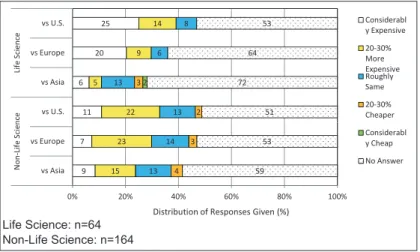
When asked about the cost of purchasing foreign- made instruments in Japan, 39% of respondents answered that it was either “considerably expensive”
or “20-30% more expensive” than doing so in the U.S. In the same question, 29% of respondents gave these same answers regarding purchases in Europe and 11% regarding purchases in Asia outside of Japan.
Compared to other fields of research, there was a more striking recognition in life sciences of a price gap, particularly between Japanese and American instruments (see Figure 5).
However, over half of respondents chose “no answer”
to these questions. The authors believe that many researchers may be in a setting that makes it difficult for them to obtain information on instrument prices overseas.
2-6 Summary
The results of the written survey show a tendency to make heavy use of foreign-made instruments in life sciences, particularly American instruments.
Researchers mainly choose foreign-made instruments because of their good performance as well as because of their prevalence and their status as the international standard. These results conform with the results of the 2003 survey.
[1]Furthermore, compared to researchers in other fields of research, a high proportion of those in the life sciences feel that there is a foreign-made
instrument price gap between Japan and the U.S.
In the 2003 survey as well,
[1]a large proportion of respondents from the life sciences answered that instrument prices in Japan are even higher than in the U.S. These results indicate that there have not been any major changes since the latest survey in the reasons why researchers opt for foreign-made instruments or their perception of prices. Within the scope of examples in the STFC’s preliminary survey, prices of American instruments in Japan are around twice as expensive as in the U.S., but this is roughly equal to other places outside the U.S., thus not contradicting the results of the abovementioned survey.
Instrument Price-Focused Discussions
Next, the STFC organized a workshop to which it invited experts with a range of perspectives concerning instruments (users, purchasing/
management, development, etc.) in order to add some multifaceted considerations of current issues concerning the use of instruments and the direction to take in the future. There were 15 participants in all. In addition to the chair, Dr. Masashi Yanagisawa, there were two university professors, four from the research promotion and management departments of university and public research institutes, four from company R&D departments and four government officials.
First, after presenting the results of the written survey, they entered a discussion on the use of instruments and related issues. All participants had fairly similar recognition of the heavy use of foreign- made instruments, so their discussion on this topic
Figure 5 : How do instrument prices in Japan compare to other countries?
Compiled by the Science and Technology Foresight Center
11 6
22 5
13 13
2 3 2
51 72
vs U.S.
vs Asia
nceLife Expensive
Roughly Same 20-30%
Cheaper
9 7
15 23
13 14
4 3
59 53
0% 20% 40% 60% 80% 100%
vs Asia vs Europe
Non-Life Scien
Considerabl y Cheap No Answer
Distribution of Responses Given (%)
Life Science: n=64 Non-Life Science: n=164
3
merely confirmed the facts. Much of the time was spent discussing the price gaps between Japan and other countries. This chapter will summarize the participants’ recognition of the current state of affairs and their awareness of problems related to the domestic-overseas price gap, as well as ideas for steps to resolve issues.
3-1 Lack of Opportunities for Many Researchers and Purchasing Managers to Learn of Instrument Prices Overseas
Most of the respondents in Figure 5 gave no answer.
It suggests that most researchers and purchasing managers are not in a position to know the prices of instruments overseas, and such a situation on the demand side is a reason why there is not an active discussion over the domestic-overseas instrument price gap.
< Key Discussion Points >
・ Many researchers do not know the actual selling price of instruments in Japan or abroad. Even insiders in the U.S. have experienced refusal on the part of their affiliated institutes to disclose instrument prices.
・ The job of the researcher is merely to select the needed instrument. Typically, the relevant department in charge handles price negotiations, in which the researcher does not have an opportunity to be involved.
3-2 Domestic Prices are Inevitably Higher
Generally, the Japanese subsidiary of an overseas manufacturer is the importer of a foreign-made instrument, which is then sold to clients through a domestic dealer. Since import processes generate various costs, domestic prices are inevitably somewhat higher than overseas. The main costs that push up prices are purchasing, exchange rates, and legal compliance work and personnel expenses added on to sales and maintenance.
< Key Discussion Points >
・ The Japanese subsidiaries that import instruments also play roles as import procedure agents, refer maintenance services, etc. Shifting these costs push up prices. It is rather uncommon for a purchaser to interact directly, for example by directly corresponding in English or paying airfare to
bring over a technician when a directly imported instrument breaks.
・ The exchange rate used for catalog prices are set to mitigate the risk of a rate fluctuation that could make the yen somewhat cheaper. Thus, the value of the yen is generally set lower than the actual exchange rate.
・ The participants cited supplementary sales and maintenance work such as manual translation, advertising expenses, maintenance training seminars, demonstration instrument purchasing/
maintenance/relocation, service parts storage and preparing backup instruments.
・ Regulations must be followed in any country, with laws in Japan such as the Electrical Appliance and Material Safety Act and the Poisonous Material Control Law. Datasheets on the safety of reagents and other documents must be translated into Japanese.
・ Personnel expenses include paying for procedures to import an instrument and quality checks.
・ In addition to the above, each company involved in the processes between import and sale take their cut, thus raising the end price.
・ Instrument purchase prices can vary even if maintenance service costs are included. In Japan, instrument prices are often set under the assumption that there will be some small amount of maintenance. In the U.S., the price only includes the cost of the instrument itself and a separate contract must be concluded for maintenance services.
3-3 Scope to Narrow the Domestic-Overseas Price Gap
While there are factors behind the domestic-overseas price gap other than those listed in Section 3-2, it is suggested there is scope to narrow the gap from its present size. When a Japanese researcher learns about market prices overseas, it can result in a lower price during negotiation. If the manufacturer feels that the market holds promise for the future, they may sell the instrument for a low price.
< Key Discussion Points >
・ There have been cases in which dealers parallel import instruments that have been quoted at nearly double the price in the U.S., which they then sell for around half the quoted price.
・ The laboratory of a Chinese researcher who returned
price was approximately the same is that in China, these transactions are handled in U.S. dollars, thus eliminating any foreign exchange issues. However, this does not fully explain the lower price than in the U.S. It is thought that it could be because U.S.
manufacturers want to enter China's vast market.
3-4 Other Opinions
There are many factors hindering the fall of instrument prices in the Japanese market. These include the market structure, the number of rival manufacturers, and the poor alternatives for bidding on the candidates for purchasing models.
< Key Discussion Points >
・ Many of the top-selling companies in the domestic market in 2001 were from the U.S. or Europe. In life sciences, foreign firms account for a particularly high share.
[2]The market mechanisms that rely on foreign-made instruments make it difficult to hold instrument prices down.
・ Laser microscopes are one type of instruments for which there is no domestic-overseas price gap, but this is because there are no international competitors to domestic manufacturers. Meanwhile, the price of endomicroscopes in Japan is twice that in the U.S. because there are no Japanese manufacturers competing in this field.
・ In the case of expensive instruments such as next- generation sequencers, there are few candidates to choose from and few venders handling them, leaving little room for multiple bids.
3-5 Workshop Summary and Future Direction The workshop allowed the participants to share information on the current state of affairs, which included instrument prices in overseas markets and purchasing by other research institutes. Nearly all participants said that first of all, researchers need to be made aware of the domestic-overseas price gaps for foreign-made instruments. For example, if a handy information source for checking overseas prices were made available, then researchers could negotiate prices after referencing going market rates.
There are numerous factors that go into setting the prices of foreign-made instruments. Many participants
made instruments more efficiently. Meanwhile, workshop participants used their past experience to determine that it is possible to shrink the current domestic-overseas price gap. It was pointed out that vendees need to learn as much as they can about the instrument prices in overseas markets and make effective use of research funds.
Participants said that in the near-term, the first step towards making more effective use of foreign-made instruments would be to stimulate the used instrument market, which is an established market in the U.S.
bioventures, for example, helps new companies procure low-cost instruments. Next, participants were of the opinion that special zones should be made and that companies, universities, research institutes and other organizations within an area should be allowed to easily share and relocate instruments. Furthermore, if multiple universities, for example, were to team up and increase their purchasing power to order large amount of products constantly, then participants thought that could bring prices down. In the long- term, they pointed out the importance of encouraging domestic instrument development and creating a market to compete with foreign-made instruments.
Conclusion
From the results of the written surveys and the opinions of workshop participants, it is suggested that perhaps half the people working in life sciences are in an environment that makes it difficult to obtain information on overseas instrument prices. The authors expect that this report will be used as a chance to share information with as many people in this field as possible.
4
S C I E N C E & T E C H N O L O G Y T R E N D S
[1] Isamu Nakatsuka, Shinji Yokota, Terutaka Kuwahara, “The Current State of Advanced Measurement and Analysis Instruments and Future Issues – Science and Technology Expert Network Written Survey Results.”
National Institute of Science and Technology Policy, Ministry of Education, Culture, Sports, Science and Technology, July 2003 (Survey Materials, pg. 98)
[2] 2002 Scientific Instrument Almanac, R&D Co., Ltd.
The top positions of overseas makers in 2010 domestic sales of life science instruments was reported to the fifth meeting of the Advanced Measurement and Analysis Technology and Instrument Development Subcommittee, Research and Development Platform Committee, Advanced Research Infrastructure Task Force, Science and Technology and Council, Ministry of Education, Culture, Sports, Science and Technology.
http://www.mext.go.jp/b_menu/shingi/gijyutu/gijyutu17/003/shiryo/__icsFiles/afieldfile/2012/06/12/1321834_4.
pdf References
Kazuhito AKAsAKA
Research Scientist, Science and Technology Foresight Center http://www.nistep.go.jp/index-j.html
Kazuhito Akasaka has been in his present post since 2010, after having engaged in drug creening, protein expression and purification, as well as research on peptides and other subjects at a pharmaceutical company. He is mainly studying research trends concerning life science in general, including medical care, health and food. Akasaka is a Doctor of Medical Science.
(Original Japanese version: published in July/August 2012) Profiles
Yasuko HAYAsHi
Life Innovation Unit
Visiting Fellow, Science and Technology Foresight Center (until March 2012)
A Doctor of Agriculture, Yasuko Hayashi is a certified Science Communicator by the National Museum of Nature and Science. After researching in the department of medicine at an American university for a few years, she is now assisting with research at a university. Hayashi hopes to help create an environment in which researchers can devote themselves to their work.
Hiromi OMOE
Life Innovation Unit
Senior Research Fellow, Science and Technology Foresight Center http://www.nistep.go.jp/
Hiromi Omoe has a D.V.M. and Ph.D. in Agriculture. She studied the molecular pathology of human and animal diseases before obtaining her current position. Omoe is interested in science and technology policies to secure the security of necessities for our survival such as food, microorganisms and chemical compounds.
科 学 技 術 動 向 2012 年 7・8 月号
15
アンケート調査の結果からもワークショップ参加者の意見から も、半数程度のライフサイエンス
関係者は海外での機器価格情報を 得にくい環境にいる可能性が考え られる。できるだけ多くのライフ
サイエンス関係者と情報を共有す る機会の一つとして、本レポート が活かされることを期待する。
1) 中塚勇、横田慎二、桑原輝隆、「先端的計測・分析機器の現状と今後の課題~科学技術専門家ネットワーク アンケート 調査結果~」、文部科学省科学技術政策研究所、2003 年 7 月(調査資料–98)
2) 科学機器年鑑 2002、(株)アールアンドディー社
文部科学省 科学技術・学術審議会 先端研究基盤部会 研究開発プラットフォーム委員会 先端計測分析技術・機 器開発小委員会(第 5 回)では、2010 年のライフサイエンス関連機器の国内販売実績は、海外メーカーが上位を占め ているという状況が報告されている。
http://www.mext.go.jp/b_menu/shingi/gijyutu/gijyutu17/003/shiryo/__icsFiles/afieldfile/2012/06/12/1321834_4.pdf
赤坂 一人
ライフイノベーションユニット 科学技術動向研究センター 特別研究員 http://www.nistep.go.jp/index-j.html
製薬企業において薬剤スクリーニング・蛋白質発現精製・ペプチドなどの探索研究に 従事し、2010年より現職。医療・健康・食などのライフサイエンス全般に関する研 究動向について主に調査中。博士(医学)。
林 康子
ライフイノベーションユニット
科学技術動向研究センター 客員研究官(2012年3月まで)
農学博士。国立科学博物館認定サイエンスコミュニケータ。米国大学医学部にて数年 間の研究活動を経て、現在は大学で研究支援に従事。研究者が研究に専念できる環境 づくりに貢献したいと考えている。
重茂 浩美
ライフイノベーションユニット 科学技術動向研究センター 上席研究官 http://www.nistep.go.jp/
獣医師、博士(農学)。ヒトや動物の疾病に関する分子病理学的研究に従事後、現職。
食品、微生物、化学物質等の生活環境因子に係る安全確保のための科学技術政策に興 味をもつ。
4
まとめ参考文献
執筆者プロフィール
科 学 技 術 動 向 2012 年 7・8 月号
15
アンケート調査の結果からもワークショップ参加者の意見から も、半数程度のライフサイエンス
関係者は海外での機器価格情報を 得にくい環境にいる可能性が考え られる。できるだけ多くのライフ
サイエンス関係者と情報を共有す る機会の一つとして、本レポート が活かされることを期待する。
1) 中塚勇、横田慎二、桑原輝隆、「先端的計測・分析機器の現状と今後の課題~科学技術専門家ネットワーク アンケート 調査結果~」、文部科学省科学技術政策研究所、2003 年 7 月(調査資料–98)
2) 科学機器年鑑 2002、(株)アールアンドディー社
文部科学省 科学技術・学術審議会 先端研究基盤部会 研究開発プラットフォーム委員会 先端計測分析技術・機 器開発小委員会(第 5 回)では、2010 年のライフサイエンス関連機器の国内販売実績は、海外メーカーが上位を占め ているという状況が報告されている。
http://www.mext.go.jp/b_menu/shingi/gijyutu/gijyutu17/003/shiryo/__icsFiles/afieldfile/2012/06/12/1321834_4.pdf
赤坂 一人
ライフイノベーションユニット 科学技術動向研究センター 特別研究員 http://www.nistep.go.jp/index-j.html
製薬企業において薬剤スクリーニング・蛋白質発現精製・ペプチドなどの探索研究に 従事し、2010年より現職。医療・健康・食などのライフサイエンス全般に関する研 究動向について主に調査中。博士(医学)。
林 康子
ライフイノベーションユニット
科学技術動向研究センター 客員研究官(2012年3月まで)
農学博士。国立科学博物館認定サイエンスコミュニケータ。米国大学医学部にて数年 間の研究活動を経て、現在は大学で研究支援に従事。研究者が研究に専念できる環境 づくりに貢献したいと考えている。
重茂 浩美
ライフイノベーションユニット 科学技術動向研究センター 上席研究官 http://www.nistep.go.jp/
獣医師、博士(農学)。ヒトや動物の疾病に関する分子病理学的研究に従事後、現職。
食品、微生物、化学物質等の生活環境因子に係る安全確保のための科学技術政策に興 味をもつ。
4
まとめ参考文献
執筆者プロフィール
15
ライフサイエンスにおける先端的計測・分析機器の使用に関する国内研究者意識科 学 技 術 動 向 2012 年 7・8 月号
アンケート調査の結果からも ワークショップ参加者の意見から も、半数程度のライフサイエンス
関係者は海外での機器価格情報を 得にくい環境にいる可能性が考え られる。できるだけ多くのライフ
サイエンス関係者と情報を共有す る機会の一つとして、本レポート が活かされることを期待する。
1) 中塚勇、横田慎二、桑原輝隆、「先端的計測・分析機器の現状と今後の課題~科学技術専門家ネットワーク アンケート 調査結果~」、文部科学省科学技術政策研究所、2003 年 7 月(調査資料–98)
2) 科学機器年鑑 2002、(株)アールアンドディー社
文部科学省 科学技術・学術審議会 先端研究基盤部会 研究開発プラットフォーム委員会 先端計測分析技術・機 器開発小委員会(第 5 回)では、2010 年のライフサイエンス関連機器の国内販売実績は、海外メーカーが上位を占め ているという状況が報告されている。
http://www.mext.go.jp/b_menu/shingi/gijyutu/gijyutu17/003/shiryo/__icsFiles/afieldfile/2012/06/12/1321834_4.pdf
赤坂 一人
ライフイノベーションユニット 科学技術動向研究センター 特別研究員 http://www.nistep.go.jp/index-j.html
製薬企業において薬剤スクリーニング・蛋白質発現精製・ペプチドなどの探索研究に 従事し、2010年より現職。医療・健康・食などのライフサイエンス全般に関する研 究動向について主に調査中。博士(医学)。
林 康子
ライフイノベーションユニット
科学技術動向研究センター 客員研究官(2012年3月まで)
農学博士。国立科学博物館認定サイエンスコミュニケータ。米国大学医学部にて数年 間の研究活動を経て、現在は大学で研究支援に従事。研究者が研究に専念できる環境 づくりに貢献したいと考えている。
重茂 浩美
ライフイノベーションユニット 科学技術動向研究センター 上席研究官 http://www.nistep.go.jp/
獣医師、博士(農学)。ヒトや動物の疾病に関する分子病理学的研究に従事後、現職。
食品、微生物、化学物質等の生活環境因子に係る安全確保のための科学技術政策に興 味をもつ。
4
まとめ参考文献
執筆者プロフィール