Joint Symposium Proceeding: Polysemy and Synonyms: How to teach to remember and oboeru from the perspective of Japanese language education
journal or
publication title
Journal of Research and Pedagogy of Otemae university Institute of International
Education
volume 5
page range 029‑036
year 2019‑03‑31
URL http://id.nii.ac.jp/1160/00001961/
How to teach Polysemy and Synonyms: How to teach “to remember”
and “oboeru” from the perspective of Japanese language education
Eri Kato
Otemae University
Reference Data:
Kato, E. (2019). How to teach Polysemy and Synonyms: How to teach “to remember” and “oboeru” from the perspective of Japanese language education. In K. Tanaka & D. Tang (Eds.), Journal of Research and Pedagogy Volume V: Global Englishes and Cross Cultural Education. Otemae University Institute of International Education.
Abstract
Looking at the textbook of the Japanese language, the English translation of the Japanese verb "oboeru" has been applied to mean "remember," "learn," "memorize," or "feel." "Oboeru" is a polysemous word, but since it does not have all the meanings represented by these English words, it is hard for the learner to understand what "oboeru" means.
Therefore, in this paper, I clarify several meanings of "oboeru" and their relevance, and propose how to explain ambiguous words from the viewpoint of Japanese language education. Also, I consider the synonyms "oboeru" and
"remember," and also propose how to explain similarities and differences between meanings of these synonyms.
日本語の教科書を見ると、動詞「覚える」の説明に
“remember,” “learn,” “memorize,” “feel”等の英訳が当 てられている。「覚える」は多義語であるが、それらの英単語が表す意味をすべて有しているわけで はないため、学習者は「覚える」がどのような意味なのかを理解しづらい。よって、本研究では「覚 える」が有する複数の意味とそれらの関連性について明らかにし、日本語教育の観点から多義語の説 明の仕方について提案する。また、類義語である「覚える」と
“remember”を取り上げ、類義語の意味 の類似点と相違点の説明の仕方についても提案する。
Foreign students who are Japanese learners study the verb "oboeru" at the beginner level. Looking at Japanese textbooks and reference books, English words such as “remember,” “learn,” “memorize,” “feel,” and others are used to explain the verb “oboeru.” In fact, the verb “oboeru” is an example of polysemy, but it does not have all the meanings represented by those English words, so learners can find it hard to understand what “oboeru” means. Therefore, this research clarifies several meanings of “oboeru” and their relevance, and it further proposes an explanation of cases of polysemy from the perspective of Japanese language education. Finally, it takes up the specific example of “oboeru”
to explain similarities and differences between synonym meaning of “oboeru” and “remember.”
This paper is structured into five parts. First, the paper outlines the metaphors (“metaphor,” “metonymy,” and
“synecdoche”) which are the theoretical background of analysis in section two. In section three, this paper offers pedagogical tactics on how to teach ambiguous words through the example of “oboeru.” In section four, the paper takes
up the case of teaching synonyms by comparing “oboeru” and “remember” as examples. Finally, the last section contains the paper’s conclusion.
Metaphor
The relevance of the word “oboeru” as an example of polysemy must be considered from multiple linguistic functions, in particular those of metaphor, metonymy, and synecdoche. Momiyama (2009, 2010) defines these terms as follows.
First, metaphor expresses an object or concept by using another form of expression (Momiyama 2010: 35). That is to say, metaphor is “a figure of speech in which one thing is described in terms of another” (Cuddon, 507).
Metonymy, on the other hand, is based on “continuity” between two things, and more broadly a similarity within thought and on the conceptual basis of two things or concepts. That is to say, it represents one thing or concept by using the form representing a different thing or concept (Momiyama 2010: 44). A common example of this is using the term
“crown” to signify a monarchy (Cuddon, 510).
Finally, synecdoche was originally used to express a specialized meaning through a general form; conversely, it indicates expressing a more general meaning by using a form that has a special meaning (Momiyama 2009: 28). That is to say, synecdoche is a figure of speech wherein a part can stand for the whole. For example, in Japanese “gohan”
literally means “rice,” but if a speaker asks “Gohan wo tabemashita ka?” (“Did you eat rice?”) the speaker is literally asking if the listener has had a meal, not only a bowl of rice.
These three figures of speech are directly relevant to the multiple meanings and polysemy of the word “oboeru,”
explained in the next section.
How to teach ambiguities: Using the example “oboeru”
Description of previous research
Looking at Nihongo Kihon Doushi Ziten (Japanese Basic Verb Usage Dictionary), “oboeru” is described as follows:
(1) Keep something in mind so that you do not forget it.
(Ex.) Junko wa eitango o 100ko oboeta. (Junko learned 100 English words.) Inu ga kainushi no namae o oboeru. (A dog remembers the owner's voice.) Denwabango o oboeru. (Learn a phone number.)
(2) It is remembered.
(Ex.) Watashi wa gakuseizidai o yoku oboeteiru. (I remember my school days well.) Kuruma no number o oboeteiru. (I remember my car’s license plate number.)
Kare wa mukashi koko e kitanoo oboeteita. (He remembered that he came here a long time ago.
[Usage] In this sense it is used in the form of “oboeteiru".
(3) Experience a certain thing and learn it.
(Ex.) Iruka ga gei o oboeru. (A dolphin learns tricks.) Kuruma no unten o oboeru. (Learn to drive a car.) Sake no azi o oboeru. (Learn the taste of sake.) (4) I feel some sense and feeling in my body and mind.
(Ex.) Hiroshi wa ashi ni itami o oboeta. (Hiroshi felt a pain in his legs.) Kokoro ni yasuragi o oboeru. (I feel comforting in my heart.) (p.103)
The Nihongo Kihon Doushi Ziten (Japanese Basic Verb Usage Dictionary) states that there are four meanings to the word “oboeru.” First, it notes that it means to “keep something in mind so that you do not forget anything,” but the meaning expressed here means to “make an effort to keep certain things in your mind,” to be more precise. This second statement means that a certain thing is remembered in the learner’s head. It relates to the meaning of memorizing, in the case of the meaning of the first and second uses, and relevance and connection is felt between both. However, the third one does not mean only a mental connection like the first or second meaning. It indicates a meaning of to acquire knowledge through the body. The fourth one expresses feelings and senses, and it is difficult to understand what kind of connection it has with the other three meanings.
In general, elementary level Japanese learners study meanings to memorize certain definitions of the verb such as those examples given in first and second. More intermediate or advanced level Japanese learners will learn the third and fourth meanings of the word. They will wonder why the meanings of the verb “oboeru” include the third and fourth definitions. So, how can teachers of the Japanese language to foreign learners explain these four meanings to make it easier for the learner to understand the meaning of “oboeru?”
Polysemic structure of "oboeru"
When thinking about the relevance of the four meanings of “oboeru,” the descriptions in the Kiso Nihongo Ziten (Basic Japanese Dictionary) is helpful. The Kiso Nihongo Ziten (Basic Japanese Dictionary) describes “oboeru” as follows:
“Oboeru” was derived from an ancient word, “omohoyu.”“Yu” is an ancient auxiliary verb that expresses spontaneity; therefore it corresponds to “seem.” It referred to something that is felt unconsciouly by the subject, or that the subject is aware of unconsciously. “Oboeru” originally was an expression of unconscious susceptibility, but it also came to be used for the action of unconscious memorization, and also came to be used in the act of intentional or conscious memory creation through knowledge and memorization techniques. It moved from sensibility to intellectual activity. (p.259)
From the above description, we can see that the meaning of “oboeru” spread from “sensibility to intelligence activity.”
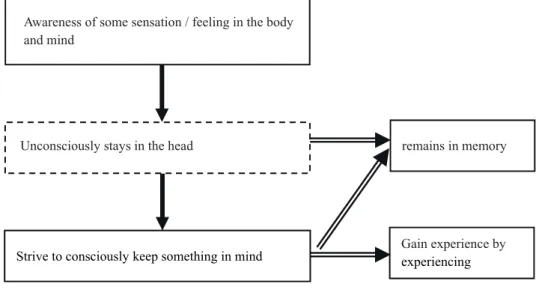
From this point of view, considering the four meanings in the Nihongo Kihon Doushi Ziten (Japanese Basic Verb Usage Dictionary), the polysemic structure of “oboeru” can be described using metaphor, as shown in Fig. 1 below. Here,
solid arrows represent metaphor and double arrows represent metonymy expansion.
Awareness of some sensation / feeling in the body and mind
Unconsciously stays in the head remains in memory
Fig. 1: Polysemy structure of "oboeru"
The meaning of “feeling some sensation or a feeling in the body and mind” in the fourth definition is used as the basic meaning, and the meaning has shifted to include “to memorize unconsciously.” We can conjecture that the meaning is expanded through metaphor from sensibility memories to unconscious memories. The modern usage of “oboeru” does not include the meaning of unconscious memory. However, when thinking about the meaning structure of “oboeru,” it is easier to understand the relationships between other meanings when we include the definition of the word as it relates to “unconscious memories.” With the use of “unconscious memorization” it means “to remain in memory.” The meaning “to remain in memory,” or “remembering,” is expressed by the word “oboeteiru,” with the “teiru” verb ending roughly equivalent to the suffix “ing” in this case. Since the meanings in these two instances are causal, it can be deduced that the meaning has been extended through metonymy. Also, it does not mean only unconsciousness memories but also means to remember consciously. This can be said to represent a semantic extension by metaphor from unconscious to conscious. Furthermore, it can be thought that it extended the meaning to refer to acquire through experience by consciously memorizing something. This can be thought of as a memory by the body including the head, so it can be said to be a meaning extension by metonymy.
By showing the Fig. 1 as given above to the learner of intermediate level Japanese or higher who has learned the basic meaning of “oboeru” as “to remember,” it is possible to explain the meaning of “oboeru” systematically. It is easy for the learner to understand and remember.
With reference to Fig. 1, we can consider the following misuse of “oboeru” by a student of Japanese. The following example is given in the Tagengo bogo no Nihongo gakushū sha ōdan corpus (International Corpus of Japanese as a Second Language: I-JAS).
Strive to consciously keep something in mind Gain experience by experiencing
(5) C: Well, what kind of food did you eat there?
K: Yeah, I don’t remember well, well I don’t remember but… that dish, um, China is, in China, that table, on top of the table, it has lots of food in it, so <Interjection by interviewer: Yes?>, uh, I don’t really remember C: Oh, really? (CCM 05 - I)
(5) C: Haa, sokode, donna ryōri o tabemashitaka?
K: Nn, yoku oboemase, maa oboemasen deshita kedo…, sono ryōri wa, nn chūgoku wa, chūgoku dewa sono teeburu wa, teeburu no ueni, ippai ryōri ga haittemasu kara, (hai), uu, nanka chotto oboemasen desita yone.
C: Aa soudesuka.(CCM05-I)
C is the interviewer, and K is the learner’s remarks. The underlined “I don’t remember” represents the meaning of
"unconsciously staying in my head" in Fig. 1. However, in Japanese, this meaning is not expressed as “oboeru,” so it is necessary to express it using the meaning of “having in memory,” which is the result. Therefore, it should be expressed as “oboeteimasen” rather than oboemasen.
How to teach synonyms: “oboeru” and “remember” as an example
Next, consider the similarities and differences between the meanings of “oboeru” and “remember.”
In the Cambridge Advanced Learner's Dictionary the meaning of “remember” is described as follows.
1. To be able to bring back a piece of information into your mind, or to keep a piece of information in your memory:
“Where did you park the car?” “I can't remember.”
I can remember people's faces, but not their names.
2. Remember to do something or to not forget to do that thing:
Did you remember to do the shopping?
3. Be remembered for something, to be kept in people's memories because of a particular action or quality:
She will be remembered for her courage.
4. To hold a special ceremony on November 11th to honor a past event or those who have died:
The British remember those who died in the two World Wars.
5. To give a present or a sum of money to someone you love or who has provided goods or services to you:
My cousin remembered me in her will.
The polysemy structure described above can be seen in Fig 2. Here, solid arrows represent metaphor and double arrows represent metonymy, while dashed lines represent synecdoche expansion of meaning.
to give a present or a sum of money to someone you love or who has provided goods or services to you
to be kept in people's memories because of a particular action or quality
to hold a special ceremony to honor a past event or those who have died
to not forget to do something
Unconsciously stay in the head to be able to bring back a piece of information into your mind, or to keep a piece of information in your memory
Fig. 2: Polysemy structure of “remember”
“Remember” has a meaning focused on the point of “remember in the head.” It is important to note that, “remember”
does not mean to “unconsciously keep something in your head,” but rather it means “to keep a piece of information in your memory.” These differences can be explained as being caused by metonymy. Also, what is different from “oboeru”
is the ability “to be able to recall piece of information to your mind.” The meaning of “unconsciously staying in the head” is extended by the metaphor to mean making a “conscious effort” to “not forget to do something.” The meaning and semantic extensions to that are the same as can be seen in the case of “oboeru.” What is different in the case of
“oboeru” is the meaning of “to be able to bring back a piece of information into your mind, or to keep a piece of information in your memory” that expands to specific memories of people. The specialization of this meaning can be explained by synecdoche. Furthermore, it extends to the specific meaning of “to hold a special ceremony to honor a past event or someone who has died.” This can also be explained by synecdoche. In addition, the meaning of “to give a present or a sum of money to someone you love who causes an act by remembering that there is a relationship between them,” can be explained by metonymy. In this way, “remember” does not express the sense of meaning like “oboeru”
of meaning to acquire information or memories through experience, but has the meaning of “to be able to recall a piece of information to mind.”
In the following example sentence, the misuse of the Japanese learner is thought to be because the learner misunderstood that “oboeru” has the meaning of “to be able to bring back a piece of information into your mind.”
(6) K: Doing that, uh, a parcel came with my roommate, uh-ummmm, ah, but I don’t want to go to UPS to retrieve up.
Uh, umm… Well, it turned out we had to go, um… well, we went together, um… and… uh…. Yesterday evening…
um… a friend from high school, um… who lives in Tuscan, um… was scheduled to come here, but, um, that friend, um, when he got to Phoenix, it was due at midnight, um, he remembered he had an essay he had an essay that he had to turn in. (EUS14-I)
(6) K: Sore o yatte, eeto, ruumumeito ni eeto, nn, aa yūbin de kozuchiumi ga kimashita ga (n), eeto sore o hirou tameni UPS, ni ikana, kereba naranakatta node, eeto maa, issho ni itte (itte), eeto, de, ano kinou no yoru wa eeto tuuson ni
sundeiru eto kōkō jidai no tomodachii ga (ūn) eeto koko ni kuru yotei desita ga, eeto sono tomodachi ga, eeto fenikkusu ni tuitara, eeto jū-ni-ji ni teishutsu, teishutsu shinakereba eeto sakubun ga aru to oboemashita. (EUS14-I)
Here, “oboemashita” (with the suffix mashita marking past tense) is a misuse of the verb “omoidasimashita,” which more literally means to remember in this case. When explaining the meaning of “oboeru” to learners, it is insufficient to translate it into English by saying “to remember,” but it is necessary to highlight what meanings they share and what meanings the words do not share. It is necessary to teach this. At that time, it is easier for the learner to understand if the teacher utilizes the charts that highlight the polysemic structure.
Conclusion
In this essay, I clarified the four meanings of “oboeru” and their relevance, and proposed how to explain them through the use of polysemy. In addition, I gave the examples of the synonyms embedded in “oboeru” and “remember,” and suggested how to explain similarities and differences between the meanings of these synonyms. To summarize my findings:
1. The meaning of “oboeru” spread from sensibility to intellectual activity.
2. The meaning of “feeling some sensation or feeling in the body and mind” of “oboeru” is used as its basic meaning.
3. By showing the above Fig. 1 to Japanese learners of the intermediate level or higher who learned the meaning of
“oboeru,” it is possible to explain the polysemic meanings of “oboeru” systematically. It is easy for the learner to understand and remember.
4. The similarities and differences between the meanings of “oboeru” and “remember” are that “remember” does not express sensatory meaning like “oboeru” or carry the meaning of to acquire through experience. Rather, it has the meaning of “to be able to bring back a piece of information into your mind.”
5. When explaining the meaning of ”oboeru” to learners, it is insufficient to translate it into English by saying “to remember,” but it is necessary to describe what the words have in common and where they differ. At that point, it is easier for the learner to explain this by using the polysemic structures described in this paper.
Bio Data
Eri Kato (PhD) is a lecturer at Otemae University. Her research interests include Japanese language teaching and linguistics, with a focus on feeling, meaning and semantics and language education. In addition to her work in semantics, she has an interest in effective pedagogies for the instruction of Japanese language education for foreigners.
References
Cambridge Advanced Learner’s Dictionary. 2nd ed. (2005). Cambridge: Cambridge University Press. https:
//japanknowledge.com
Cuddon, J. A. (1998). Dictionary of Literary Terms & Literary Theory. London: Penguin Books.
Koizumi Yasushi (ed.). (1989). Nihongo Kihon Dōshi Jiten (Japanese basic verb usage dictionary). Tokyo: Taisyuukan Shoten.
Yoshiyuki Morita. (1989). Kiso Nihongo Jiten (Basic Japanese Dictionary). Tokyo: Kadokawa Shōgaku Publishing.
Yosuke Momiyama. (2009). Nihongo hyōgen de manabu kiso kara no ninchi gengogaku (Cognitive Linguistics of Introductory Learning of Japanese Expressions). Tokyo: Kenkyūsha.
Yosuke Momiyama. (2010). Ninchi gengogaku Nyūmon (Introduction to cognitive linguistics). Tokyo: Kenkyūsha.