• 検索結果がありません。

Extension and Unification of Singular Perturbation Methods for ODEs Based on the Renormalization Group Method

N/A
N/A
Protected

Academic year: 2021

シェア "Extension and Unification of Singular Perturbation Methods for ODEs Based on the Renormalization Group Method"

Copied!
61
0
0

読み込み中.... (全文を見る)

全文

(1)

Extension and Unification of Singular

Perturbation Methods for ODEs Based on the Renormalization Group Method

Department of Applied Mathematics and Physics Kyoto University, Kyoto, 606-8501, Japan

Hayato CHIBA *1

September 29, 2008; Revised May 1 2009 Abstract

The renormalization group (RG) method is one of the singular perturbation methods which is used in search for asymptotic behavior of solutions of di ff erential equations. In this arti- cle, time-independent vector fields and time (almost) periodic vector fields are considered.

Theorems on error estimates for approximate solutions, existence of approximate invariant manifolds and their stability, inheritance of symmetries from those for the original equation to those for the RG equation, are proved. Further it is proved that the RG method unifies traditional singular perturbation methods, such as the averaging method, the multiple time scale method, the (hyper-) normal forms theory, the center manifold reduction, the geometric singular perturbation method and the phase reduction. A necessary and su ffi cient condition for the convergence of the infinite order RG equation is also investigated.

1 Introduction

Di ff erential equations form a fundamental topic in mathematics and its application to nat- ural sciences. In particular, perturbation methods occupy an important place in the theory of di ff erential equations. Although most of the di ff erential equations can not be solved exactly, some of them are close to solvable problems in some sense, so that perturbation methods, which provide techniques to handle such class of problems, have been long studied.

This article deals with a system of ordinary di ff erential equations (ODEs) on a manifold M of the form

dx

dt = ε g(t , x , ε ) , xM , (1.1)

which is almost periodic in t with appropriate assumptions (see the assumption (A) in

*1
E mail address : [email protected]

(2)

Sec.2.1), where ε ∈ R or C is a small parameter.

Since ε is small, it is natural to try to construct a solution of this system as a power series in ε of the form

x = ˆx(t) = x 0 (t) + ε x 1 (t) + ε 2 x 2 (t) + · · · . (1.2) Substituting Eq.(1.2) into Eq.(1.1) yields a system of ODEs on x 0 , x 1 , x 2 , · · · . The method to construct ˆx(t) in this manner is called the regular perturbation method.

It is known that if the function g(t , x , ε ) is analytic in ε , the series (1.2) converges to an exact solution of (1.1), while if it is not analytic, (1.2) diverges and no longer provides an exact solution. However, the problem arising immediately is that one can not calculate infinite series like (1.2) in general whether it converges or not, because it involves infinitely many ODEs on x 0 , x 1 , x 2 , · · · . If the series is truncated at a finite-order term in ε , another problem arises. For example, suppose that Eq.(1.1) admits an exact solution x(t) = sin( ε t), and that we do not know the exact solution. In this case, the regular perturbation method provides a series of the form

ˆx(t) = ε t − 1

3! ( ε t) 3 + 1

5! ( ε t) 5 + · · · . (1.3)

If truncated, the series becomes a polynomial in t, which diverges as t → ∞ although the exact solution is periodic in t. Thus, the perturbation method fails to predict qualitative prop- erties of the exact solution. Methods which handle such a di ffi culty and provide acceptable approximate solutions are called singular perturbation methods. Many singular perturbation methods have been proposed so far [1,3,6,38,39,43,44,47,50] and many authors reported that some of them produced the same results though procedures to construct approximate solu- tions were di ff erent from one another [9,38,43,44,47].

The renormalization group (RG) method is the relatively new method proposed by Chen, Goldenfeld and Oono [8,9], which reduces a problem to a more simple equation called the RG equation, based on an idea of the renormalization group in quantum field theory. In their papers, it is shown (without a proof) that the RG method unifies conventional singular perturbation methods such as the multiple time scale method, the boundary layer technique, the WKB analysis and so on.

After their works, many studies of the RG method have been done [10-13,16,21,22,26- 32,35,36,42,45,46,48,49,53,55-59]. Kunihiro [28,29] interpreted an approximate solution obtained by the RG method as the envelope of a family of regular perturbation solutions.

Nozaki et al. [45,46] proposed the proto-RG method to derive the RG equation e ff ectively.

Ziane [53] , DeVille et al. [32] and Chiba [10] gave error estimates for approximate solutions.

(3)

Chiba [10] defined the higher order RG equation and the RG transformation to improve error estimates. He also proved that the RG method could provide approximate vector fields and approximate invariant manifolds as well as approximate solutions. Ei, Fujii and Kunihiro [16] applied the RG method to obtain approximate center manifolds and their method was rigorously formulated by Chiba [12]. DeVille et al. [32] showed that lower order RG equa- tions are equivalent to normal forms of vector fields, and this fact was extended to higher order RG equations by Chiba [11]. Applications to partial di ff erential equations are appeared in [16,31,42,45,46,55-59].

One of the purposes of this paper is to give basic theorems on the RG method extending author’s previous works [10-12], in which the RG method is discussed for more restricted problems than Eq.(1.1). At first, definitions of the higher order RG equations for Eq.(1.1) are given and properties of them are investigated. It is proved that the RG method provides approximate vector fields (Thm.2.5) and approximate solutions (Thm.2.7) along with error estimates. Further, it is shown that if the RG equation has a normally hyperbolic invariant manifold N, the original equation (1.1) also has an invariant manifold N ε which is di ff eomor- phic to N (Thms.2.9, 2.14). The RG equation proves to have the same symmetries (action of Lie groups) as those for the original equation (Thm.2.12). In addition, if the original equa- tion is an autonomous system, the RG equation is shown to have an additional symmetry (Thm.2.15). These facts imply that the RG equation is easier to analyze than the original equation. An illustrative example to verify these theorems is also given (Sec.2.5).

The other purpose of this paper is to show that the RG method extends and unifies other tra- ditional singular perturbation methods, such as the averaging method (Sec.4.1), the multiple time scale method (Sec.4.2), the (hyper-) normal forms theory (Sec.4.3), the center manifold reduction (Sec.3.2), the geometric singular perturbation method (Sec.3.3), the phase reduc- tion (Sec.3.4), and Kunihiro’s method [28,29] based on envelopes (Sec.4.4). A few of these results were partially obtained by many authors [9,38,43,44,47]. The present arguments will greatly reveal the relations among these methods.

Some properties of the infinite order RG equation are also investigated. It is proved that

the infinite order RG equation converges if and only if the original equation is invariant under

an appropriate torus action (Thm.5.1). This result extends Zung’s theorem [54] which gives a

necessary and su ffi cient condition for the convergence of normal forms of infinite order. The

infinite RG equation for a time-dependent linear system proves to be convergent (Thm.5.6)

and be related to monodromy matrices in Floquet theory.

(4)

Throughout this paper, solutions of di ff erential equations are supposed to be defined for all tR.

2 Renormalization group method

In this section, we give the definition of the RG (renormalization group) equation and main theorems on the RG method, such as the existence of invariant manifolds and inheritance of symmetries. An illustrative example and comments on symbolic computation of the RG equation are also provided.

2.1 Setting, definitions and basic lemmas

Let M be an n dimensional manifold and U an open set in M whose closure ¯ U is compact.

Let g(t , ·, ε ) be a vector field on U parameterized by tR and ε ∈ C. We consider the system of di ff erential equations

dx

dt = ˙x = ε g(t , x , ε ) . (2.1)

For this system, we make the following assumption.

(A) The vector field g(t , x , ε ) is C 1 with respect to time tR and C with respect to xU and ε ∈ E , where E ⊂ C is a small neighborhood of the origin. Further, g is an almost periodic function with respect to t uniformly in xU and ¯ ε ∈ E ¯ , the set of whose Fourier exponents has no accumulation points on R.

In general, a function h(t , x) is called almost periodic with respect to t uniformly in xU ¯ if the set

T (h , δ ) : = {τ | || h(t + τ, x)h(t , x) || < δ, ∀ tR , ∀ xU ¯ } ⊂ R

is relatively dense for any δ > 0; that is, there exists a positive number L such that [a , a + L]T (h , δ ) ∅ for all aR. It is known that an almost periodic function is expanded in a Fourier series as h(t , x)

a n (x)e i λ

n

t , (i = √

− 1), where λ nR is called a Fourier exponent. See

Fink [20] for basic facts on almost periodic functions. The condition for Fourier exponents in

the above assumption (A) is essentially used to prove Lemma 2.1 below. We denote Mod(h)

the smallest additive group of real numbers that contains the Fourier exponents λ n of an

almost periodic function h(t) and call it the module of h.

(5)

Let

k = 1 ε k g k (t , x) be the formal Taylor expansion of ε g(t , x , ε ) in ε :

˙x = ε g 1 (t , x) + ε 2 g 2 (t , x) + · · · . (2.2) By the assumption (A), we can show that g i (t , x) (i = 1 , 2 , · · · ) are almost periodic functions with respect to tR uniformly in xU such that Mod(g ¯ i ) ⊂ Mod(g).

Though Eq.(2.1) is mainly considered in this paper, we note here that Eqs.(2.3) and (2.5) below are reduced to Eq.(2.1): Consider the system of the form

˙x = f (t , x) + ε g(t , x , ε ) , (2.3) where f (t , · ) is a C vector field on U and g satisfies the assumption (A). Let ϕ t be the flow of f ; that is, ϕ t (x 0 ) is a solution of the equation ˙x = f (t , x) whose initial value is x 0 at the initial time t = 0. For this system, changing the coordinates by x = ϕ t (X) provides

X ˙ = ε ∂ϕ t

X (X) 1

g(t , ϕ t (X) , ε ) : = ε ˜g(t , X , ε ) . (2.4) We suppose that

(B) the vector field g satisfies the assumption (A) and there exists an open set WU such that ϕ t (W)U and ϕ t (x) is almost periodic with respect to t uniformly in xW, the set of ¯ whose Fourier exponents has no accumulation points.

Under the assumption (B), we can show that the vector field ˜g(t , X , ε ) in the right hand side of Eq.(2.4) satisfies the assumption (A), in which g is replaced by ˜g. Thus Eq.(2.3) is reduced to Eq.(2.1) by the transformation xX.

In many applications, Eq.(2.3) is of the form

˙x = F x + ε g(x , ε )

= F x + ε g 1 (x) + ε 2 g 2 (x) + · · · , xC n , (2.5) where

(C1) the matrix F is a diagonalizable n × n constant matrix all of whose eigenvalues are on the imaginary axis,

(C2) each g i (x) is a polynomial vector field on C n .

Then, the assumptions (C1) and (C2) imply the assumption (B) because ϕ t (x) = e Ft x is almost

periodic. Therefore the coordinate transformation x = e Ft X brings Eq.(2.5) into the form of

Eq.(2.1) : ˙ X = ε e Ft g(e Ft X , ε ) : = ε ˜g(t , X , ε ). In this case, Mod( ˜g) is generated by the absolute

(6)

values of the eigenvalues of F. Note that any equations ˙x = f (x) with C vector fields f such that f (0) = 0 take the form (2.5) if we put x → ε x and expand the equations in ε .

In what follows, we consider Eq.(2.1) with the assumption (A). We suppose that the system (2.1) is defined on an open set U on Euclidean space M = C n . However, all results to be obtained below can be easily extended to those for a system on an arbitrary manifold by taking local coordinates. Let us substitute x = x 0 + ε x 1 + ε 2 x 2 + · · · into the right hand side of Eq.(2.2) and expand it with respect to ε . We write the resultant as

k = 1

ε k g k (t , x 0 + ε x 1 + ε 2 x 2 + · · · ) = ∞ k = 1

ε k G k (t , x 0 , x 1 , · · · , x k − 1 ) . (2.6) For instance, G 1 , G 2 , G 3 and G 4 are given by

G 1 (t , x 0 ) = g 1 (t , x 0 ) , (2.7)

G 2 (t , x 0 , x 1 ) = ∂ g 1

x (t , x 0 )x 1 + g 2 (t , x 0 ) , (2.8) G 3 (t , x 0 , x 1 , x 2 ) = 1

2

2 g 1

x 2 (t , x 0 )x 2 1 + ∂ g 1

x (t , x 0 )x 2 + ∂ g 2

x (t , x 0 )x 1 + g 3 (t , x 0 ) , (2.9) G 4 (t , x 0 , x 1 , x 2 , x 3 ) = 1

6

3 g 1

x 3 (t , x 0 )x 3 1 + ∂ 2 g 1

x 2 (t , x 0 )x 1 x 2 + ∂ g 1

x (t , x 0 )x 3

+ 1 2

2 g 2

x 2 (t , x 0 )x 2 1 + ∂ g 2

x (t , x 0 )x 2 + ∂ g 3

x (t , x 0 )x 1 + g 4 (t , x 0 ) , (2.10) respectively. Note that G i (i = 1 , 2 , · · · ) are almost periodic functions with respect to t uni- formly in xU such that Mod(G ¯ i ) ⊂ Mod(g). With these G i ’s, we define the C maps R i , u (i) t : UM to be

R 1 (y) = lim

t →∞

1 t

t

G 1 (s , y)ds , (2.11)

u (1) t (y) = t

(G 1 (s , y)R 1 (y)) ds , (2.12) and

R i (y) = lim

t→∞

1 t

t

G i (s , y , u (1) s (y) , · · · , u (i s 1) (y))

i − 1

k = 1

u (k) s

y (y)R i−k (y)

ds , (2.13)

u (i) t (y) = t

G i (s , y , u (1) s (y) , · · · , u (i s 1) (y))i−1

k = 1

u (k) s

y (y)R ik (y)R i (y)

ds , (2.14) for i = 2 , 3 , · · · , respectively, where t

denotes the indefinite integral, whose integral con-

stants are fixed arbitrarily (see also Remark 2.4 and Section 2.4).

(7)

Lemma 2.1. (i) The maps R i (i = 1 , 2 , · · · ) are well-defined (i.e. the limits exist).

(ii) The maps u (i) t (y) (i = 1 , 2 , · · · ) are almost periodic functions with respect to t uniformly in yU such that Mod(u ¯ (i) ) ⊂ Mod(g). In particular, u (i) t are bounded in tR.

Proof. We prove the lemma by induction. Since G 1 (t , y) = g 1 (t , y) is almost periodic, it is expanded in a Fourier series of the form

g 1 (t , y) =

λ

n

Mod(g

1

)

a n (y)e i λ

n

t , λ nR , (2.15)

where λ 0 = 0. Clearly R 1 (y) coincides with a 0 (y). Thus u (1) t (y) is written as u (1) t (y) =

t

λ

n

0

a n (y)e i λ

n

s ds . (2.16) In general, it is known that the primitive function

h(t , y)dt of an uniformly almost periodic function h(t , y) is also uniformly almost periodic if the set of Fourier exponents of h(t , y) is bounded away from zero (see Fink [20]). Since the set of Fourier exponents of g 1 (t , y)R 1 (y) is bounded away from zero by the assumption (A), u (1) t (y) is almost periodic and calculated as

u (1) t (y) =

λ

n

0

1 i λ n

a n (y)e

n

t + (integral constant) . (2.17) This proves Lemma 2.1 for i = 1.

Suppose that Lemma 2.1 holds for i = 1 , 2 , · · · , k − 1. Since G k (t , x 0 , · · · , x k − 1 ) and u (1) t (y) , · · · , u (k−1) t (y) are uniformly almost periodic functions, the composition G k (t , y , u (1) t (y) , · · · , u (k t 1) (y)) is also an uniformly almost periodic function whose mod- ule is included in Mod(g) (see Fink [20]). Since the sum, the product and the derivative with respect to a parameter y of uniformly almost periodic functions are also uniformly almost periodic (see Fink [20]), the integrand in Eq.(2.13) is an uniformly almost periodic function, whose module is included in Mod(g). The R k (y) coincides with its Fourier coe ffi cient associated with the zero Fourier exponent. By the assumption (A), the set of Fourier exponents of the integrand in Eq.(2.13) has no accumulation points. Thus it turns out that the set of Fourier exponents of the integrand in Eq.(2.14) is bounded away from zero. This proves that u (k) t (y) is uniformly almost periodic and the proof of Lemma 2.1 is completed.

Before introducing the RG equation, we want to explain how it is derived according to

Chen, Goldenfeld and Oono [8,9]. The reader who is not interested in formal arguments can

skip the next paragraph and go to Definition 2.2.

(8)

At first, let us try to construct a formal solution of Eq.(2.1) by the regular perturbation method; that is, substitute Eq.(1.2) into Eq.(2.1). Then we obtain a system of ODEs

 

 





˙x 0 = 0 ,

˙x 1 = G 1 (t , x 0 ) , ...

˙x n = G n (t , x 0 , · · · , x n − 1 ) , ...

Let x 0 (t) = yC n be a solution of the zero-th order equation. Then, the first order equation is solved as

x 1 (t) = t

G 1 (s , y)ds = R 1 (y)t + t

(G 1 (s , y)R 1 (y)) ds = R 1 (y)t + u (1) t (y) ,

where we decompose x 1 (t) into the bounded term u (1) t (y) and the divergence term R 1 (y)t called the secular term. In a similar manner, we solve the equations on x 2 , x 3 , · · · step by step. We can show that solutions are expressed as

x n (t) = u (n) t (y) +

 

 R n (y) +

n − 1

k=1

u (k)

y (y)R n−k (y)

 

 t + O(t 2 ) ,

(see Chiba [10] for the proof). In this way, we obtain a formal solution of the form ˆx(t) : = ˆx(t , y) = y +

n = 1

ε n u (n) t (y) + ∞ n = 1

ε n

 

 R n (y) + n−1

k = 1

u (k)

y (y)R nk (y)

 

 t + O(t 2 ) . Now we introduce a dummy parameter τ ∈ R and replace polynomials t j in the above by (t − τ ) j . Next, we regard y = y( τ ) as a function of τ to be determined so that we recover the formal solution ˆx(t , y):

ˆx(t , y) = y( τ ) + ∞ n = 1

ε n u (n) t (y( τ )) + ∞

n = 1

ε n

 

 R n (y( τ )) + n−1

k = 1

u (k)

y (y( τ ))R nk (y( τ ))

 

 (t − τ ) + O((t − τ ) 2 ) . Since ˆx(t , y) has to be independent of the dummy parameter τ , we impose the condition

d

d τ τ= t ˆx(t , y) = 0 , which is called the RG condition. This condition provides

0 = dy dt +

n = 1

ε nu (n) t

y (y) dy dt

n = 1

ε n

 

 R n (y) +

n − 1

k=1

u (k) t

y (y)R n−k (y)

 



=

 

id + ∞

n = 1

ε nu (n) t

y (y)

 

dy dt

 

id + ∞

n = 1

ε nu (n) t

y (y)

 

 ∞

k = 1

ε k R k (y) .

(9)

Thus we see that y(t) has to satisfy the equation dy / dt =

k = 1 ε k R k (y), which gives the RG equation. Motivated this formal argument, we define the RG equation as follows:

Definition 2.2. Along with R i and u (i) t , we define the m-th order RG equation for Eq.(2.1) to be

˙y = ε R 1 (y) + ε 2 R 2 (y) + · · · + ε m R m (y) , (2.18) and the m-th order RG transformation to be

α (m) t (y) = y + ε u (1) t (y) + · · · + ε m u (m) t (y) . (2.19) Domains of Eq.(2.18) and the map α (m) t are shown in the next lemma.

Lemma 2.3. If |ε| is su ffi ciently small, there exists an open set V = V( ε ) ⊂ U such that α (m) t (y) is a dieomorphism from V into U, and the inverse ( α (m) t ) −1 (x) is also an almost periodic function with respect to t uniformly in x.

Proof. Since the vector field g(t , x , ε ) is C with respect to x and ε , so is the map α (m) t . Since α (m) t is close to the identity map if |ε| is small, there is an open set V tU such that α (m) t is a di ff eomorphism on V t . Since V t ’s are ε -close to each other and since α (m) t is almost periodic, the set ˜ V : =

tR V t is not empty. We can take the subset VV if necessary so that ˜ α (m) t (V)U.

Next thing to do is to prove that ( α (m) t ) −1 is an uniformly almost periodic function. Since α (m) t is uniformly almost periodic, the set

T ( α (m) t , δ ) = {τ | ||α (m) t+τ (y) − α (m) t (y) || < δ, ∀ tR , ∀ yV } (2.20) is relatively dense for any small δ > 0. For yV, put x = α (m) t (y). Then

|| ( α (m) t+τ ) −1 (x) − ( α (m) t ) −1 (x) || = || ( α (m) t+τ ) −1 ( α (m) t (y)) − ( α (m) t+τ ) −1 ( α (m) t+τ (y)) ||

L t+τ ||α (m) t (y) − α (m) t+τ (y) || < L t+τ δ, (2.21) if τ ∈ T ( α (m) t , δ ), where L t is the Lipschitz constant of the map ( α (m) t ) 1 | U . Since α (m) t is almost periodic, we can prove that there exists the number L : = max tR L t . Now the inequality

|| ( α (m) t+τ ) −1 (x) − ( α (m) t ) −1 (x) || < L δ (2.22)

holds for any small δ > 0, τ ∈ T ( α (m) t , δ ) and x ∈ α (m) t (V). This proves that ( α (m) t ) 1 is an

almost periodic function with respect to t uniformly in x ∈ α (m) t (V).

(10)

In what follows, we suppose that the m-th order RG equation and the m-th order RG trans- formation are defined on the set V above. Note that the smaller |ε| is, the larger set V we may take.

Remark 2.4. Since the integral constants in Eqs.(2.11) to (2.14) are left undetermined, the m-th order RG equations and the m-th order RG transformations are not unique although R 1 (y) is uniquely determined. However, the theorems described below hold for any choice of integral constants unless otherwise noted. Good choices of integral constants simplify the RG equations and it will be studied in Section 2.4.

2.2 Main theorems

Now we are in a position to state our main theorems.

Theorem 2.5. Let α (m) t be the m-th order RG transformation for Eq.(2.1) defined on V as Lemma 2.3. If |ε| is su ffi ciently small, there exists a vector field S (t , y , ε ) on V parameterized by t and ε such that

(i) by changing the coordinates as x = α (m) t (y), Eq.(2.1) is transformed into the system

˙y = ε R 1 (y) + ε 2 R 2 (y) + · · · + ε m R m (y) + ε m + 1 S (t , y , ε ) , (2.23) (ii) S is an almost periodic function with respect to t uniformly in yV with Mod(S )Mod(g),

(iii) S (t , y , ε ) is C 1 with respect to t and C with respect to y and ε . In particular, S and its derivatives are bounded as ε → 0 and t → ∞ .

Proof. The proof is done by simple calculation. By putting x = α (m) t (y), the left hand side of Eq.(2.1) is calculated as

dx dt = d

dt α (m) t (y)

= ˙y + m k = 1

ε ku (k) t

y (y)˙y + m

k = 1

ε ku (k) t

t (y)

=

 

id + m

k = 1

ε ku (k) t

y (y)

 

˙y + m

k = 1

ε k

 

 G k (t , y , u (1) t , · · · , u (k−1) t ) −

k − 1

j = 1

u ( j) t

y (y)R kj (y)R k (y)

 

 .

(2.24)

(11)

On the other hand, the right hand side is calculated as ε g(t , α (m) t (y) , ε ) =

k=1

ε k g k (t , y + ε u (1) t (y) + ε 2 u (2) t (y) + · · · )

= ∞

k=1

ε k G k (t , y , u (1) t (y) , · · · , u (k t 1) (y)) . (2.25) Thus Eq.(2.1) is transformed into

˙y =

 

id + m

k = 1

ε ku (k) t

y (y)

 

1 m

k = 1

ε k

 

 R k (y) + k−1

j = 1

u ( j) t

y (y)R kj (y)

 



+

 

id + m k=1

ε ku (k) t

y (y)

 

− 1 ∞ k=m+1

ε k G k (t , y , u (1) t (y) , · · · , u (k t 1) (y))

=

 

 id +

j = 1

( − 1) j

 

m

k = 1

ε ku (k) t

y (y)

 

j





 



m k = 1

ε k R k (y) + m

k = 1

ε ku (k) t

y (y)

mk

j = 1

ε j R j (y)

 



+

 

id + m k = 1

ε ku (k) t

y (y)

 

− 1 ∞ k = m + 1

ε k G k (t , y , u (1) t (y) , · · · , u (k−1) t (y))

= m

k=1

ε k R k (y) + ∞

j=1

( − 1) j

 

m k=1

ε ku (k) t

y (y)

 

j m

i=m−k+1

ε i R i (y)

+

 

id + m k = 1

ε ku (k) t

y (y)

 

−1 ∞ k = m + 1

ε k G k (t , y , u (1) t (y) , · · · , u (k t 1) (y)) . (2.26)

The last two terms above are of order O( ε m + 1 ) and almost periodic functions because they consist of almost periodic functions u (i) t and G i . This proves Theorem 2.5.

Remark 2.6. To prove Theorem 2.5 (i),(iii), we do not need the assumption of almost periodicity for g(t , x , ε ) as long as R i (y) are well-defined and g , u (i) t and their derivatives are bounded in t so that the last two terms in Eq.(2.26) are bounded. In Chiba [10], Theorem 2.5 (i) and (iii) for m = 1 are proved without the assumption (A) but assumptions on boundedness of g , u (i) t and their derivatives.

Thm.2.5 (iii) implies that we can use the m-th order RG equation to construct approximate solutions of Eq.(2.1). Indeed, a curve α (m) t (y(t)), a solution of the RG equation transformed by the RG transformation, gives an approximate solution of Eq.(2.1).

Theorem 2.7 (Error estimate). Let y(t) be a solution of the m-th order RG equation and

α (m) t the m-th order RG transformation. There exist positive constants ε 0 , C and T such that a

(12)

solution x(t) of Eq.(2.1) with x(0) = α (m) 0 (y(0)) satisfies the inequality

|| x(t) − α (m) t (y(t)) || < C |ε| m , (2.27) as long as |ε| < ε 0 , y(t)V and 0tT /|ε| .

Remark 2.8. Since the velocity of y(t) is of order O( ε ), y(0)V implies y(t)V for 0 ≤ tT /|ε| unless y(0) is ε -close to the boundary of V. If we define u (i) t so that the indefinite integrals in Eqs.(2.12, 14) are replaced by the definite integrals t

0 , α (m) 0 is the identity and α (m) 0 (y(0)) = y(0).

Proof of Thm.2.7. Since α (m) t is a di ff eomorphism on V and bounded in tR, it is su ffi cient to prove that a solution y(t) of Eq.(2.18) and a solution ˜y(t) of Eq.(2.23) with y(0) = ˜y(0) satisfy the inequality

|| ˜y(t)y(t) || < C ˜ |ε| m , 0 ≤ tT /|ε|, (2.28) for some positive constant ˜ C.

Let L 1 > 0 be the Lipschitz constant of the function R 1 (y) + ε R 2 (y) + · · · + ε m 1 R m (y) on ¯ V and L 2 > 0 a constant such that sup t R , y V ¯ || S (t , y , ε ) || ≤ L 2 . Then, by Eq.(2.18) and Eq.(2.23), y(t) and ˜y(t) prove to satisfy

|| ˜y(t)y(t) || ≤ ε L 1

t

0

|| ˜y(s)y(s) || ds + L 2 ε m+1 t . (2.29) Now the Gronwall inequality proves that

|| ˜y(t)y(t) || ≤ L 2

L 1 ε m (e ε L

1

t − 1) . (2.30)

The right hand side is of order O( ε m ) if 0 ≤ tT /ε .

In the same way as this proof, we can show that if R 1 (y) = · · · = R k (y) = 0 holds with km, the inequality (2.27) holds for the longer time interval 0tT /|ε| k + 1 . This fact is proved by Murdock and Wang [41] for the case k = 1 in terms of the multiple time scale method.

We can also detect existence of invariant manifolds. Note that introducing the new variable s, we can rewrite Eq.(2.1) as the autonomous system

 



dx

dt = ε g(s , x , ε ) , ds

dt = 1 .

(2.31)

(13)

Then we say that Eq.(2.31) is defined on the (s , x) space.

Theorem 2.9 (Existence of invariant manifolds). Suppose that R 1 (y) = · · · = R k−1 (y) = 0 and ε k R k (y) is the first non-zero term in the RG equation for Eq.(2.1). If the vector field R k (y) has a boundaryless compact normally hyperbolic invariant manifold N, then for su ffi ciently small ε > 0, Eq.(2.31) has an invariant manifold N ε on the (s , x) space which is di ff eomorphic to R × N. In particular, the stability of N ε coincides with that of N.

To prove this theorem, we need Fenichel’s theorem :

Theorem (Fenichel [18]). Let M be a C 1 manifold and X (M) the set of C 1 vector fields on M with the C 1 topology. Suppose that f ∈ X (M) has a boundaryless compact normally hyperbolic f -invariant manifold NM. Then, the following holds:

(i) There is a neighborhood U ⊂ X (M) of f such that there exists a normally hyperbolic g-invariant manifold N gM for any g ∈ U . The N g is di ff eomorphic to N.

(ii) If || fg || ∼ O( ε ), N g lies within an O( ε ) neighborhood of N uniquely.

(iii) The stability of N ε coincides with that of N.

Note that for the case of a compact normally hyperbolic invariant manifold with boundary, Fenichel’s theorem is modified as follows : If a vector field f has a compact normally hyper- bolic invariant manifold N with boundary, then a vector field g, which is C 1 close to f , has a locally invariant manifold N g which is di ff eomorphic to N. In this case, an orbit of the flow of g on N g may go out from N g through its boundary. According to this theorem, Thm.2.9 has to be modified so that N ε is locally invariant if N has boundary.

See [18,24,51] for the proof of Fenichel’s theorem and the definition of normal hyperbol- icity.

Proof of Thm.2.9. Changing the time scale as ttk and introducing the new variable s, we rewrite the k-th order RG equation as

 



dy

dt = R k (y) , ds

dt = 1 , (2.32)

and Eq.(2.23) as

 



dy

dt = R k (y) + ε R k + 1 (y) + · · · + ε m k R m (y) + ε m + 1 k S (sk , y , ε ) , ds

dt = 1 ,

(2.33)

(14)

respectively. Suppose that m2k. Since S is bounded in s and since

y ε m + 1 k S (sk , y , ε ) ∼ O( ε k + 1 ) , ∂

s ε m + 1 k S (sk , y , ε ) ∼ O( ε ) , (2.34) Eq.(2.33) is ε -close to Eq.(2.32) on the (s , y) space in the C 1 topology.

By the assumption, Eq.(2.32) has a normally hyperbolic invariant manifold R × N on the (s , y) space. At this time, Fenichel’s theorem is not applicable because R × N is not compact.

To handle this di ffi culty, we do as follows:

Since S is almost periodic, the set

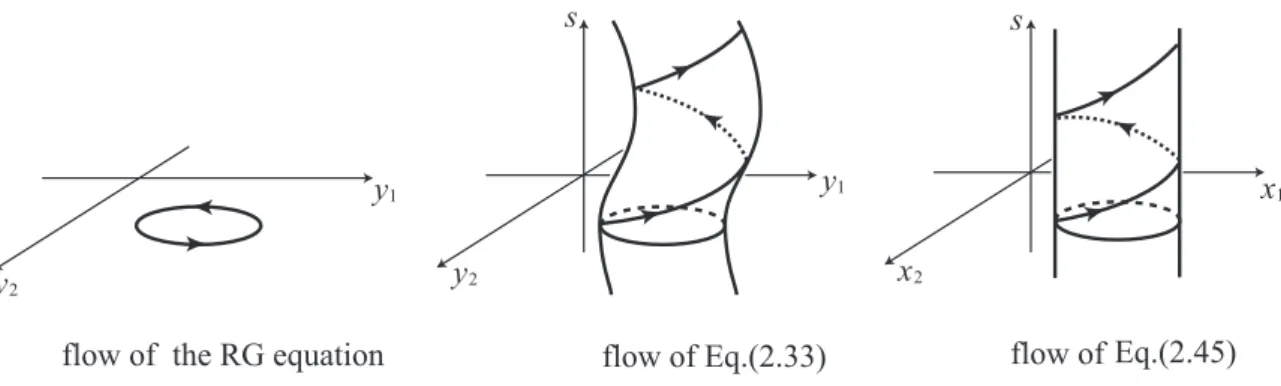
T (S , δ ) : = {τ | || S ((s − τ ) /ε k , y , ε ) − S (sk , y , ε ) || < δ, ∀ sR } (2.35) is relatively dense for any small δ > 0. Let us fix δ so that it is su ffi ciently smaller than ε and fix τ ∈ T (S , δ ) arbitrarily. Then W : = [0 , τ ] × N is a compact locally invariant manifold of Eq.(2.32) with boundaries { 0 } × N and {τ} × N (see Fig.1).

Now Fenichel’s theorem proves that Eq.(2.33) has a locally invariant manifold W ε which is di ff eomorphic to W and lies within an O( ε ) neighborhood of W uniquely.

To extend W ε along the s axis, consider the system

 

 ˙y = R k (y) + ε R k + 1 (y) + · · · + ε m k R m (y) + ε m + 1 k S ((s − τ ) /ε k , y , ε ) ,

˙s = 1 . (2.36)

Since the above system is δ -close to Eq.(2.33), it has a locally invariant manifold W ε,δ , which is di ff eomorphic to W ε . By putting ˜s = s − τ , Eq.(2.36) is rewritten as

  ˙y = R k (y) + ε R k+1 (y) + · · · + ε m−k R m (y) + ε m+1−k S ( ˜sk , y , ε ) ,

˙˜s = 1 , (2.37)

and it takes the same form as Eq.(2.33). This means that the set K : = { (s , y) | (s − τ, y)W ε,δ }

is a locally invariant manifold of Eq.(2.33). Since W ε,δ is δ -close to W ε and since δ ε , both of W ε ∩ { s = τ} and K ∩ { s = τ} are ε -close to W. Since an invariant manifold of Eq.(2.33) which lies within an O( ε ) neighborhood of W is unique by Fenichel’s theorem, K ∩ { s = τ}

has to coincide with W ε ∩ { s = τ} . This proves that K is connected to W ε and KW ε gives a locally invariant manifold of Eq.(2.33).

This procedure is done for any τ ∈ T (S , δ ). Thus it turns out that W ε is extended along the

s axis and it gives an invariant manifold ˜ N ε R × N of Eq.(2.33). An invariant manifold N ε

of Eq.(2.1) is obtained by transforming ˜ N ε by α (m) t .

(15)

Note that by the construction, projections of the sets ˜ N ε ∩ { s = τ}, τ ∈ T (S , δ ) on to the y space are δ -close to each other. This fact is used to prove the next corollary.

s

0 2

W W K

W

Fig. 1 A schematic view of the proof for the case that N is a circle. The W

ε

is ε-close to W and W

ε,δ

is δ -close to W

ε

. The K is the “copy” of W

ε,δ

.

The next corollary (ii) and (iii) for k = 1 are proved in Bogoliubov, Mitropolsky [6] and Fink [20] and immediately follow from Thm.2.9.

Corollary 2.10. Suppose that R 1 (y) = · · · = R k − 1 (y) = 0 and ε k R k (y) is the first non-zero term in the RG equation for Eq.(2.1). For su ffi ciently small ε > 0,

(i) if the vector field R k (y) has a hyperbolic periodic orbit γ 0 (t), then Eq.(2.1) has an almost periodic solution with the same stability as γ 0 (t),

(ii) if the vector field R k (y) has a hyperbolic fixed point γ 0 , then Eq.(2.1) has an almost periodic solution γ ε (t) with the same stability as γ 0 such that Mod( γ ε ) ⊂ Mod(g),

(iii) if the vector field R k (y) has a hyperbolic fixed point γ 0 and if g is periodic in t with a period T , then Eq.(2.1) has a periodic solution γ ε (t) with the same stability as γ 0 and the period T (it need not be the least period).

Proof. If R k (y) has a periodic orbit, Eq.(2.33) has an invariant cylinder ˜ N ε on the (s , y) space

as is represented in Fig.1. To prove Corollary 2.10 (i), at first we suppose that g(t , x , ε ) is

(16)

periodic with a period T . In this case, since S (t , y , ε ) is a periodic function with the period T , ˜ N ε is periodic along the s axis in the sense that the projections S 1 : = N ˜ ε ∩ { s = mT } give the same circle for all integers m. Let y = γ (t) , s = t be a solution of Eq.(2.33) on the cylinder. Then γ (mT ) , m = 0 , 1 , · · · gives a discrete dynamics on S 1 . If γ (mT ) converges to a fixed point or a periodic orbit as m → ∞ , then γ (t) converges to a periodic function as t → ∞ . Otherwise, the orbit of γ (mT ) is dense on S 1 and in this case γ (t) is an almost periodic function. A solution of Eq.(2.1) is obtained by transforming γ (t) by the almost periodic map α (m) t . This proves (i) of Corollary 2.10 for the case that g is periodic.

If g is almost periodic, the sets ˜ N ε ∩ { s = τ} give circles for any τ ∈ T (S , δ ) and they are δ -close to each other as is mentioned in the end of the proof of Thm.2.9. In this case, there exists a coordinate transformation Y = ϕ (y , t) such that the cylinder ˜ N ε is straightened along the s axis. The function ϕ is almost periodic in t because ||ϕ (y , t + τ ) − ϕ (y , t) || is of order O( δ ) for any τ ∈ T (S , δ ). Now the proof is reduced to the case that g is periodic.

The proofs of (ii) and (iii) of Corollary 2.10 are done in the same way as (i), details of

which are left to the reader.

Remark 2.11. Suppose that the first order RG equation ε R 1 (y) 0 does not have normally hyperbolic invariant manifolds but the second order RG equation ε R 1 (y) + ε 2 R 2 (y) does. Then can we conclude that the original system (2.1) has an invariant manifold with the same sta- bility as that of the second order RG equation? Unfortunately, it is not true in general. For example, suppose that the RG equation for some system is a linear equation of the form

˙y /ε =

0 1 0 0

y − ε 1 0

0 1

y + ε 2 0 0

4 0

y + · · · , yR 2 . (2.38) The origin is a fixed point of this system, however, the first term has zero eigenvalues and we can not determine the stability up to the first order RG equation. If we calculate up to the second order, the eigenvalues of the matrix

0 1 0 0

− ε 1 0

0 1

(2.39)

are −ε (double root), so that y = 0 is a stable fixed point of the second order RG equation

if ε > 0. Unlike Corollary 2.10 (ii), this does not prove that the original system has a stable

almost periodic solution. Indeed, if we calculate the third order RG equation, the eigenvalues

of the matrix in the right hand side of Eq.(2.38) are 3 ε and −ε . Therefore the origin is an

unstable fixed point of the third order RG equation. This example shows that if we truncate

higher order terms of the RG equation, stability of an invariant manifold may change and

(17)

we can not use ε R 1 (y) + ε 2 R 2 (y) to investigate stability of an invariant manifold as long as R 1 (y) 0. This is because Fenichel’s theorem does not hold if the vector field f in his theorem depends on the parameter ε .

Theorems 2.7 and 2.9 mean that the RG equation is useful to understand the properties of the flow of the system (2.1). Since the RG equation is an autonomous system while Eq.(2.1) is not, it seems that the RG equation is easier to analyze than the original system (2.1). Actually, we can show that the RG equation does not lose symmetries the system (2.1) has.

Recall that integral constants in Eqs.(2.12, 14) are left undetermined and they can depend on y (see Remark 2.4). To express the integral constants B i (y) in Eqs.(2.12, 14) explicitly, we rewrite them as

u (1) t (y) = B 1 (y) + t

(G 1 (s , y)R 1 (y)) ds , and

u (i) t (y) = B i (y) + t

G i (s , y , u (1) s (y) , · · · , u (i s 1) (y))

i − 1

k = 1

u (k) s

y (y)R ik (y)R i (y) ds , for i = 2 , 3 , · · · , where integral constants of the indefinite integrals in the above formulas are chosen to be zero.

Theorem 2.12 (Inheritance of symmetries). Suppose that an ε -independent Lie group H acts on UM. If the vector field g and integral constants B i (y) , i = 1 , · · · , m − 1 in Eqs.(2.12, 14) are invariant under the action of H; that is, they satisfy

g(t , hy , ε ) = ∂ h

y (y)g(t , y , ε ) , B i (hy) = ∂ h

y (y)B i (y) , (2.40) for any hH , yU , tR and ε , then the m-th order RG equation for Eq.(2.1) is also invariant under the action of H.

Proof. Since hH is independent of ε , Eq.(2.40) implies g i (t , hy) = ∂ h

y (y)g i (t , y) , (2.41)

for i = 1 , 2 , · · · . We prove by induction that R i (y) and u (i) t (y) , i = 1 , 2 , · · · , are invariant under the action of H. At first, R 1 (hy) , hH is calculated as

R 1 (hy) = lim

t→∞

1 t

t

G 1 (t , hy)ds

= lim

t→∞

1 t

th

y (y)G 1 (t , y)ds = ∂ h

y (y)R 1 (y) . (2.42)

(18)

Next, u (1) t is calculated in a similar way:

u (1) t (hy) = B 1 (hy) + t

(G 1 (s , hy)R 1 (hy)) ds

= ∂ h

y (y)B 1 (y) + ∂ h

y (y) t

(G 1 (s , y)R 1 (y)) ds

= ∂ h

y (y)u (1) t (y) .

Suppose that R k and u (k) t are invariant under the action of H for k = 1 , 2 , · · · , i − 1. Then, it is easy to verify that

u (k) t

y (hy) = ∂ h

y (y)u (k) t

y (y)h

y (y) 1

, (2.43)

G k (hy , u (1) t (hy) , · · · , u (k−1) t (hy)) = ∂ h

y (y)G k (y , u (1) t (y) , · · · , u (k−1) t (y)) , (2.44) for k = 1 , 2 , · · · , i − 1. These equalities and Eqs.(2.13), (2.14) prove Theorem 2.12 by a

similar calculation to Eq.(2.42).

2.3 Main theorems for autonomous systems

In this subsection, we consider an autonomous system of the form

˙x = f (x) + ε g(x , ε )

= f (x) + ε g 1 (x) + ε 2 g 2 (x) + · · · , xUM , (2.45) where the flow ϕ t of f is assumed to be almost periodic due to the assumption (B) so that Eq.(2.45) is transformed into the system of the form of (2.1). For this system, we restate definitions and theorems obtained so far in the present notation for convenience. We also show a few additional theorems.

Definition 2.13. Let ϕ t be the flow of the vector field f . For Eq.(2.45), define the C maps R i , h (i) t : UM to be

R 1 (y) = lim

t →∞

1 t

t

(D ϕ s ) y 1 G 1 (s , ϕ s (y))ds , (2.46) h (1) t (y) = (D ϕ t ) y

t

(D ϕ s ) y 1 G 1 (s , ϕ s (y))R 1 (y)

ds , (2.47)

(19)

and

R i (y) = lim

t →∞

1 t

t

(D ϕ s ) y 1 G i (s , ϕ s (y) , h (1) s (y) , · · · , h (i s 1) (y))

(D ϕ s ) y 1 i−1 k = 1

(Dh (k) s ) y R ik (y)

ds , (2.48)

h (i) t (y) = (D ϕ t ) y t

(D ϕ s ) y 1 G i (s , ϕ s (y) , h (1) s (y) , · · · , h (i s 1) (y))

(D ϕ s ) y 1

i − 1

k = 1

(Dh (k) s ) y R ik (y)R i (y)

ds , (2.49)

for i = 2 , 3 , · · · , respectively, where (Dh (k) t ) y is the derivative of h (k) t (y) with respect to y, (D ϕ t ) y is the derivative of ϕ t (y) with respect to y, and where G i are defined through Eq.(2.6).

With these R i and h (i) t , define the m-th order RG equation for Eq.(2.45) to be

˙y = ε R 1 (y) + ε 2 R 2 (y) + · · · + ε m R m (y) , (2.50) and define the m-th order RG transformation to be

α (m) t (y) = ϕ t (y) + ε h (1) t (y) + · · · + ε m h (m) t (y) , (2.51) respectively.

In the present notation, Theorems 2.5 and 2.7 are true though the relation Mod(S )Mod(g) in Thm.2.5 (ii) is replaced by Mod(S ) ⊂ Mod( ϕ t ). Note that even if Eq.(2.45) is autonomous, the function S depends on t as long as the flow ϕ t depends on t.

Theorem 2.9 is refined as follows:

Theorem 2.14 (Existence of invariant manifolds). Suppose that R 1 (y) = · · · = R k − 1 (y) = 0 and ε k R k (y) is the first non-zero term in the RG equation for Eq.(2.45). If the vector field R k (y) has a boundaryless compact normally hyperbolic invariant manifold N, then for su ffi ciently small ε > 0, Eq.(2.45) has an invariant manifold N ε , which is di ff eomorphic to N. In partic- ular, the stability of N ε coincides with that of N.

Note that unlike Thm.2.9, we need not prepare the (s , x) space, and the invariant manifold N ε lies on M not R × M. This theorem immediately follows from the proof of Thm.2.9.

Indeed, Eq.(2.33) has an invariant manifold ˜ N ε R × N on the (s , y) space as is shown

in the proof of Thm.2.9. An invariant manifold of Eq.(2.45) on the (s , x) is obtained by

transforming ˜ N ε by the RG transformation. However, it has to be straight along the s axis

(20)

because Eq.(2.45) is autonomous. Thus its projection onto the x space gives the invariant manifold N ε of Eq.(2.45) (see Fig.2).

y y

s s

y

1 1

x

1

y

2 2

x

2

Eq.(2.45) flow of the RG equation flow of Eq.(2.33) flow of

Fig. 2 A schematic view of the proof for the case that N is a circle. The projection of the straight cylinder on to the x space gives an invariant manifold of Eq.(2.45).

For the case of Eq.(2.1), the RG equation is simpler than the original system (2.1) in the sense that it has the same symmetries as (2.1) and further it is an autonomous system while (2.1) is not. In the present situation of (2.45), Theorem 2.12 of inheritance of symmetries still holds as long as the assumption for g is replaced as “the vector field f and g are invariant under the action of a Lie group H”. However, since Eq.(2.45) is originally an autonomous system, it is not clear that the RG equation for Eq.(2.45) is easier to analyze than the original system (2.45). The next theorem shows that the RG equation for Eq.(2.45) has larger symmetries than Eq.(2.45).

To express the integral constants B i (y) in Eqs.(2.47, 49) explicitly, we rewrite them as h (1) t (y) = (D ϕ t ) y B 1 (y) + (D ϕ t ) y

t

(D ϕ s ) −1 y G 1 (s , ϕ s (y))R 1 (y) ds , and

h (i) t (y) = (D ϕ t ) y B i (y) + (D ϕ t ) y

t

(D ϕ s ) y 1 G i (s , ϕ s (y) , h (1) s (y) , · · · , h (i s 1) (y))

(D ϕ s ) y 1

i − 1

k = 1

(Dh (k) s ) y R ik (y)R i (y) ds ,

for i = 2 , 3 , · · · , where integral constants of the indefinite integrals in the above formulas are chosen to be zero.

Theorem 2.15 (Additional symmetry). Let ϕ t be the flow of the vector field f defined on

UM. If the integral constants B i in Eqs.(2.47, 49) are chosen so that they are invariant

Fig. 1 A schematic view of the proof for the case that N is a circle. The W ε is ε-close to W and W ε,δ is δ -close to W ε
Fig. 2 A schematic view of the proof for the case that N is a circle. The projection of the straight cylinder on to the x space gives an invariant manifold of Eq.(2.45).
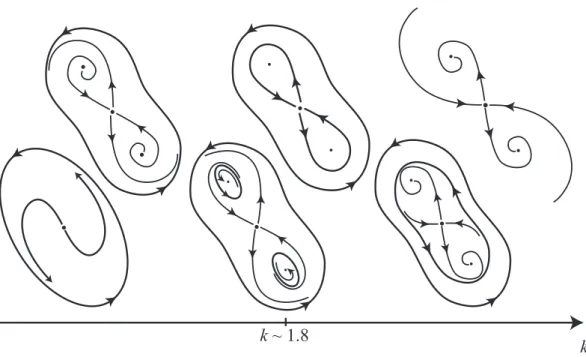
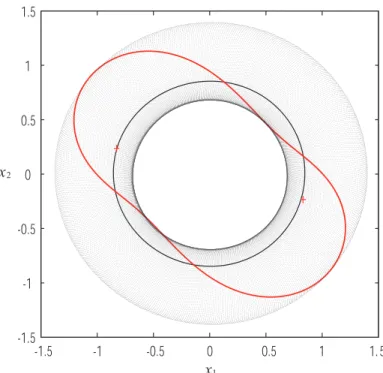
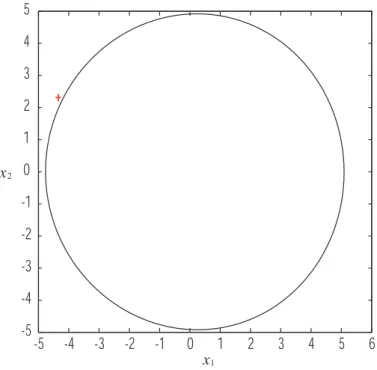
Fig. 3 Numerical results of the system (2.65) and its RG equation (2.68) for ω = 3 , k = 1.8 and ε = 0.01
Fig. 4 Phase portraits of the RG equation (2.69).
+5

参照

関連したドキュメント

The objective of this paper is to apply the two-variable G /G, 1/G-expansion method to find the exact traveling wave solutions of the following nonlinear 11-dimensional KdV-

This paper is devoted to the study of maximum principles holding for some nonlocal diffusion operators defined in (half-) bounded domains and its applications to obtain

In this paper, we establish some iterative methods for solving real and complex zeroes of nonlinear equations by using the modified homotopy perturbation method which is mainly due

Wheeler, “A splitting method using discontinuous Galerkin for the transient incompressible Navier-Stokes equations,” Mathematical Modelling and Numerical Analysis, vol. Schotzau,

To derive a weak formulation of (1.1)–(1.8), we first assume that the functions v, p, θ and c are a classical solution of our problem. 33]) and substitute the Neumann boundary

Dubrovin and Novikov also investigated the question of the conservation of local field-theoretical Hamiltonian structures in Whitham’s method and suggested the pro- cedure

Many families of function spaces play a central role in analysis, in particular, in signal processing e.g., wavelet or Gabor analysis.. Typical are L p spaces, Besov spaces,

In this work, we proposed variational method and compared with homotopy perturbation method to solve ordinary Sturm-Liouville differential equation.. The variational iteration