• 検索結果がありません。

BIG DATA ANALYTICS AND CORPORATE SOCIAL RESPONSIBILITY (CSR) : Adding Quantifiable and Qualifiable Sustainability Science to the Three P’s

N/A
N/A
Protected

Academic year: 2021

シェア "BIG DATA ANALYTICS AND CORPORATE SOCIAL RESPONSIBILITY (CSR) : Adding Quantifiable and Qualifiable Sustainability Science to the Three P’s"

Copied!
16
0
0

読み込み中.... (全文を見る)

全文

(1)

RESPONSIBILITY (CSR) : Adding Quantifiable and Qualifiable Sustainability Science to the

Three P s

著者 Marsden Janet H., Shirai Yasuto, Wilkinson Valerie Anne

journal or

publication title

Studies in informatics, Shizuoka University

volume 23

page range 29‑43

year 2018‑03‑28

出版者 Shizuoka University. Faculty of Informatics

URL http://doi.org/10.14945/00024907

(2)

論文(査読論文)

BIG DATA ANALYTICS AND CORPORATE SOCIAL RESPONSIBILITY (CSR):

Adding Quantifiable and Qualifiable Sustainability Science to the Three P’s

Janet H. Marsden

1

Yasuto Shirai

2

Valerie Anne Wilkinson

3

1

Morrisville State College, Department of Computer and Information Technol- ogy, Morrisville, New York

2/3

Shizuoka University, Faculty of Informatics, Hamamatsu, Shizuoka, Japan 432- 8561, Japan

Summary: The modern university functions as a knowledge watershed for civilization. A faculty of informatics trains students to create, distribute, mediate, deploy, interpret, translate, and utilize the products of information and communication technology for the greater good of the society it serves. Quantifiable research must be able to factor in the cost of a comfortable and secure society, a verdant and sustainable ecology, and a resilient environment for communities and business to thrive. CSR brings qualifiable research in sustainability science to the task of coordinating emerging big data platforms, offices, and skills.

Keywords: big data, General Systems Theory (GST), sustainability science, Triple Bottom Line (3BL), Complexity, Corporate Social Responsibility (CSR), resilience.

How to apply the paradigm of thinking globally and acting locally to the prob-lem of sustainability is a complex question (see Figure 1). The way for-ward we are proposing is applying sustainability science based on computational data analysis. In rigorously defining effective, fair and equitable solutions to the issues of sustainable economic development, we look to big data, an ever-increasing flood of structured, semi-structured, and unstructured data to bring to the service of sustainability and improved infrastructure resilience in an economically and socially responsible way. In this article we discuss various aspects of applying big data computation to sustainable and resilient management policies, leading to proactive responses to ecological and

1 Introduction

The aphorism “Think globally, act locally”

has long been a man-tra for planners. Although the

exact origins of the phrase are uncertain, the concept

has been adopted widely by the environmental

movement, practitioners and advocates for

sustainability, and by many organiza-tions concerned

about global climate change, including the UN

([35], [45], [14], [22]). As sustainability science

embraces computational methods (e.g. big data), the

idea of thinking globally and acting locally becomes

even more relevant and important. Qualifying and

quantifying sustainability as part of the bottom

line is a way to approach the ethical dilemma of

balancing many competing yet worthy interests.

(3)

financial issues. All the sensors and data gathering engines over the years have inevitably created so- called “big data,” with changes in data generation creating new filing, storage, and access requirements with more to come. The needs of the environment and human societies must not be forgotten, but seem to be increasingly subsumed by the frenetic scramble to monetize data and information for profit. Destruction of the environment and resulting species extinctions are ongoing. In this article, we discuss the costs of corporate neglect of social responsibility for the sake of unrelenting profit.

Usually a discussion of costs ends with the bottom line, hopefully in the black, which is the first bottom line “Profit” . We are arguing for the conversation to include other bottom lines, i.e. the community or

“People” and the environment or “Planet.” These are the three Pʼ s, three bottom lines, or 3BL.

In 2017, Hurricanes Harvey, Irma, and Maria ravaged infrastruc-ture in Texas, Florida, and Puerto Rico. The estimated damage is $300 billion, or twice the cost of all hurricane damages in the past decade [21]. The cost of Hurricane Katrina in 2005 was $108 billion [1] and the cost of Hurricane Sandy in 2012 was $75 billion [5]. The authors began their research into big data with their research into the use of advanced information technologies for emergency response beginning with Katri-na and continuing through Sandy, and found great advances in technol- ogy adoptions, applications, platforms and protocols [34]. Unfortu-nately, technological advances have not resulted in improved infrastruc-ture resilience.

The damage in 2017 was tremendously exacerbated

by poor land use practices, deferred maintenance

and failing infrastructure. The American Society of

Figure 1. The Three Spheres of Sustainability (University of Michigan, 2002)

(4)

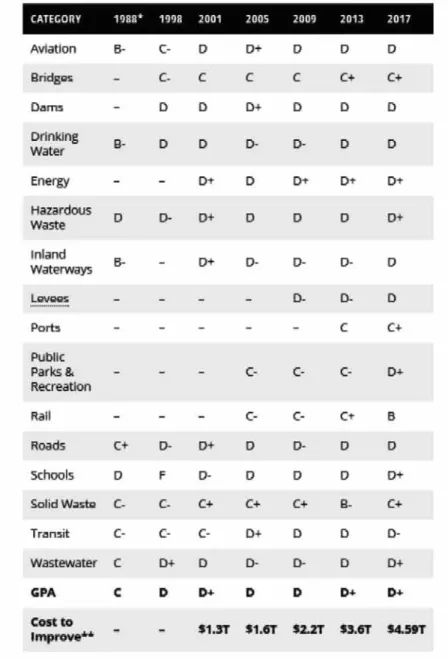
Civil Engineersʼ (ASCE) 2017 Infrastructure Report card gives an overall grade of D+ to US critical infrastructure (the same as it has been for many years) and estimates over $4 trillion in deferred maintenance [3]. (See Figure 2.)

According to the Intergovernmental

Panel on Climate Change, “Scientific evidence for warming of the climate system is unequivocal” [9].

At NASAʼ s website on the evidence for global climate change, we find that “Multiple studies published in peer-reviewed scientific journals show that 97 percent or more scientists agree that

Figure 2 ASCE 2017 Infrastructure Report Card Summary

(5)

ʻClimate-warming trends over the past century are extremely likely due to human activi-ties.ʼ ” [32]. There is ample data to support the need for infrastructure improvement, and there is ample ability to use computational methods such as low cost sensor networks or Internet of Things (IoT) technology to monitor and enable timely response to infrastructure deterioration; but this would require that necessary maintenance and long deferred improvements are completed. Despite the increasing risk associated with climate change-related extreme events, there is reluctance at some levels of government and industry to form the necessary public-private partnerships to achieve these ends.

Much of this reluctance relates to concern for the “Bottom Line” , PROFIT, which controls the allocation of resources and supports a cynical ideology that places more value on profit than on the common good.

Following Superstorm Sandy, the state of New York began working on plans to add resilience to its electric grid while transitioning away from generating energy through fossil fuel combustion [33]. But the corporate contribution estimated for the New York Renewing the Energy Vision (NY REV) project of $1B by 2030 is woefully inade- quate in light of the infrastructure damage and cost estimates. Despite the clear connection between fossil fuel combustion and extraction and increasing contributions to greenhouse gas emissions and other pollu-tion impacts, corporate greed ravages the countryside with fracking and pipeline construction to carry tar sands from Alberta, Canada and the western US across the United States. There are periodic accidents which foul groundwater and devastate the regions where they occur. All of the problems of extreme weather events, wildfires and public health issues resulting from polluting water and air reportedly can cost the U.S. up to

$360 billion annually – nearly half of annual U.S.

economic growth – within the next ten years, according to ʻThe Economic Case for Climate Action in the United Statesʼ [42].

On the social side of these matters of corporate management are not only the human cost of infrastructure failure and pollution impacts, but also problems of diversity, gender, ethics, and human rights, adding complexity to the pressing issues we face. A study by MIT reveals sys-temic algorithmic bias and little corporate or government interest in ad-dressing the problems [28]. Consider known gender biases in companies such as Uber developing information technology and information com-munication technology (IT/ITC). In August, 2017, a male engineer was allegedly fired by Google over his posting a viral memo suggesting that women are “biologically” less likely to succeed in tech [40]. Google was already under investigation in a case brought by the U.S. Depart-ment of Labor accusing Google of systemic sexism in pay difference [7]. On July 16, 2017, Catherine Shu at TechCrunch reported that an admin-istrative law judge sided with Google, reducing the demand for docu-mentation [40].

N e g a t i v e i m p a c t s s u c h a s j o b displacement and lower wages for US workers are associated with practices related to the H1B visa pro-gram [41], a program largely used by tech sector businesses. Economic inequality in the US has been exacerbated by long term wage stagnation across the broader economy for the last 40 years [39].

Not only do these technology-related stories touch

on ethics, diversity, and the work envi-ronment in

IT/ICT related businesses, it poses a question worth

pursuing, “How is the world of technology adapting

to the society it is supposed to serve?” We must be

able to depend on both government and industry to

develop appropriate systems and software to address

important issues of fairness and equity if we are to

have any hope of building a sustain-able and ethical

(6)

future.

The discussion of 3BL embraces the work of the Faculty of In-formatics and the Department of Computer Information Technology which mediates the products and services of technology to the commu-nity and the world. The university experience itself is the primary place for students to understand and utilize IT/ICT actually, while preparing to contribute after graduation. At a high level of engagement, informat-ics practitioners accept that big data analytics works together with CSR to develop a sustainable and resilient world.

2 Big Data Analytics

When did data evolve from “data” to big data? A simple query in a Google search asks, “When did big data emerge?” , and ʻA Brief History of Big Data Everyone Should Readʼ appears to offer some of the history that is needed, which is not in the form of computer records. If the subject is simply data, we can go back 18,000 years to tally bones or 2400 years to the emergence of the abacus. When this document asserts that in 1663 John Gaunt carried out the first experiment in statistical analysis, we find the beginning of the instrumentation of what would eventually turn into a database [31].

In 1865 Richard Millar Devens used the terms “Business Intelli-gence” in an encyclopedia where he mentioned analyzing information in a structured manner [23]. George Boole set the stage for binary search engines [4]. It all leads to better and quicker tools for searching and storing and more and more types of information to search and store.

The Brief History fixed the date of the emergence of the concept of big data in 2007 with the Wired magazineʼ s article “The End of Theory: The Data Deluge Makes the Scientific Model Obsolete” [2].

This article caused considerable consternation among academics and others who had been working

with theorizing and analyzing the data deluge for decades, developing, for example, search engines and content analysis tools; because it stated that the data could directly answer research ques-tions without the need to hypothesize, test or analyze - a position of ex-treme naïveté.

There are several characteristics of big data that make it both challenging to work with and important to master. One is immensity. Data of all types, new types, structured, semi-structured, and unstruc-tured, are streaming into existence all the time. Data volumes are ex-ploding, and more data has been created in the past two years than in the entire previous history of the human race [30].

Another is its emerging character. New sources of permanent digital data such as satellite re-mote sensing, UAV observation data, GIS, Twitter, Flikr, etc., plus dig-itized archives of ancient to recent modern analog materials are being made accessible.

The rate of this data generation is enormous. It is

esti-mated that by the year 2020, 1.7 MB of new

information will be created for every human being

on the planet every second [30]. Finally, the data are

complex. The challenges for the humanities and the

social sciences are really less about “big data” and

more about “complex data.” It is important to note

that big data itself is relative. What we consider big

now is not the same as what we considered big five

years ago or what we will consider big five years

from now. Sayeed Choudhury of John Hopkins

University says it is not just the volume of data,

it is also the methods needed to deal with it. Data

becomes big data when traditional methods are

inadequate and completely new methods are needed

to ana-lyze the available data [8]. Although the

normal volumes of data in the humanities and social

sciences are generally an order less than in the

natural sciences, the analysis of multiple terabytes

of data still creates methodological problems and

(7)

demands new approaches.

According to Peter Doorn, director at Data Archiving and Net-worked Services (DANS) in the Netherlands, big data is an important issue for the humanities and social sciences because the ability to ana-lyze big volumes of data opens up new avenues of research, making it possible to answer questions that could not be answered using tradition-al methods. “The data itself does not define what you can do with it.” [12]. In the social sciences, there are long traditions of qualitative sur-vey and interview methodology with researchers asking questions about all kinds of ideas people may have. Survey method is a quantitative method limited by the number of people able and willing to participate, so it has become very driven by issues of how to accurately represent populations through sampling.

New big data approaches have expanded research methods, for example, doing things like a sentiment analysis on Twitter posts. This is a totally new way of getting social science knowledge and an approach only possible because of new computing capacity that allows us to ana-lyze digital data, either 'born digital', like tweets, emails, log files, etc., or digitized. Increasingly, data that are ʻborn digitalʼ are being used for research, for example data that is produced through social media, ad-ministrative processes, financial transactions, brokers, etc. One of the great challenges of big data is finding ways to meaningfully analyze the vast volumes of data being generated by digital communications and transaction systems, a challenge that the humanities and social sciences are uniquely qualified to handle because of their experience with quali-tative approaches.

Traditional research data are also entering the realm of big data through mass digitization.

These are data that were originally analog but

have subsequently been digitized. Examples of mass digitization pro-jects are online databases such as Google Scholar. Digital databases al- low millions of digitized pages from books, newspapers and magazines to be searched through a central location. Whether natively digital or digitized, from an analytic standpoint, there are three categories of data: structured, semi- structured and unstructured, each requiring different analytic approaches. Structured data are usually captured in databases through various data collection processes or methods, such as business or scientific systems. These data consist of records composed of well-defined variables within vetted and standardized taxonomies and on-tologies, and often have extensive metadata records associated with them. Semi-structured data contain both structured and unstructured information. Examples are transaction logs, emails or tweets. Structured parts of the message may include the sender and receiver, origin, signa-ture, date/timestamp, header or subject line, etc. The unstructured part is the body of the message, usually text or images.

Finally, unstructured data are often the product of digitization efforts such as producing digi-tal images of historic documents, maps, blueprints or books.

These data are unstructured files, but if they are

digitized with descriptive, contex-tualizing metadata,

they can be analyzed effectively. A standard refer-

ence citation record format is a good example of

the kind of metadata usually available. However,

qualitative methods are far too labor inten-sive to be

feasible for large volumes of textual data, leading

to efforts to develop analytic tools using artificial

intelligence to assist human sub-ject matter experts

in doing content analysis, for example, on very large

datasets consisting of hundreds or even thousands of

full text articles or even books. Even data from the

natural sciences can be used in different ways than

originally intended for social science research or for

(8)

humani-ties research. Datasets produced by particle accelerators or telescopes can still be used in a variety of different ways by different specialists, for example the examinations of citizen science analyses of big data.

Other methods may require parallel processing on a grid because running the analysis on a laptop or personal computer might take days, weeks or months. Another contrast is data complexity. In many cases, researchers in the natural sciences traditionally dealt with data coming from a particular measuring device or piece of equipment generating structured data records. When multiplied by long time frames or fre-quent measurement intervals, this generates massive data streams but they are all roughly the same. When analyzed in combination with relat-ed data streams they become more complex but they are still structured data. In

contrast, in the humanities the problem is more often dealing with data from multiple sources, which are all different (structured, semi- or unstructured data).

The challenge of analyzing many disparate datasets is an area where big data techniques can help. For example, a recent project analyzing historical data on economic growth and dis-tribution of wealth on a global scale involved literally thousands of data sets from multiple countries, including some that do not even exist an-ymore. Using whatever data were available required finding ways to recalculate and convert the data into some new standard measurement to make it possible to compare these countries economically over time. This kind of analysis starts with expert researchers that can provide the important contextual understanding to make the analysis meaningful and must involve data scientists, statisticians and information technol-ogy experts with the technical expertise to implement

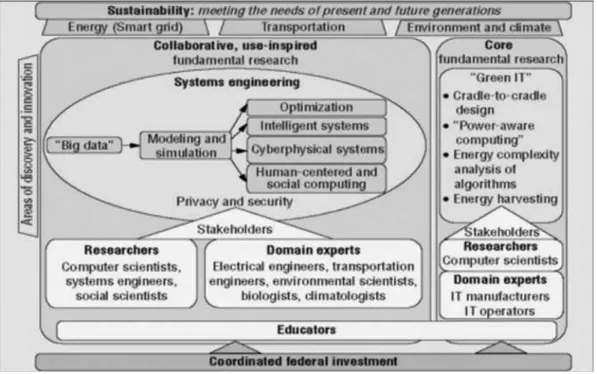
Figure 3. Many subdisciplines of computing will contribute to and will be challenged by sustainability

objectives. Achieving sustainability goals will require that computer scientists enter into

interdisciplinary collaborations with other scientists, and vice versa, and that researchers across

fields integrate their efforts with education, devel-opment and practice. (Fisher, 2013, p. 4)

(9)

the research meth-ods. That is where the challenge for the humanities and social sciences is less about 'big data' and more about 'complex data' (see Figure 3).

3 The Triple Bottom Line

In 1994 John Elkington, the founder of a British consultancy SustainAbility, first coined the phrase “the triple bottom line” advocat-ing the development of a “people account” and a “planet account” to accompany the finance-only account of any business activity [18]. Elkingtonʼ s keyword was sustainability.

3.1 The TBL modified by big data

TBL is an accounting framework that incorporates three dimen-sions of performance:

social, environmental and financial, reflecting the goals and values of sustainability science. This differs from traditional reporting frameworks as it includes ecological (or environmental) and social measures that can be difficult to assign appropriate means of measurement. The TBL dimensions are also commonly referred to as People, Planet and Profits. We will refer to these as the 3Ps.

Each of the traditional 3 bottom lines, sometimes called "the 3P's", must be understood as essentially financial. The first bottom line is Profit, being "in the black." That is comprehensible.

Working with numbers is the way one works with money. Everyone wants the account books to show black, but the financial impacts of making business and policy decisions without considering sustainability will increase expo-nentially. For example, the health and pollution costs of burning coal to produce electricity far outweigh the costs of investing in renewable en-ergy systems.

The second and third bottom lines

represent the society, or Peo-ple, and the environment, or Planet. These two bottom lines are also financial, and therefore People and Planet must be monetized. For Peo-ple, big data analytics provide the data relevant to understanding the financial costs of under-developing, under- rewarding, and under-paying workers and the financial rewards of cultivating diverse capacities of workers, promoting a satisfying work week, and ensuring equal oppor-tunity to all student populations, etc. This impacts social engineering regarding educational, training, and internship quotas, loans, hiring practices, tax incentives. The third bottom line is the environment, or Planet, which considers the financial impact of policy and protocol on land use, or over-use, industryʼ s carbon foot-print, and environmental protection and restoration.

The issue at hand is this; it will cost much more than money if one only considers money as the bottom line. In the wake of Hurricanes Harvey, Irma and Maria, Joe Ryan posted an article at Bloomberg with the title Climate Shocks May Cost U.S. $1 Billion a Day [37]. Evidently some stakeholders are taking the matter to heart. Alister Doyle reported on US costs from extreme weather events and air pollution caused by fossil fuel combustion, quoting James McCarthy, professor of Ocean-ography at Harvard University. McCarthy said there is widening evi-dence that a shift from fossil fuels makes economic sense. “Why is Iowa, why is Oklahoma, why is Kansas, why is Texas investing in wind en-ergy? Not because they are interested in sea level rise or ocean tempera-tures, but because itʼ s economically sensible.” [13].

In countries like India and Tibet,

investments in low cost and minimal infrastructure

solar photovoltaic and wind electicity generation

(10)

(PV) are bringing electric lights and power to to remote villages for the first time ([26], [29]). These solutions could be implemented in the Car-ibbean where large numbers of people remain without power after 2017ʼ s hurricane devastation. Initial investment costs would be higher than rebuilding the destroyed fossil fuel infrastructure, but would result in a sustainable and resilient power grid. But vested interests are unwill-ing to relinquish sunk investments in fossil fuel energy, despite the cost of unsustainable fuel imports [19]. Some financial interests see a better financial future in wind and sun than fossil fuel. Can we hope that gov- ernment and enough corporations will “connect the dots” in time? As long as Profit means that it is all about money, our future is bleak. If human beings at every organizational level, however, agree to include People and the Planet in their necessary calculations, we may have a chance to achieve a sustainable future and mitigate the worst impacts of climate change.

3.2 The Path to CSR with big data

“The Bottom Line” is the final line in an accounting ledger which shows profit or loss.

The term provides a metaphorical way of saying,

“the most important thing.” It is also used in a derogatory way, as in “he is a bottom-line person;

only cares for money.”

Implementation of data driven 3BL paints a picture of a possible future, in which the coordinated activities of governments and corpora- tions move with the agreement of the people towards sustainable, resil-ient infrastructure and economic development that promotes the com-mon good. Figure 4 looks at the entire field of big data in quadrants. All of the activities, organizational decisions, platform, input, and filing activities, plus the mediation of the products of IT/ICT to societies

and the environment are included as the big data actors. We began this ex-amination of big data analytics in the context of a faculty of informatics.

CSR begins at school. The implementation of CSR globally in each of the three Ps (3BL) can be understood as:

Profit: Enhancing economic well-being. Economic concerns must in-clude creating local wealth through intelligent collaboration and coop-eration, using innovation to create and develop local and global markets based on fair and mutually agreed business practices, and a commitment to the equitable and sustainable utilization of natural resources. Em- ployees should be able to earn a living wage, receive adequate health care and affordable housing.

Planet: Environmental Care. Caring for the planet involves looking at the whole life-cycle of products and implementing cradle-to-cradle re-cycling systems as an intrinsic part of product design.

Changing produc-tion practices will shrink our carbon and resource “footprint” , enhancing, rather than impoverishing our local natural environment.

People: Cultivating social well-being. Providing wider community benefit through business activities includes respecting the welfare and dignity of staff and contractors, treating customers openly and honestly, and providing high quality service and support. Industry and govern-ment partnerships are important for accomplishing the objectives that are beyond the scope of either sector alone.

In September 2015, the United Nations General Assembly estab-lished 17 sustainability goals for development, to achieve by 2030 [43]. Letʼ s just look at the first five of the seventeen:

Goal 1) Elimination of Poverty

(11)

Goal 2) Zero Hunger

Goal 3) Good Health and Well-being Goal 4) Quality Education

Goal 5) Gender Equality

Clearly, education is implicated from beginning to end, because if students are educated in a world that assumes equality of opportunity for men and women, without consideration of rich or poor, whether or not there is disability, it will affect the mindset about what kind of jobs our university students can choose and train for.

The staff and the faculty of the university are empowered and charged with inculcating the values determined by the educational insti-tute in vision, policy, and curriculum. Informatics students engage in their learning activities with respect for themselves, each other, and the team. Or so it would

be in an ideal world. As the Roman satirist, Juve- nal said, “Quis custodiet ipsos custodes?” (Who guards the guardians themselves?) [27]. A voluntary system of checks and balances with sus-tainability and resilience must be built into the planning, staffing and execution of the programs. Even a highly principled institution can be challenged to maintain sustainable practices which balance rigor and creativity.

4 The Issues

The need for sustainable development is

clear to city planners, infra-structure developers,

civil engineers and the governments and compani-

es that fund them. It is also clear that corporations

and governments cut costs when possible, when it

is possible to find loopholes or strategies to evade

principled land use and abuse human beings. This is

true when considering the finances, the society, and

Figure 4: Quadrants of big data and big data actors

(12)

the environment. Our ability to continue to function as a global civilization requires a resilient infra- structure and principled practices.

To return to the main topic: All of the bottom lines must eventu-ally be translated as the financial bottom line, i.e. What is the cost to corporations of human disease, land over-use?

What is “social capital” or “environmental capital”

worth in terms of money? What is the carbon footprint of the enterprise? We must “operationalize”

sustainability [24].

How is this to be done? We only have space for one great ex-ample of a multi-national corporation with a great CSR sustainability ranking. The Dow-Jones Sustainability Index (DJSI) is a high level monitoring instrument with global credibility [11]. We find that Unile-ver scored first place in the category of personal products [36].

That is a great accomplishment which the Unilever Group has accomplished mul-tiple times. In the final analysis for 2017, Unilever scored 89 out of 100 overall, achieving industry-leading scores in 11 out of 25 categories. This is a very good company that is assessed by a reliable monitor.

It seems that Unilever is a high profile company doing well, in a global international economy. That does not mean success is a static thing and that the company is always beyond reproach. On April 13, 2017, Daphne Dupont- Nivet wrote an article debunking “Unileverʼ s Sustainability Myth.” [15]. Standards are not as transparent as one would hope, it is not easy to find clear information, and real farmers in the Unilever world did not perceive themselves are operators with codes and standards to uphold. On March 15 of 2017, Unilever was accused by a journalist at Forbes of failing to uphold sustainable corporate

re-sponsibility, in that the CEO, Paul Polman, is,

“a poster child of a CEO gone rogue.” [6]. It is a real “can of worms” to dig into the allegations against Unilever and the voices that spoke out in its defense: Forbes claims that Unileverʼ s rejection of a takeover effort by Kraft Heinz mys-tified Wall Street. Polman, on the other hand, saw the Kraft Heinz gam-bit as a “hostile take-over bid,”

to destroy the long-term values that he held so important [6].

With disarming candor, the Chief Marketing and Communica-tions Officer at Unilever explained why he disbanded the CSR office. The existence of the CSR office “leads to a sense in the rest of the busi-ness that itʼ s being taken care of elsewhere; that itʼ s someone elseʼ s problem. CSR shouldnʼ t be a weight on one side of a set of scales - in-stead, it should be a collective mindset.” [45].

The struggle to create a sustainable and resilient civilization is ongoing, as we have often repeated in this essay. To rank CSR efforts globally is a complex bit of research, with variable parameters and dif-fering biases in the various measure. Forbes, United Nations, and Dow- Jones each have a ranking system with different parameters, and differ-ent top-scorers in each. And, we are just talking about “the good guys,” here, which seems a bit disingenuous when there are so many really bad guys. Nonetheless, companies like Unileverʼ s commitments to sustain-ability are valuable and essential to the world.

At the time that we were writing this article, there was a massive Equifax security breach.

On September 7th 2017, Equifax, one of the three

major credit reporting companies in the USA,

reported a breach that could affect 143 million

Americans. To make matters worse, the company

(13)

determined that the hack occurred from mid-May to July, and only announced in in September [38]. This is only one immense security breach among dozens of others in 2017. Gretel Egan at Wombat Securi- ty reported the “scary data breach statistics of 2017 on October 25 “The headline numbers — 1,120 total breaches and more than 171 milli on records exposed — are frightening in their own right.” [16].

People who are gaming the system, committing fraud, embez-zlement, money- laundering and bribery on a small or large scale are getting better and better at getting what they want. These are simple cheaters, who do not respect the rule of law and the cooperative en-deavor of humanity to advance civilization in their attempts to carve out a life for themselves.

5 Conclusion

Despite the promise of big data, the reality is that big data has so far been relentlessly exploited for its revenue generating potential at the expense of the consumer, who is also the owner of the data that has be-come so valuable to commercial and criminal interests. In fact, the in-terests represented by all other bottom lines besides Profit have been subjugated by Profit and with few exceptions, corporations and even governments have abdicated their responsibilities to act ethically and for the public good. It is time to demand balance among the bottom lines.

CSR presents an ethical dilemma - or THE ethical dilemma of balancing many competing yet worthy interests. Building a profitable business is a laudable ambition, as is governing a country to be fair and democratic. How to apply the thinking globally and acting locally para-digm to the host of problems we face raises complex questions of bal- ancing competing needs and wants, many of which

are reasonable and some of which are unarguable, such as basic human rights or preserving fragile ecosystems. The way forward we are advocating is to apply sus-tainability science. There are a lot of jobs that need to get done but that aren't profitable, for example, helping refugees, growing organic food or creating fine art. Basing corporate decisions on the basis of profit alone has caused untold environmental and social costs in the pursuit of profit without regard for the ancillary costs. What is needed is agreement be-tween the public and private sectors as to what is, in fact, the true bot- tom line; and the agreement must include social and environmental as well as economic fairness.

Jobs that need to get done but that

may not be profitable means that they are often

ignored, avoided or eliminated except as labors of

love. Leaving these jobs to the marketplace has

caused black markets to arise in some jobs while

encouraging other jobs to migrate to less ex-pensive

regions. Sustainability is the science of providing

the needs and wants of the present while ensuring

the ability to meet the needs and wants of the

future. In terms of sustainability, it makes sense

to pay people a living wage for all jobs, even so-

called “unskilled” jobs. It makes sense to provide

affordable health care and support those who are

old or disabled. It makes sense to provide people

with birth control and allow them to manage their

own reproduction. It makes sense to subsi-dize

local agriculture if necessary rather than importing

cheaper food from elsewhere. It makes sense to

subsidize the replacement of fossil fuels with

renewable energy. It makes sense to incorporate

cradle to cradle recycling into manufacturing

processes and dismantle and elimi-nate landfills to

ensure adequate supplies of materials. Sustainability

may not be easy, but it is possible if we choose to

apply science rather than ideology. And, it may be

(14)

our salvation.

References

1.Amadeo, Kimberly. 2017. “Hurricane Katrina Facts: Damages and Costs.” The Balance, September 08, 2017. Received Feb 1, 2018 from https://www.thebalance.com/hurricane-katrina- facts-damage-and-economic-effects-3306023 2.Anderson, C. 2008. “The End of Theory: The Data

Deluge Mak-es the Scientific Model Obsolete” , Wired. Accessed 2018.1.19 at: https://www.

wired.com/2008/06/pb-theory/

3.ASCE 2017 US Infrastructure Report Card.

2017. American So-ciety of Civil Engineers 2017 US Infrastructure Report Card, p.

100. Accessed 2018.1.19 at: https://www.

infrastructurereportcard.org/

4.Barnett, Janet Heine. 2013. "Applications of Boolean Algebra: Claude Shannon and Circuit Design," Convergence (July 2013), DOI:10.4169/

loci004000. Received 2018.1.17 from: https://

www.maa.org/press/periodicals/convergence/

5.Blake, Eric S., et alia. 2013. “Tropical Cyclone Report: Hurri-cane Sandy.” February 12, 2013.

Received Feb 1, 2018 from http://www.nhc.noaa.

gov/data/tcr/AL182012_Sandy.pdf

6.Borelli, Tom. 2017. “Unilever and the Failure of Corporate So-cial Responsibility.” Received 2018.1.25 from: https://www.forbes.com/sites/

econostats /2017/03/15.

7.CBSNews. 2018. CBS Interactive, Inc., Jan 9, 2018. Received from: https://www.cbsnews.

com/news/what-kind-of-case-do-white-google- engineers-have-in-discrimination-lawsuit/

8.Choudhury, Sayeed. 2008. Case Study in Data Curation at Johns Hopkins University. Library Trends Fall 2008. Received 2018.01.14 from:

https://jscholarship.library.jhu.edu/

9.IPCC. 2014. “Climate Change AR5 Synthesis Report 2014” . In-tergovernmental Panel on

Climate Change (IPCC), Cambridge University Press. Available 2018.1.19 at: https://www.ipcc.

ch/report/

10.Dictionary.com, unabridged. “bottom line. (n.d.)”.

Retrieved Oc-tober 1, 2017 from Dictionary.com 11.Dow-Jones Sustainability Index Annual

Review. 2017. Annual Scoring Methodology Review: Corporate Sustainability Assess-ment (CSA). Received 2018.1.25 from: http://www.

robecosam.com/en/sustainability

12.Doorn, Peter. 2014. “Big data in the humanities and social sci-ences.” Science Node, Feb 5 2014.

Received 2018.01.14 from: https://sciencenode.

org/feature/big-data-humanities-and-social- sciences.php

13.Doyle, Alistair. 2017. “Weather extremes, fossil fuel pollution cost US $240 billion: study.” Oslo, Reuters.com. Received 2018.1.19 from: https://

www.reuters.com/article/us-climatechange-usa/

weather-extremes-fossil-fuel-pollution-cost-us- 240-billion-study-idUSKCN1C22AM

14.DuBos, R. 1972. "Stockholm 1972 - Declaration of the United Nations Conference on the Human Environment” . United Na-tions Environment Programme (UNEP), 1972. Retrieved Feb 1, 2018 from: http://webarchive.loc.gov/

all/20150314024203/http%3A//www.unep.org/

Documents.Multilingual/Default.asp?documenti d%3D97%26articleid%3D1503

15.Dupont-Nivet, Daphne. 2017. “Inside Unileverʼ s Sustainability Myth.” The New Internationalist.

Received 2018.1.25 from: https://newint.org/

features/web-exclusive

16.Egan, Gretel. 2017. “Scary Data Breach Statistics of 2017.” Blog post at Wombat Securities.

R e c e i v e d 2018.1.24 f r o m : h t t p : / / w w w.

wombatsecurity.com/

17.Ellul, J. Penser globalement, agir localement, Pyremonde, Paris, 2006.

18.Elkington, John. 2004. (archive) “Enter The

(15)

Triple Bottom Line.” Retrieved January 18, 2018 from: http://www.johnelkington.com/archive/

TBL-elkington-chapter.pdf

19.Fairley, Peter. 2017. “Why Solar Microgrids May Fall Short in Replacing the Caribbean's Devastated Power Systems” . IEEE Spectrum, 13 Oct 2017. Retrieved Feb 1, 2018 from:

https://spectrum.ieee.org/energywise/energy/the- smarter-grid/should-a-devastated-caribbean-leap- forward-to-renewable-power-and-microgrids 20.Fisher, D. 2013. “Sustainability in Leadership

in Science and Technology: A Reference Handbook” , W. S. Bainbridge, Ed: SAGE Publications, pp. 201-209.

21.Fortune Editors and Reuters. 2017. “AIG Says the Hurricane Season Will Cost It $3 Billion” . Received 2018.1.19 from: <http://fortune.

com/2017/10/10/aig-hurricane-season-damage- cost-impact/>

22.Geddes, P. 1915. Cities in Evolution: an introduction to the town planning movement and to the study of civics. Wentworth Press, 2016.

23.Heinze, Justin. 2014. History of Business Intelligence. Received 2018.01.14 from: https://

www.betterbuys.com/bi/history-of-business- intelligence/

24.Herz, Jonathan. 2009. “The New Sustainable Frontier.” Office of Governmentwide Policy.

(OGP) Received 2018.1.19 from: https://www.

wbdg.org/FFC/GSA/

25.Hindle, Tim. 2009. "Triple Bottom Line". The Economist. No-vember 17, 2009. Retrieved 14 August 2014. Last referenced: January 18, 2018.

26.Jhunjhunwala, Ashok. 2017. “Innovative Direct-Current Microgrids to Solve Indiaʼ s Power Woes: Solar DC microgrids could do for electrification what mobile phones did for telephony” . IEEE Spectrum, 31 Jan 2017.

Retrieved Feb 1, 2018 from: https://spectrum.

ieee.org/energy/renewables/innovative-direct-

current-microgrids-to-solve-indias-power-woes 27. J u v e n a l . (127 c e ) “S a t i r e V I ,” ( l i n e s

347–348) Satires. Full text available at:

https://books.google.com/books/about/The_

Satires_of_Juvenal.html?id=tt9NAQAAMA AJ&printsec=frontcover&source=kp_read_

button#v=onepage&q&f=false

28.Knight, Will. 2017. “Biased Algorithms Are Everywhere, and No One Seems to Care” . MIT Technology Review, July 12, 2017. Retrieved 2018.1.19 from: https://www.technologyreview.

c o m / s /608248/ b i a s e d - a l g o r i t h m s - a r e - everywhere-and-no-one-seems-to-care/

29.Kumagai Jean and Gorman Celia. 2017.

“Lighting Up Lingshed: A Remote Village in the Himalayas Gets Lights and Internet Access” . IEEE Spectrum, 26 Jan 2017. Retrieved Feb 1, 2018 from: https://spectrum.ieee.org/video/green- tech/solar/lighting-up-lingshed-a-remote-village- in-the-himalayas-gets-lights-and-internet-access 30.Marr, B. 2015. Big Data: Using SMART Big

Data, Analytics and Metrics To Make Better Decisions and Improve Performance. Wiley &

Sons.

31.Marr, B. 2015. “A brief history of big data everyone should read” . World Economic Forum. Received 2018.01.19 from: https://www.

weforum.org/agenda/2015/02/

32.NASA Global Climate Change Scientific Consensus. 2017. Available at: https://climate.

nasa.gov/evidence/

33.New York Reforming the Energy Vision (NY REV). 2015. Available at: https://rev.ny.gov/

34.Pew Research Center for Internet and Technology. 2017. “Social Media Fact Sheet” . Pew Research Center. Jan 12, 2017. Re-trieved Jan 29, 2018 from: http://www.pewinternet.org/

fact-sheet/social-media/

35.Reed, C. 2000. David Brower obituary. The

Guardian, Nov 8, 2000. Retrieved Feb 1, 2018

(16)

from: https://www.theguardian.com/news/2000/

nov/08/guardianobituaries1

36.RobecoSAM. 2017. “Corporate Sustainability Index” . Accessed Feb 1, 2018 at: https://

yearbook.robecosam.com/companies/#data- search*="unilever"]

37.Ryan, Joe. 2017. “Climate Changed.” Bloomberg.

Received 2018.1.19 from: https://www.

bloomberg.com/news/articles/2017-09-27/

38.Siegal, Tara et alia. 2017. “Equifax Says Cyberattack May Have Affected 143 Million in the U.S.” , The New York Times: Busi-ness day.

39.Shambaugh, Jay and Nunn, Ryan. 2017. “Why Wages Arenʼ t Growing in America” . Harvard Business Review, October 24, 2017. Retrieved 2018.1.19 from: https://hbr.org/2017/10/

40.Shu, Catherine. 2017. “Judge sides with Google in its battle with the Labor Department over employee pay data.” TechCrunch.

Retrieved 2018.1.19 from: https://techcrunch.

com/2017/07/16/

41.Torres, Nicole. 2017. “The H-1B Visa Debate, Explained” . Har-vard Business Review, May 4, 2017. Retrieved 2018.1.19 from: https://hbr.

org/2017/05/

42.Universal Ecological Fund US. 2017. “The Economic Case for Climate Action in the United States” . Last referenced 2018.1.19 at: https://

feu-us.org/

43.United Nations. 2015. “Transforming our world: the 2030 Agen-da for Sustainable Development” . Sustainable Development.

R e - c e i v e d 2 0 1 8 . 1 . 2 5 f r o m : h t t p s : / / sustainabledevelopment.un.org/post2015/

transformingourworld

44.Vanderburg, Willem H. 1987. "Technique and Responsibility: Think Globally, Act Locally, According to Jacques Ellul." Technology and Responsibility. Springer Netherlands, 1987. 115- 132.

45.Weed, Keith. 2016. “A new type of CSR: Why I disbanded Uni-leverʼ s CSR Department, in a nutshell.” LinkedIn. Received 2018.1.25 from:

https://www.linkedin.com/pulse/

Figure 2 ASCE 2017 Infrastructure Report Card Summary
Figure 3. Many subdisciplines of computing will contribute to and will be challenged by sustainability  objectives

参照

関連したドキュメント

Let T be a reduced purely two-dimensional scheme, projective over an algebraically closed field of positive characteristic (resp. the algebraic closure of a finite field). Let L be

The study of the eigenvalue problem when the nonlinear term is placed in the equation, that is when one considers a quasilinear problem of the form −∆ p u = λ|u| p−2 u with

For the three dimensional incompressible Navier-Stokes equations in the L p setting, the classical theories give existence of weak solutions for data in L 2 and mild solutions for

Greenberg and G.Stevens, p-adic L-functions and p-adic periods of modular forms, Invent.. Greenberg and G.Stevens, On the conjecture of Mazur, Tate and

The proof uses a set up of Seiberg Witten theory that replaces generic metrics by the construction of a localised Euler class of an infinite dimensional bundle with a Fredholm

[Mag3] , Painlev´ e-type differential equations for the recurrence coefficients of semi- classical orthogonal polynomials, J. Zaslavsky , Asymptotic expansions of ratios of

A bounded linear operator T ∈ L(X ) on a Banach space X is said to satisfy Browder’s theorem if two important spectra, originating from Fredholm theory, the Browder spectrum and

(Recent result: Yes, but consistent quantum gravity is delicate.) Early universe cosmology: Observations of cosmic microwave background, maybe even earlier stages with