• 検索結果がありません。

阪南大学学術リポジトリ

N/A
N/A
Protected

Academic year: 2021

シェア "阪南大学学術リポジトリ"

Copied!
16
0
0

読み込み中.... (全文を見る)

全文

(1)

Towards Understanding the Issues Concerning the  Adoption of CLIL Approaches to English Language 

Teaching and Learning in Japanese Universities

Martin Parsons  1) Larry Walker  2)

Abstract

 In recent decades, the forces of globalisation have made English language skills an important requirement. Despite a number of initiatives designed to improve English language education, Japan has one of the lowest average scores in comparisons by country on international tests of English. A new approach showing promise in Europe and which may prove beneficial in Japan is Content and Language Integrated Language ( CLIL ) . As universities, through entrance exams, often set the agenda for language education, they offer the most opportune starting point for the introduction of CLIL. However, the unique characteristics of the Japanese socio - cultural context will need to be taken into consideration to enhance the chances of a successful introduction.

Keywords: CLIL, Japan, university, culture, foreign language education, EFL, education Introduction

 This paper reports the preliminary findings of a study which aims to assess the applicability of the Content and Language Integrated Learning approach to foreign language education (which in practice means English language education in the great majority of cases) at universities in Japan. If it is considered appropriate, the design and development of materials and courses based on a review of successful models of Content and Language Integrated Learning programmes in other parts of the world, principally Europe, aimed at facilitating its uptake on a broader scale will be attempted.

 The reasons for undertaking such a project lie in economic, social and cultural trends experienced domestically in both Japan itself and in the dynamic relationship between Japan and other nations in the wider world. Chief among these trends are two inter - related phenomenon:

   1) the processes of globalisation. As with most modern states, Japan depends for its prosperity on international trade in key sectors of the economy. Japan's rate of food self - sufficiency has fallen to below 40 % in recent years ( Japan Agri News, 2013 ; Japan Times, 2010) , and Japan is one of the world's largest importers of energy and mineral resources. Put simply, without 1) Faculty of Business, Hannan University

2) Faculty of Letters, Kyoto Prefectural University

(2)

international trade Japan as we know it in modern times could not exist;

   2) the emergence of the English language as the pre - eminent language in many areas of international interaction, making it in some senses the world's de facto lingua franca. While the number of people using English with facility, as either their first or second language, and the number of people learning English is difficult to quantify accurately, both numbers are clearly considerable. For example, Crystal (2003 , p. 6) suggested 10 years ago that a quarter of the world's population, around 1 . 5 billion people, were either fluent or competent in English. Some years later Graddol (2006, p. 101) estimated that around one-third of the world's population may be engaged in learning English. However, the most salient feature of this emerging situation is probably not so much these statistics as the influence that English has come to exert in international affairs. It is now the main language for international scholarship, the global media, technology, international trade and diplomacy - particularly for discussion of international treaties and mediation in international disputes.

 At the same time, there is a general sense that the world has now entered an era in which information and the ability to manage, analyse and manipulate it has become more important than at any time in the past. Even skilled factory workers now often need to be able to understand complex flowcharts or engineering diagrams and make decisions on the diagnosis and rectification of problems, something that would have been quite rare even a few short decades ago. It is becoming imperative that citizens have the ability to understand, assess and manage complex concepts.

Moreover, many of these concepts or ideas and information are disseminated and distributed internationally through the medium of the English language.

 As such, if Japan is to maintain its position as one of the world's leading economies in this era of globalisation and to actively engage in international forums, high level English language skills will be required by a growing proportion of the population. Unfortunately, Japan is in the lower ranks of scores in international tests of English based on comparisons with other countries.

 Consequently, new approaches to foreign language teaching and learning ought to be investigated and where appropriate adapted and adopted into the Japanese educational environment. One approach that has the potential to provide positive outcomes is Content and Language Integrated Learning.

Background

 Japan's high rate of high school graduation and the ubiquity of English in the school curriculum mean that almost every person of working age has taken at least six years of English lessons as part of their formal education. For those who have progressed to university, which is now more than 50%

of high school graduates, formal English language education is even longer. Additionally, millions

pursue English language studies privately or in language schools outside the formal education

system, both during their years of formal education and after. Ministry of Economy, Trade and

Industry statistics show that in 2012 commercial foreign language conversation schools had sales of

77 , 341 , 000 , 000 yen ( METI, 2013) , the overwhelming majority of which would have been devoted to

the study of English. In 1995 , Koike and Tanaka suggested that 3 , 000 billion yen was being 'spent for

(3)

the English language teaching (ELT) industry in Japan every year' (1995, p. 19).

 However, international tests of English, like TOEFL and IELTS, indicate that this study and expenditure has not resulted in an effective command of the English language for most learners, with Japan having one of the lowest mean scores in comparisons by country and first language of test takers (ETS, 2011; IELTS, 2011).

 The need for improvements in English language education has been long understood by the Japanese government and a number of initiatives have been introduced in recent decades. For example, in order to promote a more communicative aspect to English language education the JET ( Japan Exchange and Teaching ) Programme, which brought native speaking university graduates to Japan to work as assistant language teachers in middle and high schools, was established in 1987 . The Ministry of Education, Culture, Sports, Science and Technology ( MEXT ) made changes to the Course of Study in 1989, 2002 and 2009 urging teachers to use more English in classrooms and to employ communicative language teaching methods. The need for improvement was stressed in 'The Prime Minister's Commission on Japan's Goals in the 21 st Century' ( CJGTC, 2000) and the 'Action Plan to Cultivate "Japanese with English Abilities"' ( MEXT, 2003) . More recently, the introduction of English lessons to the primary school curriculum in 2011 and efforts such as the 'Global 30' Project and the 'Global 30 plus' Project in universities have attempted to address the problem at different ends of the educational spectrum.

 It is also understood in the business world. The Japan Business Federation ( Keidanren ) has long called for improved English language skills in graduates (Keidanren, 2000, 2013), and from one perspective, it appears that large international companies may be avoiding Japan as a result of less than adequate English language skills. According to The Economist, in 1990 the Tokyo Stock Exchange (TSE) held ⅓ of the world's stock-market capitalisation, but by 2011 it had fallen to 7%.

One reason cited was the lack of English used in the TSE (The Economist, Nov 26, 2011, p. 75).

 The ultimate cause of this situation has long been laid at the door of the educational methods employed by Japanese schools in the teaching of English, which are said to overly focus on entrance examination preparation (Imamura, 1978; Tajino & Walker, 1997; Guest, 2000; Takahashi, 2004;

Neustupný and Tanaka, 2004; Takahashi, 2004), and grammar-translation teaching techniques (Hino, 1988 ; Gorsuch, 1998 ; Gorsuch, 2001) which can result, for example, in Japanese people on encountering an English sentence, mentally translating it into Japanese, then formulating an answer in Japanese and translating that into English before responding (Imamura, 1978). This is not only cumbersome and time consuming, but obviously can lead to misunderstandings.

 In turn, it is claimed that the agenda for this teaching methodology is set by university entrance examinations, which often test pupils for their knowledge of discreet grammar and vocabulary items, sometimes with little context (Brown & Yamashita, 1995). As a result, many teachers of English in schools feel obligated to rely upon the grammar - translation ( 'yaku-doku' in Japanese ) and audio - lingual methods to enable their pupils to pass these tests ( Law, 1995 ; Gorsuch 1998 ; Guest 2000 ; Takagi 2001) . Browne and Wada (1998) suggest that this is also informed by a lack of effective pre - and in-service training provided to language teachers.

 As is believed in Japan, graduating from so - called elite universities positively influences students'

employment opportunities ( Matsuyama, 1978 ; Nakane, 1984 ; Reischauer, 1977 ; Sugimoto, 2010 ;

(4)

Takahashi, 2004), so any move away from entrance examination preparation by teachers has the potential to adversely affect pupils' future prospects. Recognising this, and the need for better English language skills in a global environment, the Japan Association of Corporate Executives has called for university entrance exams to be replaced by an external, internationally recognised test, in this case TOEFL, which focuses on the practical skills of reading, writing, speaking and listening ( Japan Association of Corporate Executives, 2013) .

 Yet, despite a general consensus on the need for improved English language skills and the ability to function in a global environment, and the introduction of a number of initiatives intend to achieve that, there is a trend of fewer Japanese students studying overseas ( New York Times, Feb 20 , 2011) . OECD figures (2013) show that only 1 % of Japanese tertiary students study abroad, half the OECD average, and that the number has been dropping since 2005 . The Economist claims that from 1996 - 2007, 28% of science and engineering doctorates awarded in the USA went to Chinese, 11% to Indians, 9 % to South Koreans, 7 % to Taiwanese, and only 2 % to Japanese ( The Economist, Nov 26 , 2011 , p. 80) . This may disadvantage Japanese students when applying for jobs, even in Japan, as companies seek graduates with not only English language skills, but a global outlook. Some Japanese companies are now hiring graduates directly from foreign countries (New York Times, Feb 20, 2011, Yomiuri Shimbun, Mar 3 , 2011 , p. 38 , April 3 , 2012 , p. 9) . At the same time, companies like Rakuten, Uniqlo and Comptoir des Cottoniers are making English language skills mandatory at certain levels of their organisations, while Takeda Pharmaceuticals is aiming to make English the language used in-house (Yomiuri Shimbun, April 3, 2012, p. 9).

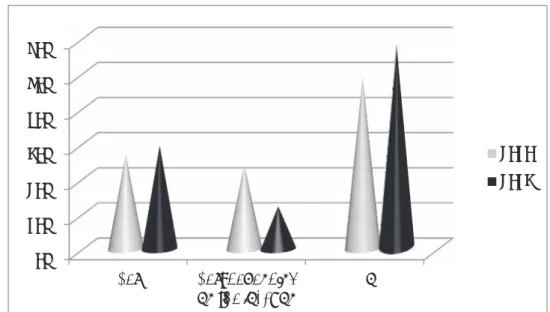
 This tendency to avoid exposure to international experience continues into the workplace. A survey of newly employed company workers by the Sanno Institute of Management (2013 a ) showed that most do not want to work overseas and that this has increased from a survey done three years

Fig. 1. Do you want to work overseas in the future?

0%

10%

20%

30%

40%

50%

60%

Yes Yes, depending on the location

No

2010 2013

Source: Sanno Institute of Management, 2013a

(5)

earlier (see Fig. 1.), and that the main reason cited was a lack of confidence in language skills.

Further, 55 . 9 % of respondents were dissatisfied with the English language education they had received throughout their schooling.

 Nevertheless, even domestically in Japan there appears to be an increasing need for English language skills in the business world (Tsuji and Tsuji 2012), due to factors such as mergers and acquisitions of companies and the efforts of Japanese companies to expand their business into global markets. However, as they note, 'it has become clear that confidence in English for specific purposes such as discussions, presentations, meetings, videoconferences is found to be low, although the importance of English in these genres is deemed to be relatively high' ( Tsuji and Tsuji 2012 , p. 406) .

Current Situation in English Language Education in Japanese Universities

 The birth rate in Japan has been decreasing for many years. Consequently, the number of pupils graduating from high schools has also been decreasing. At the same time, the number of universities and tertiary education institutions in Japan has been rising. According to the Ministry of Education, Culture, Sports, Science and Technology, in 2012 there were 783 universities, with 2,876,134 students.

The corresponding figures in 1990 were 507 universities with 2 , 133 , 362 students. As such, the ratio of university entrants to the population cohort stands at 50 . 8 % ( MEXT, 2012 a ) . A greater number of universities are attempting to attract a greater number of enrollees from a gradually decreasing population pool, resulting in relaxed entrance standards at various post-secondary institutions. This has in turn led to a perception of a lower level of general academic ability among students, and a lower level of English language acquisition prior to entering university ( Ikegashira, Matsumoto, Morita, 2009, p. 17).

 In response, some universities have taken steps or introduced measures aimed at improving their provision of English language education, such as increasing the use of English as the medium of instruction. For example, universities such as Akita International University have made studying in English a central plank of their educational philosophy, and in 2000, Ritsumeikan Asia Pacific University opened as a mostly bilingual university.

 Not concidentally, in 2003 , Japan realised a long standing goal of attracting 100 , 000 exchange students. In 2008 , a new goal was set with the ' 300 , 000 International Students Plan' ( MEXT, 2008) . In order to help achieve that goal, the 'Global 30' Project was established with large-scale funding from the Ministry of Education for five years beginning in the 2009 academic year. Thirteen 'elite'

universities were chosen to develop degree programmes in English ( MEXT, 2012 b ) . Funding for

these programmes ends in in fiscal 2013 , and from that point universities must decide whether to

continue these programmes through different funding measures. A visit to Osaka University to

discuss their 'Global 30 ' Project with staff and view classes made it clear that dedicated professors

are providing lessons requiring high level English language skills. These classes appear to be popular

with students and Osaka University has elected to continue with the programme after government

funding ends. However, as should be expected given the aims of the 'Global 30' Project, the majority

of students taking classes are international students or Japanese students who have attended

international schools in Japan.

(6)

 While the 'Global 30' Project aims at bringing international students to Japan, the Project for Promotion of Global Human Resource Development, also known as 'Global 30 Plus', was introduced in 2011 to encourage universities to develop programmes which aim to help Japanese students improve their English language skills to the extent that they will be able to study abroad, with 41 universities selected to develop innovative programmes (JSPS, 2012).

 A number of other universities throughout Japan have developed courses, such as English for Academic Purposes and English for Specific Purposes aimed at improving the quality of English language education at their individual institutions.

 These efforts are welcome, but in the current environment they represent the minority of English language programmes at universities. An Asahi Shimbun and Kawai Juku survey ( Asahi Shimbun, 2013) found that while 89 % of universities consider internationalisation important, or very important, over 70% of universities are finding it difficult to make funding available to promote internationalisation, 48 % are having difficulty securing academic staff to promote internationalisation and 56 % are having difficulty in securing academic staff who can teach in English. Nationally, only 4 . 2 % of academic staff are foreigners and they are not necessarily trained as language teachers.

Given the general English language ability of Japanese university students, as revealed by international tests of English ( noted above ) , many of these programmes cater to those students who have already managed to achieve a relatively high, or very high, command of English. As such, it is clear that English immersion programmes, English only courses and the like are not a realistic option for the majority of universities in Japan.

 That notwithstanding, almost all universities in Japan insist that students take English as a graduation requirement. In some cases this may only be for one year, but in many cases students are required to take English for a minimum of two years. The paradox is clear. Most universities have in place a system in which requires students to take English lessons, but do not have the resources to provide the kind of English language education that they themselves believe is necessary.

 Consequently, it becomes clear that new approaches are needed which aim to improve English language skills and which also seek to be part of a broader reform of educational practices that focus on the development of the kind of cognitive skills required in a new era of globalisation and rapid change, the so - called information society. Ideally, this would locate English language education as part of an integrated education system, and not, as is commonly the case now in the majority of Japanese educational institutions, as a stand- alone subject which appears to neither foster general foreign language skills nor the specific foreign language skills required in a globalising society.

Regarding CLIL

 A trend in foreign language education that has emerged in Europe in recent years which has the

potential to be one those new approaches is Content and Language Integrated Learning ( hereafter

CLIL). In the classroom setting, CLIL is an educational approach in which pupils or students learn a

subject in the school curriculum, such as maths, science, sport or geography through the medium of

a foreign ( usually a second, but sometimes even a third ) language. It is considered to be a dual -

(7)

focus approach in which learning of both the content of the curricula subject and the foreign language is the object ( Coyle, Hood & Marsh, 2010) . Ideally, equal focus would be given to both the learning of subject content and to the learning of the language, however greater or lesser degree of weight may be placed on either language or content depending on the context in which CLIL is being applied. In this way, a subject is taught and learnt through a foreign language, and the language is taught and learnt through a subject at one and the same time. There is also potential for CLIL to be utilised outside of the classroom or educational institution. In principle, sport or cultural club activities could also be conducted using CLIL approaches, as indeed could other activities in the community, such as cooking lessons, and children's summer activities.

 The immediate antecedents of CLIL are French language immersion schools established in Canada during the 1970 s ( Eurydice, 2006 ; Lyster, 2007 ; Mehisto, Marsh & Frigols, 2008) . However, while the term 'Content and Language Integrated Learning' first came be widely used in Europe through the 1990 s to describe trends in language education across Europe ( Coyle, et al., 2010) , it is by no means a new concept. Teaching and learning in a foreign or second language has occurred in many places and times in history. For hundreds of years, Chinese was the medium of higher learning in Japan. In ancient Europe, Romans were educated in Greek, and later Latin became the language of scholarship throughout the continent for hundreds of years, while until relatively recently French had long been considered the language of diplomacy in Europe, such that anyone aspiring to be an effective diplomat required a proper command of French. In modern times in Japan, during the Meiji Era, instruction in all subjects at university level was carried out in English, French and German for almost a decade ( Omura, 1978) as Japan embarked on a rapid programme of modernisation and industrialisation.

 Each of these situations could be regarded as examples of foreign language immersion education.

Tedick, Christian and Fortune (2011) define immersion programmes as those in which at least 50%

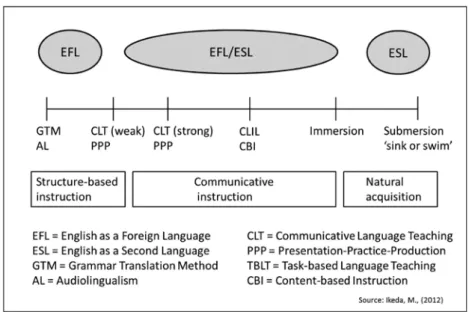
of learning takes place in the foreign, or target, language. CLIL, on the other hand can be considered an 'umbrella term' ( Mehisto, et al., 2008 , p. 12) covering a broad spectrum of approaches and methods to teaching and learning in a target language and 'which would encompass any activity in which a foreign language is used as a tool in the learning of a non-language subject in which both language and the subject have a joint curricular role' ( Marsh, 2002) . Another way of visualising where CLIL lies on the language teaching and learning spectrum is shown in figure 2 .

 CLIL is theoretically based upon a '4Cs' framework of Communication, Content, Cognition and Culture, which are inter-related within a specific context (Coyle, et al. 2010). In this conceptualisation, Content can be understood as the subject matter, or class ( maths, science, geography, etc ) in the curriculum; Communication refers to students' use and learning of language;

Cognition to the development of the cognitive skills that connect the understanding of content and the use of language; and Culture reflects the different perspectives to which students will be exposed and the greater understanding and consciousness of themselves and their own culture and that of others they can be expected to develop.

 Graddol (2006, p. 86) notes that 'it differs from simple English-medium education in that the

learner is not necessarily expected to have the English proficiency required to cope with the subject

before beginning study.' As such, CLIL has the potential to be a 'just - in - time approach as opposed to

(8)

a just - in - case approach' ( Mehisto, et al., 2008 , p. 21) to learning a language, such that students are provided with the language tools and skills they need to deal with the content of the subject when they need and will use those skills, rather than on the assumption that they may need whatever skills are provided at some time in the future. This means that, in principle, pupils and students would have the opportunity to put their newly acquired linguistic resources into practice immediately, improving the likelihood of those skills being retained in the long term.

 It is now recognised that by teaching the content of subjects in the regular curriculum through a second language, with appropriate support and assistance, learners are exposed to a more natural way of learning a foreign language. Rather than an abstract concept that must be studied simply for knowledge of its workings or for test taking, the second language becomes something with real, contextual meaning in the lives of learners. In the same way that learners' first language knowledge and skills develop in complexity and depth as they learn content subjects at school, a similar process can be expected to take place with a second language in a CLIL environment.

 Since the 1990s, CLIL-type programmes and initiatives have been widely adopted in many countries across Europe, where 'CLIL type provision is part of mainstream education in the great majority of countries at primary and secondary levels' ( Eurodyce, 2006 , p. 13) . CLIL programmes have been officially promoted by both the EU itself in policy on foreign language learning

3)

and member governments. In Spain, for example, CLIL has been strongly promoted by the government ( Kessler, 2005) .

 Studies from across Europe are revealing that, as might be expected, CLIL gives better outcomes in terms of foreign or second language acquisition than traditional EFL courses ( Basque Institute of 3) For example http://ec.europa.eu/languages/documents/clilbroch-xx.pdf_en.pdf, http://ec.europa.eu/languages/

eu-language-policy/policy-documents_en.htm

Fig 2. Positioning of CLIL in Language Teaching Methodologies

(9)

Educational Evaluation and Research, 2007; Lasagabaster, 2008; Ruiz de Zarobe, 2008; Várkuti, 2010), while Lázaro (2011) found that learners in a high school CLIL environment developed certain L 2 language skills at a much quicker rate than those in traditional EFL environments. Studies in Andalusia, Spain, found positive outcomes for target language performance and positive appraisal of CLIL programmes by pupils, teachers and parents (Perez Cañado, 2011).

 Other scholars have found evidence of higher levels of motivation among pupils taking CLIL classes when compared to those taking traditional language classes ( Lasagabaster & Sierra, 2009 ; Lasagabaster, 2011; Seikkula-Leino, 2007), as well as general student approval of CLIL type programmes ( Dalton - Puffer, et al., 2009) . Crucially, content knowledge and understanding appear to be unaffected by learning through a second or foreign language ( Serra, 2007) . Equally importantly, Seikkula - Leino (2007) found that though in the short term pupils in CLIL classes may lag behind those in mainstream classes, development of L1 is not adversely affected in the long term by CLIL programmes, and Bergroth (2006) found no significant difference in L 1 development as measured in matriculation testing three years after immersion education had ended. Merisuo - Storm (2006) also found no adverse effect to L 1 literacy due to CLIL instruction in a foreign language and also found that the usual difference in interest in reading between boys and girls was not evident in CLIL classes.

 This leads to the possibility of functional bilingualism for pupils and students, which is claimed to offer many benefits. The Centre for Languages, Linguistics and Area Studies at the University of Southampton maintains an internet site claiming 700 benefits (Gallagher-Brett, 2005) of learning a second language. Mehisto and Marsh (2011) reviewed much of the literature surrounding benefits accrued by bilingualism and noted many actual or potential economic, cognitive and health benefits.

One health benefit is the late onset of Alzheimer's disease among bilinguals compared to monolinguals (Bialystok, Craik & Freedman, 2007; Craik, Bialystok & Freedman, 2010), which has particularly important implications in terms of health and social welfare in an aging society like Japan ( MIC, 2012) . Additionally, Rubio - Fernandez and Glucksberg (2012) found that bilinguals are able to understand others' point of view, or the way other people see a given situation, better than monolinguals.

 Without drawing fine lines in terms of definitions or trying to quantify what a bilingual person

might be capable of doing, business leaders are offering some key insights of what is required in a

globalized world. Sakakibara (2013b) of the Sanno Institute of Management claims that the need for

a major foreign language, such as English or Chinese, is not the only requirement for a 'global

person'. The ability to express opinions and convince others of the value of those opinions is lacking

in the way Japanese people interact with others. As a businessman acquaintance of the authors put

it, '… when I was looking for a company to work at more than 20 years ago speaking English was

enough to find a job.' Now, though, the ability to think creatively and act independently and adapt to

a business environment are essential requirements ( personal interview, 2013) . This is an area in

which CLIL approaches, if effectively implemented, may have a significant impact. Teachers in one

study in Spain claimed that 'CLIL programmes also increase generic competence acquisition

( knowledge of the world, intercultural skills, motivation or learning strategies ) and do not water

down contents, but increase their learning' ( Perez Cañado, 2011 , p. 394) .

(10)

 While adopting CLIL approaches to L2 teaching and learning is no guarantee of successful attainment of bilingualism, the European Commission (2013) claims that the use of CLIL offers the following benefits:

  builds intercultural knowledge and understanding   develops intercultural communication skills

  improves language competence and oral communication skills   develops multilingual interests and attitudes

  provides opportunities to study content through different perspectives   allows learners more contact with the target language

  does not require extra teaching hours

  complements other subjects rather than competes with them   diversifies methods and forms of classroom practice

  increases learners' motivation and confidence in both the language and the subject being taught.

 Of particular note for the Japanese context here is that no extra time needs to be found in the curriculum to utilise CLIL, as schedules for pupils and students in most Japanese schools and universities are already very full. Another important feature of these benefits is the development of cultural understanding and communicative skills, which are key goals identified in the Ministry of Education's Course of Study.

Considerations Regarding the Adoption of CLIL in Japan

 Throughout Europe and the rest of the world CLIL programmes and approaches differ according to local circumstances (Marsh, 2002; Wolff, 2002; Lasagabaster, 2008), and this will also need to be the case in Japan. Social, cultural and historical factors need to be taken into consideration. Any adoption of CLIL in Japan, or by Japanese educational institutions, should be specifically tailored to the Japanese context on a macro scale, and to each institution on a micro scale. Merely wholesale importing and applying approaches which may have proven successful in other parts of the world does not guarantee similar success in Japan.

 As Aspinall (2006) has noted in respect of foreign language education in Japan, there are cultural issues at play in Japan which can make it difficult for policy which has been developed and proposed at the bureaucratic level to be adopted and implemented in the classroom or institution. The pressures and time constraints that individual teachers and schools face may make it difficult to make substantive changes, even if all are in agreement that changes are desirable.

 Horiguchi, Harada, Imoto & Atobe (2010) found that an attempted implementation in Japan of the European language portfolio ( ELP ) at Keio schools in Tokyo faced a number of hurdles. There were practical issues regarding the wording and clarity of some of the descriptors used. Socio - cultural issues existed, with teachers and pupils often noting that the ELP it did "not fit the Japanese context'

(Horiguchi, et al., 2010, p. 145) or that they could not understand why they were using the ELP

given that the circumstances surrounding language learning and teaching were quite different in

Europe and Japan. There was a sense that some of the key concepts, such as self - evaluation, did not

(11)

apply to the learning environment that pupils found themselves in. Institutional concerns also emerged. Teachers and individual schools felt the imposition of a new educational tool from a central research facility infringed on their autonomy, 'Keio's core institutional identity' ( Horiguchi, et al., 2010, p. 149).

 Similarly, Rappleye, Imoto & Horiguchi (2011) found that the attempt to adapt the Common European Framework of Reference for Languages ( CEFR ) from the European context ran into a number of difficulties, some unforeseen, when applied to an elite tertiary educational institution in Japan. Many of these problems revolved around 'personal' conflicts and misunderstandings arising from different views being held and different goals being aimed for by various actors in the initiative.

 While issues of this kind do not preclude the adoption of educational policies or pedagogical approaches from other parts of the world, they cannot be ignored. Consequently, careful consideration of the needs of all players must be taken to ensure that any uptake of CLIL in Japan is founded upon a solid basis in order to give it a reasonable chance of success.

 Sophia University in Tokyo is currently involved in an attempt to implement CLIL across a number of classes, which have been documented as a series of cases studies ( Izumi, Ikeda &

Watanabe, 2012). Many of the difficulties they encountered and achievements they have made have in these case studies point to possibilities inherent in CLIL approaches. While this is not proof of the applicability of CLIL to the broad spectrum of university contexts in Japan, by making the results of their efforts available it serves as a valuable model to other institutions.

Summary and Discussion

 As has been noted, the ability to use English well is becoming an important part of the skill-set of globally oriented citizens and workplace personnel. In the field of English language education, Japan has a number of successful programmes and schools. Large scale initiatives to improve English language education, such as the 'Global 30 ' and 'Global 30 Plus' programmes, appear to be realising improvements at a small number of select institutions. However, the educational system in general is not providing enough opportunities for all pupils and students to acquire the kinds of English language skills that are increasingly required in a globalised world. Outmoded methods of teaching have proved resistant to change, despite decades of sustained effort and funding intended to bring more effective methods into practice.

 As a consequence, a fresh approach to this problem is called for. One such approach to language teaching and learning showing great promise in various parts of the world, in particular Europe, and which may prove of value as a catalyst for change in Japan is Content and Language Integrated Learning (CLIL). As studies have shown, however, it is not easy to engender change in the field of education and the introduction of policy measures from other parts of the world is not always successful. In order to give CLIL approaches a chance to make a difference to the way English language education is delivered an environment conducive to its uptake will need to be ensured.

 In Europe, the great majority of CLIL practitioners are content teachers - that is, the teachers of

non - language subjects - with the support of language teachers. Anecdotally, at present in Japan the

teachers showing most interest in CLIL are foreign language teachers. As such a bridge will need to

(12)

be built between teachers of content classes and teachers of language classes. Noting the issues regarding autonomy referred to by Horiguchi, et al., we hope to go some way to determining in the course of this research project whether it is possible to build that bridge.

 As noted above, universities are often seen to be setting the agenda for the way in which English language education is carried out in schools, due to the influence of entrance examinations. As a consequence, the opinions of teachers and other actors working in universities across the spectrum of Japanese higher education will need to be canvassed. Throughout this research project, we intend to try to ascertain the opinions of students, professors, and administrators regarding CLIL and its possibilities. Additionally, the opinions of business people and organisations will need to be taken into consideration.

 The situation surrounding the use of CLIL in Europe at all educational levels, but in particular at the tertiary level, will need to be investigated thoroughly. Discovering the best principles and policies employed in implementation, and understanding the issues of difficulty that it has been necessary to negotiate. Learning from the strengths and structural make - up of successful programmes and projects, as well as from the reasons for the lack of success in other programmes and projects, will help to make any efforts to implement CLIL in Japan more prone to success. The researchers intend to focus efforts primarily on two countries. Finland, where the principles of CLIL were first formulated and developed, and which has a proven track record of excellence in education, and Spain where perhaps more so than any other country a confluence of interested parties has emerged. The Spanish central government and regional governments have placed high priority on second and third language acquisition, and have developed policies to promote the use of CLIL approaches. Research into CLIL in Spain is one of the driving forces of the development of a rigorous theoretical basis for CLIL.

 If these investigations prove fruitful, a number of concrete issues regarding day to day classroom practice will become of major importance. The development of teaching materials and other resources, and making them easily accessible to teachers will be crucial. These resources will ideally be developed from a number of sources, but with the aim of both making them applicable to the Japanese context, and based on clear principles which promote the learning of English and content as well as promoting the development of the cognitive and critical thinking skills required by modern citizens in a globalising world.

 Finally, the dissemination of knowledge about CLIL and techniques and materials suitable to the Japanese context will also be necessary. It is envisioned that a various avenues of communication will be employed, including both traditional formats, digital tools and any other appropriate method.

Acknowledgment

 This work was supported by JSPS Kakenhi Grant - in - Aid for Scientific Research ( C ) , grant number 25370671 .

References

Asahi Shimbun, August 9, 2013, p. 30 Kokusaika ni takai hādoru, ( 国 際 化 に 高 い ハ ー ド ル ), [High Barriers to

(13)

Internationalisation].

Asahi Shimbun Digital (2013) Kokusaika ni takai hādoru: "shikin no kakuho ga konnan" nana wari ijo, ( 国際化に 高いハードル「資金の確保が困難」7割以上 ), [High Barriers to Internationalisation: "Funding Difficult to Secure" Say More than 70%], http://www.asahi.com/edu/hiraku/article09.html, [Accessed November 12, 2013].

Aspinall, R. (2006) Using the paradigm of 'small cultures' to explain policy failure in the case of foreign language education in Japan, Japan Forum, 18 (2), pp. 255-274.

Basque Institute of Educational Evaluation and Research, (2007) Trilingual students in secondary school: A new reality, http://www.isei-ivei.net/eng/pubeng/Trilingual-students.pdf, [Accessed September 29, 2012].

Bergroth, M. (2006) Immersion students in the matriculation examination: Three years after immersion, in Exploring Dual-Focussed Education: Integrating language and content for individual and societal needs, Björklund, S., Mård-Mettinen, M. Bergström, M and Södergård, M. (eds), Vaasa, http://www.uwasa.fi/

materiaali/pdf/isbn_952-476-149-1.pdf, [Accessed September 30, 2012].

Bialystok, E., Craik, F. & Freedman, M. (2007), Bilingualism as a protection against the onset of symptoms of dementia, Neuropsychologia, 45, pp. 459-464.

Brown, J.D., & Yamashita, S.O. (1995) English Language Entrance Examinations at Japanese Universities: What Do We Know About Them?, JALT Journal, 17 (1), pp. 7-30.

Browne, C. M. & Wada, M. (1998) Current Issues in High School English Teaching in Japan: An Exploratory Survey, Language, Culture and Curriculum, 11 (1), pp. 97-112.

CJGTC (Prime Minister's Commission on Japan's Goals in the 21st Century) (2000) The Frontier Within:

Individual Empowerment and Better Governance in the New Millennium - Chapter

1

Overview.

Coyle, D., Hood, P., & Marsh, D. (2010) Content and Language Integrated Learning, Cambridge: Cambridge University Press.

Craik, F., Bialystok, E. & Freedman, M. (2010), Delaying the onset of Alzheimer Disease: Bilingualism as a form of cognitive reserve, Neurology, 75, pp. 1726-1729.

Crystal, D. (2003) English as a Global Language, Cambridge: Cambridge University Press.

Dalton-Puffer, C., Hüttner, J., Schindelegger, V. & Smit, U. (2009) Technology-Geeks Speak Out: What Students Think About Vocational CLIL, International CLIL Research Journal¸ 1 (2), pp. 18-25.

Economist (2011) November 26, 'Listing, not keeling', p. 75.

Economist (2011) November 26, 'Where rats and robots play', p. 80.

Educational Testing Service (ETS) (2011) TOEFL Candidates and Populations, http://www.ets.org/toefl/

research/topics/candidates_and_populations, [Accessed April, 2012].

European Commission (5 July, 2013) Content and language integrated learning, http://ec.europa.eu/languages/

language-teaching/content-and-language-integrated-learning_en.htm, [Accessed November 1, 2013].

Eurydice (2006) Content and Language Integrated Learning (CLIL) at School in Europe, Brussels: Eurydice.

Gallagher-Brett, A. (2005) Seven Hundred Reasons for Studying Languages¸ University of Southampton: Subject Centre for Languages, Linguistics and Area Studies, https://www.llas.ac.uk/resourcedownloads/6063/700_

reasons.pdf, [Accessed November 5, 2013].

Gorsuch, G. (1998) Yaku-doku EFL in two Japanese high school classrooms: An exploratory study, JALT Journal, 20 (1), pp. 6-32.

Gorsuch, G. (2001), Japanese EFL Teachers' Perceptions of Communicative, Audiolingual and Yakudoku Activities: The Plan Versus the Reality, Educational Policy Analysis Archives

9

(

10

), http://epaa.asu.edu/ojs/

article/view/339, [Accessed September 21, 2012].

Graddol, D. (2006) English Next, London: British Council.

Guest, M. (2000) "But I have to teach grammar!": An analysis of the role "grammar" plays in Japanese university English entrance examinations, The Language Teacher, 24 (11), pp. 23-29.

Hino, N. (1988) Yakudoku: Japan's Dominant Tradition in Foreign Language Learning, JALT Journal, 10 (1and2), pp. 45-55.

Horiguchi, S., Harada, Y., Imoto, Y., & Atobe, S. (2010) The implementation of a Japanese version of the "European

Language Portfolio - Junior Version -" at Keio: Implications from the perspective of organizational and

educational anthropology, in Can do statements in language education in Japan and beyond: Applications of

the CEFR, Schmidt, M. G., Naganuma, N., O'Dwyer, F., Imig, A., and Sakai, S. (eds), Tokyo: Asahi Press.

(14)

IELTS (2011) Researchers - Test taker performance 2011, http://www.ielts.org/researchers/analysis_of_test_

data/test_taker_performance_2011.aspx [Accessed September 12, 2012].

Ikeda, M., (2012) CLIL genri to shidoho [CLIL Principles and Methodology], in CLIL: New Challenges in Foreign Language Education at Sophia University: Volume 2, Practices and Applications, Izumi, S., Ikeda, M. &

Watanabe, Y. (Eds.), Tokyo: Sophia University Press.

Ikegashira , A., Matsumoto Y. & Y, Morita, Y. (2009) English Education in Japan: From Kindergarten to University, in Into the Next Decade with (2nd) FL Teaching, Reinelt, R. (Ed.), Ehime University, Japan.

Imamura, S. (1978) Critical Views on TEFL: Criticism on TEFL in Japan, in The Teaching of English in Japan, Koike, I. (ed.), Tokyo: Eichosha.

Izumi, S., Ikeda, M. & Watanabe, Y. (2012) CLIL: New Challenges in Foreign Language Education at Sophia University: Volume

2

, Practices and Applications, Tokyo: Sophia University Press.

Japan Agri News (2013) Japan's food self-sufficiency rate for

2012

stays flat at

39

%, http://english.agrinews.

co.jp/?p=891, [Accessed November 9, 2013].

Japan Association of Corporate Executives (Keizai Doyukai) (2013) Achieving University Entrance Exams that Test Practical English Abilities: Connections with English Education Reform in Primary and Secondary Education and International Standardization, http://www.doyukai.or.jp/en/policyproposals/2013/130422a.html, [Accessed October 26, 2013].

Japan Society for the Promotion of Science (JSPS) (2012) Gurōbaru jinzai ikusei suishin jigyō ( グローバル人材育 成 推 進 事 業 ), [Project for Promotion of Global Human Resource Project], http://www.jsps.go.jp/j-gjinzai/

kekka.html, [Accessed November 13, 2013].

Japan Times (2010) Food self-sufficiency rate fell below

40

% in

2010

, http://www.japantimes.co.jp/

news/2011/08/12/news/food-self-sufficiency-rate-fell-below-40-in-2010/, [Accessed November 9, 2013].

Keidanren (2000) Gurōbaruka jidai no jinzai ikusei ni tsuite ( グローバル化時代の人材育成について ), [Regarding the Development of Human Resources in the Era of Globalisation], http://www.keidanren.or.jp/japanese/

policy/2000/013/index.html, [Accessed October 26, 2013] .

Keidanren (2013) Fostering people who Can Excel in Global Arena , http://www.keidanren.or.jp/en/

policy/2013/059.html, [Accessed October 26, 2013].

Kessler, M. "Spain opts to instruct in English", Guardian 11 February, 2005, http://www.guardian.co.uk/

education/2005/feb/11/tefl1, [Accessed January 6, 2013].

Koike, I. & Tanaka, H. (1995) English in Foreign Language Policy in Japan: Toward the Twenty-first Century, World Englishes, 14 (1), pp. 13-25.

Lasagabaster, D. (2008) Foreign Language Competence in Content and Language Integrated Courses, The Open Applied Linguistics Journal, 1, pp. 30-41.

Lasagabaster, D. (2011) English achievement and student motivation in CLIL and EFL settings, Innovation in Language Learning and Teaching, 5 (1), pp. 3-18.

Lasagabaster, D. and Sierra, J. M. (2009) Language Attitudes in CLIL and Traditional EFL Classes, International CLIL Research Journal¸ 1 (2), pp. 4-17.

Lázaro, A. (2012) Faster and Further Morphosyntactic Development of CLIL vs. EFL Basque-Spanish Bilinguals Learning English in High-School, International Journal of English Studies, 12 (1), pp. 79-96.

Lyster, R. (2007), Learning and Teaching Languages Through Content: A counterbalanced approach, Amsterdam/

Philadelphia: John Benjamins Publishing Company.

Marsh, D. (2002) CLIL/EMILE: The European Dimension, Actions, Trends and Foresight Potential, Jyväskylä:

University of Jyväskylä.

Matsuyama, M. (1978) Entrance Examinations: College Entrance Examinations and English Education in Japan, in The Teaching of English in Japan, Koike, I. (ed.), Tokyo: Eichosha.

Mehisto, P., Marsh, D., & Frigols, M. (2008) Uncovering CLIL: Content and Language Integrated Learning in Bilingual and Multilingual Education, Oxford: Macmillan.

Mehisto, P. & Marsh, D. (2011) Approaching the Economic, Cognitive and Health Benefits of Bilingualism: Fuel for CLIL, in Content and Foreign Language Integrated Learning: Contributions to Multilingualism in European Contexts, Ruiz de Zarobe, Y., Sierra, J. M. and Gallardo del Puerto, F. (eds), Bern: Peter Lang.

Merisuo-Storm, T. (2006) Development of Boys' and Girls' Literacy Skills and Learning Attitudes in CLIL

(15)

Education, in Exploring Dual-Focussed Education: Integrating language and content for individual and societal needs, Björklund, S., Mård-Mettinen, M. Bergström, M and Södergård, M. (eds), Vaasa, http://www.uwasa.fi/

materiaali/pdf/isbn_952-476-149-1.pdf, [Accessed September 30, 2012].

Ministry of Economy, Trade and Industry (METI) (2013), Tokutei sābisu sangyou doutai toukei chōsa, ( 特定サー ビ ス 産 業 動 態 統 計 調 査 ), [Statistics from a survey of selected service industries], http://www.meti.go.jp/

statistics/tyo/tokusabido/result-2.html, [Accessed November 12, 2013].

Ministry of Education, Culture, Sports, Science and Technology (MEXT) (2003) Action plan to cultivate "Japanese with English abilities", http://www.mext.go.jp/b_menu/houdou/15/03/03033101/001.pdf, [Accessed February, 2005].

Ministry of Education, Culture, Sports, Science and Technology (MEXT) (2008) Outline of the Student Exchange System, http://www.mext.go.jp/component/a_menu/education/detail/__icsFiles/afieldfi le/2009/11/04/1222424_20_001.pdf, [Accessed November 11, 2013].

Ministry of Education, Culture, Sports, Science and Technology (MEXT) (2012a) Statistics, http://www.mext.

go.jp/english/statistics/, [Accessed November 10, 2013].

Ministry of Education, Culture, Sports, Science and Technology (MEXT) (2012b) The "Global 30" Project to Invite 300,000 International Students to Japan, http://www.uni.international.mext.go.jp/global30/, [Accessed November 11, 2013].

Ministry of Internal Affairs and Communications (MIC) (2012) Kōreisha no jinkō, ( 高齢者の人口 ), [Population of Aged People], http://www.stat.go.jp/data/topics/topi631.htm, [Accessed 17 September, 2012].

Nakane, C. (1984) Japanese Society, Japan: Tuttle.

Neustupný, J. V. & Tanaka, S. (2004) English in Japan: An Overview, in English Language Teaching: The Case of Japan, Makarova, V. and Rodgers, T. (eds).

New York Times (2011) February 20, 'Fewer Japanese Students Studying Abroad', http://www.nytimes.

com/2011/02/21/world/asia/21iht-educLede21.html?pagewanted=all&_r=0, [Accessed November 6, 2013].

OECD (2013) Education at a Glance 2013: Japan, http://www.oecd.org/edu/Japan_EAG2013%20Country%20Note.

pdf, [Accessed November 12, 2013].

Perez Cañado, M.L. (2011) The Effects of CLIL within the APPP: Lessons Learned and Ways Forward, in R.

Crespo and A. García de Sola (eds.) Studies in Honour of Ángeles Linde López, Granada: Universidad de Granada.

Rappleye, J., Imoto, Y. & Horiguchi, S. (2011) Towards 'thick description' of educational transfer: understanding a Japanese institution's 'import' of European language policy, Comparative Education, 47 (4) pp. 411-432.

Reischauer, E.O. (1977) The Japanese, Cambridge, MA: Belknap Press.

Rubio-Fernandez, P. & Glucksberg, S. (2012) Reasoning about Other People's Beliefs: Bilinguals Have an Advantage, Journal of Experimental Psychology: Learning, Memory and Cognition, 38 (1) pp. 211-217.

Ruiz de Zarobe, Y. (2008) CLIL and Foreign Language Learning: A Longitudinal Study in the Basque Country, International CLIL Research Journal¸ 1 (1), pp. 60-72.

Sanno Institute of Management (2013a) Shinnyū shain no gurōbaru ishiki chōsa, ( 新入社員のグローバル意識調査 ), [Survey of the Global Consciousness of New Company Employees] http://www.sanno.ac.jp/research/pdf/

global2013.pdf, [Accessed November 12, 2013].

Sanno Institute of Management (2013b) Sakakibara Y. Koramu "gurōbaru jinzai" no yōken to wa: zenpen, コラム

「グローバル人材」の要件とは【前編】, [Column: Important Matters regarding "Global Personnel": Part 1], http://www.hj.sanno.ac.jp/ri/page/9602, [Accessed November 6, 2013].

Seikkula-Leino, J. (2007) CLIL Learning: Achievement Levels and Affective Factors, Language and Education, 21 (4), pp. 328-341.

Serra, C. (2007) Assessing CLIL at Primary School: A Longitudinal Study, The International Journal of Bilingual Education and Bilingualism, 10 (5), pp. 582-602.

Sugimoto, Y. (2010) An Introduction to Japanese Society, Port Melbourne: Cambridge University Press.

Takahashi, Y. (2004) TEFL and Communication Styles in Japanese Culture, Language, Culture and Curriculum, 17 (1), pp. 1-14.

Tajino, A. & Walker, L. (1997) English Language Education in Japan: with Special Reference to the Social and

Educational Background, Studies in the Humanities and Sciences, Hiroshima Shudo University, 37 (2) pp. 95-

(16)

110.

Tedick, D.J., Christian, D. & Fortune, T.W. (2011) The Future of Immersion Education: An Invitation to 'Dwell in Possibility', in Immersion Education: Practice, Policies, Possibilities, Tedick, D.J., Christian, D. and Fortune, T.W. (eds), Bristol: Multilingual Matters.

Tsuji K. & Tsuji, S. (2012) Assessing the Need for English at Manufacturing Companies in Japan, Proceeding of the JACET

51st

International Convention.

Várkuti, A. (2010) Linguistic Benefits of the CLIL Approach: Measuring Linguistic Competences, International CLIL Research Journal¸ 1 (3), pp. 67-79.

Wolff, D. (2002) Approaching CLIL, The CLIL Quality Matrix: Central Workshop Report, http://archive.ecml.at/

mtp2/CLILmatrix/pdf/wsrepD3E2005_6.pdf, [Accessed November 13, 2013].

Yomiuri Shimbun (2011) Chōhyōgaki no shūkatsu: oshiyoseru gurōbaruka: gaikokujin gakusei mo raibaru, ( 超氷河 期の就活:押し寄せるグローバル化:外国人学生もライバル ), [Super glacial age for searching for work:

Surging globalisation: Foreign students are also rivals], March 3, p. 38.

Yomiuri Shimbun (2012) Kaigai e: shinjin ni gōrei: kōyōgo wa eigo, shinkōkoku charenji, ( 海外へ:新人に号令:

公用語は英語:新興国チャレンジ ), [Go Abroad, New Employees Ordered: English is the Official Language:

Build a New Country], April 3, p. 9.

(2013年11月29日掲載決定)

Fig. 1. Do you want to work overseas in the future?0%10%20%30%40%50%60%
Fig 2. Positioning of CLIL in Language Teaching Methodologies

参照

関連したドキュメント

In the case, say, of showing that a genus 2 algebraically slice knot is not concordant to a knot of genus 1, we have to prove that it is not concordant to any knot in an innite

We have formulated and discussed our main results for scalar equations where the solutions remain of a single sign. This restriction has enabled us to achieve sharp results on

One problem with extending the definitions comes from choosing base points in the fibers, that is, a section s of p, and the fact that f is not necessarily fiber homotopic to a

7.1. Deconvolution in sequence spaces. Subsequently, we present some numerical results on the reconstruction of a function from convolution data. The example is taken from [38],

In section 4 we use this coupling to show the uniqueness of the stationary interface, and then finish the proof of theorem 1.. Stochastic compactness for the width of the interface

It is worthwhile to note that the method of B -bounded semigroups does not require X to be a Banach space (in fact X is not required to have any structure but linear) and

I think that ALTs are an important part of English education in Japan as it not only allows Japanese students to hear and learn from a native-speaker of English, but it

It is known that quasi-continuity implies somewhat continuity but there exist somewhat continuous functions which are not quasi-continuous [4].. Thus from Theorem 1 it follows that