• 検索結果がありません。

Molecular Dynamics Studies on Structure and Dynamics of Spherical Micelles Micke Rusmerryani

N/A
N/A
Protected

Academic year: 2021

シェア "Molecular Dynamics Studies on Structure and Dynamics of Spherical Micelles Micke Rusmerryani"

Copied!
10
0
0

読み込み中.... (全文を見る)

全文

(1)

Micke Rusmerryani

a,b

, Gia Septiana Wulandari

a,b

, Shuhei Kawamoto

b

, Hiroaki Saito

b

, Kiyoshi Nishikawa

b

,Hidemi Nagao

b

a

Faculty of Mathematics and Natural Sciences, Institut Teknologi Bandung, Jl. Ganesha 10, Bandung 40132 Indonesia

b

Institute of Science and Engineering, Kanazawa University, Kakuma, Kanazawa 920-1192 Japan E-mail: [email protected]

Abstract. Due to the soft and flexible structure, lipid molecule forms various shapes such as micelle, bilayer and vesicle. In these systems, since the spherical micelle can be applied to the application of drag delivery system, the analysis of detailed structure and dynamics of the micelle is important. In this study, we carried out molecular dynamics (MD) simulations of the spherical micelles dimer in water solvent to investigate the dynamical structure and correlated motion of the micelle dimer. The MD simulations were run under the constant NPT and NVT conditions with periodic boundary. We adopted the ASIC analysis, which is based on the aperture, symme- try, isotropy, and compactness of the micelle structure to analyze the shape fluctuations for each micelle. From this analysis, we show the stability and correlated motion of spherical micelle and investigate the patterns of synchronization motions between micelle dimer. The mutual fluctuations were periodically shown in the constant NVT simulation, implying that the existence of synchro- nization phenomena between micelle dimer.

Keywords: spherical micelles, molecular dynamics, dynamics, synchronization

1 Introduction

Biological phospholipids show a self-assembly processes to form a certain aggregate such as micelles, vesicles, and membranes. In these systems, the micelle is an aggregate of surfactant molecules in aqueous solution. The micelle is formed by the competition between the hydrophobic and the electrostatic interactions of lipid molecule. The shape of micelle also depends on the molar density of lipid in aqueous solution. In the high lipid density condition, the lipid molecule aggregates so as to direct the head group of lipid to each other and forms the inverse micelle.

Because of the soft and flexible structure, the structure (shape and size) of micelle fluctuates in aqueous solution and depends on both the component of the surfactant molecule and solution conditions such as the temperature and presence of impurities [1]. Also, it forms various structures such as the spherical, cylindrical, and rod-like structure. In these structures, because the spherical micelle structure is relatively stable in aqueous solution, the spherical micelle is expected to apply to drag delivery system.

In the previous research [2], four structural parameters, aperture A, symmetry S, isotropy I, and compactness C (ASIC), were introduced to investigate the shape uctuation of micelle system.

From the analysis of ASIC parameters at each time step, the structural fluctuation and correlated

motion of the micelle were shown in detail. This analysis clearly showed the correlation between

the isotropy I and compactness C. This technique could be expanded for other cases in biological

dynamics. Other valuable informations can be shown by combining with the other parameters. In

other research [3], the synchronization motion in mutual micelle clusters were implied in aqueous

solution. Based on the previous research, it should be interesting to investigate the dynamical

(2)

(c) Spherical Micelles in Boxwater Figure 1: Initial Condition

structure and the synchronization motion in mutual clusters such as two spherical micelles. Ther- modynamic conditions will also be studied to figure out the effects on lipids dynamics. Our goal is to find out whether the dynamics of both micelle have any correlation. In this study, we thus carried out molecular dynamics (MD) simulations of the spherical micelle dimer in water solvent to reveal the dynamical structure and correlated motion of the micelle dimer system. We analyze the fluctuation of the spherical micelle by the ASIC analysis and investigate the synchronization motion between micelle dimer by the time correlation analysis.

2 Computational Methods 2.1 Initial Structure

In this study, we used 8 POPC (1-palmitoyl-2-oleoyl-phosphatidycholine) lipids for each micelle.

Figure 1 (a) shows the structure of POPC lipid. The POPC lipid has two hydrocarbon chains and one phosphatidylcholine (PC) head group [4]. The initial coordinates of the micelle dimer and water molecule were placed in the MD box by Packmol program [5]. The 11,326 TIP3P water were filled in the MD box (8.2 × 15.8 × 8.2 nm). Figure 1(c) shows the snapshot of initial structure of micelle dimer in the MD box.

2.2 Molecular Dynamics Simulation

In this study, two molecular dynamics simulations under the constant NPT and NVT conditions

were carried out by NAMD 2.7b3 program package. We used the CHARMm36 force field [6] and

TIP3P model for the POPC and water molecule, respectively. The periodic boundary condition

(3)

(a) After 10 ns NPT simulation

(b) After 10 ns NVT simulation Figure 2: Final Snapshot

was applied to the MD box, and the particle mesh Ewald (PME) method was adopted for the electrostatic interaction. The cutoff length for nonbond interaction in real space was 12 ˚ A [7].

The constant NPT simulation is used for the system equilibrium. The MD box decreased until 5.85 × 11.11 × 5.84 nm after 10 ns. The length of MD box fluctuated 0.36% during the simulation.

We conformed the micelle dimer sufficiently equilibrated in 10 ns. After 10 ns, the MD simulation was continued to the constant NVT simulation for 10 ns. The effects due to the difference of the MD conditions on structural and dynamical behavior of micelle dimer are also investigated in this study. Both MD simulations were run under the constant temperature (T=300 K). Figure 2 shows the last snapshots of micelle dimer for each simulation at 10 ns.

3 Analysis

3.1 ASIC analysis

In this study, the ASIC analysis was adopted to investigate the dynamical structure and corre-

lated motion of the POPC spherical micelle dimer [2]. The ASIC analysis gives four structural

parameters, aperture A, symmetry S, isotropy I, and compactness C of the micelle system. Each

parameter can be calculated by using the defined vectors ~ r

1

(t), ~ r

2

(t) and R(t) in the POPC lipid. ~

The vector ~ r

1

(t) is applied for the unsaturated acyl chain, the vector ~ r

2

(t) is applied for the sat-

urated acyl chain, and the vector R(t) is given by averaging the vectors ~ ~ r

1

(t) and ~ r

2

(t). The

(4)

I(t) = 1 N

u t

X

j=1

X

k=2,(k>j)

| R ~

j

(t) × R ~

k

(t)|, (3)

C(t) = 1 N

N

X

i=1

| R ~

i

(t)|, (4)

where, N is the total number of lipids in a micelles. We analyze the flexibility of micelle by assessing these ASIC parameters at each MD time steps. The detailed dynamics information about the dynamics of spherical micelles can be obtained by these four parameters.

3.2 Time correlation and delayed time analysis

The time correlation analysis was performed to investigate the correlated motion between micelle dimer in water solvent. The relaxation properties of micelle structure were evaluated by using time correlation function (TCF). The TCF is one of the most common tools to analyze the time- dependent properties of physical variable and is useful to investigate the dynamics of micelle structure. The relaxation of structural parameter is estimated by the sufficient statistical average of the time series of structural parameter. The time-correlation function (TCF) of variable A(t) is defined as following equation;

C

AA

(dτ ) = 1 T − τ

Z

T−τ 0

A(t) · A(t + τ)dt, (5)

where τ is lag time[8]. This equation is the same as the form of auto-correlation function, when the A(t) and A(t + τ ) are the same variable, whereas the cross-correlation function correlation is defined by the two different variables. For example, the time correlation of dynamical properties A(t) and B(t) is expressed as

C

AB

(dτ ) = 1 T − τ

Z

T−τ 0

A(t) · B(t + τ)dt. (6)

Delayed time analysis was evaluated by calculating the direction correlation between the micelle dimer [3]. From the Eq.2, we dene symmetry vector S(t), by using the vector ~ R(t). The direction ~ correlation (DC) is expressed by following equation;

Dc

ij

(t, t

0

) =

S ~

i

(t) · S ~

j

(t

0

)

| S ~

i

(t)|| S ~

j

(t

0

)| . (7)

This analysis gives the degree of parallel between the i

th

and j

th

micelle. When the DC equals

to 1, the micelle dimer should have parallel orientation. Conversely, when the DC equals to -1,

the micelle dimer are in antiparallel condition. This analysis can be applied to investigate the

synchronization motion between micelle dimer.

(5)

Figure 3: Time (ns) vs RMSD (nm

2

)

Figure 4: Time (ns) vs Distance (nm)

4 Results and Discussion

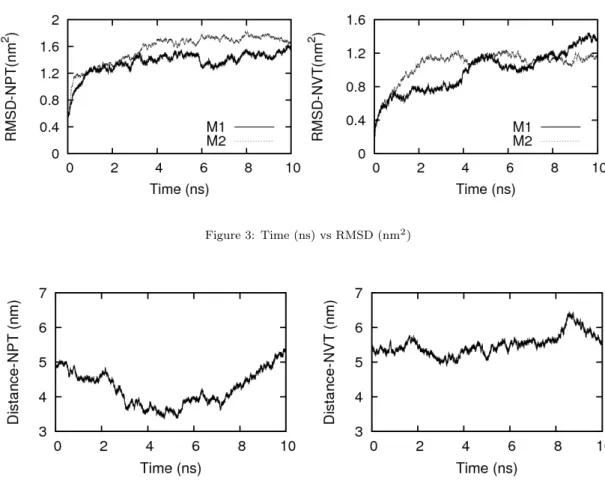
From each MD simulation, we obtained trajectories of micelle dimer in water solvent. Here, we simply call those micelles as the micelle 1 and micelle 2. We first calculated the root mean square displacement (RMSD) of each micelle to assess the equilibrium of the system during the simulations.

The observed RMSD in the constant NPT and NVT simulation is shown in Figure 3. The results showed that the structures of both micelles in the constant NPT condition were equilibrated after 5 ns. However in NVT simulation, the RMSD of micelle 1 increased after 5 ns, showing the large displacement of micelle 1 in the system.

Figure 4 shows the distance between the center of mass of each micelle. We found that the

micelles were getting closer to each other, and then went back to the initial distance in the constant

NPT MD simulation. In NVT simulation, the observed micelle distance was found to be flctuated

around the 5.5 nm. This difference could be cased by the difference of simulation conditions; the

fluctuation of MD box possibly affects the dynamics of micelle. The distance between micelle dimer

in NVT simulation was found to be larger than that in NPT simulation.

(6)

Figure 5: Time (ns) vs ASIC-NPT plotted every 20 ps

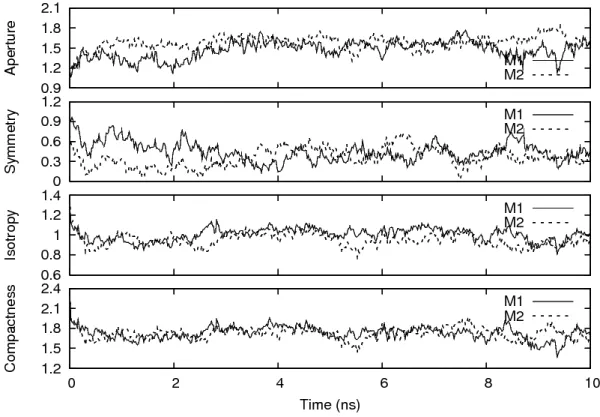
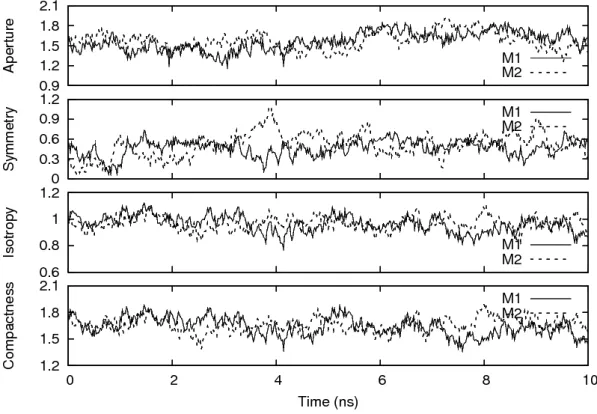
Figure 5 and 6 shows the observed ASIC parameters as a function of MD time steps. We found that the structural parameter of micelle A, I and C were high values whereas S showed low value in both constant NPT and NVT condition. In the constant NVT condition, the ASIC parameters were found to fluctuate around average values. In NPT simulation, the motion of lipid chain tail are more exible than in NVT simulation, because it has wider range of A-uctuation. However, the constant NVT simulation shows a higher A value. In the symmetry parameter S, the micelle 2 was more symmetric than micelle 1 in NPT simulation, whereas the opposite symmetry character was shown in NVT simulation. We also found that the most symmetric structure was micelle 2 in NPT ensemble. Figure 5 shows that the micelle 2 reached nearly zero at some points, indicating that the micelle 2 has sufficient symmetry at these time steps.

Some interesting results were shown in the parameters of isotropy I and compactness C. In NPT simulation, the highest (or the lowest) I was exactly shown at the same time when the parameter C showed the highest (or the lowest) value. This implies that there is a correlation between the isotropy I and compactness C. We also found that both micelles have quite similar distribution of C fluctuation in NPT simulation.

To reveal the correlation between micelle dimer and the correlation in themself, the time cor-

relation were calculated by using Eq. (5) and (6). The observed TCF are shown in Figure 7. The

observed TCF of micelle 1 in the constant NPT simulation monotonically decrease value in first 3

(7)

Figure 6: Time (ns) vs ASIC-NVT plotted every 20 ps

ns, implying the relaxation of TCF of each micelle in this time. However, further statistic average should be taken for the clear this relaxation property. On the other hand, in the constant NVT simulation, we did not see the usual relaxation in each micelle in this time range. This implies the there is no correlation in each micelle. The larger correlation time or sufficient statistic average should be used for the observation of relaxation of the TCF.

The direction correlation was estimated by Eq. 7. The calculated DC in the constant NPT and NVT condition are shown in Figure 8. We found that the observed correlation values some- times show parallel direction. The probability distribution of DC in the constant NPT simulation shows that the peak of distribution appears around zero. However, in NVT simulation, mutual fluctuations were shown at many times, suggesting that two micelles have the similar orientation during the simulation.

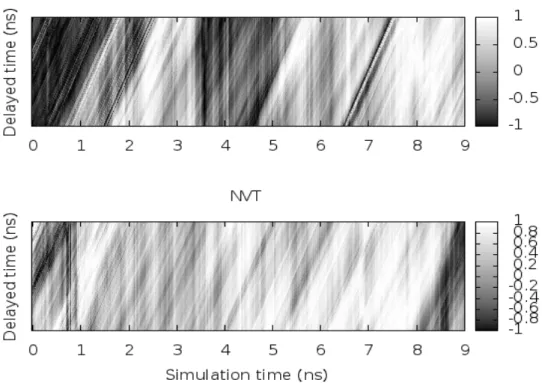
Figure 9 shows the calculated direction correlation with delayed time of 1 ns. In this figure,

the direction correlation was plotted with gray scaled color; DC = 1 was represented as white

color, and DC = 1 was represented as black color. Mutual fluctuations periodically occur in NVT

simulation. On the other hand, there are unsmooth patterns at several times. This result shows

that the dynamics of each micelle are correctively oscillated in this period of time, indicating the

synchronization motion of micelle dimer.

(8)

Figure 7: Autocorrelation of Symmetry

Figure 8: Direction correlation at the same time

5 Summary

We have carried out the molecular dynamics (MD) simulation of the micelle dimer in water solvent

to investigate the dynamical structure and correlation motion of the micelle system. We found

that the structure of micelle was randomly fluctuated during MD time steps. The simulation also

showed the sufficient correlation between the isotropy and compactness of micelle structure. We

analyzed the time correlation function of each micelle in both constant NPT and NVT simulations

and showed the difference of relaxation of symmetry fluctuation of micelle. We however found that

further statistic average should be taken for the clear this relaxation property. In the analysis of

direction correlation between micelle dimer, the dynamics of each micelle were found to be oscil-

lated correctively in the period of time, indicating the synchronization motion of micelle dimer. In

the future, it is interesting to investigate another method to reveal the existence of synchroniza-

tion. Furthermore, the concepts of limit cycle and synchronization might help us to analyze the

phenomena of synchronization.

(9)

Figure 9: Color-mapped of DC with delayed time 1 ns

References

[1] P. S. Goyal, V. K. Aswal (2001). Micellar structure and inter-micelle interactions in micellar solutions: Results of small angle neutron scattering studies. Current Science.

[2] A. Purqon, A. Sugiyama, H. Nagao, K. Nishikawa (2007). Aperture, symmetry, isotropy, and compactness analysis and their correlation in spaghetti-like nanostructure dynamics. Chem.

Phys. Lett., 443, 356 - 363.

[3] A. Purqon, H. Nagao, K. Nishikawa (2008). Synchronization Patterns in Spaghetti-Like Nan- oclusters. Int. Journal of Quantum Chem., 108, 2870 -2880.

[4] Hanahan, Donald J. (1997). A Guide to Phospholipid Chemistry, Oxford University Press, New York.

[5] L. Martinez, R. Andrade, E. G. Birgin, J. M. Martinez (2008). Packmol: A Package for Building Initial Configurations for Molecular Dynamics Simulations. Journal of Comp. Chem., 30, 2157 - 2164.

[6] J. B. Klauda, et all (2010). Update of the CHARMM All-Atom Additive Force Field for Lipids:

Validation on Six Lipid Types. J. Phys. Chem., 114, 7830 - 7843.

(10)

Figure 1 (a) shows the structure of POPC lipid. The POPC lipid has two hydrocarbon chains and one phosphatidylcholine (PC) head group [4]
Figure 3: Time (ns) vs RMSD (nm 2 )
Figure 5: Time (ns) vs ASIC-NPT plotted every 20 ps
Figure 6: Time (ns) vs ASIC-NVT plotted every 20 ps
+3

参照

関連したドキュメント

Nevertheless, a suitable mix of analytical and numerical techniques allows us to detect a sequence of homoclinic bifurcations—analogous to those occurring in the

As an application, we give semantics of modal proofs (a.k.a., programs) in categories of augmented simplicial sets and of topological spaces, and prove a completeness result in

(The origin is in the center of each figure.) We see features of quadratic-like mappings in the parameter spaces, but the setting of elliptic functions allows us to prove the

The main novelty of this paper is to provide proofs of natural prop- erties of the branches that build the solution diagram for both smooth and non- smooth double-well potentials,

A wave bifurcation is a supercritical Hopf bifurcation from a stable steady constant solution to a stable periodic and nonconstant solution.. The bifurcating solution in the case

Related to this, we examine the modular theory for positive projections from a von Neumann algebra onto a Jordan image of another von Neumann alge- bra, and use such projections

σ(L, O) is a continuous function on the space of compact convex bodies with specified interior point, and it is also invariant under affine transformations.. The set R of regular

Then it follows immediately from a suitable version of “Hensel’s Lemma” [cf., e.g., the argument of [4], Lemma 2.1] that S may be obtained, as the notation suggests, as the m A