Study on Reactivity and Utilization of Halogenated Organic Compounds
著者 Yasuda Kensei
year 1994‑09‑30
URL http://hdl.handle.net/2297/30617
博 士 論 文
Study on R e a c t i v i t y and U t i l i z a t i o n o f Halogenated Organic Compounds
Kensei YASUDA
Contents
General
Chapter 1
1.1 1.2 1,3 1.4 1.5 1.6 1.7 1.8
lntroduction
Chapter 2 2.1 2.2 2.3 2.4
Chapter 3
3.1 3.2
Co-pyrolysis of Halogenated Hydrocarbons with Methanol
onActivatedAlumina •••••••••••••••••••••••••••t•t•...,...,..., lntroduction ••••-••-••-••••••-••-••••••••••-•-••-••-••-••-••••••-•••••••-••
Experimental -••-••-••-••••••-••••••••••••••••••"..m."..".."..."..""."
AIIylChloride -••-••-•••t••-••-••-•-••-••-••-•`..."..."...""
1,2-Dichloropropane ••••-••••••-••-••••t•••••-•"...,..,...,....",.m."
1,3-Dihalopropane ••••-••-••-••-••••••-••-••-••-•••••..."..."
1,2,3-Trichloropropane -••-••-••-••-••••••-••-••-••••••••••-••-••-••••
2-Chloroethyl Compounds •••••••••••••••••••••••••`••••••••••••••••••••••••••
ReactionMechanism ••••-••-••-••-••-••-••••••-•••••••••••••••••`-•-••- References ••••-••-••-••-•---••-••-••-••••••-•••••••••-••••••••••-••••`•-
Disproportionation of Dihaloalkanes ••••••••••••••••••••••••••••••••••••••
lntroduction ••••••••••••••••••••••••••••••••••••••••••••••••••••••••{••••••••••••••••••-••
Experimental -••-•-••-••-••-••-••-•-••-••-••-••"•."...m.".."...
Disproportionation of 1-Bromo-3-chloropropane
on Activated AIumina -••-••-••-••-••-••-••-••••••-••••••••••-••••••••••••
Disproportionation of 1-Bromo-2-Chloroethane Catalyzed by
Tetraethyiammonium Chloride ••••-••-•••••••••-••••••••••••••t••••••••••
References -••-••-••-•-••-••-••-••-••-••-••••••-••••••-••••••••••-••-••-
Transchlorination and Disproportionation of Halogenated
Benzenes -••-••-••-••-••-•••-•-••-••-••-••-••-••••••-••-••-••-••---•••lntroduction ••••-`•-••-••-••-••••••-••••••-••-.".."...".."..".."...
Experimental -•---••-••-••-••-•-••-••-••-•-••-••-••-••-••-••--•••
-i-
1
10 10 12 15 17 21
29 34 37 38
40 40
41
42
46 54
56
56
58
3.3 Transchlorination of Polychlorobenzenes and Benzene into
Chlorobenzene -••-••-••-••-••••••-••••••••••••••-••-••••••-••`••••••'"'•'-•
3.4 Disproportionation of Halogenated Benzenes ••••••••••••••••••••••••
References ---••---••---••-••-••-••-••-••-•--••-••••••-••-••-••-`-•
Chapter 4 Vapor-phase Carbonylation of Alkyl Chloroacetate ••••••••••••••
4.1 lntroduction -••••••••••-••-••••••-••••••-••••••-••-••••••••••-••-•••••••••--- 42 Experimental -•••t••••••-••••••••••••••-••••••-••••••••••-••-•t••••••••••.•••.m"
4,3 Carbonylation of Aikyl Chloroacetates in the Presence
of the Alkoxide Anion Donor ••••-••••••••••••••-t•••••••••••••`••••`••••••••
4,4 lnvestigation of Catalyst -•-••-••-••-••-••-••••••-•••`••••••••••••••••••- 4.5 lnvestigation of Reaction Conditions ••••••••••••••••••••••••••t••••••`••••
4.6 Vapor-phase Carbonylation of Other Halogenated Organic
Compounds -•t-••••••-•.m.m.".."....,."..."..".."...,...,..".""..
References `•••••••-••••••-••••••-••-••••••-••••••-••-••-••-••-•••••-••-•-
Chapter 5 Reactions of Chlorinated Hydrocarbons with Potassium
Acetate ••••-•-••-••-••-••-•••t•••••."..-.m..."...,..m."..."h.
5.1 Dehydrochlorination of 1,2,3,4-Tetrachlorobutanes with
Potassium Acetate in Polar Solvents •••••••••••••••••••••••••••••••••••••
5.1.1 lntroduction -••-••-••-••-•t••••••••-••••t•-••••`••••••.••...,,...."..".
5.1.2 Experimental -••••••-••••••-••••••••••••••-•••••t••••••••••••-••-••••••••••
5.1,3 ReactionProducts -••-••-••-••-•••••-•••t••-••-••••••-•••••••--•- 5,1,4 Consumption Rate and 1,2-Elimination of 1,2,3,4-
Tetrachlorobutanes ••••••••••••••`••••••••••••••••••••••••••••••••-••-•••'•
5,1.5 Solvent Effects ••••--••••-••---••-•••••-••-••-••-••-••-••••••-•-
5,1.6 PotassiumCarboxylates ••••••••••••••••••••••••••••••••••••••••••••--•t•5,1.7 ReactionTemperature •••••`••t•••••••••••••••••••••••••••••••••••••-•••-•
5.2 Solvent Effects on the Esterification of 2-Chloroethyl
Compounds with Potassium Acetate •••••••••••••••••••••••••••••••••••••5.2.1 lntroduction -••-••-•••-•••--••••••-••-••••••••••••••-••-••-•••••••••-'
5,22 Experimental -•-••••••••••-••-••-•-•-•••••••-•-••-••-•"••-••••"
59 71 80
82 82 84 87 93 103
108 113
115
"5
115 115 117
120
122
126
126
128
128
128
5.2.3 Results and Discussion •••• •• •••
References
Conclusion •••••`••-••••••-••••••-
List of Papers •••••••••••••i••••••
Aknowledgement •••••••••••••••
129 136
139
141
144
-iii"
AB AcOK AC AME BCE BCP CFC-113 cp
1-CP 2-CP DAB DBP
2,3-DCB-1 ,3 o--DCB
DCM
1 ,3-DCP
2,3-DCP
DMF DMM DMSO
EDB EDC MAB MCA
PCB
1 ,2-PDC 1 ,3-PDC
TCB
List of Abbreviations
allyl bromide, CH2=CHCH2Br potassium acetate, CH3COOK allyl chloride, CH,=CHCH2Cl
allyl methyl ether, CH2=CHCH,OCH3 1-bromo-2-chloroethane, BrCH2CH2CI 1-bromo-3-chloropropane, Br(CH2)3CI 1,1,2-trichloro-1,2,2-trifluoroethane, CCI2FCCIF2 chloropropenes
1-chloropropene, CHCI=CHCH3 2-chloropropene, CH2=CCICH3
1,4-diacetoxy-2-chloro-2-butene, AcOCH2-CCI=CH-CH,OAc 1,3-dibromopropane, Br(CH2)3Br
2,3-dichloro-1,3-butadiene, CH2=CCI-CCI=CH2 Gdich1orobenzene
1,2-dichloro-3-methoxypropane, CH2CICHCICH20CH3 1,3-dichloropropene, CHCI=CHCH2Cl
2,3-dichloropropene, CH2=CCICH2Cl N,N-dimethylformamide, HCON(CH3)2 dimethyl malonate, CH,(COOCH3)2 dimethyl sulfoxide, (CH3)2SO
1,2-dibromoethane, BrCH2CH2Br 1,2-dichloroethane, CICH2CH2Cl
4-acetoxy-1,2-dichloro-2-butene, CICH2-CCI=CH-CH20Ac methyl chloroacetate, CICH2COOCH3
polychlorobiphenyl
1,2-dichioropropane, CICH2CHCICH3 1,3-dichloropropane, Cl(CH2),Cl
1,2,3,4-tetrachlorobutane, CICH2CHCICHCICH2Cl
TCB-2
2,3,4-TCB-1
TCP TEAC
1,2,4-trichloro-2-butene, CICH2-CCI=CH-CH2Cl
2,3,4-trichloro-1-butene, CH2=CCICHCICH2CI
1,2,3-trichloropropane, CH2CICHCICH,Cl
tetraethylammonium chloride, (C2Hs),N'Cl
General lntroduction
Since World War ll, many chlorinated organic compounds have been used in large amounts in various fields, owing to their many excellent properties and functions. For example, insecticides, herbicides, bactericides and nematicides were massproduced
and were contributed to the development of agricultural technology.
Tetrachloroethylene, trichloroethylene, 1,1,1-trichloroethane and CFC-113 are excellent solvents as the dry cleaning agent and degreasing agent of the metal material in high technical industrial field,i'2) Polychlorobiphenyl (PCB) has an
outstanding characteristic property and had been used as the insulating oil and heat medium in a Iarge amount.3) A large quantity of chlorine produced in soda industry is consumed by the productions of poly(vinyl chloride) and poly(vinylidene chloride), which are one of the most important chemical industries.4'5) As the chemical intermediates, many halogenated organic compounds are used in fairly large amounts and in the fine chemical fields.
Since the covalent bond between carbon and chlorine atoms is strong, it is necessary to break the bond with large energy. In general, polychlorinated organic compounds such as PCB and tetrachloroethylene are inactive to the various chemical reagents and are incombustible. In addition, the destruction of those compounds does not proceed spontaneously and the residual toxity has become a serious social problem,6'7) Hydrogen chloride evolved by the incineration of chlorine-containing plastics is troublesome to neutralize. Furthermore, the decomposition products are often responsible for the environmental pollution, lt has been spoken that the exposure to vinyl chloride, trichloroethylene and tetrachloroethylene may cause both genetic damage and birth defect as well as an increase in liver cancer.8'9) The destruction of the earth's stratospheric ozone layer by chlorofluorocarbons has become
a heated topic in scientific and political circtes.iO)There are two basic methods to make the disposal halogenated organic
compounds harmless; i.e., the pyrolytic decompositions"bi3) (incineration,i4-i7) plasma
decomposition,i8) fused-salt decomposition,i9) and thermal hydro-dechlorination20)),
and the chemical degradations (y-ray or ultraviolet ray irradiation,2i-25) reaction with
alkali26L28) or peroxide,29) ozonolysis,30'3i) and electrolytic reduction32)), However, many of these methods require the severe conditions and produce a variety of compounds without economic values due to the non-selective fission of the chemical bonds.
Hence, if the hazardous or useless halogenated organic compounds can be converted into harmless and useful ones by means of chemical reactions under milder
conditions, a very fruitful aspect will be obtained in both scientjfic and industrial fields.From such a point of view, many investigations have been carried out extensively.
However, there are little systematic investigations in this field. Shinoda has studied on the reactivities of halogenated organic compounds towards various chemical reagents for a long time. His major investigations in this field are divided into three
sections and are summarized as follows, Moreover, the advance in this field has been reviewed in detail by shinoda.33-37)
Chlorine-sensitized photooxidation38-43) : Chloroethanes and chloroethylenes were converted into chloroacetyl chlorides by means of photooxidation in the presence of chlorine. The chloroacetyl chlorides were formed by the electrophilic chain reaction
mechanism, and the formation rate was affected by the oxygen pressure. The reaction rate increased with an increase in the number of chlorine atom in chloroethanes and chloroethylenes.
Co-pyrolysis of Chlorohydrocarbons with Alcoho144-52) : The 1,1-/1,2-
dichloroethylene ratio in co-pyrolysis of 1 ,1 ,2-trichloroethane with alcohol or ether on
activated alumina amounted to several times as high as that in ordinary pyrolysis, The higher homologs of normal alcohol series facilitated the conversion of 1,1,2- trichloroethane to the dichloroethylenes, The co-pyrolyses of several chloroethanes with methanol gave the corresponding dehydrochlorinated compounds, On the other hand, allyl-type chlorides such as 3,4-dichloro-1-butene were converted into significant amounts of methoxy compounds by the co-pyrolysis with methanol, accompanied with dehydrochlorinated and isomerized compounds.
Reaction of Chlorohydrocarbons with Sodium Hydroxide in Aqueous Alcohol53-55) : ln the elimination of hydrogen chloride from chloroethanes with ethanolic sodium
" hydroxide, the reaction constant, p value was positive. 1,2,3,4-Tetrachlorobutanes (TCB) were dehydrochlorinated by sodium hydroxide in aqueous methanol to give 2,3-
dichloro-1,3-butadiene and 1,2-dichloro-1,3-butadiene accompanied with
methoxylated compounds, The effects of alcohols on the reactions of TCB and 3,4- dichloro-1-butene with sodium hydroxide in aqueous aicohol can be explained in terms of the inductive and steric effects of alkyl groups in alkoxide ions,
On the basis of such a background, in this study, co-pyrolysis with methanol, disproportienation, transchlorination, vapor--phase carbonylation with carbon monoxide, and elimination and nucleophilic substitution with potassium carboxylates were investigated for the sake of efficient utilization and harmlessness of halogenated organic compounds, e, g., o-dichlorobenzene and PCB, ln addition, the relationship between the reactivity and the structure of the substrate was studied.
This thesis consists of five chapters.
In chapter 1, the co-pyrolysis of halogenated hydrocarbons with methanol on activated alumina was investigated, Shinoda has applied the co-pyrolysis with alcohols to the chemical modification of chlorinated ethanes and substituted a)lyl chlorides, and has showed that the co-pyrolysis proceeded at relatively low temperature and characteristic products were formed in comparison with the thermal and catalytic crackings. Hence, the co-pyrolysis with methanol on activated alumina was also examined for some halogenated propanes in order to extendedly understand the product composition and the reaction mechanism,
The substrates of the co-pyrolysis with methanol were allyl chloride, 1,2- dichloropropane (1,2-PDC), 1,3-dihalopropanes, 1,2,3-trichloropropane aCP), and 2-chloroethyl compounds (RCH2CH2Cl)•
CH30H
RCH2CH2Cl " RCH=CH2+RCH2CH20Me+CH3Ci
Al203
The co-pyrolyses of allyl chloride and 1,2-PDC wjth methanol gave the oxygen-
containing derivatives such as acetone, acrolein and allyl methyl ether. 1,3-
Dihalopropane was methoxylated with methanol on activated alumina into 1-halo-3-
methoxypropanes and 1,3-dimethoxypropane. This reaction was accompanied with
the dispreportionation, but the dehydrohalogenation of 1,3-dihalopropane was not
observed. On the other hand, the co-pyrolysis of TCP with methanol gave 1,2-
dichloro-3-methoxypropane, and dichloropropenes and their methoxy-derivatives,
The effect of the molecular structure upon the consumption rate of the substrate
was studied by carrying out the co-pyrolysis of 2-chloroethyl compounds with
methanol.
ln chapter 2, the disproportionation of dihaloalkanes was discussed. Since the
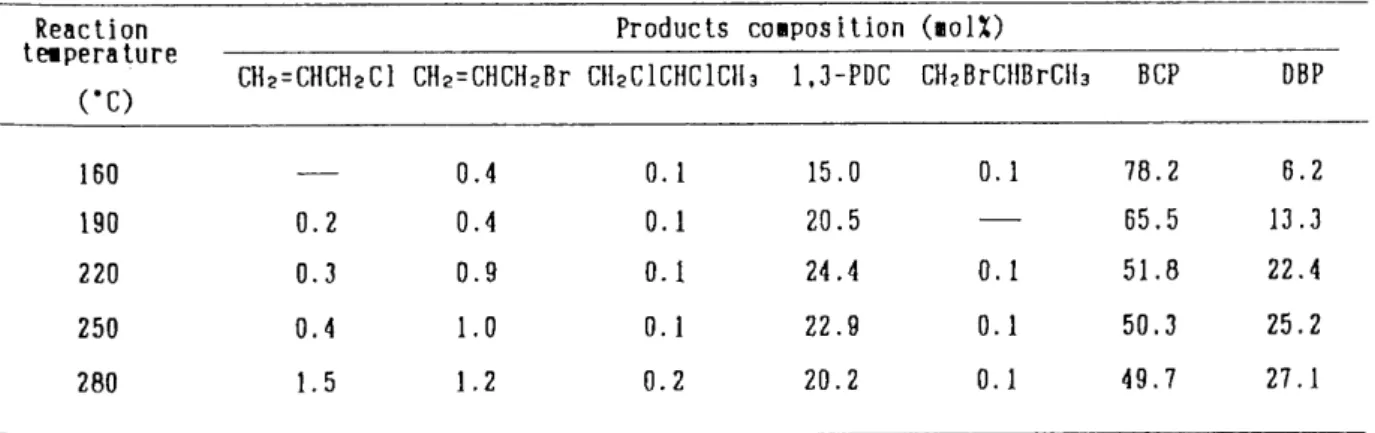
co-pyrolysis of 1-bromo-3-chloropropane (BCP) with methanol was accompanied by the disproportionation of BCP as described in chapter 1 , the transformation of BCP on activated alumina into 1,3-dibromopropane (DBP) and 1,3-dichloropropane (1,3- PDC), was investigated in detail, Thjs reaction proceeded as follows:
2Br(CH2)3Ci i=iaf/i6i r,o, Ci(CH2)3Ci + Br(CH2)3Br
These three compounds, BCP, DBP and 1,3-PDC were found to be in equilibrium.
In addition, it was attempted to convert 1-bromo-2-chloroethane into 1,2- dibromoethane and 1 ,2-dichloroethane with tetraethylammonium chloride as acatalyst in various solvents in order to compare this Iiquid-phase reaction with the vapor- phase disproportionation.
Chapter 3 was related to the transchlorination and the disproportionation of halogenated benzenes, Since aromatic polychlorides such as polychlorobiphenyl (PCB) are well-known as a carcinogenic substance, the use of these cempounds are forbidden at the present time. Furthermore, polychlorobenzenes such as o- dichlorobenzene (o-DCB) and 1 ,2,4-trichlorobenzene are produced in a large amount as by-products in the production of p--dichlorobenzene. The transchlorination of o- DCB, 1,2,4-trichlorobenzene, 1,2,4,5-tetrachlorobenzene, hexachiorobenzene, and PCB with benzene into chlorobenzene and the disproportionation of halogenated benzenes were attempted in the presence of catalyst under various reaction
conditions.
QXcl,' ("1)O Bt!9!e{999!9Ci21CeCi3 ,9/
,o/<lua'ci2iceci3 ox.ox
CIn CIn+1 Cln.1
Activated charcoal was a suitable carrier, and rare earth metal chlorides such as
cerium (lll) chloride enhanced remarkably the catalytic actMty of palladium(ll) chloride
supported on activated charcoal. o-DCB, 1,2,4-trichlorobenzene, 1,2,4,5- tetrachlorobenzene, hexachloro-benzene, and PCB were transchlorinated with benzene into chlorobenzene in good yield.
On the other hand, the transchlorination between o-DCB and mono-substituted benzenes (C6HsX) was carried out in order to investigate the substituent effect on the conversion of o-DCB into C6H4XCI,
ln chapter 4, the vapor-phase carbonylation of alkyl chloroacetates with rhodium
(III) chloride supported on activated charcoal was described. The
methoxycarbonylation of methyl chloroacetate (MCA) into dimethyl malonate <DMM) with carbon monoxide in the presence of methanol has been usuaUy performed using cobalt carbonyl catalyst in the liquid-phase, However, since the liquid-phase
carbonylation has several disadvantages, the vapor-phase carbonylation with carbon monoxide under atomospheric pressure was carried out, and a carrier, a metal halide and a promoter suitable for the vaper-phase carbonylation were investigated.
CICH2COOCH3 + CH30H + CO " CH2(COOCH3)2 + HCI
Rhodium (lll) chloride was found to be excellent in the activity and the selectMty for
the formation of DMM, The addition of metal iodides to the catalyst system enhanced remarkably the activity of rhodium (lll) chloride supported on activated charcoal. Furthermore, the vapor-phase carbonylation of MCA was carried out in order to find the optimum reaction conditions.
The vapor-phase alkoxycarbonylation of alkyl chloroacetates with an alkoxide ion donor such as alcohol, ether, and ester gave the corresponding dialkyl malonates.
In order to examine the effect of the structure of substrate molecules on the
methoxycarbonylation of halogenated organic compounds, RCH2X, s-C4HgX and C6HsX were methoxycarbonylated with carbon monoxide and methanol to give the corresponding methyl carboxylates.
ln chapter 5, reactions of chlorinated hydrocarbons with potassium acetate (AcOK)
Were described. 2,3-Dichloro-1,3-butadiene for raw material of synthetic rubbers is
obtained by means of dehydrochlorination of 1,2,3,4-tetrachlorobutanes with
Potassium hydroxide or sodium hydroxide in aqueous methanoi, Since relatively mild
reaction conditions were considered to be desirable for the selective formation of 2,3- dichloro-1,3-butadiene, the reactions of meso- and d/-1,2,3,4-tetrachlorobutanes with AcOK in polar solvents were carried out in order to elucidate the selectMty for the formation of 2,3-dichloro-1 ,3-butadiene and the solvent effect on the rate of reaction.
Moreover, the esterifications of 2-chloroethyi compounds <RCH2CH2Cl) with AcOK in a solid-liquid system were performed in order to study the effect of solvent and the
structure of substrate on the rate of esterification,
AcOK
RCH2CH2Cl su.I.,,t RCH2CH20AC+KCI
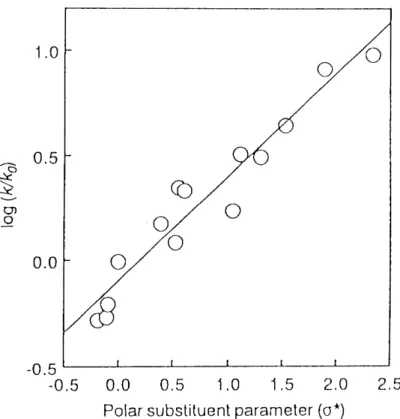
A linear free energy relationship was found to exist between the relative rate constant
"
and Taft's substituent constant (u),
ln this study, hazardous or useless halogenated organic compounds could be converted selectively into the harmless and useful derivatives by various reactions, The interesting relationships between the reactivity and the structure of substrate were found out depending upon the kinds of attacking reagents. It is expected that the results of the structure-reactivity relationships are helpful for utilization of other
useless or harmful halogenated organic compounds.
References
1) Kirk-Othmer, "Concise Encyclopedia of Chemicai Technology," John Wiley & Sons, Inc., 1985, p 752,
2) D. Sugjto, Suido Kyokai Zasshi, 52, 53 (1983),
3) Kirk-Othmer, "Concise Encyclopedia of Chemical Technology," John Wiley & Sons, lnc., 1985, p 272.
4) Kirk-Othmer, "Concise Encyclopedia of Chemical Technology," John Wiley & Sons, lnc,, 1985, p 1229.
s) J. S. Scone, "Chlorine, lts Manufacture, Properties and Uses," Van Nostrand Reinhold, 1962, p 729.
6) T, Yamashita, Kogai to Taisaku, 14, 251 (1978), 7) K. Sakai, Kogai to Taisaku, 23, 106 (1987), 8) E. Kotter, 1<agaku Kogyo, 32, 94 (1981).
9) N, lto et aL, J, NatL Cancer /nst., 51,817 (1973),
10) M, J, Molina and E S. Rowland, Nature, 249, 810 (1974), 11) A Maccoll, Chem, Rev,, 69, 33 (1969).
12) 1. Mochida and T. Seiyama, "Kagaku Sosetsu No. 3," Kagaku Dozin, 1973, p 131.
13) C, C. Lee and G. L Huffman, Environ. Progress, 8, 190 (1989).
14) Y. Kawamura, Y. Toba, Y. Ogisu, and Y. Tanaka, Kogai, 10, 15 (1975).
15) Y, Kawamura, MOL, 13, 25 (1975).
16) K. Komamiya and S. Morisaki, Environ. Sci. TechnoL, 12, 1205 (1978).
17) S. Imamura, T. Ikeda, and S, lshida, Nippon Kagaku Kaishi, 1989, 139, 18) J. Bonton, Chem. Eng. Nevvs, Dec. 22 (1986).
19) E, Ohta, S. Inoue, and S. Ohtani, Nippon Kagaku Kaishi, 1977, 1407.
20) R. Louw, H, Dijks, and P. Mulder, Chem. & /nd,, 19, 759 (1983),
21) T, Kagitani, K, Takemoto, and Y. Uyama, Nippon Kagaku Kaishi, 1975, 1922, 22) T. Nishiwaki, J. Ninomiya, S. Yamanaka, and K. Anda, /Vippon Kagaku Kaishi, 1972, 2225,
23) T, Nishiwaki, M. Usui, K. Anda, and M. Hida, Nippon Kagaku Kaishi, 1979, 343.
24) T. Nishiwaki, Yuki Gosei Kagaku Kyokaishi, 39, 228 (1981).
2s) K, Tanaka, K, Harada, and T, Hisanaga, Chemica/ Engineering, 34, 23 (1989), 26) P. H, Groggins, "Unit Processes in Organic Synthesis," McGrow-Hill Book Co, lnc,, 1958, p 249.
27) A. Oku, K, Yasufuku, S. Kato, H. Kato, and H, Kataoka, Nippon Kagaku Kaishi, 1979, 1577,
28) A, Oku, H, Ueda, and H, Tamatani, Nippon Kagaku Kaishi, 1980, 1903.
29) G, Nobile, W. Tumiatti, and P, Tundo, ACS Symp. Ser,, 338, 376 (1987).
30) D. G. Williamson and R, J. Cvetanovic, J, Amer. Chem. Soc,, 90, 4248 (1968).
31) E. Sanhueza, l, C, Hisatsune, and J. Heicklen, Chem. Rev,, 76, 801 (1976).
32) H. Sugimoto, S, Matsumoto, and D. T. Sawyer, Environ, ScL TechnoL, 22, 1182 (1982).
33) K. Shinoda, Yuki Gosei Kagaku Kyokaishi, 32, 940 (1974).
34) K. Shinoda, Yuki Gosei Kagaku Kyokaishi, 34, 455 (1976).
35) K. Shinoda, Kagaku Kyoiku, 26, 72 (1978).
36) K, Shinoda, Research Reports of Toyama National Co/fege of Techno/ogy, 12, 67
(1 978) .37) K. Shinoda and T. Nakamura, Soda to Enso, 42, 303 (1991), 38) K, Shinoda and K, Konno, Nippon Kagaku Kaishi, 1973, 527.
39) K, Shinoda and K, Konno, Nippon Kagaku Kaishi, 1973, 531.
40) K. Shinoda, Nippon Kagaku Kaishi, 1973, 536.
41) K. Shjnoda, A/ippon Kagaku Kaishi, 1973, 542.
42) K, Shinoda and S. Anzai, Nippon Kagaku Kaishi, 1974, 1584,
43) K. Shinoda, S. Anzai, and S, Seki, Nippon Kagaku Kaishi, 1975, 1520.
44) K. Shinoda, Chem Lett., 1973, 877,
45) K. Shinoda, Bu/L Chem. Soc. Jpn,, 47, 2406 (1974).
46) K. Shinoda and S. Anzai, Nippon Kagaku Kaish"975, 316, 47) K, Shinoda, Nippon Kagaku Kaish4 1975, 661.
48) K. Shinoda and S, Anzai, Nippon Kagaku Kaishi, 1976, 560, 49) K Shinoda, Chem Lett., 1976, 1417,
50) K, Shinoda, Nippon Kagaku Kaishi, 1977, 629, 51) K, Shinoda, Nippon Kagaku Kaishi, 1977, 1785.
52) K. Shinoda, Nippon Kagaku Kaishi, 1977, 1789.
53) 54) 55)
K.
K, K.
Shinoda and S, Anzai, Nippon Kagaku Kaishi, Shinoda, Nippon Kagaku KaishL 1979, 1507, Shinoda, Nippon Kagaku Kaishi, 1979, 1612.
1974, 1945.
Chapter 1 Co-pyrolysis of Halogenated Hydrocarbons with Methanol on Activated Alumina
1.1 lntroduction
Chlorinated olefins such as 1,1,2-trichloroethene, CHCI=CC12, and 1,1,2,2- tetrachloroethene, CCI2=CCI2, are used as cleaning solvents, while vinyl chloride, vinylidene chloride and chloroprene are useful as monomers for plastics and synthetic rubbers. In general, the chlorinated olefins are made by the combination of the addition of chlorine to olefin and the dehydrochlorination of the polychlorinated
hydrocarbon, When halogenated hydrocarbons are treated with an aqueous
suspension of calcium hydroxide or an alcoholic solution of potassium hydroxide, halogenated olefins are formed. However, these processes have aserious drawback.
That is, alkaline reagents such as alkali metal and alkaline earth metal hydroxides are necessary to remove hydrogen halides. Furthermore, inorganic salts, which are formed by reaction of alkaline reagents with hydrogen halides, are useless and difficult to be discarded. Hence, alternative processes such as the pyrolysis and catalytic cracking of chlorohydrocarbon are used extensively and the hydrogen chloride evolved in these processes are used for the oxychlorination of ethylene.
It has been reported that treatment of halogenated aliphatic carboxylic acids, nitriles, or esters with aliphatic alcohols and/or ethers at 260 to 320 OC under the pressure of 700 psi resulted in the formation of a mixture of alkyl halides and
unsaturated aliphatic compounds,i) A similar halogen exchange proceeded when tetrachloroethane was allowed to react with ethanol (or methanol) at 260 OC in the presence of activated alumina,2'3)
The thermal decomposition4) and the catalytic cracking5) of polychloroparaffins as well as the dehydrochlorination of polychloroalkanes with hydroxide of alkali or alkaline earth metai6> have been reviewed in detail by several investigators, However, little is known about the co-pyrolysis of chlorohydrocarbons with alcohols on the activated alumina, except for Shinoda's reports,7-i6)
Andrussow and Edler3) reported that the co-pyrolysis of 1 ,1 ,2,2-tetrachloroethane
with methanol over activated alumina proceeded according to the following equation.
CHCI2 CHCI2 + CH30H " cHcl.cc12 + CH3Cl + H20 (1 '1)
Thereby, Shinoda has applied the co-pyrolysis to 1,1 ,2-trichloroethane and has found that the co-pyrolysis of 1 ,1 ,2-trichloroethane with methanol on activated alumina gave 1,1-dichloroethene in a good yieid,7'9'i2) On the contrary, the ordinary pyrolysis of
1,1,2-trichloroethane yielded an equimoiar mixture of the three isomeric dichloroethenes.i7) Furthermore, the co-pyrolytic method was applied in the case of chloroethanes such as 1,2-dichloroethane,8) 1,1-dichloroethane,8) 1,1,1- trichloroethane,8) 1,1,1,2-tetrachloroethane,8> 1,1,1,2,2-pentachloroethane,8) and substituted allyl chlorides such as 3,4-dichloro-1-butenei3'i5'i6) and 1,4-dichloro-2- butene.i6) lt is noteworthy that the co---pyrolysis of allyl-type compounds with methanol on alumina catalyst afforded significant amounts of the corresponding Methoxylated compounds,i3ti5•i6)
CH2=CHCH2CI +2CH30H - CH2=CHCH20CH3 + CH3Cl + H20 (1•2)
ln this chapter, the co-pyrolysis was extended to some halogenated hydrocarbons
having the number of carbon more than that of chloroethanes, that is, allyl chloride
(AC), 1,2-dichloropropane (1,2-PDC), 1,3-dihalopropanes, 1,2,3-trichloropropane and
2-chloroethyl compounds (RCH2CH2Cl), because the co-pyrolyses of these halides
with methanol were expected to afford methoxylated compounds via allyl halides, ln
addition, the products composition, the effect of molecular structure on the rate
constant and the reaction mechanism were investigated.
1.2 Experimental
Materia/s : Solvents and commercjally available compounds were purchased from standard suppliers except for materials indicated below and were used without further purification. y-Chlorobutyronitrile was synthesized by the reaction of 1-bromo-3-
chloropropane with potassium cyanide as described.i8) 1-Chloro-3-methoxypropane was prepared from 1-bromo-3-chloropropane by modifying the method of Henne and Haeckl.i9) Activated alumina (KHA-34), 3 - 4 mm in particle diameter, was obtained from Sumitomo Chemical Industry Co,
General Procedure for Co-pyrolysis : A flow-type reaction system shown in Fig.
1.1 was used. The reactor was Pyrex glass tube of 2,6 cm diameter and 40 cm long, and was heated in a vertical electric furnace. The evaporator, made of glass tube of the same diameter, was placed in a helix-coli heater, The reaction temperature was measured with a Chromel-AIumel thermocouple in a thermowell placed in the catalyst bed. Twenty grams of alumina catalyst was placed in the middle of the reactor, the catalyst bed being supported by necking the reactor tube. While the reaction temperature was regulated by the use of a mercury relay and adjusting the voltage of atransformer, nitrogen gas was passed overthe catalyst, ln all the runs, two organic chlorides were competitively pyrolyzed at 250 OC in order to check the balance of the volatile products such as propylene and to keep the effect of the time factor and the effect of the concentration of methanol constant, A mixture of two organic chlorides
and methanol in a1:1:5 volume ratio was then fed into the evaporator with a microfeeder and preheated to 250 OC, the vapor being passed to the reactor. The product gas stream was led to a cooler and was condensed in a water-ice trap, Organic products were separated from the aqueous Iayer and analyzed by GC method.
AnalYtical Method : The IR, NMR, UV and mass spectra were recorded with a
Hitachi 125 spectrometer, a JNM-MH 100 spectrometer using TMS as internal
standard, a Hitachi 124 spectrometer and a Hitachi RMU-6MG spectrometer,
respectively, Gas chromatographic analyses were performed on a Shimadzu GC-5A
aPparatus using a2 m x3 mm column with 10 O/o PEG 6000 operating at 100 OC with
a helium flow,
a
b
c
b
e
o8o
d
iX5
o
f
g
l
,
h
1a:
b:
c:
d:
e:
f:
g:
h:
i:
Micro feeder
Thermocouplc Preheater
(Evaporator) Furnace
Catalyst Reactor
Cooler Trap
Ice-bath
Fig.1.1. Reaction apparatus
Syntheses ofAuthentic Samples : 1,2-Dichloro-3-methoxypropane (DCM) was
prepared by chlorination of allyl methyl ether, which was produced from allyl chloride and methanol by the action of sodium hydroxide in carbon tetrachloride : bp 169.5 OC.
Chloro(methoxy)propenes were prepared from 2,3-dichloropropene (2,3-DCP) and
1,3-dichloropropene (1 ,3-DCP) by modifying the method of Henne and Haeckl.i9)
1.3 Allyl Chloride20)
Since the co-pyrolysis of substituted aHyl chlorides such as 3,4-dichloro-1 -butene with methanol gave the corresponding methoxylated derivatives in significant
amounts,i3'i5'i6) the co-pyrolysis of allyi chtoride (AC) was carried out to study product
composition under various reaction conditions.
/dendification of Products : AC was co-pyrolyzed with methanol to give allyl methyl ether (AME), acrolein, formaldehyde and acetone. The reaction products were treated with 2,4-dinitrophenylhydrazine in acidic solution2i) and were separated as the
corresponding 2,4-dinitrophenylhydrazones except AME by means of column
chromatography (silica gel, benzene). Moreover, the identification of these derivatives
were performed by comparing these NMR and IR $pectra with those of authentic samples.22'23> Three 2,4-dinitrophenylhydrazones were coincided with those derived from formaldehyde, acetone and acrolein, respectively, Mass spectra bore out these results. AME was identified by means of measuring NMR24) and mass spectra.
Time Factor (VV/F? : A mixture of AC and methanol in a molar ratio of 1 : 2,02 was co-pyrolyzed on catalyst at 300 OC. The time factor (W/F : g•h/mol) was varied by adjusting the feed rate of AC (F : mol/h), the weight of the catalyst (W: g) being kept constant. Table 1.1 shows the effect of the time factor on the product distribution.
As the time factor increased, the formation of AME was increased. On the other hand, the formation rate of acrolein was initially increased and then was dimished with
an increase in W/F, lt seems reasonable to assume that polymerization and
carbonization of acrolein on actjvated alumina are accelerated with increasing VV/F.
The co-pyrolysis of AC with methanol yielded AME in Iarge amounts, Taking into account that thermal decomposition of AME gives propene and formaldehyde,25) the formation of acrolein in the co-pyrolysis of AC may be attributed to the decomposition of the resulting AME,
Reaction Temperature : A mixture of AC and methanol in a 1 : 2,02 molar ratio Was co-pyrolyzed at various temperatures. Figure 1,2 shows plots of ln([AC]o![AC]) against time factor, VV/F. [AC]o and [AC] are the concentrations of AC at ts and t (Min), respectively, The consumption rate of AC is first-order with respect to [AC]
and is expressed by the following equation, Activation energy is calculated from the
Arrhenius
plot tobe
k=
37.1 25.5
kJ/mol.
exp(-371 OO/RT)
(mol/g•h) (1•3)Table 1,1 The in
effect of the co-pyro}ysis of
time AC
factor (W/F) on the products distribution with methanol on activated alumina at 300 eC.
W/F
(g•h/mo1)
Products composition
(molZ)HCHO CH2=CHCH20Me
CH2= CH CH2C1CH3COCH3 CH2=CHCHO 54.4
81.3
108.7 162.6321.9
o o o o 2
.55 .41 .54 .67 .Ol
32.
39.
43.
51.
61.
30 Ol 35 72 28
65.51 57.87 48.4O 35.90 27.16
o 0. 17
O.36 O.82 1.63
1.64 2.54 7.35 1O.89
7.92
oM
:f!{"
) o
u < =
1,2
1.0
O,8 O,6 O,4
O,2
o,o
O 200 400 600
VV/F (g • h/mol)
Fig, 1 ,2, The first --order kinetic plots fo r
AC consumption at various temperatures, Molar ratio (MeOH/AC) : 2,02
Reaction temperature (Åé) :
oilso, ej17o, ollgo, ol21o,
Oi250,
1.4 1,2-Dichloropropane20)
Since 1,2-dichloropropane (1,2-PDC) was expected to give allyl chloride, 1,2- pDC was selected as a substrate of the co-pyrolysis. A mixture of 1,2-PDC and methanol in a molar ratio of 1.0 : 7,2 was fed into the evaporator with a microfeeder and preheated to 200 OC, the vapor being passed to the reactor (an alumina catalyst was placed in the middle of the reactor and was kept at 270 OC), The time factor (W/F) was varied by adjusting the feed rate of the mixed solution. The co-pyroiysis of 1 ,2-PDC with methanol gave 2-chloropropene (2-CP), trans- and cis-1 -chloro-1 - propenes (1-CP), accompanied with acetone and aclorein. The product distributions in the co-pyrolysis with the various time factors are shown in Table 1.2. AII products, especially 2-CP and acetone, increased with in an increase in W/F.
Tominaga26> and okazaki27) reported the catalytic activity and the selectivity for catalytic cracking of 1,2--PDC. However, this catalytic cracking was carried out at high temperature and resulted in low conversion of 1,2--PDC, On the contrary, the co-pyrolysis of 1,2-PDC with methanol proceeded at a lower temperature at a higher conversion than the catalytic cracking. The dehydrochlorination in the co-pyrolysis seems to proceed more smoothly than that in the catalytic cracking, since hydrogen chloride generated reacts with methanol to give methyl chloride.
Table 1.2 The effect of the time factor (W/F) on the products distribution in co--pyrolysis
of 1,2-PDC with methanol on activated aluraina at 270 "C,
V/F
(g•h/eol)
Products composition (molX)
CH2=CCICH3 CHCI=CHCH3 CH2=CHCH2Cl CH3COCH3 Cl{,=CHCHO CH2CICHCICH3
+
CH2=CHCH20He
131.6 198.0 303.0 392.2 800.0
O.71 1.27 1.95 3.48 g.Io
11.49 15,64 17.94 23.52 24.41
O.41 O,47 O.57 O.61
L31
1.39 2.52 4,OO 6,44 25.24
O.50 O.63 O.86 1,27 3.70
85.50 79.47 74.66 64.68 36.24
Under similar reaction conditions, 2-CP was co-pyrolyzed with methanol into acetone and methyl chloride on activated alumina. This result suggests that 2-CP
reacts with methoxide ion to gjve the intermediate, CH3CCI(OMe)CH3, which may split into acetone and methyl chloride, On the other hand, ailyl methyl ether and acrolein were formed in the co-pyrolysis of ailyl chloride, as described in section 1,3. Thus, the reaction routes for the co-pyrolysis of 1,2-PDC with methanol are considered as
follows:Route 1
-Hcl MeOH
CH2CICHCICH3 ---.- CH2=CCICH3 ---.•-
1,2-PDC 2-CP
[cH3-/ii iM-8H3]- cH3cocH3+Meci "•4)
Route 2
- HCI
CH2CICHCICH3 --- CHCI=CHCH, (1•5)
12-PDC 1-CP
' Route 3
-Hcl MeOH
CH2CICHCICH3 --- CH2=CHCH2Cl ---
1,2-PDC AC
/ CH2=CHCH3 +HCHO (1•6)
CH2=CHCH20Me
X"-'--,bli CH2=CHCHO+CH4 AME
Mixtures of 1,2-PDC and methanol in various molar ratios were co-pyrolyzed at 300 OC in order to investigate the amounts of 2-CP and acetone formed through Route 1. The proportion of the consumption of 1,2-PDC through Route 1 in the total consumption through Route 1-3 is defined as follows:
R.,tel . [2'C P] ' [C H3COCH3] x loo <o/.) (I .7)
100 --- [1,2-PDC]
Where [1 ,2-PDC], [2-CP] and [CH,COCH,) indicate the concentration (molO/o) of 1,2-
PDC, 2-CP and CH3COCH3 in reaction products, respectively, Figure 1.3 shows that
the proportion of the Route 1 is very small in the absence of methanol even at high
vv/F and is sure[y increased with increasing the molar ratio of methanol to 1,2-PDC, That is, the reaction through the Route 1 scarcely occurred in the absence of methanol, L e., in the ordinary catalytic cracking.
30
G.o 20
:- 's
m
cr
o 10
o
O2468
Molar ratio (MeOH/1 ,2-PDC)
Fig. t.3. The effect of the molar ratio on Route 1.
Reaction temperature : 300 Åé VV/F (g•hlmol) :
O j99.0, o l198,O, O l392.2.
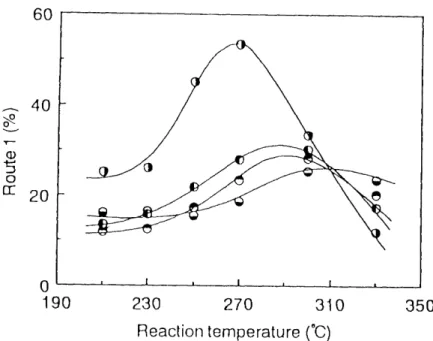
The mixture of 1,2-PDC and methanol in a molar ratio of 1 .0 : 7.2 was fed into the reactor at the varjous reactjon temperatures, As shown in Fig. 1,4, curves of the Route 1 vs. reaction temperature had peak points at 200 --- 300 OC. However, because the acidic sites of alumina are known to be more activated at higher temperature,9> it is thought that the proton on acidic sites of alumina attacks predominantly B-chlorine of 1,2-PDC, and the proportions of the Routes 2 and 3 increase at the temperature more than 300 OC.
Figure 1.5 shows plots of ln([1,2-PDC]/[1,2-PDC],) against VV/F at the various reaction temperatures, [1 ,2-PDCI and [1 ,2-PDC]o are the concentrations of 1,2-PDC at tand S (min), respectively, The rate constant of co-pyrolysis for1,2-PDC is expressed by the following equation.
k=22.9 exp(-45200/RT) (mol/g•h) (1•8)
60
A 40
Yoo:' Åë
s o cr 20
o
190 230 270 3GO 350
Reaction temperature (Åé)
Fig. 1 ,4, The effect of the reaction temperature on Route 1 .
Molar ratio (MeOHII ,2-PDC) : 7.2
W/F <g•h/moI) :
Ol198, eI303, Oi392, O:800.
t.2
Ci-,
a a
("•(Jr-
O•8
L-.-l
b
l[S
a a
,,hkJr'"
V O.4
o,o
o
o 200 400 600
W/F(g•h/mol>
800
Fig. 1.5 The first-order kinetic plots for 1,2-PDC
consumptlon at vanous temperatures.
Molar ratio (MeOH/1 ,2-PDC) : 7.2
Reaction temperature (Åé) :oi21o, ei23o, oj2so, ol27o, oj3oo,
O l330.
1.5 1,3-Dihaiopropanes28)
1,3-Dihaiopropanes were chosen as a substrate of the co-pyrolysis in order to clarifY the behavior of halogens in these molecules,
/den tifica tion of Products : The co-pyrolysis products of 1 -bromo-3-chloropropane
(BCP) with methanoi were composed of 1-chioro-3-methoxypropane, 1-bromo-3- methoxypropane, 1,3-dimethoxypropane, 1,3-dichloropropane (DCP), and 1,3- dibromopropane (DBP), The mixture of co--pyrolysis were poured into water in order to separate from methanol, Then, the products were fractionated by preparative gas chromatography. The identification was performed by measuring IR, NMR and MS spectra. Table 1.3 shows spectroscopic data of IR, NMR and MS,
Table 1.3 Spectroscopic data for the
1-b ro mo-3- ch lo ro prop ane
products
ob ta in ed in theco-pyrolysis of
Coe po und
IR, cm-i
iH NMR (CCI a), 6 , ppmMS, m/e
MeO(CH2)3OMe
Br(CH2)3OMe
Cl( CH,),OM e
1115(C-O-C) 1.72 (m, J=6 2825(-OMe) 3.27 (s, 6H, 2870(-CH2-) 3.34 (t, J=6
.3 Hz,
-OCH3)
.3 Hz,1120(C-O--C) 2.02 (m, J=5.
2825(-OMe)
2875 ( -• CH2-)
2.24 (s, 3H, 3,39 (t, J=5.
3.39 (t, J=6.
1120(C-O-C) 1.87 (m, J=6.
2820(-OMe)
287O(-CH2•-)660(-C1)
3.19 (s, 3H, 3.35 (t, J=6.
3.49 (t, J=6.
8 Hz,
-OCH3)
1 Hz, 4 Hz,O Hz,
-OCH3)
O Hz, O Hz,2H, -CH2-) 4H, -CH20Me)
2H, -CH2-•)
2H, -CH2Br) 2H, -CH20He)
2H, -•CH2-)
2H, -CH2Cl)
2H, --CH20Me)72(1OO) 71(22.4)
57 (19. 5)
45(73.2) 42(17.2)
154(MX2, 15.9) 152(M', 14.3) 122(17.2)
120 (17. 2)
73(1OO)
43 (20. 5)
42(23.1) 100(M++2, 2.8) 108(H', 7.9)
76(6.5) 45(1OO)
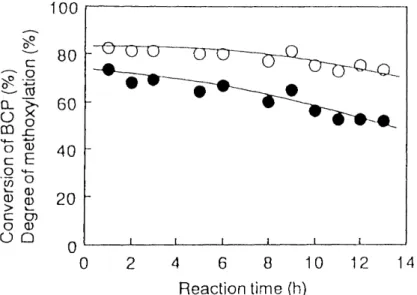
Deactivation of Catalyst : Since the deactivation of catalyst was anticjpated from
Preliminary experiments, amixture of 1-bromo-3-chloropropane (BCP) and methanol
in a molar ratio of of BCP (/r: mol/h)
1.0 : 12,2 was fed over 20 g of activated alumjna at the feed of O,034 and was co-pyrolyzed for a long time at 220 OC,
rate
1OO
Goo
80
v c
E'O.g.a- g- 6o
m=
y- "
22 4o
•8-6
hi 8 2o
88 l6
o
O 2 4 6 8 10 12 14
Reaction time (h)
Fig. I ,6, The effect of the reaction time on the catalytic activity,
O : Conversion of BCP, o: Methoxylation (O/o),
Figure 1.6 shows the effect of the reaction time on conversion of BCP and the degree of methoxylation. The degree of methoxylation is defined as follows:
Degree of methoxylation (O/o) =
[MeO(CH2)3Brj + [MeO(CH2)3Cll + 2[MeO(CH2)30Me] o•g)
where [MeO(C2)3Br], [MeO(CH2),Cl], and [MeO(CH,)30Me] are the compositions (molO/o) of 1-bromo-3-methoxypropane, 1-chloro-3-methoxypropane and 1,3- dimethoxypropane in the reaction mixture, respectively, Since it was observed that the deactivation of catalyst proceeded with the reaction time, the catalyst was newly employed in each experiment, The ratio of the feed rate of substrate to the amount of the catalyst was O.5 mL/g•h, in all runs,
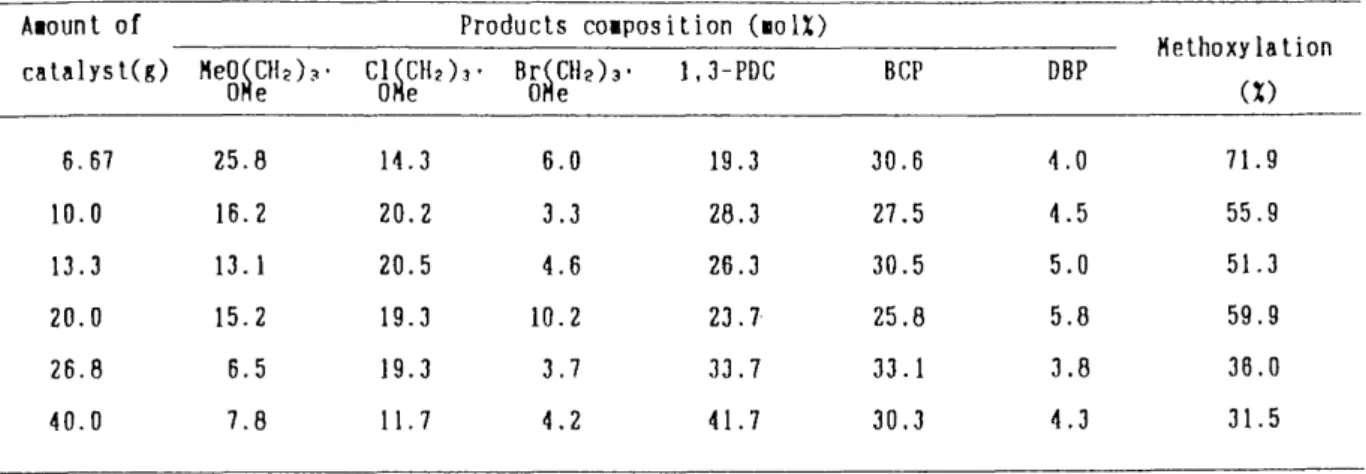
Amount of Catalyst:The amount of cataiyst (VV) and the feed rate of BCP (F)
Were varied, whi[e the time factor (W/e was kept at 394,7 (g•h!mol), A mixture of
BCP and methanol in a molar ratio of 1 : 12,2 was co-pyrolyzed on activated alumina
at 220 OC. Experimental results are shown in Table 1.4. BCP was transformed into
1,3-dibromopropane (DBP) and 1,3-dichloropropane (1,3-PDC), accompanied with
the methoxylation of BCP into 1-chloro-3-methoxypropane, 1-bromo-3-- methoxypropane and 1,3-dimethoxypropane. In addition, the dehydrohalogenation of halogenated compounds which occurred in ordinary pyroiysis or catalytic cracking could not be observed in this experiment, On the other hand, the conversion of BCP was not affected by the amount of catalyst and the degree of methoxylation was almost constant at 10 to 20 g of amounts of catalyst,
Table 1.4 The effect of the areount of the catalyst on tu ethoxy la tion of BCP at 220 'C Anount of
catalyst(g)
Products co-position (moIX)
He8fi gH?) .?• C6figH2),• B5figH?),• 1,3-PDC BCP DBP
Methoxylation
(x)
6. 67 10.0 13.3 20.0 26.8 40.0
25.8 16.2 13.1 15.2 6.5 7.8
14.3 20,2 20.5 19.3 19.3
IL7
6.0 3.3 4.6 10.2 3.7 4.2
19.3 28,3 26.3 23.7 33,7 41.7
30,6 27.5 30.5 25.8 33.1 30,3
4.0 4.5 5.0 5,8 3.8 4,3
71.9 55.9 51.3 59.9 36,O 31.5
{o{iO
v c
.9 ts
->
Å~
=
'lii5o
:iliE
60 50 40 30 20 10
O 5 10 15 o
Molar ratio (CH30H/BCP)
Fig. 1 ,7. The effect of molar ratio on methoxylation at 22o ec.
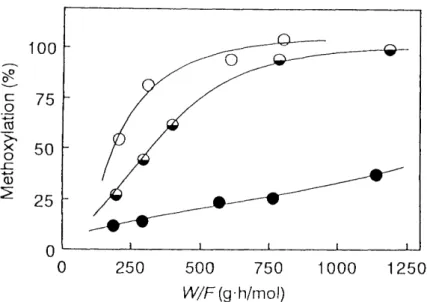
Molar Ratio (MeOH/BCP?:The catalyst (20 g) was placed in the middle of the reactor, the reaction temperature being kept at 220 OC, Mixtures of BCP and methanol in various molar ratios were co-pyrolyzed, the time factor being kept constant at 394,4 (g•h/mol) by adjusting the feed rate of the mixture solution. Figure 1.7 shows that the degree of methoxylation is not affected at the molar ratio of more than 5. Taking into account the reproducibility of experimental results, the subsequent co-pyrolyses were performed in the molar ratio of 12,2 (volume ratio : 5),
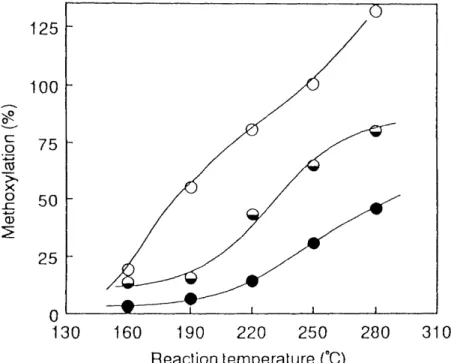
Reaction Temperature : A mixture of substrate (1,3-PDC, BCP or DBP) and methanol was fed to the reactor at feed rate of 40 mUh, Figure 1,8 shows the effect of reaction temperature on the methoxylation. The degree of methoxylation increased with increasing the reaction temperature in the order of 1,3-PDC < BCP < DBP, Thus, these results suggest that the bromine atom in 1,3-dihalopropane is more preferentially replaced by methoxyl group than the chlorine atom.
{oeo
v c
.9
't{i
->
Å~
=
'liiSo
E
125 IOO
75 50 25
o
130 160 190 220 250 280 310
Reaction temperature (Åé)
Fig. 1 .8. The effect of reaction temperature on methoxylation.
e ;1,3-PDC, O:BCP, OiDBP.
Time Factor (VV/F2 : The time factor was varied by adjusting the feed rate of mixed
SOIution, the reaction temperature being kept at 220 OC. Figure 1.9 shows the
eXperjmental results. The degree of methoxylation was increased with an increase
in the time factor, as well as in the reaction temperature, Because a large excess
Goo
v c
'.'
o N
J>
Å~
o
=
'trsE
1OO 75 50 25
o
O 250 500 750 1000 1250
W/F (g • h/moI)
Fig. 1 .9. The effect of VV/Fon methoxylation at 220 Åé.
O:1,3-PDC, OiBCP, o:DBP.
O.3
:A
r"N(
A5o9[N: o.2
oo gov y{ o
o 8 o.i
Ei;
8
9`"
o.o
O 500 1000
W/F (g•h!mol)
Fig. i.1O. Methoxylation rate of I,3-PDC.
Reaction temperature (OC) :
ol16o, oilgo, oj22o, ei2so, oj2so,
tc
9 o
-2,5
-3.5
-4.5
-5,5
e
1.8 2.0 2.2
1!Tx 1o3 (K'i)
Fig. 1 .1 1 , Arrhenius plots for methoxylation of 1 ,3-diha(opropanes.
ei1,3PDC, o:BCP, OiDBP.
of methanol is used, the rate of methoxyiation is pseudo-first-order in concentration of substrate. Accordingly, the rate constant of total reaction could be calculated by
eq, 1•1 O.2.303
k= VV/F
200 x log
200 - [Br(CH2>30Me + Cl(CH2)30Me + 2MeO(CH2)30Me]
(mol/g•h) (1 •1 0)
The rate constants for the substitution of bromine and chlorine in BCP with methoxyl group were also determined by eqs, 1•11 and 1t12, respectively.
2,303 100
(1•11)
kBr
log
100 - [Cl(CH2)30Me + MeO(CH2)30Me]
W/F
2.303 100
kci=
W/F
Tab1e 1OO
1.5
- [Br(CH2)30Me + MeO(CH2)30Me]
Activation energies and entropies of the methoxylation
(mollg•h)
(mol!g•h)
of activation
Su bs trate
Substituted
group
Activation
energy (J/mo1)
gn,t:gP,{i8X
(J/deg•mo1 at 22o oc)
BCP
DBP
1,3-PDC
Br and Cl
BrCl Br Cl
58100 52600 63900 53200 59600
-202 -211
-192
-211--21O
Figure 1.1O shows first-order kinetic plots for the methoxyiation of 1,3-PDC at the Various temperatures. The rate constant of total reaction was obtained from the Slopes of the straight line in Fig. 1,10. Figure 1,11 shows the Arrhenius plots.
ACtivation energies and entropies were determined from the slopes and the intercepts
of straight lines and were collected in Table 1.5, The activation energy for the methoxy-replacement of bromine in BCP was as Iarge as that of bromine in DBP, There was no significant difference in the reactivity of chlorine between BCP and 1,3- pDC, although the methoxyl-replacement of bromine was faster than chlorine.
Discussion : The co-pyrolyses of 1 ,3-dihalopropanes with methanol over activated alumina catalyst were characterized by the methoxylation accompanied with the disproportionation. That is to say, in the reaction of BCP with methanol, the methoxylation and the disproportionation proceeded simultaneously or competitively to give 1-halo-3-methoxypropanes, 1,3-dimethoxypropane, DBP and 1,3-PDC.
Thus, BCP is methoxylated according to the following equations.
Cl(CH2)3Br + 2 MeOH --'---'--.- Cl(CH2)30Me + MeBr + H20 (1•13) Cl(CH2)30Me + 2 MeOH ----. MeO(CH2)30Me + MeCl + H20 (1 •1 4)
On the other hand, the reaction of BCP with sodium hydroxide in aqueous methanol differed from the vapor--phase co-pyrolysis of BCP with methanol in product composition; in the liquid-phase reaction, the dehydrohalogenated products were mainly formed and the methoxylated products were rarely detected in the reaction
mlxture.
The methoxide ion generated on the basic sites of activated alumina attacks BCP according to reaction mechanism as the following equations.
Disproportionation:
Cl(CH2)3Br "- Cl(CH,)3'+Br- (1'15)
Cl(CH2)3Br+Br' "-•qie--- Br(CH2)3Br+Cl' (1'16)
Cl(CH2)3'+Cr "- CI(CH2)3Cl (1•17>
Methoxylation:
MeOH -e Meo'+H' (1'18)
Cl(CH2)3Br+MeO' - Cl(CH2)30Me+Br' (1•19)
Cl(CH2)30Me+MeO' ---> MeO(CH2)30Me+Br' (1•20)
Formation of methyl halide:
H'+Br' sHBr ;H'+ct- .Hc} (1 '21)
MeOH+HBr '--> MeBr+H2o ;MeoH+Hcl ---.- MeCl+ H20 <t'22)
BCP is dissociated into a carbonium and halide ions on the acidic sites of activated alumina (eq, 1•15) and the halide ion attacks the BCP (eq. 1•16). In the case of methoxylation, adsorption of methanol molecules on basic sites of activated alumina by hydrogen bonding through the hydrogen of the hydroxyl group generates inc}pient methoxide ions (eq, 1•18), which attacks BCP to give methoxy compounds (eqs. 1•19 and 20). Thus, reaction of eq. 1•19 competes with reaction of eq, 1•16. Taking into consideration that methyl chloride is formed by reaction of methanol and hydrogen chloride under conditions similar to this co-pyrolysis,29-3i) methyt halides in this reaction are produced according to eqs. 1•21 and 22.
Consequently, since halide ions are converted into methyl halides, the methoxylation of BCP is always more favorable than disproportionation of BCP into DBP and DCP. While 1,2-dichloropropane,32) 1,2,3-trichloropropane33) and chlorinated ethanes8) gave the dehydrochlorinated compeunds by co-pyrolysis with methanol, 1,3--dihalopropanes did not give the dehydrohalogenated compounds.
These results may be attributed to that the electron density of hydrogen atoms in the
2-position of 1 ,3-dihalopropanes is higher than those of 1 ,2-dichloropropane, 1 ,2,3-
trichloropropane and chlorinated ethanes and that the methoxide ion is liable to attack
the terminal carbon atom of 1,3-dihalopropane.
1.6 1,2,3-Trichloropropane33)
In liquid-phase reaction, allyl-type halides are susceptible to bimolecular nucleophilic replacement,34-36) On the other hand, the reaction of 1,2,3- trichloropropane (TCP) with methanolic sodium hydroxide affords only 2,3- dichloropropene (2,3-DCP), and the formation of 1,2-dichloro-3-methoxypropane (DcM) is not observed.i9) The vapor-phase co-pyrolyses of substituted allyl chlorides such as 3,4-dichloro-1-butene and 1,4-dichloro-2-butene with methanol on activated alumina produce significant amounts of the corresponding methoxylated derivatives,i5'i6) A preliminaly investigation revealed that products in the co-pyrolysis
of TCP with methanol on activated alumina differed from those in the liquid-phase reaction of TCP. That is to say, the formation of DCM was observed in the co- pyrolysis of TCP. Hence, the co-pyrolysis of TCP with methanol on activated alumina was investigated in detail under various conditions in order to understand the formation of DCM,
The co-pyrolysis of TCP with methanol on activated alumina gave 2-chloro-3- methoxypropene, DCM, 2,3-dichloropropene (2,3-DCP), cis-1-chloro-3-
methoxypropene, and cis- and trans-1 ,3-dichloropropenes (cis-1 ,3-DCP and trans- 1,3-DCP), The identification of products was carried out by a comparison of their IR,
NMR, and MS spectra with those ef authentic samples, Table 1.6 shows the spectroscopic data of IR, NMR and MS spectra for the reaction products,
ln order to clarify the reaction conditions in the co-pyrolysis of TCP with methanol, the effects of time factor (W/F), molar ratio of methanol to TCP, and reaction temperature on the product distribution were examined as follows,
Time Factor (1!V/F? : A mixture of TCP and methanol in a molar ratio 1.0 : 12.7 was co-pyrolyzed and the time factor (VV/F) was varied by adjusting the feed rate of TCP
(F: mol/h), the weight of catalyst (W:g) being kept at 20 g, The product
distributions in the co-pyrolysis with various time factors at 250 OC are shown in Table lt7, As the time factor increased, the conversion of TCP and the formation of Methoxylated compounds such as DCM steadily increased.
Mo/ar Ratio (MeOH/77CP? : Mixtures of TCP and methanol in various molar ratios
Were co-pyrolyzed on catalyst (20 g) at 300 OC. The time factor was kept constant
Tab1e 1.6 Spectroscopic data for the 1,2,3-trichloropropane
products obtained in the co-pyrolysis of
bo Npou nd
IR, cm-i
iH NH R(CC14), 6 , pPMMS, m/e
CH,=CCICH20Me
cis- cH c1= CH CH 2O Me
tran s- CH C1= CH CH 2OM e
C1CH2CHC1CH20Me
720(Cl) 900(C=CH2)
111O(C--O-C)283O(-OMe) 2940(-CH2-)
75O(C-C1) 111O(C-O-C) 163O(H-C=C-H) 2820(-OMe)
292O(--CH2-)80O(C-C1)
93 O(H- C=C-- H)
111O(C-O-C) 2820(-OMe) 2920(-CH2-) 74O(C-Cl)
113O(C-O-C) 2830(-OMe) 2940(-CH2-)
3 3 5 5
3 3 5 5
3 3 5 5
3 3 3 4
.
,
.
.
.
17 75 09 17
16 91 63 83
'15
70 70 84
,
.
.
40 62 72 oo
(s (s (s (s
'
'
'
'
(s, (dd (dt (dt
(s, (dd (dt (dt
(S, (dd (dd (m,
'
'
'
'
'
'
3H 2H H, H,
'
'
, -OCH3) , -CH20Me)
H•-C=C-Cl)
H- c= c- cII2o Me)
3H,
2H
H, H,3H, 2H H, H,
3H,
2H 2H
H,
-OCH3) , -cH2oMe)
-CH20Me)
=CHCI)
-OCH3)
, •-CH20Me)=CH--CII20Me)
=CHCI)
-OCH3) , -CH20Me) , -CH2Cl) -CHCI-)
108(M++2, 107(M+1, 106(M, 6.
1O5(M-1, 71(100) 45(81) 41(100) 108(M+2, 107(M+1, 106(M, 3.
105(M-1, 75(100) 71(100) 45(100) 41(100) 108(M+2, 107(M+1, 106(M, 2.
105(M--1,
71(100) 41(59)
146(M+4, 144(M+2, 142(M, 7.
45(100)
2 5.
o) 5.
3.
12 6) 20
o.
3.
4) 6.
.5) o)
4)
L
5.
6) 2)
.4) .6)
3) 4)
4)
4) 6)
at 416.3 (g of catalysVmol of TCP/h). Figure 1.12 shows the effect of the molar ratio on the product composition. In the molar ratios of 7,O or above, the conversion of TCP remained constant,
Reaction Temperature : A mixture of TCP and methanol in a molar ratio ef 1.0 :
12.7 was fed over 20 g of activated alumina at various feed rates. Figure 1.13 shows
the effect of the reaction temperature on the conversion of TCP into DCM. As the
reaction temperature increased, the conversion of TCP increased. However, the yield
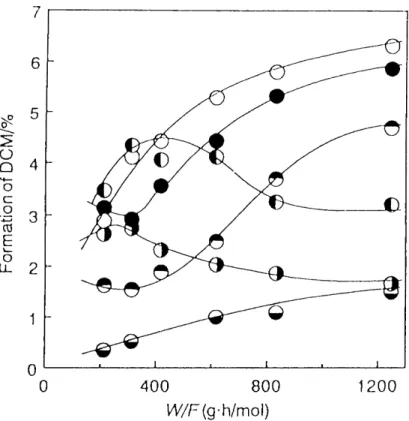
Of DCM showed a maximum value at 270 OC, because of the decomposition of
Table 1.7 Products distribution on activated alumina
(mo IX )
at 25o e
in C
the co-pyrolysis of TCP and methano1
Product W/F (g•h/mol)
208,1 312.5
416.2 614,3
832.4 1248.6CH,=CC1CH2OCH3
cis-CHCl= CH CH2O CH32,3-DCP
cis-1,3-DCP trans-1,3-DCP
D CH T CP
O.87 1.07
2.71 O.17 O.05 3.35
91.78
891.22 1.46 4.72 O.15 O.04 3.11
.30
2 1 3 o o 3 89
.19 .49 .06 .12 .22 .91 .Ol
2,79 2.37 2.51
O. 10
O.21 4,92
87,10
805,41 3.19
5, 14
O,17 O.04 5.63
.42
8, 4.
5.
o.
o.
6.
74.
92 95 05 14 03 02 89
>o<o
5 E
t
.9 .ucoo Q
E o o
't;
v = 9
a
1OO 80 60 40 20 o
o 10
Molar ratio
20
(MeOHrrCP)
30
Fig. I,12, The effect of the molar ratio on the products
composltlon.
Reaction temperature : 300 OC, VV/F=416.3 (g•hlmol).
o : TCP, e : CH2=CCICH2Cl+CH2=CCICH20Me,
o : CHCI=CHCH2Cl+CHCI=CHCH20Me, e: DCM.
7
6
>o<O 5
s 84
-c'
-g-3
g
u2
1
o O 400 800 ,1200
W/F (g • hlmol)
Fig. 1.13. The effect of the reaction temperature on the