Effects of Educational Interventions in Peer Tutoring in Foundational English Learning
journal or
publication title
The Journal of Kanda University of International Studies
number 32
page range 217‑242
year 2020‑03‑31
URL http://id.nii.ac.jp/1092/00001639/
Obstruction or Promotion? A Study into the Effects of Educational Interventions in Peer Tutoring in
Foundational English Learning
Azusa Kodate
Abstract
While “peer tutoring” often refers to “language practice partners” in language learning contexts, the Peer Tutorial Programme at the ASC at KUIS aims to increase English grammar understanding and exam scores. Although there are many examples and cases for training peer tutors with rather general skill sets for running tutorial session, there is limited precedent study on how they can be supported in subject specific areas. In order to seek effective practices in supporting the peer tutors in the subject area, the researcher investigated educational interventions using two different approaches over two years.
One of the significant findings was that educational support that maintains tutor and tutee discretion over learning contents and methods is key for supporting tutors.
1. Introduction
The term “peer tutoring” is now widely used and the definition and interpretation of this
can vary from one institution to another. While peer tutoring often refers to “language
practice partners” or “study buddy” in language learning contexts with emphasis on
increasing language input and output, the Peer Tutorial Programme at the Academic
Success Center (ASC) at Kanda University of International Studies (KUIS) aims to
increase foundational grammar understanding and TOEFL and TOEIC scores. Peer
tutors at the ASC, therefore, are not merely study partners, but they are expected to be facilitators of learning who have better subject matter understanding than tutees. In search of effective tutor training practices, two kinds of experimentations were carried out. The first approach was to introduce tutors to in-house learning materials which controlled both learning contents and methods. These task-based materials were designed in ways to foster deep active learning and cooperative learning among tutors and tutees.
The second approach was to develop a test to measure tutees’ understanding of foundational English grammar, which left tutors with the discretion over learning contents and methods depending on the test results. This paper is going to discuss the stages and analysis of the action research.
2. The Peer Tutorial Programme at the ASC
In its current format, the Peer Tutorial Programme at the ASC aims to boost students’
achievement in areas of academic and language examinations. In order to achieve this, the programme aims to promote, among students, a firm understanding of English grammar; to nurture skills and attitude towards deep learning; to help them develop cognitive and metacognitive skills; and to critically and effectively act to direct their own learning. There are three tutorial areas offered within the programme; foundational English grammar, TOEFL preparation, and TOEIC preparation. Tutorials are carried out in fixed small groups with a maximum of four participants in each group. Each group meets on a weekly basis throughout a semester, adding up to 10 sessions in total. The duration of each session is ninety minutes. Through repeated group activities, trust and friendly culture can develop (Yasunaga, 2015), and collaboration and cooperation can thrive among group members. Such a friendly atmosphere is said to enhance creative attitude and achievement in learning, stimulating intrinsic motivation for learning (Deci
& Ryan, 1985).
3. Research method
Action research is the framework in this study. According to Creswell (2013), action research is used to examine immediate social or educational problems, which are often small scale or local. It is cyclical, with the results of one programme being used to inform the planning of the following cycle. The cycle involves the identification of an existing problem, data collection through qualitative and/or quantitative studies, interpretation of the gathered data, and an evaluation of the completed cycle, and further implementation of a new plan to address the identified issues. In the case of educational action research, educators may continue to carry out further research followed by this implementation in the objective for more desirable outcome.
Some of the common data collection methods include observation of individual and/or group behaviour, taking audio and/or video recordings, distributing questionnaires or surveys, conducting interviews, taking field notes, and writing journals. Multiple data collection methods can be combined.
For this paper, a traditional programme consisting of the following four stages is used:
1. Study and plan, 2. Take action, 3. Collect and analyse evidence, and 4. Reflect (Creswell, 2013; Stinger, 2008).
4. Stage 1 (Cycle 1): Study and plan - Reasons behind the action research
Difficulties in the Foundational English stream
The Peer Tutorial Programme at the ASC started offering the tutorial service in
foundational English from 2017 in response to a real demand among students for
opportunities to learn basic English grammar. The programme seemed to meet their needs
at the outset, but it did not take long for issues and challenges to become apparent. Further,
observations and data acquired from the programme evaluation surveys conducted at the end of semester with both tutors and tutees strongly suggested a need for modifications to aspects of the programme.
In the first instance in 2017, through session observations and comments received from tutors, it became evident that many of the Foundational English tutors were struggling with the actual operation of their tutorial sessions. Many commented that it was not clear what the programme was aiming for, whereas the TOEFL and TOEIC programmes were straightforward in terms of their purpose (to improve student test scores). Some tutors reported that attempts to get information from their tutees about what they might want to study in the sessions, typically elicited responses such as ‘I am not good at grammar so I want to improve my grammar’. This was not helpful for tutors to set learning goals. It can also be said that tutors were not equipped with the necessary skills to elicit useful information from tutees by narrowing down such an abstract response.
In order to interpret and understand this situation more thoroughly and to improve the programme, a survey was carried out with all the tutors at the end of the semester. The survey consisted of 21 items asking about tutors’ perception of their own tutoring skills and experiences.
While tutors identified a broad range of issues, the discussion below focuses on four issues that were identified by a significant percentage of the Foundational English tutors, namely ‘Getting tutees to talk’, ‘Getting tutees to think’, ‘Selecting the right learning materials for tutees’ and ‘Dealing with a topic I did not know the answer of’. The details of those four areas are discussed in Kodate (2017).
Limits of the training system
Those highlighted areas of tutoring skills had been addressed in regular training sessions,
but the result of the survey indicated the necessity for support. In training, emphasis had been placed on practice through role plays and other means to exercise the tutoring skills.
There are, however, limits to training such as time constrains. Tutors get together for in-person training sessions during one-hour lunchtime breaks and on a weekend.
Inevitably, training contents are packed into these sessions. It is thus possible that tutors’
understanding and internalisation of the training contents may be compromised. There are also some tutors who cannot attend training due to various commitments outside of the tutorial programme. The most challenging part, nevertheless, is putting learned skills into actual practice. In reality, tutors need to tackle the differences in tutees’
understanding levels as well as group dynamics. Even if tutors understand the theoretical aspects of what they learn, it will take certain time and conditions for them to be able to put that into practice.
Tutor turnover
Tutor turnover can also be a factor that can contribute to the issues. Tutors are basically
hired under a one-year contract from April when the school year begins, but some
students leave the programme mid-year due to participation in study abroad programmes,
teaching practicum, and various other reasons. Some tutors continue throughout the year,
while others do not. Therefore, the shortest participation period as a tutor can be one
semester in some cases. When there is a tutor who leaves the programme, the position
needs to be filled by a new tutor. New tutors lack experience and knowhow that
experienced tutors may have gained overtime, thus they are required to take training
sessions to acquire basic tutoring skills. It is also not realistic to expect tutors to become
able to tactfully use the skills that they have learnt into practice immediately after
receiving training. For the majority of them, it takes substantial time and experience to
be able to perform those skills to a satisfactory level.
In this way, even though those four aspects raised by the tutors are covered in training, it takes certain conditions for tutors to put what they learned into practice. Then, how should educational support be provided to tutors by means other than training? It is simply not possible for the programme staff to sit for tutorial sessions and give advice at times. Session observations are carried out every semester by filming each tutor’s session, but the disadvantage of this is that the feedback cannot be provided spontaneously.
Increasing the frequency of observation raises the burden not only on tutors and teachers, but also on tutees. This is not realistic from both scalability and ethical perspectives.
Considering the means that can directly influence tutors’ facilitation skills in the session, a decision was made to develop learning materials that can be used in the session. The four aspects that were identified challenging by the tutors were addressed in ways to assist their skills in the learning materials. These learning materials were then made available to both experienced and new tutors.
5. Stage 2 (Cycle 1): Take action - Materials development
The learning materials that were developed aiming to support tutors in the following four areas:
Getting tutees to talk
Getting tutees to think
Selecting the right learning materials for tutees
Dealing with a topic I did not know the answer of
Supporting skills to get tutees to talk and think
Clear instructions were included in the learning materials to ensure that everyone in the
group would have an opportunity to share their ideas in turn. The sections where both
tutees and tutors are asked to share their ideas are often followed by a section to select, refine, and summarise those ideas, providing all participants with the opportunities to constructively evaluate their ways of thinking.
Sets of instructions for tutors were designed and developed in ways that ensure various types of interactions (namely solo, pair, and group activities), and these are utilised in order to achieve the main task of each learning material. These solo, pair and group sub tasks were designed also to eliminate free riding. In order to help tutors get tutees to think and talk more, and challenge their understanding, counter examples are presented in the materials. They are asked to point out inconsistencies and errors in the example and give counter proposals to correct the language. By providing opportunities for students to critically analyse the language, ask each other probing questions, the activities aim to promote a “deep approach” to learning (Marten & Säljö, 1997). This allows students to deepen their understanding as it challenges their cognition.
SOLO taxonomy was also used as one of the frameworks to design the learning materials
with the aim of deepening tutee understanding of foundational English grammar. Biggs
and Collis (1982) proposed a taxonomy of learning (Figure 1) that seeks to move students
along a continuum that begins with a stage where they perhaps miss the point of learning
altogether, through to a phase where they are able to generalise ideas and deal with
abstractions. This taxonomy informs the materials development process as a structural
framework to progressively deepen students’ understanding.
Figure 1: A hierarchy of verbs that may be used to form intended learning outcomes
In this way, a scaffold has been developed to ensure that the right conditions can prevail to afford opportunities for real cooperative learning.
Supporting skills to select suitable learning materials for tutees
Built into this procedure, each activity has a section called ‘Finding learning resources’.
This requires students to think about what they have learned so far in the activity. It also requires them to refine their understanding of the linguistic elements necessary to achieve the learning goal represented in the ‘can do’ statement. The activity also asks students to look at the learning resource they selected and discuss how they want to use it in group learning.
Supporting skills to deal with topics tutors do not know the answer to
Democratizing the learning process and moving tutors away from the idea that they
should be infallible sources of knowledge has also been built into the materials development process. Nevertheless, it does not mean that tutors can just walk in a session without having sufficient knowledge about the learning topics of the day. In order to address this and support the tutors further, a “tutor reference” was developed for each learning material. The tutor reference provided the information of the key grammar and vocabulary items, possible points where tutees may encounter difficulties in understanding the learning contents, and the recommended resources to which tutors can refer in preparation for their tutorial session. These references were given to all the Foundational English tutors.
Logistics
For the initial attempt, learning materials that are at the CEFR A1, A2, and B1 were made.
The covered areas were Speaking, Reading, and Writing. The concept and reasons behind the materials development were explicitly explained to the tutors in a training session, and Foundational English tutors were instructed to use the learning materials in their tutorial sessions. They were also told that once they completed all the activities in those materials, they could negotiate learning topics with their tutees and resume regular tutorial sessions. The materials were printed so all the Foundational English tutors and tutees had a copy.
6. Stage 3 (Cycle 1): Collect and analyse data
A survey was conducted to evaluate the effectiveness of the learning materials.
Evaluation survey 2018
The survey was carried out with 21 tutors in the Foundational English stream at the end
of the semester. It consisted of the following six items asking about tutors’ perception of
the effectiveness of the learning materials and their own tutoring experiences. The survey employed a 5-point Likert scale.
The level suitability of the learning materials to my tutees
The learning materials helped my tutees improve their English.
The learning materials helped me facilitate cooperative learning in my tutorial session.
The learning materials helped me facilitate deep active learning in my tutorial session.
The length of time it took to complete the learning materials
The tutor references helped me prepare my tutorial session.
These items were followed by a commentary section to further investigate the reasons behind their responses. The survey was distributed through an online system, and the tutors were asked to answer the survey every time they completed each learning material.
Overall, the average response rate was 82%.
‘The level suitability of the learning materials to my tutees’
For the A1 speaking material, 81% of the tutors felt that it was at the right level for their tutees, and 19% of the tutors answered that it was somewhat easy for their tutees. For the A2 reading material, 62% of the tutors answered that it was at the right level for their tutees, while 14% of the tutors answered it was somewhat easy for their tutees, and 24%
of the tutors answered it was somewhat difficult for their tutees. For the B1 writing material, 60% of the tutors answered it was at the right level for their tutees, and 40% of the tutors answered that it was somewhat difficult for their tutees.
It has to be noted that, for instance, CEFR B1 level is said to be equivalent to TOEFL
ITP 437 and above (CIEE, 2019) and TOEIC 550 and above (Tannenbaum and Wylie,
2008). Therefore, considering the English levels of the tutees who participate in the Foundational English stream (mostly below 420 in TOEFL ITP and 480 in TOEIC), it remains doubtful whether the tutors were able to accurately judge the English levels of their tutees. Some tutors also pointed out that it was not intuitive for them to understand how difficult or easy each learning material was, judging based on the CEFR levels. The CEFR levels were introduced and explained to the tutors in training beforehand, but as Bower et al. (2015) pointed out, even professional teachers need a certain training and preparation to familiarise themselves with the CEFR levels.
For those reasons, there is room for discussions on whether the CEFR-based learning materials are really suitable in the peer learning context, particularly when that happens in the extracurricular context where students do not have immediate access to teachers.
‘The learning materials helped my tutees improve their basic English.’
For the A1 speaking material, 75% of the tutors strongly agreed, and 25% of the tutors agreed. For the A2 reading material, 29% of the tutors strongly agreed, and 57% of the tutors agreed, while 10% of the tutors somewhat disagreed and 5% answered strongly disagreed. For the B1 writing material, 67% of the tutors somewhat agreed, while tutors who strongly agreed remained 20%, and the remaining 13% somewhat disagreed.
Though the majority of them agreed that there was some positive effect on improving
tutees’ English, there were a few tutors who expressed disagreement. Those tutors who
disagreed said that the emphasis was over placed on language skills (i.e. speaking,
reading, and writing) due to the nature of the task-based learning materials, whereas they
wanted to focus more on basic aspects of English grammar.
‘The learning materials helped me facilitate cooperative learning in my tutorial session.’
For the A1 speaking material, 69% of the tutors strongly agreed, and 31% of the tutors somewhat agreed. For the A2 reading material, 24% of the tutors strongly agreed, and 71% of the tutors somewhat agreed, while 5% of the tutors somewhat disagreed. For the B1 writing material, 60% of the tutors somewhat agreed, and the remaining 40% strongly agreed.
Almost all tutors agreed that the learning materials helped them with session facilitation skills. Their comments revealed that this was partly due to the fact that there were many sections that encouraged discussions and comments from tutees. Those tutors who expressed disagreement said that they thought getting tutees to work on reading activities, which forced them to work individually while they were reading, within a tutorial session, reduced the opportunity for cooperative learning. There is a possibility that this may also be an indication that the tutees were not up to the CEFR A2 level reading task. Also that it took a lot longer for them to complete the reading task than the material developer’s intention.
‘The learning materials helped me facilitate deep active learning in my tutorial session.’
For the A1 speaking material, 25% of the tutors strongly agreed, and 75% of the tutors somewhat agreed. For both the A2 reading and B1 writing materials, 40% of the tutors strongly agreed and 60% of the tutors somewhat agreed.
All tutors agreed that the learning materials helped them to facilitate deep active learning
in their tutorial sessions. Many commented that the step-by-step construction of the
learning contents, which were designed using SOLO taxonomy as a framework, helped
tutees to consolidate their understanding of the foundational grammar. This careful structure of the activities seemed to be perceived effective in promoting deep active learning among tutees.
‘The length of time it took to complete the learning materials’
For the A1 speaking material, 31% of the tutors answered that it took less than 60 minutes and 25% answered that it took 90 minutes. This means about half of the tutors spent one tutorial session (=90 minutes) working on the material, while 12% of tutors spent about three sessions working on the material. For the A2 reading material, only 24% of tutors were able to complete the material within one tutorial session, while it became evident that almost 70% of the tutors spent three or more sessions completing the contents. The similar tendency can be observed for the B1 writing material.
The contents of the learning materials may have been overloaded, and required three or more sessions to be completed for some tutors. As a result, both tutors and tutees got tired of the learning contents and their focus and purpose of learning got lost. SOLO taxonomy was employed with the intention to generate deep active learning, but the survey result suggested that it had the opposite effect in some cases.
Particularly because there is the limited timeframe of 10 tutorial sessions per semester, those tutors who disagreed felt frustrated by the contents of the learning materials designed with learners in general in mind, because they were not able to be more attentive to their tutees’ immediate learning needs.
‘The learning materials helped me deal with questions from tutees.’
For the A1 speaking material, whereas more than half of the tutors found the tutor
reference useful, 25% of them disagreed. For the A2 reading material, all the tutors
agreed that it was helpful to some degree. For the B1 writing material, half of the tutors strongly agreed and the other half somewhat disagreed.
Those tutors who expressed agreement said that they were able to check what the learning contents would be by looking at the learning materials in advance. This helped them to prepare for possible questions raised by tutees in actual tutorial sessions. The tutor reference developed for each learning material was also recognised as a useful resource because it provided tutors with key grammar items and expressions, and it also offered information as to what useful learning resources are out there to supplement tutees’
understanding. On the other hand, those tutors who disagreed found it was difficult for them to judge whether tutees’ answers were correct/accurate when it came to productive tasks such as writing compositions, due to their immaturity of their own English. Some tutors were dissatisfied because some of the grammar points inquired by tutees were not covered in the tutor reference. This was because the tutor references were designed to show tutors only the key grammar and expressions at the given CEFR level. This means that other grammar and expressions at lower or higher levels were not dealt with in the references.
7. Stage 4 (Cycle 1): Reflect
Overall, it would be fair to say that the highly-controlled learning materials gave some directions and guidance to those tutors who were not confident to facilitate Foundational English tutorial sessions. As “foundational English” can be interpreted broadly, the learning materials helped tutors narrow down the learning topics for each session. It was also shown that for tutors who were unfamiliar with the concept of cooperative learning, it gave them guidance and hints on session facilitation methods for such forms of learning.
Though, for many of the tutors, the learning materials were perceived positively, the
downside of them were observed by the researcher as follows:
As the learning contents are prepared in advance by the centre, there is no real flexibility of what can be learned in tutorial sessions unless the tutor has the skills to build his or her session around it. This also means that the advantage of peer learning and the organic nature of peer interaction may be compromised to some extent. Lack of discretion may become a source of frustration for both tutors and tutees.
As the learning contents are prepared in advance, the real-world weaknesses or requests of tutees may not be taken into consideration in actual sessions.
It remains challenging for tutors to select the right learning materials for tutees unless they have a good understanding of what each CEFR level means.
In case of group tutoring, it is only natural that difference in tutee understanding exists because no matter how close their test scores may be at the entry stage of the programme, their understanding may vary depending on the learning contents. Using the CEFR-aligned learning materials with tutees whose English levels vary means it is likely that there may always be a tutee who is not fully satisfied because the task is either too easy or difficult for him/her. Such group dynamics is supposed to work favourably in peer learning, but whether it is always ideal in “tutorial” session is questionable.
SOLO taxonomy was adopted to design step-by-step activities to complete the main task in the learning materials with intention to promote deep processing of learning contents, but this resulted in a rather crammed, long activities. There is a risk that tutors and tutees lose interest in the learning contents.
Through the action research Cycle 1, it was found that the learning materials which were
intended to provide micro-level support can be an obstruction to some tutors. The
learning materials may be more useful for new tutors and tutors who are not confident to get tutees actively involved in their tutorial sessions as they play a role in demonstrating techniques to engage tutees in cooperative learning. The use of the learning materials, therefore, should be optional, not obligatory, especially with experienced tutors. It is a fact, however, that the experienced tutors also expressed concerns with the broad nature of the Foundational English stream. In the second cycle of the action research, an attempt to provide tutors with macro-level support will be discussed.
8. Stage 1 (Cycle 2): Study and plan
In the Cycle 1, the effect of the micro-level support was examined and it was found that it has a potential to be an obstruction rather than promotion of learning in group peer tutorial sessions. The direction of the research then shifted to provide macro-level support.
Getting ideas from the TOEFL and TOEIC streams
The results of the survey conducted to evaluate the effectiveness of the renewed programme indicated that the TOEFL and TOEIC tutors did not seem to have significant issues in planning and managing their tutorial sessions. The reasons behind this may be as follows:
Because tutees are aware of their own weaknesses and test scores, it is easy for tutors and tutees to negotiate learning contents.
Because both tutees and tutors are aware of tutees’ weaknesses and test scores, session contents can be designed to meet tutees’ immediate learning needs.
This, in turn, helps retain tutees’ motivation high.
With the test, it is relatively easy for students to narrow down their learning
needs and goals as their weaknesses are represented in scores and questions to
which they could not answer correctly. Because of the concrete, simple nature
of such goals, they can be easily shared among group members. A shared goal is a vital element in cooperative leaning.
It seems that language exams provide some benefits in assisting the process of shaping the directions of learning at the outset. For those reasons listed above, the decision was made to develop a test to measure tutees’ understanding of foundational English grammar.
It has to be noted that the test and its procedure still have to address the four challenging aspects raised by the Foundational English tutors, namely, ‘Getting tutees to talk’,
‘Getting tutees to think’, ‘Selecting the right learning materials for tutees’,and ‘Dealing with a topic I did not know the answer to’.
Addressing the issues through the test
In theory, the test should be able to address all the four issues as described below.
‘Getting tutees to talk’ and ‘Getting tutees to think’
By getting tutees to work on the test prior to the first tutorial session, tutees can understand their own weaknesses and strengths, thus it is easy for them to relate themselves to learning topics. As a result, they become more involved and responsible in sessions, and they are therefore expected to talk and think more proactively in sessions.
‘Selecting the right learning materials for tutees’
The original problem was that those tutors, who found it difficult to find the right learning materials for tutees, were also facing difficulties setting the learning goal. By introducing a test, tutees’ weaknesses will be revealed and learning goals can be set based on these.
‘Dealing with a topic I did not know the answer to’
By getting tutors to mark their own tutees’ tests, tutors will be able to see their weaknesses.
This should help tutors predict possible questions that may be brought up by tutees.
9. Stage 2 (Cycle 2): Take action
Making the test to measure the understanding level of tutees
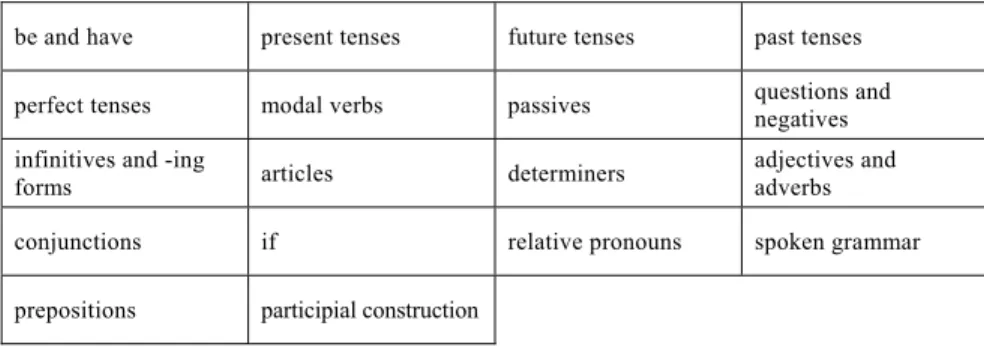
Test items (Table 1) were determined based on two sources. One of them was a grammar textbook which was commercially available. In particular, this time, ‘Oxford Practical English Grammar Part A and B’ (English title: The Good Grammar Book) (Swan and Walter, 2006) were used as the primary source. The textbooks are widely used among EFL learners, and cover foundational grammar points. The other source was “tutor portfolio”. In the ASC Peer Tutorial Programme, tutors are required to keep the record and reflection of each session, including what learning resources were used, what went well and what did not went well, and what could be improved in the next session. There is also a section for them to fill in with the information of the prominent questions brought up by the tutees in each session. Among those questions listed in their portfolio, commonly asked grammar questions were picked up and taken into the test items. Mostly, these grammar items are made into descriptive questions in the test.
be and have present tenses future tenses past tenses
perfect tenses modal verbs passives questions and negatives infinitives and -ing
forms articles determiners adjectives and
adverbs conjunctions if relative pronouns spoken grammar
prepositions participial construction