An Investigation into the Feasibility and Practicality of Blended Learning at Kanda
University of International Studies: Piloting an Online Module
journal or
publication title
言語教育研究
number 28
page range 19‑30
year 2017‑11
URL http://id.nii.ac.jp/1092/00001505/
An Investigation into the Feasibility and Practicality of Blended Learning at Kanda University of International Studies: Piloting an Online Module
David Faulhaber
ABSTRACT
One form of online (or distance) education is blended learning—also referred to as hybrid instruction. While adoption and implementation of blended learning at the tertiary level in Asia has occurred at a slower rate compared to Europe or North America, it is nonetheless beginning to make inroads at a number of Japanese universities. Key to the Kanda University of International Studies (KUIS) context is the fact that offering some form of blended learning instruction could allow for a greater overall pass-rate of students who cannot attend face-to-face classes due to illness, family emergency, or—notably—job hunting. Based upon previous research conducted at the university, this project pilots a blended learning class module that yields useful insights into student reactions to online learning and considers how usage of such modules might keep more KUIS students—
especially in the third and fourth year—from failing courses due to excessive absences (and, in addition, provide a means of instruction in cases when a class might otherwise be cancelled).
INTRODUCTION
Many universities in the United States and Europe offer distance education (online learning) in one form or another to make classes more accessible and to leverage the pedagogical affordances of current technology (in particular, mobile electronic devices such
comprising “a combination of forms of instructional technology, including traditional forms of learning used in conjunction with web-based, online approaches” (Nicolson, Murphy, &
Southgate, 2011).
While adoption and implementation of blended learning at the tertiary level in Japan has occurred at a much slower rate when compared to the aforementioned regions, it is nonetheless beginning to take root in Asia (Latchem and Jung, 2010) and at a number of Japanese universities (Hinkelman and Gruba, 2012; Ishikawa, Akahane-Yamada, Robotics, Kitamura, Smith, Tsubota, & Dantsuji, 2013; Lavin and Yoshii, 2013; Yamamoto and Shichida, 2013). This trend will only amplify in the coming years. With Japanese universities already in fierce competition for incoming students, those institutions not prepared to embrace the changing educational landscape by offering high-quality instruction through a variety of forms and delivery systems—not to mention the marketing appeal offered by the scalability of distance options—may very well find themselves struggling to keep their doors open.
Offering blended learning options also creates one possible avenue to a greater overall pass-rate; students who cannot attend face-to-face classes due to illness or family emergency, for example, would be able to complete course work without the need to be on campus.
Establishing a viable program of blended learning classes or online modules also prepares any university for campus closures triggered by severe weather, natural disasters, or even quarantine resulting from airborne disease; in such cases, instruction would continue (if perhaps not on a 100% basis) using the protocols and technology already in place.
BACKGROUND
A study looking into the practicality of hybrid instruction at KUIS was conducted by Mynard and Murphy in 2012. They found that “offering flexible learning options is a feasible
option for KUIS” (p. 132). Even so, issues preventing successful implementation of blended learning activities included the lack of adequate (i.e. ‘fast enough’) technology and uniform development and delivery platforms. Several students in the study also experienced unfamiliarity with blended learning and what was expected of them (and others) during online activities. (This may be attributable to the fact that the distance component under examination took place during a single day of a week-long intensive summer course.)
The key technological hurdles identified by Mynard and Murphy have largely been mitigated in the intervening years since their research. A study by Castellano (2012) looking into teacher use of iPads informed a university-wide policy change requiring all incoming freshmen (beginning in April of 2014) to purchase iPads for use in coursework. The existence of a standard platform soon led to the transition and augmentation of existing course materials to new formats (Apple iBooks, for one) to take advantage of the new devices.
These developments prompted a return to where Mynard and Murphy left off. With faster wireless connectivity and iPads in the hands of all incoming students, how would a course with an online component fare in the new technological landscape? The author conducted a survey of (his) students in November of 2015 to first gauge interest regarding online courses. Respondents included 57 sophomores taking Media English (compulsory) and 20 juniors and seniors enrolled in an EISO III elective course. In Figure 1 (below), data separated by second-year (Media English) and third- and fourth-year (EISO III) students show that younger respondents—even by only one or two years—are more willing to take a course with an online component (though far fewer indicate a preference for a 100% online course).
Figure 1. Media English (second-year) and EISO III (third- and fourth-year) student
responses to the question “Would you be interested in taking an online class at KUIS?” (November 2015)
The same survey was given in October 2017 (almost exactly two years later) to the author’s second-year Media English students. Responses this time around were more distributed: while it’s worth noting that the number of students expressing a desire for courses with some online component decreased by 9% overall, there was a significant migration away from the 2015 survey’s clear preference (courses that are 25%-online) toward options at either end of the spectrum.
Table 1
Responses from Media English (sophomore) students from November 2015 (n=57) and October 2017 (n=65) to the question “Would you be interested in taking an online class at KUIS?”
2015 2017 % change
0% online 14% 23% +9%
25% online 52.6% 30.8% –21.8%
50% online 31.6% 38.5% +6.9%
100% online 1.8% 7.7% +5.9%
In the spring of 2016, however, something remarkable happened that caused a shift in the project’s focus. That semester, 12 students (out of 27) in the researcher’s EISO III elective course exceeded the university’s maximum allowable number of excused absences—
primarily due to the need to attend job interviews and informational sessions. (Most students did pass the course upon completion of extra work assigned by the instructor but there can be little doubt that missing so many lectures is not ideal.)
Figure 2. Pass / fail ratio for students enrolled in the researcher’s EISO III course who would have failed based solely on the university’s limit for allowable excused absences.
In light of this revealing information, the researcher made the decision to refocus the study on third- and fourth-year students as they are in greater danger of failing courses due to excessive absences. Blended learning presented itself as a potential stopgap solution. Offering an online version of an in-class lecture could make all the difference in the world for students who suddenly find themselves between a rock and a hard place—forced to choose between attending class or networking for future employment opportunities. The researcher set out to create and pilot an online module that would replicate (within reason) a face-to-face 90- minute class, using the following research questions to guide the project:
1. What are students’ perceptions of blended learning as a part of regular coursework?
2. What limitations and obstacles (institutional, technical, or otherwise) are encountered in the deployment of and engagement with online materials for blended learning at KUIS?
METHODOLOGY
Two modules were created for 25 students to complete online (outside of class), one each for primary source materials that would have normally been covered in class on the day of piloting: Walt Disney Productions’ 1937 animated short “Hawaiian Holiday” and Rap Reiplinger’s satiric parody of the Hawaii tourism industry, “Puka Shell Tour Guide” (2003).
(The course, (Re)presentations of “Hawaii” in American Popular Culture, critically examines various constructions of race and culture with respect to Hawaii in the context of American popular culture.) Since the majority of KUIS students are already (somewhat) familiar with the Google Apps for Education environment—the EISO III course in question uses Google Classroom for the posting of class materials and announcements—Google Forms was selected as the vehicle to deliver each module. The two source material videos, as well as video recordings of the researcher’s presentation slides from the lecture (complete with voiceover and transcript), are embedded within the form alongside open-ended questions that allow students to both engage with the material and receive credit for their participation.
On the morning of the piloting (three hours before the Wednesday class was scheduled to begin), students were notified by email and the course website that they would be participating in an online version of that day’s class. Students were instructed to complete the
message or had questions about the assignment; no one showed up.
FINDINGS
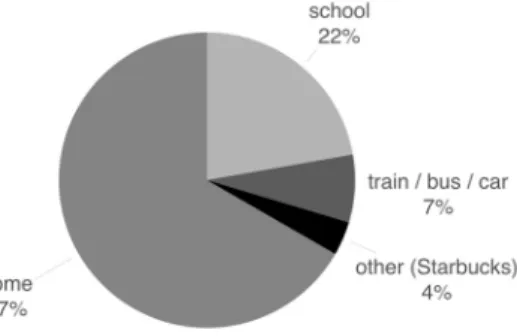
Perhaps as a result of notification of the online class being sent out three hours before the class’s morning start time of 10:40, an overwhelming majority of participants reported completing the online modules from home (see Figure 3). Additional factors take into account weather and geographic location (“today was rainy, my house is far from school and train for 2nd comma [sic] is always busy”) and the ability to focus in a quiet environment (“I did it in my room. Here is the best place to study. Quiet, warm and I could focus on it.”).
Figure 3. Responses to the question “Where did you do the online activities?”
Not surprisingly, students devoted more time (on average) to each module than would have been spent on the same material in the classroom. The “Hawaiian Holiday” and “Puka Shell Tour Guide” activities take approximately 35 and 45-minutes to complete, respectively, in a face-to-face classroom situation. Figure 4 shows time-on-task (as reported by study participants) for each of the two modules.
Figure 4. Participants’ (self-reported) time-on-task for each module.
The inclusion of written responses—in lieu of conversation with classmates—may account for some of the extra time, but students also took advantage of the affordances of the online modules. One respondent stated that if she “cannot understand to [sic] contents, I can listen and repeat many times.” This sentiment is echoed in another comment, in which a student notes, “I can write down my ideas so I can organize my thought [sic].”
Convenience is also a factor that was mentioned repeatedly by participants. When asked in the follow-up survey if they preferred synchronous (students and the instructor are online at the same time) or asynchronous (students complete the activities at a time most convenient for them) classes, 92% of respondents favored online work they could complete at a time of
common responses relate to studying outside of the classroom.
Table 2
Responses to the question “Why would you take an online class?”
choices responses I want to study outside of class (at home, on the train, etc.). 11
I prefer working by myself. 4
I don’t always want to study in a classroom. 6
My schedule is too busy. 4
I don’t want to take an online class. 5
Other: “If I can not go to class because of illness or
something, it would help my study in home.” 1
CONCLUSION
Obstacles that hampered the effective implementation of blended learning activities in Mynard and Murphy’s study—namely, outdated, sluggish, and varied delivery platforms—
did not negatively impact the piloting of this study’s online modules to nearly the same degree. The one factor which did cause trouble for several participants is Google Forms;
those who switched to other apps or switched off their iPad before completing the activity sometimes found that previously entered responses had vanished. This is something that can be addressed by looking to other options for hosting the online content. What is key, however, is that only a few students were adversely affected—and not those who completed modules in a single sitting (without leaving Google Forms for extended periods of time).
79% of respondents stated they would like to do online activities (that cover the same topics as in class) in their free time and on their own volition when they are absent. The remaining 21% said they might be interested. (No one chose “I probably would not do online activities.”) When asked the same question—but with the promise that an unexcused absence
would be converted to an excused one (upon completion of the online modules)—the number of respondents who said they would be very interested in this option rose to 86%. Eight said they might be interested, while four expressed they probably would not choose to do this.
The results of this study indicate that offering flexible learning options—here, in the form of online modules that cover the same material as a missed class’s lecture—at KUIS may be a viable option for reducing the number of students who are in danger of failing classes due to excessive absences (especially in cases where a choice must be made between attending class or preparing for a career after university).
REFERENCES
Castellano, J. (2012). The introduction of iPads at a Japanese university EFL program. 言語 教育研究, 23, 39-46.
Hinkelman, D., & Gruba, P. (2012). Power within blended language learning programs in Japan. Language Learning & Technology, 16(2), 46-64.
Ishikawa, Y., Akahane-Yamada, R., Robotics, A. I., Kitamura, M., Smith, C., Tsubota, Y., &
Dantsuji, M. (2013). The development of self-regulated learning behaviour in out-of- class CALL activities in a university EFL blended learning course. Glasgow, 10-13 July 2013 Papers, 112.
Latchem, C., & Jung, I. (2010). Distance and blended learning in Asia. New York, NY:
Routledge.
Lavin, R., & Yoshii, M. (2013). CHALLENGES IN IMPLEMENTING BLENDED LEARNING WITH TABLET DEVICES. ICERI2013 Proceedings, 2552-2557.
Mynard, J., & Murphy, P. (2012). An investigation into offering flexible language courses utilising blended learning. 言語教育研究, 23, 101-137.
Nicholson, M., Murphy, L., & Southgate, M. (2011). Language teaching in blended contexts.
Edinburgh, UK: Dunedin.
Oliver, M., & Trigwell, K. (2005). Can ‘blended learning’ be redeemed? E-Learning, 2(1), 17-26.
Reiplinger, R. (Performer). (2003). Rap’s Hawaii [DVD]. United States: EMMIS Television Broadcasting and Mountain Apple Company.
Sharpsteen, B. (Director), & Disney, W., Sutherland, J. (Producers). (1937). Hawaiian holiday [Animated short]. United States: Walt Disney Productions.
Yamamoto, Y., & Shichida, M. (2013, March). A Case Study on Blended Learning of a Practice-Based University Course in Japan. In Society for Information Technology &
Teacher Education International Conference (Vol. 2013, No. 1, pp. 1143-1146).