A Survey Analysis
journal or
publication title
Hoshi journal of general education
number 34
page range 43‑54
year 2016‑12‑10
URL http://id.nii.ac.jp/1240/00000803/
43 Beliefs, Strategies and Confidence in English: A Survey Analysis
Beliefs, Strategies and Confidence in English: A Survey Analysis
Yoko Kanazawa Sayuri Yoshizawa-Watanabe Yukiko Ohashi Steven Bohme
(Hoshi University, School of Pharmacy and Pharmaceutical Sciences)
Abstract
The present study investigates Japanese intermediate-level students beliefs, learning strategies and confidence in their English abilities.
Questionnaire responses from a total of 236 students at high and low intermediate levels with a pharmacy major showed that while analytical beliefs were common, higher proficiency level students preferred more experiential strategies, and that they were more confident in communication in English. The findings of the present study support previous research suggesting the importance of experiential learning.
Keywords: learner beliefs, confidence, proficiency, experiential learning strategies, analytical learning strategies
1. Introduction
Research interests in SLA have shifted from teacher-directed to
student-centered instruction in the past decades, and numerous studies
have shown that learner belief about language learning plays an important
role in their choices of strategies which in turn may affect their L2
development; if students believe that translation and memorization are
effective strategies, they will try to memorize words and translate them, rather than using them in communication. While previous studies suggest that beliefs might affect learning outcomes [1], they do not necessarily show a strong relationship between them.
Understanding learner beliefs contributes to more successful language learning [2][3]. Likewise, learners need to be aware of their own beliefs by evaluating how those beliefs affect their second language learning [4]. Assessing L2 learner beliefs is also essential in understanding their approaches to language teaching [1][2][5][6]. From a motivational perspective, Dörnyei emphasizes the importance of creating realistic learner beliefs as an important motivational strategy [7].
Although learner beliefs are viewed as an important individual difference variable in L2 learning [8][9], the concept has remained relatively unexplored. Thus, further research is needed to fully understand the real impact of learner beliefs on L2 learning. Recently, Izumi et al. and Ogawa and Izumi investigated the relationship between learner proficiency, beliefs, learning strategies and confidence, finding that higher- level students hold stronger beliefs in experiential learning approaches, while lower-level students, who tend to believe in analytical approaches, show low confidence in their L2 abilities [10][11]. They also found that analytic beliefs are positively correlated to the use of analytical learning strategies and negatively with the use of experiential learning strategies. In contrast, beliefs in experiential learning seem to promote more flexible or balanced use of analytic and experiential strategies. Furthermore, the use of experiential strategies is more strongly related to improved confidence in L2 use.
While the findings of the previous studies illustrate high and low
proficiency learner beliefs and learning strategies, further research is
needed to generalize the results. Furthermore, anecdotal evidence shows
that students majoring in science tend to prefer analytical approaches
even in language learning. Thus, the present study examines beliefs and
45 Beliefs, Strategies and Confidence in English: A Survey Analysis
strategies taken by analytical-minded learners with intermediate level proficiency without any overseas experience.
Based upon Ogawa and Izumi [11], the following hypotheses were formed.
1. Lower-intermediate proficiency learners tend to believe in analytical learning more strongly than the higher-intermediate proficiency learners.
2. High-intermediate proficiency learners tend to use experiential learning strategies more frequently than the lower group learners.
3. Higher proficiency learners tend to have higher degrees of confidence in their communication abilities in English.
2. Methods
A questionnaire modified from Ogawa and Izumi [11] was given to 239 students in 8 classes taught by 4 different instructors. The students were in their second year at a pharmaceutical university in Tokyo, and those with overseas experience were removed from the data. A total of 234 students were divided into two groups; 199 lower intermediate level students with TOEIC scores of 595 and below, and 35 students with TOEIC scores of 600-750. In the context of our university, we considered students with TOEIC scores of 600 and above as high intermediate because of their good performance in English classes.
The questionnaire consisted of 50 Likert-scale questions examining
their beliefs, strategies, and confidence in their L2 ability. The
questionnaire items were written in both English and Japanese, and were
divided into five parts, consisting of 9 to 11 questions per section.
3. Results
Table 1 Beliefs and learning strategies of students majoring in pharmacy at different levels Statement Lower groupHigher groupt-test MSD M SDt p Beliefs in analytical learning 1 It is important to understand English grammar.4.25.813 4.08.9121.192.234 2 It is important to memorize vocabulary 4.59 .6194.68.620 -.842.401 3 It is important to understand everything the teacher says 3.53.906 3.79.741-1.680.094 4 It is important to check any words I don’t understand. 3.761.001 3.82.982-.309.757 5 I want my English teacher to explain grammar rules in Japanese3.421.084 3.13.9911.539 .125 6 I want my English teacher to correct all my mistakes. 3.39.9433.58 1.030 -1.098.273 7 It is important to know all grammatical terms to learn English 3.26.9512.821.353 2.423 .016 8 It is important to do many exercises to learn my English 3.94.900 3.741.1311.193.234 9 We should learn correct grammar first before we speak English 3.39.910 3.051.4691.863.064 10 It is important to speak English with native-like accent as much as possible. 3.70.907 4.261.245-3.311.001 Belief in experiential learning 11 In order to learn English, it is important to speak with others in English. 4.38 .8054.711.206 -2.105.036 12 In order to learn English, it is important to listen to a lot of English. 4.56.6914.761.364 -1.398.164 13 I don’t get bothered if I don’t understand everything the teacher says in the English class.3.311.066 3.631.895 -1.459.146 14 It is unreasonable to expect to understand everything I read in English. 3.101.036 3.472.063-1.665.097 15 It doesn’t matter if I make mistakes when speaking with others in English. 3.51.928 4.032.047-2.496.013 16 I would like my English teacher to use as much English as possible in the English class. 3.33.879 3.892.203-2.672.008 17 You can learn English naturally in an English-speaking country. 3.45.974 3.742.367-1.263.208 18 It is okay to guess if you encounter unknown words or phrases in English. 3.78.903 4.532.345 -3.411.001 19 I can communicate in English without knowing grammar rules. 3.78.835 4.242.614-2.026.044 20 It is okay to speak English with some Japanese accent. 3.07 .9903.292.977 -.817.415
47 Beliefs, Strategies and Confidence in English: A Survey Analysis
Analytic learning strategies 21 I learned English by studying school textbooks carefully. 3.54.9544.083.049-2.054.041 22 I learned English by doing many exercises. 3.57.9094.303.135-2.734.007 23 I learned English from reading grammar explanations. 3.57.9523.923.419-1.231.220 24 I learned English by memorizing rules and words/idioms 3.78.9554.543.388-2.672.008 25 I learned English by translating it into Japanese. 3.72.9604.243.670-1.732.085 26 I learned English by translating Japanese into English.3.41.9614.003.873-1.889.060 27 I learned English by using Japanese translation to check my comprehension.3.82.8674.303.950-1.549.123 28 I learned English by reviewing what I was taught in the English class. 3.42.9974.324.130-2.730.007 29 I learned English by repeating and practicing a lot. 3.51.9334.414.278-2.657.008 Experiential learning strategies 30 I learned English by speaking with others in English. 2.881.0324.054.564-3.247.001 31 I learned English by listening to the radio or watching TV/movies in English. 2.481.1183.684.744-3.146.002 32 I learned English by reading a lot of English magazines, books, and/or newspapers. 2.131.0573.494.964-3.484.001 33 I learned English by writing e-mails, letters, or diaries in English.1.90.9923.145.165-3.129.002 34 I learned English by making friends who spoke English.1.871.0743.305.327-3.462.001 35 I learned English by trying to think in English. 2.371.0883.625.459-2.975.003 36 I learned English by imitating what English speakers said. 2.581.1203.955.542-3.191.002 37 I learned English by immersing myself in an English-speaking environment. 2.081.1573.815.792-3.860.000 38 I get nervous when speaking in English.3.501.1104.305.797-1.789.075 39 I am afraid of making mistakes when using English.3.421.0594.166.012-1.626.105 40 I will ultimately learn to speak English very well. 2.74.9153.976.149-2.692.008 Confidence 41 I am confident with my ability to have conversation in English. 2.08.8973.766.357-3.558.000 42 I am confident with my ability to speak English. 2.06.9213.706.540-3.389.001 43 I am confident with my ability to pronounce English. 2.17.9784.146.634-3.974.000 44 I am confident with my ability to understand spoken English 2.43.9854.496.715-4.102.000 45 I am confident with my ability to understand written English 2.83.9244.466.894-3.191.002 46 I am confident with my ability to write in English 2.39.9064.087.135-3.218.001 47 I am confident with my ability to explain English grammar2.47.9874.037.324-2.879.004 48 I am confident with my ability to use grammar in communication. 2.23.8903.76 7.529 -2.763.006 49 I am confident with my ability to translate English to Japanese. 2.77.9504.707.520-3.490.001 50 I am confident with my ability to translate Japanese to English.2.31.9044.117.795-3.155.002
As shown in Table 1, overall participants tended to believe in both analytical and experiential learning. Regarding beliefs in analytical learning, no statistical difference was observed between the two groups except in questions 7 and 10, which shows that those in the lower group tended to believe in the importance of knowing grammatical terms more strongly than those in the higher group (t = 2.423, p = .016), while those in the higher group believe in the importance of speaking English with native-like accents more strongly (t = -3.311, p = .001).
With regard to beliefs in experiential learning, the higher group believed more strongly in all the questions than the lower group, and statistical differences were seen in questions 11 (t = -2.105,
p = .036),15 (t = -2.496, p = .013), 16 (t = -2.672, p = .008), 18 (t = -3.411,
p =.001) and 19 (t = -2.027,
p = .044), all of which were related to L2 usefor communication. Question 11 concerns the importance of speaking in English to learn, and question 15 is about positive attitudes toward making mistakes. Likewise, questions 18 and 19 focus on guessing for comprehension and fluency without worrying about grammatical accuracy.
The higher group tended to believe in having a lot of input and output practice through communication, and at the same time, wanted to be corrected by their English teacher slightly more than the lower group.
Interpreting Two-way repeated measures ANOVA results (Table 2
and Figure 1), the multivariate tests indicate a nonsignificant group main
effect,
F (1, 236) = .926, p = .337; a significant belief main effect, F (1,236) = 7.731, ηG2 = .015, p = .001), and a nonsignificant belief by-group
interaction effect, F (1, 236) = .349, p = .55. These results signify that
differences are seen between analytic and experiential beliefs, implying
that students tend to value experiential beliefs over analytic beliefs. On
the other hand, although students in the higher group tend to believe in
experiential learning more strongly than those in the lower group, no
statistical differences were observed between the groups in terms of
beliefs.
49 Beliefs, Strategies and Confidence in English: A Survey Analysis
In terms of analytic strategies, statistical differences were observed in questions 21, 22, 24, 28, and 29 (see Table 1). These results indicate that students in the higher group seem to have invested time and effort in practicing and using the grammar and vocabulary above and beyond simple memorization, vis-a-vis the lower group. Additionally, in experiential strategies, while no statistical differences were seen in questions 38 and 39, all other questions showed significant differences between the two groups (p < .01). Students in the higher group displayed higher scores than those in the lower group. The main effect in both groups; F (1, 236)
= 5.319, ηG2 = .02, p = .2 and strategy; F (1, 236) = 52.02, ηG2 = .09, p = .001, as well as the interaction effect; F (1, 236) = 4.082, ηG2 = .006,
p =.04 shown in Table 3 show the differential degrees in the use of different strategies by these groups. Examining the method simple main effects, different degrees in the use of analytic and experiential strategies were observed in both groups (lower level, p = .001; higher level, p = .021), which implies that in both groups, students tend to employ more analytic than experiential strategies. In analytic strategies, no statistical differences were seen between the lower and higher groups (p = .675), however, the experiential strategies showed differences in the degree of use (p = .004), meaning students at a higher level use more experiential strategies (see Table 3 and Figure 2).
In the area of confidence, significant differences were seen in all the
questions (p < .01), finding that the students in the higher group tended
to be more confident in their overall English ability. Those in the higher
group tended to be confident in conversation, pronunciation, understanding
spoken and written English than those in the lower group, compared with
the ability to explain grammar or to use it in communication.
50
Figure 1 Beliefs in language learning of the students with different levels Belief
Estimated Marginal Means group 1 = lower level group
group 2 = higher level group belief 1 = analytic learning belief 2 = experiential learning
Table 3 Two-way repeated measures ANOVA results on strategies at different levels
Source SS df MS F p ηp2
Group (high / low) 3.264 1 3.264 5.319 .022 .022
Error 144.849 236 .614
Strategies (analytic / experienti 24.534 1 24.534 52.023 .000 .181 Strategy × Group 1.925 1 1.925 4.082 .044 .017
Error (belief) 111.295 236 .472
Table 2 Two-way repeated measures ANOVA results on belief at different levels
Source SS df MS F p ηp2
Group (high / low) .220 1 .220 .926 .337 .004
Error 56.002 236 .237
Belief (analytic / experiential) 1.625 1 1.625 7.731 .006 .032
Belief × Group .073 1 .073 .349 .555 .001
Error (belief) 49.619 236 .210
51 Beliefs, Strategies and Confidence in English: A Survey Analysis
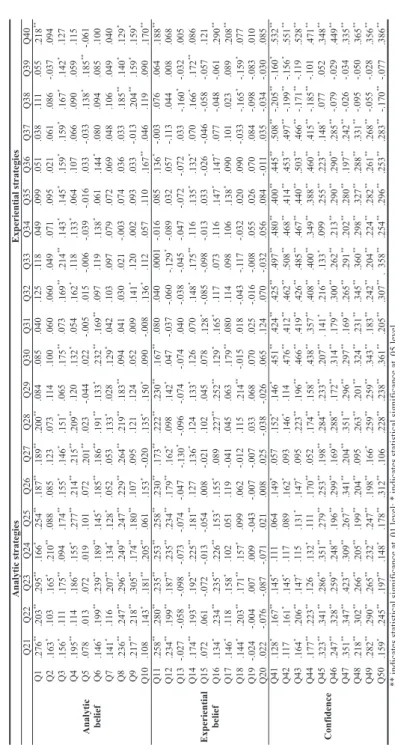
Table 4 shows all the correlation results between belief and strategies of both groups. Some of the questions showed both positive and weak correlations with experiential strategies, while more analytic strategies were positively correlated with both analytic and experiential beliefs.
Confidence also has a strong positive correlation with both analytic and experiential strategies.
Among the confidence question items, the higher group was significantly more confident in their abilities concerning actual language production such as conversation, speaking, and pronunciation, compared with more receptive skills or meta-knowledge such as understanding written English, or the ability to use or explain grammar.
In summary, the study found that both groups did not differ statistically in their beliefs in analytical learning, but the higher group tended to use experiential learning strategies more frequently than the lower group. The higher group also had higher degrees of confidence in their communication abilities in English. From the above results, the second and third hypotheses were supported.
Figure 2 Strategies in language learning of the students with different levels Estimated Marginal Means
Strategies
group 1 = lower level group group 2 = higher level group belief 1 = analytic strategies belief 2 = experiential strategies
Table 4 Spearman rank correlational matrix for beliefs and strategy use about learning languages Q21Q22Q23Q24Q25Q26Q27Q28Q29Q30Q31Q32Q33Q34Q35Q36Q37Q38Q39Q40 Q1 .276** .203** .295** .166* .254** .187** .189** .200** .084 .085 .040 .125 .118 .049 .099 .051 .038 .111 .055 .218** Q2 .163* .103 .165* .210** .088 .085 .123 .073 .114 .100 .060 .060 .049 .071 .095 .021 .061 .086 -.037 .094 Q3 .156* .111 .175** .094 .174** .155* .146* .151* .065 .175** .073 .169** .214** .143* .145* .159* .159* .167* .142* .127 Q4 .195** .114 .186** .155* .277** .214** .215** .209** .120 .132* .054 .162* .118 .133* .064 .107 .066 .090 .059 .115 Q5 .078 .013 .072 .019 .101 .072 .201** .023-.044 .022 -.005 .015 -.006 -.039 -.016 .033 -.033 .138* .185** -.061 Q6 .146* .199** .239** .189** .145* .185** .186** .191** .133* .232** .169** .097 .119 .138* .061 .144* .080 .094 .085 .100 Q7 .141* .116 .207** .134* .128* .052 .053 .133* .028 .129* .042 .103 .097 .079 .072 .069 .048 .106 .049 .040 Q8 .236** .247** .296** .249** .247** .229** .264** .219** .183** .094 .041 .030 .021 -.003 .074 .036 .033 .185** .140* .129* Q9 .217** .218** .305** .174** .180** .107 .095 .121 .124 .052 .009 .141* .120 .002 .093 .033 -.013 .204** .159* .159* Q10 .108 .143* .181** .205** .061 .153*-.020 .135* .150* .090 -.008 .136* .112 .057 .110 .167** .046 .119 .090 .170** Q11 .258** .280** .235** .253** .258** .230** .173** .222** .230** .167** .080 .040 .0001 -.016 .085 .136* -.003 .076 .064 .188** Q12 .234** .199** .187** .235** .234** .179** .162* .098 .142* .047 -.037 -.060 -.129* -.089 .032 .057 -.113 .044 .008 .068 Q13-.027-.058-.098-.073-.074-.047-.130*-.096-.074 -.074 .040 -.038 -.045 -.047 -.072 -.072 .033 -.160* -.032 .005 Q14 .174** .193** .192** .225** .181** .127 .136* .124 .133* .126 .070 .148* .175** .116 .135* .132* .070 .166* .172** .086 Q15 .072 .061-.072-.013-.054 .008-.021 .102 .045 .078 .128* -.085 -.098 -.013 .033 -.026 -.046 -.058 -.057 .121 Q16 .134* .234** .235** .226** .153* .155* .089 .227** .252** .129* .165* .117 .073 .116 .147* .147* .077 -.048 -.061 .290** Q17 .146* .118 .158* .102 .051 .119-.041 .045 .063 .179** .080 .114 .098 .106 .138* .090 .101 .023 .089 .208** Q18 .144* .203** .171** .157* .099 .062-.012 .115 .214** -.015 .018 -.043 -.117 -.032 .020 .090 -.033 -.165* -.159* .077 Q19-.024-.004 .007 .009-.043-.007-.007 .033 .068 .070 .025 -.016 -.008 .055 .026 .070 .084 -.098 -.083 .010 Q20 .022-.076-.087-.071 .021 .008 .025-.038-.026 .065 .124 .070 -.032 .056 .084 -.011 .035 -.034 -.030 .085 Q41 .128* .167** .145* .111 .064 .149* .057 .152* .146* .451** .424** .425** .497** .480** .400** .445** .508** -.205** -.160* .532** Q42 .117 .161* .145* .117 .089 .162* .093 .146* .114 .476** .412** .462** .508** .468** .414** .453** .497** -.199** -.156* .551** Q43 .164* .206** .147* .115 .131* .147* .095 .223** .196** .466** .419** .426** .485** .467** .440** .503** .466** -.171** -.119 .528** Q44 .177** .223** .126 .132* .111 .170** .052 .174** .158* .438** .357** .408** .400** .349** .388** .460** .415** -.185** -.101 .471** Q45 .323** .341** .286** .351** .279** .253** .198** .284** .233** .207** . 141* .216** .133* .099 .255** .223** .148* .077 .052 .348** Q46 .247** .328** .259** .248** .196** .299** .169** .288** .172** .314** .179** .300** .262** .213** .290** .290** .285** -.079 -.029 .449** Q47 .351** .347** .423** .309** .267** .341** .204** .351** .296** .297** .169** .265** .291** .202** .280** .197** .242** -.026 -.034 .335** Q48 .218** .302** .266** .205** .199** .204** .095 .263** .201** .324** .231** .345** .360** .298** .327** .288** .331** -.095 -.050 .365** Q49 .282** .290** .265** .232** .247** .198** .166* .259** .259** .343** .183** .242** .204** .224** .282** .261** .268** -.055 -.028 .356** Q50 .159* .245** .197** .148* .178** .312** .106 .228** .238** .361** .205** .307**. 358** .254** .296** .253** .283** -.170** -.077 .386**
Experiential strategies ** indicates statistical significance at .01 level; * indicates statistical significance at .05 level.
Analytic strategies Analytic belief Experiential belief Confidence
53 Beliefs, Strategies and Confidence in English: A Survey Analysis
4. Conclusion
The present study supports the study by Ogawa and Izumi [11], suggesting that it is necessary to encourage more experiential learning in the classroom to promote student confidence in communication in English.
However, the study also found that the higher group also believed in analytical learning fairly strongly except in those questions concerning explanation of grammatical rules or knowing grammatical terms, which are not directly related to communicative skills. Students in the lower group seem to be more interested in meta-knowledge. This suggests that students in the lower group are more exposed to the traditional approach, where grammar translation, rote memorization, L1 explanation etc. are prevalent, while higher level students tend to have engaged in more communicative activities, which may have inclined them to value experimental strategies over analytic approaches. Furthermore, students in the higher group may simultaneously use bottom-up strategies pursuing accuracy in production as well as fluency for communication. Those well-balanced approaches are important in language learning.
The results of the present study provide some evidence of intermediate or average level student beliefs, learning strategies, and confidence. Learners at lower-intermediate proficiency levels may tend to use analytical strategies, which may result in a low level of confidence.
Longitudinal studies should be conducted to explore how students accustomed to analytical learning can gain confidence in communication through more experiential approaches.
Acknowledgements
We would like to thank the anonymous reviewers for their comments.
References
[1] Tanaka, K. & Ellis, R. (2003). Study Abroad, language proficiency, and learner beliefs about language learning. JALT Journal, 25, 63-85.
[2] Yang, N.D. (1999). The relationship between EFL learners’ beliefs and learning strategy use. System, 27, 515-535.
[3] Chawhan L. and Oliver, R. (2000). “What beliefs do ESL students hold about language learning?” in TESOL in Context, 10 (1): 20-26.
[4] Kalaja, P. (2003). “Research on students’ beliefs about SLA within a discursive approach”, in P. Kalaja and A.M. Ferreira (eds.), Beliefs about SLA: New Research Approaches. Netherlands: Kluwer Academic Publishers, 131-152.
[5] Wenden, A. (1999). An introduction to metacognition knowledge and beliefs in language learning: Beyond the basics. System, 27, 435-441.
[6] Breen, M.P. (ed.), (2001). Learner contributions to language learning: New directions in research. Harlow, Essex: Pearson Education Limited.
[7] Dörnyei Z. (2001). Teaching and Researching Motivation. England: Pearson Education Limited.
[8] Dörnyei, Z. (2005). The psychology of the language learner. Mahwah, NJ:
Lawrence Erlbaum.
[9] Ellis, R. (2008). “Learner beliefs and language learning”, in Asian EFL Journal, 10, 4: 7-25.
[10] Izumi, S, Shiwaku, R., & Okuda, T. (2011). Beliefs about language learning, learning strategy use, and self-efficacy / confidence of EFL learners with and without living –abroad experience. Sophia Linguistica, 59, 151-184.
[11] Ogawa, E & Izumi, S. (2015). Belief, strategy use, and confidence in L2 abilities of EFL learners at different levels of L2 proficiency. JACET Journal 59, 1-18.