Does the New Administrative Procedure Law of China Improve the Remedy of Social Security Rights?
CAI Zehao
iAbstract: The importance of the judicial remedy of social security rights increases with the progress of the legislature of the social security system in China. The amendment of the Administrative Procedure Law
(APL
)specifies a series of the social security rights as accepting administrative case, and summarizes the condition of prior enforcement in the disputes of administrative benefits of social security. Other improvements include: clarifying the role of administrative contract in the disputes of social security, enhancing the degree of judicial independence and specifying the process of judicial review on some of the regulatory documents. After a further summary on the shortages of the amendment, the paper ends with the prospect and suggestion on the optimization of the system in the future.
Keywords: amendment of the Administrative Procedure Law in China; social security; remedy of right; achievement and deficiency
中国の新たな行政訴訟法は社会保障の権利救済を改善するか
要旨
:
中国の社会保障制度と立法を整える中で、社会保障権の司法救済は 日増しに重要になってきた。新しい行政訴訟は一連の社会保障の権利を明 確にし、社会保障の行政給付の争議において先的執行の条件を与えた。他にも、社会保障の争議中の行政契約の役割明確化や、司法機関の独立性の 向上、規範性文書のある部分における司法審査の過程の列挙など改善が必 要な箇所を含んでいる。当論文では、新法の不足を補足しつつ、将来制度 の改善について展望と提案を言及していく。
キーワード
:
中国行政訴訟の修正案社会保障権利救済業績と欠落1 Introduction
The growth and development of economy has never been the ultimate goal of humanity, while in modern society, economic growth serves the fundamental purpose of comprehensive development of humanity via several basic systems including the system of social security which offers distributive justice,
ⅱas well as the judicial system designed to guarantee procedural justice.
ⅲHence, the first amendment in 2014 on the Administrative Procedure Law
(herein and after refferred to as the APL
), linking both of social security and procedure of administrative lawsuit, offers a great opportunity to examine the extent and quality of both kinds of justice.
After almost one year after the enactment of the APL, currently related literature
in China focus more on the justiciability,
ⅳwhile the most of the systematic
studies on the remedy of social security rights found
Vwere before the amendment,
making administrative judicial remedy on social security a realm with insufficient
attention. This paper tries to compare the clauses in the APL, in an attempt to
summarize the improvements as well as deficient aspects of the administrative
judicial protection on social security rights.
2 Backgrounds: the System of Social Security Laws Reinforced
The new millennium so far witnessed the reinforcement of the system of the social security law in China in two manners: 1
)by establishing new regulatory documents/clause that norm a certain right in social security or; 2
)by upgrading the legal validity of existed regulatory documents.
ⅵThe reinforcement laid the bedrock of the protection of social security rights from judicial remedy in China.
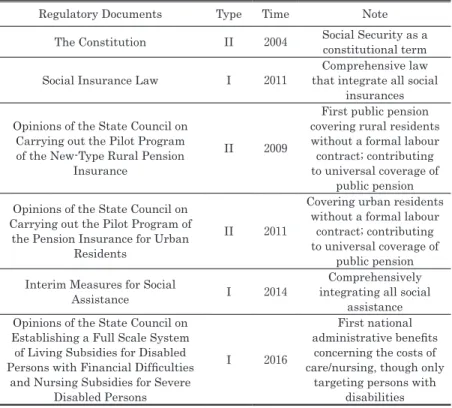
Table 1 Examples of 2 types of reinforcement of social security laws (2000-2016)
Regulatory Documents Type Time Note
The Constitution II 2004 Social Security as a constitutional term
Social Insurance Law I 2011
Comprehensive law that integrate all social
insurances Opinions of the State Council on
Carrying out the Pilot Program of the New-Type Rural Pension
Insurance
II 2009
First public pension covering rural residents without a formal labour contract; contributing to universal coverage of
public pension Opinions of the State Council on
Carrying out the Pilot Program of the Pension Insurance for Urban
Residents
II 2011
Covering urban residents without a formal labour
contract; contributing to universal coverage of
public pension Interim Measures for Social
Assistance I 2014
Comprehensively integrating all social
assistance Opinions of the State Council on
Establishing a Full Scale System of Living Subsidies for Disabled Persons with Financial Difficulties
and Nursing Subsidies for Severe Disabled Persons
I 2016
First national administrative benefits
concerning the costs of care/nursing, though only
targeting persons with
disabilities
Source: author compiled based on the related regulatory documents.
Type I and Type II in table 1 below indicate whether the specific regulatory document/ related clause was upgraded with higher legal validity
(Type I
)or newly established
(Type II
). The reinforcements of Type I meant more rights were created in the sense of statutory laws or policies written on paper, while those of Type II meant former pilot program or regional policies have been confirmed, enacted and protected by regulatory documents with higher legal validity, and thus with higher degree of stability and anticipation of social security rights. Generally speaking, the reinforced system of social security law has contributed in the protection of rights in the sense of universality and stability.
2.1 Reinforcements by increasing the degree of universality of social security rights
In terms of universality, traditionally the social insurance was designed mainly for employees in urban areas with formal labour contract after the Reform and Opening led by DENG Xiaoping since late 1970s. For example, it was not until 2009 that the public pension for rural and urban residents without a formal labour contract was introduced by Opinions of the State Council on Carrying out the Pilot Program of the New-Type Rural Pension Insurance in 2009, followed by Opinions of the State Council on Carrying out the Pilot Program of the Pension Insurance for Urban Residents in 2011. The regulatory documents above from the State Council, albeit with relatively low legal validity, fix the loophole in the right of public pension for citizens without a formal labour contract on a legal basis, setting the milestone of universality that social insurance has become available on a legal basis for literally all citizens no matter what the employment status, household registration, income level or residential area of a potential insured-to- be person is.
With larger population covered by the statutory social security system, the
potential of disputes over social security rights increase as well, and thus demand corresponding development in the remedy of social security rights, including the remedy via administrative lawsuit.
2.2 Reinforcements by increasing the degree of stability
By integrating various social insurance projects and social assistance projects, the system of social security rights in China began to step into a new era of unity on a legal basis with higher stability.
ⅶFor example, an administrative regulation is based on the decision by the congress on the empowerment, while the term of empowerment shall not exceed five years, expert as otherwise specified in the decision according to the Legislature Law of China. That means a specific social security right protected by administrative regulatory documents may change or even end at least every 5 years. On the contrary, a law can only be made or amended by the NPC or its standing committee. Hence, by upgrading the legal validity of the system of social security laws, beneficiaries may expect more stable and lasting rights.
Noteworthy is that the reinforcement of the social security laws not only marks a development in the protection of human rights in the legislative sense, but also challenges the judicial remedy of social security rights profoundly. This is because social security rights, after being written into national legal documents, in the form of commodity, cash benefit or service alike, have thus become a lawful claim across the nation provided qualifications of a certain right is matched.
On the contrary, over a long period of time after the Reform and Opening,
social security benefits or services have been considered as a matter of social
policy issue or of pilot program undergoing, where the typical settlement of
related disputes may vary from case to case and from province to province.
ⅷ
Considering the social security rights have been universalized and stabilized by reinforced social security laws, the disputes of a specific social security right shall be put under judicial review as the ultimate remedial method. In addition, among all the judicial remedies of social security rights, administrative and labour disputes are relatively more relevant than criminal and common civil disputes, as the state plays a vital role in either funding the social security system or supervising the operation of the system in China. In this sense, the amendment of the APL, is worth further examining.
In the next chapter, amendments shall be analyzed into two groups: one that has immediate link to social security, and another protect the social security rights in an indirect but especially supportive manner.
3 Optimized Administrative Remedial Rights: Changes on Paper 3.1 The development of the APL
Relatively speaking, the APL is the youngest made and least often amended
procedure law in the People
’s Republic of China. In comparison to the APL, the
Criminal Procedure Law of the PRC was created much earlier in 1979, while the
Civil Procedure Law
(Tentative
)was made in 1982. As shown in table 2, it was
not until 1989 that the APL was created by the Second Session of the Seventh
National People
’s Congress, without any amendment for as long as 25 years, while
its civil and criminal counterparts have already experienced two amendments
respectively in the same period. On November 1
st, 2014, the National People
’s
Congress passed the first amendment of the APL, which has been enacted since
the 1st May, 2015.
Long before the APL created, it was regulated in a few laws in an isolated manner that some administrative lawsuits could be filed to the court. Nevertheless, the systematic procedure of the administrative suitcase dated back to 1982 when the CPL
(Tentative
)was passed, clarifying that any administrative suitcase enumerated by law should follow the CPL
(Tentative
).
ⅸThus, it is universally acknowledged that the APL was enlightened by and drawn lessons from the CPL.
X3.2 The Direct Improvements Concerning the Remedy of Social Security Rights
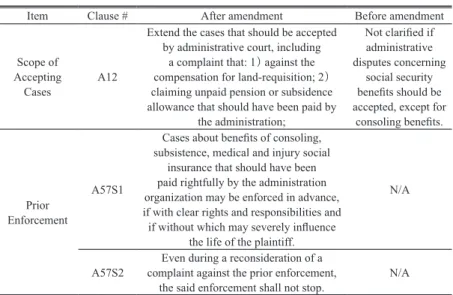
Table 3 demonstrates the major changes on the TPL that directly affect social security rights. The new APL optimized the protection of social security rights by clarifying the scope of accepting cases in an enumerated manner for the first time. In comparison, before the amendment only complaints against the consoling benefits, one of the social security benefits mainly aiming at the military service that should have been rightfully paid by the administrative organization was listed.
Another equally significant aspect directly related to the protection of social security rights is the complaints against the compensation of the land-requisition.
Several administrative regulatory by the central government have required that the fund for compensating the land requisitioned from farmers must be reserved before any requisition, and that a reasonable proportion of the compensation Table 2 Comparison of creation and amendment(s) of procedure laws in China
Created Date Date of Amendment ( s )
Criminal Procedure Law 1979.07.01 1996.03.17
2012.03.14 Civil Procedure Law 1982.10.01 ( Tentative ) 2007.10.28
1991.04.09 2012.08.31
The Administrative Law 1989.04.04 2014.11.01
Source: author compiled.
aforementioned should be used to cover the farmers into social security systems such as public pension, social medical insurance, etc.
xiHowever, the compensation for the land requisition from the farmers, as discussed pervasively by numerous literature, has been an area not without numerous disputes between the administration and the farmers.
xii
Lastly, the prior enforcement has been introduced to cover the disputed concerning social security benefits under some circumstances in Article 57. This is an advancement in the protection of social security rights because of the nature of social security, i.e. to provide with public financial supports or services for the people in need. Even though the prior enforcement is limited to cases with clear facts, it offers the opportunity to the court to rule in favour of the plaintiff
Table 3 Direct changes of the APL concerning social security rights
Item Clause # After amendment Before amendment
Scope of Accepting
Cases A12
Extend the cases that should be accepted by administrative court, including
a complaint that: 1) against the compensation for land-requisition; 2) claiming unpaid pension or subsidence allowance that should have been paid by
the administration;
Not clarified if administrative disputes concerning
social security benefits should be accepted, except for
consoling benefits.
Prior Enforcement
A57S1
Cases about benefits of consoling, subsistence, medical and injury social
insurance that should have been paid rightfully by the administration organization may be enforced in advance, if with clear rights and responsibilities and if without which may severely influence
the life of the plaintiff.
N/A
A57S2 Even during a reconsideration of a complaint against the prior enforcement,
the said enforcement shall not stop. N/A Source: author compiled based on the amendment of the APL.
Note: A#S# refers to Article # Section # of the new law; the previous law with
corresponding clause, if applicable, may be in different article or section. Other
tables in this article also apply.
under the emergency before the chores of paper works fully done. Also, the right to complaints via reconsideration for the related administration organization is reserved but limited to once. However, according to the new APL, during the reconsideration the prior enforcement remain effective, which prevents any possible harassment mainly from the administrative organization to the administrative counterpart.
3.3 Other supportive Amendments for the remedy of social security rights Table 4 Changes Underpinning the remedy of social security rights
Item # After amendment Before
amendment
Admini- strative
Contractor A 2 S 2
Extend the subjects of
“ administrative action ” to organization empowered
by a law, regulation or rule.
Not clarified if empowered
organization could make
“ administrative action ”
Judicial Indepen-
dence
Appearance of the Admini- strative in Court
A 3 S 3
The person in charge of an administrative organization against a complaint should appear in court to respond to the complaint, or, if he or she is unable to, authorize a relevant employee of the organization to appear in
court.
The person in charge of an administrative
organization appears as respondent is not
required.
Jurisdiction across Admini- strative Regions
A 18 - S 1
Case after administrative reconsideration may be sent to court where the reconsideration taken place as long as the case
has been reconsidered.
Applicable only when the original
administrative action is changed by reconsideration
A 18 - S 2
Local people's courts may be determined to have jurisdiction over administrative cases across administrative
regions.
N/A
(Continued on the next page)
The relevant amendments are threefold: the increasing trend of the utilization of administrative contract in the governance of social security, the under-integrated governance of social security system and the path-dependency of empowerment in social security law.
Just as shown in table
4above there are
3dimensions of changes in the new APL that strengthen the judicial remedy of administrative disputes that concern social security rights. With the welfare pluralism progressing across the world,
xiiithe providers of social security diverse from the status of state-monopoly to multiple sectors including NPO and NGO, also known in China as the socialization of welfare.
xiv
Thus, the extended definition of
“administrative action
”offers a broader scope where liabilities or disputed actions by non-administrative organization
(or administrative contractors
), if the action related to the provision of social
Item # After amendment Before
amendment
Judicial Review Regulatory on Documents
A 53 - S 1
A judicial review on the regulatory document, on which an administrative
is based, may be required at the same time a complaint against
the claimed illegal administrative action.
N/A
A 64
If the court find the regulatory document mentioned in A 53 illegal,
suggestions shall be put forward to the organization that makes
the documents.
N/A
Change the term
“ specific administrative action” in this law into
“administrative action”.
N/A
Source: author compiled based on the amendment of the APL.
security is empowered by listed regulatory documents, would be put under the judicial examination of the APL. This amendment in the APL matches the trend of the increasing involvement of administrative contract in the delivery of social security, especially in the field of social welfare services, public health and the investment of social security fund, the fields where professionalism dominates.
xv
Another supportive amendment is the enhancement of the independence of judicial power by two means: the appearance of the administrative leader or employee in court and the jurisdiction across the administrative region. Firstly, it is demanded that the representative of the administrative organization, preferably the leader of the organization as the representative of the legal person, should appear as defendants. Moreover, it matters not only for confirming the equality between the administrative organization and the administrative counterpart by the presence of both sides, but also for creating a platform where both sides of disputes could have a better understanding of the nature of unsatisfying results or conflicting opinions. As mentioned above, the modern social security has stepped into an era where more and more professionalism may involve, so the appearance of the leaders
(or designated personnel
)of the administrative organization shall contribute to further explaining the operation in a way that judicial professionals alone may not interpret competently. This may in turn improve the governance of social security in the long run, as the court might become an open realm where citizen with claimed damaged rights from legislature may confront the administration as policy enforcer, and examine the justifiability and feasibility of social security rights and responsibilities in detail.
The second improvement contributing to the higher judicial independence is the
jurisdiction across administrative region. The amendment matters because of the
under-development in the infrastructure, the administrative operation mechanism
as well as legislature concerning social security. For example, even though the national pooling of the public pension has been written into the Social Insurance Law,
xvithe status quo is that most of the pension funds are pooled at provincial or even municipal level. The under-integrated managerial mechanism not only increases the cost of management when citizens move or change the work across the pooling region, but also making judicial protection more difficult if the original administrative action was made by the organization in other provinces. The new APL has empowered the court where the administrative reconsideration happens, and empowered the people
’s higher court to designate the local court to rule administrative cases across the region after the consent of the People
’s Supreme Court.
xviiThis change will not only increase the efficiency of ruling when cases across the administrative region happen, but also offer a more strict supervision on the administration under the background of the over-powerful administration v.s. judicial remedy,
xviiiby reducing the influence from the local government to the local court.
Lastly, the new APL also lifted the ban on the judicial review on regulatory documents. This change is significant for social security because over a period of time the social security system in China has been based on policies by the government rather than on laws made by the congress. Even though the social security laws have been reinforced just as Chapter 2 summarized, the influence of the path-dependency
xixstill exists that the social security rights were mostly based on regulatory documents with relatively low legal validity. Unfortunately, it has been widely known in China that the regulatory documents, also known as abstract administrative action, are nostly not included in accepting case the administrative judicial review.
The division of abstract v.s. specific administration action is not written in the
law of China, with only the notion of specific administrative action written in the old APL. In the new law, the notion
“specific administrative action
”is replaced with
“administrative action
”, and the judicial review on the justifiability on the regulatory documents with low legal validity is also empowered to the court, which will play a vital part in the governance of social security.
4 Conclusion and Discussion
This paper analyze the new and old APL that shall have improvements on the judicial remedy of social security rights in theory, and summarize several achievements, including the extended scope of accepting case, the prior enforcement of necessary case concerning the benefit of minimum subsistence, social insurance etc, and other supportive amendments for the remedy of social security rights. In general, the optimization of administrative judicial remedy is mainly aiming at social insurance benefits and social assistance benefits. However, there is not without deficiency about the new APL that would be well-advised to address as the direction to furthering the improvements as follows:
Article 12 defines the scope of the accepting case about social security rights by listing, including social insurance, minimum subsistence allowance and consoling benefits, while social welfare and other social assistance projects have not yet been included even some these projects might still run and funded by the state.
With the development of the social security system and laws, more social security projects would be introduced with clearer legal definition. Thus, when defining the scope of accepting case, ruling out some specific type of case, rather than listing them, may be better in the next amendment.
Also, the current amendment only lists the complaint against the social
security benefits as accepting case, while other responsibilities or action from the administration such as information and notification are understated. Nevertheless the right to information and notification in social security is vital, as it serves the purpose of sufficient understanding and governance in the whole social security system. As the under-notification or misinformation has caused several cases of tragedy nationwide, the legal responsibility of faults in notification and information by the administration should be further clarified and put under the scope of administrative judicial remedy.
The judicial review on the justifiabiliby of the regulatory documents is limited.
According to Article 2, Section 2, only organization empowered by regulatory documents with the legal validity of at least administrative or local rules can be regarded as qualified organization to make
“administrative action
”concerning social security. Thus, when NPOs or NGOs cooperate with governments such as at district level would not be regarded as administrative contractor in the context of judicial remedy of citizens
’social security rights. Also, even after the court found the regulatory documents illegal, the documents can only be sent to the legislature without further procedural regulation. This would be frustrated to people in need expecting the final result of the disputes. Thus, the procedure of the judicial review on regulatory documents should be specified, though not necessarily in the APL.
Appendix: Translation of the Related Terms Terms in Chinese Terms in English
行政诉讼法 Administrative Procedure Law 民事诉讼法 Civil Procedure Law
复议
reconsideration
规范性文件
regulatory document(s) 行政 \ 地方法规 administrative\local regulation 行政 \ 地方规章 administrative\local rule
最低生活保障 Subsistence Security Allowance
ⅰ CAI Zehao is currently a Nagoya-based doctoral student at the faculty of China Study of Aichi University, Japan. He is also a Ph.D candidate at Renmin University of China. Any comment on this paper is welcome via the following email: [email protected].
ⅱ On the role of social security in modern society, see: 郑功成. 社会保障 : 和谐社会的基本制 度保障[J]. 法学家, 2005, 5: 6-11.
ⅲ On the relation between the two types of justice, see: Palmer E. Judicial review, socio- economic rights and the Human Rights Act[M]. Bloomsbury Publishing, 2007; Tyler T R, Boeckmann R J, Smith H J, et al. Social justice in a diverse society[M]. Westview Press, 1997. Evidence-based discussion see: Folger R, Konovsky M A. Effects of procedural and distributive justice on reactions to pay raise decisions[J]. Academy of Management journal, 1989, 32(1): 115-130.
ⅳ See: 龚向和,
邓炜辉. 当代中国社会保障权之可诉性透视─基于《人民法院案例选》(1992 ~2010) 的文本分析 [J]. 河北法学 ,2012,03:9-15. Also see: 钟会兵,李龙. 社会保障
权可诉性分析:背景、规范与实践[J]. 武汉大学学报( 哲学社会科学版 ),2009,06:761-767.
ⅴ See: 尹乃春 . 论社会保障司法救济的构建与完善 [J]. 经济体制改革,2007,05:149-152.
ⅵ In the context of legal validity, regulatory documents in China include the Constitution, law, judicial interpretation ( by the People ’ s Supreme Court ) , administrative regulation ( by the State Council), local regulation (by the People’ s Congress of provincial and designated areas, etc), departmental rules (by departments of the State Council, etc) and local rules (by the governments of the provincial and designated res).
ⅶ One example is that in Chapter 2 of the Interim Measures for Social Assistance, the subsistence security allowance is no longer divided into rural and urban allowance. Another one is that in 2014, Opinions of the State Council on Establishing a Unified Basic Pension Insurance System for Urban and Rural Residents in 2014 has ended any difference in the public pension benefits for residents, in rural areas or in urban areas alike, in the same pooling region.
ⅷ For example, the first official document refers to the new-type rural medical insurance is a policy decision jointly made by the Communist Party of China and the State Council in 2002.
In this document, only some basic principle and time table concerning the medical insurance were made, leaving the provincial and other local areas with high autonomy.
ⅸ Article 3, Section 2.
ⅹ 湛中乐 . 《行政诉讼法》 的 “变革” 与 “踟蹰” [J]. 法学杂志 , 2015, 36 ( 3 ) : 23-33.
ⅺ E.g. No. 29 of the Office of the State Council (2006), and No. 14 of the Ministry of Labour
and Social Security (2007), etc.
xii Recent typical evidence-based discussion about the disputes of land requisition include: 仇大