Enhancing Learning Management Systems
by using Learning Styles
By
Pitigala Liyanage Madura Prabhani
A dissertation submitted in partial fulfillment
of the requirements for the
Degree of Doctor of Engineering
In the
Interdisciplinary Graduate School of Science
and Engineering
of
Shimane University
Japan
Declaration
I hereby certify that this dissertation entitled “Enhancing Learning Management Systems by using Learning Styles” is entirely my own work. Wherever other sources of information have been used, they have been acknowledged.
This dissertation has not been accepted for any degree and is not being submitted for any other degree.
Pitigala Liyanage Madura Prabhani Signature :
Acknowledgements
I dedicate my first sentence to offer my sincere gratitude to my supervisor, Professor Masahito Hirakawa for accepting me as a student in Shimane University. His accepting me as a student in his laboratory was a clear pathway to progress on my research work. Sensei’s direct supervision, encouragement assisted me to continue my research work and reach the necessary competent level of research. His research outlook attributions were a generous mentoring to me. His guiding the research process gave me sufficient encouragement to achieve the desired objectives.
As my first child was born while I was progressing on my research study, balancing research with child care was itself a challenge. This challenge was met by my own imitativeness with the confidence gained by Sensei’s support and My family supportive roles to keep me focused and motivated.
The academic staff members of the Department of Mathematics and Computer Science at Shimane University deserve recognition for their advice. Especially Prof. Yamada’s advice on Data Mining was helpful to structure the research at its initial stage. My lab members at Hirakawa Lab should receive special thanks for their friendship and assistance for research work. The staff of the International Student Section of Shimane University assisted me in numerous occasions, and I am indebted to them.
As I was a privately funded student, the generous scholarships I received from the Kunibiki Foundation in 2013/14 and Japan Student Services Organization (JASSO) in 2014/15 helped me immensely. I pay very special gratitude for these two organizations for selecting me and granting me the scholarship funding.
The pilot dataset used in this research was obtained with permission from a Learning Management System installed at Siksil Institute of Business and Technology, Sri Lanka. I thank the Chairman and the staff for this assistance. The main datasets used in this research were obtained with permission from a Learning Management System used at the Department of Information Technology, University of Sri Jayewardenepura, Sri Lanka. I extend my sincere thanks to the Academic Staff of the Department of Information Technology and Staff of the Information Technology Resource Centre for their assistance.
For evaluating the content recommendation module, I utilized a course conducted by My Sensei, Professor Masahito Hirakawa. My thanks again for Sensei and the students of the course for their cooperation and assistance.
assistance provided by the Vice Chancellor, Dean of the Faculty of Management Studies & Commerce, and Coordinator, Information Technology Resource Centre (ITRC) in granting me leave, as well as my colleagues at the ITRC for covering up my duties during my absence gratefully.
I am indeed indebted to my family for the continuous support provided through my entire life. Both my parents dedicated themselves to put me onto a firm education foundation as a dream of their own. I bow my head in deep respect for them in my own Buddhist way. I’m indeed fortunate to be with my loving husband – Lasith, who has been truly a limelight. He guided me through multiple roles to enhance my quality of education and life while taking care of our loving daughter Senuli, in the midst of his research work as well.
Abstract
This thesis investigates how Learning Management Systems (LMSs) can be enhanced by using learning styles of learners. The cost of computing devices and connectivity to the Internet has seen a gradual fall throughout the years. This cost decline has resulted in increase in the number of individuals who own computing devices including smartphones. Ubiquitous computing is a term that can be applied to the present day. Educational establishments around the world are realizing the need to extend learning beyond the classroom using technology. LMSs are often the choice of e-learning systems in the endeavor to create virtual classrooms.
It has been nearly 15 years since the first LMSs appeared on the market. While the number of LMS implementations and their users are on the rise, they have not been universally accepted as providing ultimate solutions to educational needs. Some researchers attribute this reason to the approach of presenting the same educational content for all learners of a course irrespective of learner differences as an unresolved limitation of LMSs. Among learner differences, learning styles have been researched extensively. Educational theorists have forwarded a number of models to explain the learning preferences of learners. Recently research investigating the applicability of learning styles to computer-based learning environments has been trending.
The literature survey attempted to review the research and techniques to evaluate the current state, limitations and trends in LMS. One observation from the existing research is the popularity of Moodle – an open source LMS. In the investigation of learning style models, similarities between them, as well as common criticisms are found. The Felder-Silverman Learning Style Model (FSLSM) is one of the most cited models with respect to e-learning and is the chosen e-learning style model for this research. Several researchers have investigated how to identify learning styles of learners in an LMS and provide a mapping between learner activity in an LMS and learning styles. The methods adopted include questionnaire type instruments as well as automatic detection of learning styles. Automatic detection of learning styles requires close monitoring of the student activities. Analyzing student activities using the database log is one of the most frequently used methods. A data mining software tool can help to extract user patterns from log data.
A significant contribution of this research is to present a framework for a learning management system that provides personalized learning material recommendations using the automatically detected learner’s learning styles. The framework contains modules for automatically detecting learners learning styles, storing individual profiles and
recommending content based on their learning styles. Recommendations are provided initially using a mapping we introduce between different types of content and learning styles to avoid the “cold start” problem. Later the collaborative filtering technique using the k-nearest neighbor algorithm is used for recommendations.
Little study on the awareness of learners to the concept of learning styles, and a relationship of a learner’s learning style to others has been done in existing research. The learning style visualization introduced in this research is aimed at filling this void. A learning style map is developed which vizualizes eight learning preference characteristics corresponding to eight preferences of the FSLSM. This visualization is a unique and valuable contribution to this research, and can even be used by instructors in their aim to understand learners better, as well as structure their content according to the learners.
The research contributions do not limit to theory. The proposed framework can be seamlessly integrated into the Moodle LMS. This research will benefit future researchers who wish to conduct further research on learning style integration into an LMS. Technical implementation details, including database modifications, software development, and API configuration for data mining are further mentioned. The open source software Weka is chosen as a data mining tool.
The performance of the framework is explained where three datasets are used for the comparison. The results reveal that the J48 Decision Tree Algorithm provides the best performance. A pilot user evaluation carried out to evaluate the learning material recommendation performance shows a satisfactory results.
This approach can be applied not only for the selected Moodle LMS but other LMSs, as they would have the same artchitecture whereby user activities are logged in a database. Therefore, the research has positive implications, for e-learning systems in general. Limitations of the framework and the developed system are also discussed. The study concludes by providing insight into further research directions emerging out of this study.
List of Figures
Figure 2-1. Moodle LMS Homepage at Shimane University (CERD) ... 9
Figure 2-2. The ADDIE model ... 12
Figure 2-3. Kolb's Cycle (First Level) ... 18
Figure 2-4. Kolb's Cycle (Second Level) ... 19
Figure 2-5. Weka GUI ... 29
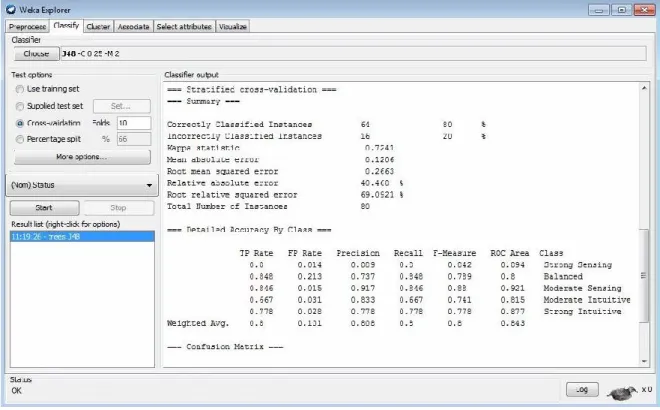
Figure 2-6. Weka classifier output ... 31
Figure 3-1. Framework for enhancing LMS using Learning Styles ... 37
Figure 3-2. Introduction to Information Technology course ... 38
Figure 3-3. Human Computer Interaction course ... 39
Figure 3-4. Experimental Moodle Installation ... 40
Figure 3-5. Adding learning material of different types ... 41
Figure 3-6. Index of Learning Styles Questionnaire on LMS ... 42
Figure 3-7. Learning styles estimated using ILS questionnaire ... 43
Figure 3-8. Simple Rule based LPE ... 44
Figure 3-9. J48 Decision Tree LPE ... 47
Figure 3-10. Individual Learning Style Map ... 49
Figure 3-11. Group learning map for learner’s use ... 50
Figure 3-12. Group learning map for instructor use ... 51
Figure 3-13. Threshold configurations ... 52
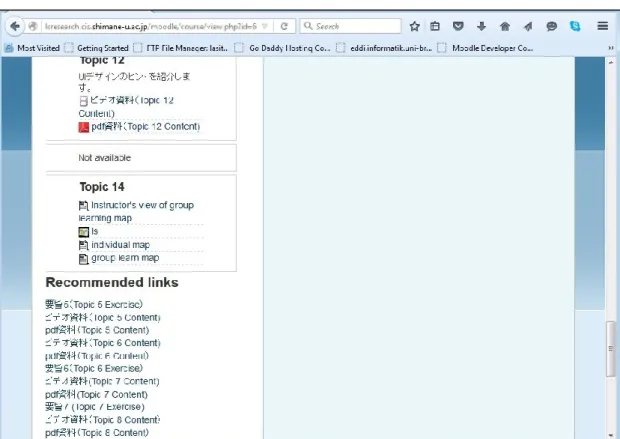
Figure 3-14. LOs recommending AIA... 58
Figure 4-1. A result of the question 1: The learning materials recommended to me via links matched my learning preference. ... 65
Figure 4-3. A result of the question 3: The recommendation I received better fits my learning preference than what I may receive from a friend. ... 66
Figure 4-2. A result of the question 2: I am not interested in the links recommended to me ... 66
Figure 4-5. A result of the question 5: The recommendations are timely. ... 67
Figure 4-4. A result of the question 4: A recommendation from my friends better suits my learning preference than the recommendation from this system. ... 67
Figure 4-7. A result of the question 7: I became familiar with the recommender system very quickly. ... 68
Figure 4-6. A result of the question 6: The layout of the recommender system interface is attractive and adequate. ... 68 Figure 4-8. A result of the question 8: I found it easy to tell the system about my learning preferences. (By Using Questionnaire) ... 69 Figure 4-9. A result of the question 9: Finding the learning materials to learn with the help of the recommender is easy. ... 69 Figure 4-10. A result of the question 10: Finding learning materials to learn, even with the help of the recommender system, consume too much time. ... 70 Figure 4-11. A result of the question 11: The recommender system effectively helped me find the ideal learning materials. ... 70 Figure 4-12. A result of the question 12: I feel supported to find what I like with the help of the recommender system. ... 71 Figure 4-13. A result of the question 13: I understood why the links were recommended to me. ... 71 Figure 4-14. A result of the question 14: Overall, I am satisfied with the recommender system. ... 72 Figure 4-15. A result of the question 15: The recommender system can be trusted. ... 72 Figure 4-16. A result of the question 16: If a recommender such as this exists, I will use it to find the learning materials to learn. ... 73 Figure 4-17. A result of the question 17: I will use this type of recommender system frequently. ... 73
List of Tables
Table 2.1. Coffield’s Families of Learning Styles ... 15
Table 2.2. Kolb's Learning Styles in a 2 x 2 Matrix ... 19
Table 2.3. Mapping online behavior for FSLSM ... 26
Table 2.4. Confusion Matrix for two class variable ... 32
Table 3.1. Sample scores (RAVG) obtained for each learning style ... 46
Table 3.2. Classification of learning styles on the basis of user preference ... 46
Table 3.3. Sample data pertaining to a single student used in the training dataset. ... 46
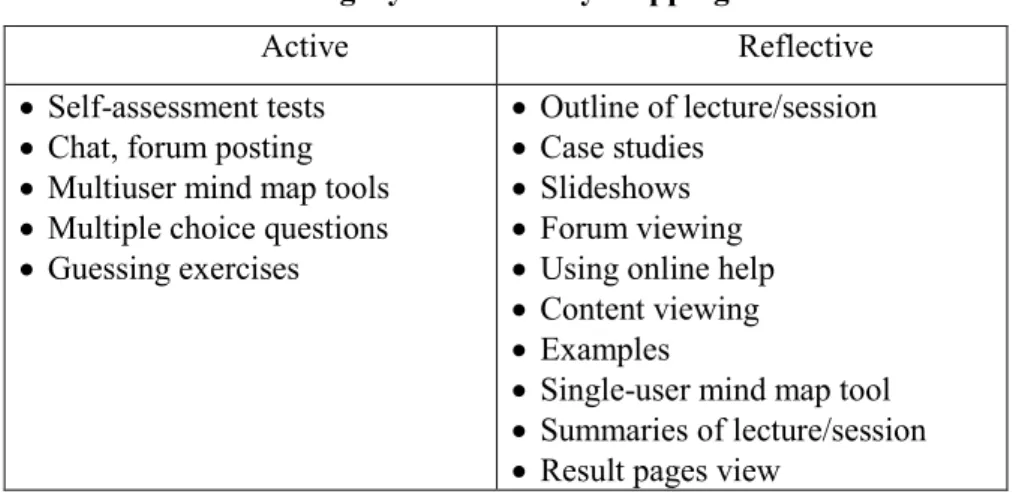
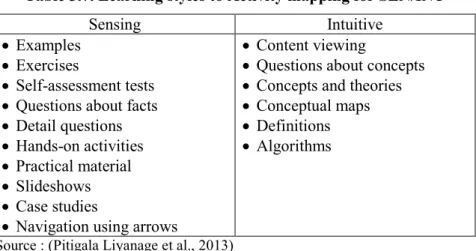
Table 3.4. Learning styles to Activity mapping for ACT/REF ... 53
Table 3.6. Learning styles to Activity mapping for VIS/VER ... 54
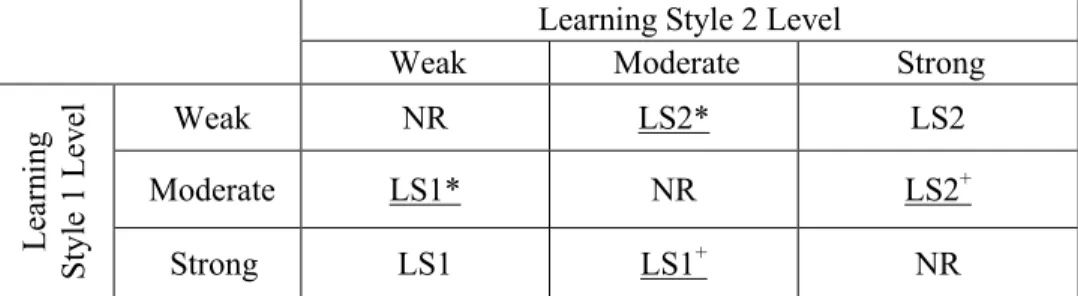
Table 3.8. Recommendation matrix for a given learning style dimension i ... 55
Table 3.9. Extract from mdl_training_ibk table ... 56
Table 3.11.Extract from mdl_cfresults table ... 57
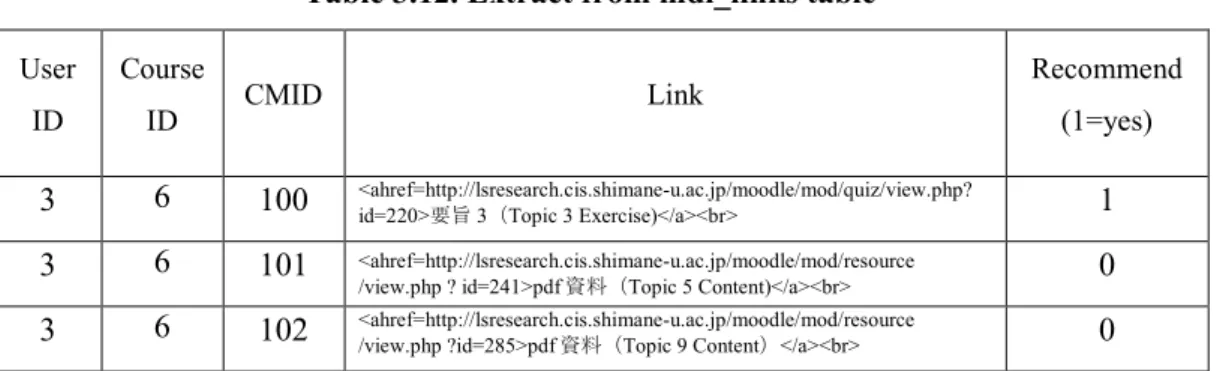
Table 3.12. Extract from mdl_links table ... 57
Table 4.1. Performance in ACT/REF dimension ... 61
Table 4.3. Performance in SEQ/GLO dimension ... 62
Abbreviations
1. MOOC – Massive Open Online Courses2. LMS – Learning Management System
3. MOODLE – Modular Object–Oriented Developmental Learning Environment 4. CBT – Computer Based Training
5. LCMS – Learning Content Management Systems 6. CMS – Content Management System
7. VLE – Virtual Learning Environment
8. SCORM – Sharable Content Object Reference Model 9. MBTI – Myers–Briggs Type Indicator
10. FSLSM – Felder–Silverman Learning Style Model 11. ILS – Index of Learning Styles (Questionnaire) 12. API – Application Program Interface
13. LO – Learning Object
14. ADDIE – Analysis, Design, Development, Implementation, Evaluation 15. LSQ – Learning Styles Questionnaire
16. ACT – Active (preference in FLSLM) 17. REF – Reflective (preference in FLSLM) 18. SEN – Sensory (preference in FLSLM) 19. INT – Intuitive (preference in FLSLM) 20. VIS – Visual (preference in FLSLM) 21. VER – Verbal (preference in FLSLM)
22. WEKA – Waikato Environment for Knowledge Analysis 23. ARFF – Attribute–Relation File Format
24. k–NN – k Nearest Neighbor
25. LLA – Learning Syle Monitoring and Learning Profile Creation Agent 26. LPE – Learning Preference Estimator
27. AIA – Adaptive Content Presentation and Interface Enhancement Agent (AIA) 28. ERA – Expert Recommendation Agent
Table of Contents
Declaration ... i
Acknowledgements ... ii
Abstract ... iv
List of Figures ... vi
List of Tables ...viii
Abbreviations ... ix
Table of Contents ... x
1. Introduction ... 1
1.1 Background of the Research ... 1
1.2 Research Objectives and Scope ... 3
1.3 Thesis Contributions ... 4
1.3.1 Thesis contributions to theory ... 4
1.3.2 Thesis contributions to practice ... 4
1.4 Thesis Organization ... 5
2. Background and Related Work ... 6
2.1 E-learning ... 6
2.2 Learning Management Systems ... 7
2.2.1 General trend ... 7
2.2.2 Moodle ... 8
2.2.3 Limitations of existing Learning Management Systems ... 10
2.3 Adaptive Learning Management Systems ... 10
2.4 The Content Creation Process for Learning Management Systems ... 11
2.4.1 Instruction design ... 11
2.4.2 Creating re-usable content for Learning Management Systems... 13
2.4.3 Learning objects ... 13
2.5 Learning Styles ... 14
2.5.1 Myers-Briggs type indicator ... 16
2.5.2 Dunn and Dunn learning style model ... 16
2.5.3 Kolb’s learning style model ... 17
2.5.4 Honey and Mumford learning style model ... 19
2.5.6 Felder and Silverman learning styles model ... 20
2.6 Relevance and Criticisms of Learning Styles ... 22
2.7 Use of Learning Styles in e-learning ... 23
2.8 Detection of Learning Styles in Learning Management Systems ... 24
2.8.1 Educational data mining ... 27
2.8.2 Tool for data mining ... 28
2.8.2.1 Attribute-Relation file format ... 29
2.8.2.2 Using Weka API ... 30
2.8.2.3 Performance measures ... 31
2.9 Personalizing Learning ... 33
2.9.1 Recommender systems ... 33
2.9.2 Recommender systems in e-learning ... 34
2.9.3 Evaluating recommender systems ... 35
2.10 Summary ... 35
3. System Design & Architecture ... 37
3.1 System Overview ... 37
3.2 Content Preparation ... 38
3.3 Content Deployment ... 40
3.4 System Functionality ... 41
3.4.1 LLA module ... 41
3.4.1.1 ILS questionnaire sub-module ... 42
3.4.1.2 Learning preference estimator sub-module ... 43
3.4.1.2.1 Simple rule-based LPE... 44
3.4.1.2.2 Data mining algorithm - based LPE ... 46
3.4.1.3 Learning style maps ... 48
3.4.1.3.1 Individual learning style map ... 48
3.4.1.3.2 Group learning styles maps ... 49
3.4.2 ERA module ... 52
3.4.3 AIA module ... 53
3.4.3.1 Using static mapping of content ... 53
3.4.3.2 Using collaborative filtering approach ... 55
3.5 Summary ... 59
4.2 LLA Functionality Evaluation ... 62
4.3 User-Centric Feedback for AIA ... 64
4.3.1 Experiment setup ... 64 4.3.2 Evaluation procedure ... 64 4.3.3 Results ... 65 4.4 Summary ... 74 5. Conclusion ... 75 5.1 Summary of Findings ... 75 5.2 Limitations ... 75 5.3 Future Work ... 77 References ... 79 Appendices ... 86
Appendix A – ILS Questionnaire ... 86
Appendix B – Japanese translation of the ILS Questionnaire ... 90
Appendix C – Summary of ILS Questionnaire results for each Dataset ... 98
Appendix D – Content recommender system user evaluation questionnaire ... 102
Appendix E – Moodle database tables used for learning style detection and recommending LOs ... 105
Chapter 1
1.
Introduction
1.1 Background of the Research
Universal access to education – the ability for every human being to have equal opportunity in education is considered a right in almost all countries. Achieving universal primary education is one of the millennium development goals adopted in the United Nations Millennium Declaration in September 2000. Yet as the target year of 2015 arrives, the goals are yet to be completely achieved.
Soon after humans learned to write, and scripts were used, recording information for the educational purpose was born. With time, this progressed to be more systematic, and study places or schools were established. The use of books created using printing presses dates back to the 15th century. Since then books have been a cornerstone in the propagation of knowledge. Learning is the process of obtaining knowledge and skill. Learning in a formal setup relied on student learners (Hereinafter, this thesis will use the term “learner” to refer to students), teachers (Hereinafter, this thesis will use the term “instructor” to refer to teachers), classrooms, writing boards, books, pens, pencils and paper.
The advent of technology has changed the classroom landscape dramatically within the last fifty years. Electronic devices such as microphones and speakers were initially used as aids for instructors. The terminology “distance learning” which was originally used for mail-order correspondence courses expanded with the use of radio and television which provided new mediums to expand as well as aid the classroom. The advent of the computer was the next “game changer”. Multimedia personal computers provided learners with the ability to experience audio and visual material – a feature unavailable in books. In fact, educational books in this age supplemented the printed material with compact disks (CD) which had supplemental information, Audio and video where relevant. Self-learning by way of such CDs was also a concept born during this era.
The landscape of learning was further transformed with the advent of the Internet. The physical distance barrier was made irrelevant, as access to learning
materials wherever in the world was only limited by data connectivity bandwidth. And while new technologies for communication have enabled higher bandwidth connections connectivity costs have been plummeting. E-learning or electronic learning as we know of today was born under these circumstances.
In the traditional education model, disparity was often discussed as a problem. When the access to education is costly, by way of tuition fees, study material, and other ancillary costs, students coming from families living close to or below a poverty line have limited options. This is especially true for higher education. This in turn, affects the student’s skills, knowledge and qualifications, which have a strong connection to their occupational prospects. A worker with low knowledge, skills and qualifications in return gets only a limited salary. A vicious cycle is created when such workers have families, as they may border the poverty line.
Schools and more popularly universities embraced e-learning as a means to defeat this educational disparity. Further, e-learning can enable global classrooms to be created. As a result, Massive Open Online Courses (MOOCs) in, for example, Stanford University1 and Harvard – MIT collaboration Edx2 have attracted hundreds of thousands of learners. Yet the technology is not limited to these institutions as business organizations are also introducing the same technologies for cost-effective employee training and customer support.
While MOOCs are a relative new addition, the most commonly used software platform which enabled e-learning is known as Learning Management System (LMS). Many different vendors have developed LMS software, with varying degree of features. Modular Object Oriented Developmental Learning Environment (Moodle)(“Moodle Learning Platform,” 2015) is one of the most popular LMSs in use today with over 64,000 sites in 220 countries combining for a total of 79 million users.
This popularity stems possibly due to several key factors. Most commercial learning software is licensed on a per user basis, and enterprise license costs are extremely high. Moodle, on the other hand, is an open source product, and as such is available at no cost. The Moodle LMS has been developed with opportunities for third
party plugins, and this has enabled its functionality to be enhanced by software developers.
The content which is stored on an LMS has to be developed with the learner in mind. In most of the time, however, courses hosted on LMS’s tend to be offered in the same format for all learners of the course, irrespective of learner differences. The learner differences can occur due to numerous factors such as prior knowledge, analytical and cognitive abilities and capacities, motivation, etc. This single format offering has been identified as a limitation of LMS implementations, irrespective of whether commercial or open sourced (Sabine Graf & List, 2005).
When a user accesses the Internet in the present age and searches for products or services on an online shopping site, the experience is enhanced due to the availability of recommendation systems. They enable the shopper to get personalized recommendations. This scheme can be extended even for online learners. Personalizing the learning experience to suit the learner has been one of the sought after features in an e-learning environment in recent years. This personalization can be tried out using explicit information elicited from the learners such as by way of a questionnaire or by automatically modeling the users based on his/her actions performed in the LMS. The personalization strategy can be based on different dynamics. Using learning style preferences is one of them. A learner following a course may have a preferred way of learning which is exhibited by his attitudes and behaviors (Honey & Mumford, 1992) which can be identified as a “learning style.”
1.2 Research Objectives and Scope
This thesis investigates how learning styles can be used to enhance LMSs. The main topic of this dissertation is detecting learning styles of learners in LMSs and the main research question is:
How can we enhance LMS using learning styles?
This research question formed the foundation for a set of aims and objectives upon which this dissertation is based. These are to:
1. Evaluate existing models of learning styles and select which of them can be applied for LMSs based learning environment.
3. Verify the predicted learning styles using an alternate approach.
4. Visualize each learner’s learning style to enable the learners to get a better understanding of learning styles.
5. Visualize the learning styles of groups of learners to enable an instructor to get a condensed view of their learning styles.
6. Recommend content for learners using the selected approach and evaluate its effectiveness.
1.3 Thesis Contributions
This section elaborates on the contributions made by this research, which can be separated in terms of contributions to theory and practice.
1.3.1 Thesis contributions to theory
While there are many different learning style models, there has been limited comparison of the models, and especially their applicability to computing environments. This research has compiled a comprehensive literature survey of previous research and summarizes its suitability for e-learning.
The research introduces a framework which analyses learner behavior in an LMS and recommends content based on the learning styles. While this concept has been touched in brief by several previous researchers, this research describes the entire process involved, including exploring its effectiveness.
One of the unique contributions of this research is a scheme to visualize the learning styles of a learner. No previous researcher has documented any efforts to visualize learning styles.
1.3.2 Thesis contributions to practice
The learning style visualization model introduced in section 3.4.1.3 can be used not only to visualize the learning styles of a learner. This scheme can further be used to compare groups of learners against an individual learner, as well as analyze learning styles of learners in a classroom. This visualization is designed in a way that it can be integrated into an existing Moodle LMS as a module, and this scheme can benefit both learners and instructors. Four learner groups - two from Shimane University, Japan, one from University of Sri Jayewardenepura, Sri Lanka, and one from Siksil Institute of Business and Technology, Sri Lanka with 54, 8, 80 and 22
students respectively, were used for different performance evaluation of the framework and these performance indicators can be used by future researchers in this domain.
1.4 Thesis Organization
Chapter 2 describes a comprehensive bibliographic literature survey carried out to lay the foundation for the research. Several concepts which are at the core of this research are explained in detail. They include characteristics of e-learning, LMSs and more specifically Moodle LMS. Further, the process involved in creating content for LMS delivery is discussed. Learning styles is a core concept, and several learning style models which have been cited are discussed; especially with their relation to learning. Another topic which is explained is data mining, and its applications in e-learning. The Weka data mining tool, which is used within the subsequent few chapters, is also introduced in this chapter. The bibliographic survey focuses on the prior work conducted in LMSs, detection of learning styles in LMS, and content recommendation systems. The chapter further highlights ongoing research topics and provides a foundation for the exploratory study.
In Chapter 3, a framework which analyzes learner behavior in an LMS and recommends content based on the learning styles is presented. The rationale behind each system elements selection is further justified. Modules and sub-modules which comprise the system and their functionality, as well as technical aspects of the software design, are further explained in this chapter.
Chapter 4 describes efforts undertaken to examine the system performance compared with previous research as well as user evaluations and discusses the implications of this system.
Chapter 5 concludes by describing the summary of findings with reference to the environment and discusses limitations of the system and how they can attempt to be resolved. The final section of this chapter elaborates on future research directions.
Chapter 2
2.
Background and Related Work
The literature survey aimed to analyze the existing research carried in related domains, as well as build the necessary background knowledge required for enhancing learning management systems using learning styles.
2.1 E-learning
The ability to learn is one of the key characteristics which is common to living beings, and especially humans. Learning activity has played a significant role in the development of historical civilizations. The Webster’s dictionary refers to the term as “the act or experience of one that learns; knowledge of skill acquired by instruction or study; modification of a behavioral tendency by experience" (“Websters Dictionary Online,” 2015). Learning activity has been studied extensively, and supported by numerous theories which underpin its foundation.
E-learning or electronic learning has its origins from the concept of distance education; which itself evolved from correspondence study programs. Correspondence study was first introduced by the University of London way back in 1858 as distance learning degrees via post. Distance education can be defined as an educational situation in which the instructor and learner are separated by time, location, or both. Distance education does not preclude the use of the traditional classroom.
The term e-learning can be defined depending on the context of use. If one were to gather its meaning from its extended form: electronic learning can be considered as “instruction that is delivered electronically, in part or wholly – via a web browser, through the Internet or an intranet, or through multimedia platforms such as CD-ROM or DVD” (B. Hall, 1997) as cited in (Clarey, 2008). The term e-learning has been used since the early 1960’s with radio and television being the carrier in the early ages. The use of computers for e-learning came into the education mainstream in the 1990’s with the usage of CD media – which gave rise to the term Computer Based Training (CBT). The advent of the World Wide Web created a path to a new dimension for e-learning. The first generation of web-based training relied
from basic text and simple graphics. Educational hypermedia systems was a term used to describe some of the first generation systems which either were browser based or client-server implementations.
With the emergence of technologies such as Macromedia Flash, more interactive content development was made possible. Nevertheless to use e-learning in educational establishments, a wider platform was required, as actors such as learners and instructors and elements such as courses or subjects need to be supported.
2.2 Learning Management Systems
2.2.1 General trend
Learning Management Systems (LMS) have been defined as “a software application or web-based technology used to plan, implement and assess a specific learning process” (Alias & Zainuddin, 2005). Several other terms used in e-learning are sometimes used as alternate term for LMS: learning content management system (LCMS), e-learning system, learning the platform, course management system and virtual learning environment (VLE). Graf comments that the concept of LMS support only at the course level, by considering the course as the smallest entity and that LCMS introduces the concept of learning objects and further supports instructors in creating, storing, and managing learning objects (Sabine Graf, 2007). Pinner suggests that out of the box the VLEs and LMS are the same things, but after implementation, depending on the way we intend to use them they become different and also provide different approaches to learning (Pinner, 2011). He further comments that VLEs are often characterized by constructivist pedagogical principals and often used as a place to collaborate and extend discussions rather than merely hosting tractable learning objects (Pinner, 2011). In this thesis, the term LMS is used as a term which covers all these terms.
As noted by Pinner, the use of e-learning and LMS is spread across a wide range of industries/sectors, with the highest portion being in schools and higher education (Pinner, 2014). When we consider the high prevalence of open source LMSs, one reason attributed could be the use of them by educational establishments, which may have developer communities to support them while constrained by budgets. The role played by an LMS may differ from institution to another. Supporting the full array of courses in a distance learning setup with one extreme,
while the other would be like a supplemental technology-aided delivery method supporting traditional teaching, i.e. blended learning.
While software such as Blackboard (“Blackboard Educational Technology Platforms,” 2014) and Desire2Learn are leading commercial products in terms of market share in universities in the United States (Green, 2013), the most widely used LMS in terms of total numbers of users, is Moodle (Elearning Industry, 2015).
2.2.2 Moodle
Moodle (Modular Object-Oriented Dynamic Learning Environment) was developed by Martin Dougiamas in 2001. It currently has over 64,000 registered sites in 220 countries, with over 79 million users (“Moodle Learning Platform,” 2015). Moodle has been grounded on the social constructionist pedagogy, which details that individuals construct their knowledge collectively, rather than simply being received from an instructor or another source.
Moodle was originally identified as a course management system but now re-defined as a learning platform. Its popularity has increased gradually, one reason is that Moodle is written in PHP and makes it one of the most well-known and widely used e-learning software infrastructures. A few reasons for its wide acceptance can be listed as follows:
1. Freely available: Both the source code and binaries are distributed freely using the GNU general public license
2. Scalability: It can be scaled to accommodate several users; is served over 100,000 users in the University of Minnesota and over 200,000 in the Open University, UK.
3. Language support – Moodle has been translated into over 100 languages, and can be installed and configured as language packs. Multiple language packs can be supported on a single site.
4. Interoperability – Moodle can run on Windows, Mac Os, UNIX, Linux or any other platform which supports PHP and database server. It also supports mobile access and cross browser compatibility.
5. Portability – Content can be moved in/out from a Moodle installation to/from any SCORM compatible LMS (See section 2.4.2).
6. Extensive documentation – Moodle has been in use for over 13 years and has a large resource base in the moodle.org site.
7. Strong user community – Being an open source project it has a large user community together with an ever active forum. Yet it also has a full-time set of developers and certified Moodle partners to further develop the project.
8. Plugins – Plugins are tools which can be used to extend the core features of the Moodle system. They can be developed by third party developers. These include plugins for:
o Activities – Provide activities in a course such as wikis, quizzes, assignments, achievement certificates.
o Authentication – permit connectivity for external authentication sources o Blocks – provide small information displays or tools which can be moved
around pages.
o Themes – change the look and feel of a Moodle LMS or of a course by using HTML and CSS.
o Reports – provide data views from Moodle for teachers and course administrators
o Plagiarism – connect to external services and submit content for plagiarism detection
In order to install Moodle, one would require a PHP capable web server such as Apache and a database such as MySQL.
2.2.3 Limitations of existing Learning Management Systems
LMS have been in use for over a decade now, and they have spread to many, higher educational establishments. Yet there have been issues with their usage. While the ability to customize features may be present, there will always be issues in tailoring a solution which claims to be an all-in-one solution.
Content creation is a process which requires careful monitoring, in order to keep to the learning outcomes expected of the course (see section 2.4). While the content prepared is designed with the learner in mind, learners who are subject to that content is not equal, and, therefore, may not absorb the information on an equal level. This can be due to numerous factors such as differences in prior knowledge, differences in analytical and cognitive abilities and capacities, differences in motivation, etc. Graf & List identified this issue of single format offering as a limitation of LMS implementations, irrespective of whether commercial or open sourced (Sabine Graf & List, 2005).
2.3 Adaptive Learning Management Systems
Adaptivity refers to the ability to change to fit circumstances. With respect to computing systems in and educational setup, De Crook et al. identified several characteristics of adaptive systems as listed below (De Crook et al., 2002).
1. Information should adapt to what a learner already knows (prior knowledge) or can do (prior skill).
2. Information should be able to adapt to a learner’s learning capabilities. 3. Information should adapt to a learner’s learning preferences or style.
4. Information should be able to adapt to a learner’s performance level and knowledge state (i.e., the system should provide feedback).
5. Information should adapt to a learner’s interests.
6. Information should be able to adapt to a learner’s personal circumstances (location, tempo, etc.).
7. Information should adapt to a learner’s motivation.
Graf suggests that in relation to adaptation in LMS, four different subcategories can be evaluated (Sabine Graf, 2007).
1. Adaptability – customizing the system for the needs of the educational institution by way of templates, language support, and user friendliness.
2. Personalization – facilities for each individual user to customize his/her own view of the system.
3. Extensibility – availability of APIs and other programming support for third party modules.
4. Adaptivity – automatic adaptation to the individual learners needs.
Profiling users is one method often mentioned as a strategy for providing adaptation. Different characteristics have been put to be used as the feature for user profiling in adaptive hypermedia systems – a precursor of modern e-learning systems. They include user’s goals, knowledge, background, hyperspace experience and preferences (Brusilovsky, 1996). User’s goals are connected to what the user aims to achieve such as accessing Information, or solving a problem or learning about a certain topic. User’s knowledge relates to their intellectual abilities within a selected sphere of knowledge. Background refers to prior experiences which are outside the selected sphere of knowledge. Hyperspace experience relates to the familiarity of systems with the same look and feels in navigation.
Graf’s study of existing LMS (Sabine Graf & List, 2005) notes the very little adaptivity in the study of nine open source LMSs. Later versions of Moodle (2.0 and later) support conditional activities such as enabling a lesson only once a student passes a quiz at an accepted level.
2.4 The Content Creation Process for Learning Management
Systems
Setting up an LMS is only a step in the process of establishing an e-learning infrastructure. Developing contents for the LMS is a more long drawn out process which needs careful monitoring.
2.4.1 Instruction design
Instruction design has been defined as “The systematic development of instructional specifications using learning and instructional theory to ensure the quality of instruction. It is the entire process of analysis of learning needs and goals
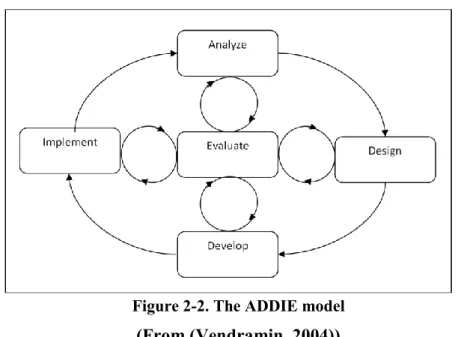
of instructional materials and activities; and tryout and evaluation of all instruction and learner activities.” (Michigan, 1996). From a design perspective, there are a number of models which can be followed. The ADDIE (Analyze, Design, Develop, Implement, and Evaluate) model is one of the best-known ones. (Figure 2-2)
Figure 2-2. The ADDIE model
(From (Vendramin, 2004))
The first stage – analysis clarifies the problems and objectives with respect to the target audience. This includes the learning environment, and the existing knowledge and skills. The design stage determines the goals and tools used to measure performance. Further, it also determines testing methods, subject matter, and considers the resources available. The development stage is the time to develop an instructional material which was planned in the previous stage. This includes interactive materials, multimedia, instruction guides. Additional software such as authoring tools may be utilized to create the multimedia materials, and can involve more than one person. Few examples of software which can be used are Articulate and Captivate. Recently introduced cloud-based tools such as Elucidat3 and Gomo4 are rapid authoring tools.
In the implementation stage, the instructional material is deployed in the target LMS. The users of the system including instructors and other facilitators as well as learners should be adequately trained in its operation. In the final stage – evaluation, two methods are used. Formative evaluation is carried out during each stage of the ADDIE process while summative evaluation is carried out at the end of the course.
2.4.2 Creating re-usable content for Learning Management Systems
One of the main issues in software engineering is software re-use. When it comes to e-learning, re-usability is important in a slightly different way. Code reusability is important to developers, but in the case of e-learning content reusability is equally or more important. In the first round of learning management systems, the content was changeable by users, but since each developer has different standards, the content was not interoperable each other. This meant content duplication and inconsistencies were common in learning environments.
The Sharable Content Object Reference Model (SCORM) introduced by the US Department of Defense’s Advanced Distribution Team in 1999 changed this scenario. It is a technical reference model which ensures that all e-learning content and LMSs can work with each other. If an LMS is labeled as SCORM conformant, it can accept any content that is SCORM conformant, and any SCORM conformant content is compatible with any SCORM conformant LMS.
When it comes to making content SCORM compliant, it is important to granulize content into a form which can be handled easily so that its value to the learning process is not lost. The concept of learning objects was used for this purpose.
2.4.3 Learning objects
The term learning object or LO has been described in literature first in 1967 but has been used extensively in relation to e-learning since 1994. It has been defined as "Any entity, digital or non-digital, that may be used for learning, education or training" by the IEEE Learning Technology Standards Committee (LTSC) (IEEE Computer Society, 2005). Other definitions have included terms to define the granularity by saying that they are smaller units of learning typically from less than 15 minutes (Wisconsin Online Resource Center, 2010), as well as focus on the reusability: In the spirit of object-oriented programming breaking down educational content into smaller units which can be reused in different educational scenarios (Wiley, 2000).
In general, it would be possible to summarize a few characteristics of LOs. Each LO can be taken independently (self-contained)
A single LO may be used in multiple contexts for multiple purposes (reusable) LOs can be grouped into much larger collections of content, including traditional
Every LO has descriptive information allowing it to be easily found by a search (tagged with metadata)
When considering the use of LOs in an LMS, it is expected that they could be packaged with SCORM compatibility to be ported to another LMS.
2.5 Learning Styles
The fact that humans do not learn equally, and differences in learning are observable was first documented by Aristotle by his observation of children in 334 B.C. (Reiff, 1992). The recent origin of learning styles can be attributed to the time period of early 1900’s when psychologists and educationalists forwarded theories which focused on relationships between memory and visual or oral instructional methods. The foundation and development of learning styles are intertwined between the domains of psychology and education, so much so that many different models have been documented with varying descriptions and scope. This is evidenced by the definition of learning styles itself: “a description of the attitudes and behaviors which determine an individual’s preferred way of learning” (Honey & Mumford, 1992) “educational conditions under which a student is most likely to learn.” (Stewart & Felicetti, 1992) cited in (Arden & Kuntz, 2015), and “characteristic strengths and preferences in the ways they (learners) take in and process information” (Felder & Silverman, 1988).
Coffield et al.’s categorization of families of learning styles (Coffield, Moseley, Hall, & Ecclestone, 2004) is one of the most comprehensive reviews of the models available in research today. The summarized list of learning styles has been prepared by Kanninen (Kanninen, 2008) in Table 2.1.
Table 2.1. Coffield’s Families of Learning Styles
Author(s) Assessment tool Year introduced
Genetic and other constitutionally based learning styles and preferences including VAKT Dunn and Dunn
Learning Style Questionnaire (LSQ) Learning Style Inventory (LSI) Building Excellence Survey (BES)
1979 1975 2003
Gregorc Gregorc Mind Styles Delineator (MSD) 1977
Cognitive structure
Riding Cognitive Styles Analysis (CSA) 1991
Stable personality type
Apter Motivational Style Profile (MSP) 1998
Jackson Learning Style Profiler (LSP) 2002
Myers-Briggs Myers-Briggs Type Indicator (MBTI) 1962
Flexibly stable learning preferences
Allison and Hayes Cognitive Style Index (CSI) 1996
Herrmann Brain Dominance Instrument (HBDI) 1995
Honey and Mumford Learning Styles Questionnaire (LSQ) 1982
Felder and Silverman Index of Learning Styles (ILS) 1996
Kolb Learning Style Inventory (LSI)
LSI Version 3
1976 1999 Learning approaches and strategies
Entwistle
Approaches to Study Inventory (ASI)
Revised Approaches to Study Inventory (RASI) Approaches and Study Skills Inventory for Students (ASSIST)
1979
1995 2000
Sternberg Thinking Styles 1998
Vermunt Inventory of Learning Styles (ILS) 1996
Source: (Kanninen, 2008)
This study identified 71 models of learning styles out of which 13 important models were selected for categorization. The first family category relates to the concept that is learning styles and preferences are largely constitutionally based, including the four modalities: visual, auditory, kinesthetic, and tactile (VAKT). The second family category relates to the concept that learning styles reflect deep-seated features of the cognitive structure, including patterns of abilities. The third considers the learning styles as one component of a relatively stable personality type. The fourth family relates to the concept that learning styles are flexible, stable learning preferences. The final category describes learning approaches, strategies, orientations, and conceptions of learning rather than simply learning styles. (Coffield et al., 2004).
2.5.1 Myers-Briggs type indicator
In 1962, Isabel Briggs Myers and her mother Katharine Briggs published a booklet explaining the Myers-Briggs Type Indicator (MBTI) for classifying psychological preferences. MBTI is based on Carl Jung’s typological theory and poses a number of questions (Versions include 93 and 126 item forms) related to four dimensions: extrovert-introvert, sensing-intuition, thinking-feeling, and judging-perceiving. The scales for the answers are bipolar, and the personality type calculated using the question scores place the respondent into one of 16 pre-determined personality types. Although its classification is based on personality, the same outlook has implications for learning behavior. As a ground-breaking classification, other models which succeeded MBTI have similarities to this approach.
2.5.2 Dunn and Dunn learning style model
Professors Ken and Rita Dunn originally proposed their model in 1974 and had been subjected to several refinements since then. Through their research carried out in schools, they observed distinct differences in the way students respond to the instructional material. Based on this research they identified five dimensions on which 20+ elements of the model are grouped (Dunn, 1984):
1. Environmental. The environmental dimension refers to the following elements: lighting, sound, temperature, and seating arrangement. For example, some people need to study in a cool and brightly lit room, while some others cannot concentrate unless they have music playing, and it is warm.
2. Emotional. This dimension includes the following elements: motivation, persistence, responsibility, and structure. For example, some people like to work on one activity at a time only starting another after finishing one, while others may like to perform several activities at the same time, multitasking in-between them. (Persistence element).
3. Sociological. The sociological dimension represents elements related to how individuals learn in association with other people: alone or with peers, with an authoritative adult or with a collegial colleague, and learning in a variety of ways or in routine patterns. For example, some people prefer to work alone when tackling a new and difficult subject, while some others prefer to work in a team (learning alone or with peer’s element).
4. Physiological. The elements in this dimension are perceptual (auditory, visual, tactile, and kinesthetic), time-of-day energy levels, intake (eating or not while studying) and mobility (sitting still or moving around). For example, some people consider themselves to work/study best at night or in the morning (time-of-day element).
5. Psychological. The elements in this dimension correspond to the following types of psychological processing: hemispheric, impulsive or reflective, and global versus analytic. The hemispheric element refers to left and right brain processing modes; the impulsive versus reflective style describes how some people take decisions before thinking and others scrutinize the situation before making decisions. Global and analytic elements are unique in comparison to other elements because these two elements are made up of distinct clusters of elements found in the other four strands. The elements that determine global and analytic processing styles are sound, light, seating arrangement, persistence, sociological preference, and intake.
This model has been commercially marketed in 11 countries with 23 testing centers, and has four different assessment instruments based on the age of the subject – Ages 7-9, 10-13, 14-19 and 17+(“International Learning Styles Network,” 2015).
2.5.3 Kolb’s learning style model
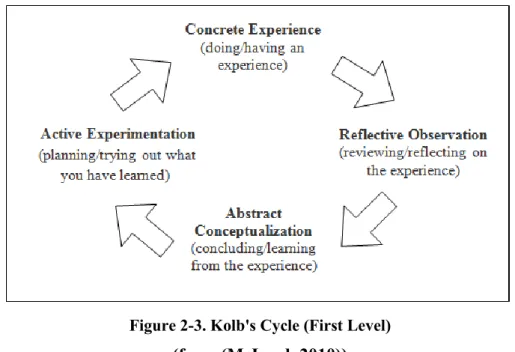
David Kolb introduced his Experiential Learning Theory in 1984 (Kolb & Kolb, 2005). It establishes four distinct learning styles based on a four-stage learning cycle and thus operates on two levels: In the first level, a four-stage cycle exists Concrete Experience (CE), Reflective Observation (RO), Abstract Conceptualization (AC), and Active Experimentation (AE), as illustrated in figure 2-3.
Figure 2-3. Kolb's Cycle (First Level)
(from (McLeod, 2010))
Kolb explains that different people naturally prefer a certain, single different learning style. Various factors may influence a person's preferred style, including social environment, educational experiences, or even the basic cognitive structure of the individual. Whatever influences the choice of style, the learning style preference itself is actually the product of two pairs of variables, or two separate 'choices' that we make, which Kolb presented as lines of the axis, each with 'conflicting' modes at either end.
A typical presentation of Kolb's two continuums is that the east-west axis is called the Processing Continuum (how we approach a task), and the north-south axis is called the Perception Continuum (our emotional response, or how we think or feel about it), as indicated in figure 2-4.
Figure 2-4. Kolb's Cycle (Second Level)
(from (McLeod, 2010))
Kolb’s model is alternatively represented in a 2 × 2 matrix (Table 2.2).
Table 2.2. Kolb's Learning Styles in a 2 x 2 Matrix
Doing (Active Experimentation) Watching (Reflective Observation) Feeling (Concrete Experience) Accommodating (CE/AE) Diverging (CE/RO)
Thinking (Abstract Conceptualization) Converging (AC/AE) Assimilating (AC/RO) Source : (McLeod, 2010)
2.5.4 Honey and Mumford learning style model
Peter Honey and Alan Mumford’s learning style model (Honey & Mumford, 1992) is based on Kolb’s Experiential Learning Theory. It identifies four learning styles: activists, theorists, pragmatists, and reflectors based on an 80 question Learning Styles Questionnaire (LSQ) which was published in 1982. In 2000, they formulated a shorter, 40 question LSQ to enable learners to get a quicker route to evaluate their learning style.
2.5.5 Pask’s Serialist/Holist/Versatilist model
Gordon Pask developed the conversation theory, out of his work with cybernetics where he proposed the human-machine interaction as a form of conversation. Its purpose was to explain learning in humans and machines, and stated that learning occurs through conversations about a subject matter. He identified two types of learners: Serialists who progress through a structure in a sequential fashion and Holists who look for higher order relations. He further stated that those who had a mixture of both can be considered as versatilists (Pask, 1988).
2.5.6 Felder and Silverman learning styles model
In 1988, Richard Felder and Linda Silverman published their learning style model which considered teaching practices that should meet the requirements of students with the full spectrum of styles (Felder & Silverman, 1988). In the Felder-Silverman learning style model (FSLSM), learners are characterized using values in four dimensions. The four dimensions are based on major dimensions in the field of learning styles and can be viewed independently of each other.
In the first dimension, the learner’s preferred method of processing information is considered and marked as active (ACT) or reflective (REF). Active learners prefer to work in groups, and they do not learn in situations that require them to be passive and tend to be experimentalists. In contrast, reflective learners work better by themselves or with one other person at most. They do not learn much in situations that provide no opportunity to think about the information being presented and tend to be theoreticians.
In the second dimension, the type of information that the learner preferentially perceives is considered and marked as sensory (SEN) or intuitive (INT). Sensory learners prefer to learn facts and like to relate to practical, real-world situations while intuitive learners prefer abstract learning material such as theories and their underlying meaning. Intuitive learners are more comfortable with symbols than sensory learners.
In the third dimension, the sensory channel through which the learner most effectively perceives external information is considered and marked as visual (VIS) or verbal (VER). Visual learners prefer pictures, diagrams, graphs, or demonstrations, whereas verbal learners prefer spoken information or audio. FSLSM considers no
other sensory channels such as touch, taste, and smell as these are relatively unimportant in most educational environments.
In the fourth dimension, how the learner progresses toward understanding is considered and marked as sequentially (SEQ) or globally (GLO). Sequential learners learn in small increments, and, therefore, have a linear learning progress, tending to follow logical stepwise paths toward solutions. Conversely, global learners use a holistic thinking process and learn in large leaps. They tend to absorb learning material almost randomly without viewing connections; however, after learning sufficient material, they suddenly understand the entire picture. They can solve complex problems and put things together in novel ways, but find it difficult to explain how they did it.
The terms used in the FSLSM to identify the dimensions are not new, and some terms and their underlying concepts are shared with other learning style models.
1. Sequential learners (FSLSM model) are very much similar to the serial learner type in Pask’s model.
2. Global learners (FSLSM model) have the same characteristic as holist learners in Pask’s model.
3. The sensing–intuitive dimension of FSLSM Model has similar characteristics to that of MBTI.
4. Active learners in FSLM have similarities with activist learners in Honey and Mumford model, and accommodating learners in the Kolb’s learning styles model. 5. Reflective learners in FSLM are similar with a reflector in Honey and Mumford
model, and diverging learners in the Kolb’s learning styles model.
6. Intuitive similar in FSLM to theorist in Honey and Mumford model, and assimilating learners of the Kolb learning styles model.
7. Sensing learners is related to pragmatist in Honey and Mumford model, and converging of the Kolb learning styles model.
While the FSLSM combines aspects of several learning style models, it differs from them in since it views learning styles as tendencies, suggesting that students have a inclination toward a specific learning style but could act differently in some situations.
In order to classify learners into each learning style model, each model has its own instruments. The Index of Learning Styles (ILS), which was developed by Felder and Soloman (Felder & Soloman, 1994), can be used as an instrument for assessing learning preferences in the four FSLSM dimensions. This instrument comprises 44 questions, with 11 questions for each dimension. The results of the questionnaire indicate an individual’s learning preference in each dimension, with scores ranging from +11 to −11. This score can be read in the following manner. A score of 1–3 (either plus or minus) indicates that the learner is fairly balanced on the dimension of that scale. A score of 5–7 (either plus or minus) indicates that he/she has a moderate preference for one side of the dimension of the scale, and will more easily learn in a teaching environment that favors that dimension. A score of 9–11 indicates that he/she has a very strong preference for one dimension of the scale, and probably has considerable difficulty in learning in an environment that does not support that preference. The ILS Questionnaire and its Japanese translation are included in Appendix A and B.
2.6 Relevance and Criticisms of Learning Styles
The concept of learning styles has been in research and publications for nearly a century and has contributed to education in numerous ways. Many instructors/teachers are made aware of the subtle changes in students learning preferences. Therefore they need to prepare relevant content and to make the environment for learning stimulating and interesting. From the student’s point of view, knowing his/her learning style provides insight into one’s strengths, weaknesses, and habits thereby show them how to take advantage of their natural skills and inclinations. In situations where poor instructors hamper learning, it enables learners to access the most relevant study material for reducing stressful learning experiences.
While the positives from learning styles can be listed as above, not everyone agrees that they are as useful as mentioned. The proponent’s claim of the use of learning styles has improved learning. The opponents of learning styles debate this, arguing that the very existence of different models, sometimes overlapping each other reflects that there is no single model which can be considered better than the others (Coffield et al., 2004). Another argument is that students learning may change over time and that depending on the age, they could change. Gender also has been
A slightly different school of thought suggests that similar to the idea that there is no universal “right” way to teach or “right” way to learn/study, there is no single learning style theory that can be considered as best.
2.7 Use of Learning Styles in e-learning
Learning styles models were conceived for traditional learning. Yet, when considering e-learning environments, differences exist the types of activities that can be performed by a learner. Popescu (Popescu, 2010) suggests merging features from major learning style models into a new Unified Learning Style Model (ULSM) by considering technology enhanced learning which includes a number of dimensions:
1. Perception modality: visual vs. verbal
2. Processing information (abstract concepts and generalization vs. concrete, practical examples; serial vs. holistic; active experimentation vs. reflective observation; careful vs. non-careful with details)
3. Field dependence vs. field independence 4. Reasoning (deductive vs. inductive)
5. Organizing information (synthesis vs. analysis)
6. Motivation (intrinsic vs. extrinsic; deep vs. surface vs. strategic vs. resistant approach)
7. Persistence (high vs. low)
8. Pacing (concentrate on one task at a time vs. alternate tasks and subjects) 9. Social aspects (individual work vs. teamwork; introversion vs.
extraversion; competitive vs. collaborative) 10. Coordinating instance (affectivity vs. thinking)
Some researchers (Felder & Silverman, 1988; S. Graf, Liu, & Kinshuk, 2010; Hsieh, Jang, Hwang, & Chen, 2011) agree that matching learning content with the learner’s learning styles can benefit them to learn easily. However, in order to identify the learning styles of students, two approaches could be considered. They follow the user modeling categories introduced by Brusilovsky (Brusilovsky, 1996): Collaborative user modeling and automatic user modeling.
In collaborative user modeling, the user has to “collaborate” for the model to be complete. In the case of learning style user modeling achieved using the
learning style using this scheme has been carried out with respect to Honey and Mumford (Sangvigit, 2012), MBTI (Radwan, 2014) and FLSLM (Kusumawardani, Prakoso, & Santosa, 2014; Morita, Koen, Ma, Wu, & Johendran, 2005; Park, 2005; Surjono, 2014). Savic and Konjovic presented a system that made recommendations using the ILS for an SCORM compatible Sakai LMS, by modifying the SCORM manifest file (Savic & Konjovic, 2009). Özpolat and Akar (Özpolat & Akar, 2009) developed a system that collected learner preference using explicit generic queries. Their system, based on the FSLSM, constructed a learner profile using a conversion unit-based keyword mapping. Furthermore, it built a learner model by processing the learner profile over a clustering unit that used the NBTree classification algorithm in conjunction with a binary relevance classifier.
While this method of using the questionnaire is simple to implement and provides quick feedback, it has its own criticisms. They include the fact that students learning styles may change during the course of the engagement, and that they are measured at only one time. It is also possible that when the students answer the questionnaire, they do not reveal their true learning style. Nevertheless, in our survey of literature we were unable to trace any visualization schemes of learning styles, even though measurement mechanisms were enabled in e-learning.
In the automatic user modeling, on the other hand, the accuracy or relevance is considered to be higher as it can be tested multiple times without interfering with the student’s real actions performed on the system. In this way, automatic detection of learning styles in e-learning can be considered as much easier to perform and accurate than in traditional learning.
2.8 Detection of Learning Styles in Learning Management Systems
Recently researchers have explored the idea of automatically identifying learning styles to personalize the learning experience (García, Amandi, Schiaffino, & Campo, 2007; Sabine Graf & Kinshuk, 2006). These studies have adopted statistical as well as simple rule-based approaches. Most current LMSs follow CMS architecture and, therefore, share the CMS feature of logging events in a database. This includes activities such as accessing content, participating in quizzes and forums. Nearly, researchers who follow the data-driven approach use this log data to model automatically students’ learning styles.