Real-time PCR and multiplex real-time PCR for ocular infections by human herpes viruses
Shiro Higaki, Motoki Itahashi , Yoshikazu Shimomura
Department of Ophthalmology, Wakakusa-Daiichi Hospital, Higashiosaka, Japan Department of Ophthalmology, Kinki University Faculty of Medicine,
Osaka-Sayama, Japan.
Abstract
Currently,there are 9 human herpes viruses known that remain latent at various sites of the human body, and some of them could become reactivated and trigger various diseases. We have been applying the real-time polymerase chain reaction (PCR) method to help clinicians diagnose ocular surface infection, especially herpetic keratitis. In the current study, we applied multiplex real-time PCR to quantify herpes simplex virus 1 (HSV-1), Human her-
pesvirus 6 (HHV-6), and Human herpesvirus 7 (HHV-7) DNA in tears taken before and after cataract surgery and penetrating keratoplasty (PKP), and aqueous humor collected at the beginning of cataract surgery. This is the first report in the field of ophthalmology on multiplex real-time PCR carried out using ocular samples to quantify HSV-1, HHV-6, and HHV-7 DNA.
Key words:
There are presently 9 human herpes viruses known to remain latent at various sites of the human body, and some of them could become reactivated and trigger various diseases. In the field of ophthalmology, herpes simplex virus (HSV-1) has long been studied as a pathogen that causes herpetic keratitis,conjunctivitis,and endotheliitis. Some reports stated that cytomegalovirus(CMV) and human herpesvirus 7 (HHV-7) also caused endotheliitis. Okuno et al. reported that HHV-6 DNA was detected by polymerase chain reaction (PCR) in tears of patients with dry eye,allergic conjunctivitis,and keratitis. Sugita et al. reported that HHV-6 DNA was detected in the vitreous humor of 2 out of 500 patients with uveitis or endophthal- mitis,and that HHV-7 DNA was not detected in the 500 patients by multiplex PCR. Thus, molecular biological techniques have been used to investigate the relationship between human herpes viruses and ocular infections.
PCR was devised by Mullis et al., for which they were awarded the Nobel Prize. It is now widely performed,even in college studentsʼtrain- ing laboratories. The PCR method can selective-
ly amplify a specific DNA fragment from a small amount of DNA. The time required for amplifi- cation is only about 2 hours. In general,electro- phoresis is necessary after DNA amplification.
PCR is a qualitative examination, not quantita- tive one.
Generally speaking, real-time PCR should be used for DNA quantification. Electrophor- esis is not required when real-time PCR is used.
Real-time PCR is classified into two methods:
the fluorescent-labeled probe method and inter- calator method. The fluorescent-labeled probe method includes the Linear Probe(such as TaqMan probe) method, Structured probe (such as the Molecular Beacon probe)method, and Cycling probe method. On the other hand, SYBR Green I etc. are added to the PCR reaction system in the intercalator method.
We performed real-time PCR by the Linear Probe method using a TaqMan probe for her- petic keratitis cases. The subjects were 56 patients with herpetic keratitis: epithelial ker- atitis in 27 eyes; persistent epithelial defect in 6;
active disciform stromal keratitis in 14; silent stromal keratitis in 6; and endotheliitis in 3.
All 27 epithelial keratitis samples were positive for HSV DNA (6.4±4.4 ×10 copies/sample).
In those with a persistent epithelial defect,HSV DNA was detected in all 6 samples (8.5 ±3.3× 10 copies/sample). In active disciform stromal keratitis, HSV DNA was positive in 8 of the 14 affected eyes (1.4±1.1 ×10 copies/sample).
Although it has been regarded as extremely difficult to detect HSV-1 by viral culture in disciform keratitis patients, HSV DNA was quantified in 8 of the 14 eyes. However,patients in whom HSV was not suspected to be involved may show a small amount of positive HSV DNA. In such cases, quantitative results of HSV DNA can be helpful in diagnosing whether or not the patients have herpetic keratitis.
In recent years, an increasing number of research laboratories perform real-time PCR for identifying a causative virus of uveitis. Our group has performed real-time PCR using a cycling probe to adjunctively diagnose bacterial, fungal, or Acanthamoeba keratitis. Cycling PCR uses a chimeric DNA-RNA-DNA probe with a strand length of 10 to 14 base pairs.
As compared with a linear or structured probe,a
cycling probe is shorter. When a mismatch is present in the vicinity of the RNA in the cycling probe, the cleavage by RNaseH does not occur.
This PCR can detect the difference of a single nucleotide.
One of the advantages of real-time PCR is its ability to quantify. However, when multiple viruses, bacteria, or fungi are quantified, the same number or more reaction tubes are neces- sary. On the other hand, multiplex PCR can detect more than one kind of DNA in a single test tube. Sugita et al. analyzed ocular samples firstly by multiplex PCR and secondly by quanti- tative real-time PCR for HHV-1 through HHV-8.
If multiplex PCR results were positive,then real- time PCR was conducted. Strictly speaking, these methods were not multiplex real-time PCR.
Here we report the outcomes of multiplex real- time PCR applied to quantify HSV-1, HHV-6, and HHV-7 DNA in tears and aqueous humor.
This is the first report in the field of ophthalmol- ogy of multiplex real-time PCR carried out using ocular samples to quantify HSV-1, HHV-6, and HHV-7 DNA.
Fig.2 The amplification plot of HHV-6 with multiplex real-time PCR.
Fig.1 The standard curve plot of HHV-6 with multiplex real-time PCR.
Subjects were 23 patients who underwent phacoemulsification,aspiration,and intraocular lens implantation (PEA+IOL) or penetrating keratoplasty(PKP). Twenty tear samples of 10 eyes receiving PEA,8 samples of aqueous humor from another 8 eyes receiving PEA, and 10 tear samples of 5 eyes receiving PKP were used.
None of the patients had a history of herpetic eye diseases.
The sequences of the primers and TAMRA probes used in the multiplex real-time PCR assay were the same as those designed by Wada et al.
In the current study,probes were quenched with TET, FAM, or VIC. ABI PRISM 7900HT Sequence Detector (Applied Biosystems, Foster City, CA, USA) was used for DNA quantifica- tion.
Figures show the standard curve plot (Figure 1) and representative amplification plot (Figure 2) of HHV-6 with multiplex real-time PCR.
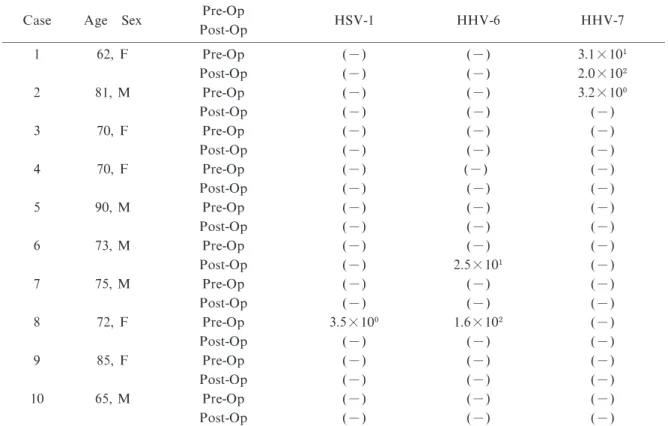
Table 1 shows the DNA copy number detected in the tears before and after PEA +IOL. The maximum amounts of DNA detected were 1.6 × 10 copies/sample for HHV-6 and 2.0×10 copies/sample for HHV-7 (Table 1). No DNA of HSV-1, HHV-6, or HHV-7 was detected in
any aqueous humor collected from another 8 eyes receiving PEA (data not shown). The DNA copy numbers before and after PKP in the tears are shown in Table 2.
The results indicated that HSV-1,HHV-6,and HHV-7 DNA were present in the ocular surface (Tables 1, 2) before and after eye surgery.
However, the amount of DNA detected was small. There is a possibility that viral DNA reactivated from a latent state was quantified.
Human herpes viruses are known to remain latent at various sites of the human body. We suggest that multiplex real-time PCR is conve- nient and useful to clarify the clinical path- ogenesis of HHV in the eye.
Acknowledgements
We thank Ms. Yukiko Mimuro for editing the manu- script and Ms. Mayumi Mizuno for technical assistance.
References
1.Grinde B (2013) Herpesviruses: latency and reactivation -viral strategies and host response. J Oral Microbiol 25: 1‑9
2.Holland EJ, Schwartz GS (1999) Classification of
Table 1 DNA copy numbers detected in the tears before and after PEA+IOL
Case Age Sex Pre-Op
Post-Op HSV-1 HHV-6 HHV-7
1 62, F Pre-Op (−) (−) 3.1×10
Post-Op (−) (−) 2.0×10
2 81, M Pre-Op (−) (−) 3.2×10
Post-Op (−) (−) (−)
3 70, F Pre-Op (−) (−) (−)
Post-Op (−) (−) (−)
4 70, F Pre-Op (−) (−) (−)
Post-Op (−) (−) (−)
5 90, M Pre-Op (−) (−) (−)
Post-Op (−) (−) (−)
6 73, M Pre-Op (−) (−) (−)
Post-Op (−) 2.5×10 (−)
7 75, M Pre-Op (−) (−) (−)
Post-Op (−) (−) (−)
8 72, F Pre-Op 3.5×10 1.6×10 (−)
Post-Op (−) (−) (−)
9 85, F Pre-Op (−) (−) (−)
Post-Op (−) (−) (−)
10 65, M Pre-Op (−) (−) (−)
Post-Op (−) (−) (−)
Reprinted with permission from Nihon Ganka Gakkai Zasshi.
herpes simplex virus keratitis. Cornea 18: 144‑154 3.Koizumi N, et al. (2008) Cytomegalovirus as an
etiologic factor in corneal endotheliitis. Ophthalmol- ogy 115: 292‑297
4.Inoue T, Kandori M, Takamatsu F, Hori Y,Maeda N (2010) Corneal endotheliitis with quantitative polymerase chain reaction positive for human her- pesvirus 7. Arch Ophthalmol 128: 502‑503
5.Okuno T et al.(2011) Role of human herpes virus 6 in corneal inflammation alone or with human her- pesviruses. Cornea 30: 204‑207
6.Sugita S et al. (2013) Use of a comprehensive polymerase chain reaction system for diagnosis of ocular infectious diseases. Ophthalmology 120: 1761 ‑ 1768
7.Mullis KB, Faloona FA (1987) Specific synthesis of DNA in vitro via a polymerase-catalyzed chain reac- tion. Methods Enzymol 155: 335‑350
8.Saiki RK et al. (1985) Enzymatic amplification of beta-globin genomic sequences and restriction site analysis for diagnosis of sickle cell anemia. Science 230: 1350‑1354
9.Giulietti A et al. (2001) An overview of real-time quantitative PCR : applications to quantify cytokine gene expression. Methods 25: 386 ‑401
10.Morozumi M et al.(2006)Simultaneous detection of pathogens in clinical samples from patients with com- munity-acquired pneumonia by real-time PCR with pathogen-specific molecular beacon probes. J Clin Microbiol 44: 1440‑1446
11.Muraosa Y et al. (2014) Development of cycling probe-based real-time PCR system to detect Fusarium species and Fusarium solani species complex (FSSC).
Int J Med Microbiol 304: 505‑511
12.Simpson DA, Feeney S, Boyle C, Stitt AW (2000) Retinal VEGF mRNA measured by SYBR green I fluorescence: A versatile approach to quantitative PCR. Mol Vis 5: 178‑183
13.Fukuda M et al. (2003) Quantitative analysis of
herpes simplex virus genome in tears from patients with herpetic keratitis. Cornea 22(7 Suppl): S55 ‑60 14.Kakimaru-Hasegawa A et al. (2008) Clinical appli-
cation of real-time polymerase chain reaction for diag- nosis of herpetic diseases of the anterior segment of the eye. Jpn J Ophthalmol 52: 24 ‑31
15.Sugita S et al.(2008)Use of multiplex PCR and real- time PCR to detect human herpes virus genome in ocular fluids of patients with uveitis. Br J Ophthalmol 92: 928‑932
16. Itahashi M, Higaki S, Fukuda M, Mishima H, Shimomura Y (2011) Utility of real-time polymerase chain reaction in diagnosing and treating Acanth- amoeba keratitis. Cornea 30: 1233‑1237
17.Itahashi M, Higaki S, Fukuda M, Shimomura Y (2010) Detection and quantification of pathogenic bacteria and fungi using real-time polymerase chain reaction by cycling probe in patients with corneal ulcer.
Arch Ophthalmol 128: 535‑540
18.Duck P, Alvarado-Urbina G, Burdick B, Collier B (1990) Probe amplifier system based on chimeric cycling oligonucleotides. Biotechniques 9 : 142 ‑148 19.Hogrefe HH, Hogrefe RI, Walder RY, Walder JA
(1990) Kinetic analysis of Escherichia coli RNase H using DNA-RNA-DNA/DNA substrates. J Biol Chem 265: 5561‑5566
20.Yabutani M, Agata N, Ohta M (2009) A new rapid and sensitive detection method for cereulide-producing Bacillus cereus using a Cycleave real-time PCR. Lett Appl Microbiol 48: 698‑704
21.Modrusan Z,Bekkaoui F,Duck P (1998) Spermine- mediated improvement of cycling probe reaction. Mol Cell Probes 12: 107‑116
22.Bekkaoui F,Poisson I,Crosby W,Cloney L,Duck P (1996) Cycling probe technology with RNase H attached to an oligonucleotide. Biotechniques 20: 240
‑248
23. Robert PY,Traccard I,Adenis JP,Denis F,Ranger- Rogez S (2002) Multiplex detection of herpesviruses in
Table 2 DNA copy numbers detected in the tears from PKP
Case Age Sex Disease Pre-Op
Post-Op HSV-1 HHV-6 HHV-7
1 72, F BK Pre-Op (−) (−) (−)
Post-Op (−) 9.3×10 (−)
2 40, M KC Pre-Op (−) (−) (−)
Post-Op (−) (−) (−)
3 79, M BK Pre-Op (−) (−) (−)
Post-Op (−) (−) (−)
4 78, F BK Pre-Op (−) (−) (−)
Post-Op (−) (−) 9.1×10
5 61, M BK Pre-Op (−) (−) (−)
Post-Op (−) (−) 3.1×10
BK : Bullous keratopathy, KC : Keratoconus
Reprinted with permission from Nihon Ganka Gakkai Zasshi.
tear fluid using the “stair primers” PCR method : prospective study of 93 patients. J Med Virol 66: 506
‑511
24. Wada K et al. (2009) Multiplex real-time PCR for the simultaneous detection of herpes simplex virus, human herpesvirus 6, and human herpesvirus 7.
Microbiol Immunol 53: 22‑29
25.Dockrell DH,Paya CV (2001)Human herpesvirus-6 and -7 in transplantation. Rev Med Virol 11: 23 ‑36 26.Miszczak D,Slonska A,Golke A,Cymerys J (2013)
Herpesviruses survival strategies--latency and apoptosis. Postepy Hig Med Dosw(Online) 67: 276 ‑ 287