Establishing electoral administration systems in new democracies
著者 Kawanaka Takeshi, Asaba Yuki
権利 Copyrights 日本貿易振興機構(ジェトロ)アジア
経済研究所 / Institute of Developing
Economies, Japan External Trade Organization (IDE‑JETRO) http://www.ide.go.jp
journal or
publication title
IDE Discussion Paper
volume 305
year 2011‑08‑01
URL http://hdl.handle.net/2344/1087
INSTITUTE OF DEVELOPING ECONOMIES
IDE Discussion Papers are preliminary materials circulated to stimulate discussions and critical comments
Keywords: democracy, institution, election, Korea, the Philippines
* Senior Research Fellow, IDE (corresponding author, [email protected])
** Associate Professor, Yamaguchi Prefectural University
IDE DISCUSSION PAPER No. 305
Establishing Electoral Administration Systems in New Democracies
Takeshi KAWANAKA* and Yuki ASABA**
August 2011
Abstract
The difficulty of holding fair elections continues to be a critical problem in many newly democratized countries. The core of the problem is the electoral administration’s lack of political autonomy and capability to regulate fraud. This paper seeks to identify the conditions for establishing an autonomous and capable electoral administration system. An electoral administration system has two main functions: to disclose the nature of elections and to prevent fraud. We argue in this paper that an autonomous and capable electoral administration system exists if the major political players have the incentive to disclose the information on the elections and to secure the ruler’s credible commitment to fair elections. We examine this argument through comparative case studies of Korea and the Philippines. Despite similar historical and institutional settings, their election commissions exhibit contrasting features. The difference in the incentive structures of the major political players seems to have caused the divergence in the institutional evolution of the election commissions in the two countries.
The Institute of Developing Economies (IDE) is a semigovernmental, nonpartisan, nonprofit research institute, founded in 1958. The Institute merged with the Japan External Trade Organization (JETRO) on July 1, 1998.
The Institute conducts basic and comprehensive studies on economic and related affairs in all developing countries and regions, including Asia, the Middle East, Africa, Latin America, Oceania, and Eastern Europe.
The views expressed in this publication are those of the author(s). Publication does not imply endorsement by the Institute of Developing Economies of any of the views expressed within.
INSTITUTE OF DEVELOPING ECONOMIES (IDE), JETRO 3-2-2, WAKABA,MIHAMA-KU,CHIBA-SHI
CHIBA 261-8545, JAPAN
©2011 by Institute of Developing Economies, JETRO
No part of this publication may be reproduced without the prior permission of the IDE-JETRO.
1
1. Introduction※
Holding regular elections is one of the key conditions for democracy. But this is not a sufficient condition. Elections also need to be fair to guarantee that political competition is played out appropriately.
Securing fairness in elections is, in fact, still a crucial problem in many of the newly democratized countries, which are mostly developing countries. Even though an authoritarian regime collapses and democratic transition takes place, this does not necessarily simultaneously bring fairness in elections. If elections are manipulated systematically by the ruling party, the regime is called electoral authoritarianism. Even if there is no systematic manipulation, elections are sometimes influenced by the elites through bribes and fraud. This is not rare in the cases of newly democratized countries.
The manipulation of elections or prevalence of fraud is actually a problem of the electoral administration system. The electoral administration systems in new democracies are not necessarily autonomous enough to insulate themselves from the pressure of dominant political players, and not capable enough to regulate electoral irregularities (López-Pintor [2000]).
Nevertheless, there are cases among new democracies where fair elections have been attained through politically autonomous and efficient electoral administration systems.
Democratic regimes in these countries have become consolidated through such an electoral administration.
Why does such divergence in electoral administration systems take place? What are the conditions that make the electoral administration system autonomous and capable, especially in new democracies? These are the main questions examined in this paper.
※ The authors thank Yutaka Onishi, Yutaka Shinada, Noriyo Isozaki, Kengo Soga, and Cleo Calimbahin for their useful comments. This work is supported by the
Grants-in-Aid for Science Research (B) (No.20330027) and the Grants-in-Aid for Science Research (A) (No.23243022).
2
We argue in this study that such an electoral administration system is established if the major political players have the incentive for it, in other words, if the major political players find establishing such an electoral administration system as the best strategy for maximizing their payoffs. Among the major political players, the player who holds the power plays a crucial role in deciding the type of electoral administration system.
In discussing the incentive structure, we consider that information exposure about the nature of elections through an electoral administration is very important, in addition to the prevention of electoral fraud. An autonomous and capable electoral administration system emerges when the player in power needs to disclose the nature of elections (which usually are fair) to avoid the costs caused by the opposition’s protest. And such an electoral administration is sustained when the players continue to see that this function as well as fraud regulation serve their interests.
To examine this argument, we compare the cases of Korea and the Philippines, two countries sharing similar settings. Both experienced democratization in the 1980s, have similar forms of government, and electoral administration systems with similar institutional settings. Nonetheless, the electoral administration systems of these two countries have diverged in actual functions. The Korean election commission strengthened its political autonomy and regulatory power, while the Philippine election commission suffers from manipulation and inefficiency. We expected that this divergence would provide an empirical base for determining the conditions of an autonomous and capable electoral administration system.
In the following sections, we will present the theory of the electoral administration system as a self-enforcing institution. We will then examine it through the cases of Korea and the Philippines.
3
2. The Electoral Administration as a Self-Enforcing Institution
The recent literature on dictatorship deals with cases where democratic institutions including elections are utilized by dictators to augment their rule (Schedler [2006], Magaloni [2006], Levitsky and Way [2010], Magaloni and Kricheli [2010]). The electoral administrations under these examples of “electoral authoritarianism” or
“competitive authoritarianism” are designed to produce results which always favor the ruler. Such a system, controlled by the ruler, is neither fair nor neutral.
Even under democratic regimes, the electoral administration system is not always autonomous and capable enough to regulate electoral processes. Table 1 indicates that 25 among one 115 electoral democracies (21.7 percent) in 2010 show a relatively lower level of fairness in the electoral process1.
Table 1 Electoral Democracies in the World as of 2010
Total number of countries 194
Number of electoral democracies 115
Total percentage of electoral democracies 59.3%
Number of electoral democracies with a lower score in its
electoral process* 25
Percentage of lower quality electoral democracies in total electoral democracies
21.7%
* The number of countries with an “electoral process” that scores either 8 or 9. Below
1 Freedom House defines an electoral democracy as having: 1. a competitive, multiparty political system; 2. universal adult suffrage for all citizens; 3. regularly contested elections conducted in conditions of ballot secrecy with reasonable ballot security, the absence of massive voter fraud, and with results that are representative of the public will; and 4. significant public access of major political parties to the electorate through the media and through generally open political campaigning. See Freedom House Methodology. The 25 countries with lower scores in their electoral process are: Albania, Bangladesh, Benin, Bosnia-Herzegovina, Comoros, Ecuador, Guatemala, Lesotho, Liberia, Macedonia, Malawi, Maldives, Mali, Montenegro, Nicaragua, Papua New Guinea, Philippines, Samoa, Senegal, Serbia, Seychelles, Tanzania, Ukraine, Vanuatu, and Zambia.
4
8 is not classified as an electoral democracy. The range of scoring is from 0 to 12.
Source: Freedom House.
Even where there is no systematic control by the ruling parties, the electoral administration systems in some of the new democracies suffer from inefficiency in preventing electoral fraud. In the worse cases, election officers themselves violate electoral rules or commit crimes of nonfeasance.
The nature of an electoral administration system is decided primarily by a country’s legal framework, constitution and statutes. Actual management is determined by the system’s personnel and the budget allocated to it. The ruling administration generally has the power to appoint management officers and initiate amendments to statues. In this sense, the ruling administration has the power to determine the nature of the electoral administration. If so, logically, the ruler prefers to keep room for electoral manipulation because he can use government resources for election purposes, something which sometimes constitutes electoral fraud. As long as the electoral administration is controlled by the ruler, these problems by and large are not uncovered2.
Yet there are cases where the rulers institutionalize autonomous and capable electoral administrations and minimize the room for their own electoral manipulation. Why do some rulers act in such a way? This seemingly contradictory behavior can be understood as the ruler’s solution for the commitment problem which imposes certain costs on him.
To use a simplified example, we suppose that an election is a two-player game of the ruler and the opposition. When elections are held, the results will be either the ruler winning and maintaining power or the opposition winning and replacing the ruler (see
2 In the following, “the ruling party”, “the ruling administration”, and “the ruler” are used interchangeably. Here “the ruler” does not imply a dictator.
5
the appendix for a formal modeling).
If the opposition wins the elections, there is little probability that the partiality of the electoral administration would be questioned. The opposition finds no merit in criticizing the elections that it has won. The ruler finds it difficult to claim that he was cheated in manipulated elections because as ruler he was in the advantageous position of being able to influence the elections using the power and resources in the government.
On the other hand, the ruler sometimes faces a problem if he wins the election. If the opposition has no information on the nature of the election, it can claim that the election was rigged by the ruler and that the opposition was the true winner. Whether or not the opposition claims it was the actual victory depends on the degree of its subjective probability of the fairness of the election.
The ruler incurs the costs if the opposition takes protest action that damages the legitimacy of the ruler’s administration. Such action also often triggers street demonstrations and causes political instability and economic stagnation. The ruler additionally needs to carry the costs of repression.
As long as the ruler possesses enough political resources to counter the opposition’s protests, he does not need to change the electoral administration system. In some cases the ruler has the means to counter protests effectively, such as influencing the media to claim his legitimacy, using police authority to subdue street demonstrations, or co-opting opposition members through his party machine. However, the ruler faces a crisis if he does not have enough capacity to counter the opposition’s protests, or if the opposition is cohesive and has enough political resources. If the ruler sees the credible and critical threat of the opposition beforehand, he prefers the strategy of holding a fair election rather than having a frontal clash in a rigged election.
6
A serious problem the ruler faces is the case where the opposition’s subjective probability is of a rigged election even though the ruler actually held a fair election. If the electoral administration system is not autonomous from the ruler or not competent, the opposition has no means to know the real nature of the election. Moreover, the very continuation of such an incompetent electoral administration system itself strengthens the opposition’s doubt about the elections. As long as there is a room for such doubt, it is likely that the opposition will attack the ruler by claiming the unfairness of elections.
The more the political resources the opposition has to confront the ruler, the higher the probability that it will take protest action.
The action that the ruler can take to prevent the costs of opposition protest is to reveal information showing that the election was fair. For this purpose an autonomous and capable electoral administration system is established. Such an electoral administration system affirms the ruler’s pre-commitment to fair elections which will present the opposition with difficulties in strengthening its protests against the ruler3. Aside from the exposure of information, an autonomous and capable electoral administration system also prevents or at least decreases fraud. The more the electoral administration has the power to guard against fraud, the stronger the commitment of the ruler to fair elections.
Information revelation also works in favor of the opposition in solving its coordination problem. The opposition faces a collective action problem as it is usually composed of various groups (Olson [1971]). It is difficult for the opposition to impose a credible threat on the ruler if it is divided and the groups do not share the same evaluation of the nature of elections. Weingast [1997] claims that having a focal point is crucial in
3 International election monitoring also seems to reveal the nature of the election.
However, due to its limited coverage, international monitors do not guarantee rulers’
commitment to fair elections in many cases. Beaulieu and Hyde [2009] show empirically that international monitors increase the probability of the opposition’s boycott because the opposition believes that it would face more difficulty competing in an election that is fraught with concealed electoral manipulation and has international legitimacy.
7
solving this coordination problem. Historically constitutions have served as the focal point. In the modern context, especially for newly democratized countries, it is elections that play the role of focal point4. Elections are the opportunity for the citizens to feel the newly brought democracy arising from the collapse of dictatorship. This means, conversely, that ambiguity in the nature of election benefits the ruler. Hence, the ruler has the incentive to create an autonomous and capable electoral administration system only if the opposition has immense resources or is very cohesive in the first place regardless of the information on elections.
Thus, the high probability that the ruler will obtain lower payoffs by not revealing information on the nature of elections is the fundamental condition for the ruler to choose the strategy of establishing an autonomous and capable electoral administration system. This condition is prepared if the opposition has the high subjective probability to view elections as rigged and take protest action, and if the ruler feels he would incur large costs from opposition protests (political instability and economic damage) which would drastically diminish the benefits deriving from power. In addition, the ruler has the larger incentive to hold fair elections if he has the high probability of winning such elections5.
The condition here is mainly induced based on the costs caused by the opposition’s protests. However, there is also the possibility of the ruler introducing a capable electoral administration in order to reduce the costs of rigging elections, for example, if he faces the problem of bloating bribery costs. This situation takes place when both the ruler and the opposition can commit fraud, and the level of fraud goes up due to intensified competition.
4 Przeworski [1999] and Fearon [2006] discuss the aspect of information and the role of elections in democratic stability.
5 Magaloni [2010, p.752] provides essentially the same conditions for the one type of democratic transition from electoral authoritarianism. This paper shares the similar theoretical approach, though we deal with the issue of democratic consolidation rather than democratic transition.
8
An autonomous and capable electoral administration is sustainable as long as the ruler and opposition have the mutual incentive to control fraud. But the probability of the ruler winning the next elections may not always be high. In this situation, the “stakes of politics” particularly matter as Przeworski [1991] claims. If the benefits derived from holding power are huge, the ruler is tempted to make sure he wins regardless of the means of acquiring power, and he loses the incentive to hold fair elections. On the other hand, the opposition also sees that acquiring power is the supreme purpose beyond the fairness in the elections. An autonomous and capable electoral administration would not be an equilibrium in such a situation. If the “stakes of politics”
are low, or if the major players, even the opposition, can reserve a certain share of the
“stakes of politics” (Weingast [2006]), the players prefer accepting the loss in elections rather than rigging the elections or protesting which have costs.
We expect mainly two alternative explanations. One is that which focuses on the norm.
This explanation claims that an autonomous and capable electoral administration system is established when the norm of clean elections is shared by the major political players. Such an administration system is not possible of course when people do not believe that elections should be fraud free. Even in the societies where people prefer clean elections, there still are cases where electoral administration systems do not function to prevent fraud. The crucial player who decides the nature of the electoral administration system is primarily the ruler. In this first explanation, the ruler needs to be strongly motivated by the norm of clean elections even if it does not serve his/her interests. This argument still seems weak in its explanatory power.
The other explanation stresses the role of historical contexts. This argues that path dependence is the basic mechanism of institutional evolution. In this explanation, institutions that appear at a critical juncture determine the type of institutions that follow (Thelen [1999]). The critical juncture for post-democratization institutions is naturally that of democratization. Hence, in this argument an electoral administration is determined by how democracy is brought about and what institutions then emerged.
9
This stance emphasizes that the constitutions enacted at the time of democratization decide the type of electoral administration system which in turn functions as the starting point for the following evolution of the institutions.
The argument of critical juncture provides some important insights. As we will see in the cases of Korea and the Philippines, the way they experienced democratization is closely related with the institutional design of the respective electoral administration systems. If holding fair elections itself constitutes the process of democratic transition, an autonomous and capable electoral administration system is expected to be created at the time of democratization. If democratic transition is caused by uprisings of the opposition (or by a splinter group from the ruling coalition), there is no chance for such an electoral administration system to emerge at the time of democratization. For the former type of democratization, it is likely that fair elections continue to constitute the focal point even after democratization. On the other hand, for the second type of democratization, establishing an autonomous and capable electoral administration system depends on the situation in the post-democratization period. In this sense the critical juncture sets the conditions for the evolutionary path of institutions.
Nevertheless, the players’ incentive structure still matters. The formation of institutions at a critical juncture can be explained as the equilibrium of the players’ interaction at that point. Furthermore, whether or not the institutions established at the critical juncture continue to exist depends on the players’ incentives after democratization.
Institutions may be changed once the players’ payoffs change. Needless to say, the cost of changing the institutions should also be taken into consideration. The cost usually induces inertia.
In the following section, we will deal with the cases of Korea and the Philippines.
10
3. Comparative Case Studies of Korea and the Philippines
As mentioned above, Korea and the Philippines share some similarities. Both of them experienced democratization in the 1980s, have presidential systems, and have constitutionally autonomous electoral administrations. On the other hand, the actual natures of their electoral administration systems have diverged in their institutional evolution. Korea’s National Election Commission (NEC) gained strong autonomy and large regulatory power, while the Philippines’ Commission on Elections (COMELEC) suffers from the intervention of elites and organizational inefficiency. Comparing these similar but contrasting cases seems fitting for examining the conditions for an autonomous and capable electoral administration.
Fair elections were the focal point in Korea for its democratic transition because the opposition was able to impose a credible threat to the ruler. The major players’
interaction brought about an autonomous and capable electoral administration as an equilibrium. Also, unsynchronized electoral cycles for the selection of the executive and legislature since democratization have functioned to sustain a strong NEC as institutional “insurance” in the sharing of power for both the ruler and the opposition.
At the same time the nationalization of political competition has caused local politicians to share the same incentive structure as the national leaders which have supported the continuity of the autonomous and capable electoral administration system.
By contrast, the democratic transition in the Philippines was brought on by coup attempt and citizen uprising. Thereafter an autonomous and capable electoral administration system was not established. Instead, a half-way compromise of allowing monitoring by private groups was introduced which still continues to be the case6. The major players in the post-democratization period have not had the incentive to reform
6 In addition, each particular party was also granted the right to field its own observers to monitor elections.
11
COMELEC, and electoral fraud has continued to exit.
(1) Korea
Korea’s post-independence political history can be divided into three periods, namely, a democratic period until 1972, an authoritarian period under presidents Park Chung-hee and Chun Doo-hwan (the Yusin Regime and the Fifth Republic) from 1972 to 1987, and a democratic period since 1987. National elections have been held continuously even during the authoritarian period, although during that period presidential elections were indirect. As of July 2010, the elective offices in Korea totaled 4,291and were composed of the president, members of the unicameral National Assembly, chief executives and local assembly members of the two levels of local government, and education board chairs and members of the upper level of local government.
The NEC has been managing the electoral administration since the onset of the second period of democratization and enjoys autonomous status and strong regulatory power.
Legally the NEC was established by the 1960 Constitution (the Second Republic) as a constitutional body to “administer fair elections”. Except for the number of members, the organizational structure and functions have been modified under the five succeeding constitutions (the 1962, 1969, 1972, 1980 and 1997 Constitutions). But its legal status as an independent constitutional body, not under the control of the president, the National Assembly, the judiciary or the Constitutional Court, has been sustained7.
7 The 1987 Constitution sets forth the hierarchy of the electoral administration managed by the NEC in order to “administer the matters related to elections, referendums, and political parties” (Article 114, Section 1). The NEC is composed of a chair and eight members. Under the NEC each upper level local government, lower level local government, and community level administration has an election commission. The members of the NEC are appointed by the president, the National Assembly and the Supreme Court Chief Justice. Each appointer has the power to select three members. The chair is elected by mutual vote. NEC members have a six-year term, which is longer than the president’s term (five years) and the National Assembly members’ term (four years). The chair cannot stay in office for more than one term.
12
The NEC’s function is not limited to administrating the electoral process. It has the power to initiate electoral reform through setting reform agendas, to enforce the laws regulating fraud, and to make semi-judicial judgments on the eligibilities of candidates.
Beyond its legal framework, the NEC has actual autonomy and strong influence. The major political players as well as the citizenry recognize the capability of the NEC for securing fair elections. There was a symbolic incident of the NEC’s political autonomy in 2004. It released a statement that incumbent president Roh Moo-hyun’s calls for support of the ruling Uri party ahead of the legislative election in April that year constituted a violation of the Election Law. The law requires the president to maintain political impartiality. It should be noted also that in terms of resources, the number of personnel provided to the NEC and the size of its budget increased dramatically after democratization in 1987.
The NEC has acquired and maintains its autonomy and capability because the major political players have come to see that such a strong election commission serves their interests. Three factors have contributed to the establishment of such an autonomous and capable electoral administration. First, the opposition has been an imposing credible threat. Second, the unsynchronized electoral cycles for the president and the National Assembly made for a fair and strong NEC to provide “insurance” for the sharing of power. Third, the nationalization of political competition caused local politicians to share the same incentive structure as the national leaders.
The opposition’s credible threat was visible when democratization took place in 1987.
In the process of democratic transition, the revival of a directly elected president was the critical issue. The constitutional amendment to bring about such elections became the target of the democratization movement. Since this target, achieving a minimal
The political independence and status of the NEC members are also guaranteed by the Constitution (Article 114, Section 4 and 5).
13
democratic procedure, was clear and simple, it effectively functioned as the focal point for the opposition to coordinate its movement. Therefore, the probability of an opposition uprising was quite high. The probability and the potential leverage of such an uprising was confirmed by an actual incident in June 1987. The killing of a student leader, Park Jong-chul, triggered a large political uprising called the June Democracy Movement.
The opposition’s credible threat push the authoritarian president Chun Doo-hwan to allow his ally, Roh Tae-woo, who was a retired army general and the president of the ruling Democratic Justice Party, to promise democratic reform (the June 29 Declaration). The main point the Declaration was revival of direct presidential elections. The opposition leaders, Kim Dae-jung and Kim Young-sam, accepted Roh’s concession. The middle class also supported the move, while the labor sector demanded further democratization and intensified its movement.
Once democratization has been declared, the next stage was to institutionalize the
“pact” between the ruler and the opposition, under the continuing threat from the opposition. The institutionalization of a democratic government was the drafting of the new 1987 Constitution (Cho [2004]). The writing of this constitution was carried out by a closed-door “eight-member political meeting” where the leader of the ruling Democratic Justice Party and the opposition leaders participated. The draft was later approved by the National Assembly and ratified by national referendum. When the elite agreed on their pact in the “eight-member political meeting”, it made certain the schedule of elections and election related reforms. These started from the direct presidential election in December 1987, then electoral reforms for the National Assembly elections, and finally the National Assembly elections in April 1988. But it was hard to predict the outcomes of the elections.
At this point, it was expected that if the elections were held in a fair manner, the opposition would be divided. The opposition leaders, the middle class, and the labor
14
sector would not be able to form a cohesive coalition against the ruling party. The ruling party would enjoy the preferable situation. But if it were believed that the election were rigged, it was expected that the opposition would be united and pose a critical threat to the ruling party, in which case the ruling party would face a crisis even if it won the elections.
Korea had in fact experienced the collapse of a ruling administration caused by fraudulent elections in 1960. President Syngman Rhee, then incumbent, supported his ally Lee Gi-bung as vice-presidential candidate in those elections8. Rhee himself had no problem in getting reelected, but he rigged the election to make Lee the winner. Lee was expected to succeed the aging Rhee in the near future, but the opposition Democratic Party claimed that the election had been fraudulent and, therefore, invalid.
Citizens joined the Democratic Party’s movement, and President Rhee was eventually expelled from power. He sought exile in Hawaii while Lee and his family committed suicide.
The ruler faces the critical threat of protest by the opposition if the nature of elections is questioned. The opposition’s threat in Korea has been credible through actual protest experience. In this context it was a rational choice for President Chun Doo-hwan and Roh Tae-woo to commit themselves credibly to fair elections in order to prevent the costly protest of the opposition led by Kim Dae-jung and Kim Young-sam. Having an autonomous and capable NEC was the solution to the commitment problem.
The unsynchronized electoral cycles of the president and the National Assembly are the second factor behind the establishing and sustaining of an autonomous and capable NEC. This explains why the NEC has increased its autonomy and capability under the 1987 Constitution despite having the same constitutional status under the authoritarian 1980 Constitution. The power and status of the NEC changed because the provisions for other offices and their interaction changed.
8 Each election was held separately though voting was conducted simultaneously.
15
Under the democratic regime of the Third Republic (the 1962 Constitution), the terms of the president and members of the National Assembly were four years and their elections were held nearly simultaneously9. In this electoral cycle the winner of the presidency was also expected to hold the majority in the National Assembly. On the other hand, under the democratic regime of the current Sixth Republic (the 1987 Constitution), the president’s term is five years, while the term of the National Assembly members is four years; and election cycles are not matched. Simultaneous elections are also impossible as the months of elections are not close (December and April). This setting has increased the probability of divided government, since the loser in the presidential elections may take the National Assembly, and vice versa.
The ruling party finds that securing fair elections under the unsynchronized electoral cycles of the president and the National Assembly works as insurance to reserve certain stakes in power. Even if the ruling party’s candidate does not win a presidential election, it has the chance to gain a certain share of the seats in the National Assembly as long as the NEC guarantees fair elections. In fact, the loser of the presidential election has a high possibility of winning a majority in the following the National Assembly elections since the ruling party tends to lose its popularity during its term in power. In this sense, the unsynchronized electoral cycle with an autonomous and capable electoral administration system bars a “winner-take-all” type of political competition. Likewise, the current opposition has a greater chance of winning the next elections under a strong NEC. Hence, it is preferable for the opposition to accept the electoral results under an autonomous and capable NEC rather than always claiming that the elections are rigged.
The actual political process took the following course. The first presidential election following 1987’s democratization was a three-cornered race. Roh Tae Woo from the ruling party ran against two opposition leaders, Kim Dae Jung and Kim Young Sam.
9 The National Assembly elections were held one month after the presidential election.
16
Roh won the race, succeeding Chun Doo-hwan. The defeated opposition leaders did not claim that the election had been fraudulent. Later the opposition gained the majority in the succeeding National Assembly elections. A divided government emerged for the first time in Korean political history. After President Roh Tae Woo, both Kim Young Sam and Kim Dae Jung assumed the presidency one after the other.
An autonomous and capable NEC served the interest of each player. Roh Tae Woo was able to win while avoiding an uprising of the opposition through the NEC’s fair electoral management. The opposition leaders were able to secure the majority in the National Assembly also due to the NEC’s management, though they had lost in the earlier presidential election. Eventually the two opposition leaders had their chances to be president, again through the fair elections administered by the strong NEC.
It is also important that the president is not allowed to run for reelection under the 1987 Constitution. After a term of five years, he has to step down. Even if a president were successful in amending the Constitution to prolong the presidenial term, the amendment would not be applicable to the incumbent president as the Constitution prohibits such an application. Hence, the president has no incentive for rigging elections and none for hindering fair elections after his term. It could be argued that a new candidate of the ruling party might be regarded as the alter ego of the incumbent president. If so, the president might have the incentive to rig the elections for this successor. Countering this possibility is the tendency of a new candidate to keep his distance and point out how he differs from the incumbent who has often lost popularity by the end of his term.
Finally, in addition to the credible threat of the opposition and unsynchronized electoral cycles of the executive and legislature, another notable factor is that political competition has become nationalized, even for local elections. Democratization expanded electoral competition to the local level, especially under President Kim Young Sam’s administration. Since 1995 local elections have been held simultaneously.
These elections are for the chief executives and local assembly members of both the
17
upper-level and lower-level of local governments. As local elections do not synchronize with the national elections, they are regarded as the preliminary skirmish of the national elections. This setting makes voters focus on national issues even for local elections, and party affiliation matters more than a candidate’s individual personality. With political competition nationalized, the incentives of local politicians are set by the national level competition among the parties rather than the personal vote at the local level. Local politicians follow the decisions of the national leaders of the parties. As long as the national political players have incentives to have an autonomous and capable NEC, local politicians share the same incentives.
Aside for the aforementioned incentive based explanation, the role of norms is sometimes pointed out as a key for making a strong electoral administration (Anderson [2007]; Asaba, Onishi and Tatebayashi [2010]). The example of Korea shows that the norm does not emerge in a vacuum. The incentive structure which promotes the loser’s consent and the winner’s self-restraint is crucial for making such a norm function, and this is provided by the constitutional framework in Korea.
Path dependence and the sequence of events are also often viewed as explanatories.
The pattern of democratization in Korea, which was democratization with the pact between the political elite, is seen as the main cause for the rise of the autonomous and capable NEC. But how such an NEC was sustained and even strengthened is explained by the incentive structure in the post-democratization period. The key has been the divided government caused by unsynchronized electoral cycles. As divided government has become the general pattern in Korean politics since 1987, it has become increasingly important for the president and the opposition to secure fair elections. Without a strong NEC, the power balance between the ruling party and the opposition would be affected, and the ruling party could become permanently in power with the opposition unable to gain power. This very likely would again bring destabilizing protests from the opposition. Through amendments of the NEC law, both players have strengthened the power of the NEC. In this process the NEC has
18
expanded its functions from mere electoral administration to semi-legislative and semi-judicial functions. As repeated elections have taken place, the unsynchronized electoral cycles are proving to provide a certain share of the political stakes to the opposition. This has consolidated the incentive structure for the political players to comply with the electoral administration, and an autonomous and capable NEC constitutes the equilibrium.
(2) The Philippines
The political history of the Philippines after independence from the US in 1946 can be divided into three periods: the democratic period from 1946 to 1972, President Ferdinand Marcos’ authoritarian regime from 1972 to 1986, and the return to democratic government after 1986. Although President Marcos suspended elections in the early part of his authoritarian rule, other than that hiatus, elections have been held continuously in the Philippines since its independence. The elective offices range from the president to local municipal councilors and all are directly elected. The total number of elected officials, for example, in the 2004 general elections was 17,660 and 50,160 candidates ran for the posts (NSCB [2006]).
Although the Commission on Elections (COMELEC), the Philippines’ electoral administration agency, is stipulated in the Constitution as an independent organization, it has been seen as politically dependent and less capable even after the 1986 reestablishment of democracy10. Calimbahin [2009: 3] points out three major problems with COMELEC. First, political and economic elites maintain patron-client relations
10 COMELEC is a constitutional body which is autonomous from the executive, legislative and judicial branches. It is composed by a chair and six commissioners who are appointed by the president for a term of seven years. Reappointment is not allowed.
The chair and the commissioners must be 35 years old or older, have a college degree, and must not have been candidates for any elective position in the immediately preceding elections. The majority of the members including the chair must be members of the Philippine Bar and have been practicing law more than 10 years. Under the central office managed by the chair and the commissioners there is a hierarchy of regional election directors, provincial election supervisors, and election officers (cities and municipalities). As of 2010 their total was 1,714 officials. (The COMELEC official web site)
19
with the bureaucracy of COMELEC and influence its work to secure results preferable to elite interests. Second, patron-client relations persist within COMELEC itself, and such relations function to maximize the personal interests of the bureaucrats. Third, COMELEC suffers from organizational inefficiency and incapacity. Calimbahin’s findings support the widely accepted perception that COMELEC is not an effective and autonomous electoral administration body. Although there have been some reforms like allowing citizen’s groups to monitor electoral processes and introducing an automated vote counting system, these have not been able to solve the problem of unfairness adequately11.
Not surprisingly, the authoritarian Marcos regime rigged elections to maintain its rule, and a variety of electoral fraud was observed during the period. Even after the 1986 democratization, such fraud has continued to exist. The Parish Pastoral Council for Responsible Voting (PPCRV), a private election monitoring organization, provides a manual to volunteers on how to monitor elections, in which various techniques of cheating are listed. These are: vote buying, intimidation, illegal use of indelible ink, kidnapping, changing the location of polling places without notice, accompanying voters to influence their voting, delisting or transferring voters from the voter lists, snatching ballot boxes, misreading the content of ballots in counting, and more (PPCRV [2007]). This manual indicates that there is a large amount of fraud and rigging in Philippine elections committed by candidates of either and all parties and by election officers12.
Aside from the regular street level fraud, there have been big election scandals. In the 1995 elections it was reported that votes for some senatorial candidates were transferred to other candidates through manipulation in the counting process. This was called the “Dagdag-Bawas” (vote shaving-adding) scandal. Apparently such manipulation is not possible without the involvement of COMELEC officers.
11 See also IFES [2009] for the problems of COMELEC.
12 See also Patino and Velasco [2004] for election related violence in the Philippines.
20
In 2005 President Gloria Macapagal Arroyo’s involvement in electoral manipulation was reported. She was the incumbent president when she ran for the same post in 2004, an election which she won. The 1987 Constitution bans reelection of the president, but Arroyo was allowed to run because as vice president she had assumed the presidency when President Joseph Estrada was forced to resign in the middle of his term. A tapped telephone conversation was exposed a year after the election. The media reported that the conversation took place between President Arroyo and a COMELEC commissioner in which the President asked about her votes. This “Hello Garci” Scandal triggered the mass resignation of cabinet members and the Arroyo administration’s approval rating plunged sharply13.
Why has the Philippines not been able to establish an autonomous and capable electoral administration? When compared with Korea, democratization in the Philippines was different. President Marcos decided to hold a presidential election in 1986 to counter the increasing pressure for regime change. But unlike in Korea, Marcos and the opposition did not form a pact for transition. Instead they confronted each other. Although Marcos allowed the National Movement for Free Elections (NAMFREL), a citizen’s group, to monitor the election, he still tried to rig it using various state resources including COMELEC. The president’s payoff would be drastically reduced if he were to lose the election and be out of power. Losing power did not simply mean that he would no longer be the president; it would mean that he would be prosecuted and his wealth would be sequestered. His family and cronies would be affected too; and, importantly, he was not sure if he could win the election.
Even though the probability of an opposition uprising was high, and the costs of such an uprising were large, Marcos still expected to obtain higher payoffs through a fraudulent election.
The government changed after democratization, but the conditions for an autonomous
13 See Tuazon [2006] for a documentation of electoral fraud in the 2004 elections.
21
and capable electoral administration continue to be insufficient. The president is the most crucial player for reforming the electoral administration. The president has the power to appoint the commissioners of COMELEC. This appointment is crucial because the reform of COMELEC depends on who become commissioners, as these appointees have the primary power to decide COMELEC’s management. The president also can initiate institutional reforms if he prefers. Through these powers the president can decide the nature of COMELEC. However, the president has no incentive to change the electoral administration because the Constitution bans him/her from being reelected. Even maintaining party strength after a politician’s presidential term does not have the similar effects of reelection because political parties are weak and fragile in the Philippines and retired presidents have no means of influencing the incumbents.
Therefore, the president has neither the incentive to rig elections nor to introduce electoral reforms.
The senate is not cohesive. An efficient electoral administration benefits only some members, but not all. Senators are elected in a bloc-vote system by the national constituency. In this setting senators are divided into two groups, those who have high popularity based on their public image and those who are not so popular but have the financial resources to get elected. The former have the incentive to establish an efficient electoral administration because they have a high probability of winning under a fair election setting. The latter prefer a less neutral and inefficient electoral administration as they think they can control the process to create favorable results for themselves. Due to this cleavage, there has been no active argument for reform of COMELEC except for the introduction of automated vote counting.
The House of Representatives prefers to retain a patronage-driven COMELEC to control the electoral process in the members’ local districts. Most of the representatives are elected from single member districts where they play the role of the ruler along with the governors and mayors. These representatives can be regarded as a whole as local politicians or local rulers. They are allowed to run for reelection, and in many
22
cases family members succeed to their position and power. The opposition may have a high subjective probability of cheating and may protest in some areas, but such protests seem not to impose huge costs on the local rulers. It is rather easier for them to subdue protests, when limited in a certain locality, through the state apparatus of the police and military or private resources like private armies. More importantly, the stakes of politics at the local level are high because of the large regulatory power in the hands of the incumbents. The local representative districts are like the personal domains of the local politicians who can monopolize or at least strongly control the economic activity in their areas. The high stakes discourage local politicians from observing fair elections and accepting their loss should they fail to be reelected. In addition, even though the local ruler may have the high probability of winning in a fair election, he is indifferent to the nature of the electoral administration as long as protests do not matter.
In short, the opposition’s protests have not been a credible threat to the major political players in the Philippines due to the term limit of the president and the local politicians’
strength in their narrow domains. Furthermore, the “stakes of politics” for the local politicians are large.
There was actually an attempt under President Corazon Aquino, the first president after the 1986 democratization, to reform COMELEC and improve its performance. This move may be explained by Aquino’s normative concern for clean elections. She appointed a succession of reform-minded lawyers to the chair of COMELEC,14 but this effort was not able to transform COMELEC into a more efficient body.
There have been some successful endeavors outside COMELEC to secure fair
14 Hilarion Davide, Jr. (1988-1989), Haydee Yorac (1989-1991), and Christian Monsod (1991-1995). Davide was a prominent lawyer and later was appointed Chief Justice of the Supreme Court. Yorac was a law instructor at the University of the Philippines and a human rights lawyer. Monsod was the Secretary General of NAMFREL. These appointments were intended to improve the capability of COMELEC and to revamp its bureaucracy (Calimbahin [2009]: 6-13).
23
elections. The most well-known activity has been election monitoring by private organizations, like the quick count of NAMFREL which operates in vote counting in parallel with COMELEC. In the official count in the 1986 snap presidential election, President Marcos was “officially” proclaimed the winner based on the COMELC count, but the quick count of NAMFREL showed that Aquino was leading (Wurfel [1988]:
300). Such a discrepancy strengthened the people’s belief in electoral manipulation which eventually provided the legitimacy to their popular uprising. NAMFREL gained a reputation as the guardian of fair elections and continued its quick count operations.
The government has also amended the election law to give legal status to such private watchdogs in the electoral process15. This is seen as the ruler’s strategic choice to uphold NAMFREL’s participation in order to avoid collusion in its oppositions. Were a president to remove NAMFREL from the electoral process, it would likely send the signal that he intends to rig elections16.
In addition, an automated counting system was introduced in the 2010 general elections. Since the start of elections under American colonial rule, voters in the Philippines had been required to write the names of candidates on the ballots. The ballot became very long because all elected offices, from the president to municipal councilors, were elected simultaneously, and some positions were elected by bloc voting. Such a voting system created a huge amount of manual work in counting17 and
15 The basic law for elections in the Philippines is the Omnibus Election Code (BP Blg.
881), which was enacted under the Marcos regime in 1985 just before the 1986 snap presidential election. The Code provides for the official participation of citizen’s groups in the election process. The Code still function as the fundamental statute though some amendments have been made. In 1995 the Code was amended, and citizen’s groups gained the right to obtain official copies of election turns.
16 Aside from NAMFREL, the PPCRV was established by Catholic groups in 1995 to provide voters education and to monitor the election process. The Social Weather Stations (SWS), a private poll organization which was established in 1985, initially aimed to contain electoral manipulation through disclosing poll results. Actually NAMFERL came to be viewed as more partisan after 1986, and it was not accredited to operate in the 2010 elections; the PPCRV was the only citizen’s group to work as a monitor.
17 At a counting site, which is usually a voting place, each ballot was read, and the numbers of votes were manually recorded on tally sheets. COMELEC then aggregated
24
such an aggregation process provided opportunities for manipulating the numbers. The Dagdag-Bawas scandal in 1995 and the Hello Garci scandal in 2005 took place because such opportunities have been so widespread. To minimize such manipulation, vote counting was automated in the 2010 elections, thirteen years after the automation law was enacted. Voters now use mark sheets and the sheets are read by machines. The voting data are transmitted electrically.
Although there have been such reforms in the Philippines, the people still do not have full confidence in their elections. One reason is that the effects of these reforms have been limited in certain types of fraud. There are other types, like vote buying, intimidation, disenfranchisement from various stages of elections, which cannot be controlled by quick counts and automation. Since automated counting was introduced, citizen’s groups have shifted their activities from quick counts to voter education and checking on fraud outside of counting. While these activities are useful, the ability of private groups to regulate fraud is restricted as they do not have cohesive power. Vote automation has also faced criticism as it still suffers from irregularities18.
The reforms to establish an autonomous and capable electoral administration system in the Philippines have not moved forward strongly because the major players who can participate in designing the institutions of the electoral administration do not have the incentives to bring about such an administration.
4. Conclusion
The nature of the strong NEC in Korea was initially decided at the point of democratic transition. It constituted the equilibrium in the interaction between President Roh Tae-woo, the ruler, and the opposition, as the opposition’s threat was credible. A strong NEC has continued to exist because it also works to the major players incentives in the
the numbers of votes based on the tally sheets.
18 See CenPEG [2010] for problems in the actual operation of automation.
25
unsynchronized election cycles which eventually led to divided government and lowered the “stakes of politics”. The nationalization of political competition also augmented the incentive structure to sustain a strong NEC.
On the other hand, the weak COMELEC was not reformed at the point of democratic transition because President Marcos, the ruler, needed to rig elections. COMELEC did not change even after democratization. The major players in the new democratic period have not had the incentives to reform COMELEC because of the term limit on the president, the cleavage in the Senate and localized competition, and the “high stakes of politics” for members of the House of Representatives. Only a half-way compromise of citizen’s group monitoring has been strengthened.
The cases of Korea and the Philippines confirm that the incentive structure of the major players matters in deciding the nature of the electoral administration system. The ruler has the incentive to establish an autonomous and capable electoral administration system for revealing information about elections if the threat of the opposition’s protest is credible, if the information on the nature of elections is crucial for the opposition’s protest, and if the ruler’s payoff will be heavily affected by opposition protest.
Furthermore, an autonomous and capable electoral administration system will be sustained if the major players find that fair elections benefit them in the long run. The
“stakes of politics”, the fundamental factor for self-enforcing democracy, matters in fair elections too because establishing an autonomous and powerful electoral administration system is one of the major conditions for political stability in democracy.
26
Appendix
The theoretical framework of this study is constructed as followings.
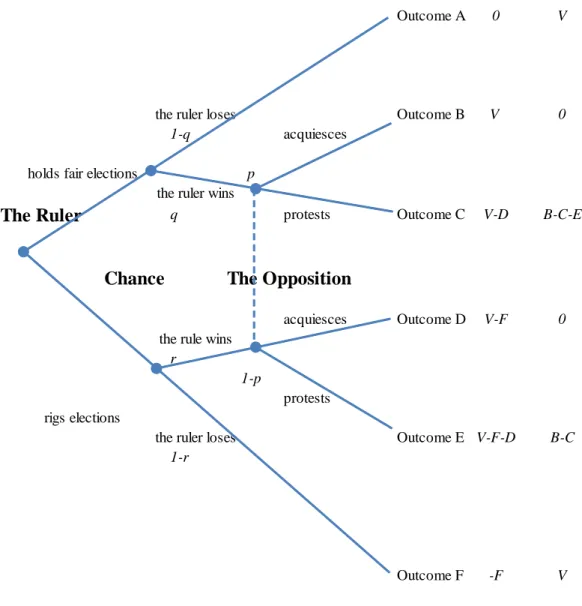
Suppose that controlling power in the state produces utility V, and that there are two players, the ruler and the opposition. If there is no fair electoral administration, the election game can be expressed as follows.
27
Figure 1 Election Game without Fair Electoral Administration
Source: Authors
The ruler has a strategy set 𝑆𝑅 ∈ {hold fair elections, rig elections}. The opposition has a strategy set 𝑆𝑂 ∈ {acquiesce if the ruler wins, protest if the ruler wins}. The ruler wins in fair elections with the probability 𝑞 ∈ [0, 1], while he loses with the probability (1− 𝑞)∈ [0, 1]. The ruler wins in rigged elections with the probability 𝑟 ∈[0, 1], while he loses in rigged elections with the probability (1− 𝑟)∈[0, 1]. Since there is no fair electoral administration, the opposition does not know the nature
the ruler the opposition
Outcome A 0 V
the ruler loses Outcome B V 0
1-q acquiesces
holds fair elections p
the ruler wins
The Ruler q protests Outcome C V-D B-C-E
Chance The Opposition
acquiesces Outcome D V-F 0
the rule wins r
1-p
protests rigs elections
the ruler loses Outcome E V-F-D B-C
1-r
Outcome F -F V
Payoffs
28
of the elections. If the ruler wins, the opposition believes that the elections were fair with the probability 𝑝 ∈ [0, 1], while it believes that the elections were rigged with the probability (1− 𝑝)∈ [0, 1]. The payoffs for each player for possible outcomes are provided in the figure. Here, F is the cost of fraud; D is the damage caused by the opposition’s protest; B is the benefits gained through protesting; C is the cost of protesting; and E is the cost caused by misjudging the nature of the elections.
The strategy profile to induce outcome A or C is:
σR= hold fair elections σO = protest if the ruler wins
This constitutes equilibrium if the following conditions are satisfied.
𝑝<𝐵 − 𝐶 𝐸
--- (a) (the condition that causes the opposition’s protest.)
𝑞>𝑟 − 𝐹 𝑉 − 𝐷
--- (b) (the condition that makes the ruler hold fair elections even if the opposition protests)
If an autonomous electoral administration were introduced, the path to Outcome C would be eliminated. Furthermore, if the electoral administration is strong enough to prevent fraud, paths to outcomes D, E, and F would also be eliminated. In such a case, the expected payoff for the ruler would always be 𝑞 ∙ 𝑉. Apparently the ruler’s expected payoff increases.
(Provided that 2∙𝑟∙𝐹
𝑉 >𝑉−𝐷𝐹 helds. Otherwise, condition (b) should be replaced by 𝑞>𝑟 −2∙𝑟∙𝐹𝑉 )
29
Hence, if conditions (a) and (b) are satisfied, the ruler has the incentive to establish a fair electoral administration. In the case of condition (b), the threshold for holding fair elections would get lower as the stakes of the politics, V, decreases.
30
References:
Anderson, Christopher J. et al [2007] Loser’s Consent: Elections and Democratic Legitimacy, Oxford University Press.
Asaba, Yuki, Yutaka Onishi and Masahiko Tatebayashi [2010] “Loser’s Disconsent in Korean Presidential Primary: Separation of Powers, Electoral Cycles, and Party Organization,” Japanese Journal of Electoral Studies, Vol. 26, No.1, July, pp.
53-66.
Beaulieu, Emily and Susan D. Hyde [2009] “In the Shadow of Democracy Promotion:
Strategic Manipulation, International Observers, and Election Boycotts”
Comparative Political Studies. Vol. 42 No. 3 392-415 March 2009.
Calimbahin, Cleo [2009] An Institution Reformed and Deformed: The Commission on Elections from Aquino to Arroyo. Chiba: Institute of Developing Economies.
VRF Series No. 453.
Center for People Empowerment in Governance (CenPEG) [2010] “The CenPEG Report on the May 2010 Automated Elections in the Philippines” Quezon City:
Center for People Empowerment in Governance.
Cho, Jung-kwan [2004], “The Politics of Constitution-Making During the 1987 Democratic Transition in South Korea,” Korea Observer, Vol. 35, No. 2, Summer, pp.171-206.
Fearon, James D. [2006] Self-Enforcing Democracy Center on Institutions and Governance Working Paper No. 14, Institute of Governmental Studies, University of California, Berkeley.
International Foundation for Electoral Systems (IFES) [2009] IFES Final Project Report: Philippines Elections Reform Project. Washington D.C.: International Foundation for Electoral Systems.
López-Pintor, Rafael [2000] Electoral Management Bodies as Institutions of Governance. Bureau for Development Policy, United Nations Development Programme
Levitsky, Steven and Lucan A. Way [2010] Competitive Authoritarianism: Hybrid
31
Regimes After the Cold War. New York: Cambridge University Press.
Magaloni, Beatriz [2006] Voting for Autocracy: Hegemonic Party Survival and Its Demise in Mexico. New York : Cambridge University Press
--- [2010] “The Game of Electoral Fraud and the Ousting of Authoritarian Rule” American Journal of Political Science. Vol. 54, No. 3 July, pp.751-765.
Magaloni, Beatriz and Ruth Kricheli [2010] “Political Order and One Party Rule”
Annual Review of Political Science. Vol. 13, pp.123-143.
National Statistical Coordination Board (NSCB) [2006] 2006 Philippine Statistical Yearbook. Makati: National Statistical Coordination Board.
Parish Pastoral Council for Responsible Voting (PPCRV) [2007] 2007 Election Monitoring Manual.
Patino, Patrick and Djorina Velasco [2004] Election Violence in the Philippines.
Quezon City: Friedrich-Ebert-Stiftung Philippine Office. Electronic ed.: Quezon City: IFES, 2004.
Przeworski, Adam [1991] Democracy and the Market: Political and Economic Reforms in Eastern Europe and Latin America. New York: Cambridge University Press.
--- [1999] “Minimalist Conception of Democracy: A Defense” in Ian Shapiro and Casiano Hacker-Cordon eds., Democracy’s Value. New York:
Cambridge University Press. pp.23-55.
Schedler, Andreas. [2006] Electoral Authoritarianism: The Dynamics of Unfree Competition. Boulder: Lynne Rienner Publisher.
Thelen, Kathleen. [1999] “Historical Institutionalism in Comparative Politics” Annual Review of Political Science. Vol. 2. pp. 369-404.
Tuazon, Bobby M. eds. [2006] Fraud: Gloria M. Arroyo and the May 2004 Elections.
Quezon City: Center for People Empowerment in Governance.
Weingast, Barry R. [1997] “The Political Foundations of Democracy and the Rule of Law.” American Political Science Review Vol. 91, No. 2, June. pp. 245-263.
--- [2004] “Self-Enforcing Democracy in Spain,” in Irwin L. Morris
32
et al (eds.), Politics from Anarchy to Democracy: Rational Choice in Political Science, Stanford University Press, pp.161-195.
--- [2006] “Designing Constitutional Stability,” in Roger D.
Congleton and Birgitta Roger D. Congleton and Birgitta Swedenborg eds., Democratic Constitutional Design and Public Policy, MIT Press, pp.343-366 . Wurfel, David. [1988] Filipino Politics: Development and Decay. Ithaca: Cornell
University Press.