Four New Species of the Selenophori Genus Group from Asia.
(Coleoptera, Carabidae, Harpalini)
Noboru I
TO*,**and Hongbin L
IANG***アジア産Seleonphori グループの4新種
(鞘翅目:歩行虫科:ゴモクムシ族)
伊藤 昇
*,**・梁
红斌
***Abstract: Four new species of the Selenophorine genera (Halpalini) are described in this paper under the names: Coleolissus (Coleolissus) yamasakoi from Sulawesi Is., Coleolissus (Tenuistilus) nigrocupreus from Laos, Coleolissus (Tenuistilus) ohtanii from Laos and Trichotichnus (Trichotichnus) flavipennis from China. 抄録:近年Selepnophori genus groupのアジアでの種多様性が明らかにされつつある.本稿では,ス ラウェシ、ラオスおよび中国から,Selepnophori genus group の下記4新種を記載した:Coleolissus (Coleolissus) yamasakoi( ス ラ ウ ェ シ), Coleolissus (Tenuistilus) nigrocupreus( ラ オ ス), Coleolissus (Tenuistilus) ohtanii (ラオス) および Trichotichnus (Trichotichnus) flavipennis(中国).
http://zoobank.org/urn:lsid:zoobank.org:pub:3E37CF13-2480-4F41-804E-ABC3D739662D Key words: Selenophori group; Coleolissus, Trichotichnus; Sulawesi; Laos; China; new species
Introduction
Species of Selenophori genus group (sense Noonan, 1985a) in the tribe Harpalini are distributed in central to south Asia, north area of Australia, southern Europe, Africa, South America and the tropical area of North America (Noonan 1985b). Recently the author has studied Asian species of the group and species diversity of Asian Selenophori genus group has been gradually cleared by some researchers (For examples, Ito, 1993, 2001, 2004, 2008, 2014, 2016 and 2017; Kataev, 2005, 2010 and 2012, etc.).
Recently I noticed that the paratype of Coleolissus nigridorsis N. Ito, 2014 from Sulawesi has different characteristics of aedeagus compared with the holotype. Therefore, in this paper, I am going to describe it as new species. Moreover additionally two new species of the genus Coleolissus Bates, 1892 from Laos and one new species of the genus Trichotichnus Morawitz, 1863 from China are described.
Material and Methods
Observation of materials. Specimens and aedeagi are observed by microscope of Nikon under 10–80× magnifications.
Preparation of aedeagi. Bodies are softened in 60% ethyl alcohol and aedeagi are isolated from body. The aedeagi are immersed in 100% ethyl alcohol for several days. Thence those are permuted the alcohol by 100% xylene and enclosed in Canada Balsam.
Measurement of body parts. The length of body: the distance between the apex of clypeus and the apices of elytra. The width of body: the maximal transverse distance of body. The width of head: the maximal transverse distance including compound eyes. The eye length: the longitudinal distance viewed in dorsal aspect. The pronotal width: the maximal transverse distance between sides. The pronotal length: the distance from apical edge to basal edge along the middle. The elytral length: the distance between the basal border and the apices along the suture. The elytral width: the maximal transverse distance between sides.
Terminology. Technical terms are referred to Beutel and Leschen, 2005 and Lawrence and Ślipiński, 2013
※ Contributions from the Osaka Museum of Natural History No. 460 (Accepted Feb. 15, 2018)
*Guest Researcher, Osaka Museum of Natural History, 1-23 Nagai Park, Higashisumiyoshi-ku, Osaka City, Osaka Prefecture, 546-0034, Japan 大阪市立自然史博物館 〒546-0034 大阪市東住吉区長居公園1-23
** 1-7-18 Higashiuneno, Kawanishi City, Hyogo Pref., 666-0117 Japan 兵庫県川西市東畦野1-7-18
Noboru ITO and Hongbin LIANG 34
Coleolissus (Coleolissus) yamasakoi N. Ito et Liang, sp. nov.
http://zoobank.org/urn:lsid:zoobank.org:act:B0CC3099-1A9B-4EEF-8BAA-675B32BDEF76 (Figs. 1 and 5)
Body widely oblong, gently convex, black, with slightly cupreous ting, shiny, very slightly iridescent on pronotum and moderately so on elytra; appendixes of buccal part, antennae, trochanters, tibiae and tarsi light brown.
Head gently convex, more or less wide, 0.69 times as wide as the pronotal width, very sparsely and microscopically punctate; labrum quadrate, rather widely rounded at apical corners; clypeus gently emarginate at apex, shallowly grooved along apex, weakly raised behind the groove, clypeal suture vague, broken in middle; frontal impressions arcuate, deep near apices, abruptly shallowed behind, reaching supraorbital grooves; eyes large, but not so prominent as hemispherical; interocular space somewhat wide, two-thirds the width of head; temples very short, 0.13 times as long as eye length; genuine ventral margins of eyes narrowly isolated from buccal fissure; mandibles stout, comparatively shorter than known species, acute at tips; antennae slender, surpassing a little beyond pronotal base, 3rd segment pubescent in almost apical half, as long as the 4th and twice the 2nd; labial palpi robust, 3rd segment sparsely pubescent, almost as long as the 2nd; ligula gently dilated forwards and blunt at apical corners, apex weakly arcuate; paraglossae fused with ligula just before its apex, surpassing the apex, narrow in the free portions; mentum transverse, with median tooth weakly produced and rounded at apex, epilobes gently expanded apicad; microsculpture clear, isodiametric on clypeus and most areas of frons, transverse meshes on lateral areas of frontal impressions.
Pronotum transverse, a half wider than long, fully rounded at sides, widest at apical third, a little more strongly convergent apicad than basad from the widest point, rather steeply declivous apico-laterad, very sparsely and microscopically punctate on disc, more or less coarsely and sparsely so in lateral furrows, mores coarsely and rather densely so in basal foveae where the punctures are confluent; apex shallowly emarginate, sublinear in middle, clearly bordered throughout; base 1.15 times as wide as apex, feebly arcuate at sides, linear between the arcuations, wholly clearly bordered; apical angles weakly protrudent, rather narrowly rounded; basal angles widely rounded, much larger than right; lateral furrows carved in a line in apical half, thence expanded backwards, adjoining basal foveae; basal foveae each small, obliquely elliptical, isolated from lateral border by tiny hump; front transverse impression obscure, widely V-shaped, the hind one obscure; median line thin, shallow, reduced near apex and base; microsculpture fairly clear, especially clear in basal foveae, composed of mixtures with isodiametric and square meshes,
Elytra oblong, 1.37 times as wide as the pronotal width, two-thirds longer than wide, rather convex, sparsely covered with rather coarse punctures and minute ones; sides clearly arcuate in humeri, very weakly divergent to each other in middle, gradually strongly incurved in apical third, shallowly sinuate preapically; apices almost straight in outer margins, acutely and briefly toothed at tips; bases shallowly emarginate, rounded at humeral angles; striae clear but thin, more or less deep, clearly crenulated in bottoms, scutellar striole long, isolated from 2nd striae; intervals a little convex on disc, gradually becoming more convex towards apices and bases, 3rd one with a series of 6-8 setiferous pores along 2nd striae, 2nd interval with a small setiferous pore but presence may be abnormal; marginal series continuous, 24-27 umbilicate pores; microsculpture vague, consisting of transverse lines and meshes. Hind wings entirely developed.
Ventral surface obscurely and sparsely punctate in prepisterna, rather coarsely and sparsely so in lateral portions of metaventrite, briefly rugose in metepisterna; metepisterna long, gently convergent backwards, approximately two-thirds longer than wide; 7th abdominal sternite in male truncate at apex, bisetose at each side.
Fore tibiae each weakly dilated apicad, vaguely sulcate, the sulcus broken in middle with seriate setae, trispinose along apico-external margin; 1st segment of mid tarsus bearing biseriate squamae only near apex; hind tarsi 0.93 times as long as the width of head, 1st segment 1.07 times as long as the 2nd and 3rd taken together, 2.5 times as long as the 3rd and 3.75 times the 4th, claw segment bisetose along both ventral margins.
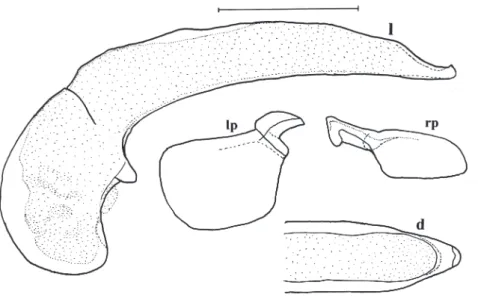
Aedeagus (Fig. 5) weakly arcuate, not stout, weakly and gradually thinned apicad, abruptly thinned just before apex, acutely hooked above at apex, with large basal bulb; dorsal orifice widely opened, inner sac without any sclerites; apical lobe transversely triangular, 1.53 times as wide as long, rounded and bordered at distal margin.
Female unknown.
Length: 11.6mm. Width: 4.7 mm
Holotype: ♂, Puncak Palopo, Sulawesi Selatan, alt. 800 m, S02º57', E120º05', 30. I–4. II. 2013, J. Yamasako leg. With green label described as Paratype, Coleolissus nigridorsis N. Ito, sp. nov. 2014, Det. N. ITO 2014. (Preserved in Ehime University in future).
Remarks. The new species closely resembles Coleolissus (Coleolissus) nigridorsis N. Ito, 2014 in outline but the body is more clearly microsculptured on dorsal surface, the head bears a little shorter and stouter mandibles, the pronotum and elytra are more
Figs. 1-4. Habitus of species of genera Coleolissus and Trichotichnus. --- 1: Coleolissus (Cleolissus) yamasakoi sp.nov.; 2: C.(Tenuistilus)
Noboru ITO and Hongbin LIANG 36
weakly iridescent, and the aedeagal inner sac does not possess any sclerites.
This species is related to Coleolissus (Coleolissus) phillipinus N. Ito, 2001 in the point of aedeagal inner sac without any sclerites, but in this new species the mandibles are shorter, the basal angle of pronotum is more widely rounded, the microsculpture on dorsal surface is more clearly impressed and the aedeagus is more slender, more weakly arcuate and hooked at apex.
Etymology. The specific name is dedicated to Dr. Junsuke Yamasako of Tokyo University who collected the holotype specimen.
Coleolissus (Tenuistilus) nigrocupreus N. Ito et Liang, sp. nov.
http://zoobank.org/urn:lsid:zoobank.org:act:9E83AFA7-F5D0-456B-88C7-1875BEE5D0FE (Fig. 2 and 6)
Body oblong, flattened, black, very shiny, weakly iridescent on pronotum and rather clearly iridescent and with blackish cupreous lustre on elytra; appendixes of buccal part, antennae and legs light brown, labrum dark brown, mandibles slightly brownish black.
Head large, 0.71 times as wide as the pronotum width, weakly raised, very sparsely and microscopically punctate; labrum subquadrate, feebly and triangularly emarginate at apex; clypeus shallowly emarginate apically, gently and narrowly slant along apex, weakly convex behind the slant; clypeal suture thin, shallow, barely bisinuate; frontal impressions fairly deep, obliquely linear; interocular space narrow, 0.58 times as wide as the width of head; eyes large, hemispherical, temples very short, one-tenth times as long as the eye length; genuine ventral margins of eyes adjoining buccal fissure; antennae slender, apical two segments surpassing pronotal base, 3rd segment pubescent in apical half, as long as the 4th and two-thirds longer than the 2nd; mandibles stout in basal halves, slender in apical halves, acute at apices, with blunt teeth; labial palpi more or less tumid, 3rd segment 0.82 times as long as the 2nd; ligula weakly expanded apicad, acute at apical corners, straight at apex; paraglossae fan-shaped; mentum regular-triangularly toothed at apex, not sharp at tip, epilobes gently widened apicad; microsculpture largely absent, observed only in apical area of clypeus as isodiametric meshes.
Pronotum transversely subquadrate, 1.40 times as wide as long, gently convex, flattened on disc, mostly not punctate, with several minute punctures in basal foveae which are thinly and longitudinally, partly obliquely rugose; sides gently arcuate in apical half, linearly oblique in basal half, not sinuate before base; apex shallowly and obtrapezoidally emarginate, bordered throughout; base 1.23 times as wide as apex, widely unbordered in middle; apical angles weakly produced, rather widely rounded; basal angles more or less larger than right, almost angulate at tips; lateral furrows narrow near apex, thence gradually widened backwards, fallen into basal foveae; basal foveae large, ill-defined, more or less deep; both front and hind transverse impressions very vague; median line thin and shallow, reduced near the impressions; microsculpture mostly invisible, detected partly in basal foveae as irregular meshes.
Elytra suboval, two-thirds longer than wide, 1.30 times as wide as the pronotal width, declivous laterally almost flat on disc, not punctate; sides almost linear in middle, clearly arcuate in humeri, shallowly sinuate preapically; apices rather produced backwards, very weakly arcuate at margins, angulate but not dentate at tips; bases each weakly oblique in lateral half, rounded at humeral angles; Fig. 5. Aedeagus of Coleolissus (Cleolissus) yamasakoi sp. nov.--- l: lateral view; d: dorsal view; lp: left paramere; rp, right paramere. Scale: 1mm.
striae not wide, shallow on disc, rather deep in apical, basal and lateral areas, clearly crenulate in bottoms, scutellar striole moderate in depth, not reaching 1st striae; intervals very weakly convex on disc, gradually becoming more convex apicad and basad, 3rd interval with a series of 5-7 setiferous pores along 2nd stria; marginal series consisting of 16-18 umbilicate pores; microscuculpture vague, partly visible as transverse line. Hind wings fully developed.
Ventral surface not punctate; metepisterna fairly convergent backwards, a half longer than wide; 7th abdominal sternite in male gently arcuate, bisetose at each side;
Legs long; fore tibiae clearly sulcate; 1st segment of mid tarsus armed with biseriate squamae only at apex, hind tarsus as long as the width of head, 1st segment 1.06 times as long as the 2nd and 3rd taken together, 2.61 times as long as the 3rd and 3.89 times the 4th, claw segment bisetose along each ventral side.
Aedeagus (Fig. 6) moderate in robustness, bisinuate dorsally, slightly hooked dorsad at apex, with large basal bulb; dorsal orifice widely open, inner sac bearing two clusters of slender sclerites, one situated a little behind middle and composed of four sclerites and another a little before middle and nine ones; apical lobe a little long-triangular, 1.20 times as long as wide, narrowly rounded and bordered at distal margin.
Female unknown.
Body length: 9.8 mm. Body width: 4.1 mm.
Holotype: ♂, Mt. Phu Pane, alt. 1200-1600 m, Hua Phan Province, N20º12', E103º59', NE Laos, 10-22. V. 1990, Native collector leg. (Preserved in Osaka Museum of Natural History in future).
Remarks. This species resembles Coleolissus (Tenuistilus) similis N. Ito, 1993 from Borneo, but in this new species the pronotum and elytra are more weakly iridescent, the pronotum bears not blunt but almost sharp and less obtuse basal angle, the elytra have more cupreous luster, and the aedeagus is sinuate dorsally in lateral view.
Also this species is allied to Coleolissus (Tenuistilus) nigricans, N. Ito, 1987 from Malay Peninsula, but in this new species the pronotum bears sharper basal angles, the elytra is more flattened and with cupreous lusre, and the aedeagus is larger in numbers of sclerites (more than two sclerites).
Etymology. The specific name refers blackish cupreous lustre on elytra.
Coleolissus (Tenuistilus) ohtanii N. Ito et Liang, sp. nov.
http://zoobank.org/urn:lsid:zoobank.org:act:5F0F888F-8B15-4634-B46E-C74435C7103F (Fig. 3 and 7)
Body oblong-suboval, rather flattened, black, well shiny, clearly iridescent on elytra; tibiae and tarsi blackish brown, outer margins Fig. 6. Aedeagus of Coleolissus (Tenuistilus) nigrocupreus
sp. nov.--- l: lateral view; d: dorsal view; lp: left paramere; rp: right paramere. Scale: 1mm.
Noboru ITO and Hongbin LIANG 38
of labrum and femora light brown, appendixes of buccal part and antennae brown.
Head gently convex, more or less small, 0.63 times as wide as the pronotal width, very sparsely and microscopically punctate, longitudinally and thinly rugose at lateral areas of clypeus; labrum almost quadrate, feebly emarginate apically; clypeus depressed in apical half, a little raised in basal half, shallowly emarginate at apex; clypeal suture shallow but clear, straight; frontal impressions rather deep near apices, gradually shallowed backwards, arcuately running outwards; eyes large but a little flatter than spherical; temples short, 0.18 times as long as the eye length; genuine ventral margins of eyes very narrowly isolated from buccal fissure; antennae missing in apical two segments in right one and three segments in left one, 9th segment reaching at pronotal base, 3rd segment almost as long as the 4th and twice the 2nd; mandibles stout, sharpened at apices, terebral tooth of left mandible rounded, retinacular tooth of right mandible triangular and blunt at tip; labial palpi more or less tumid, 3rd segment as long as the 2nd; ligula constricted just behind apex, weakly bilobed at apex; paraglossae isolated forwards from the constriction, narrowly fan-shaped in free parts; mentum transverse, median tooth regular-triangular and blunt at apex, epilobes weakly widened forwards; microsculpture clearly and isodiametrically detected in depressed part and lateral portions of clypeus and vaguely detected in frons as transverse meshes.
Pronotum transversely quadrate, 1.44 times as wide as long, arcuate at sides, more strongly convergent apicad than basad, gently convex, very sparsely and minutely punctate in narrow central area, a little more coarsely and moderately so in apico-medially and surround the central area, coarsely and densely so in basal foveae; apex rather deeply emarginate, sublinear in middle, clearly bordered throughout; base 1.29 times as wide as apex, very weakly bisinuate, wholly and clearly bordered; apical angles fairly protruding forwards, narrowly rounded; basal angles a little larger than right, angularly rounded; lateral furrows carved in a line in apical half, thence gradually widened basad and fused with basal foveae; basal foveae large, shallow, ill-defined; front transverse impression and hind one short and shallow; median line shallow but clear, running front transverse impression to base; microsculpture mostly in visible under 80× magnification, partly and vaguely visible near puncture of basal foveae.
Elytra suboval, 1.65 times as long as wide, 1.26 times as wide as the pronotal width, almost flattened on disc, steeply slant at narrow lateral areas, very sparsely and microscopically punctate; sides very weakly arcuate in middle, gently arcuate in humeri, very shallowly sinuate preapically; apices fairly produced backwards, closed from each other, gently rounded at apical margins, acute at sutural angles; bases each rather deeply emarginate, with right humeral angle; striae rather wide, deep, clearly crenulated in bottoms, scutellar striole long, parallel to 2nd striae; intervals almost flat on narrow central area, convex in the surrounding areas, 3rd interval bearing a series of 7-8 setiferous pores along 2nd stria; marginal series narrowly interrupted in middle, composed of 11 + 14 umblicate pores; microsculpture vaguely visible as transverse lines. Hind wings entirely developed;
Ventra surface sparsely and minutely punctate on lateral areas of metaventrite and metepisterna; metepisterna more or less long but not elongate, 1.27 times as long as wide; 7th abdominal sternite in male truncate at apex and bisetose at each side.
Legs rather long; fore tibiae clearly sulcate in basal four-fifths, arranged with two or three setae along each sulcus near the apex; Fig. 7. Aedeagus of Coleolissus (Tenuistilus) ohtanii sp. nov.---
l: lateral view; d: dorsal view; lp: left paramere; rp: right paramere. Scale: 1mm.
hind tarsi long, 1.31 times as long as the width of head, 1st segment 1.13 times as long as the 2nd and 3rd taken together, 2.83 times the 3rd and 3.78 times the 4th; claw segment bisetose along each ventral margin;
Aedeagus (Fig. 7) elongate, gently arcuate, gradually thinned from apical fourth to apical fifth, very thin and weakly curved ventrad in apical fifth, not thickened at tip; dorsal orifice widely open, cluster of sclerites lying in basal three-fourths of inner sac and consisting of two or three series of the slim spines: apical lobe rounded at distal margin and a little wider than long.
Female unknown.
Body length: 8.9 mm. Body width: 3.6 mm.
Holotype: ♂, Mt. Phu Pane, alt. 1200-1600 m, Hua Phan Province, N20º12', E103º59', NE Laos, 10-22. V. 1990, Native collector. (Preserved in Osaka Museum of Natural History in future).
Remarks. This species is related to Coleolissus (Tenuistilus) puncticollis N. Ito, 2013 but the body is smaller (body length=10.8 mm and body width=4.8 mm in C. puncticollis). In this new species the pronotum is not entirely rounded but angularly rounded at basal angles, more coarsely punctate in basal foveae and more weakly bisinuate on base, the ventral surface is more minutely punctate, and the aedeagus is elongate at apex.
Etymology. The specific name is dedicated to Mr. N. Ohtani who kindly offers many invaluable materials for my study.
Trichotichnus (Trichotichnus) flavipennis N. Ito et Liang, sp. nov.
http://zoobank.org/urn:lsid:zoobank.org:act:045791D9-00C9-403F-AE18-A425CF0E4DE1 (Figs. 4 and 8 )
Body widely oval, dark reddish brown, shiny, clearly iridescent on elytra; buccal parts, mandibles except for inner margins blackish brown, antennae, legs, wide lateral margins of pronotum, and outer two intervals and sutural intervals light yellowish brown and subtransparent.
Head more or less narrow, 0.60-0.63 times as wide as the pronotal width, gently convex, very sparsely and microscopically punctate except for clypeus rather densely punctate, interocular space wide, 0.69-0.70 times as wide as the width of head; labrum qudrate, rounded at apical angles, shallowly emarginate at apex; clypeus gently slant along apex which is shallowly emarginate; clypeal suture very slightly curved, thin, clear and shallow throughout; frontal impressions arcuately divergent from each other, clear, more or less deep in apical halves, thence shallowed backwards, reaching at supraorbital grooves; eyes large but weak in prominence; temples gently oblique, short, 0.15 times as long as eye length; genuine ventral margins of eyes adjoining buccal fissure; ligula narrow, constricted behind apex, acutely and triangularly protruding at apical corners, truncate at apex; paraglossae wide, isolated from ligula
Fig. 8. Aedeagus of Trichotichnus (Trichotichnus) flavipennis sp. nov.--- l: lateral view; d, dorsal view; lp: left paramere; rp: right paramere;eis: everted inner sac; ss: subsemcircular sclerite; cs: cluster of spinose sclerites; ci: cavity of inner sac. Scale: 1mm.
Noboru ITO and Hongbin LIANG 40
forwards from the constriction, rounded at apical margins; 3rd segment of labial palpus tumid, sparsely and thinly setose, nearly one-fourth longer than the 2nd; mentum not so transverse, with small and regular-triangular teeth at apex, epilobes narrow, parallel-sides; microsculpture mostly invisible in male and vaguely transverse meshes under 80× magnifications, clearly visible as isodiametric meshes near apex of clypeus.
Pronotum transversely quadrate, about a half wider than long, gently convex, largely smooth, rather coarsely and moderately punctate in latero-basal areas; sides clearly arcuate apicad and hardly arcuately oblique basad from middle; apex rather deeply emarginate, thinly an clearly bordered throughout; base one-third wider than apex, hardly bisinuate, clearly bordered throughout; apical angles widely rounded; basal angles rounded, rather larger than right angle; lateral furrows engraved in a line in apical third, thence abruptly widened backwards; basal foveae each ill-defined, very shallow, isolated from lateral furrow by weak and wide hump; front transverse impression shallow, the hind one obsolete; median line very thin, reaching both apex and base; microsculpture partly observable as vague transverse meshes.
Elytra widely suboval, 1.41-1.44 times as long as wide, 1.28-1.30 times as wide as the pronotal width, weakly convex on disc, gently sloped laterad and apicad, impunctate; sides gently curved in humeri, very weakly arcuate in middle, somewhat deeply sinuate preapically; apices not produced, widely and weakly rounded, isolated from each other; striae narrow, more or less deep in apical and basal areas, clearly crenulated in bottoms, scutellar striole rather long; intervals almost flat on disc, gradually becoming a little more convex apicad and basad, a discal pore of 3rd interval adjoining 2nd stria and situated a little before apical two-fifths; microsculpture vaguely and partly visible as thin and transverse lines. Hind wings entirely developed.
Ventral surface almost impunctate, minutely punctate in lateral areas of metaventrite and somewhat coarsely so along outer sides of metepisterna; metepisterna fairly elongate, 1.30-1.34 times as long as wide; apical margin of 7th abdominal sternite bisetose at each side and widely and weakly rounded in both sexes.
Legs short; fore tibiae each trispinose along apical third of outer margin, with vague and short sulcus a little before middle which bears three short setae; 1st segment of mid tarsus without adhesive squamae, hind tarsi short, 0.85-0.87 times in male and 0.83 times in female as long as the width of head, 1st segment 0.89 times as long as the 2nd and 3rd taken together, twice the 3rd and 2.67 times as long as the 4th, claw segment bisetose along each ventral margin.
Aedeagus (Fig. 8) in lateral view, gradually thickened apicad, abruptly convergent from apical sixth, knob-shaped at apex and acute at dorsal tip; dorsal orifice wide, opened to oblique left; inner sac armed with a cluster of spinose sclerites and a small subsemicircular sclerite; apical lobe trapezoidal, slightly arcuate at distal margin.
Length: 7.0-7.9 mm. Width: 3.1-3.7 mm.
Holotype: ♂, Near Gu Chen, alt. 1,600 m, 20 km E. of Pingwu, N. Sichuan, China, 3. VII. 1990, A. Gorodinski leg. (Preserved in the Institute of Zoology, Chinese Academy of Sciences, Beijing in future). Paratypes: 5 ♂♂, 1♀, same data as the holotype. (Preserved in the Institute of Zoology, Chinese Academy of Sciences, Beijing in future and collection of N. Ito).
Remarks. This new species is closely allied to Trichotichnus (Trichotichnus) flavomarginatus N. Ito, 2001, but differs from it in the following points: the body is wider, pronotum is wider in outer yellowish part and more widely rounded at basal angles, and elytra are smaller in apical yellowish part, and aedegus is more thickened at apex and not triangular but trapezoidal at apical lobe.
Etymology. The specific name is derived from wide yellowish lateral margins of elytra in Latin. Acknowledgement
I would like to express my hearty thanks to Dr. J. Yamasako of Graduate School of Arts and Sciences, Tokyo University, Tokyo for offering his collecting important material through Dr. Kiyoshi Ando of Graduate School of Agricultural Sciences, Ehime University, Matsuyama, Mr. Norio Ohtani, Hiroshima for their kindly offering many invaluable material and to Mr. Yasuhiko Hayashi, Kawanishi for taking a pictures.
References
Beutel, R. G., and Leschen, R. A. 2005. Coleoptera, Beetles. 1. Morphology and Systematics (Archostremata, Adeaphaga, Myxophaga, Polyphaga partim). Arthopoda: Insecta, Handbook of zoology, 4: xi + 567 pp. Walter de Gruyter GmbH & Co., KG, Berlin and New York.
Ito, N. 1993. Study on Asian Carabidae, V. (Coleoptera). The species of the genus Coleolissus Bates. Entomological Review of Japan 48: 47–56, pl. 6.
Ito, N. 2001. A new record of the Harpaline genus Coleolissus from the Phillipines with description (Coleoptera: Carabidae). Entomological Review of Japan 56: 25–30.
Ito, N. 2001. Note on Orientalis group of the genus Trichotichnus II. Entomological Review of Japan 57: 101–106.
Ito, N. 2004. Descriptions of four new species of the Selenophori group (Harpalini, Carabidae) from Asia, including the first record of the genera Coleolissus and Hyphaereon from Laos (Coleoptera). Entomological Review of Japan 59: 275–286. Ito, N. 2008. Species of the Harpaline Selenophori group (Coleoptera: Carabidae) from Asia. TAICHIUS. Special Publication of the
Japan Coleopterological Society 2: 39-81
Ito, N. 2014. New Taxa of the Harpaline Selenophori group from tropical Asia. Japanese Journal of Systematic Entomology 20: 61–80.
Ito, N. 2016. Six new species of the Selenophori carabids from India and adjacent regions (Coleoptera, Carabidae, Harpalini). Elytra (New Series), Tokyo, 6: 359-372.
Ito, N. 2017. Five New Species of the Selenophori Genus Group from Tropical Asia (Coleoptera, Carabidae, Harpalini): 49-60. In: M. Hasegawa and J. Yamasako (edt.), Beetles and Diversity. Special Bulletin of the Coleopterological Society of Japan 1: v + 309 pp.
Kataev, B. M. 2005. On Ophoniscus-complex of the Selenophori genus-group (Coleoptera, Carabidae, Harpalini). In: Konstantinov, A., Tishechkin, A. and Penev, L. (eds). Papers celebrating the 80th birthday of Igor Konstantiovich LOPATIN. Contributions to Ststematics and Biology of Beetles. 261-188. PENSOFT Publishers, Sofia - Moscow.
Kataev, B. M. 2010. A taxonomic review of the subgenus Hyparpalus (genus Parophonus) of the Oriental and Australian regions (Coleoptera: Carabidae: Harpalini). Zoosystematica Rossica 19: 277–300.
Kataev, B. M. 2012. Species of the genus Dioryche similar to D. cuprina (Dejean, 1929) comb. nov. (Coleoptera: Carabidae: Harpalini). Zoosystematica Rossica, 21: 112–130
Lawrence, J. F. and Ślipiński, A. 2013. Australian beetles. 1: Morphology, classification and keys. viii + 561 pp. CSIRO publishing. Noonan, G. R. 1985a. Classification and names of the Selenophori Group (Coleoptera: Carabidae: Harpalini) and of nine genera and
subgenera placed in incertae sedis within Harpalini. Milwaukee Public Museum, Contrbutions in Biology and Geology 64: 1–92.
Noonan, G. R. 1985b. Reconstructed phylogeny and zoogeography of the genera and subgenera of the Selenophori group (Insecta: Coleoptara: Carabidae: Harpalini: Harpalina). Milwaukee Public Museum, Contrbutions in Biology and Geology 65: 1–33.