付 属 資 料
1.合同レビュー調査報告書に関する協議議事録(M/M) 2.インタビュー対象者 3.日本側からの投入 4.インドネシア側からの投入 5.評価グリッド結果(和文)JOINT MIDTERM REVIEW REPORT
ON
JAPANESE TECHNICAL COOPERATION
PROJECT FOR
CLIMATE VARIABILITY STUDY AND SOCIETAL
APPLICATION THROUGH INDONESIA-JAPAN
"MARITIME CONTINENT COE"-RADAR-BUOY
NETWORK OPTIMIZATION FOR RAINFALL
PREDICTION
Jakarta, June 12, 2012
Midterm Review Team
Pictures
Ina TRITON Buoy Cable for Buoy Sensors
MPR (Multi Parameter Radar) CDR (C-Band Doppler Radar)
CDR Observation SIJAMPANG (at BPPT)
Abbreviations and Acronyms
AWS Automatic Weather Station
BMKG Agency for Meteorology Climatology and Geophysics
BPPT Agency for the Assessment and Application of Technology
BRKP Agency for Marine Affairs and Fisheries Research
CDR C-Band Doppler Radar
CRA Collaborative Research Agreement
EEZ Exclusive Economic Zone
GEOSTECH GeoSystem Technology Laboratory
IDR Indonesian Rupiah
JAMSTEC Japan Agency for Marine-Earth Science and Technology
JCC Joint Coordinating Committee
JFY Japanese Fiscal Year
JICA Japan International Cooperation Agency
JPY Japanese Yen
JRA25 Japanese Re-Analysis 25 years
JST Japan Science and Technology Agency
KLH Ministry of Environment
LAPAN National Institute of Aeronautics and Space
M/P Master Plan
MCCOE Maritime Continent Center of Excellence
MEXT Ministry of Education, Culture, Sports, Science and Technology
MPR Multi Parameter Radar
NECP National Emergency Communications Plan
NEONET Nusantara Earth Observation Network
NHM Non Hydrostatic Model
PO Plan of Operation
PU Ministry of Public Works
PUSPIPTEK Research Center for Science and Technology
QPE Quantitative Precipitation Estimation
QPF Quantitative Precipitation Forecast
R/D Record of Discussions
RISTEK Ministry of Research and Technology
SATREPS Science and Technology Research Partnership for Sustainable Development
SIJAMPANG SISTEM INFORMASI HUJAN DAN GENANGAN BERBASIS KERUANGAN (Pool Based Rain and Spatial Information System)
SINTEXF Scale Interaction Experiment-Frontier Model
WBS Work Breakdown Structure
WPR Wind Profiler Radar
TABLE OF CONTENTS Pictures
Abbreviations and Acronyms 1. Introduction
1-1 Objective of the Midterm Review --- 1
1-2 Members of the Midterm Review Team --- 1
1-3 Schedule of the Midterm Review --- 2
1-4 Outline of the Project --- 2
2. Methodology of the Midterm Review 2-1 Criteria for Evaluating Development Assistance --- 3
2-2 Methods of the Midterm Review and the Data Collection --- --- 4
2-3 Limits and Constraints of the Midterm Review --- 4
3. Current Progress and Achievements 3-1 Input of the Project --- 6
3-2 Current Progress and Achievements --- 7
3-3 Process of the Project Implementation --- 10
4. Results of the Midterm Review 4-1 Relevance --- 12 4-2 Effectiveness --- 12 4-3 Efficiency --- 13 4-4 Impact --- 14 4-5 Sustainability --- 14 5. Conclusions --- 15 6. Recommendations --- 16 List of Annexes
Annex 1 Outline of the Project
Annex 2 List of Interviewees
Annex 3 List of Inputs from Japanese side
Annex 4 List of Inputs from Indonesian side
1. Introduction
1-1 Objective of the Midterm Review
Two (2) years and two (2) months have passed since Japanese technical cooperation project for Climate Variability Study and Societal Application through Indonesian-Japan “Maritime Continent COE”-Radar-Buoy Network Optimization for Rainfall Prediction (hereinafter referred to as “the Project”) was started in April, 2010.
Following the Record of Discussions (R/D) of the Project signed on January 22, 2010 between JICA and BPPT on behalf of the Indonesian Government, this midterm review was conducted in order to review the current progress of the Project, and to assess whether the Project has been properly implemented as planned in the Master Plan (M/P).
1-2 Members of the Midterm Review Team
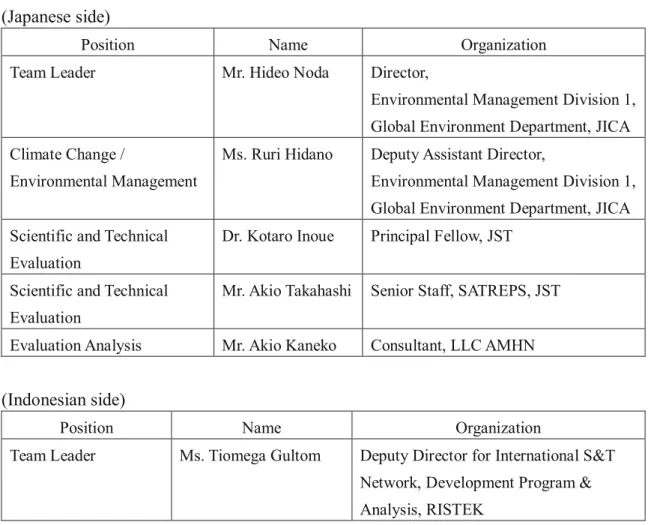
The Midterm Review was conducted by a team whose members are from both Japan and Indonesia as shown in Table 1-1.
Table 1-1 Members of the Midterm Review Team (Japanese side)
Position Name Organization
Team Leader Mr. Hideo Noda Director,
Environmental Management Division 1, Global Environment Department, JICA Climate Change /
Environmental Management
Ms. Ruri Hidano Deputy Assistant Director,
Environmental Management Division 1, Global Environment Department, JICA Scientific and Technical
Evaluation
Dr. Kotaro Inoue Principal Fellow, JST Scientific and Technical
Evaluation
Mr. Akio Takahashi Senior Staff, SATREPS, JST Evaluation Analysis Mr. Akio Kaneko Consultant, LLC AMHN
(Indonesian side)
Position Name Organization
Team Leader Ms. Tiomega Gultom Deputy Director for International S&T Network, Development Program & Analysis, RISTEK
1-3 Schedule of the Midterm Review
The Midterm Review was conducted from June 5, 2012 to June 12, 2012 along with a schedule as shown in Table 1-2.
Table 1-2 Midterm Review schedule
Date Schedule
June 5 (Tue) -Meeting with Mr. Tomoyuki Tada, Senior Representative in JICA Indonesia Office
-Visit to Serpong, future MCCOE building, buoy factory and radar site -Interview with Indonesian Experts for Output 3
June 6 (Wed) -Interview with Indonesian Group Leaders for Output 1 to 6 from BPPT, BMKG and LAPAN
-Meeting with Dr. Ridwan Djamaluddin, Deputy Chairman, BPPT June 7 (Thu) -Meeting with Dr. Marzan Aziz Iskandaor, Chairman, BPPT
-Meeting with Prof. Amin Soebandrio, Deputy Minister and Ms. Tiomega Gultom, RISTEK
-Interview with Japanese Experts June 8 (Fri) -Discussion for Midterm Review Report
-Meeting with Mr. Masato Kawanishi, JICA Expert in “the Project of Capacity Development for Climate Change Strategies in Indonesia” June 9 (Sat) -Work on Midterm Review Report
June 10 (Sun) -Work on Midterm Review Report
June 11 (Mon) -Final Discussion for Midterm Review Report with BPPT (Dr. Sadly and Dr. Fadli) and RISTEK (Ms. Tiomega)
June 12 (Tue) -Confirmation of Midterm Review Report on the 3rd Joint Coordinating Committee of the Project
1-4 Outline of the Project
2. Methodology of the Midterm Review
2-1 Criteria for Evaluating Development Assistance
When evaluating programs and projects it is useful to consider the following DAC Criteria, as laid out in the DAC Principles for Evaluation of Development Assistance. JICA is also following these criteria for Official Development Assistance evaluation. Table 2-1 Five (5) Criteria for Evaluation
Criteria Evaluation
Relevance The extent to which the aid activity is suited to the priorities and
policies of the target group, recipient and donor. In evaluating the relevance of a program or a project, it is useful to consider the following questions:
To what extent are the objectives of the program still valid?
Are the activities and outputs of the program consistent with the overall goal and the attainment of its objectives?
Are the activities and outputs of the program consistent with the intended?
Effectiveness A measure of the extent to which an aid activity attains its
objectives.
In evaluating the effectiveness of a program or a project, it is useful to consider the following questions:
To what extent were the objectives achieved / are likely to be achieved?
What were the major factors influencing the achievement or non-achievement of the objectives?
Efficiency Efficiency measures the outputs -- qualitative and quantitative -- in
relation to the inputs. It is an economic term which signifies that the aid uses the least costly resources possible in order to achieve the desired results. This generally requires comparing alternative approaches to achieving the same outputs, to see whether the most efficient process has been adopted. When evaluating the efficiency of a program or a project, it is useful to consider the following questions:
Were activities cost-efficient? Were objectives achieved on time?
compared to alternatives?
Impact The positive and negative changes produced by a development
intervention, directly or indirectly, intended or unintended. This involves the main impacts and effects resulting from the activity on the local social, economic, environmental and other development indicators. The examination should be concerned with both intended and unintended results and must also include the positive and negative impact of external factors, such as changes in terms of trade and financial conditions. When evaluating the impact of a program or a project, it is useful to consider the following questions: What has happened as a result of the program or project?
What real difference has the activity made to the beneficiaries? How many people have been affected?
Sustainability Sustainability is concerned with measuring whether the benefits of
an activity are likely to continue after donor funding has been withdrawn. Projects need to be environmentally as well as financially sustainable. When evaluating the sustainability of a program or a project, it is useful to consider the following questions: To what extent did the benefits of a program or project continue after donor funding ceased?
What were the major factors which influenced the achievement or non-achievement of sustainability of the program or project?
(Source : http://www.oecd.org/dac/evaluation/)
2-2 Methods of the Midterm Review and the Data Collection
(1) Collect necessary data for the review through reports, documents, questionnaires and interviews to focal persons (see Annex 2).
(2) Review the program and the process of inputs, activities and outputs. (3) Evaluate the Project by five (5) evaluation criteria.
(4) Draw conclusions and make recommendations for the Project
(5) Make "Midterm Review Report" for the confirmation in JCC members. 2-3 Limits and Constraints of the Midterm Review
Due to time and resource constraints, it was not possible to interview all the Japanese experts and the Indonesian experts who were involved in the Project implementation. Efforts were made, however, to gather the information by literature
review or by interviewing other personnel in a similar field so as to reduce possible sample biases. The Midterm Review Team was able to gather data from the core members of the Project. Therefore, it is reasonably said that the information collected within the evaluation framework maintains a substantial level of reliability and validity.
3. Current Progress and Achievements 3-1 Input of the Project
(1) Japanese side (see Annex 3) (a) Japanese experts
One (1) long-term expert as a Project Coordinator has been dispatched since July, 2010.
Total number of 17 short-term experts has been dispatched 83 times since June, 2010.
(b) Training in abroad
Total 25 Indonesian experts were dispatched to Japan for trainings including two (2) Indonesian experts who participated in the on-board training by the Oceanographic Research Vessel "MIRAI."
Total 4 Indonesian experts were dispatched to Germany for MP radar training. (c) Provision of machinery and equipment
Equipment such as MPR and Buoy equivalent to approx. IDR 3,206,000,000 (equivalent to about JPY 3 million) in JFY 2010 and approx. IDR10,024,000,000 (equivalent to about JPY 100 million) in JFY 2011 was provided.
(d) Local cost born by Japanese side
IDR 1,938,336,103 in JFY 2010 and IDR 4,323,120,747 in JFY 2011 were provided
Operational and maintenance cost for four (4) radars (XDR in Padang, three (3)
WPRs in Manado, Pontianak and Biak1) has been borne until March, 2012. Originally
it was expected to complete the granting process by that time. However, there has been a delay in the process and final procedures are now being taken by the Indonesian Government.
(2) Indonesian side (see Annex 4) (a) Indonesian experts
Total 99 Indonesian experts have been allocated 35 from BPPT, 34 from BMKG, 26 from LAPAN, 2 from RISETK and 2 from BRKP.
1 XDR and three (3) WPRs were originally assets of MEXT. CDR and XDR have been utilized for the Project
activities to obtain the data of rainfall distribution. WPRs have been utilized for window profiling. Granting process of those radars from Japanese Government to Indonesian Government is almost completed. CDR, an asset of JAMSTEC, will also soon be transferred to BPPT after the completion of the above process.
(b) Provision of facilities
Office space and utilities at BPPT building in Jakarta and PUSPIPTEK in Serpong were properly provided.
(c) Local cost born by Indonesian side
Voyage expenses for buoy deploy/recovery training approx. IDR 324,000,000 in Indonesian fiscal year 2011 was provided.
The operational and maintenance costs for the radars will be borne by Indonesian side after April, 2012.
3-2 Current Progress and Achievements 3-2-1 General
Outputs of this Project were originally set in chronological order when the Project started. In the reality, activities related to Output 1 to consider and propose the possible vision and structure of MCCOE have not formally started yet. The intensive discussions will soon be started in parallel with other activities implementation.
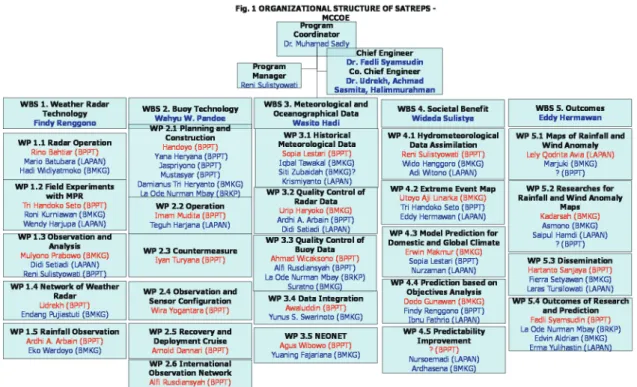
Fig. 1 is a diagram of the Indonesian experts participating in the Project. Work Breakdown Structure (WBS) was made by the Indonesian side to clarify the roles and responsibilities among Indonesian experts. WBS 1 to 5 are basically corresponding to Output 2 to 6 accordingly.
3-2-2 Output 1
There is a program under the Indonesian Government to establish MCCOE as a laboratory under GEOSTECH of BPPT. A new building for GEOSTECH has been constructed since February 2012 in a corner of the PUSPIPTEK in Serpong, which is expected to be completed by the end of 2012. BPPT is the only responsible agency for the construction with the Indonesian Government budget.
The Project is expected to provide necessary advice for the establishment of MCCOE to become a firm institution contributing to the Indonesian society as well as the international society.
(a) Current Progress
Vision, mission and an organizational structure of MCCOE will be considered by running activities for Output 2 to 6 during the second half of the Project and will be one of the main agenda for next year’s JCC.
(b) Achievement
Symposium and workshops with the topic of Climate Variability issues were held three (3) times.
3-2-3 Output 2 (a) Current Progress
Usually, operation of the radars does not require many staffs so that Japanese experts have been transforming the operational skills to some core members of the Indonesian experts. They learned how to utilize five (5) radars (CDR, XDR, and three (3) WPRs) by series of trainings. Radars are now ready for the operation and data release to the public. It is expected that those core members will transfer their knowledge to other Indonesian experts during the second half of the Project.
MPR has been procured by the Project. This radar is the first radar implemented in the Equatorial tropics region of South-East Asia, in a high temperature and a high humidity environment. Field experiments were conducted in December 2011 in West Sumatra. The verification of the obtained data has been done by comparing with the in-situ data from weather stations and rain gauges deployed both by BMKG and the Project. This activity is the basis for QPE and QPF in the activity of Output 5.
(b) Achievement
has been successfully operated for the first time in Indonesia. 3-2-4 Output 3
(a) Current Progress
After the huge tsunami hit the coast of Sumatra in 2004, the Indonesian Government has instructed BPPT to develop the tsunami buoy. Deployment of tsunami-buoy, named as Ina Buoy, was started five (5) years ago in 2008. BPPT has been appointed to enforce the capacity for tsunami-buoy operation and there are more than 50 staffs dedicated to the buoy operation. With the past experiences, the Indonesian experts were able to smoothly join the activities for Output 3, even though there is a difference between tsunami-buoy and ocean-climate buoy.
Activities are almost on schedule. Series of on-site and on-board trainings for the construction and deployment of ocean-climate buoy have been conducted in Japan as well as in Indonesia.
(b) Achievement
The first ocean-climate buoy, named as Ina TRITON buoy has been developed consisting of mooring gears including surface buoy and meteorological and underwater sensors. Data of four (4) underwater parameters; temperature, depth, salinity and current and six (6) atmospheric parameters; wind, temperature, relative humidity, precipitation, atmospheric pressure and shortwave radiation are obtained by using iridium satellite communication system. The Ina TRITON buoy is optimized and adjusted by the collaboration of the Japanese and the Indonesian experts. Through this work, Indonesian experts are now able to construct, deploy and recover the Ina TRITON buoy by themselves.
Countermeasures for the vandalism were developed by covering the sensors. 3-2-5 Output 4
(a) Current Progress
CDR data have been transformed and disseminated as information on rainfall distribution over Jakarta and its vicinity in every six (6) minutes. With the guidance of the Japanese experts, the Indonesian experts analyzed CDR data and innovated the
system called SIJAMPANG2 in May, 2010. It is published through the website of BPPT
and socialized by using the social media. The system can integrate the real weather information sent from people by SMS. The system is also helpful for flood warning in
Jakarta and its vicinity. Data from other four (4) radars have been archived.
Historical meteorological data in BMKG have been digitalized. Oceanographical data will be obtained after deployment of the Ina TRITON buoy.
(b) Achievement
Historical meteorological data have been collected from 107 stations so far and put into a database. In the original plan, it was expected to collect the data from 200 stations but currently it seems that data are available in only 185 stations.
The project contributed to initiate the rainfall information system of SIJAMPANG, a prototype of QPE by transforming necessary data from CDR.
A computer program for the quality control of the real time data of the Ina TRITON buoy has been developed and waiting for the examination.
3-2-6 Output 5 (a) Current Progress
Activities related on QPF have been just started. NHM has been selected for experimental short-term rainfall forecast.
(b) Achievement
There appears no particular achievement yet. 3-2-7 Output 6
(a) Current Progress
Results of calculation of SINTEX-F model has been compared with those of LAPAN model for predicting rainfall over rice production areas in Indonesia. Key technologies for 3-month-prediction by the Japanese side and 6-month-prediction by Indonesian side are now being developed.
(b) Achievement
It has been found that the 3-month-prediction for the rainfall by SINTEX-F is applicable with significant correlations (0.6) for June-November at least at three (3) locations among eleven (11) rice production centers.
3-3 Process of the Project Implementation
(1) Indonesian experts from BMKG, LAPAN and BRKP are participating in the Project based on the CRA signed between BPPT and JAMSTEC. With time and distance
constraints among agencies, it has been difficult to hold regular meetings and to spare enough time for the Project.
(2) Activities in Output 1 were expected to start from the first year of the Project; however intensive discussions to consider and propose the framework of MCCOE will start from now on. Various activities subject to MCCOE have been forced to be implemented along with the tentative framework of MCCOE.
(3) MPR was procured just in time for its scheduled operation for the Project, although towing-truck is still yet to be delivered. Therefore, other arrangements for MPR transportation had to be made with additional cost.
4. Results of the Midterm Review 4-1 Relevance
Relevance of this project is high. Climate variations are focusing on the short-term period of Climate Change whose policies are shown in (1) and (2). They align with Japanese ODA policy to Indonesia as shown in (3). Furthermore, after the Project commencement, Presidential instruction was given to deal with the extreme climate condition such as (4). Indonesian government has also the policy to establish Center of Excellence; COE as shown in (5).
(1) Regulation of the President of the Republic of Indonesia “National Medium-Term Development Plan 2010-2014” describing Climate Change as one of the important issues to be tackled
(2) “National Action Plan Addressing Climate Change” issued in 2007 from KLH (3) Japanese ODA policy towards Indonesia stating Climate Change as one of the main
areas to be focused
(4) Presidential Instruction of the Republic of Indonesia “National Security of Rice Production in Anticipating Extreme Climate Condition” issued in March 2011 (5) Science and Technology Policy issued in 2010 from RISTEK
4-2 Effectiveness
Effectiveness of the Project is fair to high.
(1) Prospect of the achievement of the project purpose
The project purpose is “by optimizing atmospheric and oceanic observation networks and utilizing observational data, research and development for improving predictability of extreme weather/climate variations and drawing up strategy to mitigate rainfall disasters are promoted, and the outcomes are published internationally.”
It is observed that the technical transfer from Japanese experts to Indonesian experts has been smoothly conducted so far especially in the areas of the buoy construction and radar operation. As for activities of Output 1, the implementation schedule have been changed from the original PO, however the Project is moving forward to speed up the process from now on.
The main challenges lie in the fact that for the second half of the Project period, the Project needs first to set up the clear goal for the minimum requirement for the predictability improvement of extreme weather/climate events and go forward to achieve the goal with all the Project members.
(2) Project management system
The Project benefits from the fact that the Team leader of the Japanese experts stays almost half a year in Indonesia and directly communicating with the Indonesian experts. However, because of the fact that several organizations are involved in project activities, it has been difficult for the Project to organize regular project meetings attended by many of the stakeholders. Those meetings are usually held on an ad-hoc basis with a small number of participants working in a specific field. Therefore, it is rather difficult for the Project to accurately comprehend the Project’s overall progress and to grasp the interrelations among each Output as well as each activity. It is recommended that meetings be held on a regular basis so that the latest information on the Project’s progress would be shared among stakeholders and the directions toward the achievement of the Project purpose would be exchanged and discussed.
4-3 Efficiency
Efficiency is fair.
(1) Provision of inputs – the Japanese side
Through interviews with the Indonesian experts, it is confirmed that the areas of expertise of the Japanese experts are well covering the needs of the Indonesian side and the dispatch was done in a timely manner. Much closer communications, for example to share the image of the purpose of the specific activity and its process before coming to Indonesia, will contribute to smoother implementation.
The procurement of MPR, which was relatively difficult, was successfully conducted with some margin of time and its operation started almost on schedule.
(2) Provision of inputs – the Indonesian side
A total of 99 Indonesian experts including those from cooperating agencies are appointed to work with the Japanese expert team and around 30 people are the core members including 20 people of buoy engineers working for Output 3. It was found that huge differences of contributions among experts exist. Especially cooperating agencies such as BMKG and LAPAN have to spend a substantial amount of time for other work assignments. It may be worth clarifying the roles and responsibilities of the group-leaders at first and also promoting the team building of each group.
Another issue is that leaves, transfers and resignations of the experts who had already received some amount of technical transfer, influenced efficient capacity development activities.
side from April 2012, however due to lack of necessary arrangements, the operation of four radars have been stopped one by one since April 2012 and are not in use at this moment. Although it does not directly affect the project activities, it is crucial for the high accuracy prediction of extreme weather/climate events to have seamless data collection.
(3) Contributing and hindering factors to efficiency
It is worth mentioning that Indonesian experts in general have strong motivation to realize the societal benefits, which is giving positive impacts on efficiency. Also some highly skilled professionals of IT sector are greatly contributing to innovate and improve the system of societal dissemination tool such as SIJAMPANG.
As for a hindering factor to efficiency, changes of the schedule of activities related to Output 1, as explained earlier, can be pointed out as the main cause which is also related to the insufficient coordination and lack of understandings of the Project purpose by the members of cooperating agencies.
4-4 Impact
Positive impacts such as SIJAMPANG appeared so far. There was a concept before the commencement of the Project but it is worth mentioning that SIJAMPANG realized during the Project.
The overall impacts of the Project are unknown at this stage. 4-5 Sustainability
Sustainability of the Project will highly depend on MCCOE establishment, where details are still unclear at the moment.
5. Conclusions
For the achievement of the project purpose, project activities have been conducted well in general along with PO, which was properly revised in the past two (2) JCC meetings. Activities of Output 1 were expected to start from the early stage of the Project; however the Project will foster the common sense of a concrete image of MCCOE from now on.
Among six (6) outputs which are to contribute to the achievement of the Project purpose, Output 2 and Output 3 have been mostly achieved, while other outputs are to be achieved with further activities.
Generally, based on the five evaluation criteria, it is concluded that the Relevance of the Project is high, Effectiveness is fair to high, and Efficiency is fair so far.
The Project purpose is expected to be achieved to a certain degree by the end of the Project period with higher prospect if the following recommendations proposed below are properly addressed.
6. Recommendations (1) Revision of Master Plan
Indicators for Project purpose should be set immediately in JCC based on the Minutes of Meetings signed on August 12, 2009 in the Detailed Planning Survey of the Project as follows;
a. Institutional and organizational mechanism of MCCOE is functioned.
b. Societal application of research on climate variations is newly introduced in Indonesia.
Also, other tentative indicators should be determined until the end of 2012. (2) Vision, mission, and organizational structure of MCCOE
It is recommendable for the Project to start the consideration of the vision, mission, and a possible organizational structure of MCCOE with enough consultation among both Indonesian and Japanese experts as soon as possible, and it is encouraged to make a proposal by the time of JCC in 2013. Such proposal is helpful to motivate and guide the members of the Project toward the common goal. In the latter half of the Project, periodical meetings among at least group leaders of the Indonesian and the Japanese side will play an important role to develop the backbone of the institutional framework of MCCOE. Contributions of this project to the foundation of MCCOE should be more specific.
(3) Commitment of cooperating organizations
It is suggested that necessary arrangements will be taken by mainly group leaders for the experts coming from BMKG and LAPAN so that their experts can be more involved in the Project.
(4) Clear common understandings of the outcomes of the Project
Indonesian side places high importance on deriving the outcomes for societal benefits. Providing high accuracy of the short term rainfall predictions and flooding alarms is one of the main goals of the Project and also enabling longer term rainfall predictions in rice production centers is the other purpose of the Project. Sometimes achieving societal benefits needs different vectors from the pure science and application development and/or capacity development of the working-levels are also required. It is suggested that the Project will share the common sense of the Project purpose by balancing different vectors and by efficient allocation of the resources.
term and area of rainfall forecast systems should be shown concretely and quantitatively. It is very important to share the project goal clearly among each group and each expert. Sharing information among different groups and also among experts in the same group are encouraged to improve the efficiency of the teamwork and to strengthen the cross-cutting relationships among five (5) groups as well as experts.
Annex 1 Outline of the Project (1) Country: Republic of Indonesia
(2) Project Title: Climate Variability Study and Societal Application through Indonesian-Japan “Maritime Continent COE”-Radar-Buoy Network Optimization for Rainfall Prediction
(3) Cooperation Scheme: Technical Cooperation Project
(4) Total Cost (at the time of the Midterm Review): Approximately JPY 398,615,000 (5) Period of Cooperation: From April 1, 2010 to March 31, 2014
(6) Responsible Agency: JICA (Japan), BTTP (Indonesia) (7) Master Plan
1. Project Purpose
By optimizing atmospheric and oceanic observation networks and utilizing observational data, research and development for improving predictability of extreme weather/climate variations and drawing up strategy to mitigate rainfall disasters are promoted, and the outcomes are published internationally.
2. Outputs and Activities
1) Institutional framework for MCCOE such as organization, personnel and budget is prepared.
Indicators (tentative)
1-1. Conference and seminars on climate variations are organized by MCCOE at least once a year, and the number of participants is more than 100.
1-2. More than XX (number) staffs are assigned in MCCOE by the end of the project.
1-3. At least one administrative document showing the organization chart, staff assignment and budget plan is issued by the end of the project.
Activities
(1-1) Organizational structure and personnel are prepared for establishing MCCOE. (1-2) Operation plans for MCCOE are prepared.
(1-3) Inter-ministry coordination framework for MCCOE is established. (1-4) International coordination framework for MCCOE is established.
(1-5) Frameworks established in (1-3) and (1-4) are periodically reviewed and revised.
2) Technology to observe and predict short-term climate and rainfall variations with high accuracy is established in MCCOE through optimized radar-profiler network. Indicators (tentative)
2-1. At least one meteorological radar is operated and maintained by Indonesian side by the third year of the project.
2-2. Rainfall observation with high accuracy through the optimized network is planned and implemented more than once a year in rain season by the Indonesian researchers in MCCOE by the third year of the project.
Activities
(2-1) Radar operation and application technology is transferred.
(2-2) Field experiments with the mobile Multi Parameter (MP) radar are implemented and concrete observation points and methodology for Quantitative Precipitation Estimation (QPE) are proposed.
(2-3) Observation and analysis of extreme events are conducted.
(2-4) Network of meteorological radars and wind profilers is optimized.
(2-5) Rainfall observation with high accuracy through the optimized network is planned and implemented by the Indonesian researchers in MCCOE.
3) Observation technology to predict short-term climate variations is established in MCCOE through observation network.
Indicators (tentative)
3-1. One ocean observation site is operated and two buoys are maintained by Indonesian side by the third year of the project.
3-2. Periodical maintenance cruise is conducted once a year. Activities
(3-1) Buoy planning and construction technology is transferred and two buoys are developed.
(3-2) Buoy operation technology is transferred and capacity building cruise is implemented.
(3-3) Countermeasure technology against vandalism is developed.
(3-4) Observation parameters and buoy sensor configuration are optimized.
(3-5) International Ocean Observational Buoy Workshop is held by MCCOE and MCCOE participates in the international surface buoy array project as buoy provider.
(3-7) Optimized buoy observations as a part of the international observation network are operated by the Indonesian researchers in MCCOE continuously, and data necessary for short-term climate prediction are provided.
4) Technology of quality control, archiving, analysis of the meteorological and oceanographical observation data and dissemination to Indonesian society is established by collaborative research in MCCOE.
Indicators (tentative)
4-1. Climate database for at least two hundred stations is established by the second year of the project.
4-2. Radar-profiler data at 5 stations are opened public by Indonesian side by the third year of the project.
4-3. One buoy site data is opened to public by Indonesian side, by two and half years after the project commencement.
Activities
(4-1) Historical meteorological data (e.g. , rainfall), climate-related records, results of environmental observation and social indices (e.g., flood, draught, forest fire, crop production, etc.) are collected and analyzed.
(4-2) Quality control of radar data is conducted.
(4-3) Analysis and quality control of buoy data acquired in the Indonesian EEZ is conducted.
(4-4) Data in (4-1), (4-2) and (4-3) are provided to NEONET and opened to domestic and global communities.
5) Data collected through output 4 are transferred to information applicable to society and societal application is developed.
Indicators (tentative)
5-1. More than five papers for refereed international journals are published yearly during the last two years of the project.
5-2. Quantitative Precipitation Forecast (QPF) ad extreme event maps are produced for at least two regions by the third year of the project.
5-3. Detection of torrential rainfall is achieved for MCCOE observation sites by the third year of the project.
5-4. Nowcasting of torrential rainfall is achieved for MCCOE observation sites by the third year of the project.
Activities
(5-1) Hydrometeorological data assimilation for QPF model is conducted, by which warning system for heavy rain and drought is proposed.
(5-2) Extreme events maps are produced based on results of radar observation and regional modeling.
(5-3) Cause of climate variations in Indonesia region and importance of the Indonesian maritime continent on global climate are understood, through which the prediction models for domestic and global climate variations are improved. (5-4) Prediction based on objective analysis incorporating Indonesian data is
compared with observations in Indonesia and other countries.
(5-5) Predictability improvement by the observation optimization is demonstrated. 6) Outcomes associated with research and prediction of short-term climate variations
including intraseasonal variation, El Nino, Indian-Ocean dipole mode will be obtained through collaboration is MCCOE.
Indicators (tentative)
6-1. More than five papers for refereed international journals are published yearly during the last two years of the project.
6-2. Hazard maps associated with development phase of NESO/IOD are made for the maritime continent by two and half years after the project commencement. 6-3. Detection of anomalous oceanic thermal conditions is achieved in the Pacific
and Indian Oceans by two and half years after the project commencement. Activities
(6-1) Maps of rainfall and wind anomaly for each region and for each phase of El Nino and Indian-Ocean dipole mode are developed by analyzing data of global air-sea coupling prediction models such as SINTEXF.
(6-2) Based on objective analysis such as JRA25 and NCEP, researches for rainfall and wind anomaly map are conducted and the scientific and social importance of the anomaly maps is clarified.
(6-3) Method of information transmission to utilize the anomaly maps as a hazard map is proposed, and the most effective and scientifically trustworthy hazard maps are created based on the prediction results.
(6-4) Outcomes of research and prediction based on the data acquired from the buoy observations in the Indonesian EEZ are published towards the world.
Annex 2 List of Interviewees (Japanese Experts)
No. Name Duty on the Project Organization
1 Dr. Manabu Yamanaka Project Leader JAMSTEC
2 Dr. Keisuke Mizuno Advisor JAMSTEC
3 Dr. Shuichi Mori Sub-Leader, Output 2 JAMSTEC
4 Dr. Yasuhisa Ishihara Sub-Leader, Output 3 JAMSTEC
(Indonesian Experts)
No. Name Duty on the Project Organization
1 Dr. Fadli Syamsudin Project Manager BPPT
2 Dr. Udrekh Network Engineer BPPT
3 Mr. Ardhi Adhary Arbain Radar Engineer BPPT
4 Dr. Wahyu Pandoe Group Leader, Output 3 BPPT
5 Dr. Yunus Subagiyo Group Leader, Output 4 BMKG
6 Ms. Nelly Florida Riama Meteorology BMKG
Annex 3 List of Inputs from Japanese side (1) Dispatch of Japanese Experts
(Long-term Expert)
No. Name Duty on the
Project Organization Period MM
1 Ms. Chiaki Fukuda Project
Coordinator JICA 2010/07/08 – up to now 23.0
(Short-term Experts)
No. Name Duty on the Project Org. Period MM
1 Dr. Manabu Yamanaka Project Leader
SL - OP 1, 5 J 2010/06/01-06/16 2010/06/29-07/14 2010/07/26-08/25 2010/11/09-11/27 2010/12/12-12/24 2011/01/17-01/26 2011/02/14-02/23 2011/03/10-03/12 2011/03/22-03/31 2011/04/01-04/02 2011/04/13-04/30 2011/05/08-06/01 2011/06/08-06/29 2011/07/05-07/23 2011/08/02-08/26 2011/09/19-09/30 2011/10/10-11/10 2011/11/12-12/20 2012/01/03-01/13 2012/01/24-02/18 2012/02/28-03/13 2012/03/25-03/31 2012/04/17-05/17 2012/06/03-06/10 14.63
2 Dr. Keisuke Mizuno Advisor / Ocean Climate SL - OP 6 J 2010/06/06-06/11 2010/09/26-09/30 2011/5/17-05/21 2012/06/09-06/14 0.90
3 Dr. Shuichi Mori Radar Meteorology SL - OP 2, 4 PC - OP 5 J 2010/06/05-06/14 2011/05/19-05/26 2011/09/13-09/19 2011/10/22-11/16 2011/11/23-12/03 2011/12/08-2012/01/05 3.03
4 Dr. Hiroyuki Hashiguchi Radar Engineering
SL - OP 2 KT 2010/07/25-08/01 2010/11/30-12/10 2011/02/26-03/09 2011/07/02-07/07 2012/01/04-01/15 2012/02/26-03/08 2.03
5 Dr. Kentaro Ando Ocean Climate SL - OP 4 PC - OP 3, 6 J 2010/06/06-06/12 2011/05/08-05/11 2011/10/10-10/13 2012/03/11-03/14 2012/06/09-06/14 1.00
6 Dr. Iwao Ueki Ocean Data Quality
Control PC - OP 4 J 2010/06/07-06/12 2011/02/27-03/05 2012/03/04-03/10 0.67 7 Dr. Yasuhisa Ishihara Buoy Engineering
SL - OP 3 J 2010/06/06-06/12 2011/04/24-05/11 2011/11/06-11/10 2012/03/11-03/17
1.23
8 Mr. Takeo Matsumoto Buoy and Sensor Operation PC - OP 3 M 2010/06/06-06/12 2011/04/24-05/11 2011/11/06-11/10 2012/03/11-03/17 1.23
9 Dr. Jun-ichi Hamada Meteorological Database PC - OP 4 J 2010/07/24-08/06 2010/12/11-12/19 2011/02/20-02/27 2011/03/20-03/29 2011/07/17-07/30 2011/09/21-09/30 2011/11/20-2012/01/05 3.73
10 Mr. Hideyuki Kamimera Radar Meteorology
PC - OP 4 / 5 J 2010/07/24-07/31 2011/02/20-02/27 2011/07/17-07/30 2011/10/22-11/13 2011/11/20-2012/01/05 5.20 11 Mr. Masayuki
Yamaguchi Buoy Engineering PC - OP 3 J 2010/06/06-06/12 2011/04/24-05/11 2011/11/06-11/10 2012/03/11-03/17
1.23
12 Dr. Yuji Kashino Ocean climate
PC - OP 1, 6 J 2011/03/06-03/17 2012/03/11-03/24 0.87 13 Mr. Tatsuno Fukuda Buoy Engineering
PC - OP 3 J 2010/06/06-06/12 2011/04/24-05/11 2012/03/11-03/17
1.07 14 Dr. Tomosaki Mega Radar Engineering
PC - OP 2 KT 2010/11/30-12/25 0.87
15 Dr. Peiming Wu Regional Modeling
SL - OP 5 J 2011/11/20-2012/01/05 1.57 16 Dr. Miki Hattori Regional Modeling
PC - OP 5 J 2011/11/27-2012/01/05 1.33 17 Ms. Naoko Miyamoto Planning and
Coordination J 2010/06/06-06/12 2011/05/17-05/21 2012/06/03-06/13
0.77
SL: Sub-Leader, PC: Person in charge, OP: Output
J: JAMSTEC, KT: Kyoto University, M: Marine Works Japan, Ltd., KB: Kobe University
(2) Training of Indonesian Personnel in Japan
Training Course Period Indonesian Experts
Data analysis 2010.09.26 ~
2010.11.27 Mr. Awaluddin (BPPT)
Buoy technology 2010.09.26 ~2010.10.09 Mr. Iyan Taryana (BPPT) Mr. Bondan Suwandi (BPPT) (IOC 50 year anniversary
symposium)*
2010.11.27 ~ 2010.12.04
Dr. Ridwan Djamaluddin (BPPT) Dr. Eddy Hermawan (LAPAN) Dr. Muhamad Sadly (BPPT) Dr. Wahyu Pandoe (BPPT) (IOC 50 year anniversary
symposium)*
2010.11.30 ~
2010.12.05 Dr. Andy Eka Sakya, M. Eng (BMKG) Buoy technology 2011.02.07 ~
2011.02.19
Mr. Arnold Dannari, S.T (BPPT) Mr. Sidarto Handoyo, B.E (BPPT)
Buoy technology 2011.07.10 ~2011.07.23
Mr. Wayan Wira Yogantara (BPPT) Mr. Muhammad Firdausi Manti (BPPT) Mr. Athur Yordan Herwindya (BPPT) Mr. Dwi Haryanto (BPPT)
Mr. Arfis Maydino Firmansyah Putra (BPPT) Mr. Bambang Subagyo (BPPT)
Mr. Yana Heryana (BPPT) Mr. Andrianshah Priyadi (BPPT) The Ocean and Earth
Research Vessel "Mirai" (in Japan and on the sea)
2011.08.09 ~ 2011.09.21
Mr. Arnold Dannari, (BPPT)
Mr. Jonasan Meiky Davis Rori (BPPT) (Meeting with JAMSTEC)* 2011.09.06 ~ 2011.09.10 Dr. Ridwan Djamaluddin (BPPT) Dr. Muhamad Sadly (BPPT) Mr. Yudi Anantasena (BPPT) Dr. Fadli Syamsudin (BPPT) Data analysis 2011.09.10 ~ 2011.10.08 Mr.Awaluddin (BPPT)
*: Regarded as a business trip without training
(3) Training of Indonesian Personnel in the third country
Training Course Period Indonesian Experts
MPR (in German) 2011.08.08 ~ 2011.08.19 Dr. Fadli Syamsuddin (BPPT) Mr. Ardhi A Arbain (BPPT) Mr. Findy Renggono (BPPT) Mr. Budi Santoso(BMKG)
(4) Provision of Machinery and Equipment
Ownership of machinery and equipment procured by overseas activity cost is belong to JICA
(JFY 2010)
(a) Procured by overseas activity cost
No. Machinery and Equipment (thousand) Unit Cost Q'ty (thousaTotal nd)
Delivered
Date Frequency of use* Condition* 1 Automatic Weather Station IDR14,880 5 74,400 2011/03/30 A A 2 HDD for WS (Data Analysis) IDR1,400 5 7,000 2011/03/21 A A 3 WS for Data Control/Analysis
IDR11,731 1 11,731
2011/02/21 A A
IDR32,536 1 32,536 IDR3,391 24 81,385
(b) Procured and transported from Japan
No. Machinery and Equipment (thousand) Unit Cost Q'ty (thousaTotal nd)
Delivered
Date Frequency of use* Condition* 1 XDR Spare Parts/Consumables JPY1,500 1 1,500 2011/02/18 A A 2 WPR Spare parts/consumables JPY1,000 1 1,000 2011/02/27 A A 3 Buoy system equipment JPY20,000 1 20,000 2012/03/12 A A 4 Navigation training buoy set (Rope and
others) JPY2,700 1 2,700 2011/04/26 A A
5 Navigation training buoy set (Body
glass ball) JPY120 12 1,440 2011/04/26 A A
*: A (Frequent/Good), B (Moderate), C (Not Frequent/Bad) (JFY 2011)
(a) Procured by overseas activity cost
No. Machinery and Equipment (thousand) Unit Cost Q'ty (thousanTotal d)
Delivered
Date Frequency of use* Condition* 1 Work Station for Data Analysis IDR12,180 2 24,360 20110/7/08 A A 2 Laptop PC for AWS Observation IDR4,750 3 14,250 2011/11/25 A A
3 Observation UPS (Manado, BMKG) IDR5,450 1 5,450 2011/10/29 A A 4 Releaser USD16.538 1 16.538 2012/03/27 A A 5 Iridium Transmitter USD2.864 1 2.864 2012/03/28 A A
(b) Procured and transported from Japan
No. Machinery and Equipment (thousand) Unit Cost Q'ty (thousanTotal d)
Delivered
Date Frequency of use* Condition* 1 Work Station for Data Analysis IDR12,180 2 24,360 20110/7/08 A A 2 Laptop PC for AWS Observation IDR4,750 3 14,250 2011/11/25 A A 3 Observation UPS (Manado, BMKG) IDR5,450 1 5,450 2011/10/29 A A 4 Releaser USD16.538 1 16.538 2012/03/27 A A 5 Iridium Transmitter USD2.864 1 2.864 2012/03/28 A A 6 Multi parameter Radar(MPR) JPY62,000 1 62,000 2012/03/12 A A 7 Radar Transportation JPY3,000 1 3,000 2012/3/12 A A 8 XDR Consumables / Spare Parts JPY1,500 2 3,000 2011/07/18 A A 9 WPR Consumables/ Spare Parts JPY1,000 1 1,000 2011/07/03 A A 10 Observation Consumables (Sonde) JPY28 200 5,600 2011/10/29 A A 11 Observation Consumables (balloon) JPY3 200 600 2011/10/29 A A 12
Buoy System Equipment
(Procured first half year of 2010 and delivered to Indonesia 2011)
JPY8,400 1 8,400 2012/03/12 A A 13 Buoy Equipment Transportation JPY2,000 1 2,000 2012/03/12 A A 14 XDR Maintenance Cost JPY1,500 1 1,500 2011/07/03 A A
(4) Expenditure of Local Cost
(IDR)
Local Cost JFY 2010 JFY 2011
Miscellaneous 1,607,692,803.00 2,204,309,919.00
Airfare 167,783,950.00 344,198,865.69
Travel Cost (excluding Airfare) 125,352,050.00 604,813,862.00
Fee & honorarium (for non-staff) 12,300,000.00 77,136,700.00
Refreshment 25,207,300.00 192,661,400.00
Annex 4 List of Inputs from Indonesian side (1) Assignment of Indonesian Experts
No. Name Organi- zation Position in the Project Responsible Output Work period 1 Prof. Dr. Jana T.
Angggadiredja, MS BPPT Chairperson - 2010/04 - 2010/06
2 Dr. Ridwan Djamarddin BPPT Chairperson 1 2011/07 - up to now
3 Dr. Muhammad Sadly, M. Eng. BPPT Project Director 1 2010/04 - up to now 4 Dr. Fadli Syamsudin BPPT Project Manager 1 2010/04 - up to now 5 Dr. Teguh Rahardjo RISTEK Representatiove of RISTEK - 2010/04 - 2011/04 6 Prof. Dr. M. Syamsa Ardisasmita, DEA RISTEK Representative of RISTEK 1 2011/05 - up to now 7 Drs. I. Putu Pudja, MM BMKG Group Leader of BMKG - 2010/04 - 2011/04 8 Dr. Andi Eka Sakya, M.Eng. BMKG Representative of BMKG 1 2010/04 - up to now 9 Drs. Afif BudionoMT , LAPAN Representatiove of LAPAN - 2010/04 - 2011/04 10 Dr. Afif Budiono LAPAN Representative of LAPAN 1 2011/05 - up to now
12 Dr. Putu Pudja BMKG Observer 1 2011/05 - up to now
13 Dr. Edvin Aldrian BMKG Observer, Climate Change 1, 3 2010/04 - up to now 11 Prof. Thomas Djamaluddin LAPAN Observer 1 2011/05 - up to now 14 Dr. Teguh Harjana LAPAN Observer, Sub-Leader 1, 4 2010/04 - up to now
15 Adi Witono LAPAN Hydrometeorology 5 2011/05 - up to now
16 Ahmad Wicaksono BPPT Sub. Leader 3.3, IT Engineer 4 2010/04 - up to now 17 Alfi Rusdiansyah, S.Si BPPT Sub. Leader 2.6, Quality Control Data 3, 4 2010/04 - up to now
18 Andrianshah Priyadi BPPT Buoy Engineer 3 2011/05 - up to now
19 Ardhasena BMKG Meteorology 5 2011/05 - up to now
20 Ardhi A. Arbain, S.Si BPPT Sub. Leader 1.5, Radar Engineer 2 2010/04 - up to now 21 Arfis Maydino Firmansyah Putra BPPT Buoy Engineer 3 2011/05 - up to now
22 Arief Suryantoro LAPAN Meteorology 5 2011/05 - up to now
23 Arnold Dannari, ST BPPT Sub. Leader 2.5, Instrument
Electronics 3 2010/04 - up to now
24 Asmono BMKG Meteorology 6 2011/05 - up to now
25 Athur Yordan Herwindya BPPT Buoy Engineer 3 2011/05 - up to now 26 Awalludin, S.Si BPPT Sub. Leader 3.4, Database Engieer 4 2010/04 - up to now
28 Bondan Suwandi BPPT System Engineer 3 2010/04 - up to now 29 Dadang Sobarna, M.Si LAPAN Atmospheric Modelling 5 2010/04 - 2011/04 30 Damianus Tri Heryanto BMKG Oceanography 3 2011/05 - up to now
31 Dr. Agus Wibowo BPPT Sub. Leader 3.5 4 2011/05 - up to now
32 Dr. Didi Setiadi LAPAN Sub-Leader, Atmospheric
Modeling 2, 5 2010/04 - up to now
33 Dr. Dodo Gunawan BMKG Sub. Leader 4.4 2, 5 2010/04 - up to now 34 Dr. Eddy Hermawan LAPAN Group Leader 5, Outcomes 6 2010/04 - up to now 35 Dr. Findy Renggono LAPAN Group Leader 1, Weather Radar
Technology 2 2010/04 - up to now
36 Dr. Imam Mudita BPPT Sub. Leader 2.2, Buoy Engieer - 2010/04 - up to now 37 Dr. Muhammad Firdausi Manti BPPT Buoy Engineer 3 2011/05 - up to now 38 Dr. Udrekh BPPT Sub. Leader 1.4, Network Engieer 2 2010/04 - up to now 39 Dr. Wahyu W. Pandoe BPPT Group Leader 2, Buoy Technology 3 2010/04 - up to now 40 Dr. Wira Yogantara BPPT Sub. Leader 2.4, Sensor Engineer 3 2010/04 - up to now 41 Dr. Yudi Adityawarman BPPT Radar Engineer 2 2010/04 - 2011/04 42 Dra. Nurhayati, M.Si BMKG Group Leader 4, Societal Benefit 4, 5 2010/04 - up to now 43 Drs. Achmad Sasmita BMKG Co. Chief Engineer of Indonesian team 1, 5 2010/04 - up to now 44 Drs. Rino Bahtiar, MT BPPT Sub. Leader 1.1, Radar Engineer 2 2010/04 - up to now 45 Drs. Wasito hadi, M.Sc BMKG Group Leader 3, Meteorological and
Oceanographical Data 4 2011/05 - up to now
46 Dwi Haryanto BPPT Buoy Engineer 3 2011/05 - up to now
47 Eko Wardoyo BMKG Radar Engineer 2 2011/05 - up to now
48 Endang Pujiastuti BMKG Network Engineer 2 2011/05 - up to now
49 Erma Yulihastin LAPAN Meteorology 6 2011/05 - up to now
50 Erwin Makmur BMKG Sub. Leader 4.3 5 2011/05 - up to now
51 Fiera Setiawan, Msi BMKG Meteorology 2 2010/04 - up to now
52 Fierra Setyawan BMKG Meteorology 6 2010/04 - up to now
53 Ginaldi Ari Nugrobo LAPAN Meteorology 4 2011/05 - up to now
54 Hadi Widiyatmoko BMKG Radar Engineer 2 2011/05 - up to now
55 Halimmurahman, MT LAPAN Co. Chief Engineer of Indonesian team 1 2011/05 - up to now 56 Hartanto Sanjaya, S.Si, M.Sc BPPT Sub. Leader 5.2, Remote Sensing
Specialist 6 2010/04 - up to now
58 Iqbal Tawakal BMKG Meteorology 4 2011/05 - up to now 59 Ir. Agus Wibowo, M.Si BPPT Network Engieer 4 2010/04 - up to now 60 Ir. Timbul Manik, M. Eng. LAPAN Radar Engineer 2 2010/04 - 2011/04 61 Iyan Turyana BPPT Sub. Leader 2.3, Buoy Engieer 3 2010/04 - up to now
62 Jaspriyono BPPT Buoy Engineer 3 2011/05 - up to now
63 Kadarsah, M.Sc BMKG Sub. Leader 5.1, Meteorology 6 2010/04 - up to now
64 Krismiyanto LAPAN Meteorology 4 2011/05 - up to now
65 La Ode Nurman Mbay, M.Si BRKP Buoy Engieer 3 2010/04 - up to now 66 La Ode Nurman Mbay, M.Si BRKP Buoy Engineer 3 2010/04 - up to now
67 Laras Tursilowari LAPAN Meteorology 6 2011/05 - up to now
68 Lely Qodrita Avia, M.Si LAPAN Atmospheric Modelling 6 2010/04 - up to now 69 Lely Qodrita Avia, M.Si LAPAN Sub. Leader 4.5 6 2010/04 - up to now
70 Mario Batubara LAPAN Radar Engineer 2 2011/05 - up to now
71 Marjuki BMKG Meteorology 6 2011/05 - up to now
72 Mr. Andri BMKG Meteorology 4 2010/04-2011/04
73 Mugni Hadi Haryadi, M.Sc BMKG Meteorology 4 2010/04-2011/04
74 Mulyono Prabowo BMKG Sub. Leader 1.3 2 2011/05 - up to now
75 Mustayar BPPT Buoy Engineer 3 2011/05 - up to now
76 Nelly Florida BMKG Meteorology 3 2010/04 - up to now
77 Nely Florida Rima, M.Si BMKG Meteorology 5 2010/04 - up to now
78 Nur Febrianti, S.Si LAPAN Meteorology 6 2011/05 - up to now
79 Nursoemakdi LAPAN Meteorology 5 2011/05 - up to now
80 Nurzaman LAPAN Meteorology 5 2011/05 - up to now
81 Reni Sulistyowati BPPT Sub. Leader 4.1 5 2010/04 - up to now
82 Reni Sulistyowati, S.Si BPPT Hydrometeorology Moedelling 1 2010/04 - up to now
83 Risyanto LAPAN Meteorology 2 2011/05 - up to now
84 Roni Kurniawan BMKG Meteorology 2 2011/05 - up to now
85 Saipul Hamdi LAPAN Meteorology 6 2011/05 - up to now
86 Sidarta Handoyo, B.Eng BPPT Sub. Leader 2.1, Buoy Engieer 2, 3 2010/04 - up to now
87 Siti Zubaidah BMKG Meteorology 4 2011/05 - up to now
88 Sopia Lestari BPPT Sub. Leader 3.1 4 2011/05 - up to now
89 Surantno BMKG Meteorology 4 2011/05 - up to now
90 Tri Handoko Seto, S.Si, M.Si BPPT Sub. Leader 1.2, Meteorology 2, 4, 5 2010/04 - up to now
91 Urip Haryoko, M.Si BMKG Meteology 2 2010/04 - up to now
92 Urip Haryoko, M.Si BMKG Sub. Leader 3.2 2 2010/04 - up to now 93 Utoyo Ajie Linarka BMKG Sub. Leader 4.2 5 2011/05 - up to now
95 Wido Hanggoro BMKG Hydrometeorology 5 2011/05 - up to now
96 Winarno, ST BPPT Telemetry Engineer 3 2010/04 - up to now
97 Yana Heryana BPPT Buoy Engineer 3 2011/05 - up to now
98 Yuaning Fajariana BMKG Network Engineer 4 2011/05 - up to now
-
67
-
Annex 5 Plan of Operation (PO)
Japan Indonesia 4 5 6 7 8 910 11 121 2 3 4 5 6 7 8 910 11 121 2 3 4 5 6 7 8 910 11 121 2 3 4 5 6 7 8 910 11 121 2 3
○ ○
1 M. Yamanaka Fadli Syamsudin (BPPT)
1-1 M. Yamanaka Deputy Chairman (BPPT)
1-2 M. Yamanaka Muhamad Sadly (BPPT),Putu Pudja (BMKG), Afif Budiono (LAPAN)
1-3 M. Yamanaka Muhamad Sadly (BPPT),Edvin Aldrian (BMKG), Teguh Harjana (LAPAN)
1-4 M. Yamanaka Fadli Syamsudin (BPPT), Nurhayati (BMKG), Achmad Sasmita (BMKG), Halimmurahman (LAPAN) 1-5 M. Yamanaka JCC
2 S. MoriH. Hashiguchi Findy Renggono (BPPT)
2-1 H. HashiguchiPost Doctoral Researcher
Rino Bahtiar (BPPT), Mario Batubara (LAPAN), Hadi Widiyatmoko (BMKG)
2-2 S. Mori Tri Handoko Seto (BPPT),Roni Kurniawan (BMKG), Wendy Harjupa (LAPAN)
2-3 S. MoriM. Hattori Mulyono Prabowo (BMKG),Didi Setiadi (LAPAN), Reni Sulistyowati (BPPT)
2-4 H. HashiguchiPost Doctoral Udrekh (BPPT),Endang Pujiastuti (BMKG)
Version 110518_1
Organizational structure and personnel are prepared for establishing MCCOE.
Unit Task
Outputs and Activities The Organ./Person in Charge
Observation and analysis of extreme events are conducted.
2013
Frameworks established in (1-3) and (1-4) are periodically reviewed and revised.
International coordination framework for MCCOE is established.
Field experiments with the mobile Multi Parameter (MP) radar are implemented and concrete observation points and methodology for Quantitative Precipitation Estimation (QPE) are proposed
Radar operation and application technology is transferred.
Institutional framework for MCCOE such as organization, personnel and budget is prepared.
Network of meteorological radars and wind profilers is i i d
2014
2010 2011 2012
Technology to observe and predict short-term climate and rainfall variations with high accuracy is established in MCCOE through optimized radar-profiler network. Mid-term review and Terminial Evaluation
Operation plans for MCCOE are prepared and implemented. Inter-ministry coordination framework for MCCOE is established.
2 4 Post Doctoral Researcher
Endang Pujiastuti (BMKG), Risyanto (LAPAN)
2-5 N/A Ardhi A. Arbain (BPPT),Eko Wardoyo (BMKG), Teguh Harjana (LAPAN) 3 Y. Ishihara Wahyu W. Pandoe (BPPT)
3-1
Y. Ishihara、 T.Fukuda T.Matsumoto, M.Yamaguchi
Handoyo, Yana Heryana, Jaspriyono, Mustasyar (BPPT),
Damianus Tri Heryanto (BMKG), La Ode Nurman Mbay (BRKP), Bambang Subagyo (BPPT), Andrianshah Priyadi (BPPT), Dwi Haryanto (BPPT) 3-2 Y. Ishihara、 T.Fukuda T.Matsumoto, M. Yamaguchi
Imam Mudita (Baruna Jaya, BPPT), Athur Y. Herwindya (BPPT) Muhammmad F. Manti (BPPT) Arfis M. F. Putra (BPPT) 3-3 Y. Ishihara、 T.Fukuda T.Matsumoto, M. Yamaguchi Iyan Turyana (BPPT), Bondan Suwandi (BPPT) 3-4 Y. Ishihara、 T.Fukuda T.Matsumoto, M. Yamaguchi Wira Yogantara (BPPT)
3-5 K. AndoY. Ishihara Fadli Syamsudin (BPPT)
3-6 N/A Arnold Dannari (BPPT)
3-7 N/A Alfi Rusdiansyah (Baruna Jaya, BPPT),Nelly Florida (BMKG)
Countermeasure technology against vandalism is developed. Buoy planning and construction technology is transferred and two buoys are developed.
Buoy operation technology including sensor calibration is transferred and capacity building cruise is implemented.
International Ocean Observational Buoy Workshop is held and the Indonesian Government participates in the international surface buoy array project as buoy provider. Buoy recovery and deployment cruise is implemented regularly.
Rainfall observation with high accuracy through the optimized network is planned and implemented by the Indonesian researchers in MCCOE
Optimized buoy observations as a part of the international observation network are operated by the Indonesian researchers in MCCOE continuously, and data necessary for short-term climate prediction are provided effectively.
Observation technology to predict short-term climate variations is established in MCCOE through optimized maritime observation network
optimized.
Observation parameters and buoy sensor configuration are optimized.
☆ ☆ ☆ ☆ 4 S. MoriK. Ando Wasito Hadi (BMKG)
4-1 J. Hamada
Sopia Lestari (BPPT), Iqbal Tawakal, Siti Zubaidah (BMKG), Krismiyanto (LAPAN)
4-2 S. MoriH. Kamimera Urip Haryoko (BMKG),Ardhi A. Arbain (BPPT), Didi Satiadi (LAPAN)
4-3 I.UekiR. Hidayat
Ahmad Wicaksono (BPPT), Alfi Rusdiansyah (BPPT), La Ode Nurman Mbay (BRKP), Suratno (BMKG)
4-4 M. YamanakaK. Ando
Awaluddin (NEONET, BPPT), Winarno (BPPT), Yunus S. Swarinoto (BMKG), Ginaldi Ari Nugroho (LAPAN)
4-5 N/A Agus Wibowo (BPPT),Yuaning Fajariana (BMKG)
☆ ☆ ☆
5 M. YamanakaP. Wu Nurhayati (BMKG)
5-1 S. MoriH. Kamimera Reni Sulistyowati (BPPT),Wido Hanggoro (BMKG), Adi Witono (LAPAN)
5-2 P. WuM. Hattori Utoyo Ajie Linarka (BMKG),Tri Handoko Seto (BPPT), Arief Suryantoro (LAPAN)
5-3 M. YamanakaS. Ogino Erwin Makmur (BMKG),Sopia Lestari (BPPT), Nurzaman (LAPAN)
Cause of climate variations in Indonesia region and importance of the Indonesian maritime continent on global climate are understood, through which the prediction models for domestic and global climate variations are
Data collected through output (4) are transferred to information applicable to society, and used for investigations to promote science and technology.
JICA Trainee: Master the buoy technology
Historical meteorological data (e.g., rainfall), climate-related records, results of environmental observation and social indices (e.g., flood, draught, forest fire, crop production, etc) are collected and analyzed
Quality control of radar data is conducted.
Hydrometeorological data assimilation for QPF model is conducted, by which warning system for heavy rain and drought is proposed
Extreme event maps are produced, based on results of radar observation and regional modeling.
JICA Trainee: Master the technology for data quality control.
Technology of quality control, archiving, analysis of the meteorological and oceanographical observation data and dissemination to Indonesian society is established by collaborative research in MCCOE.
Analysis and quality control of buoy data acquired in the Indonesian EEZ is conducted.
Database in (4-4) is provided to NEONET and opened to domestic and global communities.
Data in (4-1), (4-2) and (4-3) are integrated to unified database.
5-4 M. YamanakaS. Ogino Dodo Gunawan (BMKG),Findy Renggono (BPPT), Ibnu Fathrio (LAPAN)
5-5 M. Yamanaka Lukijanto (BPPT),Nursoemadi (LAPAN), Ardhasena (BMKG) 6 K. MizunoY. Masumoto Eddy Hermawan (LAPAN)
6-1 Y. MasumotoK. Ando R. Hidayat
Lely Qodrita Avia (LAPAN), Marjuki (BMKG), Nur Febrianti (LAPAN)
6-2 Y. MasumotoK. Ando R. Hidayat
Kadarsah, Asmono (BMKG), Saipul Hamdi (LAPAN)
6-3 K. MizunoK. Ando Hartanto Sanjaya (BPPT),Fierra Setyawan (BMKG), Laras Tursilowati (LAPAN)
6-4 K. Mizuno Y. Masumoto K. Ando Y Kashino Fadli Syamsudin (BPPT), La Ode Nurman Mbay (BRKP), Edvin Aldrian (BMKG), Erma Yulihastin (LAPAN)
☆
☆ ☆
Whole Japanese and Indonesian Whole Indonesian Radar Japanese and Indonesian Radar Indonesian Buoy Japanese and Indonesian Dissemination of anomaly hazard map is proposed in effective and scientifically reliable way. models for domestic and global climate variations are Prediction based on objective analysis incorporating Indonesian data is compared with observations in Indonesia and other countries
Maps of rainfall and wind anomaly for each region and for each phase of El Nino and Indian-Ocean dipole mode are developed by analyzing data of global air-sea coupling prediction models
Based on objective analysis, researches for rainfall and wind anomaly maps are conducted, and the scientific and social importance of the anomaly maps is clarified.
Outcomes of research and prediction based on the data acquired from the buoy observations in the Indonesian EEZ are published towards the world.
Outcomes associated with research and prediction of short-term climate variations including intraseasonal variation, El Nino, Indian-Ocean dipole mode will be obtained through collaboration in MCCOE.
JICA Trainee: Workshop in Japan
Predictability improvement by the observation optimization is demonstrated.
(1)日本人専門家
No. Name Duty on the Project Organization
1 Dr. Manabu Yamanaka Project Leader JAMSTEC
2 Dr. Keisuke Mizuno Advisor JAMSTEC
3 Dr. Shuichi Mori Sub-Leader, Output 2 JAMSTEC
4 Dr. Yasuhisa Ishihara Sub-Leader, Output 3 JAMSTEC
(2)インドネシア人専門家
No. Name Duty on the Project Organization
1 Dr. Fadli Syamsudin Project Manager BPPT
2 Dr. Udrekh Network Engineer BPPT
3 Mr. Ardhi Adhary Arbain Radar Engineer BPPT
4 Dr. Wahyu Pandoe Group Leader, Output 3 BPPT
5 Dr. Yunus Subagiyo Group Leader, Output 4 BMKG
6 Ms. Nelly Florida Riama Meteorology BMKG
7 Dr. Eddy Hermawan Group Leader, Output 6 LAPAN 2.インタビュー対象者
(1)日本人専門家 (a)長期専門家 No. 職名 職名 所属 期間 MM 1 福田 千秋 調整員 JICA 2010/07/08- 現在まで 23.0 (b)短期専門家 No. 職名 職名 所属 Period MM 1 山中 大学 研究代表者、研究統括 SL - OP 1, 5 J 2010/06/01-06/162010/06/29-07/14 2010/07/26-08/25 2010/11/09-11/27 2010/12/12-12/24 2011/01/17-01/26 2011/02/14-02/23 2011/03/10-03/12 2011/03/22-03/31 2011/04/01-04/02 2011/04/13-04/30 2011/05/08-06/01 2011/06/08-06/29 2011/07/05-07/23 2011/08/02-08/26 2011/09/19-09/30 2011/10/10-11/10 2011/11/12-12/20 2012/01/03-01/13 2012/01/24-02/18 2012/02/28-03/13 2012/03/25-03/31 2012/04/17-05/17 2012/06/03-06/10 14.63 2 水野 恵介 アドバイザー、海洋気候 SL - OP 6 J 2010/06/06-06/11 2010/09/26-09/30 2011/5/17-05/21 2012/06/09-06/14 0.90 3 森 修一 レーダー気象 SL - OP 2, 4 PC - OP 5 J 2010/06/05-06/14 2011/05/19-05/26 2011/09/13-09/19 2011/10/22-11/16 2011/11/23-12/03 2011/12/08-2012/01/05 3.03 4 橋口 浩之 レーダー技術 SL - OP 2 KT 2010/07/25-08/01 2010/11/30-12/10 2011/02/26-03/09 2011/07/02-07/07 2012/01/04-01/15 2012/02/26-03/08 2.03 3.日本側からの投入
5 安藤 健太郎 海洋気象 SL - OP 4 PC - OP 3, 6 J 2010/06/06-06/12 2011/05/08-05/11 2011/10/10-10/13 2012/03/11-03/14 2012/06/09-06/14 1.00 6 植木 巌 海洋データ品質管理 PC - OP 4 J 2010/06/07-06/12 2011/02/27-03/05 2012/03/04-03/10 0.67 7 石原 靖久 ブイ技術 SL - OP 3 J 2010/06/06-06/12 2011/04/24-05/11 2011/11/06-11/10 2012/03/11-03/17 1.23 8 松本 健寛 ブイ及びセンサー運用 PC - OP 3 M 2010/06/06-06/12 2011/04/24-05/11 2011/11/06-11/10 2012/03/11-03/17 1.23 9 濱田 純一 気象データベース PC - OP 4 J 2010/07/24-08/06 2010/12/11-12/19 2011/02/20-02/27 2011/03/20-03/29 2011/07/17-07/30 2011/09/21-09/30 2011/11/20-2012/01/05 3.73 10 上米良 秀行 レーダー気象 PC - OP 4 / 5 J 2010/07/24-07/31 2011/02/20-02/27 2011/07/17-07/30 2011/10/22-11/13 2011/11/20-2012/01/05 5.20 11 山口 誠之 ブイ技術 PC - OP 3 J 2010/06/06-06/12 2011/04/24-05/11 2011/11/06-11/10 2012/03/11-03/17 1.23 12 柏野 祐二 海洋気候 PC - OP 1, 6 J 2011/03/06-03/17 2012/03/11-03/24 0.87 13 福田 達也 ブイ技術 PC - OP 3 J 2010/06/06-06/12 2011/04/24-05/11 2012/03/11-03/17 1.07 14 妻鹿 友昭 レーダー技術 PC - OP 2 KT 2010/11/30-12/25 0.87 15 伍 倍明 領域モデリング SL - OP 5 J 2011/11/20-2012/01/05 1.57 16 服部 美紀 領域モデリング PC - OP 5 J 2011/11/27-2012/01/05 1.33 17 宮元 直子 研究統括補佐、研究企画 調整 J 2010/06/06-06/12 2011/05/17-05/21 2012/06/03-06/13 0.77 SL: サブリーダー、 P 専門家、OP: 成果 J: 独立行政法人海洋研究開発機構、 KT: 京都大学、 M: 株式会社マリン・ワーク・ジャパン