
Hybrid Packet-Pheromone-Based Probabilistic Routing for Mobile Ad Hoc Networks
9
0
0
全文
(2) KASHKOULI NEJAD et al.: HYBRID PACKET-PHEROMONE-BASED PROBABILISTIC ROUTING FOR MOBILE AD HOC NETWORKS. 2611. we present our hybrid packet-pheromone-based protocol. Section 4 presents a comparison between our new algorithm, and the hint-based probabilistic protocol (HBPP) based on extensive simulation study. Section 5 concludes this paper. 2.. based routing algorithms for MANETs have been shown in [10]–[15]. 3.. Hybrid Packet-Pheromone-Based (HPPB) Probabilistic Routing Algorithm. Related Works. There have been several routing protocols proposed for AdHoc networks in the literature. In the following we present those which the present work is related to. In [7], Gunes et al. proposed an adaptive algorithm for routing in MANETS applying Ant-colony Based Routing (ARA). In this algorithm when a connection request arrives at a node, a forward ant (FANT) with a unique sequence number is launched from source to destination to search for paths. Once an ant reaches the destination, the information of the FANT is extracted and a backward ant (BANT) is launched to search for a path from destination to source. When the sender receives the BANT from destination node, the path is established and data packets can be sent. This approach suffers from high setup delay, because it waits for all ants to complete their search. One other disadvantage of this algorithm is that high mobility causes the overhead to increase considerably. This is due to the flooding inherent to the approach in the route finding phase. With high nodes’ mobility route failure occurs more often, which triggers the route failure handling part of the algorithm, which in worst case has to backtrack the path until the sender. For a review of ant-based routing in Ad-Hoc networks one may refer to [8]. In [9], Garlick et al. proposed a probabilistic routing algorithm for ad hoc networks by exploiting swarm intelligence, called Termite. In this algorithm, a network node is equipped with probabilistic pheromone table that contains the selection probability of neighbor nodes when a packet is moving toward its destination node. As a packet is dispatched from the source to the destination, it follows the pheromone trail for its destination through the network while leaving pheromones for its source. Termite in this sense assumes bidirectional communicational links between nodes. When a packet is received directly from a particular node, it assumes that packets can be forwarded in the opposite direction, while unidirectional links can break Termite. This could be a big disadvantage especially in heterogeneous mobile Ad-Hoc networks. Route Requests on the other hand, perform a random walk over the network until a node is found which contains some pheromone for the requested destination. Some similar papers have proposed routing algorithms for MANETs based on mobile agents. The main idea of these schemes is that while agents moving towards a destination they use pheromones to store topology information so that the following packets can track the route towards their destinations. The main difference to our method is that our hybrid scheme uses the packet-pheromones to discover the current traffic situation, while the network topology discovery is performed by the hints. An investigation on agent-. Our HPPB algorithm for mobile ad-hoc networks is presented in this section. As we explained in Introduction, we base our scheme on top of HBPP scheme. In HBPP each node n has a hint table that contains hints towards any possible destination. These hints are originated (produced) by other nodes, which are not farther than a specific hop distance (which is called LookAhead or L) from n. A node n uses the hints in its hint table in selecting the next hop node among its neighbor nodes in the packet forwarding process. In the proposed scheme, each node has a dual-table for routing that incorporates a Hint table introduced in HBPP and a Pheromone table. The hint table contains for each destination a list of neighbors and their hints towards that destination, while the pheromone table contains a pheromone concentration for each neighbor towards every destination. Therefore, we do not make any changes to hints or the way they are stored in HBPP. The difference here to the HBPP scheme is that the next hop node is decided according to the value of not only hints, but also depending on the continuously and dynamically reported pheromones. Pheromone updates are based on the packet forwarding feedback information, and will be much more frequent than hint updates in presence of heavy traffic, even without involving any extra overhead. In this way we can guarantee a more adaptive selection of the next hop node in comparison to the Hint-Based Protocol. 3.1 Routing Dual-Table Structure In our algorithm a node i with k neighbors has a Hint table, HT i , that has N−1 (N is the number of nodes in the network) rows and k + 1 (including the its own hint towards that destination) columns, and a Pheromone table Pi = [pid,n ]N−1,k with N − 1 rows and k columns. In the hint table, each row corresponds to a destination node and each column corresponds to a neighbor node, with one additional column reserved for the hints a node calculates itself to be broadcasted to its neighbor nodes (own hints). Each cell in this table lets say of row d and column n contains multiple of 4-tuples with form of (h, hop, g, b), where h is the hint towards destination d received through neighbor node n, generated hop hops away by node g with time-to-live b, 0 <= b <= B. A hint is a value that represents the probable distance between the node which generated the hint (g) and a destination (d). The smaller the hint the closer the generating node might be to the destination, so, after receiving a packet traveling towards that destination, a node might want to forward the packet towards the generating node of the smallest hint it has in its hint table. This should be done through the neighbor node between the current node and the generating node, which would be the.
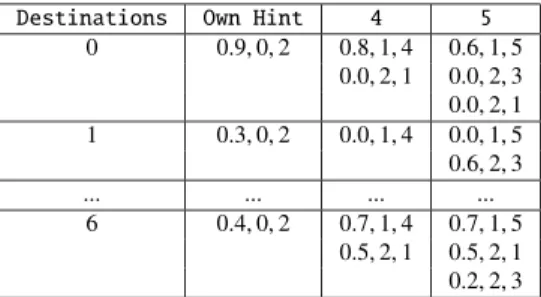
(3) IEICE TRANS. COMMUN., VOL.E92–B, NO.8 AUGUST 2009. 2612. 3.2.2 Pheromone Table Updating. Fig. 1 Table 1. A simple network topology at time t. Pheromone table of node 2 with L = 2.. Destinations. 4. 5. 0. p20,4 = 0.8. p20,5 = 0.4. 1. p21,4 = 0.0. p21,5 = 0.5. .... .... .... 6. p26,4 = 0.3. p26,5 = 0.1. Table 2 Hint table of node 2 with L = 2. Destinations Own Hint 4 5 0 0.9, 0, 2 0.8, 1, 4 0.6, 1, 5 0.0, 2, 1 0.0, 2, 3 0.0, 2, 1 1 0.3, 0, 2 0.0, 1, 4 0.0, 1, 5 0.6, 2, 3 ... ... ... ... 6 0.4, 0, 2 0.7, 1, 4 0.7, 1, 5 0.5, 2, 1 0.5, 2, 1 0.2, 2, 3. neighbor through which the current node received the hint. In the pheromone table, each row corresponds to a destination node and each column corresponds to a neighbor node. The value pid,n is used in addition to the hints in the hint table to reflect the current network traffic and congestion situation more efficiently. The higher the pheromone the more reliable would be the neighbor node it corresponds, node n, for being chosen as the next hop in the path of a packet traveling towards the correspondent destination d. A simple network topology at time t is illusterated in Fig. 1. Table 1 and Table 2 show the corresponding pheromone table and hint table with L = 2 of node 2 at a specific time t of this network. For simplicity the time-tolive of each tuple is not shown in the hint table. 3.2 Routing Table Updating 3.2.1 Hint Table Updating Hints are dispersed by broadcasting control messages within beacon packets. Each node i broadcasts a heartbeat packet every ΔT B s [6]. This packet encapsulates hints generated by node i itself and nodes located at distance at most L − 1 hops from itself for all destinations (the value L is called the Lookahead of the protocol). Therefore, a node receiving the control packet will update its hint table by hints generated at most L hops away from itself.. Whenever a data packet is forwarded successfully to a neighbor node, the sender node updates the pheromone table. On its path from its source s, to its destination d, when reaching the intermediate node i at time t, a data packet should be forwarded to one of i’s neighbors. If the process of forwarding the packet to the neighbor n was successful, the packet will deposit a pheromone-increment on the link (i, n) for destination d in node i, and update the pheromone as follows: pid,n (t + 1) = pid,n (t) + ΔP. (1). Here ΔP is the pheromone-increment parameter. Like this pheromones (hereafter called packet-pheromones) of a neighbor node is increased only if it was able to receive the packet and was not congested. Thus packet-pheromones can provide us with a neighbor’s congestion information. Also packet-pheromones for a neighbor which has moved out of the transmission range of node i can not be increased. Like real pheromone the artificial pheromone concentration decreases with time to inhibit a fast convergence of pheromone on the links. To do so, a new factor called the Pheromone Coefficient q (where 0 < q < 1) is involved in our proposed scheme. The main task of this factor is to melt down the pheromones after a constant period of time (ΔT dec ), using the following equation: pid,n (t + 1) = pid,n (t) · q, ∀d∀n, q ∈ (0, 1). (2). In this way the pheromone accumulation on the neighbors’ links will only reveal the latest information. Therefore using Pheromone Coefficient we keep the information even more up-to-date. 3.2.3 Packet Forwarding We assume that each data packet includes a list of visited nodes V. Upon the arrival of a packet p destined to d in a node i at time t, it determines an ordered list of possible next hop nodes. The order is determined by the value of function F described as: F( j) = BH i (d, j) − pid, j (t), j ∈ {Neigh(i) − V(p)}. (3). Here, BH i (d, j) is the best (lowest) hint among hints in the cell HT i [d, j], and Neigh(i) is the set of neighbors of i. Each time i tries to forward the packet to the node at the head of the list, and selects the next node in the list if forwarding process was not successful. This will be repeated until i received the acknowledgement for packet p from a neighbor node n, in which case the packet-pheromone of the link (i, n) is increased according to Eq. (1), or the list is empty, and the packet will be dropped. Like this, in our algorithm we provide for multiple paths [16] at all intermediate nodes which is shown to improve the performance of multipath routing protocols in.
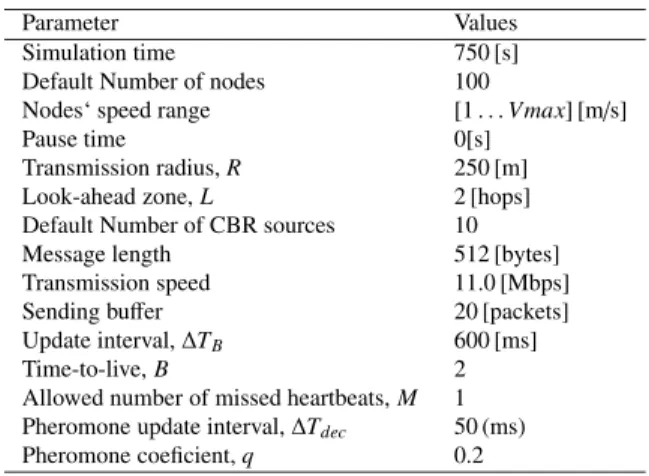
(4) KASHKOULI NEJAD et al.: HYBRID PACKET-PHEROMONE-BASED PROBABILISTIC ROUTING FOR MOBILE AD HOC NETWORKS. 2613. [17], without any need for route recovery process. To select the next hop for a packet in the proposed HPPB scheme, not only the routing information but also the network congestion information is considered and is continuously updated by packet-pheromones. Here latency is only dependant on the packet traversing the network, unlike ant-based algorithms where the route discovery delay is also considerable. Thus the latency will be somewhat similar to HBPP, with some enhancements according to the more adaptability our algorithm enjoys. 3.3 Comparison with the HBPP Routing Scheme The HBPP scheme is resilient to node-mobility. However, it cannot support high traffic rates at the same time. This is because of the updating mechanism of the hints and the structure of them. Usually the hints are updated every fixed time interval. This interval can not be too small, because it will involve a very high overhead that aggressively consumes the network’s limited resources. Hints also do not contain any information about node congestion. Thus, under a high transmission rate scenario, where nodes congestion is most likely to happen, the HBPP scheme reports a high rate of packet loss. Our proposed hybrid routing scheme suggests to use the already available packet forwarding’s feedback information to provide the routing scheme with up to date information about the traffic situation without producing any additional overhead. Here no changes have been made to the value of the hints; only new information about congestion has been taken into consideration. In this way the routing scheme will be able to efficiently avoid the congested nodes and hence perform its routing process faster than before while still taking advantage of the HBPP scheme’s mobility resilience. Based on the aforementioned explanation, the proposed hybrid routing scheme does not underperform HBPP under any condition. 4.. Simulation and Results Analysis. In this section we verify the performance of our algorithm based on simulation of a random Ad-Hoc network. We compared the performance of the proposed algorithm with the promising HBPP algorithm. 4.1 Simulation Model and Assumptions In this part we talk about simulation model and assumptions. 4.1.1 Transmission Primitives Packet transmissions are governed by an ideal scheduler. A FIFO buffer of 20 packets in size is used at each node. A packet reception is notified to a sender’s neighbor provided that it remained for the whole duration of the transmission within the transmission range and such that no collisions with other transmissions occurred in the meanwhile.. Table 3. Default simulation parameters.. Parameter Simulation time Default Number of nodes Nodes‘ speed range Pause time Transmission radius, R Look-ahead zone, L Default Number of CBR sources Message length Transmission speed Sending buffer Update interval, ΔT B Time-to-live, B Allowed number of missed heartbeats, M Pheromone update interval, ΔT dec Pheromone coeficient, q. Values 750 [s] 100 [1 . . . Vmax] [m/s] 0[s] 250 [m] 2 [hops] 10 512 [bytes] 11.0 [Mbps] 20 [packets] 600 [ms] 2 1 50 (ms) 0.2. At the end of the transmission, the scheduler checks whenever other packets awaiting in the sending buffers can be served. For each packet successfully delivered to the next hop, an acknowledgement (Ack) packet is generated by default through the DCF MAC protocol. The proposed routing scheme uses such Ack packets in the packet-pheromone increment process. 4.1.2 Mobility We apply Random Way point mobility model with zero pause time in a square shaped area of 1.5Km edge. At the beginning of the simulation nodes are located uniformly at random in the area. After that each node chooses a random destination point in the area and moves towards it with a random speed in the range of [1..Vmax ]m/s, when it reaches the destination point it continues doing the same process. 4.1.3 Traffic We adopt the constant bit rate traffic model widely used in performance analysis of MANETs. The constant bit rate sources always send packets of 512 bytes in length to the same destination. The number of sources is 10% of the number of nodes in the network. The default values of main parameters of the simulation are listed in Table 3. 4.2 Performance Metrics The following metrics were estimated during a simulation: • Delivery probability, ratio of the number of data packets delivered to the destinations to those generated by the traffic sources. • Average path length, given in number of hops a packet traverses until it reaches its destination. • End to end packet delay, the time elapsed from when a packet is generated by the source until it is delivered to the destination. Due to the fact that our algorithm no additional control packets is introduced to the HBPP algorithm discussed.
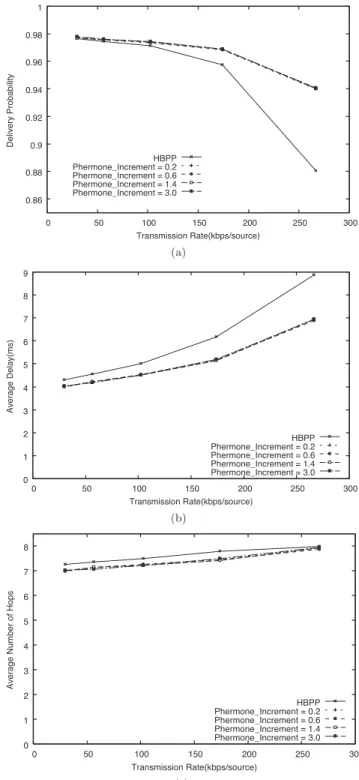
(5) IEICE TRANS. COMMUN., VOL.E92–B, NO.8 AUGUST 2009. 2614. in [6], our results won’t be including this metric. Each experiment is conducted with an initial warm up time of 75 s before collecting statistical data. For each simulation setup we run the simulation 300 times, and The results were confirmed experimentally at 95% confidence interval. 4.3 Results Analysis In this part, we investigate the behaviour of our algorithm in compare with the original HBPP protocol over different scenarios. 4.3.1 Performance over Transmission Rate and NodesMobility In the following set of experiments, we inspect the impact of transmission rate at high node-mobility on the performance of the proposed routing scheme. As shown in Fig. 2, the performance is inspected at a fixed high speed of node-mobility (Vmax = 20 [m/s]) using different values of pheromone-increment (ΔP = 0.2, 0.6, 1.4, and 3.0). The results in Fig. 2(a) indicate that the proposed scheme reports a higher delivery probability than the original scheme particularly at high transmission rates. For example, with the increase of transmission rate to 273 (kbps/source) the original HBPP scheme reports a delivery probability equal to 0.88, while such value has been significantly enhanced to 0.94 thanks to the proposed scheme. Similarly, the average packet delay has been decreased from 8.9 (ms) to 6.9 (ms), as shown in Fig. 2(b). We can also note that the above enhancement in delivery probability and packet delay didn’t involve any notable increase in the average number of hops, as illustrated in Fig. 2(c). In general, the above results demonstrate that the proposed routing scheme outperforms the original one with the increase of transmission rate. This is due to the fact that, in the original hint-based scheme, if the neighbor node j always reports the best hint toward the destination node, such node j will be always chosen as the best next hop. Particularly, in high transmission rates such node will be occupied fast, and consequently become unable to receive more packets. The original scheme will, however, keep selecting such node j without any consideration to the congestion problem discussed above, which will again result in the decrease of delivery probability and the increase of average packet delay. On the other hand, the proposed scheme can easily avoid the above flaws thanks to the combination of the newly proposed packet-pheromone approach with the original hintbased scheme. The use of the packet forwarding feedback information (packet-pheromone) to continuously update the dual-table after each packet’s forwarding step helps all the nodes to always keep track of the neighbor nodes’ congestion situations. Now, the next hop selection in the proposed scheme is much smarter to avoid congested nodes. This is why the proposed scheme reports a significant enhancement in terms of delivery probability and packet-delay at high. Fig. 2 Performance as a function of transmission rate when Vmax = 20 (m/s) using different pheromone-increment.. transmission rates. Please note that all the above simulations were conducted under a high node-mobility. It is also worth to note that the proposed scheme reports the same performance at different values of pheromoneincrement. As we explained in the previous section, the selection of the next hop node is based on the combination of the hint and the pheromone. As a matter of fact, in most cases the first two or three nodes in the neighbor.
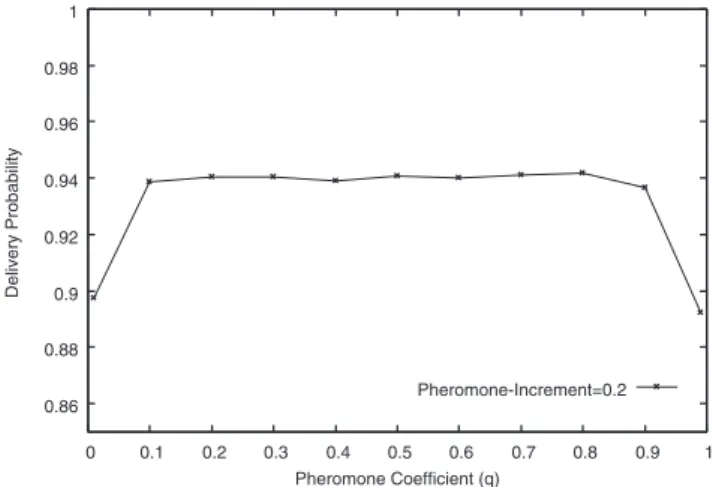
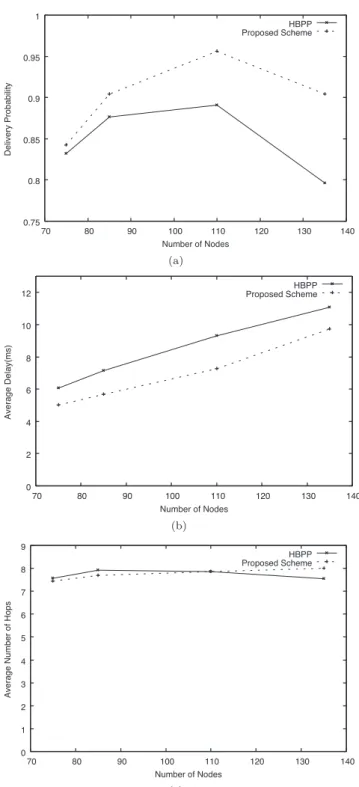
(6) KASHKOULI NEJAD et al.: HYBRID PACKET-PHEROMONE-BASED PROBABILISTIC ROUTING FOR MOBILE AD HOC NETWORKS. 2615. nodes list report very similar best hint values (with a very slight difference). Therefore, the selection of the next hop node among these nodes with similar hint values mainly depends on the pheromone value. In order to explain this fact clearly, lets consider the following scenario: suppose that there is a sender node (let’s refer to this node as S ) that has a group of incoming packets that need to be forwarded downlink. Usually, It will select the best neighbor node in the neighbor list as the next hop node (let’s refer to this node as A). S will then transmit the following n packets to A as long as A receives each packet successfully, and hence the amount of pheromone that will be accumulated on the link to A will be equal to (n · ΔP). Now, in case that A fails to receive any packet, S will send its packets to the second best neighbor node in the list (let’s refer to it as B). However, this sender node will keep checking A (i.e., the currently failed one) first before sending its packet to B until the amount of pheromone accumulated on link to B becomes bigger than the pheromone accumulated on the link to A. Once the pheromone value gap between B and A is filled, B will replace A in the list and become the first choice. Since the pheromone-increment value (ΔP) is constant for all the neighbor nodes, filling up the pheromone value gap between B and A will depend only on n not on the pheromone-increment value. This is why our proposed scheme reports the same performance at different pheromone-increment values. Thus, the next set of experiments will be conducted using only one randomly chosen value of ΔP = 0.2. It is worth to note here, that there is another factor which is helping the routing scheme to fill up the pheromone gap or in other word keep the pheromone value always updated. As we explained in the previous section, the Pheromone coefficient q melt down the pheromone value continuously using Eq. (2), in order to keep them always up to date. Based on a careful observation, we found that the value of q cannot be either too small (i.e., very close to 0) or too big (i.e., very close to 1) because of the following two main reasons. First, in case of a very small q, the accumulated pheromones will melt down too fast, and hence the effect of pheromones will be totally eliminated. Second, in case of a very big q, the pheromones will melt down too slow, and hence the accumulated pheromones will last for a long time and the purpose of refreshing them will not be achieved. Both of the above cases are against to the main objective of q, which is to keep the information revealed by the pheromones value always up-to-date. To investigate the effect of Pheromone Coefficient q on the proposed routing scheme’s performance in terms of delivery probability, we conducted our simulation experiments under a simultaneous high node-mobility and high transmission rate scenario while changing the value of q, as shown in Fig. 3. We can easily note from the reported simulation results that the above discussion is true. Moreover, we can find that the delivery probability does not vary if the q value is away from its extreme bounds. Next, we investigate the influence of the nodes-. Fig. 3 Performance as a funciton of Pheromone Coefficient (q) when transmission rate = 273(kbps/source),Vmax = 20(m/s), with ΔP = 0.2.. mobility (Vmax ) on the performance of the proposed scheme at high transmission rate (273 (kbps/source)), as summarized in Fig. 4. The reason of conducting this set of simulation experiments is to prove that the proposed scheme did not sacrifice the node-mobility resilience offered by the HBPP scheme, which was the main reason behind selecting this scheme to be embedded in our proposed hybrid scheme. The results in Fig. 4 clearly demonstrate that the proposed scheme has inherited the same node-mobility resiliency of the HBPP scheme. However, as our proposed hybrid scheme can support high transmission rates, while the HBPP scheme can not, the reported results prove the outperformance of the proposed routing scheme under simultaneous high transmission rates and high node-mobility scenario. For example, with the nodes-mobility of Vmax = 37 (m/s) and transmission rate of 273 (kbps/source), the original HBPP scheme shows a delivery probability equal to 0.87, while such value has been significantly enhanced to 0.93 thanks to the proposed scheme. Similarly, the average packet delay has been decreased from 9.3 (ms) to 7.3 (ms), as shown in Fig. 4(b). Again, it can be easily noted that the above enhancement in delivery probability and packet delay didn’t involve any notable increase in the average number of hops, as illustrated in Fig. 4(c). 4.3.2 Performance over Number of Nodes Here, we study the impact of node density on the performance of the proposed scheme. In our simulations we increased the number of nodes in the network area (i.e., square shaped area of 1.5 Km), while keeping the same ratio of sources/nodes to its default value (i.e., 10%). All of the performance metrics are investigated at a high speed of nodemobility (Vmax = 20 [m/s]), and high transmission rate (273 (kbps/source)), as shown in Fig. 5. The results in Fig. 5(a) show that the delivery probability of the proposed scheme and the original one increase up to certain limit and then both of them start to decay with different rates. Actually, with the increase of the num-.
(7) IEICE TRANS. COMMUN., VOL.E92–B, NO.8 AUGUST 2009. 2616. Fig. 4 Performance as a function of Speed when transmission rate = 276(kbps/source) with ΔP = 0.2.. ber of nodes in the network, a similar increase in the network connectivity could happen and hence enhance the delivery probability. After a certain limit, with the increase of nodes’ number (and thus the number of sources and the traffic volume too), the network nodes become highly congested. Such congestion becomes more severe in case of adopting a high transmission rate. Since the original scheme. Fig. 5 Performance as a function of number of nodes when transmission rate = 273(kbps/source),Vmax = 20(m/s), with ΔP = 0.2.. only depends on the best hints without considering the congestion issue in the next hop selection procedure, their delivery probability starts to decay very fast in the above case. On the other hand, the proposed scheme can still report a significantly better performance because of its capability to avoid congested nodes in the next hop selection procedure. In general, we can easily notice from Fig. 5(a) that the proposed scheme reports a higher delivery probability.
(8) KASHKOULI NEJAD et al.: HYBRID PACKET-PHEROMONE-BASED PROBABILISTIC ROUTING FOR MOBILE AD HOC NETWORKS. 2617. than the original scheme particularly at high node density. For example, with the increase of the number of nodes to 135 the original HBPP scheme reports a delivery probability equal to 0.79, while the proposed scheme succeeded to significantly increase this value to 0.90. Similarly, the proposed scheme has decreased the average packet delay from 11.0 (ms) to 9.7 (ms), as shown in Fig. 5(b). It is also interesting to note that the above enhancement in delivery probability and packet delay didn’t involve any notable increase in the average number of hops, as illustrated in Fig. 5(c). 5.. [11]. [12]. [13]. Conclusion. This paper proposed a new dynamic and adaptive routing scheme for Ad-Hoc networks. Instead of forwarding the packets depending on the meta-information provided by the Hint-based scheme only, our scheme uses the packet forwarding feedback (packet-pheromone) to dynamically choose the next hop for congestion avoidance. We have shown through simulation-based analysis that the proposed scheme can significantly enhance both the delivery probability and the packet-delay under high node-mobility with high transmission rate in big ad hoc networks.. [14]. [15]. [16]. [17]. works,” IEICE Trans. Commun., vol.E84-B, no.8, pp.2087–2094, Aug. 2001. R.R. Choudhury, K. Paul, and S. Bandyopadhyay, “MARP: A multiagent routing protocol for mobile wireless ad hoc networks,” Autonomous Agents and Multi-Agent Systems 8, pp.47–68, 2004. N. Migas, W.J. Buchanan, and K.A. McArtney, “Mobile agents for routing, topology discovery, and automatic network reconfiguration in ad-hoc networks,” 10th IEEE International Conference and Workshop on the Engineering of Computer Based Systems, pp.200–206, Huntsville, USA, 2003. R.R. Chpudhury, S. Bandyopadhyay, and K. Paul, “A distributed mechanism for topology discovery in ad-hoc networks using mobile agents,” Proc. 1st Annual Workshop on Mobile Ad-Hoc Networking Computing, MobiHOC Mobile Ad-Hoc Networking and Computing, Boston, USA, 2000. D. Kotz, R. Gray, S. Nog, D. Rus, S. Chawla, G. Cybenko, D. Coll, and N.H. Hanover, “Agent TCL: Targeting the needs of mobile computers,” IEEE Internet Comput., vol.1, no.4, pp.58–67, 1997. S. Marwaha, “Mobile agents based routing protocol for mobile adhoc networks,” Proc. IEEE Global Telecommunications Conference (GLOBECOM’02), pp.17–21, Taipei, Taiwan, 2002. L.R. Reddy and S.V. Raghavan, “SMORT: Scalable multipath ondemand routing for mobile ad hoc networks,” Elsevier Ad Hoc Networks, vol.5, pp.162–188, 2007. A. Nasipuri, R. Castaneda, and S.R. Das, “Performance of multipath routing for on-demand protocols in mobile ad hoc networks,” Mobile Netw. Appl. (MONET), vol.6, no.4, pp.339–349, 2001.. Acknowledgement This work was supported in part by JSPS grant (B) 21300018 and Global COE Program CERIES in Tohoku University. References [1] D. Pompili and M. Vittucci, “PPMA, a probabilistic predictive multicast algorithm for ad hoc networks,” Elsevier Ad Hoc Networks, vol.4, pp.724–748, 2006. [2] D. Kliazovich and F. Granelli, “Cross-layer congestion control in ad hoc wireless networks,” Elsevier Ad Hoc Networks, vol.4, pp.687– 708, 2006. [3] B. Scheuermann, C. Lochert, and M. Mauve, “Implicit hop-by-hop congestion control in wireless multihop networks,” Elsevier Ad Hoc Networks, vol.6, pp.260–286, 2008. [4] E.M. Belding-Royer and C.E. Perkins, “Evolution and future directions of the ad hoc on-demand distance-vector routing protocol,” Elsevier Ad Hoc Networks, vol.1, pp.125–150, 2003. [5] M. Abolhasan, T. Wysocki, and E. Dutkiewicz, “A review of routing protocols for mobile ad hoc networks,” Elsevier Ad Hoc Networks, vol.2, pp.1–22, 2004. [6] R. Beraldi, L. Querzoni, and R. Baldoni, “A hint-based probabilistic protocol for unicast communications in MANETs,” Elsevier Ad Hoc Networks, vol.4, pp.547–566, 2006. [7] M. Gunes, U. Sorges, and I. Bouazizi, “ARA-The ant-colony based routing algorithm for MANETs,” International Workshop on Ad Hoc Networking (IWAHN 2002), vol.4, Vancouver, British Columbia, Canada, Aug. 2002. [8] L. Rosati, M. Berioli, and G. Reali, “On ant routing algorithms in ad hoc networks with critical connectivity,” Elsevier Ad Hoc Networks, vol.6, pp.827–859, 2008. [9] M. Roth and S. Wicker, “Termite: Emergent ad-hoc networking,” Second Mediterranean Workshop on Ad-Hoc Networks, Medhia, Tunisia, 2003. [10] X. Wang, F. Li, S. Ishihara, and T. Mizuno, “A multicast routing algorithm based on mobile multicast agents in ad-hoc net-. Keyvan Kashkouli Nejad received his B.S. degree from Tohoku University, Sendai, Japan, in 2007. He is currently working toward Master degree in the Graduate School of Information Science in Tohoku University Japan. His research interests include routing protocols in adhoc networks.. Ahmed Shawish received the B.S. and M.S. degree from Ain Shams University, Cairo, Egypt in 1997 and 2002, all in Computer Sciences. Since 2005, he is on a fellowship/mission provided by the Egyptian government to get the Ph.D. degree from the Graduate school of Information Science, Tohoku University, Japan. His current research focuses on supporting the Voice over Internet-Protocol (VoIP) applications over wired and wireless networks. He is a student member of the IEEE..
(9) IEICE TRANS. COMMUN., VOL.E92–B, NO.8 AUGUST 2009. 2618. Xiaohong Jiang received his B.S., M.S. and Ph.D. degrees in 1989, 1992, and 1999 respectively, all from Xidian University, Xi’an, China. He is currently an Associate Professor in the Department of Computer Science, Graduate School of Information Science, TOHOKU University, Japan. Before joining TOHOKU University, Dr. Jiang was an assistant professor in the Graduate School of Information Science, Japan Advanced Institute of Science and Technology (JAIST), from Oct. 2001 to Jan. 2005. Dr. Jiang was a JSPS (Japan Society for the Promotion of Science) postdoctoral research fellow at JAIST from Oct. 1999–Oct. 2001. He was a research associate in the Department of Electronics and Electrical Engineering, the University of Edinburgh from Mar. 1999–Oct. 1999. Dr. Jiang’s research interests include optical switching networks, routers, network coding, WDM networks, VoIP, interconnection networks, IC yield modeling, timing analysis of digital circuits, clock distribution and fault-tolerant technologies for VLSI/WSI. He has published over 130 referred technical papers in these areas. He is a member of IEEE.. Susumu Horiguchi (M’81–SM’95) received the B.Eng the M.Eng and PhD degrees from Tohoku University in 1976, 1978 and 1981 respectively. He is currently a Full Professor in the Graduate School of Information Sciences, Tohoku University. He was a visiting scientist at the IBM Thomas J. Watson Research Center from 1986 to 1987. He was also a professor in the Graduate School of Information Science, JAIST (Japan Advanced Institute of Science and Technology). He has been involved in organizing international workshops, symposia and conferences sponsored by the IEEE, IEICE, IASTED and IPS. He has published over 150 papers technical papers on optical networks, interconnection networks, parallel algorithms, high performance computer architectures and VLSI/WSI architectures. Prof. Horiguchi is members of IPS and IASTED..
(10)
図
+2
関連したドキュメント
To capture the variation of effective control reproduction number (R c (t)), the control process are divided into three periods, the average of R c (t) are calculated for each stage
q-series, which are also called basic hypergeometric series, plays a very important role in many fields, such as affine root systems, Lie algebras and groups, number theory,
In this paper, we present a new numerical scheme by QSC methods to solve the fractional bioheat equation with mixed boundary value conditions for thermal therapy.. This new
In order to relieve influence of unfair arguments, a Gaussian distribution-based argument-dependent weighting method and a hybrid support-function-based argument-dependent
By employing the theory of topological degree, M -matrix and Lypunov functional, We have obtained some sufficient con- ditions ensuring the existence, uniqueness and global
In this paper, based on a new general ans¨atz and B¨acklund transformation of the fractional Riccati equation with known solutions, we propose a new method called extended
As in 4 , four performance metrics are considered: i the stationary workload of the queue, ii the queueing delay, that is, the delay of a “packet” a fluid particle that arrives at
Following a recommendation of the Ad Hoc Sub-Committee on “Supporting Mathematics in Developing Countries” appointed in 2003 (see the Report on ICMI Activities in 2000-2004,
