Abstract─ Growing attention to inclusive innovation in recent years reflects two significant changes that globalization has engendered. One is the emergence of a functional global economic system, in which many developing nations have become integrated and their economic viability enhanced. The other is its atten-dant social change ; namely the increased complexity in societal configuration, of which the widening income gap within a society is the most widely observed manifestation. Inclusive innovation has been touted as the prospective approach for business entities in adapting to such societal evolution. It has first come to be known as a collective term for innovation that promotes affordable access to qual-ity goods and services to the bottom of the pyramid. In essence, it is innovation for inclusion that aims at promoting better livelihood for this segment of population that has long been economically marginalized in society. In order to effectively manage entrepreneurial activity in sophisticated yet fractured society, however, another approach is called for. This new management approach is labeled innova-tion by inclusion that aims at promoinnova-tion and enhancement of partnerships with diverse stakeholders. Such management must, not only recognize important stakeholders and their claimed or unclaimed stakes, but also appreciate their inherent and compounded relationships. This requires systems approach and the expansion of management purview beyond immediate entrepreneurial interest and concern. Thus the focus of innovation by inclusion is twofold. One is the for-mation of coalition, not just with other business entities, but also with other orga-nizational entities that materially influence its business environment. The other is the promotion of collaborative efforts between the coalition members. The objec-tive of this new management strategy is no longer limited to viability or profit-ability of the business entity concerned. Instead, the new management should also aim for alignment of coalition members and their activities towards the enhance-ment of societal fabric, and the sharing of benefit from such enhanceenhance-ment. In
Some Issues and Ideas
short, new management aims at developing the network of win-win relationships for all the coalition members, which may include government agencies or civic institutions. Thus, it entails the formation of developmental vision and strategy that all the coalition members can share and cooperate towards its realization. As such, many organizations will have difficulty in adapting the strategy or in putting it into practice. A few developmental projects are thus presented, to illustrate the application of systems approach for innovation by inclusion, and the management of such challenges.
1.Historical Perspective 1. 1. Nothing new under the sun?
Both innovation and management have been recurrent topics ever since business en-terprise and operation have come under scientific scrutiny. Numerous studies have been conducted, by featuring one or the other, or sometimes their synergetic relationship. While new theories on innovation or management never stop appearing and replacing old ones, there is a nagging feeling of déjà-vu, among business elites, or being reminded of the old proverb, “there is nothing new under the sun.” The subject at hand, inclusive innovation and new management, may be regarded as yet another of such attempts. Instead of deny-ing such doubts, it is worth notdeny-ing that human memory is fallible and timely reminder has merits. Furthermore, individual perception of the real world is never perfect, and manage-ment may be enhanced by applying new theories and perspectives. Indeed, globalization has accelerated the evolution of human society, as well as that of business environment, in the last few decades. Such changes have naturally prompted new thinking and theories in innovation and management.
The above-mentioned proverb has come down from a biblical source, and it is used to asseverate that there is nothing truly novel in existence. Such a claim is hard for any seri-ous engineer or scientist to accept. That is no surprise. After all, they see, or take part in, the constant progress in scientific knowledge and technology. Indeed, our own experience attests that the material change in our living milieu, in the span of a few recent decades, has been remarkable. For example, advancing information technology (IT, in short) has considerably transformed the societal fabric that serves as the framework for people’s live-lihood, and the mobility of economic resources has increased and geographically expanded.
In short, globalization is no longer a concept but a reality.
Today, the proverb’s interpretation is more metaphysical than physical, and it is used to mean that every new idea has some sort of precedent or echo from the past. In this sense, even globalization is not an exception either. One succinct characterization of global-ization is the unprecedented geographical expansion of human interaction. However, geographical expansion of human interaction is nothing new, and it has been the constant thrust in the evolution of human society, apart from its speed and scale in recent years. (Tanahashi, 2009a) In fact, it is more important to comprehend this evolutionary process, than its current outlook. This process may be described by using the two illustrations be-low.
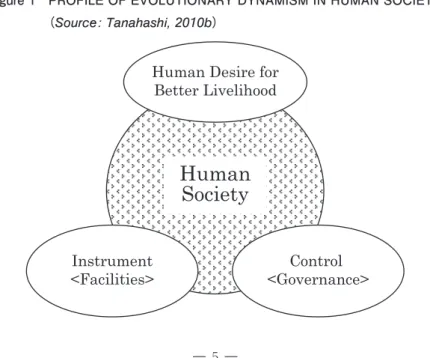
The first illustration is Figure 1. At the center of this figure is Human Society, which embodies the dynamic world of human interaction. The driving force for such dynamism stems in “Human desire for better livelihood,” and it is indicated in the oval and placed at the top of human society. Such a force is nowadays globalization, but in the 19th century, it was probably the Industrial Revolution. Advancement and sophistication in human inter-action comes hand-in-hand with the advancement and sophistication in the two essential driving factors ; namely, instrument and control, or in more familiar terms, facilities and governance. The former is defined as a collective term for physical and metaphysical
fa-Figure 1 PROFILE OF EVOLUTIONARY DYNAMISM IN HUMAN SOCIETY (Source: Tanahashi, 2010b)
Human
Society
Human Desire for
Better Livelihood
Control
<Governance>
Instrument
cilities for human interaction, while the latter is defined as a collective term for formal and informal measures for controlling or governing human interaction and the use of its facili-ties.
Next in order is how to express the inherent dynamism in human society, and Figure 2 is such an expression. The essence of this picture is two-fold. Firstly, it represents the fact that the facility and control factors complement each other for promotion of productive human interaction. Secondly, their complementary relationship is closely interwoven to form societal fabric. This is illustrated as the two dimensional portrayal of society. One dimension is the control axis, which stretches from the individual’s moral sentiment at one end to the public governance system at the other. The other dimension is the facility axis, which stretches from instrument to civilization. These stretches represent the individuals at one end and the entire society at the other, and they reflect the complexity of societal configuration.
The illustrated concept is particularly useful in appreciating the contemporary signifi-cance of the above proverb. It does not apply in the evolutionary development along the instrument or facility axis. Instead, it applies to the evolutionary development along the control or governance axis. This evolutionary process reflects the collective human wisdom Figure 2 STRUCTURAL ILLUSTRATION OF SOCIETAL FABRIC(Source: Tanahashi, 2010b)
Individual’s Morale o ie ’s ode o ondu ivili a ion ul ure
for managing human behavior toward productive utilization of available facilities in society. Personal nature or disposition may vary significantly among people, but their collective or aggregate behaviors tend to manifest the inherent human instinct and nature that vary little over time, or against geographical diversity. Development of new facilities may con-tinue, and so does the development of appropriate control or governance measures. However, such measures are likely to find some sort of precedent or echo from the past, because they inevitably reflect the enduring human nature.
1. 2. Emergence of the bottom of the pyramid and inclusive innovation
Synergetic relationship between innovation and management is widely acknowledged in today’s business world. However, how to promote such relationship and to enhance busi-ness development remains the perpetual question and challenge for all busibusi-ness entities. This perpetuity suggests that there is no answer or strategy to the issue that can apply to all circumstances. That should not deter any individual business entity from innovation or management improvement. Instead, each business entity must comprehend the business environment it uniquely faces, and design appropriate strategy for itself. Naturally, the timing and accuracy of such comprehension and design effort will greatly affect its success or failure. Furthermore, stakes are higher today, with the emergence of “the winner-takes-all society.” (Frank and Cook, 1996) This trend is closely linked with globalization, and particularly with its manifestation that the market and competition has become global for all kinds of economic goods.
How to enhance such efforts is, thus, a critical question for any business entity’s viabil-ity. One thing is clear ; i.e., such exercise must be made on solid theoretical foundations. Such theoretical exercise may begin with the cognizance of the above mentioned syner-getic relationship, and that in turn calls for sound conceptual framework for the relationship. Innovation is commonly defined as the process to transform some certain idea or invention into a good or service that creates economic value. This value is the reflection of apprecia-tion by the user or customer of the good or service that is realized from the process. As such, the greater the number of customers, the more profitable the good or service is to its supplier. In other words, innovation enhances the viability of a business entity, and the business entity strives to introduce valuable innovations for its prospective customers. Such managerial drive and entrepreneurial vigor, in turn, enriches people’s livelihood and enhance the society’s viability.
The definition of innovation also deserves careful reassessment. There is a tendency to acknowledge some new technological idea or invention to be at the core of innovation. That may have been so in the past when the business environment was product-driven. This is no longer the case today, as it is nowadays market-driven. As such, even an old idea or invention can lead to innovation by adapting it in the new business environment. Par-ticularly notable is the geographical expansion of modern industrial production operations into the developing world. This change is, of course, linked to globalization, which has heightened the mobility of three essential resources for such industrialization ; namely, technology, information and finance.(Friedman, 1999)
Industrial development has been, and still is the mainstay of economic development, and the enhancement of people’s livelihood. While the gap in per capita income is still sig-nificant between the advanced economy and the developing economy, it is narrowing now. For example, the percentage of economically deprived people (below the “poverty line” set by the United Nations) has dropped from 23.2% to 14.9% in the last decade (United Nations, 2012). Such statistics clearly indicate that a significant portion of people in the developing world have enhanced their chances for better livelihood, and started to enjoy their mate-rial and economic gains. The business world has taken notice of these people, and started to pay attention to them as a prospective market. In recent years, this has led to the popular naming of these people as the bottom of the pyramid (BOP, in acronym) collec-tively, and also of the market that targets them.(Prahalad, 2010)
The business world has long regarded this market segment as a marginal one where little business prospect is found. However, the significant growth of this market in size has made many business entities to adapt their strategy to get engaged in this market. From such adaptation efforts they have recognized that their goods and service must also be adapted to the livelihood and lifestyle of the BOP. This recognition has in turn made them appreciate the need for innovation effort for such adaptation. Indeed, this kind of innovation effort has become so important that it has been given a special label, called inclusive innova-tion. One current working definition says that “inclusive innovation is any innovation that leads to affordable access of quality goods and services creating livelihood opportunities for the excluded population, primarily at the base of the pyramid, and on a long term sustain-able basis with a significant outreach.” (Mashelkar, 2012) The UNDP also regards inclusive innovation as a prospective tool and valuable thrust for sustainable economic
de-velopment in many developing nations. Its interest led to active promotion of the international conference on inclusive innovation and innovative management (ICIIIM), which was held in Bangkok, in December 2012. The conference highlighted efforts and exercises of inclusive innovation, both in the public sector and the private sector, of such nations.(Patanapongse, 2012)
1. 3. Emergence of corporate social responsibility and new management
Does management of such efforts and exercises also require adaptation? Methodologi-cally speaking, management need not change. Yes, the characteristics of the targeted market or customers may be different, and also the characteristics of the goods and ser-vices to be provided may be different. However, the organizational entity that performs the management is the same, and also its operational system and issues are likely to remain the same. Changes in management are more likely to occur when the tenets or objectives of the organizational entity is, or needs to be, modified. All the more, it is worth noting that such needs are also increasing today, particularly if the organizational entity operates inter-nationally, or if its scale of operation is significant enough to affect social equilibrium.
A good case in point is the business entity that exploits economic resources in the developing world to enhance its profitability in its primary market in the advanced econo-my. Many internationally famous companies that combine manufacturing and retailing operations exemplify this kind of business operation and practice. It is almost obligatory in the management of such business operations to take full advantage of lax local regulations that have direct impact on operational cost ; such as labor practice, environmental protec-tion, safety measures for industrial operaprotec-tion, and safety standards of products, to name just a few. However, that entails some management risks. If an unfortunate accident oc-curs in its operation or products, and if its practice of double-standards is attributed to have caused the accident, the business entity sometimes faces criticisms and even condemnation from its customers, or socially-conscious public. With the global expansions of the internet and social network services in recent years, any business entity can ill-afford to overlook such criticisms or to delay corrective actions, and to jeopardize its business viability. There-fore, business entities are nowadays increasingly taking corporate social responsibility (CSR, in acronym) seriously and adapting its management accordingly.
alterna-tive practice to circumvent blatant double-standards. For example, it can outsource all the operations that involve exploitative practices to local business entities in the developing countries. It may even set up such local business entities for the sake of outsourcing, and keep the façade of its non-involvement. Management can also act more responsibly, by promoting appropriate regulations for industrial operations, together with the local gover-nance system, so as to reduce detrimental impact on the local community or on the national economy. Unfortunately such principled exercise often faces two obstacles. Some business entities may try to put such CSR into practice, but their competitors may not. Then, the former will be economically handicapped in the competitiveness with the latter. Another obstacle is corrupt government officials who would acquiesce with those business entities and their operations that try to circumvent even those existing regulations, for personal gains. Unfortunately, this is quite a widespread problem that afflicts many nations in the world, as various reports from Transparency International, the global coalition against corruption, attest.
It is worth noting from this organization’s claims that reduction of corrupt practice entails coalition or collaborative effort by government, business community and civil society of each nation concerned. It is also worth noting that such coalition or collaborative effort is indeed called for not just against corruption, but also for many other efforts that aim at enhancing people’s livelihood or living milieu. Is the promotion of such efforts beyond the management of a business entity or its CSR? Perhaps it is in the traditional view of corpo-rate management ; in other words, if the management limit itself within the entity’s organizational and operational boundaries. However, such traditional or conservative man-agement style is becoming obsolete, albeit slowly.
Interest in finding partnership for collaborative effort is certainly on the rise in today’s business world. This trend is exemplified by the increasing popularity of open innovation as new management strategy. This concept was initially promoted by Henry Chesbrough, who explains that “Open innovation is a paradigm that assumes that firms can and should use external ideas as well as internal ideas, and internal and external paths to market, as the firms look to advance their technology.”(Chesbrough, 2003) Obviously, the focus of his concern is on the business entity and its technological innovation. If the epochal and profound impact of globalization on human society, and on business environment, is fully appreciated, even such paradigm shift in management does not appear adequate or
appro-priate.
It is in this background, inclusive innovation should be redefined and new paradigm for corporate management should be promoted. The redefinition begins with the recognition of two distinctive approaches or paths to inclusive innovation, which may be expressed as innovation for inclusion, and innovation by inclusion. The former is very similar to the in-clusive innovation as earlier defined. In that case, the implicit target for inclusion is the bottom of the pyramid or BOP. Of course, the target for inclusion need not be limited to BOP : it could be expanded to include the physically challenged people, for example. Then the focus of innovation may be technological and for universal design. Innovation by inclu-sion is a new approach, and it adds a new dimeninclu-sion to inclusive innovation. The feature of this new approach and its impact on management is, hence, the main subject of the fol-lowing discourse. In the discourse, innovation by inclusion is used when its contrast with innovation for inclusion needs to be made clear ; while inclusive innovation is used when such distinction is of marginal importance.
The focus of innovation by inclusion is the formation of coalition, and the promotion of collaborative efforts between the coalition members. From management standpoint, the objective of this management strategy is no longer confined to the enhancement of viability or profitability of any specific business entity concerned. Instead, the objective should be the alignment of coalition members and their efforts towards the enhancement of societal fabric, which is the framework for people’s livelihood, and the sharing of benefit from such enhancement. In a more colloquial expression, it aims at developing the network of win-win relationships, not only between business entities, but also including or involving govern-ment institutions and civil society, who may be collectively called “active stakeholders.” That is, of course, easier said than done. The main reason is that such practice is clearly outside the traditional management purview, which is centered on the individual business entity and its own viability. The new strategy or management therefore entails the identi-fication of such stakeholders, and the formation of collaborative relationship between them. The latter effort calls for the formulation of developmental vision and strategy that all the coalition members can share and cooperate towards its realization. As such, many organi-zations will have difficulty not only in this formulation effort, but also in aligning their operations along the strategy so formulated. Nevertheless, the need for new management is imminent.
2. Expanding Business Frontier and New Management 2. 1. Long Shadow of Globalization
Economic progress in the recent years is impressive if measured by the growth of GDP or trade figures. However, this progress has also compounded the growth of economic disparity within a nation, as well as between nations. Current attention to inclusive innova-tion may be viewed as a manifestainnova-tion of political concern for attenuainnova-tion of such implicainnova-tion from economic development. It is important, therefore, in the discourse on inclusive innova-tion to elucidate this political concern and its background.
The first step for such elucidation is to make clear the distinction between progress and development. In a nutshell, progress refers to the outcome of human endeavors, while devel-opment refers to the human endeavor that aims at, or results in, realizing certain progress in society. It is worth noting here that such endeavor does not all come from the public sector, but also from the private sector. Business or commercial activities produce goods and services, because they are valued in some quarters of the society, if not by the society as a whole. Needless to say that even a developmental endeavor by a public sector organi-zation does not always result in benefiting the public at large or society equitably.
In this regard, development of a nuclear power plant offers an interesting case in point. The proponents of nuclear plant development have emphasized its cost advantage over conventional methods of power generation and, lately, its contribution to the reduction of greenhouse gases. However, the recent calamitous event at the Fukushima nuclear power plant in Japan has forced the world to face the inherent risk of this nuclear technology. The proponents have argued for the technology by expediently delineating the boundaries of concern for their own argument. If such an artificial boundary setting is removed, a very different picture emerges. For example, the claimed cost advantage is totally an illusion, once the cost for decommissioning an obsolete plant, or the safe disposal of nuclear waste, is all included. Likewise, its claim to contribute to alleviation of global warming is illusory : two-thirds of the heat generated by nuclear combustion escapes into the environment, thus surreptitiously contributing to global warming. It is needless to say that enormous environ-mental and economic costs of the eventuality, such as the Fukushima disaster, have never been reckoned in its cost-benefit calculation.
As the above example illustrates, linking developmental endeavor to societal progress is never simple or straightforward. Rational behavior of any organization has been to ef-fectively achieve its organizational goals or objectives, while appeasing its demanding stakeholders, with minimum expenditure. The narrower the organization sets its boundary for concern, the easier its management becomes. In other words, the system to be demar-cated by the purview of management makes all the difference in the implications of organizational actions and behavior to the society. Accordingly, the essential tenet of inclu-sive innovation should be threefold ; namely, (a) to expand and clarify the systemic purview for management, (b) to improve the organization’s interaction with the society, and (c) to enhance its total contribution to societal progress. As such, it is obvious that no organization willingly espouses innovation by inclusion. In other words, no organization does so willingly, unless such practice is obligatory, or benefits itself. What circumstance is drawing organizations into practice in, or promotion of, innovation by inclusion? Its short answer is “globalization.”
2. 2. Accelerating Societal Evolution
Globalization has been interpreted in many ways, but there is a common understand-ing that it has considerably changed the economic system and the business practice worldwide. However, to ensure its sustainability, the social ramifications of such changes must be better understood. Studies for such issues abound, but few have elucidated the evolutionary process that has led to such changes and impact in human society. One study (Tanahashi, 2010b) has taken steps toward such elucidation. This study has succinctly characterized globalization as follows :
(a)Global espousal of free-market economy ;
(b)Democratization of information, finance and technology ; and (c)Unprecedented geographical expansion of human interaction.
Some important societal impacts of globalization have already been explained in reference to these characterizations. One such impact is the increased complexity of societal configu-ration, and now its economic or societal ramification ought to be elucidated.
As a “social animal” humans have always interacted with one another, to enhance their safety or sustenance. History shows that mankind has constantly strived to invent or de-velop various instruments to enhance the productivity of its action or interaction with others. Over time human interaction expanded both in scale and scope, with attendant
sophistication in instrument. However, such achievement did not come naturally. History also shows that mankind did not always engage in constructive or socially productive inter-action, and some have been destructive or exploitative by nature or intention. Over time, human wisdom has led us to appreciate that such vitiating interaction is unstable and often counterproductive in the long run, and that it is possible to foster constructive or produc-tive interaction for mutual benefit. Human society thus started to evolve by forming a group with the intention of fostering such interaction.
Once such a group is formed, then it is natural for the group to cooperate for advance-ment or enrichadvance-ment of its intra-group interaction. For that purpose, the group usually develops certain measure of control or governance to promote effective intra-group interac-tion, which are collectively called social compact. They may also develop certain facilities for such intra-group interaction. Again, their effective usage cannot be left to individual members’ liberty : it also calls for appropriate supplementation to the prevailing social com-pact. The totality of such facilities and supplementary group-specific compact is called culture. This definition thus implies that any culture has its origin in certain group in soci-ety. However, this does not deny the possibility of some culture spreading to a wider segment of society, or even to the entire society.
Some groups are “closed,” or formed with stipulated exclusivity in their membership, such as professional guilds in the Middle Ages. However, most groups in modern society are “open” in nature, by accepting in principle all those individuals who agree to, or submit to, the group-specific social compact involved. Although a society is theoretically formed by the aggregation of such groups, the configuration of real society is much more complex. Firstly, each person belongs to several groups, reflecting one’s life and disposition. Further-more, one’s group affiliation may be temporary, and it may be sustained only for achievement of some personal objectives. Secondly, geographical expansion of interaction implies that some groups may have quite large membership. Naturally, the larger the group’s member-ship becomes, the higher chance of competition or conflict being engendered within the group or among its members. Therefore, the institutional system is often necessary to avoid or resolve such competition or conflicts. Otherwise, a group may become fractured into several factions, with each faction vying for greater control or influence within the group.
Nowadays, groups may also be formed principally for a shared objective, with limited shared social compact or institutional governance. Some international non-governmental organizations (NGO’s) fall into this category. With the expanding internet access, groups may even be formed through social networking. Absence of institutional structure does not make a group less powerful than more traditional kinds of group. On the contrary, the absence makes it easy for people to associate with a group. Once such a group grows in size, it gains “power.” With such power, the group can manipulate issues or prevailing so-cial compact or order. (Canetti, 1960)
The above discourse on the increasing complexity of societal configuration clearly sug-gests the attendant increase of complexity in management of business or entrepreneurial operation. As already mentioned earlier, not just production or supply of goods and ser-vices, but also its operational process comes under social scrutiny. In other words, the management that aims at customer satisfaction is no longer adequate : instead, it must pay attention to a variety of social effects that the business operation engenders and to the di-verse stakeholders in such effects. In the past, vocal or demanding stakeholders are limited in number, because the majority of potential stakeholders are unable to form a group that is sizable enough to exercise “power” over the management. Nowadays, however, such groups can be easily formed, and they could easily join forces, if useful, to achieve their respective objectives. This implies that there is a very dynamic business or social environ-ment where the stakeholders to any issue and their claims and strength are not only increasing, but their interaction is becoming sophisticated and complex. Thus, manage-ment of any organization, in the private or public sector, with substantial goal or objective to achieve, must adapt to this emerging situation. That calls for a paradigm change and strategic adjustment in its management, or new management.
It is now in order to recapitulate the essential features of such adjustment, which are broadly hinted in the above discourse. They may be described as follows :
a)Broadening of management purview, beyond the organization’s activity sphere. b) Exercise of systems approach, to recognize important stakeholders, to comprehend
their stakes, and to discern the significant interactions between them, as well as with the organization itself.
c) Reexamination of its relationship with the stakeholders, not as those with adversary interference to its activity, but as potential partners in enhancing the activity’s merit
or contribution to the partnership and even to the society at large. d)Development of inclusive innovation, with such partnership in mind.
e) Development of collaborative relationships and cooperative management, towards such goal.
3. New Scope of Inclusive Innovation
3. 1. Symbiosis between New Management and Inclusive Innovation
The above discourse may give the impression that new management calls for inclusive innovation. While they are related, it is not a “cause and effect” relationship, but rather a symbiotic relationship. Indeed, inclusive innovation helps promote new management and, hence, foster societal progress more effectively. Furthermore, inclusive innovation offers new scope for societal progress in the developing world. Conventional wisdom has long alleged the deficiency in pertinent technology and technical skills in the developing world as a major stumbling block in its drive for socio-economic progress. However, such percep-tion is becoming obsolete lately. Indeed, globalizapercep-tion, or the democratizapercep-tion of informapercep-tion, finance and technology in particular has considerably reduced such impediments.
What is needed now is innovative management that can open a new horizon and scope for new development by taking full advantage of sophisticated facilities and control or gov-ernance institutions found in today’s societal fabric. Practice of such management calls for two managerial instruments ; namely, systems approach and inclusive innovation. These instruments have synergetic relationship with each other, as later explained. For now, it is in order to elucidate the prospective role of inclusive innovation in such management. The conventional view of “innovation” tends to place technological element at its core. Such a view is linked to the modern history, in which industrial development has been regarded as the key to socio-economic progress. Over time, however, the environmental cost and social cleavage that capitalistic approach to industrial development has engendered have begun to threaten the aimed societal progress. Thus, the paradigm shift to new approach to developmental endeavor is taking place, and inclusive innovation has emerged as new driving force for socio-economic progress.
Now the question may be asked ; “If not technology, what would be the main thrust for inclusive innovation?” The answer is “innovation by inclusion.” Innovation by inclusion
differs from the conventional view of innovation, and also from innovation for inclusion. Its core element of innovation is “inclusion” itself. Here, inclusion means more than just a physical or metaphysical association, and connotes functional integration. In other words, inclusion signifies expansion of systemic boundary and operation, so as to enhance the prospect of veritable socio-economic progress from developmental endeavor.
That being said, management of such endeavor still faces a critical issue of boundary delineation. In other words, it entails the clear demarcation of the system under manage-ment purview and the attendant environmanage-ment. Such demarcation also means the separation of stakeholders into two categories : namely, those inside the system, and the others who are outside the system or who are regarded as belonging to its environment. Significance of such demarcation is well illustrated in the development of a nuclear power plant. As it has been argued earlier, given the current stage of nuclear technology, such developmental project can only be justified by the political predilection to disregard the long-term implica-tion of nuclear hazards and waste. Future generaimplica-tions of people are likely to receive no benefit (i.e., supply of electricity) but to bear the blunt of residual cost ; namely, all the en-vironmental hazards and degradations that the plant causes during and after its operation. Such blatant disregard is allowed because, even in democracy, future generations form no political constituency, and they cannot raise their voices or claims as veritable stakeholders in the development.
This example also suggests the relevance of inclusive innovation, or innovation by in-clusion for true societal progress. The relevance stems from the expanded management purview that the principal agency for a developmental endeavor adopts. Management purview is closely linked to the agency’s tenet and the objective(s) of its developmental endeavor at issue. Besides such management principles, management practice that fea-tures innovation by inclusion is equally important, because it touches on the livelihoods of more people than those directly associated with the endeavor, and that it enhances its ben-eficial effect quantitatively or qualitatively. In other words, the benben-eficial effect will be shared by a wider circle of people in society. This will certainly be the case, if the expan-sion of managerial purview need not be limited to geographical dimenexpan-sions, and it may also include the extension of time horizon and future generations in society.
3. 2. Power of “Innovation by Inclusion”
If innovation by inclusion is merely to improve the altruistic image of the agency at issue, then it is unlikely to be espoused by the private sector. There are in fact three fea-tures that make innovation by inclusion an attractive management strategy and practice for organizations in the private sector, as well as in the public sector. One such feature is already mentioned ; i.e., innovation by inclusion can be initiated or practiced without calling for any new technological innovation. The second feature is the broad systemic purview for management, which enhances the organization’s adaptability, or resilience, to changing environment. This feature stems from the management that utilizes the knowledge of systemic relationships of active components within the system, and of interaction between such components and environmental factors. The third feature stems from system design or structure itself, which serves as an operational framework for collaboration among the stakeholders with diverse interests in, and capabilities for, the developmental endeavor at issue. The involvement of many stakeholders implies that the developmental endeavor will be subjected to diverse scrutiny, and to more rigorous formulation of developmental objec-tives. That in turn impels innovative management and leads to better chance of achieving the designed developmental objective and intended societal progress.
While these features of innovation by inclusion deserve wider recognition and appre-ciation, there is another factor that explains the increased global interest in inclusive innovation. It is the financial factor. The importance of business entities and their prospec-tive participation and contribution to societal progress has been stated earlier. However, they do not act in the similar manner as their counterparts in the public sector. The differ-ence is that the former’s participation or contribution can be designed or directed to selected segments of society, while the latter tends to be mandated to ensure societal fair-ness or equitability. However, the financial reality of today implies the diminishing scale and scope for developmental initiatives by the public sector, as exemplified by the current financial crises in the Euro zone, or by the mounting sovereign debt in Japan. In contrast, the financial resources available in the private sector have increased so much as to face difficulties in finding attractive investment opportunities, and to flow into speculative “mon-ey games.” The rational solution to this financial issue is the expansion of cooperative or collaborative relationship between the two sectors and their organizational entities. This idea is not new, and it has already been practiced in the form of BOT (build-operate-trans-fer) projects.
Reflecting the diverse nature of developmental endeavors, many different schemes have been devised under the banner of BOT, to make such projects attractive to the pri-vate sector enterprises. Nonetheless, the majority of BOT schemes have been applied to physical infrastructure development. This suggests that many such projects have been initiated by the public sector. In other words, there still remain many prospective areas for socio-economic development if the private sector’s entrepreneurial initiatives are encour-aged and supported by the public sector. Cognizant of this situation, a new approach, i.e., public private partnership (PPP in acronym) has been touted in recent years. A typical form of its practice is the transfer of management function to the private sector enterprise from the public sector organization that has provided public services by its own facilities and staff. The transfer of operational responsibility for ports and airports from the public sector to the private sector is a good case in point. Even the application of such practice for operation of prisons and maintenance of government buildings and facilities has become possible.
It is worth noting in the above discourse that the initiative for innovation has primar-ily come from the public sector side. BOT and PPP schemes are no exception. This implies that innovation by inclusion yet has an unexplored domain, where the initiative for such innovation comes from the private sector. For example, enterprises in the private sector can take initiatives in the development of facilities, with effective support by the public sec-tor in the development of control or governance mechanisms for use of such facilities. The importance of such cooperation or collaboration will only increase in the future and, in due course, such style of developmental effort could become a mainstay of societal progress and enrichment of people’s livelihood. This approach is hereafter referred to as Business In-spired Development or BID.
3. 3. Putting “Business Inspired Development” into Practice
This BID may not sound like any breakthrough in development strategy, but its impli-cation suggests otherwise. For example, facility to be developed may be physical or metaphysical, and it need not be designed for, or operated as, public services. However, its development must meet two essential criteria to deserve support of the public sector. One such criterion is that the facility at issue must be useful in enhancing or promoting produc-tive interaction in the society concerned. The other criterion is that the accessibility to the facility is, in principle, open to any members who can take part in such productive
interac-tion in the society. Health care system is a good case in point. In the majority of nainterac-tions, health care is largely provided by private institutions, under strict government regulations and supervision. As such, its development will call for facility development by the private sector and attendant adjustment in the control or governance of its use by the public sec-tor.
Similar situation exists in information or communication systems and their develop-ment, because of significant evolution in IT technology in recent years. Even more siginificant is societal evolution. However, the developmental effort for production of goods and services are lagging behind time, because of the prevailing narrow and organization-centered management purview in the private sector. Take, for example, the ageing population that is a common societal evolution in most nations with advanced economy. Japan is sure to bear the blunt of such evolutionary change in the coming decade. Its gov-ernment has thus taken a step to mitigate the expected increase of care for the elderly, by instituting a national insurance scheme for such care.
This government action may be appraised positively, and is expected to promote ap-propriate facility development for the care. However, it may severely inhibit innovative development of goods and services for the elderly, as the scheme inevitably forces the pri-vate sector enterprises to comply with the regulations set for the disbursement from the insurance scheme. In view of the greater diversity in the need for the care of the elderly, than that of medical care, it is likely, in the long run, that the elderly in Japan will suffer from the limited scope and options for improving their quality of life (QOL, in acronym).
The above discourse indicates, albeit indirectly, the importance of promoting BID ap-proach, for the effective adaptation to societal evolution. Indeed, prospective areas for BID are many, and they are found, or rather created, by entrepreneurial entities in the private sector and their innovative management. Its significance to the private sector may be bet-ter explained by contrasting it with business process re-engineering (BPR by acronym) which came to be widely known during the 1990s. BPR focuses on the analysis and design of workflows and processes within an organization, and it aims at rethinking and re-engi-neering business process and operation. It typically aims at material improvement in its performance, through a holistic approach toward realization of its business objectives. For such business entities, the main difference of BID to BPR is the scope of rethinking and
re-engineering, and it looks beyond organizational boundaries. It employs systems approach to elucidate the organization’s roles and objectives in a broader societal context, and aims at redesigning its operational structure to enhance its performance. It must also be empha-sized that such systems approach and redesigned operational structure may very well lead to inclusion of new partners in both the private and public sectors.
4. Shapes of Innovation by Inclusion in Action
The management of developmental endeavor may not find the above theoretical dis-course very easy to put into practice, and it may wish to see some kind of manual for practice of innovation by inclusion. However, the wish is unlikely to be realized, not only because the prospective areas of its application are so diverse, but also because the basic system structure for its application varies significantly with the institutional structure and the objective of developmental endeavor at issue. As such, the exchange of relevant ideas and experiences will be the most practical approach for its promotion. In this respect, the organization of the Conference on “Inclusive Innovation and Innovative Management,” held in Bangkok in 2012, was a very timely event. Although innovation for inclusion, was a predominant topic at this conference, other avenues for innovative management were also explored, and the prospect for innovation by inclusion, was also introduced. This paper is a sequel to that initiative. In this chapter, three interesting projects, in which the author has played a key role, are presented, and the pivotal role of systems approach in innovation by inclusion is elucidated.
4. 1. Health Service Coverage and Development
In management, there is a saying that “anything measured can be improved.” One aggregate measure of national health is the life expectancy at birth, and it has been ad-opted widely in various United Nations’ statistics. These statistics indicate significant gaps in health status between nations with advanced economies and those in the developing world. Furthermore, the statistics also suggest that much of this difference can be attrib-uted to the high infant and child (or “under-5”) mortality rates in the latter. Accordingly, under the auspices of Millennium Development Goals (MDG), set by the United Nations in 2000, many developing nations have instituted health services that aim at improving child health.
Naturally, some relevant performance measure is required for management of such health services. Although these mortality rates can serve as such a measure, their applica-tion in the management is not very practical for two reasons. Firstly, these mortality rates can be seriously affected by socio-economic conditions that are beyond the control of any health service system. Secondly, the timely compilation of pertinent statistics entails a rather sophisticated governance system, which is often lacking in the developing world. In short, measurement of these rates is subject to so many delays and errors that it may not be applied effectively in management. Instead, health service coverage can be a more di-rect and practical measure of performance.
Health service coverage is a concept that quantitatively expresses the extent of inter-action between the service offered and the people for whom it is intended. In this sense, improvement of this measure can be a veritable measure of the health service operation at issue. However, caution is advised for its application in management. While the concept may appear simple and straightforward, its actual measurement is not. Indeed, its applica-tion in health service management entails systemic comprehension of the process that effects the aimed interaction between the health service and its target population (Tana-hashi, 1978).
It is normal for any kind of health service to show a material gap between its theo-retical capacity and realized outcome. Such a gap arises from a number of factors that affect the interaction between health service and its target population, or the utilization process. This relationship is illustrated in Figure 3, in which the triangular structure rep-resents the conceptual framework of interaction. Utilization process begins with resource allocation for provision of health service at issue, and ends with achievement of service objective. In between, it is possible to recognize a few key stages towards achieving the objective, with each stage indicating the realization of certain important conditions for ser-vice provision. Health serser-vice coverage can be defined for each stage, as the ratio between the number of people for whom the condition is met and the target population. In other words, this set of coverage measurement depicts the dynamics of utilization process, as il-lustrated in Figure 4. For example, if the performance curve declines notably to the left, it implies the presence of bottlenecks in that particular stage of the process.
calls for some specific efforts that involve different skills, staff, or organizations, as well as different facilities. The figure also indicates that effective service management entails bal-anced deployment of such resources on one hand and, on the other, operational coherence between service provision and behavioral characteristics of the target population. In short, effective management will benefit from exercise of innovation by inclusion, so that comple-mentary and targeted allocation and organization of limited service resources to remove any serious bottlenecks in the utilization process can be effected.
Application of the above management concept and strategy is by no means limited to health service or its development, and they have the potential for much wider application. Indeed, they have provided the theoretical basis for a new management tool called “Mar-ginal Budgeting for Bottlenecks (MBB),” and the above systemic concept of health service coverage is often referred to as “Tanahashi Model” and acknowledged as the cornerstone of its theoretical development. Also the tool, MBB, has proven useful in the United Nations’ new drive for socio-economic development under the MDG banner.(Knippenberg, et. al., 2002) The United Nations Children’s Fund (UNICEF) is in the forefront of this drive and it has been making good use of this management tool.
4. 2. Research & Development for Health Care System
In innovation, “research & development (R&D)” is widely acknowledged as its essen-Figure 3 SCHEMATIC MODEL OF HEALTH SERVICE COVERAGE AND UTILIZATION
POPULATION TA TPOPULATION
I TA T
I APA IT
I
OUTPUT
POTENTIAL
COVERAGE
COVERAGE
ACTUAL
UTILIZATION
tial part and parcel. What is not fully appreciated is the difficulty in moving from research to development. This is true even for an organization with a well established management framework. Provision of health or medical care to a population may fall on the responsibil-ity or management of the ministry or the regional authorresponsibil-ity concerned, but it typically involves many different service entities and their effective cooperation. Furthermore, the quantitative or qualitative advancement in such care involves different institutional entities, such as those engaged in research or in manpower development. As such, innovation or R&D in health care system can always face a challenge of systemic management, and such Figure 4 SCHEMATIC RELATIONSHIP BETWEEN THE PROCESS OF SERVICE PROVISION
AND COVERAGE MEASUREMENT (Source: Tanahashi, 1978)
(5) EFFECTIVENESS COV.
T ET O TION
T EO ETIC O OF SE VICE OVISION
OCESS OF SEVICE OVISION
N E OF EO E ( ) CONT CT COVE E ( ) CCE T I IT COVE E ( ) CCESSI I IT COVE E ( ) V I I IT COVE E E FO NCE C VE
“People who receive effective service”
“People who use the service”
“People who are willing to use the service”
“People who can access the service”
management will call for innovation by inclusion, as exemplified above.
The case to be presented here is based on an actual project that was carried out in an African country in 1995. The project aimed at evaluating a Japanese ODA program that had provided technical and financial assistance to a medical research institute in the coun-try over several years. At the same time, this exercise was expected to find a prospective ODA program that could build on the past assistance and on the research capability of the institute. Although the evaluation effort itself did not have high stakes for anybody, the resulting recommendations might have a serious impact on some stakeholders. The prin-cipal stakeholder was the medical research institute itself, and other stakeholders included the two national governments and their agencies that had been involved in the ODA pro-gram, as well as some other agencies or organizations that could benefit from a new ODA proposal that might be recommended from the evaluation effort. In order to assure objec-tivity in the effort, the evaluation team was formed with only those experts who had experience in ODA programs but no involvement in the program at investigation. Further-more, in order to avoid any national interest or bias of the donor nation, approximately one half of the team members were dispatched by the aid agency of another country.
Even with such care being taken in the composition of the evaluation team, the objec-tivity of evaluation effort cannot be guaranteed. The main reason for this problem arises from individual “experts.” They cannot be free from their inherent biases that arise from their respective professional knowledge and experience. One prospective approach toward enhanced objectivity is to provide a relevant conceptual framework of reference for the evaluation task at hand and, by so doing, to provide coherent orientations for all the evalu-ation team members with diverse experience and expertise. That is quite a tall order in practice.
There is a saying ; “Research for the sake of research.” This saying suggests that re-searchers have a strong predisposition to value research activity, far more than its development or innovation aspect. As such, the conceptual framework for the evaluation effort should not be confined to the medical institute. Instead, it should elucidate ; (a) the core institutional structure of the health care system in the country, (b) the structural relationships between the key organizations with distinctive operational responsibilities in the system, and (c) the prospective interaction of the research institute with them. With
such a conceptual framework, it is possible to apply the pertinent evaluation criterion ; i.e. how to enhance the potential contribution of the institute and its research capability to the nation’s health care system.
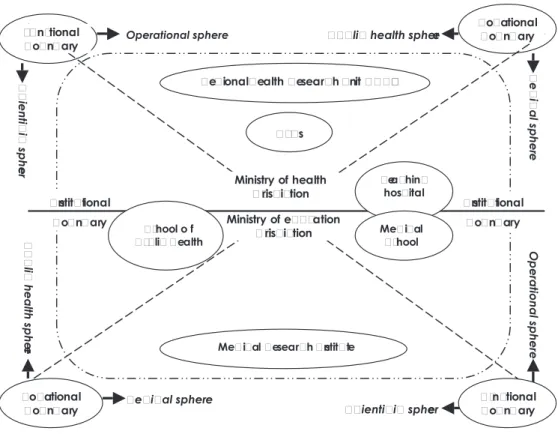
The applied conceptual framework is best described by the following two illustrations. The first one is Figure 5, which depicts the basic systemic structure of health care. In the same vein, the systemic relationship between different research efforts, which collectively help realize veritable development of health care system, is depicted in Figure 6. Knowl-edge and methodology that such research efforts may provide, must be widely disseminated and practiced, and that entails education and deployment of health manpow-er. In this regard, the evaluation effort must focus its attention to the research institute’s existing institutional framework and conditions under which the research institute had to operate. The institute at issue was part of the national university and the nation’s veritable center for higher education, and the university includes the medical faculty and the school of public health, as well as the teaching hospital. Accordingly, this institutional framework must be taken into consideration of the research institute’s prospective roles and activities and, thus, of the evaluation effort.
The illustration in Figure 6 depicts the institutional framework applied in this effort. Worth noting in this figure is the presence of “health research unit (HRU),” that has
nation-Figure 5 TWO CONCEPTUAL DIMENSIONS OF HEALTH CARE SYSTEM (Source: Tanahashi, 1997) HEALTH A T T E TE A E AT E T HEALTH E E A E E LE
wide organizational structure within the ministry of health. Its organizational tenet is to serve as a vital institutional link between research and development in health care. How-ever, relevant research capability is under the jurisdiction of the ministry of education and its affiliated research institutions. In other words, for this HRU system to become the veritable institution for promoting R&D process in the national health system, the institu-tional boundary, depicted in Figure 6, must be overcome and collaborative relationships must be established with other organizational entities in the system.
A major contribution of the evaluation exercise was to elucidate the fundamental poli-cy issue concerning the medical research institute. The institute was already well recognized as a leading medical research institute in Africa, and it had become a regional center for excellence in medical research in Africa. From the institute’s point of view, fur-thering such excellence should be obvious and justifiable, as it would continue to contribute to the national prestige. From the nation’s point of view, however, its research capability
Figure 6 AN INSTITUTIONAL CONFIGURATION FOR HEALTH RESEARCH AND DEVELOPMENT PROCESS (Source: Tanahashi, 1997)
Ministry of health ris i tion Ministry of e ation ris i tion nstit tional o n ary nstit tional o n ary o ational o n ary o ational o n ary n tional
o n ary Operational sphere
ientii spher e ienti i sphere Operational spher e li health sphere li health spher e eial spher e e i al sphere n tional o n ary e ional ealth esear h nit
s ea hin hos ital Me i al hool Me i al esear h nstit te hool o f li ealth
should be utilized in advancing the nation’s health care system. Such utilization could only be realized by putting innovation by inclusion into practice. If the national government at that time had such policy predisposition in socio-economic development, it might have found it easy to resolve the above policy issue.
Unfortunately, a number of factors obstructed the appreciation and implementation of the recommendations by the evaluation team. The research institute had been used to enjoy, with pride, its autonomous institutional status, and its research staff had little incen-tive for diverting their time and resources to anything but their research work. At the national level, the centrifugal management has been the norm, as in most national govern-ments. (Tanahashi, 2014) Therefore, inter-ministerial cooperation, stipulated in the recommendation, would have entailed the auspices of the prime-minister’s office. That might have been possible if the project had been conducted under its aegis. In reality, however, the project was under the aegis of the Japanese Ministry of Foreign Affairs, the primary concern of which was to demonstrate that its ODA programs have been managed with objective scrutiny. As such it had no stake in the implementation of any recommenda-tion from the evaluarecommenda-tion exercise.
It is worth noting from the above analysis the presence of Achilles heel in innovation by inclusion. That is the difficulty of finding or establishing the managerial authority that can muster all the key stakeholders and marshal their cooperation.
4. 3. Inclusive Innovation for Development of Cultural Tourism
Tourism is widely recognized as a growing industry and many nations, with advanced economy or developing economy, have instituted a variety of policy initiatives and institu-tional support for tourism development. However, it is the private sector that dominates tourism industry. As such, its development can be a prospective area for adapting the earlier mentioned BID scheme. Its effective adaptation inevitably entails congruous actions by all the stakeholders concerned in tourism development. Such congruity can only be expected if they share common understanding with regard to the perspective and prospect, as well as the strategy, for such development.
Not surprisingly, the main development thrust stems from globalization. One of its attendant trends, i.e., the unprecedented geographical expansion of human interaction,
im-plies significant increase of cross-cultural interaction. For such interaction to be productive, it helps for the interacting parties to have cross-cultural sensitivity, empathy and commu-nication skill. Indeed, it has been pointed out that promotion of such productive cross-cultural interaction is important in making globalization sustainable (Tanahashi, 2010c). Cultural tourism, therefore, has a potential to contribute to such enhancement. In order to fully realize such a potential, its development strategy must make good use of two features of globalization ; namely, growing need for people to nurture humanitarian bond, and expanding facilities for networking.
Now the key issue is to articulate an effective development strategy. The initial step for this effort is to admit that tourism does not have an intrinsic mechanism to promote cross-cultural understanding or communication. Such promotion must be designed into tourism and, therefore, cultural tourism has attracted the attention of both policy makers for, and stakeholders in, tourism. This trend is best exemplified by the growing popularity of UNESCO World Heritage Program, in which cultural heritage plays a major role. For example, the number of countries that have signed the World Heritage Convention in the course of the last ten years has risen from 139 to 178. Furthermore, the number of na-tional governments who have submitted the tentative lists for this UNESCO designation has grown from 33 to 132.
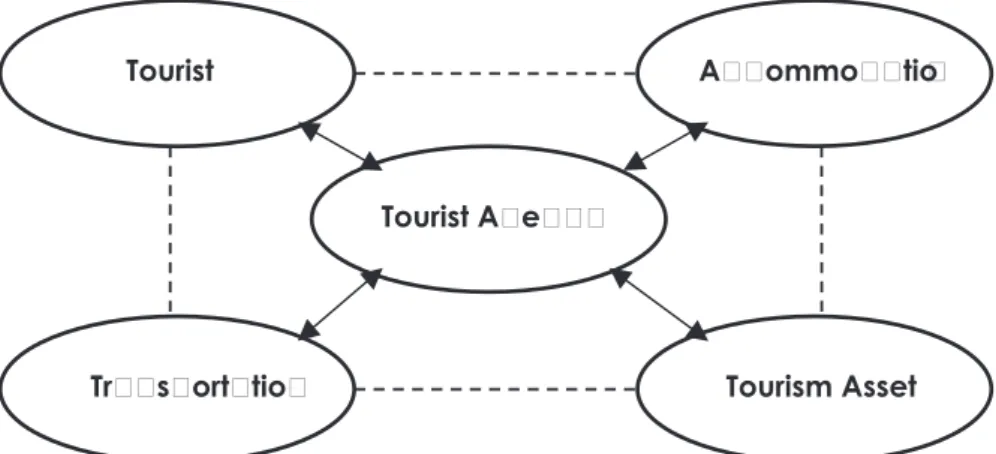
As before, systemic approach is also helpful in such articulation effort, and that ought to start from the definition of tourism. Tourism is defined as “the activities of persons who travel and temporarily stay in places outside their usual environment for leisure purposes.” (Tanahashi, 2008) This definition indicates the three essential components that make up tourism, besides tourists. They are leisure activity, transportation, and accommodation. Ac-commodation normally means the facility for temporary stay, such as hotels, hostels and pensions. However, in this context, it means all sorts of services and facilities that help tourists fully enjoy their leisure activities at their respective destinations. In theory, there-fore, it may include premises of interest, such as temples and shrines, as well as souvenir shops along their access roads. The systemic relationships between these components and tourists are illustrated in Figure 7, which should be viewed as a two-dimensional image of a triangular pyramid, with tourist at its apex.
objective ; namely, cultural tourism and leisure tourism. It is also useful to differentiate cultural tourism into two categories according to the tourist’s interaction with cultural properties ; namely “passive” cultural tourism and “active” cultural tourism. Sightseeing tourism is the typical form of the former. In contrast, the latter features the tourist’s initia-tive in experiencing or learning cultural traditions and practice. The latter is sometimes called creative tourism, to emphasize the individuality, on the part of tourists, for activity planning. Such tourism shows a departure from the conventional style of tourism operation in which travel agency performs the pivotal role. In contrast, the new or more progressive style of tourism features the tourist’s initiative in designing and effecting tourism. This style of tourism is clearly increasing, because of the advancement in communication tech-nology that is exemplified by the phenomenal expansion of internet in recent years. Such modal shift in tourism is illustrated in Figure 8.
The promotion of this new kind of tourism calls for two-pronged efforts, namely devel-opment of accommodation facilities by local tourism operators in partnership with tourists, and expansion and enhancement of this accommodation sector, with regard to tourism ser-vices. The unique assets of local tourism operators are their familiarity with local culture, and their ability to present, or share with visitors, their cultural properties and practice. In short, innovation by inclusion and their expanded participation in tourism could materially help make the locality a desirable destination for cultural tourism. Furthermore, such tour-ism development does not require a large-scale investment. However, it does require convenient communication link for the partnership and cooperation. That is nowadays
pos-Figure 7 CONCEPTUAL STRUCTURE OF TOURISM
Leisure Activity r s rt ti
sible with the advancing IT technology that has diversified as well as enhanced the communication links between stakeholders, as illustrated in Figure 8(b). The link cer-tainly facilitates the long tail marketing by local tourism operators for geographically scattered customers with diverse cultural interests.
Figure 8 MODAL SHIFT IN TOURISM OPERATION
Tourism Asset
A ommo tio
Tr s ort tio Tourist
Tourist A e
(a) OPERATIONAL MODEL OF CONVENTIONAL TOURISM
( ) OPERATIONAL MODEL OF PRO RESSIVE TOURISM
A ommo tio Tourist ter et Tourism Asset Tr s ort tio Primary interaction econ ary interaction
Practica interaction eoretica interaction
This strategy can and should be applied well beyond any particular locality, although this aspect is little appreciated by most local tourism operators. They tend to regard their counterparts in other localities as competitors, instead of collaborators. However, if local tourism operators aim at fostering true partnership with those tourists who are interested in active cultural tourism, they should collaborate in providing pertinent services that help such tourists enrich their cultural experience and understanding. Enrichment comes in two forms, i.e., depth and width. Some tourists may have interest in certain cultural expe-riences, such as traditional performance arts or culinary culture. Experiential enrichment will then come with visits to many different localities that offer their distinctive cultural traditions, respectively. Similarly, other tourists may be interested in traditional commu-nity life and get well acquainted with people and their life-style. In that case, the enrichment comes with diverse and intimate interaction with the local people.
Whichever kind of cultural enrichment the tourist may desire, the pertinent service can only be effected through organized collaboration of local tourism operators. Such col-laboration is best promoted by those entrepreneurs who espouse innovation by inclusion. A few successful examples of this practice exist in Japan. The first example is the case of cultural enrichment in depth. A community that is endowed with several cultural proper-ties within itself, as well as in its adjacent areas, has established a program called “Machi-Yado,” or “township for accommodation.” The essence of this program consists of the lodging facility and information service that allow tourists to stay relatively inexpen-sively and to experience and enjoy a variety of cultural interaction in the locality, according to their individual interests. Such features are effected by the participation of local families who offer their spare rooms for lodging, and of local business enterprises which extend their hospitality to tourists.
Examples of cultural enrichment in width also exist. One such example is the network-ing of local inns that share some geographical features, such as hot sprnetwork-ings, distinctive local food and dishes, or cultural heritages. More often than not, such inns regard each other as competitors, and not collaborators, thus making their networking appear rather counter-intuitive. However, such behavior tends to reduce the chances for tourists to fully appreciate the local culture and, in turn, the attractiveness of the locality itself. The net-working should, therefore, aim at provision of pertinent information for such extension of tourism and for the enabling transportation links are typical of such facilities. Again,
in-novation by inclusion is the key to such network development. 5. Prognosis for New Management
There is one key component that greatly affects innovation by inclusion and its pros-pect for success. That is governance system. Its operational characteristic can be broadly divided into two categories ; i.e., centrifugal governance and centripetal governance (Tana-hashi, 2011& 2014). The former style of governance has been the norm for historical reasons, but globalization is gradually making it obsolete and calling for the modal shift to the latter.
Nation has been the framework of governance for centuries. In much of the last cen-tury, nation building has been the central issue for governance in many countries, and limited national resources have to be mobilized and utilized to strengthen its nationhood. For such purpose, centrifugal governance, which emanates controlling force from the central government, is effective. Indeed, it has been widely practiced in Asia, where many coun-tries have experienced the stage of nation building or re-building in the 20th century. Japan’s rapid rise to an economic power, after the devastation during the Second World War, certainly gave credence to centrifugal governance.
Today, however, Japan no longer serves as a model nation in governance. Instead, Japan has become an exemplary case of failure in adapting its governance to the change of time. Such failure manifests most clearly in the national government’s heavy dependence on bond issuance to finance its programs on the one hand and, on the other, the sluggish economic performance and growth that continues ever since the end of “economic bubble” at the end of 1980’s. This continued poor economic performance is generally attributed to the centrifugal governance that Japanese government has exercised ever since the period of nation-rebuilding after the Second World War. At that time, mobilization of national re-sources under the directives of the central government was necessary and effective. However, even the central government became aware of the creeping obsolescence of cen-trifugal governance, and it initiated the policy of “deregulation” since the early 1980’s, and the policy of “economic restructuring” since 2000. The notable achievement of such policy changes is the abolition of state enterprises, and their privatization.