Iteration dynamical systems
of
discrete
Laplacians
on
the plane lattice
(Itsmathematical
structure
and
computer simulations
of
designs)
Y.MAKINO1)
C.HADLICH
2),G.GUERLEBECK2),A.KIMURA3), andO.SUZUKI4$)$*1) Department of home economics, Shimane Prefectural Shimane Womep’s College,
Matsue-city,Shimane, Japan.
2) Institute ofMathematics$,$ Weimar InstituteofTechnology, Geschister-Scholl str.8,
Weimar, Germany
3)GraduateSchool ofLiterature and SocialSciences, Nihon University Setagaya-ku, Tokyo,
Japan.
4)Departmentof ComputerSciences andSystem Analysis, Nihon Uni\mbox{\boldmath $\nu$}ersity, Sakurajosui;
Setagaya-ku, Tokyo, japan.
(Y.Makino) [email protected]
(C.Hendlich)[email protected](G.Guerelebeck)fossi.uni-weimar.de
(A.Kimura)[email protected](O.Suzuki)[email protected]
Keywords: dynamicalsystem, discreteLaplacians, design-samplers
INTRODUCTION
Thisis
a
continuation
ofpapers on iteration
dynamical sytemsofdiscreteLapalcian$s([2],[3])$.
$\ln$this
paper
we are
concemed with(1)Mathematical structure ofiteration dynamical systemofdiscreteLaplacians
on
theplane lattice and(2)$The$design-pattems produced by the dynamicalsystem.
At first
we
givea
stability theorem for the dynamical system whoseLaplacian isdefinedbyeven
neighborhoods.Nextwe
are
concerned withcomputer simulations of designs. Wecan
realizemany
kinds of designs andwe
can
give
a
classification ofdesigns
bythechoices
of neighborhoods,sources
andthe steps oftheiterations.
Finallywe
analyzethevariations
ofpattern and
we
can
show thatwe
supply thedesign-samplersusingour
software.ITERATION
DYNAMICAL
SYSTEM OF DISCRETE LAPLACIAN
Werecall thedefinition oftheiterationdynamical system of discreteLaplacians([l]).We
choose the plane lattice which is generatedby twofamiliesof lineswhich
are
orthogonaleachother. We $identi\theta$
a
latticepointwitha
cell obtained by the lattice. Wecalla
setof cellswhichare
attached with thereference cellsa
neighborhood $U_{p}$.
We call neighborhood even(orodd)ifthenumberofthe cellsiseven(respectively odd). Welist several examples of neighborhoods.
(1) Evenneighborhoods
(2)Odd neighborhoods -N 禍「 $N$ $-N$王
$\ulcorner w-$ $\ulcorner E$
$-8W^{\ulcorner}8\ulcorner 8\mathbb{E}$
NWNES NNEESW NW E$S$
Wedenote
a
neighborhood $U_{p}$bythedirectionsN,NE,$E$,ES,S,SW,W,NW.Forexamplewe
can
denote theNeumann neighborhood byN,E,$S$,W. Wetakethespace
$F$ of {0,1} valued fUnctionson
theplane lattice and$def_{1}ne$theLapacian operationby$\Delta_{U_{\rho}}f(p)=\sum_{q\in U_{p}}(f(q)-f(p))$
Choosing
an
initial function $f_{0}\in F$,we
define the dynamical system defined by the iteration of theLaplacian:
$\{f_{n}\},f_{n}=\Delta_{U}f_{n-l}(n=1,2,\ldots)$
We call point $p\in L$
a source
ofthe dynam$i$cal system when $f_{n}(p)=$] forany $neN$.
Then wecan obtain the designs of distribubons of$0$ and 1 on the lattice plane and we
can
get various kind ofdesignsbythechoiceofneighborhoods,
sources.
SOME BASIC PROPERTIES ON THE DYNAMICAL SYSTEMS
Here
we
recallsome
basicnotationson
thedynamical systems and state assertionson
mathematicalstructures([1],[2]). At first we notice that we consider dynamical system$s$ under the periodic
condition. Namely, choosing
an
integer $M$, which is called the size,we
consider the followingperiodicfunctions:
$F(N)–\{f\epsilon F|F\{x*M,$ $y+M$) $– F(x)(m, n\epsilon l)|$
Choosing neighborhoodsunder theperiodic condition,
we
can
define the discreteLaplacianand
we can
considerthe iterationdynamical system. Weprepareseveral basicnotations:(1) A dynamical systemiscalledstable if
$3k\epsilon N$
S.$tf_{n}=f_{k}(^{\vee}n\geq k)$
(2)A dynamical
$s_{3_{n,1s.tf_{n^{-}}}^{stemisca11edperiodic,If}3V}$
(3)A point $p\in F$ iscalled
a
source
ofadynamical system,if $f_{n}(p)=1$ forany $n\in N$.
We
can
statesome
basic propertieson
the dynamical systems:lftheneighborhoodis even,
we
see
that the dynamical systemisstable with the stability speed2
$p$for Moor neigh., Hexagonal neigh., Neumanneigh.,and Sierpinski neigh.
Ifthe neighborhoodisodd,
we see
that thedynamicalsystemisperiodic, periodisdifferent depending theneighborhoods.
(2) In the
case
where$M$isodd,we
may
expect the dynamical system isperiodicinthecase
of
a
singlesource.
We give the table ofperiods for smaller$M$:We
can
provethefollowingassertion:PROPOSITION
In the
case
where $M=2^{p}$, neighborhood is Sierpinski type, and it hasone
point source, thedynamicalsystemisstable with the stabilityspeed $2^{p}$
.
PROOF
We give
an
outline of the proof of Proposition inthecase
$p=4$.
Only byan
observation in thissimplecase we mayunderstand that
our
assertion holds. The detail will be given in anotherpaper.口
$arrow$ $\circ$$O$
口
$\div$$-\backslash$
Wenoticethefollowing facts:
(1) Puttingthe
source
attheupper
corner
intherightside,we see
that the Pascaltrianglemod2appears
intheupper
trianglepart.(2)Atthe 4 step,everyelement in the diagonal is 1.
(3) The lower triangleisfilled by$0$
.
SOFTWARE”DESIGNER KENTAURUS 2005”
We make
a
brief commenton
our
software.
Wehave well developed software named “DesignerKentaurus 2005”.The softwareis writtenby JAVA.
The software has threepanels:(l)Themainpaneldescribes the behavior ofthe dynamicalsystem,
and(2)$the$second panel describes the table of$neigborh\infty ds$and(3)$the$third
one
describes thesources.
CLASSIFICATION OF DESIGN-PATTERNS
We
can
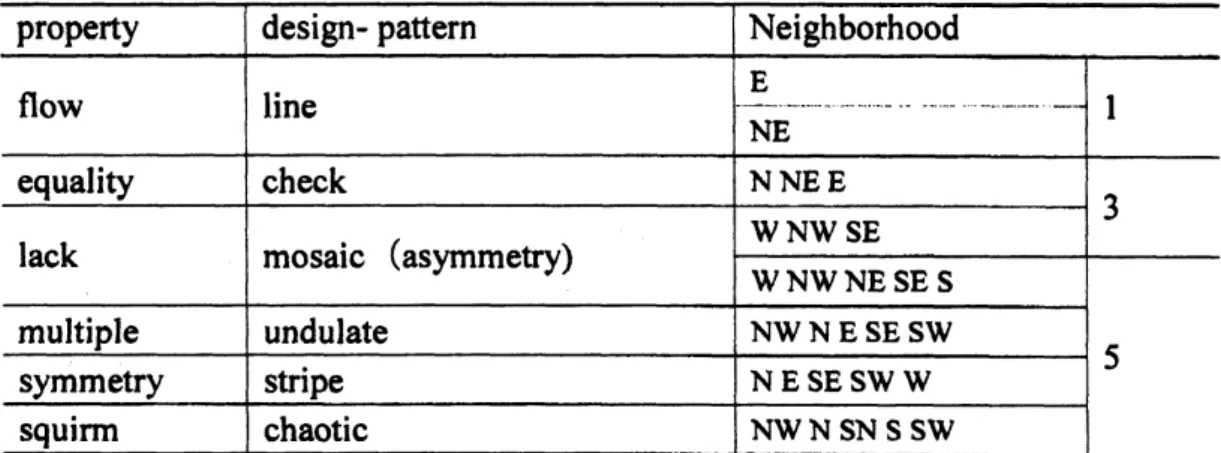
classifythedesign-pattems choosing neigborhoods, sources,steps. Wenotice thattheir characters depend $on$ oddness and
evenness
of neighborhoods stronglyas we
haveseen
inthe previous
paper[3]. We treatdynamical systemswitha
singlesource.
Design-pattern I
-even
neighborhood
–We
can
observethe followingkindsofdesigns. The left sideofthe explanationsunderthepicture$s$istype ofneighborhood, for example moor, Neumanndiag.Neumannetcand the
(4)$Bordered$ pattern (5)$Crystal$pattern (6)$Braid$ pattern
(7)Gasket
pattern
Design-pattern
$II$-odd
neighborhood
with
plural
sources-We
can
obtain design pattems with different taste $:(1)stripe$ pattern, (2)$mosaic$pattem,(3)$checkpattem,(4)undulate$patternand(5)$line$pattern:
(1)Stripe pattern
$|\cdot|\Vert\Vert|\Vert\Vert|\Vert|[[\Vert\Vert$
$NE$SE SW$W[4]$ step-127
(2) Mosaic
pattern
(4)
Undulate pattern
NWNESESW [5) $step-120$ NWNESESW [5] step-128 NWNESESW [5) $step-152$
(5)Line pattern
(6)
Chaotic pattern
We
can
make chaotic
pattemsanddesigns
of periodic
characters choosingplural
sources.
When
we
putthe
sources
without symmetries,we may
obtain
chaotic patterns easily.Table 2
examination
of pattems
$\Pi$(oddneighborhood)
CONSTRUCTION OF
DESIGN-SAMPLERS
By
these
observations,we
can
obtain
thefollowing
manualof
con
structing designs.
Table
3
structure
of software
We
needsome
experiences
for
getting
desired
pattem$s$.
We
will
give
a
manual
ofproducing
designs
systematically.(1)We have given
a
theoremon
the mathematical structureofiterationdynamical systemon our
dynamical system inthe simple$st$case.
Namelywe
haveproveda
stabilitytheorem for the Sierpinski’s neighborhood with
a
source.
Wemay
expecttoobtainanalogous resultsforgeneral
even
neighborhoods.This will be given intheforthcomingpaper.
(2) Wenoticethat
our
dynamicalsystem inthecase
of line lattice is identicalwith thedynamicalsystem
#90
ofWolffam’s
table of cellularautomata([7]). Hencewe
may
expecttoobtain
analogousresultsfor
the planelattice.
(3)Wehaveproduced
many
kinds ofdesignsby$u$se
ofour
simulators and makeanalysison
them.Oursimulationsare
defined by theiteration dynamical systemsandwe can
reproduce them
as
one
wantstoobtain them. By this factwe
havegiven themanualofproducing designs followingthe consumer’s needs.
(4)The$evenness/oddness$ofneighborhoods give bigdifference not onlyintheirimpressions
given bythe designsbutalso intheirmathematical structures.This
can
beobserved inthepsychological experiments
on
the visualimpressions([3]). Wenoticethatthis character playsan
importantrolein the discussionson
the differenceofJapanese and Europeandesigns. Also
we
have$s$een
thatwe
have made the simulations ofthetime change ofnumbers of familiesofextinctanimals by
use
of theeven
neighborhoods([4]). Herewe
want to express
our
stresson
thefact thatour
simulationsmay
expecttodescribetheevolution ofthe universe. This topics willbe discussed inthe forthcomingpaper. References
[1] Y.Aiba, K.Maegaito, Y.Makino and O.Suzuki: Dynamical systems defined by iterations ofdiscrete Laplacians andtheir computer simulations, 1-8, Proc. ISSAC Int. Conf. (ICU Univ. 2004, Tokyo)
2005.
$[2]Y.Aiba$, K.Maegaito and O. $Suzuki:Iteration$ dynamical systems of discrete Laplacian
on
the plane lattice(I)(Basic propert$i$
es
and computer simulations), Proc. IKEM2006(Weimar)2006
[3] A.Kimura,Y.Makino, K.Maegaito and $O.Suzuki:Iteration$ dynamical systems of discrete
Laplacian
on
the plane lattice(II)(The underlying factors determining the visual impressions
$\hslash om$ design pattems), Proc. IKEM2006(Weimar)2006$[4]K.Kosaka$
ans
$\ovalbox{\tt\small REJECT}:lteration$ dynamical systems of discrete Laplacian and evolutionof extinct animals,To appear in Proc. ISSAC Int. Cong.(Catania,Italy)
[5] Y.Makino, A.Kimura, K.Maegaito and O.Suzuki: Dynamical system defined by iteration of discrete
Laplacian(IV) (Productionofdesignsamplers),65-70,Proc.ofConf. ofAppliedMath.2004.
[6] S. Watanabe: Pattern recognition: human and mechanical.NewYork:$W\ddagger 11y$