Strategic Choices for Low-Carbon China and
Proposition of East Asia Low-Carbon Community
Z
HOUWeisheng
※, Q
IANXuepeng
※※,
S
UXuanming
※※※, L
IFan
※※※※Abstract
To solve the global climate change problem, countries require more than efforts at local level: multilateral cooperation and climate policy integration are essential for realizing a wide-area low-carbon society. Realizing a low-carbon society is not a simple action that ad-dresses global warming while ignoring the quality of human life, but is a process to achieve harmonious sustainable development of economy, environment and society while solving the problem of global warming simultaneously. According to the principle of “Common but Differ-entiated Responsibilities”, China should stick to the consistent pathway towards emission re-duction. Energy saving, followed by fuel transformation and renewable energy utilization, is the most efficient technology China will promote to achieve the emission reduction, In addi-tion, Carbon Capture and Storage (CCS) technologies will play an important role after 2050. Chinaʼs CO2 emissions are likely to peak around 2040 (550ppm) or even earlier in about 2030
(450ppm) with great efforts. No single energy source is going to be the solution to global warm-ing. Development of alternative power sources is the only way towards sustainable develop-ment. As a developing country, Chinaʼs pathway to a low-carbon economy is absolutely a no-re-gret approach with recognizing the uncertainty of climate change. Nevertheless, the low-car-bon economy is just one of the necessary conditions for achieving sustainable development. In this study, firstly we discussed the future direction and technology strategies for realizing a low-carbon society in the Post-Kyoto climate policy framework. Secondly, the study focused on analyzing Chinaʼs adaptation measures to climate change and strategic approach to
※ Professor, College of Policy Science, Ritsumeikan University, [email protected] ※※ Associate Professor, College of Asia Pacific Studies, Ritsumeikan Asia Pacific University,
※※※ Research Associate, National Institute for Environmental Studies, Japan, suxuanming@
gmail.com
※※※※ Research Assistant, North Carolina Clean Energy Technology Center, USA, fanli0415@
gmail.com
© The Policy Science Association of Ritsumeikan University:
bon society. Finally, we proposed to establish an “East Asia Low-Carbon Community” as an important way to deal with climate change problems and also discussed the urgency and ne-cessity of building a “Nuclear Power Safety and Security System” in East Asia.
Keywords
Climate change, low-carbon society, sustainable development, East Asia Low-Carbon Commu-nity, China
1. Introduction
China currently ranks as the world's largest emitter of CO2but its CO2 emissions
per capita is far less than the worldʼs average. In addition, China's carbon emissions
per unit of GDP remain 6 timesʼ larger than Japanʼs CO2 emissions per unit of GDP
(IEA, 2013&2014). As the greatest source of emissions, China shall take more sibility for climate change. However, its low per capita emissions differentiate respon-sibilities for emission reduction from other developed countries. Meanwhile, Chinaʼs possible reduction of carbon intensity reinforces its role as a key player in addressing climate change through different ways. Achieving a low-carbon society is not a single approach to choose between fighting climate change and having better quality of life. Itʼs a comprehensive strategy that not only maintains a safe climate, but also drives sustainable community to bring economic, social and environmental benefits. In other words, achieving a low-carbon society offers various new opportunities. Developing a low-carbon society would eventually contribute to improving energy structure, devel-oping renewable energy, maintaining energy security, adjusting industrial structure, enhancing energy efficiency, solving public health problem, increasing living stan-dards, curbing population growth, and extending vegetation area. It is always the goal of a harmonious society that human beings pursue even without global warming.
This paper firstly explained the basic framework on climate change and the Post-Kyoto climate policy regime. Secondly, this paper discussed about the technolo-gy stratetechnolo-gy for carbon reduction, and the uncertainty of the climate change problem. Later on, this paper emphasized the analysis on China's pathway towards a low-car-bon society and the policy framework on establishing an East Asia low-carlow-car-bon com-munity to achieve an interregional low-carbon society.
2. Basic Framework on Climate Change
2.1 The “Common but Differentiated Responsibilities” and three groups of countries parties
In the Framework Convention on Climate Change, the concept of “Common but
Differentiated Responsibilities” was introduced based on the fact that the cumulative
carbon emissions as well as the per-capita emissions vary from developed countries to developing countries. In order to better clarify the differentiated responsibilities among countries, the Convention distinguishes member countries into three different groups based on their different income levels, ranging from developed countries par-ties (i.e. US and Japan) to middle-income countries parpar-ties (i.e. Korea and Mexico) and developing countries parties (i.e. China and India) (Zhou, 2008). The Convention also offers three forms of participation: 1) compulsory participation (enter into a legally binding agreement with mandatory limits on emission reduction objectives), 2) self-imposed participation (voluntarily set and meet non-legally binding emission re-duction objectives), and 3) voluntary participation (carry out non-mandatory emission reduction activities with no particular reduction objectives) (UN, 1998).
2.2 Post–Kyoto global climate regime
The Kyoto Protocol was agreed in 1997 and entered into force on 16 February 2005. As the first commitment period of the Kyoto Protocol expired by the end of 2012,
now we have entered a “Post-Tokyo Protocol” era (also called “Post-Kyoto”). Currently,
there are two alternative policy frameworks of climate change for the “Post-Kyoto” period (Zhou, 2006&2008).
1) Kyoto Approach
In the Post-2012 global climate regime, the binding targets for emission reduction in Kyoto Protocol will continue in force. The Kyoto Protocol is the first international agreement that legally binds countries to emission reduction targets. Although the protocol has served as a good start, there are always problems inherent in the Proto-col to be addressed. For example, there are concerns regarding the methodology on emission target setting, negotiations in emission limits, economic policy decision-mak-ing, risk management for not meeting the binding target, and the form of agreement making. Therefore, completing the first commitment period does not bring an end to the protocol, rather, it brings forward the second commitment period.
2) Non-Kyoto Approach
emis-sion reduction, and each state may choose self-imposed participation or voluntary participation and promote reduction through international cooperation, such as Asia-Pacific Partnership for Clean Development and Climate (APP) and Major Econo-mies Meeting on Energy Security and Climate Change. This kind of non-Kyoto ap-proach is one of the trials towards the establishment of new Post-Kyoto climate re-gime. It is supplementary to but doesnʼt replace Kyoto Protocol. China will adopt non-Kyoto approach in emissions reduction from now on.
2.3 Technology strategies of achieving a low-carbon society
With the rapid development of the global economy, the significance of achieving a wide low-carbon society lies in the development of innovative low-carbon technolo-gies and transfer of existing technolotechnolo-gies. These technology stratetechnolo-gies generally con-sist of the following five sustainable approaches.
1) Promoting energy saving on a global scale
2) Utilizing low-carbon energy resources (fossil fuel reformation, renewables, nucle-ar power development and utilization)
3) Developing new environmental technologies (CO2 separation, capture,
sequestra-tion and reutilize)
4) Increasing carbon sink sources (afforestation, ocean absorption, biotechnology) 5) Developing new energy technologies (space solar power production, nuclear
fu-sion)
The above technology strategies for CO2 mitigation can be classified as “no-regret
strategy” (i.e. energy-saving, afforestation), “mini-max regret strategy” (i.e. fuel
re-form, renewable energy development), and “specific measures” (i.e. CO2 capture and
storage technology)
3. China's Pathway Towards a Low-carbon Society
3.1 The evolution of China's climate policy under the Convention
As a developing country with a large population, China is confronted with pover-ty, pollution, and severe environmental problems. In the process of policy making and implementation, the Chinese government would always give priority to the domestic problems such as poverty and pollution over environmental problems. Chinaʼs climate change policy evolution is divided into three phases (Zhou, 2006).
1) Phase 1: Observation Phase ( ~ 1997, COP3 held in Kyoto)
seemed to be limited to the problems of developed countries. Developed countries should take the lead in reducing emissions. By holding the idea that emission reduc-tion and economic growth is contradictory, China did not take any acreduc-tion on mitiga-tion and adaptamitiga-tion to climate change.
2) Phase 2: Learning Phase (1997 ~ 2005, Kyoto Protocol adopted)
The Intergovernmental Panel on Climate Change (IPCC) reports and the Kyoto Protocol were the two main reasons that triggered China to recognize the urgency as well as the importance of understanding the climate change problems. Meanwhile, a series of natural disasters occurred in China further raised a growing public aware-ness on climate change issues from the field of academia to enterprises, and the pub-lic. China began to realize that the effort on emission reduction would not only
con-tribute to the reduction of CO2 emissions, but also help solving domestic pollution
problems, as well as promoting energy efficiency. Chinese government came to under-stand the necessity and importance of achieving a low-carbon society for developing countries.
3) Phase 3: Action Phase (2005~)
Since the adoption of Kyoto Protocol in 2005, Chinese government has been firm-ly insisting on the principle that developed countries have a higher obligation to com-bat climate change and cut emissions. China, as a member of the developing countries parties, was under no obligation to accept compulsory emission reduction target. But, at the same time, China has proactively implemented “Kyoto Approach” and “Non-Kyo-to Approach” “Non-Kyo-to reduce emissions. In other words, China internalized the “pressure” from Protocol as its own “driving force” for reducing carbon emissions. Starting in 2006, China imposed a series of measures to fight against the climate change and pro-moted the low-carbon economy. The measures include enacting Renewable Energy Law, establishing carbon trading market, proposing long-term development plan for renewable energy as well as nuclear power. In the 15th Conference of the Parties (COP 15) held in Denmark, China was committed to making a 40% to 45% cut in its carbon intensity by 2020, compared with the 2005 level, as one of Chinaʼs “Kyoto Approach”. In detail, China intended to achieve this ambitious emission reduction goal by various effective strategies, including improving clean energy and nuclear development, in-creasing vegetation covers, promoting energy conservation and carrying out other environmental protections activities. As one of Chinaʼs “Non-Kyoto Approach”, China has been actively participating in the bilateral and multilateral cooperation on climate change with Japan, US and EU.
3.2 Approaches for coping with the uncertainty of climate change
The difficulty in forecasting the climate change is a major barrier to deal with the climate change problems. What scientists have known is that climate change is a com-prehensive phenomenon which not only relates to the change of quantitate and
con-centrations of CO2 in the atmosphere, but also relates to the increase in sea level as
well as the global mean temperature. However, it remains imperative to address the wide uncertainties in our understanding of climate change and its effects. It is worth noting that some climate change effects impose a long-term effect on the environ-ment. Therefore, it becomes extremely difficult for scientists to find a perfect solution for climate change with huge uncertainty. For years, there have been contentious de-bates over whether global warming is occurring. Though a few scientists argues that
global warming is the greatest scam in 21st century, there is a strong consensus among
most scientists that global surface temperatures have increased in recent decades. All science has uncertainty, so as the climate change. Lacking of global warming knowledge leads to a public debate over the causes of the global warming phenomena. Some scientists state that water vapor is the major cause for global warming, some blame sunspot, and some people think that global warming is just a natural cycle of
Earthʼs climate. Nevertheless, no one disagrees that CO2 is one of the chief
green-house gases. But how much impact CO2 plays on global warming remains highly
con-troversial.
The public controversy developed three distinguished attitudes toward global warming. The first attitude says that that global warming is a natural effect. No effort could stop global warming, so we do nothing about it. The second attitude is
“mitiga-tion”. The “mitigation” attitude holds the opinion that the CO2 emissions produced by
human activities are the main causes for the global warming. Therefore, we have to reduce the emissions to curb global warming. The third attitude combined the first two attitudes. We call it “adaptation”. It states that both natural factors and human factors force the global warming. Even if we have very limited ability to completely stop the global warming; we have to actively seek proper solution to slow the trend.
With technology development and our deepened understanding of the nature, the uncertainty of global warming and climate change would be gradually reduced. Ac-cording to the IPCC Fifth Assessment Report (AR5) (IPCC, 2013), it is extremely likely that human influence has been the dominant cause of the observed warming since the mid - 20th century. In addition, the increasing temperature of the Earth is largely the
result of emissions of CO2 from human activities. In other words, human-caused
Kyoto Protocol determines the compulsory emission reduction target for develop-ing countries, but also has three innovative flexible mechanisms (Emission traddevelop-ing, Clean Development Mechanism and Joint Implementation) to help developing coun-tries to achieve emission reduction and sustainable development. Kyoto Protocol is a sophisticated international climate agreement with well-defined responsibilities for different countries without ignoring the uncertainty of the climate change problem. Despite of the uncertainty of climate change, constructing a low-carbon society is one of the necessary conditions to realize sustainable development.
3.3 Consistent pathway towards emission reduction
The concentration of CO2 has increased obviously and each country has its own
responsibility which varies according to the emission of the country. The internation-al negotiation on emission reduction functions like a game theory, where evidence is required to decide how much emissions need to be reduced. Following the principle of “Common but Differentiated Responsibilities”, China needs to find the proper pathway of emission reduction on the basis of global reduction objective and the actual nation-al conditions (shown in Figure 1).
According to “Kyoto Approach”, Chinaʼs strategic plan on emission control divid-ed into three stages. The first stage is from 2008 to 2012 (first commitment period of Kyoto Protocol) when China has made efforts on emission reduction voluntarily. The
second stage is a voluntary stage. In the second stage, China pledged to make a 40% to 45% cut in its carbon intensity by 2020, compared with the 2005 level. The carbon in-tensity reduction target is a voluntary action that is set based on its own national con-ditions and does not include legally binding requirements. The third stage is a binding commitment stage. In the future, China will take on mandatory emission reduction, but these targets should differ from those of developed countries. The third stage of carbon emission would only happen if the carbon emission per capita in China were greater than the global average level. By some estimation, Chinaʼs carbon emission per capita will exceed the global level by 2020.
Chinaʼs three emission-reduction stages are developed based on the current emis-sions, regardless of the accumulative emissions. The start point of the mandatory emission reduction stage would delay if the accumulative emissions factor was also taken into account. The three-stage emission reduction is a fair and practical solution that is both in the best interest of Chinese people and the world as well.
3.4 A no-regrets emission reduction policy
China as a developing country will achieve sustainable economic and social de-velopment through no-regret option and mini-max regret option. From a scientific point of view, there are three ways to reduce the carbon emissions:
1) No-regret option: No-regret approach suggests effective carbon reduction even if there is no proven links between global warming and carbon emissions. No-re-gret approach plays a key role in sustainable development. Effective no-reNo-re-gret options include afforestation, energy conservation. No-regret approach is consid-ered as the primary strategy for emissions reduction.
2) Mini-max regret option: The second approach refers to the development of clean energy, including wind, solar and biomass. Generally speaking, the development cost of a new type of energy is relatively higher and more risky than fossil fuels. Even so, it is necessary to pursue emissions reduction through mini-max regret option that minimizes the likelihood of the worst-case outcomes, and conse-quently optimizes the industrial structure, minimizes and secures the energy supply.
3) Specialization option: The specialization option indicates Carbon Capture and Storage technology (CCS) that specially designed to cope with climate change. The CCS technology is a relatively new concept. It can temporarily prevent the
CO2 entering the atmosphere but never serves as an ultimate solution to climate
3.5 China’s CO2 emissions peak and optimal pathway for emissions reduction
The figure 2 shows Chinaʼs CO2 emissions from 2010 to 2100 and its optimal
strat-egies for global warming mitigation under the business-as-usual (BAU) case of SRES B2 emissions scenario (RITE, 2003; IPCC SRES, 2000). According to IPCC, the B2 sce-nario describes a world in which the emphasis is on local solutions to economic, so-cial, and environmental sustainability. It is a world with continuously increasing glob-al population, intermediate levels of economic development, and less rapid and more diverse technological change. We developed this figure by using Dynamic New Earth 21 (DNE21) model. DNE 21 is an integrated assessment model developed by the Re-search Institute of Innovative Technology for the Earth (RITE). It is a dynamic non-lin-ear optimization model evaluating cost-effective warming mitigation strategies from a long-term and global point of view. The model consists of 10 world regions and 3 sub-models as Energy Systems Sub-Model, Macro-economic Sub-Model and Climate Change Sub-Model.
According to the most recent IPCC report, limiting warming to no more than 2
degrees C will require stabilizing concentrations of CO2 at 450 ppmv (parts per
mil-lion per volume) or less by 2100. We set a target of 450 ppmv CO2 in the atmosphere to
run the following simulations.
Figure 2. China’s emission peak year and its global warming mitigation strategies
-500 0 500 1000 1500 2000 2500 3000 3500 2010 2020 2030 2040 2050 2060 2070 2080 2090 2100 Energy Saving Reforestation Fuel Switch Hydro & Geoth. Wind Photovoltaics Biomass Nuclear Aquifer Disp. Ocean Disp. Gas Well Disp. EORUse Disp. Net Emission(450ppmv) NetEmission(BAU) Annual CO 2 Em ission s& Reduction (Mt-C/Year)
1) Chinaʼs CO2 emissions peak
According to Figure 3, under the BAU case, the CO2 emissions in China will shoot
up from 1030 million tons in 2010 to 3080 million tons in 2100. To achieve the global
target of 450 ppm CO2 (2 degrees C) in the atmosphere by 2100, the global CO2
emis-sions by 2050 have to reduce by 40 to 70% compared to the 2010 level. For achievement of the stabilization, the IPCC report indicates that negative net emissions are required toward the end of this century. In this case, China would be expected to reach its emissions peak by 2030 (Zhou, 2010), and increase its emissions by 18% compared to 2010. By 2050, the emissions would have a slight increase of 5% compared to 2010 lev-el. By 2080, the emissions have to reduce by 70% compared to 2010 levlev-el. The total emissions by 2100 are required to be negative.
On November 12, 2014, U.S. and China reached an agreement on greenhouse gas-es reduction targets. The United Statgas-es has pledged to cut its emissions to 26-28% be-low 2005 levels by 2025. For the first time officially, China said it would aim to stop emissions rising by “around 2030”, which matches the peak year simulated by setting the target of 450 ppmv in the previous study. It is important to note that the peak year also highly depends on what mitigation strategies China would take and how much
Figure 3. The prediction of China’s CO2 emissions with different emission reduction
targets -500 0 500 1000 1500 2000 2500 3000 3500 2010 2020 2030 2040 2050 2060 2070 2080 2090 2100 Net Emission(BAU) Net Emission(450ppmv) Net Emission(550ppmv) Anual CO 2 Em issions (Mt-C/Year)
the mitigation strategies would cost. As the Figure 3 indicates, if the target of CO2 concentration in the atmosphere is set at 550 ppm level by 2100 (2 times as the first industrial revolution level), China would delay its emission peak year by 10 years to 2040. A reasonable and suitable peak year would be achieved without sacrificing one countryʼs economic and social development.
2) Technical approaches of Chinaʼs CO2 emission reduction
DNE21 Model is a non-linear dynamic optimization model, which maximizes the consumption utility and minimizes the cost of energy system. The results show when, where, how to reduce emissions to reach the global cost-efficient objective, and pro-vide the cost-efficient reduction solution to each region or state respectively. Accord-ing to Figure 2, the optimal emission reduction solution for China is energy savAccord-ing, followed by fuel switch, clean energy development and nuclear development. The CCS technology would play a significant role after 2050. Considering the uncertain factors of nuclear power and other security issues, the simulation holds a conservative point of view on the nuclear power installation period and the size of the nuclear stations. In fact, China has 23 nuclear power stations with capacity of 11.88 million kilowatts currently. The electricity production by nuclear power shares less than 2% of the countryʼs total generation capacity. There are 27 stations under construction, and 230
stations are planned to be built in the near future. According to the 12th 5-Year Plan,
the total capacity will reach 42.94 million kilowatts by 2015, and 90.00 million kilo-watts by 2020 (NEA, 2013).
3.6 No single type of energy can save the world – best mix power sources
The development of clean energy and promotion of low-carbon economy are the two feasible approaches people would consider. Both of them are inevitable choices of the social development as well as a necessary perquisite for sustainable development (Chinese Academy of Science, 2009).
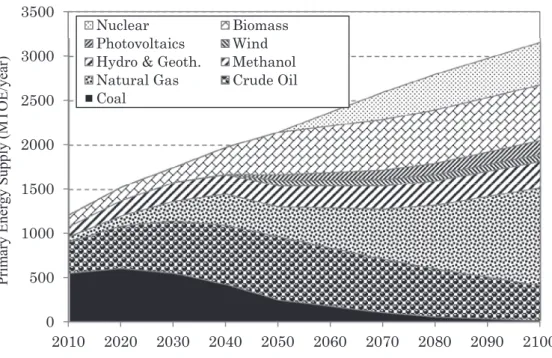
Figure 4 shows Chinaʼs primary energy supply structure with CO2 reduction
tar-get of 450 ppmv. Coal shared 45% of the total energy supply in 2010. It would decline sharply after 2030, by 12% in 2050, 2% in 2080 and 0.5% in 2100. Conversely, the supply of natural gas, hydro, biomass and nuclear would greatly increase. In particular, the supply of natural gas would increase significantly after 2050 due to the development of shale gas. Nuclear power is also expected to increase its share of the total energy supply after 2050. Figure 5 shows Chinaʼs final energy consumption structure under 450ppmv scenario. It is important to note that there is little consumption of coal after 2030. The consumption of electricity grows from 18% in 2010 to 63% of total energy consumption in 2100. The technical roadmap is that part of the fossil fuels will be
Figure 4. China’s primary energy supply structure (450ppmv)
Figure 5. China’s final energy consumption structure (450ppmv) 0 500 1000 1500 2000 2500 3000 3500 2010 2020 2030 2040 2050 2060 2070 2080 2090 2100 Nuclear Biomass Photovoltaics Wind Hydro & Geoth. Methanol Natural Gas Crude Oil Coal Pr im ar y En erg y Supp ly (M TO E/ yea r) 0 500 1000 1500 2000 2500 3000 2010 2020 2030 2040 2050 2060 2070 2080 2090 2100 Electricity Biomass Hydrogen Ethanol Methanol NaturalGas OilProducts Coal Final Energ y Con su m ption ( M TO E/ year )
made into oil products and the other will be transformed into electricity. In the
pro-cess of electricity generation, CO2 will be captured and stored. This roadmap is
sum-marized to the strategy of using electricity to replace coal and fossil fuels.
At present, there is no single energy technology can entirely solve the global warming problem. Fossil fuels would run out in the future. Development of clean ergy is an inevitable solution to combat global warming. However, a single type of en-ergy would never sustain the social development. We need a best mix of power sourc-es that maximizsourc-es the rsourc-espective advantagsourc-es of different typsourc-es of power generation from the comprehensive perspective of stable supply, environmental performance, and economic efficiency. To realize efficient, clean and safe energy supply is the basic principle for energy development in China. In long term, the development of the re-newable low-temperature heat such as solar heat, geothermal and ocean thermal ener-gy will become more and more important (Sun, 2013&2014).
4. Establishing the East Asia Low-Carbon Community
4.1 The differences and potential of emissions reduction in Japan, China and Korea
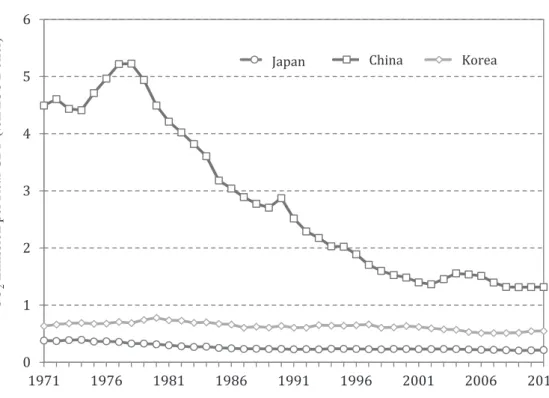
Figure 6 compares the CO2 emission per unit of GDP (carbon intensity) in Japan,
China and Korea. Here, the GDP refers to the real GDP. It is clearly observed that the gap between carbon intensity in China and Japan, and China and Korea has dimin-ished. In 1971, the carbon intensity for China was 11.8 times greater than for Japan. In 2011, the gap has narrowed to 6.2 times greater for China than for Japan. Still, the gap is wide. In Figure 7, the line with block on the top indicates the total sum of emissions of Japan, China and Korea. The upside area shows the converted total emissions from
the three countries, assuming that Korea and China achieved the same level of CO2
carbon intensity level as of Japan. The downside area shows the reduced emissions in total. The total reduced emissions of Japan, China and Korea in the past 40 years were 169.8 billion tons. If China and Korea improve their carbon intensity levels to the level of Japan, the total emissions can be reduced by 10.9 billion tons, which accounts for 64% of the total sum of emissions from Japan, China and Korea.
Similar conclusion can be drawn by comparing the total emitted CO2 emissions
and reduced CO2 emissions in China (Figure 8). The total emissions of China from
1971 to 2011 were 117.5 billion tons. If China can improve its carbon intensity level to
Japanʼ level, it would save China 102.3 billion tons CO2 emissions, which is 87% of the
fac-tors, such as industrial structure, energy mix, technology development, life style and exchange rate. The wide gap in technology development between China and Japan is an excellent example to support this idea. In 2007, the electricity production in China from coal-fired power plants was 2722.9 billion kWh. In 2005, the efficiency rate of coal-fired power generation is 43% and 32% in Japan and China, respectively. By in-creasing its efficiency rate up to Japanʼ level, China would reduce 710 million tons of
CO2 emissions, while the total CO2 emission of Japan in 2011 were 1.17 billion tons.
That is to say, the potential emission reduction would reach more than half of the
to-tal CO2 emission in Japan by improving technology only in thermal generation field.
Besides, the economic benefits including the decrease of coal usage and reduction of other pollutants could be obtained at the same time.
Apparently, itʼs impossible for China to improve its carbon intensity to Japanʼs level for a short period of time. There are two conclusions we can draw from the pre-vious analysis. First of all, China has great potential on improving the carbon intensi-ty to a certain level. Secondly, China, Japan and Korea would gain economic and envi-ronmental benefits from establishing an East Asia Low-Carbon Community to cope with global warming.
Figure 6. Comparison of CO2 emissions of Japan, China and Korea
Source: 2014 EDMC HANDBOOK of ENERGY & ECONOMIC STATISTICS 0 1 2 3 4 5 6 1971 1976 1981 1986 1991 1996 2001 2006 2011 日本 中国 韓国 C O2 Em
ission per Real
GD P (ton/k U S D oller )
0 2000 4000 6000 8000 10000 12000 1971 1976 1981 1986 1991 1996 2001 2006 2011 日本並み排出原単位場合の日中韓合計のCO2排出削減値 日本並み排出原単位場合の日中韓合計のCO2排出値 日中韓合計のCO2排出実績値 C O2 Em issions and Reductio n (m tons )
Total emission reduction at Japan's carbon intensity level Total emission of Japan, China and Korea at Japan's carbon intensity level
The actual emission of Japan, China and Korea
0 1000 2000 3000 4000 5000 6000 7000 8000 9000 1971 1976 1981 1986 1991 1996 2001 2006 2011 日本並み排出原単位場合の中国のCO2排出削減量 日本並み排出原単位場合の中国のCO2排出量 中国のCO2排出量実績値 C O2 Em issions and Reductio n (m tons
) Total emission reduction of China at Japan's carbon
intensity level
Total emission of China at Japan's carbon intensity level The actual emission of China
Figure 7. Total emission reduction of Japan, China and Korea at Japan’s carbon inten-sity level
Source: 2014 EDMC HANDBOOK of ENERGY & ECONOMIC STATISTICS
Figure 8. Total emission reduction of China at Japan’s carbon intensity level Source: 2014 EDMC HANDBOOK of ENERGY & ECONOMIC STATISTICS
4.2 Proposals for the East Asia Low-Carbon Community
Currently, the realization of a low-carbon society is recognized as a common goal throughout the world. Japan owns the best energy efficiency technology in the world.
Advancing energy efficiency technology to reduce CO2 emissions is not a
cost-effec-tive way for Japan. Conversely, China will greatly benefit from development of energy efficiency technology. In addition, an inter-regional cooperation would further
accel-erate the CO2 emissions reduction in China. Moreover, the positive correlation
be-tween economic growth, pollution prevention, and low-carbon development serves as an important incentive for government to implement the low-carbon policy. Therefore, it has become a major issue for China, Japan and Korea to promote technology inno-vation and transfer, reform economic and social system to build a multinational low-carbon society.
The following factors are unique and important features for understanding the
CO2 emission reduction in China, Japan and Korea:
1) China, Japan and Korea represent developing country, developed country and middle-income country, respectively.
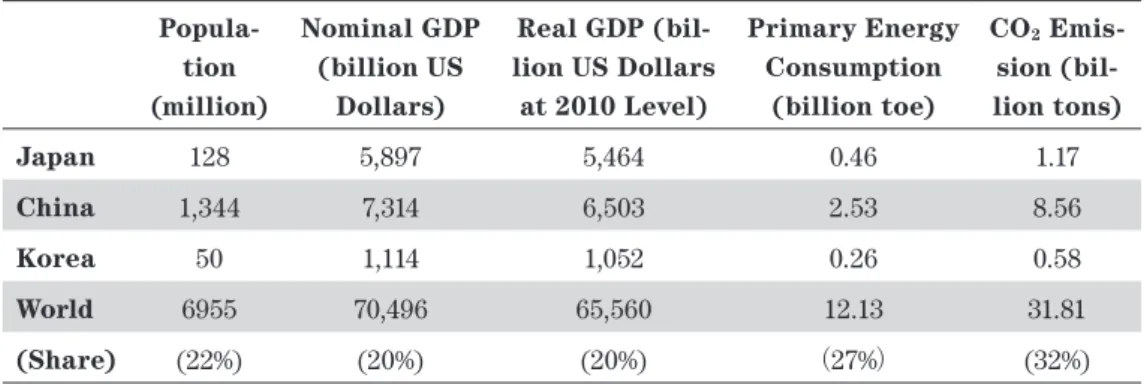
2) The total sum of population, GDP and primary energy consumption in China, Japan and Korea take up 20% of the world level.
3) Currently, China is the biggest CO2 emitter in the world, but its average
emis-sion per capita is below the world average level. China would not participate in
com-pulsory CO2 emissions reduction obligation in the near future.
4) In history, Japan has undergone several phases of economic growth, pollution problem, and global warming problem. In contrast, China is experiencing these three conditions at the same time.
5) The rapid urbanization in China, Japan and Korea has created various domes-tic problems that need to be addressed immediately before the global warming prob-lem.
Hence, it is necessary and urgent for China, Japan and Korea to work together to build an interregional low-carbon community to prevent global warming.
In 2008, the author proposed a policy framework on an East Asia Low-Carbon Community that focused on the cooperation of building an interregional low-carbon society among China, Japan and Korea (Zhou, 2008&2010&&2014(1)&2014(2)). On the Twelfth Tripartite Environment Ministers Meeting (TEMM12) which was held in May 2010 at Hokkaido, China, Japan and Korea reached an agreement on a long-term coop-eration of building a low-carbon, low pollution and sustainable society based on the East Asia Low-Carbon Community framework (Zhou, 2010).
4.3 Framework of the East Asia Low-Carbon Community
The East Asia region is a very special region in the world where contains high mobility, diversity and distinction. China, Japan and Korea are the three countries that play the most important role in the East Asia region and also well represent three distinguished country group as developing country, developed country and
middle-in-Table 1. Basic Profile of Japan, China and Korea Popula-tion (million) Nominal GDP (billion US Dollars) Real GDP (bil-lion US Dollars at 2010 Level) Primary Energy Consumption (billion toe) CO2 Emis-sion (bil-lion tons) Japan 128 5,897 5,464 0.46 1.17 China 1,344 7,314 6,503 2.53 8.56 Korea 50 1,114 1,052 0.26 0.58 World 6955 70,496 65,560 12.13 31.81 (Share) (22%) (20%) (20%) (27%) (32%)
Figure 9. Multi-layered Structure of East Asia Low-Carbon Community
based on the Principle of Common but Differentiated Responsibilities, the reduction approach is divided into three stages as spontaneous stage, voluntary stage and binding commitment stage
in dealing with the global climate change problem, it is necessary to realize a low-carbon community at a global level
from specific issues to complex issues, from local problems to global problems, policy integration is required – “kill two birds with one stone”. In particular, in the case of developing countries, they are confronted with poverty, pollution and the global climate change problem which need to be addressed simultaneously
the CO2emission reduction framework aims at a win-win solution for all the participants,
and designing a mechanism which also has co-beneficial effects on other emissions 1st Axis Time Period 2nd Axis Regional Linkage 3rd Axis Policy Integration 4th Axis Sharing Results
come country, respectively. Currently, there are poverty, pollution and global climate change problem that need to be addressed simultaneously. In this paper, we propose to establish an East-Asia Low-carbon Community that consists of 4 important factors (Figure 9) to support the community system (Zhou, 2010).
4.4 Top design for the East Asia Low-Carbon Community
As the top design, 3 points are summarized in considering the construction of mutual beneficial international low-carbon community combining economic and envi-ronmental aspects (Zhou, 2008).
(1) The integration of local and global environmental measures
In the past, developed countries experienced economic development, local envi-ronmental problems such as regional pollution, and global envienvi-ronmental issues such as the global warming in the order. Today, developing countries are facing those three issues at the same time. On the other hand, the acidification problem and global warming are those associated with the major causative agent produced by fossil fuel combustion, the due of which is deeply rooted in modern civilization. Therefore, it is important to consider measures to promote the integration of local and global envi-ronmental protection. And regarding global envienvi-ronmental issues, the expected re-sults will not be obtained unless concrete measures are adopted at local level. Espe-cially for the realization of a low-carbon society, the participation of developing coun-tries and proper support to local activities are important perspectives.
(2) The application of marketing mechanism in technology transfer
Under the economic globalization, international competitiveness is the basic con-dition for the survival of the enterprises. Many technologies are owned by private companies. It is regarded that the technology transfer could reduce the competitive-ness and further lead to a hollowing out of industry and technology of the transfer county. Moreover, there are many factors that hamper the promotion of technology transfer, such as lack of adequate protection of intellectual property rights of develop-ing countries, lack of institutional and financial mechanisms to promote technology transfer, lack of systems to promote technology transfer and digestion and inefficient technology transfer procedure. Therefore, to promote technology transfer, and take advantage of the transferred technologies efficiently, it is necessary to apply a market mechanism, which is useful at allocating resources.
(3) The win-win situation between developed and developing countries
In addition to the reduction of environmental pollutants such as CO2 and SOx,
economic benefits can be obtained through environmental cooperation. Such cooper-ation projects should consider the sharing of economic and environmental benefits
and match the needs of both sides. This method could help to mitigate the risks of technology transfer for advanced countries, reduce the financial burden for the devel-oping countries, and improve the efficiency of energy-intensive sectors such as ther-mal power plants. At the same time, business opportunities will be created for devel-oped countries. To promote such kind of technology transfer, the counterpart coun-tries should provide specific policy incentives for securing human resources and fi-nancial support. And the enterprises in developed countries should be more active to catch the business chance, such as energy-saving technology transfer through the linkage of CDM and ESCO etc. The realization of the East Asia Low-Carbon Commu-nity needs their active engagement.
4.5 The East Asia Low-Carbon Community and building nuclear security sys-tem in Japan, China and Korea
(1) Current status of nuclear power in Japan, China and Korea
For years, there are on-going debates between opponents and proponents on whether the development of nuclear power is a solution to global warming. Some fu-els, such as uranium and plutonium, are exhaustible and not the necessary outcomes of human evolution. That is to say, nuclear is not indispensable to the evolution or survival of human beings. From the view of history of technology there is no “perfect” technology with zero “risk”.
Since the Fukushima Daiichi nuclear disaster occurred after the Great East Japan Earthquake, there are parties in growing numbers supported to a “nuclear-free society”. However, in the East Asian region, besides Japan, there are still more than 40 groups of running nuclear power reactors in mainland China, South Korea and Taiwan. Even if all the nuclear power reactors in Japan are abolished, risks from nuclear power ac-cidents caused by other neighboring countries cannot be removed. Therefore, it is im-portant to build a comprehensive nuclear security system at a multi-national level to address the potential security problems from the planning stage to implementation.
Figure 10 shows distribution of nuclear power plants in East Asia (Zhou, 2014(3)). Nowadays, there are 4 nuclear power plants, containing 16 groups of running nuclear power reactors in China (mainland). On February 17, 2013, Unit 1 of Hongyan River Nuclear Power Plant, which was the first primary nuclear power plant located in northeastern China, began to generate electricity. Immediately after the Fukushima nuclear power accident occured, the reviews of construction plan for building new nuclear powers are suspended. According to the “medium to long-term development plan” of nuclear power, which was announced in October 2012, until 2020, the con-struction plan of inland nuclear power would not be allowed until 2015. However, the
26 groups of nuclear power reactors with on-going construction are aimed to opera-tion by 2015. Besides ensuring the sufficient energy supply, China was also seeking
CO2 reduction solutions to global warming in the international community. Chinese
government has announced the target of reducing 17% of CO2 emissions in the White
Paper titled “Chinaʼs Policies and Actions for Addressing Climate Change (2011)”. Al-though the current proportion of nuclear power only accounts for 1.8% of the total power production, the authorities have set a goal for increasing the nuclear power ca-pacity up to 40 million kilowatts by 2015, and 80 million kilowatts by 2020. Hence, it has become an extremely difficult task for China to not only ensure energy supply but also solve environmental problems without developing nuclear power.
In Korea, there are 4 nuclear power plants, 21 groups of nuclear power reactors in operation. Korea has to pay great attention to the 3 nuclear power plants and 15 groups that facing toward the Sea of Japan, since when nuclear accident occurs, the nuclear leaking will have great impact on both countries. Since the Fukushima acci-dent, with some nuclear generators destroyed by earthquake, the others stopped for general inspection. Further, by January 2015, all the nuclear power plants stopped for inspection. Realizing the fact that other than imported resources, nuclear power is the only domestic energy that can sustain the energy supply in Japan, some people suggested activating the reactors that are under the inspection. On the other hand, as shown in Figure 11, as one of the solutions to global warming, the decrease of nuclear
power production led to a increase of Japanʼs CO2 emissions from primary energy in
recent years. It is a trilemma in the international community that states want to achieve economic growth ensure stable energy supply, and also address environmen-tal problems.
(2) Big challenges for the nuclear power sector of China a. Shortage of advanced technique talents
When viewing the whole plan of nuclear power in China, there are 10 groups of one million kilowatt nuclear power plant built at the same time in one year at the peak time. At that time, whether there is sufficient planning, management and operation capacity in China is the most serious issues that concerned by international society. With the rapid expansion of nuclear power development, there are other serious prob-lems emerged and remain to be solved, which include lacking of high technique tal-ents, the poor production technology of nuclear power equipment, inadequate con-struction and installation capacity, as well as insufficient development and design skills. Regulatory authorities are also facing the issue of human resources shortage (Zhou, 2013).
Figure 10. The location of nuclear power stations in Japan, China and Korea
Figure 11. Comparison of CO2 emissions by primary energy of Japan, China and Korea
Source: 2014 EDMC HANDBOOK of ENERGY & ECONOMIC STATISTICS
◎: In Operation ■: Under Construction ▲: Planned ◆: Inactive 2 2.5 3 3.5 4 1971 1976 1981 1986 1991 1996 2001 2006 2011 中国 日本 韓国 CO2 emissions by primary energy (ton/toe)
b. The hidden risk of insufficient nuclear fuel resources
There is no doubt that nuclear power development is important to Chinaʼs energy supply. However, from a long-term perspective, it is possible that nuclear fuels would only be developed for 50 years in China. Most of the short or medium term nuclear power plants in China are the pressurized water reactor (PWR) power plants. The PWRs are inefficient in terms of the use of uranium resources.. Therefore, the large demand for uranium resources, the low efficiency of PWR, and the insufficient nuclear fuel supply are the most significant constraining factors that hinder the sustainable development of nuclear power industry in China.
c. Lacking radioactive waste dispose technology
The safe disposal of radioactive waste presents one of the most difficult environ-mental problems in China. The appropriate nuclear waste management requires a great amount of financial investment and long-term efforts from conducting laborato-ry experiments to producing disposal equipment. It offers a great business opportuni-ty to companies from other countries that have advanced waste disposal technology. (3) Proposal of the nuclear security system for Japan, China and Korea
The decision on whether to develop nuclear power exerts huge influence on build-ing the East Asian low-Carbon community. Japan, China and Korea have close geo-graphical and economical relationships. When nuclear accident occurs, it could make a significant impact on all the countries. In particular, as the nuclear industry of Chi-na has faced a serious challenge as described above, it is not a problem for a single country, but also a challenge for all the three countries.
The main purpose of the “East Asia Nuclear Security System” is to train and ex-change human resources across countries and regions, to share information, to build a platform for technology transfer and provision, as well as to promote the govern-ment, industry and research academiaʼs participation in intergovernmental panels on nuclear crisis prevention. In particular, the nuclear safety is usually achieved by multi-ple efforts, including mutual monitoring system, share of experience on safety culture development, construction of cooperation system on nuclear safety, exchange of tech-nology, as well as the cooperation between nuclear experts in East Asia area. It is also important to promote information exchange under emergent conditions between gov-ernments, academic and research institutions, and non-profit organizations. Japan could help China with the issue of lacking human resources. In Europe, a country with a long history of nuclear development, a considerable number of nuclear techni-cians and engineers are expected to retire shortly after. Nevertheless, with the
pro-posed platform of East Asia Nuclear Security System, Japan, a developed country with a great number of experienced talents, is expected to play an important role in addressing the issues associated with nuclear power development. Nuclear accidents and disasters are local, but the experience and lessons from the accidents should be shared by all human beings. Nuclear safety problem has become an international problem across borders. It is urgent for Japan, China and Korea to set up a nuclear security system with potential opportunities for exchanging technology, talent, and information.
5. Conclusions
In this study, we analyzed the direction and technical strategy for realizing a low-carbon society in post-Kyoto climate regime from the fundamental framework of climate change. Regarding the uncertainty of climate change, adaptation measures and the social perspective of low-carbon society were focused too. Finally, we pro-posed the concept of “East Asia Low-Carbon Community” and “Nuclear Power Safety and Security System in East Asia”.
According to the principle of “common but differentiated responsibilities”, Chinaʼs reduction effort should stick to a grading strategy from voluntary phase, to self-im-posed phase, and finally arriving at the phase of mandatory reduction. The technology choice that China most probably takes is energy-saving, followed by fuel transforma-tion and the utilizatransforma-tion of renewable energy and nuclear power. In additransforma-tion, the
tech-nologies such as CCS will play an important role after 2050. In case the CO2
concentra-tion is set to 450 ppmv as the target by 2100, Chinaʼs CO2 emissions may peak around
2030. If the target is changed to 550ppmv, the peak may occur around 2040. Consider-ing any sConsider-ingle energy source is impossible to save the world, it is the only way to es-tablish an energy system which can support the sustainable development of the soci-ety by combining various types of energy. To realize efficient, clean and safe energy supply is the basic principle for energy development in China. The Low-Carbon soci-ety is a comprehensive index, now only in its infancy. China, as a developing country, taking a low-carbon pathway is absolutely a no-regret approach. It is never too late for China to start, but there is still a lot of work to do. Nevertheless, the low-carbon econ-omy is just one of the necessary conditions for achieving sustainable development.
The Wide-area low-carbon society is considered to be the most effective way for the sustainability of the world and climate change. In the process towards this goal, there are many important issues, such as financial mechanism, technology develop-ment and transfer, cultivation of human resources, and capability developdevelop-ment. Thus,
we propose 3 points as the top design in considering the construction of mutual bene-ficial international low-carbon community combining economic and environmental aspects.
As learned from the air pollution in Beijing, besides economic development, we still have to face many local and global environmental problems, such as air and wa-ter pollution, cross board sand pollution, long-wa-term security of nuclear power and en-ergy resources. Therefore, it is important to apply multi-dimensional and comprehen-sive measures into climate policy framework and establish wide international cooper-ation on global warming. Furthermore, the establishment of the East Asia Low-Car-bon Community is expected to form a society full of vitality through harmonious de-velopment of economy, environment and society.
Reference
Chinese Academy of Science, 2009. Report on Sustainable Strategies for China, Science Press International Energy Agency (IEA), 2013. Energy Balances of non-OECD Countries 2012.
Inter-national Energy Agency Press.
International Energy Agency (IEA), 2014. Energy Balances of non-OECD Countries 2012. Inter-national Energy Agency cPress.
IPCC SRES, 2000. Nakićenović, N., and Swart, R., ed., Special Report on Emissions Scenarios: A special report of Working Group III of the Intergovernmental Panel on Climate Change, Cambridge University Press
IPCC, 2013. Climate Change 2013: The Physical Science Basis. Contribution of Working Group I to the Fifth Assessment Report of the Intergovernmental Panel on Climate Change [Stock-er, T.F., D. Qin, G.-K. Plattn[Stock-er, M. Tignor, S.K. Allen, J. Boschung, A. Nauels, Y. Xia, V. Bex and P.M. Midgley (eds.)]. Cambridge University Press
National Energy Administration (NEA), 2013. The 12th 5-Year Plan for Energy Development. Research Institute of Innovative Technology for the Earth (RITE), 2001 Introduction of
Inte-grated Evaluation Model DNE 21
Sun, F., Ikegami, Y., Arima, H., Zhou, W., 2013. Performance Analysis of the Low Temperature Solar-boosted Power Generation System: Part I. Comparison between Kalina Solar System and Rankine Solar System, Journal of Solar Energy Engineering (ASME), Vol.135 (1), no. 011015.
Sun, F., Ikegami, Y., Arima, H., Zhou, W., 2013. Performance Analysis of the Low Temperature Solar-boosted Power Generation System: Part II. Comparison between Kalina Solar Sys-tem and Rankine Solar SysSys-tem, Journal of Solar Energy Engineering (ASME), Vol.135 (1), no. 011016.
Sun, F., Zhou, W., Ikegami, Y., Nakagami, K., and Su, X., 2014. Energy-exergy analysis and opti-mization of the solar-boosted Kalina cycle system 11 (KCS-11), Renewable Energy 66 (2014) 268-279.
United Nations, 1998. Kyoto Protocol to the United Nations Framework Convention on Climate Change, United Nations.
Zhou, W., 2006. How Developing Countries Can Engage in GHG Reduction: A Case Study for China、Sustainability Science、2006.6、Vol.1、No.1.
Low-Carbon Society, Environmental Conservation Engineering, Vol.37, No.9, pp.642-646. Zhou, W., 2008. The Measures to Climate Change of China in Post-Kyoto Climate Regime: the
Integration of Local and Global, Environmental Research Quarterly, The Hitachi Environ-ment Foundation, No.149, pp.63-74.
Zhou, W., 2010. The Meaning of Chinaʼs Self-imposed Goals and Prospect for Post-Kyoto Cli-mate Regime, Annual Meeting of the Society for Environmental Economics and Policy Studies, Nagoya University.
Zhou, W., 2000. The Road to The Earthʼs Regeneration, Mao, Y. ed. Scenarios for Saving the Earth: CO2 Reduction Strategies, THE NIKKAN KOGYO SHIMBUN.
Zhou, W., 2010. Chinese Movement and Future Prospects to Post-Kyoto Climate Policy Regime, Journal of Policy Science
Zhou, W., 2010. Low-Carbon Strategy for China, 12th Annual Meeting of China Association for Science and Technology, Fujian, China.
Zhou, W., Nakagami, K., Su, X. and Ren, H., 2010. Policy Framework and Evaluation Model of the East Asia Low-Carbon Community, Environmental Conservation Engineering, Vol.39, pp.536-542
Zhou, W., 2013. The East Asia Low-Carbon Community and Nuclear Security System, Environ-ment and Health, Vol.26, pp.162-174.
Zhou, W., Su, X. and Qian, X., 2014(1). Study on the Introduction of CO2 Emissions Trading Sys-tem for Realizing East Asian Low-Carbon Community, Journal of Policy Science, Vol.8. Zhou, W., Ren, H., Su, X., Qian, X., Yamazaki, H., Inaba, K., Sun, F., Kato, H. and Haga, H.,
2014(2). Realization of the East Asia Low-Carbon Community and Establishment of Policy Engineering, Journal of Policy Science, Vol.21, No.3.
Zhou, W., Xu, S. Inaba, K., Qian, X. and Nakagami, K., 2014(3). Toward Establishing Nuclear Power Safety and Security System in East Asia-Statistical Analysis of Nuclear Power Plant Accidents around the World, Journal of Policy Science, Vol.9