Impression Mechanism for the Contemporary
Japanese Based on the Analysis of Impression
Management in The Tale of Genji
journal or
publication title
Kwansei Gakuin University social sciences
review
volume
21
page range
39-57
year
2017-02-18
Impression Mechanism for the Contemporary Japanese Based
on the Analysis of Impression Management in The Tale of Genji
Yoshinobu SATO*, Toshimi AISHIMA**
I. The Significance of The Tale of Genji in the Study of Emotion
In discussing the origin of Japanese omotenashi (おもてなし;Japanese hospi-tality) in the viewpoint of marketing, Aishima and Sato (2015, 2016 a, 2016 b) ar-gued that the Japanese concept of omotenashi originated from the sequence of the historical flow of the banquets described in the Man-yo-shu (万葉集;Collection of Ten Thousand Leaves, the oldest collection of Japanese poetry), renga (連歌,col-laborative poetry) gathering, and the cha-no-yu (茶の湯;Japanese “Way of Tea”) that was influenced by Sen-no-Rikyu. The culture of a “reading atmosphere” was focused in the papers; that is, the ability of reading delicate nuances of the atmos-phere in those banquets and gatherings as well as the ability to compose poems ap-propriate to a situation was indispensable in those days. To be successful in such occasions, guests as well as hosts should have the highest level of culture, the so-phisticated techniques of poetry composition, and above all, the ability of sensing the subtle changes in mood. Sato and Aishima (2016) pointed that the rules of omotenashi at the banquets of the Man-yo-shu and renga gatherings were largely similar to the unspoken but observed rules in karaoke parties.
From the series of research mentioned above, the authors recognize the impor-tance of clarifying how the essential abilities to read the subtle changes of an atmos-phere in Japanese omotenashi could be nurtured. In this paper, the authors intend to analyze the expression of emotions described in The Tale of Genji (hereafter re-ferred as Genji), that is, the occurrence and expression of emotions (and the rule), and the strategies of impression management (IM) of the main characters. The rea-sons are as follows:
────────────────────────────────────────── * Professor, Institute of Business and Accounting, Kwansei Gakuin University
**Doctoral Student, Institute of Business and Accounting, Kwansei Gakuin University
Kwansei Gakuin University Social Sciences Review
Vol. 21, 2016 Nishinomiya, Japan
In recent years, in marketing research, emotion has been shown to play an im-portant role in the creation of customer values and co-creation of values in experi-ence marketing, the Service Dominant Logic, and the Service Logic of Nordic school. In addition, in the service marketing, emotional labor and the impression management by sales personnel have been treated as traditional objects of study. Therefore, the study of emotional occurrence and emotion expression serves as a backbone of the previous research.
Otsuka (2000) explained in Characters Could Not Show Emotions in The Tale of Genji, an ambitious work with a rather sensational title, that the expression of Japanese emotions has completely changed just after the Genji. According to Ot-suka, the characters including Hikaru Genji, the shining prince, in Genji conceal their emotions, whereas the gods and goddesses in Kojiki, the oldest book in Japa-nese history, demonstrate their feelings forthrightly. They often cry, shout, laugh, and become upset. Otsuka (2000) attempted to analyze their ways of expressing emotions in two categories of Japanese classic literature: (1) before Genji, for exam-ple, Kojiki, Man-yo-shu, and Old Buddhist Stories, and (2) after Genji, for examexam-ple, Konjaku Monogatari and the Tale of Heike. Otsuka (2000) also argued that contem-porary Japanese share similar ways of (not) expressing emotions. There is a possi-bility that her argument corresponds, at a deeper level, to the authors’ point that the unspoken rules of contemporary karaoke parties are similar to those in the Man-yo-shu banquets and renga gatherings.
Apart from the academic (scientific) authenticity of the claim, Otsuka (2000) has a point in her categorization of the historical trend of Japanese emotional ex-pressions. Therefore, it is important to decode Genji. The occurrence and expression of emotions or the IM strategy of the Japanese who possess a collectivistic and in-terdependent sense of self with a high-context communication culture is considered different from those of the Anglo Saxons who have an individualistic and independ-ent self-view and a low context communication culture. If they are differindepend-ent, it is impractical to apply, to Japan, the theory of marketing research and consumer be-havior research generated in the United States. It could even lead to a misunder-standing. A Japanese-style marketing research that is theoretically grounded on the foundation of the Japanese culture and its social structure and consumer behavior is required. Therefore, it is significant to analyze the emotions portrayed in Genji, which provides the impetus for the “creation” of emotion in the contemporary Japa-nese.
Holbrook (1999, p. 12) described the eight categories of feelings (efficiency, excellence, status, esteem, play, aesthetics, ethics, and spirituality) that relate to the typical sentiments of consumers by using a 3-dimensional matrix of 2×2, while in Genji, there are strikingly few categories of emotions. Rather, the characters in
Yoshinobu SATO, Toshimi AISHIMA 40
Genji understand skillfully each other’s feelings, which are expressed in subtle but diverse ways, just as infinite shades are expressed in sumi-e (Japanese ink painting), which is drawn in black and white. In this field, as a study of “self-monitoring in social interaction,” the comparative analysis of the high and low self-monitoring fea-tures has been advanced (Ickes, et. al. 2006). However, the authors do not think that the comparison between high self-monitor and low self-monitor could explain the ability of Hikaru Genji, the protagonist in Genji, to capture the feelings of his oppo-nent.
Therefore, it is necessary to examine the reality of Genji. In the research of the classic literature, almost all scholars agree that while the novel written by Murasaki Shikibu in the 11th century was a fiction, it was rich in reality, based on customs,
values, cultures, human relations, events, and so on. For instance, Goto (1986) dis-cussed in detail the political conflicts, events, and the atmosphere at the courts de-scribed in the novel and reasoned that they were based on historical facts. Imai et.al (1991) argued that Murasaki Shikibu accounted faithfully the customs and conducts in those days and detailed several scenes in Genji with reference to historical re-cords. Tanaka (1995) confirmed that historical facts were heavily reflected in the fictional novel. Masuda (2002) highlighted that the aristocratic society described in Genji was a realistic portrayal of the social aspect of the Heian period. As such, there is no further requirements to confirm the novel’s authentic depiction of the Heian era based on the numerous validations from the previous studies.
However, it is important to provide an overview of the influences of Genji on Japanese culture in subsequent periods, the emergence and expression of emotions, or the IM strategies in particular. In the Muromachi (1336-1573) and Azuchi Mo-moyama (1573-1603) periods, when renga was popular irrespective of titles, occu-pations, and social positions, knowledge of Genji was necessary for even common people to compose renga poems, because the poems reflect the aesthetics of the classic. An immense number of picture scrolls, synopsis, parody fictions, or dramas based on Genji were enjoyed by the people so that the novel, its values, and its aes-thetic consciousness became widespread in the society, irrespective of rank.
A parody of the classic titled Incredible Tale of Genji, A Country Bumpkin was one of the best-selling books in the Edo period (1603-1868). It is true that Genji was sometimes criticized as immoral by Buddhists or the government, and Murasaki Shikibu was said to have been condemned for writing the novel. Nevertheless, many novelists and poets willingly used the novel as reference even in those days. Ihara Saikaku (1642-1693) wrote the Life of a Lady’s Man, one of his most famous nov-els, based on Genji. Matsuo Basho (1644-1694) applied some phrases and sentences of Genji into his Narrow Road to the Deep North. Ueda Akinari was influenced by the classic in writing Ugetsu Monogatari (1776). In addition, there are a large
ber of literary pieces created under the influence of Genji in theatrical performances, such as kabuki, Noh, and Joruri, as well as in pictures. Motoori Norinaga, an estab-lished scholar on Japanese culture, pointed out brilliantly that the essence of Genji is not a romance but “mono-no-aware,” (an empathy toward things), which resulted in the novel earning an unshakable position in Japanese literature (Teramoto 1983, Suzuki 2003, Iwatsubo 2013).
In the Meiji era (1868-1912), Genji was utilized as an advertising material for projecting good images or ideas of Japan, and as teaching aids for girls. Suematsu Kencho, a diplomat, first translated The Tale of Genji into English. However, his translation was given an undeservingly low evaluation by scholars. In fact, Seiden-sticker was influenced by the Suematsu version in translating Genji. Suematsu trans-lated the novel to manipulate Japan’s image for the Europeans, particularly the Brit-ish, so that they would have a positive opinion of the Japanese. His intention was to show them that the Japanese in the 11th century could produce such a deep and
so-phisticated work of literature, aptly grasping the human nature. In addition, Sue-matsu attempted to apply it as a guidebook of Japanese culture, and dismissed the idea that Japan was a feudal, male chauvinistic society as perceived by the Europe-ans in those days (Kawakatsu 2008, pp. 44-52).
Suematsu also regarded Genji as a somewhat realistic novel. An advocate for female education, Suematsu praised Murasaki Shikibu for her acute power of obser-vation and delicate touch. He intended to publicize that Japanese women, even dur-ing the Heian period, had enjoyed a far higher level of education than expected (Kawakatsu 2008, pp. 76-81).
In 1938, an explanation was added in the elementary school textbooks that Genji had been accepted as a piece of world literature. After 1951, people began en-joying the classic with much enthusiasm in its various new versions, for example, with more readable synopsis, or in kabuki and movies (Kawakatsu 2008, p. 397). Tanizaki Junichiro referred to Genji when he wrote The Makioka Sisters, which be-came very popular among women. Pertaining to this point, Donald Keene (2013) stated as follows:
The theme of The Tale of Genji is so universal [as] to cross the borders be-tween languages. It has received high praise from abroad. There are various translations in more than ten languages. For example, Waley, Seidensticker, and Tyler, my student, published the translation in English. I prefer Waley’s . . .
There are also many translations of Genji into modern Japanese, for which Tanizaki is the most famous. Once I wrote for a literary magazine that, in com-parison, Waley’s translation is superior to that of Tanizaki. I regretted for being rude to Tanizaki, and sent a written apology to him. I was very relieved
be-Yoshinobu SATO, Toshimi AISHIMA 42
cause he answered, “I don’t care.”
Tanizaki was probably influenced by Genji. It has been said that he would not have been able to write The Makioka Sisters if he had not worked on the Genji translation into modern Japanese. Around 1948, Tanizaki sent Waley The Makioka Sisters, consisting of three volumes, with his own signature. Not in-terested in Japanese modern literature, Waley read but did not translate them. He gave me the books. I thought The Makioka Sisters was a masterpiece. How-ever, Waley chose not to fulfill Tanizaki’s wish to have the novel translated into English.
As will be explained below, Yukiko, one of the main characters of the Makioka Sisters, shares the same IM strategy with Hikaru Genji, to a remarkable extent.
This paper is organized as follows. In Section II, the authors explain the re-search method for reading The Tale of Genji to show the emergence and expression of emotions and IM strategies specific to the Japanese people. In Section III, the characteristics of emotion expressions are pointed out from the analysis of emotions in Genji. In Section IV, the authors compare between the analysis of emotions in Genji with the research results on emotion in American culture that is contrary to those of Japanese culture, which forms the basis of the emergence and expression of emotions, and IM strategies. Section V presents the summary of the conclusion of this study and future research themes.
II. Research Method of This Study
In this section, the method of analyzing The Tale of Genji is explained. The authors listed the typical scenes where the occurrence and expression of emotions, and IM strategies (emotional scenes) were evident in relation to Hikaru Genji; as a result, 70 scenes were selected.
Then, the emotional scenes were categorized by several standards: the emo-tional scenes of man-woman relationships centered on Hikaru Genji, the emoemo-tional scenes of women in relation to Hikaru Genji, and the emotional scenes of power re-lationships between men. A comparative analysis of the emotions that occurred was also performed; that is, the emotions were classified into two categories of positive and negative, and subsequently the two main categories were re-classified into sub-categories.
Furthermore, if possible, the process of continuous changes of the occurrence and management of emotions (which included IM as well as emotion management) was pursued. Emotion is considered temporal; hence, the study of emotion has been
developed on this premise. In Genji, many scenes illustrate the petrification process of emotions.
Finally, the authors analyze the success and failure patterns of the IM strategies in two cases, that is, the IM strategies against Hikaru Genji and those of Genji. He failed in his IM strategy when he was young, and this leads to his relegation to Suma. Afterwards, he utilizes the bitter experience to overcome the ensuing emo-tional scenes. Next, the following section shows the results of the analysis.
III. Analysis of the expression of emotions in The Tale of Genji
In this section, the authors explain the results of analysis of expression of emo-tions in Genji as follows. First, the system of social position and the social structure are shown, and this helps clarify the rules of the emergence and expression of emo-tions, and the IM strategy. Secondly, the dynamic features of the emergence and ex-pression of emotions, and the IM strategies were organized according to timeline in the scenes where the upper and middle nobility showed their emotions. Finally, the authors report the results of the analysis of the IM strategies that were taken by the protagonist, Hikaru Genji, and the characters around him.
1. Social Structures and the Occurrence of Emotions in the Main Characters of The Tale of Genji
From the analysis of the emotional scenes in Genji, there are diverse rules or norms in the emergence and expression of emotions in accordance with their charac-ters’ social class. Upper class aristocracy, particularly highest echelon of the upper nobility (i.e., those who were close to the emperor and the crown prince) showed no great emotion for two following reasons: (1) political reason (if they showed their emotion, they might run the risk of giving their political rivals some cues of their weaknesses), and (2) social reason (those who expressed their emotions freely were regarded as vulgar. The upper nobility had been taught not to express their emotion, and not to show strong emotion. The authors will explain in detail in the following.
In general, the upper class aristocracy includes, according to the order of titles, in the first place, daijō-daijin (Grand Minister); in the second place, sadaijin (Min-ister of the Left), udaijin (Min(Min-ister of the Right), and naidaijin (Lord Keeper of the Privy Seal); in the third place, dainagon (Major Counselor, chief counselor of state), and chunagon (Middle Counselor); and in the fourth place, the councilor. The middle-class aristocracy consists of non-councilors of the fourth, and the fifth rank aristocracy. In addition, there is another category: It is the “super-upper class nobil-ity” consisting of the “relatives of the Emperor, the Crown Prince, the Empress, and the Princess.”
Yoshinobu SATO, Toshimi AISHIMA 44
In the upper class aristocracy, daijō-daijin, the Minister of the Left, the Minis-ter of the Right, and the Lord Keeper of the Privy Seal classes nearly overlap with the super upper class aristocracy. In other words, only members of the super upper class aristocracy have the chance of being daijō-daijin and Ministers of the Left and Right, and the Lord Keeper of the Privy Seal. Even nobilities who are not related to Emperor, or even distant relatives, could reach the position of dainagon. In such cases, dainagon is the highest career point for these classes. It was impossible for a person of this standing to establish communication with the super upper class aris-tocracy. In the case of the super-upper class aristocracy, one would start as a daina-gon for a while in youth, and then, he would attain promotion to higher positions. (In general, he starts the career ladder from the fourth.) Yugiri, a son of Genji, who starts from the sixth place is quickly promoted to the fourth, the third, and then to the second place.
It is important to point out that there is an insuperable gap between the super upper class aristocracy and other upper class aristocracy. Not a few middle-class aristocrats were stationed in remote areas as zuryo, or governors. In many cases, they prospered there. In fact, people in those days had imagined that zuryo led rich lives in their respective areas. On the other hand, the people scorned the zuryo for leaving the Capital to remote and unsophisticated areas. For example, the father of Lady Akashi is looked down on because he is a rich zuryo. Suetsumu Hana, a young lady of noble birth, repeatedly refuses the offers by her aunt to move to Ky-ushu, where her husband was appointed as zuryo.
There are some cases where even ladies from the super upper class nobility marry zuryo, by some quirks of fate. In those days, the parents of the wife (the first wife, or the one from the most distinguished family) had to care for the man (son-in -law), from the preparation of his clothes to financial support. Thus, parents without such properties or assets could not marry off their daughter to a desirable candidate, even if the parents are relatives of the Emperor or the Crown Prince.
Then, the authors classify the differences of the social norms at that time that became the foundations of the emotions of the upper class aristocracy (including su-per upsu-per class aristocracy) and of the middle-class aristocracy. In examining the emotional scenes of middle-class aristocracy, The Tale of Ochikubo, also a typical popular novel in those days, is referred to.
The authors start with the case of a successful romance. Table 1 shows the evaluations of a successful romance seen from the male side. Since it is natural for the parents from the female side to provide the male with economic assistance, the fulfillment of love is heavily depended on their wealth status.
In Table 1, both the man and lady from the upper class would think that the spouse is a “legitimate partner,” in that their partnership is well balanced. On the
other hand, Table 2 shows unsuccessful romance from the male side.
In the case of romance, a man from the upper class aristocracy would attempt to make a situation possible, even though it is unfavorable in the beginning. It is not rare that they would use their power or realize a situation as they pleased. They would not retain their love if the relationship with a woman does not go well from the middle.
Table 3 shows the case of rivalries between men. In the upper class aristocracy, the subtle differences between their positions create a significant impact on their re-lationships. For example, when both are super upper class, the man from the slightly lesser class would tend to have a strong sense of competitiveness against his opponent who is slightly higher class.
Table 4 shows the case of rivalries between the women. When they have ro-mantic relationships with the same man, the sense of rivalry is “(relatively) strong” in every case. For Sei Shōnagon and Mu-rasaki Shikibu, if the two serve noble la-dies (e.g., empresses, princesses, or noble wives) in the rivalry, they also become ri-vals. In addition, the speediness of their son’s promotion would also lead to rival relationships.
Table 5 shows the master-servant re-lationship between the male. In general, the upper stream aristocracy has parent-like relationships with their servants. The persons from the middle stream aristocracy
Table 1 Successful Romance Seen from the Male Side.
Male
Female
Upper class Middle butrich Middle Upper
class
Satisfied,
pleased Accept Comfy Middle Joy, walkingin the air Agree Accept
Table 2 Unsuccessful Romance Seen from the Male Side.
Male
Female
Upper class Middle butrich Middle Upper Forget or
accept
Lost
interest Despise Middle Burn for love Accept Forget
Table 3 Sense of Rivalry between the Men.
The opponent Upper class Middle The person Upper Strong None
Middle None Average
Table 4 Sense of Rivalry between the Women.
The opponent Upper stream Middle The person Upper Strong None
Middle None Average
Table 5 Master-Servant Relationship between the Men.
Servant The person Upper stream
Trust, consideration, responsibility
Middle ?
Yoshinobu SATO, Toshimi AISHIMA 46
rarely have close feelings with their ser-vants.
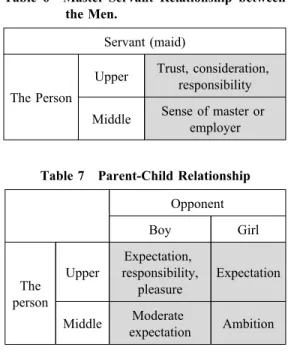
Table 6 shows the master-servant (maid) relationship of women. Compared to the upper class, wives and daughters of middle-class aristocracy seem to cognize their role as the master. In Genji, such women are described as arrogant. In The Tale of Ochikubo, the servants try to change jobs for better prospects when they could not foresee much possibility in the future of their master. Though the main characters in The Tale of Ochikubo are in the upper class aristocracy, most of them are not noble members of the super upper class; therefore, they had no direct commu-nications with the Emperor or the Crown Prince.
Finally, Table 7 shows the parent-child relationship. In the upper class aristoc-racy, the parents tend to devote themselves to the education of the boys, since they will grow up and serve the Emperor. The daughters are also cherished and educated to be a princess or empress. In the case of middle-class aristocracy, because they could not seek for such high positions, the boys are educated moderately. On the other hand, the parents can harbor wishes to have their daughter serve at the court, and to be near the Emperor or the Crown Prince.
Thus far, the basic work has been completed necessary for introducing the emotional scenes in Genji. In the following, the authors present the analysis results of the dynamism of the occurrence and expression of emotions.
2. Dynamism of the Occurrence and Expression of Emotions (IM strategy). (1) Negative emotions
The authors start the explanation with the occurrence-expression of negative emotions. As seen above, the upper class nobles, essentially, were not considered to have negative emotions. If the upper class aristocracy demonstrates a negative emo-tion, it is because the romance has not gone well. In the following, the situations are classified into two: (1) “the love has gone,” and (2) “things do not go as they have expected.”
Table 8 shows the emotion occurrence and emotion management of the super upper class aristocracy, upper class aristocracy, and middle-class aristocracy when
Table 6 Master-Servant Relationship between the Men.
Servant (maid)
The Person
Upper Trust, consideration,responsibility Middle Sense of master or
employer
Table 7 Parent-Child Relationship
Opponent Boy Girl The person Upper Expectation, responsibility, pleasure Expectation
Middle expectationModerate Ambition Impression Mechanism for the Contemporary Japanese 47
“the love has gone.” While the upper class nobles think that they should accept such fate, and they would try consciously to do so, the super upper class would uncon-sciously regard the situation as fate.
Table 9 shows a comparison of the feelings between the four social classes in the case that “things do not go as they have expected.”
(2) Positive emotions
Subsequently, the occurrence and expression of positive emotions and the IM strategies are explained in the following. In the super upper aristocracy, they seldom have positive feelings. In Genji, the upper class nobility feels happy in a few cases, whereas the middle-class aristocracy often feels glad. However, common people feel various positive emotions. Table 10 shows the flow of emotion occurrence and emo-tion expression between the four social classes when “they get satisfactory results.”
In Characters Could Not Show Emotions in The Tale of Genji, Otsuka (2000) explained about the negative emotions in the following:
[T]hus, tears of the Heian period are not peculiar to commoners. The way of showing tears is particular to the nobility. They did not weep because of hun-ger, pain related to their labor, or poverty. Rather, their tears are for matters far
Table 8 Occurrence and Expression of Emotions (IM strategies) When “Love is gone.”
Flows of Occurrence and Expression of Emotions (IM strategy)
Super upper Sad→sighs over his or her fate→sings a part of poems in Kokinshu and covers the face with the sleeve (suggesting tears)
Upper Sad→tries to accept it as fate but in vain→composes a poem expressing the sorrow; show of tears
Middle Sad→grieves→shows bitterness, grudges, and resentment; and weeps Lower Sad→vents the feelings openly to somebody
Table 9 Occurrence and expression of emotions (IM strategies) When “Things Do Not Go s They Have Expected.”
Flows of Occurrence and Expression of Emotions (IM strategy)
Super upper Gets somewhat surprised→ wonders if some demonic power has worked and becomes convinced
Upper Becomes surprised and goes into a bad temper→ tries to overcome the feelings→ grum-bles sometimes→ leaves it unsettled/laments over his or her fate→ accepts fate
Middle Bad mood→ blames other persons for the situation→ continues on blaming →accepts/ has the anger calmed by somebody else
Lower Feels disappointed but recovers relatively fast
Yoshinobu SATO, Toshimi AISHIMA 48
above such concerns. (Otsuka 2000, pp. 65-7)
[In Genji,] the main characters never show their anger, even if they are upset. Only lower persons or countrymen display anger. In the noble class, the feel-ings of anger are limited to the villains, Empress Kokiden or the adopted Prin-cess Omi, who have no knowledge of noble manners. It is true that the main characters, both men and women, weep often, but they manage to suppress their tears even when they have reasons to cry profusely. On the contrary, they smile in such situations. (Otsuka 2000, p. 87)
Hikaru Genji himself was the person who always suppresses anger . . . [To the people on the enemy side] he did not show anger . . . Such attitudes of Genji were favorably regarded as “generous” by the people. His tolerance led to his popularity and resulted in him winning the support of those around him. They led to “cordial human relations” through the suppression of emotional expres-sion. (Otsuka 2000, pp. 113-4)
As already explained, the people in the upper aristocracy of that era avoided showing their emotions overtly because there were more disadvantages to expressing them; that is, they are relatives to each other by marriage in a closed social circle. In addition, as promotions were often determined by human relations and personali-ties rather than political abilipersonali-ties or education, they thought that it be advantageous not to express their honest feelings. Realistically, plain expression of emotions might lead to trouble. Politics in those days were founded on private human rela-tionships. Therefore, they could not find any merit in showing their emotions openly.
The other reason is that they showed no expression of emotions as a sign of “being (upper class) noble.” The expressionlessness had some effects to differentiate
Table 10 Occurrence and Expression of Emotions (IM strategies) When “They Get Satisfactory Results.”
Flows of Occurrence-Expression of Emotions (IM strategy)
Super upper Satisfied→ grateful for the fate→ happy, but afraid if someone may see the feeling→ hides the happiness
Upper Happy, satisfied→ thankful to somebody and fate→ is in a good mood, shows tears of joy sometimes→ eager to talk
Middle Happy, joyful→ thankful to the Gods or fate→ is in a good mood→ weeps for joy→ has a celebration party sometimes
Lower Happy, joyful→ thankful to the Gods, and is pleased to think it as a reward for worship-ping the gods→ cries for joy
with other people. As is explained in the leisure class of theory (Veblen 1899) and the “cultural capital” concept (Bourdieu 1979), the investment of the nobles onto things useless for their jobs, unnatural gestures, and high cultures had a class identi-fication effect. In Genji, they usually read the slight change of feelings of the other (s) from facial expressions, which apparently give them no hints. They also manage to understand the other person(s) who muttered a single phrase (of the old poem).
Finally, the results are presented of an analysis of the IM strategies imple-mented between the protagonist and the characters around Genji.
3. IM Strategies against and of Genji
First, the failure cases of the IM strategies in Genji are introduced. In a typical scene, Lady Suetsumu Hana, who is originally a princess from the imperial family, lacks beauty and culture as well as wealth and wit, but is supported by Genji as one of his lovers, sends him a gift for an adopted daughter’s coming-of-age ceremony. Suetsumu tries to show her good personality, but the gift is shabby and old-fashioned. Moreover, the (poor) poem attached to it does not fit the situation; namely, she laments over her fate, as she could not be with him. Her gift giving has created an opposite effect (“Miyuki” in Genji, Vol.2, pp. 476-7). In this matter, Genji despises Suetsumu. By analyzing the scene, the reasons for the failure of her IM strategy are summarized as four points as follows:
1) She does not understand her own position: She had better be quiet and do nothing in such occasion.
2) She fails to have the sympathy of Genji as she sticks to her own principles and does not hesitate to have her own way.
3) She could not make herself cultured in that she always makes poor poems with the same (old-fashioned) pattern. She is too pure to behave according to the situation.
On the other hand, a successful IM strategy against Genji is presented by the former Emperor Suzaku, whose daughter Genji accepts as his first wife. (“Wakana” in Genji, Vol.2, pp. 547-9). The flow of the IM strategy is as follows.
Suzaku wishes that Genji would marry his third princess, Sannomiya, because Genji was the most trusted, but Suzaku knows that there is Lady Murasaki, who is treated virtually as the first wife and that it seems there is nothing left to be desired for her.
In an uncertain voice, Suzaku talked of old and recent happenings . . . ‘Fearing that I might die without accomplishing the first of my resolves, I have finally taken the step. Now that I have changed to these dark robes I know more than ever how little time I have ahead of me. I fear that I shall not go far down the
Yoshinobu SATO, Toshimi AISHIMA 50
way I have chosen. I might be satisfied with the easier route. I shall calm my thoughts for a time and invoke the holy name, and that will be all. I am not a man of very grand and rare substance, and I cannot think that I am meant for anything different. I must reprove myself for the years of lazy indecisions.’ He described his plans and hopes and managed to touch upon the matter that worried him most. ‘I am sad for all of my daughters, but most of all for the most inadequately protected of them.’
Genji feels sad for Suzaku. Suzaku admits that that it is hard to choose a suit-able husband and says that he should have made a proposal to Yugiri, the son of Genji, while he was still single.
Genji is so moved by the former emperor’s word as to say that he is willing to “take responsibility” of the princess. Indeed, he has been interested in the third prin-cess of Suzaku. The fact that he dares not to think of it seriously is because of Lady Murasaki.
The reasons of the success of the IM strategies of Suzaku are as follows:
1) He understands their mutual positions: Suzaku is superior to Genji in his so-cial position, but talks as if they were on the same level, in front of “the Bud-dha.”
2) He avoids saying things logically or clearly. He chooses to evoke sympathy of Genji by suggesting that he is worried about her daughter, Sannomiya; as a result, Genji feels sorry for him. Furthermore, he hints that there is nobody suitable for the daughter except Genji, by saying that he should have asked Yugiri to marry her.
3) He shows culture and manages to control his honest feelings: He needs not appeal to his culture, but his talks of Buddhism suggest his lofty personality. He hides the sickness to Genji in the scene.
Firstly, the IM strategy for Genji of Suzaku is one of the most successful in Genji. As already made clear, the successful and failure patterns of the IM strategy for Genji are just the opposite of each other. Secondly, the IM strategy of Genji himself must be explained. In the scene, Genji attempts to draw a yes from Lady Murasaki on the case of Suzaku’s request (“Wakana” in Genji, Vol.2, pp. 549-50).
Although she knows of Suzaku’s intention, Lady Murasaki has never dreamt that Genji would accept the request of Suzaku. Genji could not dare to confess his decision on that day. On the following day, Genji tells her the conversation between Suzaku and him. He says,
He is in very poor health indeed . . . He said many sad things, but what seems to trouble him most as he goes off to his retreat is the future of the Third
cess . . . I was really so extremely sorry for him that I found it impossible to refuse. I suppose people will make a great thing of it. The thought of taking a bride at my age has seemed so utterly preposterous that I have tried through this and that intermediacy to suggest a certain want of ardor. But to see him in person and have it heard directly from him−I simply could not bring myself to refuse. Do you think that when the time does finally come for him to go off into the mountains, we might have her come here? Would that upset you terri-bly? Please do not let it. Trust me, and tell yourself what is the complete truth, that nothing is going to change. She has more right to feel insecure than you do.
Lady Murasaki replies as follows. “Yes, it is sad for her. The only thing that worries me is the possibility that she might feel less than completely at home.” She accepts his decision on the marriage.
The IM strategies by Genji in the scene above are as follows:
1) He evokes her sympathy by putting himself in her situation. He understands her feelings very well, and he carefully manages to make her feel pity for Su-zaku.
2) He does not say it outwardly but rather suggests his intention indirectly. In-stead, he attempts to win her sympathy. He focuses on Suzaku’s poor health and worries so that Lady Murasaki thinks she should agree to the decision in the situation.
3) He shows kindness and sincere love, which the partner could not refuse.
Figure 1 Necessary Conditions for IM Strategy to Become Successful
Yoshinobu SATO, Toshimi AISHIMA 52
Lady Murasaki admits she has no choice but to accept the situation.
The successes and failures of the IM strategies of and against Genji are in the state of the pair comparison, as already seen above. They are shown in Figure 1.
IV. Discussion
This section compares the features clarified from the analysis of the emotional scene in Genji in the context of the framework of the IM strategy that has been mainly developed in the United States (Bolino 1999; Bolino, Long, and Turnley 2016; Côté and Hideg 2011; Diefendorff and Greguras 2008; Ferris, Treadway, et al. 2007; Gardener 1992; Grandey, Rafaeli, et al. 2010; Ickes, Holloway, et al. 2006; Jones and Pittman 1982; Johnson, Griffith, et al. 2001). The most famous framework for the IM strategy in the United States is presented by Jones and Pittman (1982), who classified the IM strategies into five types: ingratiation, self-promotion, intimidation, supplication, and exemplification. Jones and Pittman (1982) identified five types of IM strategy, which are categorized as assertive, whereas Gar-dener (1992) classified the strategy of face-saving as a defensive type. Defensive IM strategies consist of accounts: defenses of innocence (“I did not know”), excuses, justification, and apologies.
Distinct features are drawn from the introduction of the IM strategy, in the United States. Whether it is assertive or defensive, the IM strategy starts in the self-centered point of view. However, such IM strategies lead to failure in Genji. In or-der to succeed in the IM strategy in the classic, it is necessary to show the utmost consideration for the other party, as Figure 1 shows.
The second feature is that, whereas people express straightforwardly their pur-poses according to the IM strategy in the United States, the characters of Genji would have the other party guess the need for their own purpose. If they are to claim clearly their position, as in the United States, they could not achieve their in-tentions in Genji.
The third obvious features is that people attempt to move the other party, based on the “Opponent Management” to achieve a successful IM strategy in the United States; however, the characters in Genji reach their goals by sharing the “ba” (場: the atmosphere of the place) with each other to the effect that they accept smoothly the result. If you try to move the opponent by the strategy in Genji, it leads to fail-ure. To succeed in employing the IM strategy, they should share the “ba” with each other and create an atmosphere that suggests that there is no other choice. They are required to have high culture and altruistic minds toward each other.
The main characters, including Hikaru Genji, who are skilled in IM strategies,
have much in common with the characters in the Makioka Sisters, the famous novel written by Junichiro Tanizaki. The story is known to be based on the everyday lives of his wife, Matsuko, and her sisters. Matsuko is a model of Sachiko in the novel (Tanizaki 2015). The story develops in the following.
The main characters in the Makioka Sisters are Tsuruko, Sachiko, Yukiko, and Taeko of a wealthy merchant of Semba in the mercantile city, Osaka. Tsuruko, clever and reliable, marries a banker and inherits the property of the family as the oldest of the four. Sachiko, the most beautiful and sociable, lives in Ashiya with her family. Together with his husband, an accountant, she is eager to seek a suitable husband for her younger sister, Yukiko. Yukiko, beautiful but too shy, tends to be seen as a gloomy person. Taeko, free and uncontrolled, tries to make her career as a doll artist. Her love affairs embarrass the sisters. The novel unfolds the marriage ar-rangements for Yukiko.
Sachiko worries if Yukiko might not marry young because of her shyness. She is always thinking about her sister and eager to arrange a formal marriage interview with a suitable man from good family and with good personality. Bright and socia-ble, she expresses her emotions relatively clearly. On the other hand, Yukiko seldom shows her emotions; she rarely laughs nor says no directly. However, she has her own opinion and never allows it to be changed or influenced by others. As a result, her family always guesses her feelings and tries to carry out her wishes.
Now, it is meaningful to examine the IM strategy of Yukiko in comparison with the IM strategy of Hikaru Genji. The results are as follows:
1) She evokes others’ sympathies by behaving as if they share the same values. Therefore, Yukiko takes it for granted that they understand her values.
2) She avoids clarifying her intentions. She manages to make herself under-stood by her implicit nuances of words and hidden meanings.
3) She expresses her opinion only vaguely. People around her finally accept her intention before they know, though she never tries to persuade nor demand. Those strategies are obviously similar to those of Genji. Then, the authors pro-ceed to explain the features of people who are skilled in the IM strategy. The first feature is that they successfully build a “ba” with the standpoint of the opponent. To achieve the purpose, they use an IM strategy in accordance with a long-term script (a manual to show explicitly which behavior is acceptable in the culture). Hofstede (1994) pointed out that Japanese had collectivism-oriented and long-term-oriented culture, and in that, they are different from the American culture where people pre-fer individualistic thinking and short-term outcomes.
The second feature of a person skilled in the IM strategy is that they have a high level of ability to control their emotions. It might be said that they possess a
Yoshinobu SATO, Toshimi AISHIMA 54
high EQ (emotional quotient), that is, the ability to understand the feelings of the other party as well as to control their own emotions (Goleman 2005). With regard to this, the question is why Genji could demonstrate such a high EQ. As Otsuka (2000) discussed, it might have been related to the coming of Buddhism. Zen Bud-dhism is the base of cha-no-yu. It is also important to see that the practice of mind-fulness meditation is another element of Zen Buddhism. The practice of mindmind-fulness allegedly helps to control emotions successfully (Ando 2003).
The third feature is that they had top quality culture. Boys from aristocratic families learned the literature of China from an early age with good tutors. Girls also had a first class knowledge of traditional poems taught by their nurse and gov-erness who were both from noble families. The most important lesson was that of making elegant poems infused with literary techniques and based on the poetic tra-dition. They learned when they should express which emotions and how everyday through reading poems and stories.
V. Conclusion
In the final section, the practical and theoretical contributions of this study are explained, and future research themes are suggested. In the first theoretical contribu-tion, this study reveals that the features of emotion occurrence, emotion expression, and the IM strategy of the contemporary Japanese are traced back to those of the upper class nobles depicted in Genji. The second contribution is that the successful patterns of the IM strategies held by Japanese, who are collectivism-oriented and have interdependent views of themselves with a high-context communication style, are in striking contrast to those of the IM strategies in United States where people are individualism-oriented and have independent views of themselves with low-context communication styles.
The theoretical findings of the study stated above also have a practical signifi-cance in the field of organizational theory as well as marketing. For example, in the realm of marketing, the findings are useful for the co-creation of values between salespersons and the service provider and the customer in the B2C, or furthermore, the creation of values between C2C. In addition, it is to be applied to the co-creation of values among various entities among different cultures. It is probable that they are applied to emotion marketing in Japanese omotenashi and the aspect of emotional labor (Grandey and Gabriel 2015).
The authors admit that there is a limit to this study. It is necessary for more in-depth research to clarify the reasons why the upper class nobles, including Hikaru Genji, are without plain and simple feelings, as seen above.
It is also required to conduct continuous study to uncover the reasons why and
how the features of EQ originating from the upper class nobility in The Tale of Genji have been passed down to the modern Japanese, and why and how they have changed.
Finally, it is indispensable for the authors to examine again how to put the theoretical findings of this study to use in a series of studies of their own on Japa-nese omotenashi (Sato and Parry 2015; Aishima and Sato 2015 a, 2015 b, 2016; Sato and Aishima 2016).
References
Aishima, T. and Y. Sato (2015 a). The origin of Japanese omotenashi in Man-yo-shu. Business
& Accounting Review, Vol.16, December, pp. 103-122.
Aishima, T. and Y. Sato (2015 b). Characteristics of omotenashi in renga gatherings in compari-son with banquets in the Man-yo-shu. Kwansei Gakuin University Social Science Review, Vol.20, pp. 63-78.
Aishima, T. and Y. Sato (2016). The origin of Japanese omotenashi. Proceedings of the Japan
Society of Marketing and Distribution.
Ando, O. (2003). Buddhism as osychology: Psychological approach to zen, meditation and
bud-dhism, Kyoto: Hozokan. (In Japanese)
Bolino, M. C. (1999). Citizenship and impression management: Good soldiers or good actors?
Academy of Management Review, 24(1), January, pp. 82-98.
Bolino, M., D. Long, and W. Turnley (2016). Impression management in organizations: Critical questions, answers, and areas for future research. Annual Review of Organizational
Psy-chology and Organizational Behavior, Vol.3, pp. 377-406.
Bourdieu, P. (1964). Les héritiers: les étudiants et la culture, Eng. The Inheritors: French
stu-dents and their relations to culture, University of Chicago Press 1979.
Côté, S. and I. Hideg (2011). The ability to influence others via emotion displays: A new di-mension of emotional intelligence. Organizational Psychology Review, 1(1), pp. 53-71. Diefendorff, J. M. and G. J. Greguras (2008). Contextualizing emotional display rules:
Examin-ing the roles of targets and discrete emotions in shapExamin-ing display rule perceptions. Journal of
Management, published online before print on July 10, 2008 as doi:10.1177/
0149206308321548, pp. 1-19.
Ferris, G. R., D. C. Treadway, et al. (2007). Political skill in organizations. Journal of
Manage-ment, 33(3), June, pp. 290-320.
Gardener III, W. L. (1992). Lessons in organizational dramaturgy: The art of impression man-agement, Organizational Dynamics, 21(1), June, pp. 33-46.
Goleman, D. (2005). Emotional intelligence: Why it can matter more than IQ, 10th anniversary edition, New York: Bantam Books.
Goto, S. (1986). Historical space of The Tale of Genji. Tokyo: University of Tokyo Press. (In Japanese)
Grandey, A. A. and A. S. Gabriel (2015). Emotional labor at a crossroads: Where do we go from here? Annual Review of Organizational Psychology and Organizational Behavior,
Yoshinobu SATO, Toshimi AISHIMA 56
January, pp. 323-349.
Grandey, A., A. Rafaeli, et al. (2010). Emotion display rules at work in the global service econ-omy: The special case of the customer. Journal of Service Management, 21(3), pp. 388-412.
Hofstede, G. (1994). Cultures and organizations: software of the mind. Profile Business.
Holbrook, M. B. (1999). Consumer value: A framework for analysis and research. London: Routledge.
Ickes, W., R. Holloway, et al. (2006). Self-monitoring in social interaction: The centrality of self -affect. Journal of Personality, 74(3), pp. 659-684.
Imai, T., S. Goto, et al. (1991). Seminar of The Tale of Genji 5: Time and Culture. (In Japa-nese)
Iwatsubo, K. (2013). Enjoyment of The Tale of Genji. Izumi Shoin. (In Japanese)
Jones, E. E., and T. S. Pittman(1982). Toward a general theory of strategic self-presentation. In J. Suls ed., Psychological perspectives on the self (pp. 231-261), Hillsdale, NJ: Lawrence. Johnson, G, J. A. Griffith, et al. (2016). A new model of impression management: Emotions in
the ‘black box’ of organizational persuasion. Journal of Occupational and Organizational
Psychology, 89, pp. 111-140.
Kawakatsu, M. (2008). Acceptance of The Tale of Genji from Meiji era to Showa era. Izumi Shoin. (In Japanese)
Keene, D. (2013). Donald Keene’s diary about downtown Tokyo: Rescuing through beauty of Genji. http : / / www. tokyo-np. co. jp / article / feature / shitamachi _ nikki / list / CK 2014040902100025.html, accessed on 9/27/2016. (In Japanese)
Masuda, S. (2002). The Tale of Genji and aristocracy. Yoshikawakobunkan. (In Japanese) Otsuka, H. (2000). Characters Could Not Show Emotions in The Tale of Genji. Mainichi
Shim-bun Publishing Inc. (In Japanese)
Sato, Y. and T. Aishima (2016). Characteristics of Japanese-style karaoke banquet in compari-son with the banquet of Man-yo-shu and renga gathering. Proceedings of the Japan Society
of Marketing and Distribution.
Sato, Y. and M. Parry (2015). The influence of the Japanese tea ceremony on Japanese restau-rant hospitality. Journal of Consumer Marketing, 32/7, pp. 520-529.
Suzuki, K. (2003). A variation of The Tale of Genji: Melodic line of Edo. Miyai Shoten Co., Ltd. (In Japanese)
Tanaka, T. (1995). The Tale of Genji and history. In R. Takahashi and A. Kubo eds., New
lec-ture: Those people who learn The Tale of Genji (pp. 54-75), Sekaishisosha Co., Ltd. (In
Japanese)
Tanizaki, J. (2015). The love of Junichiro Tanizaki: Letters of Matsuko and Sigeko. Chuokoron-Shinsha, Inc. (In Japanese)
Teramoto, N. (1984). The Tale of Genji and its acceptance. Yubun Shoin. (In Japanese)
Tynan, C. and S. McKechnie (2009). Experience marketing: A review and reassessment. Journal
of Marketing Management, 25(5-6), pp. 501-517.
Veblen, T. (1899). The theory of the leisure class: An economic study of institutions. New York, NY: Macmillan.