Japan Advanced Institute of Science and Technology
JAIST Repository
https://dspace.jaist.ac.jp/
Title
FORWARD LINK CAPACITY LIMIT OF CODED FFH/CDMA
MULTIUSER MOBILE RADIOS
Author(s)
Kawahara, T.; Matsumoto, T.
Citation
Electronics Letters, 27(21): 1918-1919
Issue Date
1991-10-10
Type
Journal Article
Text version
publisher
URL
http://hdl.handle.net/10119/4806
Rights
Copyright (c)1991 IEEE. Reprinted from
Electronics Letters, 27(21), 1991, 1918-1919.
This material is posted here with permission of
the IEEE. Such permission of the IEEE does not in
any way imply IEEE endorsement of any of JAIST's
products or services. Internal or personal use of
this material is permitted. However, permission
to reprint/republish this material for
advertising or promotional purposes or for
creating new collective works for resale or
redistribution must be obtained from the IEEE by
writing to [email protected]. By choosing
to view this document, you agree to all
provisions of the copyright laws protecting it.
Description
tion by direct reaction between tungsten and silicon'. Appf. Surf Sci., 1989,38, pp. 486194
4 PAILHUN, P., =mi, N., GEIPEL, IR, H. I., and SLUSSER, G. I.: 'Dopant diffusion in tungsten silicide', J . Appf. Phys., 1982, 53, (4), pp. 305!%3062
ISAAC, R. o., LUCC- c. I., and PETERSSON, c . s.: 'The behavior of boron (also arsenic) in bilayers of polycrystalline silicon and tung- sten disilicide', J . Appf. Phys., 1982,53, (11). pp. 7372-7376
5 IAHNEL, F., BIERSACK, I., CROWDER, B. L., D'HEURLE, F. M., FINK, D.,
FORWARD LINK CAPACITY LIMIT OF CODED FFHlCDMA MULTIUSER MOBILE RADIOS
Indexing terms: Mobile radio systems, Codes and coding The theoretical limit of the forward link (base to mobile) user capacity of fast frequency hopping code division multiple access (FFH/CDMA) mobile communication systems with error correction coding is investigated. The channel cutoff rate of coded FFH/CDMA channels is calculated and the optimal code rate that maximises the user capacity is deter- mined. It is shown that with deletion-free transmission, the frequency efficiency of an FFH/CDMA channel coded at the optimal code rate is 47% higher than without coding.
Introduction: Since Goodman e t al. presented a fast frequency hopping code division multiple access (FFH/CDMA) system and applied it to mobile/personal radio communications in 1980,' it has attracted much attention, and several per- formance improvements have been made.24 In the FFH/ CDMA system, the same frequency band is shared by many users and the transmitted symbol is extracted from the detec- tion matrix indicating detected frequencies.
It was shown in Reference 1 that with deletion-free tran- sition (all the errors are due to the interference from other users), 209 forward link (base to mobile) users transmitting
32 kbit/s speech (or data) could be accommodated with a bit error rate (BER) less than or equal to using a 20MHz bandwidth. Reference 2 showed that by algebraically structur- ing the address sequence, the user capacity could be further increased by about 60%. Another power strategy is to use coding for error protection. Several practical codes suitable for FFH/CDMA channels have been and their decoding performances have been analysed taking into account the desired signal deletions and interference inser- tions.
This Letter investigates the theoretical limit of the forward link user capacity of FFH/CDMA mobile communication systems with coding. The optimal code rate that maximises the forward link user capacity is then determined from the channel cutoff rate.
GF(2"). The coded symbol with symbol duration of T is then divided in time into L chips, each of which has a chip dura- tion of TIL, and a random address sequence with rate LIT is added to the chip sequence with modulo-2K. The 2' fre- quencies are available for the forward link transmission, and one, corresponding to a chip modified by the random address, is transmitted over the chip interval. Prior to transmission, the chip sequence is fed to an OR logic circuit to accommo- date the chips of other users hitting the same frequency slot. In the receiver, the received power of each of the 2' fre- quencies is detected by an energy detector. Hard decision is used for detection. Both the transmitter and the receiver know the predetermined address sequence, and the address sequence is then added with modulo-2' to the detection matrix which indicates received detected frequencies. The detection matrix is the input to the decoder, and the transmitted symbol is esti- mated and delivered to each user as the channel output. Channel cutof r a t e : The channel cutoff rate R, represents one of the upper bounds of the information bit rate. With bit rate R( IR,) information bit/channel symbol, the input informa- tion can be transmitted with BER I e - N ( R o - R ) where
N
is the code length (from this feature, communication with an infor- mation bit rate of R I R , is referred to as 'reliable communi- cation'). R , characterises only the coding channel, and is independent of the specific code employed.Several of the formulas required to analyse the channel cutoff rate and user capacity are shown in Table 1 of Refer- ence 1, and they will be used in this Letter without derivation. The average probability p I of insertion due to interference is given by
PI = [I
-
(1-
2-K)M-'](l - P o ) (1) where p D is the average deletion probability that the transmit- ted frequency is not detected by the energy detector. p D is expressed asp D = 1
-
exp{2(15))
-
where
r
is the average received signal to noise power ratio (SNR), and b is the threshold normalised with respect to the receiver noise power.6 Another factor that affects the value of p, is the false alarm probability p F , which is expressed as a function ofb,
and was taken into account in Reference 1.However, because for large
r
values po is approximately expressed as a function ofp2/r,
po can be set at any value independently of p F . Thus, we assume p F = 0.The received dehopped frequencies are represented in the detection matrix Y including entries from the desired signal and interferers. If neither insertion nor delection occur, Y has a row corresponding to the transmitted 2'-ary FSK symbol. Therefore, it is reasonable that the number of the entries in the ith row of the detection matrix Y is used as the metric for the ith symbol xi of the 2'-ary FSK.
The Chernoff bound of the metric difference D(1) is given by
I
Xil,,,,,o(1)
=el'""'.
Y)-m(a. Y)l System model: Fig. 1 shows the system model to be. analysed.The input bit stream to be transmitted is stored in a K bit
Fig. I System model
Chernoff parameter and E denotes ensemble average. Assuming that xi is transmitted and that insertion and dele- tion occur randomly, D(L) becomes
where
(g)
denotes the binomial coeflicient. the channel cutoff rate R, is given byBecause an FFH/CDMA channel is a symmetric channel,
(5) R, = K - log,{ 1
+
(2x-
1)D}where
D
= min D ( I )1 2 0
Fig. 2 shows the calculated channel cutoff rate R, against the number M of users sharing the FFH/CDMA channel for L = 19 and K = 8 with p D as a parameter. The minimum value of D(L) with respect to I was determined numerically. It is found from Fig. 2 that R, approaches its maximum value of 8( = K) as M decreases. As p D increases, M must be decreased further to ensure the maximum value of R,. This is implied because R , is dominated by desired signal deletions rather than interference insertions.
0 200 400 600 800 lCQ0
number of usersM
E E E
Fig. 2 Channel cutoff rate against user capacity FFH/CDMA
K = 8 L = 19
Optimal code rate: The number of users can be increased by using a low rate code with large error correction capability. However, low rate codes increase the transmission bandwidth. Because of this tradeoff, there exists an optimum code rate that maximises the user capacity normalised by the code rate. The channel cutoff rate R , is expressed as a function of the number of the users M. Therefore, with coding rate r = R / K , if M satisfies
M
I
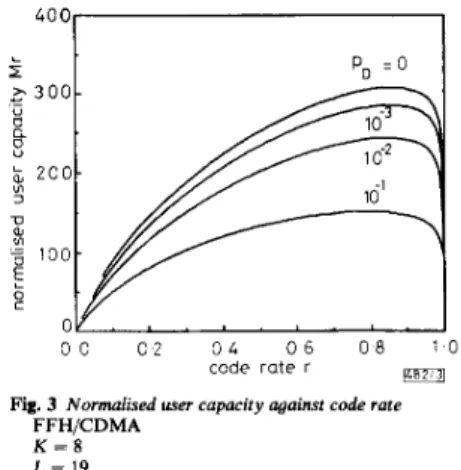
R;’(rK) (7)reliable communications are possible for all the M users via the coded FFH/CDMA channel having a bandwidth l/r times larger than the original uncoded FFH/CDMA channel. Fig. 3
shows the number of the users normalised by the code rate Mr against code rate r for
L
= 19 and K = 8 with p D as a parameter. It is found from Fig. 3 that for all values of p D , Mr is maximised at a code rate of about 0.85. If po = 0, the coded FFH/CDMA channel can accommodate 308 users and reli- able communications are possible, using the same bandwidth as that of the uncoded system. This user capacity is 1.47 times larger than that of the uncoded system with the same L and K values.’Conclusion: The channel cutoff rate of the coded FFH/CDMA channel was calculated and the optimal code rate that maxi- mises the user capacity was determined. It has been shown
that the optimal code rate for 256-ary FSK with 19 hop/ symbol is about 0.85. With deletion-free transmission, the capacity is 359 users
(normalised
capacity is 308users),
and0 0 0 2 0 4 0 6 0 8 1 0
code rate r
m
Fig. 3 Normalised user capacity against code rate FFHjCDMA
K = 8
L = 19
reliable communication for all users is made possible by hard decision maximum likelihood decoding. This coded FFH/ CDMA system is 47% more frequencyeflicient than an uncoded system.
T. KAWAHARA T. MATSUMOTO
2nd August 1991
NTT Radw Communication Systems Laboratories
1-2356, Tuke. Yokosuknrhi, Kanayawa-ken, 238, Jupan References
GOODMAN, D. I., HENRY, P. s., and PRABHU, v. K.: ‘Frequency- hopped multilevel FSK for mobile radio’, Bell Syst. Tech. J , Sep tember 1980.59. pp. 1257-1275
TIMOR, U,: ‘Multistage decoding of frequency-hopped FSK systems’, Bell Syst. Tech. J., April 1981.60, pp. 471483 ~ L YT. I.: , ‘Coding and decoding for code division multiple user communication system’, IEEE Trans., 1985, COM-33, (9, pp. 31Ck316
KIM, s. w., and STARK, w.: ‘Optimum Reed-Solomon codes for frequency-hopping spread-spectrum multiple-access communica- tion system’, IEEE Trans., 1989, COM-37, (2). pp. 138444 VITERBI, A. I.: ‘A processing satellite transponder for multiple access by low-rate mobile users’. Dig. Satellite Commun. C o d Montreal, P. Q., Canada, 23rd-25th October 1978, pp. 166-174 SCHWARTZ, M., BENNETT, w. R., and STEIN, s.: ‘Communication systems and techniques’ (McGraw-Hill, 1966). pp. 396-41 1
AUTOMATIC GAIN CONTROLLED OSCILLATING AMPLIFIER
Indexing terms: Amplifiers, Automatic control, Oscillators, Circuit design
An amplifier based on an injection-locked surface transverse wave oscillator is described and characterised. It is shown to exhibit automatic gain control. Its noise performance is dis- cussed for the cax of a 2 Mbit/s binary phase shift key signal.
Introduction: Traditional amplifier design techniques restrict the onset of oscillations by avoiding the corresponding loop phase and gain conditions. This is often accomplished by designing the circuit so that the
k
factor, a figure of merit that ensures unconditional stability, is greater than 1. If uncon- ditional stability cannot be achieved, or if it requires too many compromises on the amplifier performance, then conditional stability is sought.’ELECTRONICS L E T E R S 10th October 1991 Vol. 27 N o . 21 1919