Asymptotic expansion of singular solutions and
characteristic polygon of linear partial differential equations
with holomorphic coefficients
大内 忠 (上智大学)
By Sunao $\overline{\mathrm{o}}_{\mathrm{U}\mathrm{C}\mathrm{H}}\mathrm{I}^{*}$ (Sophia Univ. Tokyo)
Abstract
Consider the equation $P(z, \partial)u(z)=f(z)$ in a neighbourhood of
$z=0$, where $u(z)$ admits singularities on the surface $K=\{z_{0}=0\}$
and $f(z)$ has the asymptotic expansion ofGevrey type with respect
to $z_{0}$ as $z_{0}arrow 0$. We study the possibility of asymptotic expansion of
$u(z)$. We define the characteristic polygon of$P(z, \partial)$ withrespect to
$K$ and characteristic indices$\gamma\dot{.}(0\leq i\leq p)$. We discuss the behaviour
of$u(z)$ in a neighbourhood of$K$, by using these notions. The main
result is ageneralization of that in [2]. The details of this paper is in
[4] and will be appeared elsewhere.
KEY WORDS: complex partial differential equations, solutions with
asymptotic expansion
\S 1
Notations and Characteristic Polygon.The coordinate of $\mathbb{C}^{d+1}$ is denoted by $z=(Z_{0}, Z^{l})=(z_{0}, z_{1}, \cdots , z_{d})\in$ $\mathbb{C}\cross \mathbb{C}^{d}$. $|z|= \max\{|Z_{i}|;0\leq i\leq d\}$. Its dual variables are $\xi=(\xi_{0},\xi^{l})=$
$(\xi_{0}, \xi_{1}, \cdots , \xi_{d})$. The differentiation is denoted by$\partial$
.
$=\partial/\partial z:$,and$\partial=(\partial_{0}, \partial’)=$ $(\partial_{0}, \partial_{1}, \cdots , \partial_{d})$. $\alpha=(\alpha_{0}, \alpha)’=(\alpha_{0}, \alpha_{1}, \cdots, \alpha_{d})\in \mathrm{N}\cross \mathrm{N}^{d}$is a multi-index
and $|\alpha|=\alpha_{0}+|\alpha’|=\Sigma_{i=^{0^{\alpha_{i}}}}^{n}$.
Let $P(z, \partial)=\Sigma_{|\alpha|\leq m}a_{\alpha}(Z)\mathfrak{X}$ be a linear partialdifferental operator with
holomophic coefficients in a neighbourhood $\Omega$ of $z=0$ in $\mathbb{C}^{d+1}$ and $K=$
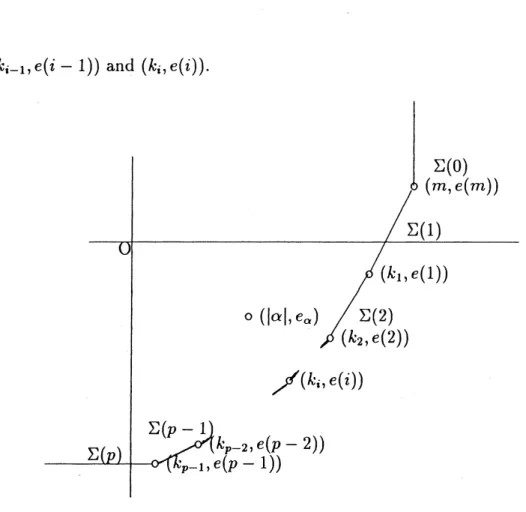
$\{z_{0}=0\}$. Let us define the characteristic polygon $\Sigma$ of$P(z,\partial)$ with respect
to the surface $K$. Let$j_{\alpha}$ be the valuation of$a_{\alpha}(z)$ with respect to$z_{0}$. Hence if
$a_{\alpha}(z)\not\equiv \mathrm{O},$ $a_{\alpha}(z)=z_{0}^{j_{\alpha}}b_{\alpha}(Z)$ with $b_{\alpha}(\mathrm{O}, Z’)\not\equiv 0$. Put $e_{\alpha}=j_{\alpha}-\alpha_{0}$. We denote
by$\mathrm{I}\mathrm{I}(a, b)$ the set $\{(x, y)\in \mathbb{R}^{2}; x\leq a, y\geq b\}$. The characteristicpolygon of$\Sigma$
isdefinedby$\Sigma=the$ convexhull
of
$\bigcup_{\alpha}\Pi(|\alpha|, e)\alpha$. The boundaryof$\Sigma$ consistsof a vertical half line $\Sigma(0)$, a horizontal half line $\Sigma(p)$ and $p-1$ segments
$\Sigma(i)(1\leq i\leq p-1)$ with slope $\gamma:,$ $0=\gamma_{p}<\gamma_{p-1}<\cdots<\gamma_{1}<\gamma_{0}=+\infty$
.
Let $\{(k_{*}., e(i))\in \mathbb{R}^{2};0\leq i\leq p-1\}$ be vertices of $\Sigma$, where $0\leq k_{\mathrm{p}-1}<$
$...<k_{i}<k_{:-1}<\cdots<k_{0}=m$. So the endpoints of $\Sigma(i)(1\leq i\leq p-1)$are
*Department of Mathematics, Sophia University, Chiyoda-ku, Tokyo 102-8554, Japan
$\mathrm{e}$-mail s-ohuti@hoffman.$\mathrm{c}\mathrm{c}$.sophia.ac.jp 1991 Mathematical Subject Classification(s):
$(k_{-1}., e(i-1))$ and $(k\dot{.}, e(i))$.
Figure 1: Characteristic polygoIl
Deflnition 1 The slope $\gamma$:
of
$\Sigma(i)$ is called the i-th characterisitic indexof
$P(z, \partial)$ with respect to $K=\{z_{0}=0\}$.Let us notice the $\mathrm{v}e$rtices of the polygon $\Sigma$ and define subsets
$\Delta(i)$ and $\Delta_{0}(i)$ of multi-indices and operators $\mathfrak{P}_{i}(z, \partial)(0\leq i\leq p-1)$. Put
$\{$
$\triangle(i)=\{\alpha\in \mathrm{N}+1;|d\alpha|=k_{i}, j_{\alpha}-\alpha_{0}=e(i)\}$,
$l_{k}$
.
$= \max\{|\alpha’| : \alpha\in\triangle(i)\}$and (1.1)
$\mathfrak{P}:(z, \partial)$ is apartial differential $\mathrm{o}\mathrm{p}e$rator with total order
$k_{i}$ and order$l_{k}.\cdot$ with
respect to $\theta$. We have $e(i)=j_{\alpha}-\alpha_{0}=j_{\alpha}-k:+l_{k}$
.
for $\alpha\in\triangle \mathrm{o}(i)$. Hence wecan wirte
(1.2) $\eta 3:(z, \partial)=z_{0}e\langle:)+k-l_{k}:(\sum_{\alpha\in\Delta_{0}(i)}b(\alpha 0, z’)\partial^{\alpha’})\partial 0k:-l_{k}:)$
and define polynomial $\chi_{P,i}(z’,\xi’)$ in $\xi’$ by
(1.3) $\chi_{P,i}(Z^{\iota}, \xi’)=\sum_{*\alpha\in\Delta \mathrm{o}()}.b_{\alpha}(0, z’)\xi\alpha$
’
\S 2
Function
spaces.Let $\Omega=\Omega_{0}\cross\Omega^{l}$ be a polydisk with $\Omega_{0}=\{z_{0}\in C^{1}; |z_{0}|<R\}$ an$\mathrm{d}$
$\Omega’=\{z’\in C^{d};|z’|<R\}$. Put $\Omega_{0}(\theta)=\{z_{0}\in\Omega_{0}-\{0\};|\arg z\mathrm{o}|<\theta\}$ an$\mathrm{d}$
$\Omega(\theta)=\Omega_{0}(\theta)\cross\Omega’$. $\mathcal{O}(\Omega)(O(\Omega’), O(\Omega(\theta)))$ is the set of all holomorphic
functions on $\Omega$ (resp. $\Omega^{l},$ $\Omega(\theta)$). We introduce subspaces of $O(\Omega(\theta))$.
Definition 2 $O_{(\kappa)}(\Omega(\theta))(0<\kappa<+\infty)i_{\mathit{8}}$ the set
of
all $u(z)\in \mathcal{O}(\Omega(\theta))$ such thatfor
any $\epsilon>0$ and any $\theta’$ with $0<\theta’<\theta$(2.1) $|u(z)|\leq C\exp(\epsilon|Z_{0}|^{-\kappa})$
for
$z\in\Omega(\theta’)$holds
for
a constant $C=C(\epsilon, \theta’)$. We put $\mathit{0}_{\mathrm{t}+\infty)(())}\Omega\theta=O(\Omega(\theta))$for
$\kappa=$ $+\infty$.Definition 3 $Asy_{\{\kappa\}}(\Omega(\theta))(0<\kappa\leq+\infty)i_{\mathit{8}}$ the set
of
all$u(z)\in \mathcal{O}(\Omega(\theta))$$\mathit{8}uch$ that
for
any $\theta’$ with $0<\theta’<\theta$ and any $N\in \mathrm{N}$(2.2) $|u(z)- \sum_{n=0}^{N}u(Z’)nZ_{0}^{n}|\leq AB^{N}|z_{0}|N\Gamma(\frac{N}{\kappa}+1)$ $z\in\Omega(\theta’)$
holds, where $u_{n}(z’)\in O(\Omega’),$ $A=A(\theta’)$ and $B=B(\theta’)$.
We say that $u(z)\in A_{\mathit{8}}y_{\{\kappa\}}(\Omega(\theta))$ has asymptotic expansion with Gevrey
exponent $\kappa$ in $\Omega(\theta)$. $u(z)\in Asy_{\{+\infty\}}(\Omega(\theta))$ means that $u(z)$ is holomorphic
\S 3
TheoremFirst we give a condition on $P(z, \partial)$ treated in $\mathrm{t}\mathrm{l}\mathrm{l}\mathrm{i}\mathrm{s}_{1)\mathrm{a}}1^{)}e\mathrm{f}$.
Condition-i $j_{\alpha}=0$
for
all $\alpha\in\triangle_{0}(i)$.If $P(z, \partial)$ satisfies Condition-i, thell
$\mathfrak{P}_{:}(z, \partial)=(\sum_{\alpha\in\Delta_{0}(i)}b(\alpha Z’0,)\partial^{\alpha’})\partial_{0}^{k.-\iota_{k}}:$.
We hav$e$
Theorem 4 Suppose that $P(z, \partial)\mathit{8}ati_{\mathit{8}fi}es$ Condition-i and $x_{P,i}(0,\hat{\xi}’)\neq$
$0,\hat{\xi}’=(1,0, \sim\cdot\cdot, 0)$. Let $u(z)\in O_{(\gamma.)}(\Omega(\theta))$ be a solution
of
(3.1) $P(z, \partial)u(z)=f(Z)\in Asy_{\mathrm{t}\}}\gamma:(\Omega(\theta))$
satisfying
(3.2) $\partial_{1}^{h}u(z_{0},0, z’’)\in Asy_{\mathrm{t}^{\gamma}}.\}(\Omega(\theta)\cap\{z_{1}=0\})$
for
$0\leq h\leq l_{k_{i}}-1$.Then there is a polydisk $W$ centered at$z=0$ such that $u(z)\in Asy_{\{\gamma:\}}(W(\theta))$.
We studied in [1] and [2] similar problems for the cas
$ei=p-1$
and$l_{k_{\mathrm{p}-1}}=0$. We gave in [2] a simple proof of the same result as Theorem 4
for this case. We show Theorem 4 by modifying the discussion in [2]. When
Condition-idoes not hold, solutions become less regular and we studied in [3]
the behaviours of solutions under tbe condition that $i=p-1$ and $l_{k_{\mathrm{p}-1}}=0$
but $\mathrm{C}_{\mathrm{o}n}\mathrm{d}\mathrm{i}\mathrm{t}\mathrm{i}_{\mathrm{o}\mathrm{n}}-(p-1)$ does not necessarily hold.
\S 4
ExampleWe give an example. Let us consider
(4.1) $P(z, \partial)=\partial_{1}\mathrm{s}\partial 3\partial+10+\partial_{0}\mathrm{z}$, $z=(z_{0}, Z_{1})\in \mathbb{C}^{2}$.
We have
$\{$
$\gamma 0=+\infty$, $\gamma_{1}=1$, $\gamma_{2}=1/2$, $\gamma_{3}=0$,
$\chi_{P},0(Z\xi_{1}’,)=\xi_{1}^{5}$, $\chi_{P,1}(Z’, \xi 1)=\xi_{1}^{3}$, $\chi_{P,2}(z\xi’,)1=I$.
Obviously $P(z, \partial)$ satisfies Condition-i and $\chi_{P,i}(z^{\mathrm{t}}, 1)\neq 0$ for $i=0,1,2$. So
it follows from Theorem 4 that there is a polydisk $W$ centered at $z=0$ such
$i=0:u(z)\in O_{(+\infty)}(\Omega(\theta)),$ $\partial_{1}^{h}u(z_{0}, \mathrm{o})\in Asy\{+\infty\}(\Omega 0(\theta))(0\leq h\leq 4)$,
$f(z)\in Asy_{\{\}}+\infty(\Omega(\theta))\Rightarrow u(z)\in Asy\{+\infty\}(W(\theta))$,
$i=1$ : $u(z)\in \mathit{0}_{(1)(}\Omega(\theta)),$ $\partial_{1}^{h}u(Z_{0},0)\in Asy_{\mathrm{t}}1\}(\Omega_{0(\theta}))(0\leq h\leq 2)$,
$f(z)\in A_{S}y\{1\}(\Omega(\theta))\Rightarrow u(z)\in Asy_{\{1\}}(\nu V(\theta))$ ,
$i=2:u(z)\in o_{(1/2)}(\Omega(\theta)),$ $f(z)\in Asy\mathrm{t}1/2\}(\Omega(\theta))\Rightarrow u(z)\in Asy_{\{1}/2\}(W(\theta))$.
References [1] $\overline{\mathrm{O}}$
uchi,S., An integral $\mathrm{r}e_{1^{)\mathrm{r}\mathrm{e}\mathrm{S}}}e\mathrm{n}\mathrm{t}\mathrm{a}\mathrm{t}\mathrm{i}_{\mathrm{o}\mathrm{n}}$ of singular solutions and
remov-able singularities to linear partial differential equations, Publ. RIMS
ICyoto Univ., 26 (1990), 735-783.
[2] $\overline{\mathrm{O}}$uchi,
S., Singular solutions with asymptotic expansion of linear
par-tial differential equations in the complex domain, Publ. RIMS Kyoto
Univ., 34 (1998), 291-311.
[3] $\overline{\mathrm{O}}$uchi, S.,
Growth property and slowly increasing behaviour ofsingular
solutions of linear partial differential equations in the complex domain
(preprint). [4] $\overline{\mathrm{O}}$
uchi, S., Asymptotic expansion ofsingular solutions and the
charac-teristic polygon of linear partial differential equations in the complex