JAIST Repository
https://dspace.jaist.ac.jp/
Title
A study on perception of emotional states in
multiple languages on Valence-Activation approach
Author(s)
Han, Xiao; Elbarougy, Reda; Akagi, Masato; Li,
Junfeng; Ngo, Thi Duyen; Bui, The Duy
Citation
2015 RISP International Workshop on Nonlinear
Circuits, Communications and Signal Processing
(NCSP'15): 86-89
Issue Date
2015-02
Type
Conference Paper
Text version
publisher
URL
http://hdl.handle.net/10119/12613
Rights
This material is posted here with permission of
the Research Institute of Signal Processing
Japan. Xiao Han, Reda Elbarougy, Masato Akagi,
Junfeng Li, Thi Duyen Ngo and The Duy Bui, 2015
RISP International Workshop on Nonlinear
Circuits, Communications and Signal Processing
(NCSP'15), 2015, 86-89.
A study on perception of emotional states in multiple languages on Valence-Activation approach
Xiao Han
1, Reda Elbarougy
2, Masato Akagi
1,Junfeng Li
3, Thi Duyen Ngo
4and The Duy Bui
41 JAIST 1-1, Asahidai, Nomi, Ishikawa, 923-1292 Japan han [email protected] [email protected] 2 Damietta Univ. Damietta, 3451 Egypt [email protected] 3 IOACAS,China No.21 North 4th Ring Road,
Haidian District, Beijing, 100190 China [email protected]
4
VNU-UET, Hanoi 144 Xuan Thuy Street, Cau Giay,Hanoi, Vietnam
[email protected] [email protected]
Abstract
Human beings can judge emotional states of a voice only by listening, no matter thay understand the language or not. Investigating the commonalities and differences of emo-tional states perception among multiple languages is impor-tant to understand how human beings perceive emotional states among multiple languages, and to build a human per-ception model independent to used languages. This paper investigates commonalities and differences among multiple languages in human perception of emotional states based on a dimensional approach. The results suggest that human be-ings can perceive emotional states regardless of languages. Moreover, the results can be used to build a human perception model regardless of languages only by control the deviations between neutral voices and other emotional states.
1. Introduction
Communication is a essential part of human beings’ so-cial life, and speech is one of the most common way for us to communicate with others. From the experience in daily life, it is found that human beings can judge the emotional states of a voice only by listening. This kind of situation oc-cur not only when they listen to their native language, but also when they listen to non-native languages they do not familiar with. It suggests that there is another way to communicate each other without common language. The commonalities and differences of emotional states perception among mul-tiple languages are parts of the fundamental knowledge on how human beings perceive emotional states of different lan-guages. Since it can help us to understand how human beings perceive emotional states among multiple languages, and can guide us to build a human perception model independent to used languages, it is significantly important for us to investi-gate.
The purpose of this study is to investigate commonalities and differences among multiple languages of human percep-tion for emopercep-tional states from speech signal. In order to achieve this goal, some detailed informations about the
com-monalities and difference, such as the neutral voices, the re-lationship of neutral state to other emotional states and the degree of emotional states, are investigated.
In fact, many previous studies [1,2,3,4] have concerned with comparison of speech emtion perception among differ-ent languages. In these studies, two kinds of emotion disc-tiptions have been used to present emotional states. They are categorical approach and dimensional approach. Both of the two emotion discriptions can present emotional states clearly. Since the dimensional approach can be used to present not only category of emotional states, but also degree of emotional states [5,6], a 2-dimension approach, Valence-Activation approach is adopted in this study.
2. Experiment
In the study, commonalities and differences among mul-tiple languages for human perception of emotional states in speech are investigated on Valence-Activation approach. To compare the commonalities and differences among multiple languages, a listening test was carried out. In the listening test, thirty listeners from three different countries were asked to evaluated emotional contents in five different languages.
2.1 Databases
Five emotional speech databases consisted of acted emo-tions in five different languages are selected in the listen-ing test. The five databases are CASIA database, IEMO-CAP database, Berlin database [7], Fujitsu database and VNU database in Chinese, Amarican English, German, Japanese and Vietnamese respectively. The utterances we used are cov-ered four basic emotion, neutral, happyness, anger and sad-ness. The total number of utterances selected are 556.
2.2 Subjects
In the listening test, all utterances are evaluated by 30 lis-teners from three different countries and speak three differ-ent native languages. Ten Chinese, ten japanese and 10
Viet-2015 RISP International Workshop on Nonlinear Circuits, Communications and Signal Processing (NCSP'15) Kuala Lumpur, Malaysia, February 27 - March 2, 2015
namese are asked to take part in the listening test. All of them are graduate students from 20 to 35 years old. No listeners have hearing impairment.
2.3 Procedure
In order to obtain the position of each utterance on Valence-Activation approach, All utterances are evaluated by 3 lis-tener groups in the listening test. Every lislis-tener is required to evaluate the emotion in the voices by his/her own perceived impression based on the way of speaking, but not on the con-tent itself. A seven-point-scale are used for their evaluation. For valence axis, the seven points are as very negative (-3), mid negative (-2), low negative (-1), neutral (0), low positive (1), mid positive (2) and very positive (3), and for activation axis, they are very calm (-3), mid calm (-2), low calm (-1), neutral (0), low excited (1), mid excited (2) and very excited (3).
The listening test was divided into 2 sessions and 4 parts in each session. In the two sessions, listeners are asked to evaluate the scores of valence axis and activation axis in-dependently. In each session, four parts, introduction [8], training, pre-test and main-test, are included. The previous three parts are aimed to help listeners to understand the ba-sic theory of dimensional representation and check their un-derstanding and abilities. In the main-test, a MATLAB GUI was used to input given scores for evaluation. All 556 stim-uli were presented randomly through a binaural headphones (STAX SPM-a/MK-2) at a comfortable sound pressure level in a soundproof room. The D/A device and driver are M-AUDIO Fast Track Pro and Asio sterio driver.
3. Results
To camparie the experiment results on Valence-Activation approach, every emotional state is presented as ellipse dis-tributed on the space. Coordinate (xE, yE) presents the center of the ellipse, in which xEand yEare the averages of valence and activation of the emotional states (E). Moreover, the stan-dard deviations of valence and activation are presented by the horizontal and vertical radii of the ellipse. Figures1(a)-(e) show the positions of the four emotional states on Valence-Activation approach. For each database, colors red, blue and green represent the evaluated results of three subjects groups, Chinese, Japanese and Vietnamese, respectively.
3.1 Position of neutral voice
In order to discuss the position of neutral voice, we extract the ellipse of neutral states. Figure2(a)-(e) show the posi-tion of neutral states. For each database, colors red, blue and green represent the evaluated results of three subjects groups, Chinese, Japanese and Vietnamese, respectively. From the figures, we can see that the position of neutral voice are
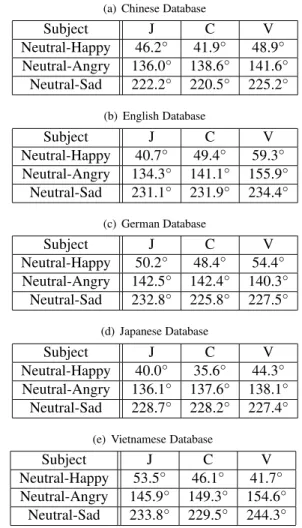
Table 1: Angles of the vector from neutral state to other emo-tional states.
(a) Chinese Database
Subject J C V Neutral-Happy 46.2◦ 41.9◦ 48.9◦ Neutral-Angry 136.0◦ 138.6◦ 141.6◦ Neutral-Sad 222.2◦ 220.5◦ 225.2◦ (b) English Database Subject J C V Neutral-Happy 40.7◦ 49.4◦ 59.3◦ Neutral-Angry 134.3◦ 141.1◦ 155.9◦ Neutral-Sad 231.1◦ 231.9◦ 234.4◦ (c) German Database Subject J C V Neutral-Happy 50.2◦ 48.4◦ 54.4◦ Neutral-Angry 142.5◦ 142.4◦ 140.3◦ Neutral-Sad 232.8◦ 225.8◦ 227.5◦ (d) Japanese Database Subject J C V Neutral-Happy 40.0◦ 35.6◦ 44.3◦ Neutral-Angry 136.1◦ 137.6◦ 138.1◦ Neutral-Sad 228.7◦ 228.2◦ 227.4◦
(e) Vietnamese Database
Subject J C V
Neutral-Happy 53.5◦ 46.1◦ 41.7◦ Neutral-Angry 145.9◦ 149.3◦ 154.6◦
Neutral-Sad 233.8◦ 229.5◦ 244.3◦
not significantly different among three listener groups for all databases.
3.2 Direction of emotional states
Direction of one emotional state is represented by angle of the vector from the center of neutral state to the center of the emotional state. It is calculated by the following equation:
angle= arctan(yE− yN
xE− xN), (1) where (xE, yE) is the center of the emotional state (E), and (xN, yN) is the center of the neutral state.
The calculated results are listed in Table1, and it reveals that directions from neutral state to other emotion states on Valence-Activation approach are similar among three listener groups.
(a) Chinese database (b) Enlish database (c) German database (d) Japanese database (e) Vietnames database
Figure 1: Emotional states’ position on Valence-Activation approach.
(a) Chinese database (b) Enlish database (c) German database (d) Japanese database (e) Vietnames database
Figure 2: Position of neutral states on Valence-Activation approach. To calculate degrees of emotional states, distances from
neutral to other emotional states on V-A space are used as a metric. Large distance means strong emotional states and vice-versa [?]. The Euclidean-distances between neutral to
other emotional states on Valence-Activation approach are calculated by the following equation:
d(E, N ) =p(xE− xN)2+ (yE− yN)2 (2) where (xE, yE) is the center of the emotional state (E), and (xN, yN) is the center of the neutral state.
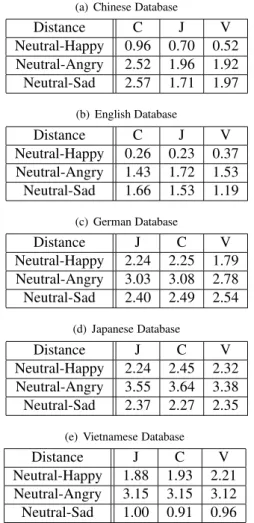
Table2listed the results. It is found that the distance are significantly different among three listener groups.
4. Disccussion
In the previous section, in order to investigate the common-alities and differences among multiple languages on Valence-Activation approach, the results of the listening test was com-pared in three points of views. They are the position of neu-tral voice, the direction of emotinal states and the distance of emotional states.
Firstly, for the position of neutral states, the results of lis-tening test are shown in Figure2(a)-(e). The figures show that the position of neutral voice are not significantly differ-ent among the three listener groups for all databases. More-over, the position of neutral voice evaluated by the three lis-tener groups are not located at the center of the approach. Considering the reason why the situation occurred in the five databases, there are three hypotheses. The first hypothesis is the position of neutral states in these languages are not at the center of approach. For Chinese, Japanese and Vietnamese
databases, since the responces of native speakers are not at the center either. The probablity that the deviation between the position of neutral states and the center of the approach caused by then languages is very low in the three databases. On the other hand, because there are no native speakers of English and German, we cannot know whether the hypothe-sis influent the results or not. The second hypothehypothe-sis is that the personality of the speaker influent the results. For Chi-nese, English and German databases, the number of speakers in one database are more than four, and for Japanese and Viet-namese databases, there are only 1 or 2 speakers. Therefore, the influence of the speakers’ personality should be strong in Japanese and Vietnamese databases, but not strong in other three databases. Then, the third hypothesis is that when speakers recording neutral voices, they spoke with other emo-tional states. This hypothesis would give strong influence to the results in the five databases.
The second point of view is about the direction of emo-tional states, which is presented by the angle of the vector from the center of the neutral state to the centers of other emotional states. As Table ?? shows, directions of
emoti-nal states on Valence-Activation approach are similar among three listener groups. It supposes human beings can perceive emotional state using these angles no matter they understand the languages or not.
Thirdly, from Figure 1(a), in Chinese database, the re-sponces of Chinese listeners are stronger than the rere-sponces of Japanese and Vietanmese subjects. Similarly with Chi-nese database, in the Figure1(b) and (c), the responces of Japanese listeners are the stronggest in Japanese database, and the responces of Vietnamese listeners are the stronggest in Vietnamese database. Moreover, Table 2shows the
cal-Table 2: Distances between neutral state and other emotional states.
(a) Chinese Database
Distance C J V Neutral-Happy 0.96 0.70 0.52 Neutral-Angry 2.52 1.96 1.92 Neutral-Sad 2.57 1.71 1.97 (b) English Database Distance C J V Neutral-Happy 0.26 0.23 0.37 Neutral-Angry 1.43 1.72 1.53 Neutral-Sad 1.66 1.53 1.19 (c) German Database Distance J C V Neutral-Happy 2.24 2.25 1.79 Neutral-Angry 3.03 3.08 2.78 Neutral-Sad 2.40 2.49 2.54 (d) Japanese Database Distance J C V Neutral-Happy 2.24 2.45 2.32 Neutral-Angry 3.55 3.64 3.38 Neutral-Sad 2.37 2.27 2.35
(e) Vietnamese Database
Distance J C V
Neutral-Happy 1.88 1.93 2.21 Neutral-Angry 3.15 3.15 3.12 Neutral-Sad 1.00 0.91 0.96
culated results of the distance between neutral states and other emotional states. For Chinese, Japanese and Viet-namese database, the distances evaluated by native speakers of the language are almost the largest one in the three listener groups. It suggests that native speaker always gives stronger responce than other people. On the other hand, for English and German database, since the three listener groups are not the native speakers of these two languages, it is difficult to distinguish which listener group gave the stronggest response.
5. Conclusions
In this paper, we attempted to investigate the common-alites and differences among multiple languages on Valence-Activation approach for human perception of emotional states in speech. In order to find the commonalies and the differ-ences, we compared the position of neutral state, the direction and the degree of emotional states among the listeners in dif-ferent native languages on Valence-Activation approach.
Ac-cording to the analysis, we achieved that the commonalities are the position of neutral state and the direction from neu-tral states to other emotional state, and the difference is the degree of emotional state. Moreover, the results suggest that when human beings perceive emotional states among multi-ple languages, although the perception of neutral states are different among different listener groups, they can still per-ceive emotional states regardless of languages. Moreover, the results can be used to build a human perception model re-gardless of languages only by control the deviation between neutral states and other emotional states.
Acknowledgment
This study was supported by the Grant-in-Aid for Scientific Research (No. 25240026) and the A3 Foresight Program made avaliable by the Japan Society for the Promotion of Sci-ence (JSPS).
References
[1] C. F. Huang, et al. “Comparison of Japanese expres-sive speech perception by Japanese and Taiwanese lis-teners”, Acoustics2008, Paris, pp. 2317–2322, 2008. [2] J. W. Dang, et al. “Comparison of Emotion Perception
among Different Cultures”, Acoust. Sci. & Tech.,31, 6,
2010.
[3] H. R. Pfizinger, et al. “Cross-language Perception of Hebrew and German Authentic Emotional Speech”,
ICPhS XVII, Hong Kong, 17-21, August, 2011.
[4] R. Elbarougy and M. Akagi, “Cross-lingual Speech Emotion Recognition System Based on a Three-Layer Model for Human Perception”, Proc. Int. Conf. APSIPA
ASC, 2013.
[5] M. Schroder, “Dimensional emotion representation as a basis for speech synthesis with non-extreme emo-tion”, in ADS 2004, E. Andre et al., Eds. (Springer, Berlin/Heidelberg, 2004), pp.209-220.
[6] M. Grimm and K. Kroschel, “Emotion Estimation in Speech Using a 3D Emotion Space Concept”, in Robust
Speech Recognition and Understanding, M. Grimm and
K. Kroschel, Eds. (I-Tech Education and Publishing, Vi-enna, 2007), Chap.16.
[7] F. Burkhardt, et al. “A Database of German Emotional Speech”, Proceedings of Interspeech, Lissabon, Portu-gal, 2005.
[8] H. Mori, et al. “Constructing a spoken dialogue corpus for studying paralinguistic information in expressive conversation and analyzing its statistical/acoustic char-acteristics”, Speech Communication,53, 36-50, 2011.