Japan Advanced Institute of Science and Technology
JAIST Repository
https://dspace.jaist.ac.jp/Title
Vietnamese Noun Phrase Chunking Based on
Conditional Random Fields
Author(s)
Nguyen, Thi Huong Thao; Nguyen, Phuong Thai;
Nguyen, Le Minh; Ha, Quang Thuy
Citation
KSE '09. International Conference on Knowledge
and Systems Engineering, 2009.: 172-178
Issue Date
2009-10
Type
Conference Paper
Text version
publisher
URL
http://hdl.handle.net/10119/9550
Rights
Copyright (C) 2009 IEEE. Reprinted from KSE '09.
International Conference on Knowledge and Systems
Engineering, 2009., 2009, 172-178. This material
is posted here with permission of the IEEE. Such
permission of the IEEE does not in any way imply
IEEE endorsement of any of JAIST's products or
services. Internal or personal use of this
material is permitted. However, permission to
reprint/republish this material for advertising
or promotional purposes or for creating new
collective works for resale or redistribution
must be obtained from the IEEE by writing to
[email protected]. By choosing to view
this document, you agree to all provisions of the
copyright laws protecting it.
Vietnamese Noun Phrase Chunking based on Conditional Random Fields
Nguyen Thi Huong Thao
†, Nguyen Phuong Thai
†, Nguyen Le Minh
‡, Ha Quang Thuy
† †College of Technolgy, Vietnam National University, Hanoi
{ thaonth, thainp, thuyhq}@vnu.edu.vn
‡
Japan Advanced Institute of Science and Technology
[email protected]
Abstract
Noun phrase chunking is an important and useful task in many natural language processing applications. It is studied well for English, however with Vietnamese it is still an open problem. This paper presents a Vietnamese Noun Phrase chunking approach based on Conditional random fields (CRFs) models. We also describe a method to build Vietnamese corpus from a set of hand annotated sentences. For evaluation, we perform several experiments using different feature settings. Outcome results on our corpus show a high performance with the average of recall and precision 82.72% and 82.62% respectively.
1. Introduction
In recent years, applications in natural language processing such as text summarization, question answering and machine translation often require syntactic analysis at various levels including full parsing and chunking. The choice of which syntactic analysis level should be used depends on the specific priority of an application: speed or accuracy. The advantage of chunking in comparison with full parsing is the high speed. Since noun phrases take an important role is these applications, noun phrase chunking is also an important task. The importance of NP chunking derives from the fact that it is used in many applications such as information extraction, co-reference resolution, argument structure identification, etc.
A text chunker divides sentences into non-overlapping phrases. Specifically, NP chunking aims to identifying non-recursive noun phrases. This task was originally proposed by Stenven Abney [3]. The author’s model divided a text into correlated phrases. Then, several other authors have been focused on
low-level noun group identification, such as terminology extraction [follow 10]. However until Lance Ramshaw and Mitch Marcus proposed chunking method by using machine learning with good results 1995 [10], this task is known widely and inspired many others to study.
The CONLL20001 share task was English text
chunking. There are eleven systems applied in this conference. Kudoh and Matsumoto system based on support vector machines method achieved the best performance. The precision, recall and F1 of all chunks were 93.45%, 93.51% and 93.48% respectively; and 93.72%, 94.02% and 93.87% with NPs [17] A number of other approaches were applied recently, such as Conditional Random Fields (CRFs) [13, 15, 20, 22, 23], Maximum entropy markov models [16], combined systems (CRFs and SVMs) [9] also got high performance.
In general, English text chunking achieved good results. However, Vietnamese NP chunking has not been studied much yet due to the lack of Vietnamese language processing resources and tools. In this paper, we present an investigation of using CRFs, a powerful statistical learning method to perform Vietnamese NP chunking task. We first build a corpus extracted from a set of hand annotated sentences. Then we perform several experiments using various feature configurations. We also investigate the effects of using different sizes of training data. Experimental results on our corpus show effective of the model.
The rest of this paper is as follow: Section 2 describes several important characteristics of Vietnamese NP. Section 3 proposes a method to build Vietnamese NP corpus. Section 4 present CRFs models and section 5 introduces our model based on CRFs. Section 6 shows experimental results. Finally, we draw the conclusions and future work in section 7.
1 http://www.cnts.ua.ac.be/conll2000/chunking/ 2009 International Conference on Knowledge and Systems Engineering
2. Vietnamese Noun Phrase Characteristics
Vietnamese is the official language of Vietnam. Many words in Vietnamese are borrowed from Chinese. Originally, it is written in Chinese-like writing system. The current writing system of Vietnamese is a modification of Latin alphabet, with additional diacritics for tones and certain letters. Vietnamese, like many languages in Southeast Asia, is an isolating language, which do not use morphological making of case, gender, number or tense. One word can be made of one or more syllables. Another important characteristic is one word can belong to many word classes such as noun, verb or adjective class. For example, “thҳng lӧi” (succeed) is made of two syllables “thҳng” (win) and “lӧi” (profit). If we consider the word meaning, “thҳng lӧi” belongs to verb class; however in other contexts, this word can be on alternative classes:
(1) Th̷ng lͫi cӫa chúng ta rҩt to lӟn (Our success is very great)
(2) Chúng ta ÿang th̷ng lͫi lӟn (We are succeeding)
(3) Chúng ta rҩt th̷ng lͫi trong viӋc này (We are very successful in this work)
“thҳng lӧi” in (1), (2), (3) is respectively a noun, a verb and an adjective. So, word class identification is mainly based on its surrounding context. Unlike English, one word can be derived from an existing word by adding prefix and suffix. Furthermore, in structure of Vietnamese NPs, head noun can receive features depicted by verbs, adjectives, numerals, nouns or pronouns, etc. So, Vietnamese NPs recognition comes up against more difficulties.
A Vietnamese noun phrase consists of a head noun, optionally accompanied by pre-modifiers and post-modifiers:
Table 1: Structure of Vietnamese noun phrase
Pre-modifiers Head Noun
P-3 P-2 P-1 Head Noun
Totality Quantifier Classifier Noun
Head Noun Post-modifiers
Head Noun P+1 P+2
Noun Attributive
modifiers Demonstrative words A pre-modifier can be located at three possible positions (Table 1). These positions are stable, and cannot be permuted each other. The number of possible cases is limited. Post-modifiers are more complicated than pre-modifiers. Many syntactic constituents can occur concurrently after the head noun. They can be
nouns, verbs, adjectives, numerals, or pronouns. In addition, these substantive words can be combined to phrases such as noun phrases, verb phrases, adjective phrases, etc. to take the part of this position. As a result, the structure of post-modifiers is very complicated; A Vietnamese NP can contain other NPs. Several examples of Vietnamese NPs are presented below:
Tҩt cҧ
All sinh viên students trѭӡng Ĉҥi hӑc Công nghӋ College of Technogy
Totality Head Noun Attributive modifiers
In this example, “Tҩt cҧ sinh viên trѭӡng Ĉҥi hӑc Công nghӋ” (All students of College of Technology) is a NP. “trѭӡng Ĉҥi hӑc Công nghӋ” is also a NP modifying the head noun.
Another example: “sӵ hoҥch ÿӏnh chính sách ҩy” (that policymaking) is a NP.
Sӵ
(Noun) hoҥch ÿӏnh (Verb) chính sách (Noun) (Pronoun) ҩy Head
Noun Attributive modifiers Demonstrative words Next part will introduce the method to build Vietnamese corpus.
3. Corpus Construction
Our corpus is derived automatically from Viet Treebank [12], a corpus consisting of 5329 hand annotated sentences2. In Viet Treebank, there are three annotation levels including word segmentation, part-of-speech (POS) tagging, and syntactic labeling. Word segmentation identifies word boundary in sentences. POS tagging assigns correct POS tags to words. Syntactic labeling recognizes constituency tags, functional tags, and null-element tags. For English, base NPs are noun phrases without post-modifiers. Ramshaw and Marcus [10] identify base NPs as the initial portions of non-recursive NP up to the head. However, if we apply the English definition of base NP for Vietnamese, it is too narrow (since in Vietnamese, modifiers which are content words – or phrases – are all post-modifiers). Therefore, we extract NPs following the structure described in Section 2, including pre-modifiers, head noun and post-modifiers except complex post-modifiers such as prepositional phrases and clauses. We proposed several rules to extract NPs depending on the depth of constituent tree. We present several examples in Figure 1 and Figure 2. Because one Vietnamese word can be composed of one
2At the moment, Viet Treebank consists of nearly 10000 sentences [12], but we have not updated yet because of time restriction,
or more syllables, we use underlines to link syllables in a word. For instances, “cuӝc ÿӡi” becomes cuӝc_ÿӡi, “xinh ÿҽp” becomes xinh_ÿҽp.
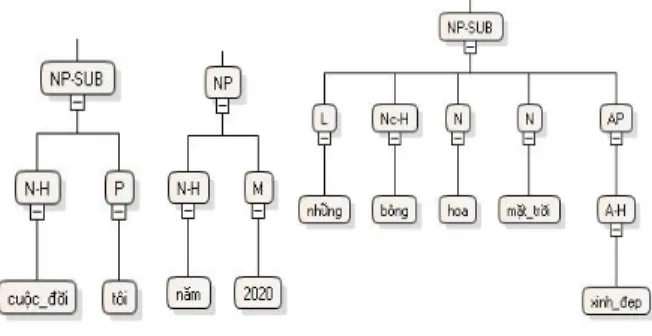
Figure 1: Examples of Vietnamese NP
Two first examples in Fingure 1: “cuӝc ÿӡi tôi” (my life) and “năm 2020” (the year 2020), the head noun is modified by a pronoun and a number respectively. The depth of the NP constituent is 1.
The NP in third example “nhӳng bông hoa mһt trӡi xinh ÿҽp” (beautiful sunflowers) is more complicated. In this example, the head noun is modified by both pre-modifiers and post-pre-modifiers. The pre-modifier is a quantifier; And post-modifiers inlude two nouns and an adjecive phrase. The depth of the NP constituent is 2.
In Figure 2, the NP in the first example: “Bӝ trѭӣng Bӝ Tài nguyên & môi trѭӡng” (Minister of the ministry of natural resources and environment) is a NP where “Bӝ trѭӣng” is the head noun which is modified attribution by a NP “Bӝ tài nguyên & môi trѭӡng”. This is a recursive NP including two NPs inside. The second example, “cѫ sӣ khám chӳa bӋnh” (the health clinic) is a NP, where “khám chӳa bӋnh” (examine and treat medically) is a verb phrase modifying attribution to the head noun “cѫ sӣ” (place). NP constituents of two these examples is 3 in depth.
Figure 2: Examples of Vietnamese NP
From several examples above, we can see the diversity of Vietnamese NP structures, especially post-modifiers. Based on the structure of NP constituents, we select NPs satisfying following criteria:
- The depth of the NP constituent is 1.
- The post-modifier that the depth of its constituent is 1 is not a prepositional phrase.
- The post-modifier is a NP or VP constituent 2 in depth.
- If the depth of NP’s branch is greater than 3, we select only initial portions NP up to the head. With respect to NPs including conjunction “và” (and), the NP phrase can be considered as a single NP spanning the conjunction or separate NPs depending on the structure of NP constituent. Figure 3 give examples of these cases.
Figure 3: Examples of Vietnamese NP including conjunction
The first phrase “nhӳng giӑt nѭӟc mҳt cҧm thông và hҥnh phúc” (sympathetic and happy tears) is considered as a NP. However, “chӗng và ÿӭa con gái” (husband and daughter) is separated into two NPs.
Other special cases such as NPs containing double quotation marks, hyphen, etc. we also built suitable rules. However, due to the diversity of NP structure, these rules may not cover all cases. So, after this process, we review again and correct error manually.
4. Conditional Random Fields
Conditional Random fields was originally introduced by Lafferty [11], is a statistical sequence modeling framework for labeling and segmenting sequential data. Overcoming weakness of HMM and MEMM, CRFs is appreciated as one the best methods for labeling tasks.
CRFs calculate conditional probability distributions
p(y|x) of label sequence
( ,..., )
1 nn
y
y
=
∈ ϒ
y
given variable sequence( ,..., )
1 n nx
x
=
∈ℵ
x
: ¸ ¹ · ¨ © § + =¦
¦
−¦¦
i i k i k k k i i k kt s Z P exp ( , , ) ( , ) ) ( 1 ) | ( y 1 y x y x x x y λ μWhere Z(x) is normalization factor to ensure a proper probability:
¦
¦
¦
¦¦
¸ ¹ · ¨ © § + = − y i i k i k k k i i k kt s Z(x) exp λ (y 1,y ,x) μ (y ,x) And tk is a transformation feature of entire observationsequence x from yi-1 state to yi state; sk is a state feature
of observation sequence at state yi. For example:
1 if xi-1 = “tҩt cҧ”, xi = “sinh viên”, yi-1 = B, yi = I
tk = 0 otherwise 1 if xi = “tҩt cҧ” and yi = I sk = 0 otherwise k
λ and
μ
kare parameters estimated from trainingdata. To train CRFs given training data, several
advanced convex optimization techniques is commonly used to maximize the likelihood such as L-BFGS, Newton, etc.
CRFs has been applied in many natural language processing applications and achieved high performance. In chunking task, CRFs has been used in many systems of different languages, such as English, Chinese, Hebrew, Korean, Indian languages [13, 15, 20, 22, 23, 24], etc. and becomes one of the best methods to identify chunks.
5. Vietnamese NP Chunking Model
We can treat noun phrase chunking as the tagging problem. Assume x=( ,..., )x1 xn is the input sentence, consists of n words, we must determine sequence of tag y=( ,...,y1 yn) We used tag set {B, I, O} where B denotes the beginning of a NP; I denotes inside of a NP; And O denote outside of a NP.
This is IOB2 data presentation model that was originally introduced by Ramshaw and Marcus [10]. NPs are extracted by identifying the beginning and the end of NPs. Besides, there are several different methods to present data, such as IOB1, IOE1, IOE2, etc. In this paper, we use only IOB2 format in all experiments. An instance of IOB2 format as follow:
nhӳng L B-NP
bông Nc-H I-NP
hoa N I-NP
mһt_trӡi N I-NP
xinh_ÿҽp A-H I-NP
ngҧ V-H O
bóng N-H B-NP xuӕng E-H O …
The two first columns are lexical and POS information, the third column is IOB2 tag.
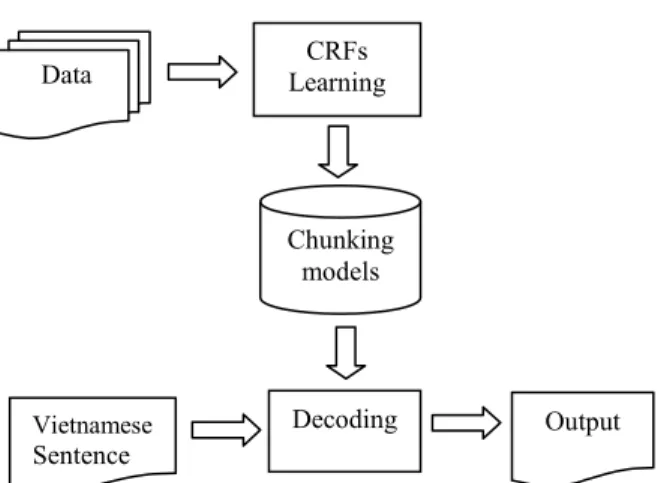
We applied CRFs to our system. The frame of Vietnamese NP chunker is described in Figure 4:
Figure 4: Vietnamese NP chunking system
6. Experiments
Our experiments with CRFs were conducted using CRF++3 toolkit – a C/C++ implementation of CRFs for
labeling and segmenting sequence data. Two types of features: unigram features and bigram features are used. We use standard measures: accuracy (at tag level); Precision, Recall and F1 (at NP level) to evaluate the performance of our chunking system.
For measuring the performance of each experiment, we use the Perl script conlleval4 provided by CoNLL-2000. Several experiments are conducted as follows:
a.
Effect of Feature Set
Performance of CRFs-based NP chunker depends on quality of feature set. Especially, Vietnamese NPs are complex; NPs identification depends on appearance context of surrounding current words.
The test set and train set are chosen randomly according to the scale of 1:2 – the common partition in large corpus. Table 2 listed details on our corpus used in this study:
Table 2: Statistics of the corpus
Number of
sentences Number of NPs Number of tokens
Train set 3552 78751 18165 Test set 1777 39005 9136 Total 5329 117756 27301 3 http://crfpp.sourceforge.net/ 4http://www.cnts.ua.ac.be/conll2000/chunking/output.html Data Learning CRFs Chunking models Vietnamese Sentence Decoding Output 175
We utilize POS and lexical information as the features. Denote Pos0 and Lex0 are POS and lexical information at current position. Posn and Lexn are POS
and lexical information in n window where n is window size. Consider the instance in section 5, assume that the current token is “mһt_trӡi”, we have:
L0 : “mһt_trӡi” P0 : N
L1 : “xinh_ÿҽp” P1 : A-H
L-1 : “hoa” P-1 : N
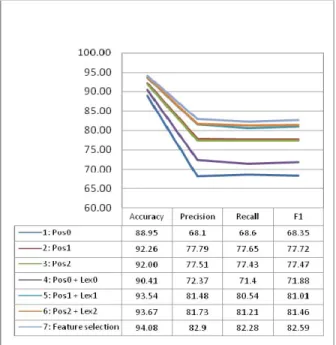
Three first experiments used only POS information with window size 0, 1, 2. After that, lexical information is added. We also use combination features (POS and lexical) in these experiments. Feature selection is made in experiment 7. Figure 5 illustrates output results.
Figure 5: Effect of feature set to performance of CRF-based NP chunker
Table 3: The feature set of experiment 7
Unigram feature Lexical L-2, L-1, L0, L1, L2, L-2L-1, L-1L0, L0L1, L1L2 POS P-3, P-2, P-1, P0, P1, P2, P3, P-2P-1, P-1P0, P0P1, P1P2, P-2P-1P0, P-1P0P1, P0P1P2 Combination L-2P-2, L-1P-1, L0P0, L1P1, L2P2, P0P1L0, P-1P0L0 Bigram feature Lexical L0, L-1, L-1L0 POS P-2, P-1, P0, P1, P0P1, P-1P0 Combination L-1P-1, L0P0
From the results, we see that part-of-speech and lexical information current word to left and right impacts to performance. If we use only POS information, POS2 is little worse than POS1. But, adding lexical information brings better results in all cases. F1 in experiment 5 is better 3.29% than experiment 2. Expanding window size to 1 achieves 9.13% better than using only current word and POS. The best performance achieved F1 = 82.59% in experiment 7 when we take feature selection. The feature set in experiment 7 is detailed in Table 3.
Table 4: Performance of CRFs-base NP chunker
Case Num of NPs Acc Pre Re F1
1 9136 94.08 82.90 82.28 82.59 2 9113 93.77 82.28 82.21 82.24 3 9130 93.88 82.53 82.50 82.52 4 8949 94.30 83.27 83.28 83.28 5 9173 94.15 82.64 82.85 82.74 Average 9100 94.04 82.72 82.62 82.67
Using these features, we perform 5 times choosing randomly train set and test set. The outcome is shown in Table 4. The fourth case archives the best performance, but the differences among five cases are not considerable. The average of F1 is 82.67%.
b. Effect of Corpus Size
Figure 6: Effect of training size to performance of CRF-based NP chunker
To investigate the effect of the size on the training set, we pick randomly different sizes of training sets, including 500, 1000, 2000, 3000, 4329 sentences. The test set is fixed 1000 sentences. The feature set is used as in experiment 7 of previous section. Figure 6 presents obtained results where numbers are F1
measures of each experiment. From this figure, we see that when increasing training set, we can get better performance.
b. Error Analysis and Discussion
From the obtained output, we detect several cases predicted incorrectly. For example, the NP “nghӅ nuôi tôm sú” (prawn-farming) is identified as follow:
nghӅ N-H B-NP B-NP
nuôi V-H I-NP O
tôm_sú N-H I-NP B-NP
The last column is the predicted tag. In this example, our chunker divided “nghӅ nuôi tôm sú” into two NPs: “nghӅ” (industry) and “tôm_sú” (prawn). Note that, in our corpus, “nuôi” (nourish) is a verb that is outside chunks in most cases.
Another example: “ÿҥi diӋn ViӋn kiӇm sát” (the representative of people’s procurancy):
ÿҥi_diӋn N-H B-NP B-NP
ViӋn_KiӇm_sát Np-H I-NP B-NP In this example, the chunker also divided the NP into two NPs. The reason may be is the POS information (Np-H) of “ViӋn_KiӇm_sát”. In many examples, words having Np-H POS information are often the beginning of a NP. Similar to this example, the NP “lӑ thuӝc Pennicillin” (the Penicillin phial) is predicted into two NPs:
lӑ N-H B-NP B-NP
thuӕc N I-NP I-NP
Penicillin Np-H I-NP B-NP However, many recursive NPs are divided well.
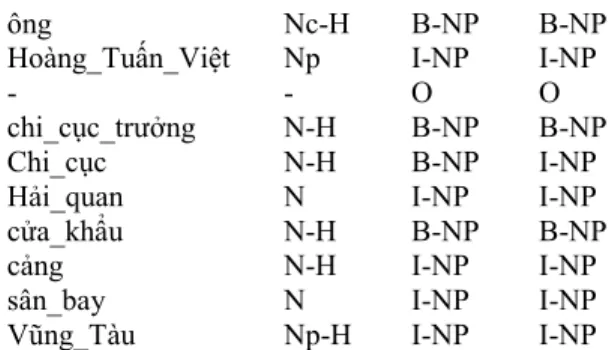
Figure 4: An example of recursive Vietnamese NP
For example, “Ông Hoàng Tuҩn ViӋt – chi cөc trѭӣng Chi cөc Hҧi quan cӱa khҭu cҧng sân bay VNJng Tàu” (Mr.Hoang Tuan Viet – branch manager of the Customs Department of Vung Tau Airport’s harbour) is a recursive NP (Figure 4). The chunker divided correctly this phrase into three NPs:
ông Nc-H B-NP B-NP
Hoàng_Tuҩn_ViӋt Np I-NP I-NP
- - O O
chi_cөc_trѭӣng N-H B-NP B-NP
Chi_cөc N-H B-NP I-NP
Hҧi_quan N I-NP I-NP
cӱa_khҭu N-H B-NP B-NP
cҧng N-H I-NP I-NP
sân_bay N I-NP I-NP
VNJng_Tàu Np-H I-NP I-NP
The results above show that CRFs-based learning is a potential approach to solve Vietnamese NP chunking task. With suitable feature set and large enough of training data, our system brings promising performance.
7. Conclusion and Future Work
Our work concentrated on solving Vietnamese noun phrase chunking problem. First, we have showed that Vietnamese NPs identification meet with difficulties because of complicated characteristics of Vietnamese NPs. Then, we have introduced a method to construct Vietnamese NP chunking corpus from Viet treebank. Performing several experiments based on CRFs models, the experimental results have shown the efficiency of our approach. In all experiments, we used only features related to part-of-speech and lexical information. Our future works will concentrate to the effects of data presentation methods and some different features; also, we will apply some other methods such as support vector machines, combined system for comparison. This work only deals with Vietnamese NP identification. Other kinds of chunks will be also studied in near future.
Our chunking system will be soon released for research purposes, and we believe that it would be helpful for the Vietnamese natural language processing community.
Acknowledgements. This paper is supported by a
national project named Building Basic Resources and Tools for Vietnamese Language and Speech Processing, KC01.01/06-10.
References
[1] DiӋp Quang Ban, Hoàng Bân, “Vietnamese Grammar”
Education Publishing House, HaNoi, 2004
[2] NguyӉn Chí Hoà. “Practical Vietnamese Grammar”.
Hanoi National University Publishing House, 2004
[3] Abney, Steven. 1991, “Parsing by chunks”. In Berwick, Abney, and Tenny, editors, Principle-Based Parsing. Kluwer Academic Publishers
[4] Andrew McCallum, Freitag, and Pereia, “Maximum entropy markov models for information extraction and segmentation”, In Proc. International Conference on
Machine Learning, 2000
[5] Andrew McCallum, “Efficiently Inducing Features of Conditional Random Fields”, Conference on
Uncertainty in Artificial Intelligence (UAI), 2003
[6] Akshar Bharathi, Prashanth R.Mannem, “Introduction to the Shallow Parsing Contest for South Asia Languages”, Proceedings of the IJCAI-2007 Workshop
on Shallow Parsing for South Asian languages, 2007
[7] Eric Brill, “A Corpus-Based Approach to Language Learning”, phD thesis, University of Pennsylvania, 1993
[8] Erik F. Tjong Kim Sang, Sabine Buchholz, “Introduction to the CoNLL-2000 Shared Task: Chunking”, Proceedings of CoNLL-2000 and
LLL-2000, pages 127-132, Lisbon, Portugal, 2000
[9] Fang Xu, Chengqing Zong, “A Hybrid Approach to Chinese Base Noun Phrase Chunking”, Proceedings of
the Fifth SIGHAN Workshop on Chinese Language Processing, pages 87–93, Sydney, July 2006
[10] Lance A.Ramshaw, Mitchell P.Marcus, “Text Chunking using Transformation-Based Learning”,
Proceedings of the ACL 3rd Workshop on Very Large Corpora, 1995, pp. 82-94
[11] Lafferty, John D., McCallum, Andrew, Pereira, Fernando C. N., “Conditional Random Fields: Probabilistic Models for Segmenting and Labeling Sequence Data”, Proceedings of the Eighteenth
International Conference on Machine Learning (ICML 2001), Morgan Kaufmann Publishers, 2001, pp. 282
[12] Nguyen Phuong Thai, Vu Xuan Luong, Nguyen Thi Minh Huyen, Nguyen Van Hiep, Le Hong Phuong. Building a Large Syntactically-Annotated Corpus of Vietnamese. Proceedings of the 3rd Linguistic
Annotation Workshop (LAW) at ACL-IJCNLP 2009 (to appear).
[13] H.X. Phan, M.L. Nguyen, Y. Inoguchi, and S. Horiguchi. “High-Performance Training Conditional Random Fields for Large-Scale Applications of
Labeling Sequence Data”, IEICE Transactions on
Information and Systems, Vol.E90-D, No.1, pp.13-21,
2007
[14] Rie Kubota Ando, Tong Zhang. “A High-Performance Semi-Supervised Learning Method for Text Chunking”. Proceedings of the 43rd Annual Meeting
on Association for Computational Linguistics, p.1-9,
June 25-30, 2005, Ann Arbor, Michigan
[15] Sha, F., Pereira, F. “Shallow parsing with conditional random fields”. Technical Report MS-CIS-02-35, University of Pennsylvania (2003)
[16] Sutton, C., McCallum, A. “An Introduction to Conditional Random Fields for Relational Learning”.
In Introduction to Statistical Relational Learning.
Edited by Lise Getoor and Ben Taskar. MIT Press. (2006)
[17] Sun, Hunag, Wang, Xu. “Chinese Chunking Based on Maximum Entropy Markov Models”, International
Journal of Computational Linguistics and Chinese Language Processing, p115-136, 2006
[18] Taku Kudo, Yuji Matsumoto. “Use of Support Vector Learning for Chunk Identification”. Proceedings of
CoNLL-2000 and LLL-2000, pages 142-144, Lisbon,
Portugal, 2000
[19] Taku Kudo, Yuji Matsumoto. “Chunking with Support Vector Machines”, Proceedings of the NAACL 2001, pages 192-199
[20] Wenliang Chen, Yujie Zhang, Hitoshi Isahara. “Chinese Chunking based on Conditional Random Fields”. NLP2006, Yokohama, Japan, pp. 149-152, Mar. 2006
[21] Yoav Goldberg, Meni Adler, Michael Elhadad. “Noun Phrase Chunking in Hebrew Influence of Lexical and Morphological Features”. Proceedings of the 21st
International Conference on Computational Linguistics and the 44th annual meeting of the ACL, p.689-696,
July 17-18, 2006, Sydney, Australia
[22] Yong-Hun Lee, Mi-Young Kim, and Jong-Hyeok Lee. “Chunking Using Conditional Random Fields in Korean Texts”. Lecture Notes in Artificial Intelligence
IJCNLP 2005
[23] Yongmei Tan, Tianshun Yao, Qing Chen and Jingbo Zhu. “Applying Conditional Random Fields to Chinese Shallow Parsing”. The 6th International Conference on
Intelligent Text Processing and Computational Linguistics (CICLing-2005)
[24] Wengliang Chen, Yujie Zhang, Hotoshi Isahara. “An Empirical Study of Chinese chunking” In Proceedings