Permanence of asingle-species
model
with 2
stages
Ryusuke Kon
(今 隆助,
[email protected]
ne.jp)
1Yasuhisa
Saito
(齋藤保久, [email protected]
) 2Yasuhiro Takeuchi
(竹内康博,
y-takeuchi@eng.
Shizuoka
ac.jp
) 11
Department
of
Systems
Engineering,
Shizuoka
University
Hamamatsu,
432-8561, Japan
(静岡大学システム工学科)2
Department
of
Mathematical
Sciences,
Osaka Prefecture
University
Sakai, 599-8531, Japan
(
大阪府立大学数理工学科)
1
Introduction
In thispaper, we considerpermanence of asingle-species model withtwo stages. The
model was proposed by Neubert and Caswe11[4] to consider the density dependence
effect to stage-structured systems. Their model has acomplex solution in the wide
range of the parameter space. Therefore, we give the conditions for permanence
to
ensure
that the species persists under such complex solutions. This paper isorganized as follows. In Section 2, we introduce asingle species model with two
stages. In Section 3, wegive the definition ofpermanence, and obtainboth sufficient
and necessary conditions for permanence of the model. The final section includes discussion and future problems.
2Stage-Structured Model
We consider permanence of the following stage-structured model:
$\mathrm{x}(t+1)=\mathrm{A}_{\mathrm{x}}\mathrm{x}(t)$ (1)
数理解析研究所講究録 1254 巻 2002 年 181-189
$\mathrm{x}(t)=(_{x_{2}(t)}x_{1}(t))\in \mathbb{R}_{+}^{2}:=\{(x_{1}, x_{2})\in \mathrm{R}^{2}$:
x:
$\geq 0,$i $=1,$2}
$t\in \mathbb{Z}_{+}:=\{0,1,2, \ldots\}$
where
$\mathrm{A}_{\mathrm{x}}=\{$
$\sigma_{1}f_{1}(\mathrm{x}(t))\{1-\gamma f_{3}(\mathrm{x}(t))\}$
$\sigma_{2}f_{2}(\mathrm{x}(t))\phi f_{4}(\mathrm{x}(t)))$ . $\sigma_{1}f_{1}(\mathrm{x}(t))\gamma f_{3}(\mathrm{x}(t))$
Each $f_{i}$ : $\mathrm{R}^{2}+arrow(0,1](i=1, \ldots, 4)$,
which defines the way of density dependence,
is acontinuous function with $f_{i}(0,0)=1$, and the parameters satisfy $0\leq\sigma_{1}\leq 1$,
$0\leq\sigma_{2}\leq 1,0\leq\gamma\leq 1$ and $0\leq\phi$. System (1) has two stages, namely, juvenile
and adult stages (see Fig.1). Population densities in the juvenile and adult stages at generation $t$ are denoted by $x_{1}(t)$ and
$x_{2}(t)$, respectively.
System (1) is the generalized version of the model introduced by Neubert and
Caswell [4]. Putting $f_{i}(\mathrm{x}(t))=\exp[-(x_{1}(t)+x_{2}(t))]$
one
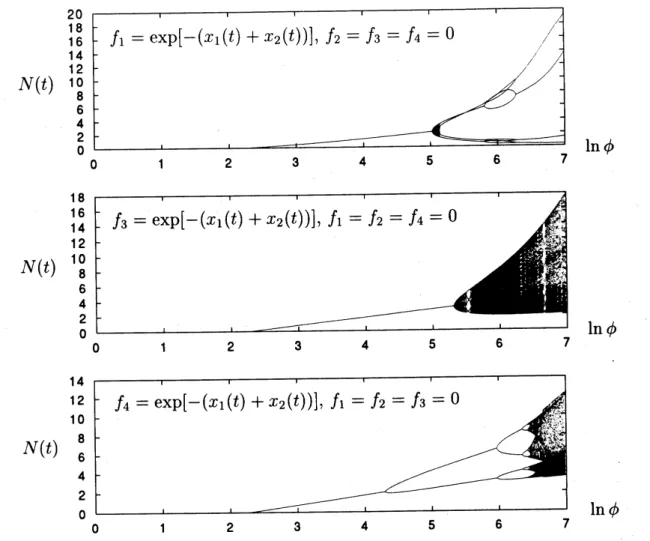
by one, they investigatedthe dynamics of (1). Fig.2 shows some examplesof the complex solutions of System (1).
Figure 1: Life cycle of System (1). $\sigma_{1}fi$ and 02$f_{2}$ denote the fraction of
juveniles and adults which survive one generation, respectively. $\gamma f_{3}$ denotes
thefraction of thesurvivingjuveniles that matureto become adult. $\phi f_{4}$ is the
number of recruitedjuveniles byone adult individual.
3Permanence
The definition of permanence is given as follows
20 18 16 14 12 $N(t)$ $\mathrm{t}08$ 6 4 2 0 $\ln\phi$ $N(t)$ $\ln\phi$ 14 12 10 $N(t)$ $68$ $420$ $\ln\phi$
Figure 2: Bifurcation diagrams. The totalpopulationdensity$N(t)=x_{1}(t)+$
$x_{2}(t)$ is plotted for the orbit $\{\mathrm{x}(t)\}_{t\in\{1001,..,1050\}}$ with $\mathrm{x}(0)=(1,1)$. The
parametersare$\sigma_{1}=0.5$, $\sigma_{2}=0.1$ and$\gamma=0.1$. $\sigma_{1}\gamma\phi>(1-\sigma_{2})\{1-\sigma_{1}(1-\gamma)\}$
holds for $\ln\phi$ $>\ln 9.9\approx 2.293$.
$\mathrm{D}\mathrm{e}\mathrm{f}\mathrm{i}\mathrm{n}\mathrm{i}\mathrm{t}\mathrm{i}\dot{\mathrm{o}}\mathrm{n}1$
.
Let $N(t)= \sum_{i=1}^{2}x_{i}(t)$, which is a total population density.Stage-structured system (1) is said to be permanent
if
there exist $\delta>0$ and $D>0$ suchthat
$\delta<\lim\inf N(t)tarrow\infty\leq\lim_{tarrow}\sup_{\infty}N(t)\leq D$
for
all $\mathrm{x}(0)\in \mathbb{R}_{+}^{2}$ with $N(0)>0$.This definition implies that the following property is enough for permanence of
the stage-structured system (1): there exists a compact set $M\subset \mathbb{R}_{+}^{2}\backslash \{(0,0)\}$ such
that for all $\mathrm{x}(0)\in \mathbb{R}_{+}^{2}\backslash \{(0,0)\}$ there exists
a
$T=T(\mathrm{x}(0))>0$satisfying $\mathrm{x}(t)\in M$
for all $t\geq T$.
The definition ofpermanence
seems
to be somewhat different from theone
usedinotherliterature. That is, in Definition 1each$x_{i}$-axis does not havetobearepellor
and only the origin has to be. But thisproperty is appropriate for (1) because iffor
all generation $t$ there is at least
one
stage in whichpopulation is positive, we
can
conclude that the species survives. We must note that the variables, $x_{1}$ and $x_{2}$, of
the stage-structured model (1) do not denote the population density of the different
species but the population density of the
same
species.In order toprove the permanence of System (1),
we
consider the existence of the$\delta$ and $D$ in Definition
1in turn.
3.1
Repellor
By using the following theorem, we consider the existence of the $\delta$ in Definition 1:
Theorem 2. (Hutson [3], Theorem 2.2) Let $(X, d)$ be a metric space. Consider the
system $F:Xarrow X$, where $F$ is continuous. Assume that $X$ is compact and that $S$ is a compact subset
of
$X$ with empty interior. Let $S$ and$X\backslash S$ be$fo$ rward invariant.Suppose that there is a continuous
function
$P:Xarrow \mathbb{R}_{+}$, which is called an averageLiapunovfunction, satisfying the following conditions: (a) $P(\mathrm{x})=0\Leftrightarrow \mathrm{x}\in S$,
(b)
$\sup_{t\geq 0}\lim_{\mathrm{y},\mathrm{y}\in X},\inf_{\mathrm{x},\backslash s},$
$\frac{P(F^{t}(\mathrm{y}))}{P(\mathrm{y})}>1$ $(\mathrm{x}\in S)$
.
Then $S$ is a repellor, that is, there is a compact set
$M\subset X\backslash S$ such that
for
all $\mathrm{x}\in X\backslash S$ there exists a $T=T(\mathrm{x})>0$ satisfying $F^{t}(\mathrm{x})\in M$for
all$t\geq T$.We need the following lemma for the application of Theorem 2to the system
with uniformly ultimately bounded solutions:
Lemma 3. (Hutson [3], Lemma 2.1, Hofbauer et al. [2], Lemma 2.1) Consider the
system $F$ : $Xarrow X$, where $F$ is continuous. Let $U$ be open with compact closure,
and suppose that $V$ is open and
forward
invariant, where $\overline{U}\subset\ddagger^{r}’\subset X$.If
thereexists a $T=T(\mathrm{x})>0$ such that $F^{T}(\mathrm{x})\in U$
for
every $\mathrm{x}\in V$, then there eists$a$
forward
invariant compact set $X_{0}\subset V$ such that there exists a $T_{0}=T_{0}(\mathrm{x})>0$satisfying $F^{\ell}(\mathrm{x})\in X_{0}$
for
all$t\geq T_{0}$.Applying Theorem 2to System (1) with $S=\{(0,0)\}$ and $P(\mathrm{x})=x_{1}+wx_{2}$,
where $w$ is apositive constant,
we
obtain the following theorem:Theorem 4. Suppose that the solution
of
System (1) isuniformlyultimately bounded.If
$\sigma_{1}\gamma\phi>(1-\sigma_{2})\{1-\sigma_{1}(1-\gamma)\}$, then System (1) is permanent.Proof.
Since the solution of System (1) is uniformly ultimately bounded, Lemma 3guarantees that there exists aforward invariant compact set $X$ such that all orbits
in $\mathbb{R}_{+}^{2}$ ultimately enter the $X$. Therefore, it is enough to consider the solutions in
$X$. First, we note that $\sigma_{1}\gamma\phi>(1-\sigma_{2})\{1-\sigma_{1}(1-\gamma)\}$ implies that $\sigma_{1}>0$, $\gamma>0$
and $\phi>0$.
Then
$X\backslash S$ is clearly forward invariant.Let $w$ be apositive constant satisfying the following equation:
$w\sigma_{1}\{1+\gamma(w-1)\}=\phi+w\sigma_{2}$. (2)
Such apositive constant $w$ always exists. Indeed, the quadratic equation
$g(w)=\sigma_{1}\gamma w^{2}+\{\sigma_{1}(1-\gamma)-\sigma_{2}\}w-\phi$
is negative at $w=0$, that is, $g(0)=-\phi<0$.
Let us check the condition (b) in Theorem 2:
$\sigma$ $=$
$\sup_{t\geq 0}\lim_{\mathrm{y}\in X}\inf_{0\mathrm{y}(0,),\backslash s’}\frac{P(F^{t}(\mathrm{y}))}{P(\mathrm{y})}$
$=$ $\sup_{t\geq 0}\lim_{\mathrm{y}\in X}\inf_{0\mathrm{y}(0,),\backslash s’}\frac{P(F^{t}(\mathrm{y}))}{P(F^{t-1}(\mathrm{y}))}\ldots\frac{P(F^{2}(\mathrm{y}))}{P(F(\mathrm{y}))}\frac{P(F(\mathrm{y}))}{P(\mathrm{y})}$
$=$ $\sup_{t\geq 0}\lim_{\mathrm{y}\in X}\inf_{0\mathrm{y}(0,),\backslash s’}\prod_{i=0}^{t-1}[\frac{\sigma_{1}f_{1}(\mathrm{y}(i))\{1+\gamma(w-1)f_{3}(\mathrm{y}(i))\}y_{1}(i)}{y_{1}(i)+wy_{2}(i)}$
$+ \frac{\{\phi f_{4}(\mathrm{y}(i))+w\sigma_{2}f_{2}(\mathrm{y}(i))\}y_{2}(i)}{y_{1}(i)+wy_{2}(i)}]$
$=$ $\sup_{t\geq 0}\lim_{\mathrm{y}\in\lambda},\inf_{0\mathrm{y}(0,),\backslash s’}\prod_{i=0}^{t-1}[\sigma_{1}f_{1}(\mathrm{y}(i))\{1+\gamma(w-1)f_{3}(\mathrm{y}(i))\}$
$+(\begin{array}{l}i\ovalbox{\tt\small REJECT}\end{array})-w\sigma_{1}f_{1}(\mathrm{y}(i))\{1+\gamma(w-1)f_{3}(\mathrm{y})\}+\{\phi f_{4}(\mathrm{y}(i))+w\sigma_{2}f_{2}(\mathrm{y}(i))\}y_{2}(i)]$,
$y_{1}(i)+wy_{2}(i)$
where $\{\mathrm{y}(t)\}_{t\in \mathbb{Z}}+=\{(y_{1}(t), y_{2}(t))\}_{t\in \mathbb{Z}_{+}}$ is a solution of System (1) with
$\mathrm{y}=\mathrm{y}(0)$
and $F$ is defined as aright-hand side of (1). By Eq.(2), we have
$\lim_{\mathrm{y}(i)arrow(0,0)}[-w\sigma_{1}f_{1}(\mathrm{y}(i))\{1+\gamma(w-1)f_{3}(\mathrm{y}(i))\}+\{\phi f_{4}(\mathrm{y}(i))+w\sigma_{2}f_{2}(\mathrm{y}(i))\}]=0$ .
Furthermore,
we
havetheboundedness
of$y_{2}(i)/(y_{1}(i)+wy_{2}(i))$. In fact, thefollowinginequality holds for all $\mathrm{y}(i)\in X\backslash S$:
$\frac{y_{2}(i)}{y_{1}(i)+wy_{2}(i)}\leq\frac{(y_{1}(i)+wy_{2}(i))/w}{y_{1}(i)+wy_{2}(i)}=\frac{1}{w}$ .
Therefore, by the continuity of the $F$,
we
obtain$\sigma=\sup_{\ell\geq 0}[\sigma_{1}\{1+\gamma(w-1)\}]^{\ell}$.
After
some
calculations, wesee
that $\sigma_{1}\gamma\phi>(1-\sigma_{2})\{1-\sigma_{1}(1-\gamma)\}$ implies that$\sigma_{1}\{1+\gamma(w-1)\}>1$. Hence, the assumptions in Theorem 2hold.
$\square$
3.2
Boundedness
Hereafter, we consider uniform ultimate boundedness of the solution ofSystem (1).
Clearly, the
boundedness ensures
the existence of the D in Definition 1.Theorem 5. Suppose that $\sigma_{1}\neq 1$ or
$\gamma$ $\neq 0$, and$\sigma_{2}\neq 1$.
If
oneof
$f_{1}(\mathrm{x})x_{1}$,$f_{3}(\mathrm{x})x_{1}$
or $f_{4}(\mathrm{x})x_{2}$ is bounded to the above,
then the solution
of
System (1) is uniformlyultimately bounded.
Proof
Let $\{\mathrm{x}(t)\}_{t\in \mathbb{Z}_{+}}$ be asolution of System (1).First,
assume
that one of $f_{i}(\mathrm{x})x_{1}(i=1,3)$ is bounded to the above, that is,there exists
a
$K_{0}>0$ such that $x_{1}f_{i}(\mathrm{x})\leq K_{0}$ for all $\mathrm{x}\in \mathrm{R}_{+}^{2}$ and $i=1$or
3. Fromthe second equation of (1), we have
$x_{2}(t+1)$ $=$ $\sigma_{1}f_{1}(\mathrm{x}(t))\gamma f_{3}(\mathrm{x}(t))x_{1}(t)+\sigma_{2}f_{2}(\mathrm{x}(t))x_{2}(t)$
$\leq$ $\sigma_{1}\gamma f_{i}(\mathrm{x}(t))x_{1}(t)+\sigma_{2}x_{2}(t)$
$\leq$ $\sigma_{1}\gamma K_{0}+\sigma_{2}x_{2}(t)$.
Since $\sigma_{2}\neq 1(0\leq\sigma_{2}<1)$, there exist $T>0$ and $K>0$ such that
$x_{2}(t)\leq K$
for all $t\geq T$. If$\sigma_{1}\neq 1$, then from the first equation of (1)
we have
$x_{1}(t+1)$ $=$ $\sigma_{1}f_{1}(\mathrm{x}(t))\{1-\gamma f_{3}(\mathrm{x}(t))\}x_{1}(t)+\phi f_{4}(\mathrm{x}(t))x_{2}(t)$ $\leq$ $\sigma_{1}x_{1}(t)+\phi x_{2}(t)\leq\sigma_{1}x_{1}(t)+\phi K$
for $t\geq T$. If$\gamma\neq 0$, then similarly to the above we have
$x_{1}(t+1)$ $=$ $\sigma_{1}f_{1}(\mathrm{x}(t))\{1-\gamma f_{3}(\mathrm{x}(t))\}x_{1}(t)+\phi f_{4}(\mathrm{x}(t))x_{2}(t)$
$\leq$ $\{1-\gamma f_{3}(\mathrm{x}(t))\}x_{1}(t)+\phi x_{2}(t)\leq\{1-\gamma f_{3}(\mathrm{x}(t))\}x_{1}(t)+\phi K$
for $t\geq T$. Note that $\gamma\neq 0$ implies that $0<1-\gamma f_{3}(\mathrm{x}(t))<1$ for all $\mathrm{x}(t)\geq 0$.
These inequalities complete the proof of the first case.
Finally,
assume
that $f_{4}(\mathrm{x})x_{2}$ is bounded to the above, that is, there existsa
$K_{0}>0$ such that $f_{4}(\mathrm{x})x_{2}\leq K_{0}$ for all $\mathrm{x}\in \mathbb{R}_{+}^{2}$. If $\sigma_{1}\neq 1$, then from the first
equation of (1) we have
$x_{1}(t+1)$ $=$ $\sigma_{1}f_{1}(\mathrm{x}(t))\{1-\gamma f_{3}(\mathrm{x}(t))\}x_{1}(t)+\phi f_{4}(\mathrm{x}(t))x_{2}(t)$ $\leq$ $\sigma_{1}x_{1}(t)+\phi f_{4}(\mathrm{x}(t))x_{2}(t)\leq\sigma_{1}x_{1}(t)+\phi I\iota_{0}$.
If$\gamma\neq 0$, then similarly to the above we have
$x_{1}(t+1)$ $=$ $\sigma_{1}f_{1}(\mathrm{x}(t))\{1-\gamma f_{3}(\mathrm{x}(t))\}x_{1}(t)+\phi f_{4}(\mathrm{x}(t))x_{2}(t)$
$\leq$ $\{1-\gamma f_{3}(\mathrm{x}(t))\}x_{1}(t)+\phi f_{4}(\mathrm{x}(t))x_{2}(t)\leq\{1-\gamma f_{3}(\mathrm{x}(t))\}x_{1}(t)+\phi K_{0}$
.
Then, there exist $T>0$ and $K>0$ such that
$x_{1}(t)\leq K$
for all $t\geq T$. From the second equation of (1), we have
$\mathrm{x}\mathrm{x}\{\mathrm{t}+1)$ $=$ $\sigma_{1}f_{1}(\mathrm{x}(t))\gamma f_{3}(\mathrm{x}(t))x_{1}(t)+\sigma_{2}f_{2}(\mathrm{x}(t))x_{2}(t)$
$\leq$ $\sigma_{1}\gamma x_{1}(t)+\sigma_{2}x_{2}(t)$
$\leq$ $\sigma_{1}\gamma K+\sigma_{2}x_{2}(t)$
for $t\geq T$. This completes the proof. $\square$
From the following theorem, we see that the boundedness of $f_{2}(\mathrm{x})x_{2}$ does not
imply uniform ultimate boundedness ofthe solution of (1).
Theorem 6. Assume that $f_{1}(\mathrm{x})=f_{3}(\mathrm{x})=f_{4}(\mathrm{x})=1$.
If
$\phi>1$, then System (1)has an unbounded solution
Proof.
Suppose that allsolutionsofSystem (1) are bounded. Then there exist K $>0$and T $>0$ such that
$x_{1}(t)\leq K$
for all $t\geq T$. By (1), we have
$x_{1}(t+1)+x_{2}(t+1)$ $=$ $\sigma_{1}x_{1}(t)+\{\phi+\sigma_{2}f_{2}(\mathrm{x}(t))\}x_{2}(t)$
$\geq$ $\phi x_{2}(t)$.
Then $x_{2}(t+1)\geq$ $\mathrm{x}2(\mathrm{t}-\mathrm{x}2(\mathrm{t}+1)\geq$ $\mathrm{x}2(\mathrm{t}-K$ for $t$ $\geq T$. Since $\phi>1$, it is
a
contradiction to the boundedness of the solution. 0
By Theorems 4and 5, we obtain the following corollary:
Corollary 7. Assume that $\sigma_{1}\neq 1$ or $\gamma\neq 0$, and $\sigma_{2}<1$. Suppose that
one
of
$f_{1}(\mathrm{x})x_{1}$, $f_{3}(\mathrm{x})x_{1}$ of$f_{4}(\mathrm{x})x_{2}$ is boundedto the above.
If
$\sigma_{1}\gamma\phi>(1-\sigma_{2})\{1-\sigma_{1}(1-\gamma)\}$,then System (1) is permanent.
The following corollary is an immediate consequence ofTheorem 6:
Corollary 8. Assume that $f_{1}(\mathrm{x})=f_{3}(\mathrm{x})=f_{4}(\mathrm{x})=1$ .
If
$\phi>1$, then System (1)is not permanent.
4Discussion
and
Future
works
By Corollary 7, it is ensured that the system whose dynamics are shown in Fig.2 is
permanent if$\phi>9.9(\ln\phi>2.293)$.
The condition $\sigma_{1}\gamma\phi>(1-\sigma_{2})\{1-\sigma_{1}(1-\gamma)\}$ in Theorem 4has astrong
re-lationship with instability of the origin. In fact, Jacobian matrix at the origin of
System (1) is given by
$A=(\begin{array}{lll}\sigma_{1}(1- \gamma) \phi\sigma_{1}\gamma \sigma_{2}\end{array})$,
and the eigenvalues Aofthe matrix satisfy $|\lambda|<1$ if and only if$\sigma_{1}\gamma\phi<(1-\sigma_{2})\{1-$
$\sigma_{1}(1-\gamma)\}$ (see Neubert and Caswe11[4]). Therefore, it is expected that under the
assumption of uniform ultimate boundedness System (1) is permanent if and only
ifthe origin is unstable. It is afuture work to show it
In Theorem 5we obtained sufficient conditions for uniform ultimate
bounded-ness
of the solution of (1). The sufficient conditions require the boundedness ofat least one of the functions $f_{1}(\mathrm{x})x_{1}$, $f_{3}(\mathrm{x})x_{1}$ or $f_{4}(\mathrm{x})x_{2}$. However, from the
anal-ogy between single-species models with stages and without stages, it is expected
that the solution of System (1) can be uniformly ultimately bounded
even
if all ofthe $f_{1}(\mathrm{x})x_{1}$, $f_{3}(\mathrm{x})x_{1}$ and $f_{4}(\mathrm{x})x_{2}$
are
unbounded. In fact, the solution of thefol-lowing single-species model with unbounded $f(N)N$ is clearly uniformly ultimately
bounded (a positive equilibrium of the system is globally stable, that is, all orbits
$\{N(t)\}_{t\in \mathbb{Z}_{+}}$ with $N(0)>0$ converge to apositive equilibrium point. This property
is proved by Theorem 1in Cull[l]$)$:
$N(t+1)=\phi Nf(N)$, $\phi>1$
$f(N)= \frac{1}{1+N^{1/2}}$.
To relax the condition in Theorem 5is afuture work.
System (1) can be easily extended to the system with $n$-stages. To consider the
permanence of the system is also afuture work.
References
[1] P. Cull, Local and global stability for population models. Biological cybernetics
54, 141-149 (1986).
[2] J. Hofbauer, V. Hutson and W. Jansen, Coexistence for systems governed by
difference equations of Lotka-Volterra type. Journal
of
Mathematical Biology25, 553-570 (1987).
[3] V. Hutson, Atheorem on average Liapunov functions.
Monatshefte fur
Mathe-matik 98, 267-275 (1984).
[4] M.G. Neubert and H. Caswell, Density-dependent vital rates and their
pop-ulation dynamic consequences. Journal
of
Mathematical Biology 41, 103-121(2000