Paleomagnetism of Rocks from the Island of
Viti Levu, Fiji
著者
YASKAWA Katsumi, INOKUCHI Hiroo, MATSUDA
Jun-ichi, TAKAHASHI Shinji, ISEZAKI Nobuhiro,
MIYATA Takao, RAO Bhaskar, RODDA Peter
journal or
publication title
南方海域調査研究報告=Occasional Papers
volume
5
page range
1-12
URL
http://hdl.handle.net/10232/15868
Kagoshima Univ. Res. Ccnler S. Pac. Occasional Papers, No. 5, p. 1-12, 1985
Paleomagnetism of Rocks from the
Island of Viti Levu, Fiji
Katsumi YASK.AWA*, Hiroo INOKUCHI*, Jun-ichi MATSUDA*,
Shinji Takahashi*, Nobuhiro Isezaki*, Takao Miyata**,
Bhaskar Rao*** and Peter RODDA***Abstract
Samples were collected at 19 sites in basalts, andesites, dacites, gabbros, sandstones
and limestones in the island of Viti Levu. They were dated at about 4 to 40 Ma. New
age data have been added in 2 sites. After partial demagnetization by alternating fields
to remove unstable components of magnetization, the directions of magnetization
became well grouped except for the rocks from a few sites. Both normal and reversed
directions are present. The volume susceptibility of each specimen has also been
measured. Using the susceptibility data the Konigsberger ratio has been calculated.
The median destractive field and the magnetic grain size have also been determined for
each specimen. As the result, the direction of magnetization for each site does not seem
to contradict the hypothesis of anticlockwise rotation of the island.
ie's
Fig. 1. The map of Viti Levu, Fiji, showing locations of paleomagnetic sampling
sites.
* Department of Earth Sciences, Faculty of Science, Kobe University, Nada, Kobe 657, Japan * * Institute of Geosciences, College of Liberal Arts, Kobe University, Nada, Kobe 657, Japan * * * Mineral Resources Department, Suva, Fiji
Yaskawa el at '• Paleomagnetism of Fiji
Introduction
The remanent magnetization of rocks from Viti Levu, Fiji has been described by several authors (Tarling, 1965 ; James and Falvey, 1978 ; Malahoff et al., 1982). Malahoff (1970) made a speculative proposal that the Fiji Platform had undergone
anticlockwise rotation, based on earthquake distribution and submarine morphology,
and some of the paleomagnetic results of these authors seem to support this hypothesis.
The present paper gives further results from some sites almost the same as some of
these authors', and also from different sites. The purpose of the present study has been
to investigate more thoroughly the direction of magnetization of the rocks distributed
in Viti Levu and to ascertain whether Malahoffs hypothesis is adequate or not, and therefore it has been necessary to investigate the stability and reliability of the paleomagnetic results in terms of the magnetic properties and mineral composition of
the samples.
Outline of geology
The geology of Viti Levu was summarized by one of us (Rodda,1967). The oldest formations in the island of Viti Levu, classified as the Wainimala Group, range from Eocene to middle-Miocene with a possible break in deposition in the Oligocene and were intruded by igneous rocks known as the Colo Plutonic Suite in two periods. The Sigatoka Sedimentary Group is latest Oligocene to mid-Miocene and probably older
than all Miocene Colo stocks, and overlies some of the volcanic rocks of the
Wainimala Group in the west. The Savura Volcanic Group, basalt to rhyolite. is thought to be also mid-Miocene and rests unconformably on rocks of the Wainimala Group in the south-east. The rocks of these Groups are unconformably covered by Mio-Pliocene sedimentary rocks with some andesite of the Ba, Nadi and Navosa Sedimentary Groups and the Medrausucu Group.
The Koroimavua Volcanic Group is Early Pliocene and overlies the Nadi Group. The Ba Volcanic Group is mostly basalt with some andesite and other differentiates and originated from several volcanic centers in the north. The rocks of the Group are mostly Pliocene to Pleistocene, but some of the basal rocks may be upper-Miocene. The Verata Sedimentary Group in the east and the Cuvu Sedimentary Group in the south-west are both Pliocene with probably some Pleistocene strata in
the east.
Sampling
site 2 0 100 zoo 100 200 300 400 100 200 300 400 500 600 i.o-, site 13 100 200 300 400 i.oi site 15 0 100 200 0 100 200 300 400 500 i.o-| site 17 io-t site 18 i.o4 site 19 0 100 200 0 i(5o 20~0
Fig.
2.
Normalized
deniagnetiztion
curve
of
a
specimen
from
each
site.
The
abscissa
shows
the
peak
intensity
of
alternating field in oersted.4 Yaskawa et at. : Paleomagnetism of Fiji
site in south and west area of Viti Levu using a magneto-compass for orientation. They were later drilled and cut into cylindrical specimens 2.5 cm both in diameter and in
length in the laboratory. As the strike direction of each sample was measured from magnetic north with a magneto-compass, the geomagnetic declination of 13.0°, inferred
for the island of Viti Levu from the IGRF-80, was added in order to obtain the true strike direction from geographic north.
The following are the brief descriptions of our sampling sites and Fig. 1 shows their approximate locations on the map of the island of Viti Levu.
Site 1 : Excavated cliff of a playing field at Narere. A part of the Suva Marl, fine
grained calcareous sandstone with rare tuffs. Three samples were taken, the highest of which was at the level predicted for the Gilbert-Gauss boundary by
the line of regression through the K-Ar dates on tuffs lower in the sequence (Rodda et al., 1984). The samples 1 to 3 are respectively at 33.6, 30.9 and 37.5 m (of siltstone only) above the Purple Marker in the Standard Sequence of the Suva Marl (Rodda, in prep.).
Site 2 : In Wainibuku Creek. Trachytic basalt flow within basaltic rudite, some of
which contains the more usual olivine basalt called Nasinu Basalt, and classified
as the Savura Volcanic Group. As it is overlain by strata of latest Miocene to earliest Pliocene, the age is geologically in the range of latest Oligocene to early middle-Miocene. Our K-Ar date is 6.49 Ma as described later.
Site 3 : By Balenabelo Road. Impure limestone associated with volcanics and
volcaniclastics ; being a member of the Wainimala Group. The limestone crops out on the road and ridges nearby and it has been dated at middle-Miocene (Coleman, 1974), probably early middle-Miocene or about 14 Ma.
Site 4 : By Balenabelo Road, in a creek east of site no.3. Basalt (possibly pillowed) of probably about the same age as the limestone of site no.3.
Site 5 : By Balenabelo Road, as above but on a ridge about 0.5 km past the creek. Probably pillowed basalt.
Site 6 : By Balenabelo Road, excavation beside the road about 0.5 km south of site no. 3. Rhyolite or dacite, being possibly an intrusive within the Wainimala Group. Site 7 : By Vatutu Road, 1 km north-west of Vatutu village and beside Nawaka Creek. Sandstone and siltstone of the basal part of the Nadi Sedimentary Group, the
age of which is given as NN. 11 by Wilcoxon (Easton, 1973).
Site 8: (17°49.1'S, 177°30.8'E) near Namulomulo. Foraminiferal limestone of the Wainimala Group, dated at late Eocene (Cole, 1960).
Site 9 : Beside Namosi Creek near Namulomulo. Volcanics of the Wainimala Group, partly pillowed. It crops out immediately below strata of the Nadi Sedimentary Group, and is presumed to be of late Eocene age.
Site 10 : A roadcut on Kings Road about 12 km north of Lautoka. A flow of augite-olivine basalt belonging to the Nacilau Volcanics of Ba Volcanic Group. It was dated at 4.73 Ma but thought to be somewhat younger (Whelan et al.,
Kagoshima Univ. Res. Center S. Pac, Occasional Papers. No. 5, 1985 5
Site 11 : A roadcut near a disused quarry and 1 km north of site no. 10 along Kings Road. Geological description is as for the site no. 10.
Site 12: (17'39.2'S, 17728.1'E) beside Varaqe Creek. Partly pillowed basalt or shoshonite lava of the Saru Shoshonite, Koroyanitu Volcano, Ba Volcanic Group. The age was thought about 5 Ma, and, as will be mentioned, actually the age of this rock has been radiometrically determined by one of us at 5.04 Ma. Site 13 : In Lomolomo area and the proposed quarry site no.2 at the west end of the Sabeto Range. Massive plug-fed lava of the Sabeto Volcanics, Koroimavua Volcanic Group. The age is thought to be as for eruptive rocks from nearby dated at 5.4 Ma (McDougall, 1963).
Site 14: (17°42.6'S, 177'31.9'E) beside Nawainiu Creek. One of the centers for the Sabeto Volcanics. Augite-biotite micromonzonite, Nawainiu Creek Intrusives of the Koroimavua Volcanic Group. Possibly one of the dykes intruding steeply dipping beds of the Nadi Sedimentary Group. It was dated at 4.9 Ma (Rodda
and Kroenke, 1984).
Site 15 : By Queens Road near Yako. Basalt with common zeolite amygdales, called Dakadaka Basalt by Skiba (1964), probably belonging to the Sigatoka Sedimen tary Group.
Site 16: By Queens Road near Navutu turnoff at Kubuna River bridge. Intrusive rock (gabbro?) of the Colo Plutonic Suite. The age is thought to be approximately
10 Ma.
Site 17: At 18 km from the east end of Sigatoka River bridge along Kavanagasau Road, on the side of the hill Navuwa. Possibly a plug of massive dacite of the Wainimala Group. The age is probably mid-Miocene.
Site 18: At 19 km from the east end of Sigatoka River bridge along Kavanagasau Road. A dyke of porphyritic andesite intruding strata of the Sigatoka Sedimen tary Group. The age is possibly middle-Miocene and may be about 14 Ma. Site 19: Mau Quarry. Hornblende andesite plug, Mau Andesite Member of the
Veisari Sandstone, Medrausucu Group. It was dated at 5.85 Ma (Gill and McDougall, 1973).
Measurements and results
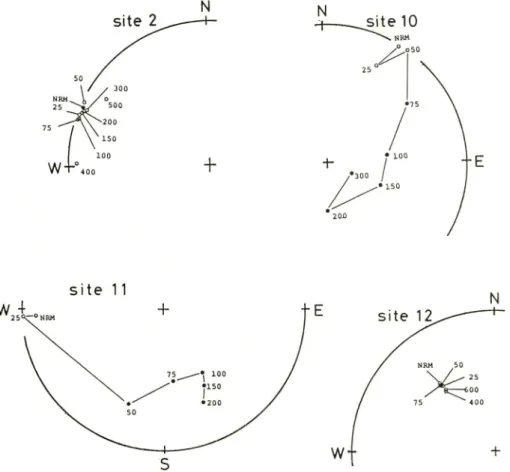
The direction and intensity of the natural remanent magnetization (NRM) of each specimen were measured with a spinner magnetometer. A cryogenic magnetometer was also employed to measure a considerably weak magnetization of a specimen. All the specimens were demagnetized in an alternating field in the following way. A specimen from each site was progressively demagnetized in steps (Figs. 2 & 3) until a stable direction of magnetization was reached. The remaining specimens from the same site were then demagnetized in the field which had been thus determined. For those sites where the direction of magnetization in the specimens continued to change on
applica-6 Yaskawa el al.: Paleomagnetism of Fiji Taible 1.
Site N ODF D 1 M (MS k K MDF Qr G.S.
(Oe) (*) n ( X 10 'emu) n (10 'emu) (Oe) {pan)
1 1 6 50 18.7 -54.2 1.9 19.4 15.6 38 1-2 6 50 III .2 30.5 1.9 12.0 31.9 38 1-3 5 50 340.5 -54.6 1.9 12.3 40.0 38 2 7 150 295.5 -4.7 194.0 5.4 125.9 72.3 772 6.9 15-20 3 19 0 148.9 10.7 0.2 3.0 126.1 0.0 23 17.6 4 1 0 197.8 23.5 238.0 2.5 93 1.9 8 10 5 14 0 322.0 -4.4 130.4 3.7 116.4 54.3 20 6.0 50-100 6 5 60 1.0 -52.9 21.9 9.8 61.9 5.3 320 9.3 20-50 7 9 50 318.3 -26.2 185.0 2.4 461.2 174.4 22 3.0 8 15 30 358.6 -3.8 0.1 8.9 19.4 0.0 155 6.7 9 10 30 28.3 -6.5 31.5 13.7 13.4 2.8 260 3.9 20-30 10 8 75 123.5 46.4 60.3 15.3 14.1 160.5 45 1.0 50-100 11 8 75 165.4 54.2 86.8 13.9 16.8 199.2 17 0.6 8-12 12 16 0 344.0 -39.6 879.3 7.5 25.2 107.4 280 20.2 5-20 13 6 0 24.1 51.8 1003.7 18.4 14.2 187.8 65 14.6 10-30 14 7 50 8.7 -31.8 137.1 3.5 298.4 160.3 48 1.8 50-100 15 7 100 65.8 39.6 156.4 11.4 29.0 46.7 80 6.6 4-10 16 12 0 140.7 -8.2 28.2 62.9 1.4 23.0 230 1.1 2-4 17 7 90 358.8 -16.1 32.7 16.3 14.7 90.8 50 1.2 10-20 18 7 60 25.6 -30.9 33.5 8.5 51.4 59.5 125 1.0 15-25 19 11 60 337.3 -36.9 48.1 6.0 58.9 97.5 30 1.1 40-60 N : number of specimens
ODF : optimum demagnetizing field
D : declination of remanent magnetization I : inclination of remanent magnetization M : intensity of remanent magnetization <M5 : semiangle of cone of 95 % confidence
k : precision parameter
k : volume susceptibility MDF: median destructive field
Qr : Koenigsberger's ratio G. S. : grain size
tion of higher fields, several more specimens were progressively demagnetized to determine the peak alternating field at which the dispersion was least. The mean direction of magnetic vectors, its estimated precision parameter k and the semiangle a95 of cone of 95 per cent confidence for the mean direction (Fisher, 1953) were calculated from the directions of stable magnetization of specimens thus obtained at each site, and are presented in Table 1 with the mean intensity of stable magnetization.
The volume susceptibility k of each specimen is also tabulated in Table 1, being calculated from the value obtained in the following way. After being demagnetized completely, each specimen was installed in the sample holder of the cryogenic magnetometer, in which the ambient geomagnetic field was stably trapped with the superconducting shield, and the intensity of magnetization induced in the weak field trapped around the specimen was measured.
As the index of the specimen's capability of maintaining a stable remanence, the Konigsberger ratio Qr was calculated as Qr = NRM/xH, where H is the geomagnetic field at each sampling site, inferred from the IGRF-80. As the quantity describing stability against alternating fields, median destructive field (MDF), the demagnetizing
Kagoshima Univ. Res. Center S. Pac, Occasional Papers. No. 5. 1985
Table 2.
'Ar rad. 'Ar rad. K Age
Sample Sample Weight (%)
(Xl0-8cm3/g) "°Ar total u (wt %) (m.y.)
2-4 0.4759 4.99 ±0.52 2-5 0.7289 5.26 ±0.39 12-2 0.4228 47.9 ± 2.1 12-6 0.4537 47.7 ± 1.3 86 82 70 59 0.185 6.94 .007 ±0.77 0.224 6.04 .009 ±0.51 2.50 4.92 .10 ±0.29 2.38 5.1 5 .10 ±0.26
field required to reduce the initial NRM intensity by half, was determined for each specimen. In Table 1 are given the mean Konigsberger ratio and the mean MDF for all the specimens at each sampling site.
Discussion of results
Gilbert-Gauss boundary The samples from site no.l were collected in order to find whether the Gilbert-Gauss boundary occurred at the expected stratigraphic level. A change from reverse to normal polarity was found to lie between samples 1-1 and 1-2. The age of this level was presumed by an extrapolated regression line as 3.46 Ma (Rodda et al. 1984), being in reasonable agreement with current polarity time scales.
New data of age The rocks from sites nos.2 and 12 have been dated at 6.49 and 5.04 Ma respectively as shown in Table 2. The age of 5.04 Ma for the rock from site no. 12 shows quite good agreement with the value presumed from the geological view
point. The age of 6.49 Ma for the rock from site no.2 is rather younger than the
geologically presumed age ; in the range latest Oligocene to early middle Miocene. An age in this range was presumed because the rock is overlain by strata of latest Miocene to earliest Pliocene age. and associated volcanics are geochemically similar to rocks of the upper Wainimala Group in eastern Viti Levu and elsewhere, which have that age range. The new radiometric age of 6.49 Ma is not in conflict with the observed
stratigraphy.
Magnetic stability The magnetic and microscopic properties of the samples do not show any particular characteristics indicating either remarkable stability of magnetiz-tion or useless instability (see in Table 1), except for site no. 12.
The Konigsberger ratio Qr is usually in the range of 2 to 20 in volcanic rocks. The ratios shown in Table 1 are not so good and not too small according to this range. The values of median destructive field MDF in Table 1 are rather low on the whole, and some of these low MDF samples show good grouping of the direction of their remanent
Yaskawa et al.: Paleomagnetism of Fiji
Table 3.
age(m. y.) D(°) K°) tf95(°) rock site MD
4.7 -56.5 -46.4 15.3 basalt 10 21.9 4.7 -14.6 -54.2 13.9 basalt 11 38.1 4.9 8.7 -31.8 3.5 dike 14 29.0 5.0 -16.0 -39.6 7.5 basalt 12 15.3 5.4? -155.9 -51.8 18.4 volcanics 13 33.7 5.9 -22.7 -36.9 6.0 andesite 19 21.7 6.5 -64.5 -4.7 5.4 basalt 2 41.8
late Mio. [NNI1] (6-10) -41.7 -26.2 2.4 sandstone 7 34.1
10 ? 140.7 -8.2 62.9 gabbro 16 41.3
middle Miocene (11- 14)? -1.2 -16.1 16.3 dacite 17 39.3
middle Miocene (11- 14)? -114.2 -39.6 11.4 basalt 15 15.3
middle Miocene (11- 14)? 25.6 -30.9 8.5 andesite 18 30.0
early mid. Mio. (14)i -31.1 -10.7 3.0 limestone 3 40.9
early mid. Mio. (14). ? 17.8 -23.5 - basalt
4* 35.9
late Eocene (37-43) -1.4 -3.8 8.9 limestone 8 41.9
late Eocene (37-43) 28.3 -6.5 13.7 volcanics 9 41.6
D : declination of remanent magnetization I : inclination of remanent magnetization #95: semiangle of cone of 95 % confidence
MD : maximum deviation angle from the declination before tilting
*The direction of magnetization of site no. 4 is of a dike through the host basalt,
so that the age may be younger than 14 m. y.
magnetization after AF demagnetization. This indicates the presence of some magnetically unstable components, i.e. an isothermal or viscous remanent magnetiza tion, that could be removed by the applied adequate alternating field.
Microscopic studies show that all the samples contain more or less of a magnetic spinel phase mineral, presumably titanomgnetite, but almost none of a rhombohedral or a hexagonal mineral. The peripheral region of some titanomagnetite might have been altered into titanomaghemite by low temperature oxidation, as the color of peripheral region is observed to be slightly different from that of the inner part of the mineral under the microscope.
The grain size of magnetic minerals, not too big nor very small as shown in Table 1, does not seem to show any correlation with other stability indices. Since the indices of magnetic stability have no clear correlation with each other, it may be the best way to estimate the reliability of the direction of magnetization with the value of a95.
Rotation of the island James and Falvey (1978) suggested on the basis of their
paleomagnetic results that approximately 21° anticlockwise rotation of the island of Viti Levu had occurred in 4 to 4.5 million years. Malahoff et al. (1982) further developed the speculation on rotation of Viti Levu. They extrapolated that
anticlock-Kagoshima Univ. Res. Center S. Pac, Occasional Papers. No. 5, 1985
site 2
site 11
Fig. 3. The examples of the direction change through stepwise partial demagnetiza tion on the equal area projection. A number by the side of a point refers to the peak intensity of alternating field in oersted. Positive dips are shown as closed circles and negative dips as open circles.
wise rotation of the island had progressed through 90' during the past 7 million years at a rate of 13.7° per m.y., but the extrapolation back past 5 million years is considered to be unwarranted using their data (see Rodda and Kroenke (1984) for comments on
their 7 Ma date).
The mean direction of magnetization of each site is tabulated in Table 3 with the value of a-95 being rearranged in order of age. As the directions for the sites nos.3, 4, 10, 11,13 and 15 are regarded as indicating the geomagnetic reversals, the values of the
declination and the inclination for each of these sites in Table 3 were changed into
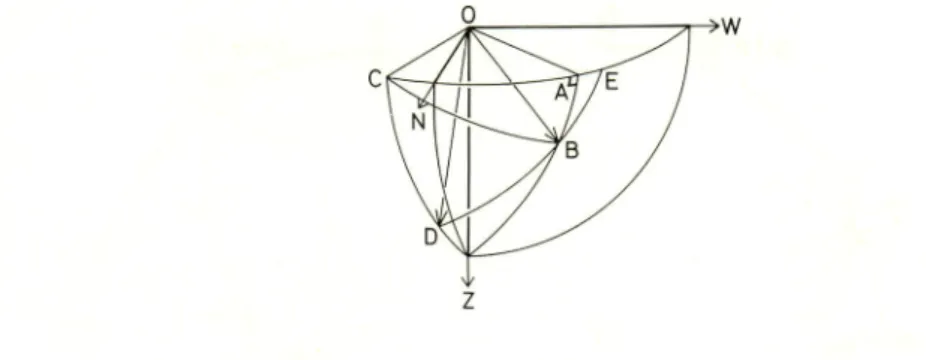
those of the antiparallel direction. As the directions in Table 3 are the values without any correction for folding or tilting of the rock bodies because of the difficulty of determining the bedding poles of igneous bodies, the declination of each site can hardly be regarded as that before tilting of the body. However, the results of the present study do not seem to contradict the hypothesis of anticlockwise rotation of Viti Levu for the following reason : Fig. 4 is a schematic diagram of rotation of a magnetic vector
1(1 Yaskawa et al. : Paleomagnetism of Fiji
>W
Fig. 4. A schematic diagram of directional change of a vector by tilting. OC shows a tilting axis, OD a vector and DB a tilting angle. CN and CD show respectively declination and inclination after tilting. AN and AB show those before tilting respectively. As the angle CAB is 90° and CD equal to CB, cos(CB) = cos(AC),
cos(AB) = cos(CD).
by tilting of its bearer, a rock body. Let ON be the meridian at a sampling site, OD the magnetic vector at present, OB that before tilting. Since the rotation around the horizontal component OC of the vector produces the maximum declination change to the unit angle of inclination change, we can estimate the upper limit of the difference between the declination before tiling (D0) and the present one, assuming the original inclination before tilting (I0).
CB = CD = present inclination (I > I0)
= assumed original inclination (I < I0) AB = assumed original inclination (I > I0)
= present inclination (I < I0)
AC = maximum estimation of deviation angle from declination before tilting
NAB = 90°
cos(AC) = cos(^g»
v ' cos(AB)The maximum deviation angles thus obtained are shown in the right end column of Table 3. The values in the column were calculated under the assumption that the magnetic inclination in Viti Levu had been kept unchanged.
As each value in this column is merely the declination difference between the
rock-magnetization at present and that before tilting at each site, and therefore it is the
angle in absolute value, we cannot determine whether the original magnetic vector before tilting lies in the right-hand side or in the left-hand side of the present vector. However, the fact that almost all the values of | D are larger than MD for younger sites not older than late Miocene, in the upper half of Table 3, clearly shows that the vector of the original magnetization before tilting must also have been in the western hemisphere since late Miocene, suggesting the possibility that anticlockwise rotation of Viti Levu had continued during this period.
Kagoshima Univ. Res. Center S. Pac, Occasional Papers, No. 5. 1985
Acknowledgments
We wish to thank Emeritus Professor S. Nakao for his suggestion of this work. The Ar isotopes were measured at Okayama University of Science through the kind courtesy of Dr. K. Nagao. Mr. H. Nishimura did much of the field work to collect the samples. This work was parly supported by the fund from the Research Center for the South Pacific, Kagoshima University.
References
Cole, W.S., Upper Eocene and Oligocene larger foraminifera from Viti Levu, Fiji, Prof. Pap. U. S. Geol. Surv. 374-A, 1960.
Coleman, P.J., Pers. comm., 1974.
Easton, W.H., Geology of Sawa-i-lau, Nanuya and Verona islands, Fiji, 5. Pac. Pet. NL, rep. (Unpublished), 1973.
Fisher, R.A., Dispersion on a sphere, Proc. Roy. Soc. London, A, 217, 295, 1953. Gill, J.B. and I.McDougall, Biostratigraphic and geological significance of
Mio-Pliocene volcanism in Fiji, Nature, 241, (5386), 176, 1973.
James, A. and D.A. Falvey, Analysis of paleomagnetic data from Viti Levu, Fiji, Bull.
Aust. Soc. Explor. Geophys., 9, 115, 1978.
Malahoff, A., Gravity and magnetic studies of the New Hebrides island arc, New
Hebrides Condominium Geological Survey, Special Rpt. Brit. Oversea Geol. Surv., Pt. Vita, New Hebrides, 67, 1970.
Malahoff, A., S.R.Hammond, J.J. Naughton, D.L. Keeling and R.N. Richmond, Geophysical evidence for post-Miocene rotation of the island of Viti Levu, Fiji, and its relationship to the tectonic development of the North Fiji Basin, Earth
Planet. Sci. Lett., 57, 398, 1982.
McDougall, I., Potassium-argon ages of some rocks from Viti Levu, Fiji, Nature, 198,
(4881), 677, 1963.
Rodda, P., Outline of the geology of Viti Levu, N. Z. Jl Geol. Geophys., 10, 1260,
1967.
Rodda, P., The standard sequence of the Suva Marl revised and completed, Rep. Miner. Resour. Dep. Fiji, 54, (in prep.).
Rodda, P., N.J. Snelling and D.C. Rex, Radiometric age data on rocks from Viti Levu, Fiji, N. Z. Jl Geol. Geophys.,10, (5), 1248,1967.
Rodda, P. and L.W. Kroenke, Fiji : a fragmented arc, In Kroenke, L.W. : Cenozoic tectonic development of the southwest Pacific, UN ESCAP, CCOP/SOPAC
Tech. Bull., 6, 1984.
12 YASKAWA et al. : Paleomagnetism of Fiji
Isotopic ages, magnetostratigraphy and biostratigraphy from the early Pliocene
Suva Marl, Fiji, Bull. Geol. Soc. Am., 96, 529, 1985.
Skiba, W.J., Geological studies in southwest Viti Levu, Mem. Geol. Surv. Fiji, 1, 1964.