Botanical Studies in the Genus Oryza I.
Morphological and Anatomical Investigations of
Glume- and Leaf-Surface with the SUMP and
Histological Method
著者
KATAYAMA Tadao C.
journal or
publication title
Memoirs of the Faculty of Agriculture,
Kagoshima University
volume
7
number
1
page range
89-117
Botanical
Studies
in the
Genus
Oryza
I. Morphological
and Anatomical
Investigations
of Glume- and Leaf-Surface
with the SUMP
and Histological
Method
Tadao C. KATAYAMA
(Laboratory of Crop Science)
The genus Oryza was divided by ROSCHEVICZ (11) into 4 sections, namely, Sativae, Granulatae, Coarctatae and Rhynchoryza. He distinguished 19 species in those four sections on the basis of morphological characteristics, such as surface structure of flowering glumes and shape of spikelets. SASAKI (12) and CHATTERJEE (1) divided the genus Oryza into 13 and 23 species, respectively. TATEOKA (15) revised the classification of the genus from a different viewpoint, removing 0. subtilata from the genus Oryza. As pointed out by KIHARA (5), however, ROSCHEVICZ'S classification still seems to be the most natural and reasonable so that it is mainly adopted by the present writer. On Meyeriana complex, however, the writer follows TATEOKA (15).
Evolutional relationships among Oryza species have been extensively investigated from morphological and cytological standpoints. ROSCHEVICZ (11) considered that the origin of O. sativa, cultivated species, is based not only on O. sativa f. spontanea but also on O. breviligulata, O. gla.berrima, O. minuta and O. officinalis. PORTERES (9), RICHHARIA (10) and others discussed the evolutional relationships among species of the section Sativae, from morphological, geographical, cytological evidences or statistical studies. However, the direct ancestor or its native place could not be exactly determined.
Cytological information has been accumulated since 1909. Chromosome numbers of all species, whose living specimens are available at present have been determined by KUWADA (6), GOTOH et al. (3) and others. GOTOH et al. (3), NANDI (7) and others have cyto-logically investigated some interspecific hybrids, in order to clarify interspecific relation-ships on the basis of genome affinity. Owing to their investigations, interrelationships among the species of Sativae section have become well established, as reviewed by KIHARA (5).
But most of the reporters emphasized on the cultivated species. This is simply due to the fact that no institute has ever had a satisfactory collection of living specimens of Oryza species. The investigations using extensive species and strains would be required to make clear the evolutional relationships among the genus Oryza. It is very fortunate that we have collected, with the aid of The Rockefeller Foundation, a great majority of Oryza species. Using the materials, would be mentioned below, the writer's aim in this investigation was to study on morphology, anatomy, physiology, taxonomy, genetics, evolution and others of the cultivated and the wild species and its variations among them in the hoping get useful informations on phylogenetic differentiation of the genus.
TATEOKA (13 and 14) used the caryopses and leaves of Gramineae, JAQUES-FELIX (4) used the leaves and glumes of Gramineae and CLARKE (2) used the leaves of Gramineae for the taxonomical studies. In this chapter, in order to examine the detail structure of glume and leaf surface, the writer studied the flowering glumes of 22 species and leaves of 20 species belonging to the genus Oryza by the convenient SUMP (SUZUKI's Universal Micro-printing) method and maceration method.
Meterials and Method
Enumeration of the species used, their distribution and chromosome number are given in Table 1. One to six strains were used in each species. Strain number, their origin of the materials used are given in Table 2. Distributing areas of wild species belonging to
Table 1. Enumeration of Oryza species used in the present studies,
their distribution and chromosome numbers
Species Distribution Chromosome
number (2n) Section I. Sativae ROSCHEV. O
. sativa L. O
. sativa var. spontanea ROSCHEV. O . perennis MOENCH O . barthii A. CHEV. O . glaberrima STEUD. O . stapfii ROSCHEV. O
. breviligulata A. CHEV. et ROEHR. O . officinalis WALL. O . australiensis DOMIN O . minuta PRESL O . eichingeri PETER O . latifolia DESV. O . alta SWALLEN O . grandiglumis PROD. O . punctata KOTSCHY
Section II. Granulatae ROSCHEV. O
. meyeriana subsp. granulata TATEOKA O
. meyeriana subsp. meyeriana TATEOKA O
. meyeriana subsp. abromeitiana TATEOKA Section III. Coarctatae ROSCHEV. O
. schlechteri PILGER O . ridleyi HOOK. O . longiglumis JANSEN O
. brachyantha A. CHEV. et ROEHR. O . coarctata ROXB.
Section IV. Rhynchoryza ROSCHEV. O . subulata NEES
Asia, Europe, Africa, America, Australia Asia Asia, America Africa Africa Africa Africa Asia Australia
Asia (only Philippines) Africa America America America Africa Asia Asia Asia
Asia (only New Guinea) Asia
Asia (only New Guinea) Africa
Asia America
Botanical. Studies in the Genus Oryza L
Table 2. Species used in
name, strain number this experiment
and origin of the strains
O. sativa O. sativa var. O . perennis O. O. O. O. barthii glaberrima stapfii breviligulata O. officinalis O. australiensis O. minuta O. eichingeri O. latifolia O. alta O. grandiglumis O. punctata O. meyeriana O.O. O. O. O. O. O. O. spontanea subsp. meyeriana subsp. meyeriana subsp. schlechteri ridleyi longiglumis brachyantha coarctata subulata granulata meyeriana abromeitiana
Kyoto Asahi (Japan), 108 (Formosa), 414 (India), 647 (Celebes), C8448 (New Guinea)
W0106 and W0107 (India), W0157 (Formosa), W0181 (Ceylon), W0562 (Malaya), W1235 (New Guinea) W0108 and W0120 (India), W0612 (Brazil), W0620 (Burma), W1214 (Philippines), W1230 (New Guinea) W0053(Kankan), W1412(Sierra Leone), W1461(Nigeria) W0024 and W0501 (Senegal), C8531 (Sierra Leone), C8581 (Nigeria)
W0651, W0652, W1055 (Africa)
W1410 (Sierra Leone), W1418 (Guinea), W1453 (Ivory Coast)
W0002 (Thailand), W0006 (Ceylon), W0564 (Malaya), W1198 (Philippines), W1301 (Sarawak)
W0008 and W1296 (Australia)
W1212, W1213, W1317, W1337 (Philippines) W1516, W1520, W1527 (Uganda)
W0542 (Mexico), W1168 (Cuba), W1197 (Columbia) W1182 (British Guiana)
W0613 and W1194 (Brazil), W1247 (Manaos) W1058 and W1408 (Nigeria), W1512 (Kenya), W1515 (Tanganyika)
W0003 (India), W0005 (Ceylon), W0067 (Thailand), W1209 (Philippines)
W1265 (North Borneo), W1314 (Philippines) W1206 and W1207 (Philippines)
W1158 (New Guinea)
W0001 (Thailand), W0563 (Malaya), W1279 (Sarawak) W1215, W1218, W1228 (New Guinea)
W0654 and W1401 (Sierra Leone), W1407 (Mali) W0551 (India), W0617 (Burma)
W0510 (Argentina)
the genus Oryza are illustrated in Fig. 163. These informations include the findings of ROS-CHEVICZ (11), CHATTERJEE (1), NEZU et al. (8) and the writer's own observations.
The standard SUMP and maceration method were used and microscopical photographs were taken. Intact flowering glumes and leaves were used for SUMP method, and the striped epidermal cells of flowering glumes and leaves were used for maceration method.
Observations and Discussion 1. Glume surface
i) SUMP method
arrangement is regular. Each cell bears a round tubercle and has a smooth or rough surface. The tubercle gives the impression of a bursting membrane. Hairs occur in most of the species.
Several characteristics in the species level are found. The cells of O. breviligulata and O . latifolia regularly and O. perennis irregularly have dichotomous apex on the tubercles. They are located in apiculus side. The cells of O. barthii have rarely a bursting membrane . Long hairs occurred are conspicuous in O. officinalis. On the contrary , hairs are rarely found in O. latifolia and O. alta. The surface structures of O. minuta and O. eichingeri are generally consisted of cells having narrow and wide width in longitudinal direction.
Section Granulatae ROSCHEV.: The cells are rectangular and have irregular contours. Each cell has a tubercle composed of several tuberclets. In O. meyeriana subsp. meyeriana , the cell has many remarkable tuberclets, which are very small in size and few in number
in other two subspecies. Their tubercl.ets are regularly arranged in two rows on each cell (Fig. 145).
Section Coarctatae RoscHEV.: In general, the cells are slender and without tubercles. They are arranged in long stripes with deep grooves between them. Species belonging to this section show a great variation in structure. O. coarctata has stomata on the glume.
In O. schlechteri, surface is uneven, and then it is impossible to take a good impression covering a wide area. Hair occurs rarely.
In O. ridleyi, hair is very short and stocky and occurs on every other lines. In O. longiglurnis, the cell has two kinds of hair, short and long hairs. Short hair is like that
of O. ridleyi, and long one is of the stomata shape. Both of them occur regularly . In O. brachyantha, also the cell has two kinds of hair and they are in groups. It is conspicuous
in this species that the differences between high (=stripe) and low (=groove) levels are clearly recognized. O. coarctata has remarkable stomata on the glume. It is conspicuous that the species has obscure surface ; in other words, it has uneven surface.
Section Rhynchoryza ROSCHEV.: The cells are polygonal, varying in size and are arranged like the scales of a tortoise shell. They have in the middle a globe-shaped tubercle, from which furrow runs radially. The furrow shows a pattern of rope.
ii) Histological investigation
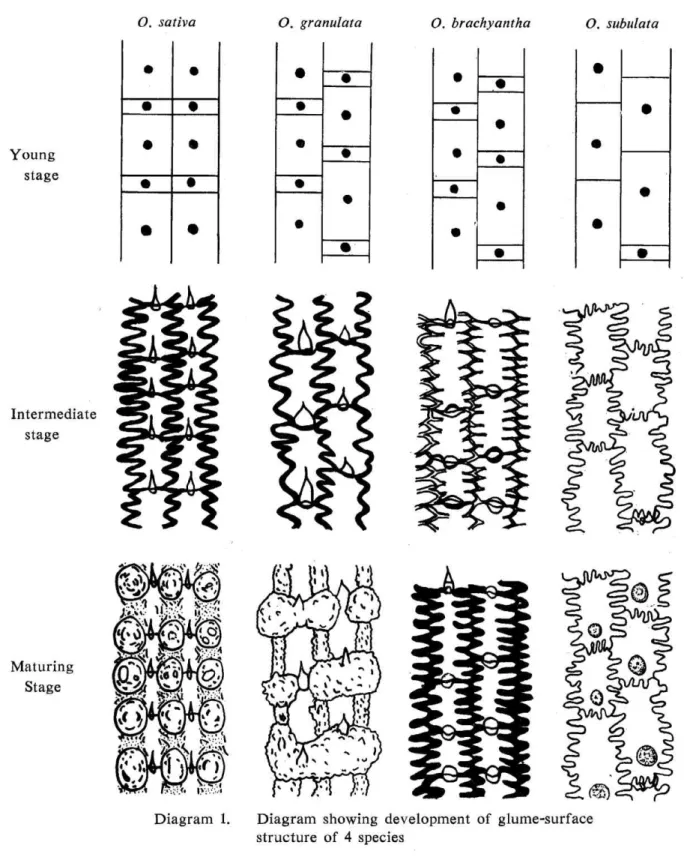
In SUMP method, remarkable characteristics of each species are certified. Because, however, as no obvious difference has been recognized in the species belonging to Sec-tion Sativae, six species representing respective section are selected and histologically investigated in order to elucidate the developmental processes during cell division and mature stage. The distinction between the glume characters of the four sections is very conspicuous. Development of glume-surface-structure of the representative four species are schematically shown in Diagram 1.
The cells of O. subulata (Section Rhynchoryza) are of equal size and are arranged like fish scales, short cells occur seldom except irregularly. In some cases , such short cells develop into hairs. In other three sections (Sections Sativae, Granulatae and Coarctatae), the epidermal cells are arranged more or less in regular longitudinal rows. The cells of species belonging to Section Sativae are arranged also in regular crosswise district, with the result of a checkerboard arrangement. In the case of species belonging to the latter three sections, each cell divides into two kinds of cells at the late developmental stage ;
Botanical Studies in the Genus Oryza I: 93
one is strongly elongated and the other is short and either remains undifferentiated or develops into a hair.
The aspects of cells in the maturing stage of each section are summarized as follows : In Section Sativae, where the short cells and the long cells are immediately adjacent to one another, the tubercles results from uneven thickening at the points of contacts of six cells which consisted of four long and two short cells. The short cells are much reduced in size. In Section Granulatae, with short cells not usually adjacent in arrangement, the tubercles are formed over the area, where two short and two long cells are in contact. They are every so often fused together, forming large warts. In Section Coarctatae, species belonging to this section show a great variation in the structure of epidermal cells. One of the species, O. ridleyi, has not tubercles. Otherwise the epidermal cells are very similar to that of the species belonging to Section Sativae. In Section Rhynchoryza, small cells, which occurred rarely in the epidermal cells, have either a short hair or a pro-trusion. The cells are diagonally arranged. Cell walls between two cells are thin and ap-parently fused, then the dual partition between its cells is not discernible. Each epidermal cell has one tubercle on its surface.
In addition to this observations, several characteristics in detail view point are found as follows. O. sativa: The hair occurs being at right angles to glume surface and its apex is parallel in young stage (Fig. 149). In the middle stage, hair extends in high spirits and occurring at right angles to glume surface (Figs. 147 and 150). The position between the two young hairs in Fig. 149 would become to tubercle as shown in Figs. 147 and 149. Origin of hairs and tubercles are clearly recognized even in the young stage (Fig. 148). Apical tip is transformed into an awn, and other tips forming matured hairs as shown in Fig. 146. Relationships of position and size between awn and hair are clearly confirmed in this figure. O. ridleyi : Surface structure in the matured stage is shown in Fig. 151. Fused
and shrinked cells consist of some unit covering some area and which is to be separated easily one another. O. coarctata: Figs. 152, 153, 154, 155 and 156 show the developmental processes of epidermal cells, in other words, the fusing and shrinking cells during young and matured stage. It is clear that the starts of tubercle and hair development are found in same time, but complete finish of tubercle is earlierly found than that of hair. In matured stage (Fig. 156), the cell arrangement begins to be confused.
2. Leaf surface i) Upper side
a: SUMP method: Twenty species were used in these investigations.
Section Sativae: In O. sativa, O. sativa var. spontanea, O. perennis, O. glaberrima, O. stapfii, O. breviligulata, cell and hair arrangements and their size are quite same ;
exclud-ing very long hair in O. breviligulata is found and flat surface, i. e., small difference between upper most and deep position in O. glaberrima is found. An aster type cell is
characteristic in O. officinalis. A deep groove found is also characteristics in O. minuta. Developmental processes are also almost the same.
Section Granulatae: They have only short hairs. Cell size seems to be uniform in each leaf.
Section Coarctatae: Species belonging to this section show a great variation in cell arrangement. Leaf of O. ridleyi has remarkable many stomata and shows striking high and
low, then it is impossible to take a clear photograph. Leaf of O. brachyantha has tubercles consisting of small tuberclets. Otherwise the cell arrangement is very similar to that of the species belonging to Section Sativae. Leaf of O. coarctata has deep grooves , and its cells rise and fall (=like waves). Each cell has many small knots .
Section Rhynchoryza: Leaf has seldom hairs. Cells show striking high and low , then it is impossible to take a good impression.
b: Maceration method : Because no obvious difference is recongnized in the species belong-ing to Section Sativae, six species representbelong-ing respective section are selected and histo-logically investigated in order to elucidate the detail structures. O. sativa : Cells arrange regularly in longitudinal direction and alternately in cross direction. Cells having hairs in its row are consists of short cells. O. meyeriana subsp. granulata : Cell arrangement is similar to that of O. sativa, except having small cell even in the rows with nothing hairs. O. ridleyi: Stoma is found only in long cell and not in short cell. O. brachyantha: It has only long cells. O. coarctata: Leaf of the species has only long cells and they arrange regularly in longitudinal direction and irregular in cross direction. O. subulata: Leaf of this species has cells showing irregular size and shape, then they arrange irregularly in cross direction. The following two points are conspicuous characteristics of this species . Cell wall shows a little thickening as found in glume-surface-cell. No knot is found in any cell surface. Drum shaped cell is found (Fig. 157), which occupied dual partition of long cell rows. In the longitudinal direction, relative length of long cell and drum shaped cell is in the ratio of one to five.
ii) Lower side
a: SUMP method: Twenty species were used also in these experiment.
Section Sativae: In general, leaves of O. sativa, 0. saliva var. spontanea, O. perennis , O. glaberrima, O. stapfii, O. breviligulata are similar in view point of cell size and cell arrange-ment. Small and large cells are found in groups. Knot is found one per cell. Stoma is found in small-cell-row. Some cell-rows rise and fall (=like waves) . Relationship be-tween small and large hairs is clearly seen in Fig. 158. Aster type cells are recognized in Fig. 159. Aster type stoma is found conspicuous in 0. officinalis. It is noteworthy that many cell-rows rise and fall in O. minuta. Most regular arrangement of stomata is seen in O. eichingeri. Other species of this section, i.e., O. australiensis, O. latifolia, O. alta, O. grandiglumis, O. punctata have no remarkable difference from O . sativa.
Section Granulatae: Cell size is almost same. In O. meyeriana subsp. meyeriana, some cells rise and fall (=like waves). Short hair is found only in O. meyeriana subsp . meyer-iana.
Section Coarctatae: Species belonging to this section show a great variation in stoma and cell arrangement. Numerous stomata are found in O. ridleyi, and moreover the gard cell shows very peculiar thickness in this species. Leaf of O. brachyantha shows many small tubercles. Leaf of O. coarctata conspicuously rise and fall and has many small
knots on each cell.
Section Rhynchoryza: Leaf shows remarkable differences in regarding of depth, size and shape of epidermal cell.
b: Maceration method: Because no obvious difference is discernible in the species belong-ing to Section Sativae, six species representbelong-ing respective section are selected and histo-logically investigated in order to elucidate to detail structures.
O
. sativa: Many drum shape cells are found. Knots are found only on long cells. In most of the long cell, knots are regularly arranged. Short hair occurs only in long cell (Fig. 160).
O
. meyeriana subsp. granulata: On the contrary, long cells are more than short cells in this species. Relationship between the long cells, having knots in one row per cell, the long cells having knots in two rows per cell, is in half-and-half ratio.
O
. ridleyi: In young stage, drum shape cells are numerously found (Fig. 161), but gradu-ally long cells become to increase more than drum shape cells. O. brachyantha : Stoma is very large as in long cell. Long cell has knot in one row per cell. O. coarctata: Epidermis consists of only long cells. It is characteristic of this species that the knots are irregularly arranged on long cell. O
. subulata: The following two points are specific characters of this species : Long cell shows long hexagonal shape. Short cell is located between respective long cells.
Summary
In order to examine the detail structure of flowering glume and leaf surface, the studies were made on the flowering glumes of 22 species and leaves of 20 species belonging to the genus Oryza by the convenient SUMP (SUZUKI's Universal Microprinting) method and maceration method.
1) Glume surface: i : Section Sativae: The cells are square-shaped or rectangular and regularly arranged. Each cell bears a round tubercle and has a smooth surface. The tubercle gives the impression of a bursting membrane. Histologically, the short cells and the long cells are adjacent to one another as the tubercles result from uneven thickening
at the points of contacts of six cells which consisted of four long and two short cells. The cells are much reduced in size. ii : Section Granulatae : The cells are rectangular and have irregular contours. Each cell has a tubercle composed of several tuberclets. Histo-logically, with short cells not usually adjacent in arrangement, the tubercles are formed over the area, where two short and two long cells are in contact. iii : Section Coarctatae : The cells are slender and without tubercles. They are arranged in long stripes with deep grooves between them. Species belonging to this section show a great variation in stru-cture. Histologically, one of the species, O. ridleyi has not tubercle. Otherwise the cells
are very similar to those of the species belonging to Section Sativae. iv : Section Rhyn-choryza: The cells are polygonal, varying in size and are arranged like the scales of a tortoise shell. They have in the middle a globe-shaped tubercle. Histologically, the cells
are of equal size and are arranged like fish scales, and seldom short cells occur.
2) Leaf surface: Specific characteristic of each species found in leaf surface are fewer than that of glume surface. However, the following characters are useful for taxo-nomical keys ; ratio of long and short cells ; shape of cells ; number and arrangement of knots found in each cell ; location, shape, size of stoma ; degree of differences found in high and low from the cell surface (=groove's depth) ; thickening of cell wall ; number and length of hairs.
3) It a good
is concluded that the morphology of flowering glume and leaf could be used as taxonomic characters in the genus Oryza.
1, 2. 3. 4. 5. 6. 7. 8. 9. 10. 11. 12. 13. 14. 15. Literature Cited
CHATTERJEE, D. A. A modified key and enumeration of the species of Oryza LINN. Indian Jour. Agr. Sci. 18: 185-192, 1948.
CLARKE, J. Preparation of leaf epidermis for topographic study. Stain Tech. 35: 35-39, 1960. GOTOH, K. and E. OKURA Cytological and genetical studies of Oryza (in Jap.). Jap. Jour. Genet. 11: 130-131, 1935.
JAQuEs-FELIx, M. Notes sur les Graminees d'Afrique Tropicale. Jour. Agr. Trop. Bot. Appl. 2: 600-619, 1955.
KIHARA, H. Considerations on the origin of cultivated rice. Seiken Ziho 10: 63-83, 1959. KUWADA, Y. A cytological study of Oryza sativa L. Bot. Mag., Tokyo 23 : 334-343, 1909. NANDI, H. K. Interspecific hybridisation in Oryza. Trans. Bose Res. Inst., Calcutta 11:
99-121, 1935-36.
NEZU, M., T. C. KATAYAMA and H. KIHARA Genetic study of the genus Oryza. I. Crossability and chromosomal affinity among 17 species. Seiken Ziho 11: 1-11, 1960.
PORTERES, P. R. Taxonomic agrobotanique des riz cultives 0. sativa LINNE et O. glaberrima STEUDEL. Jour. Agr. Trop. Bot. Appl. 3: 341-384, 541-580, 627-700, 821-856, 1956.
RICHHARIA, R. H. Origins of cultivated rices. Indian Jour. Genet. & Plant Breed. 20 : 1-14, 1960. ROSCHEVICZ, R. J. A contribution to the knowledge of rice (in Russ. with Eng. Sum.). 1931. SASAKI, T. On the distribution of Oryza species (in Jap.). The collection of Papers in Crop Science, Tokyo: 631-750, 1935.
TATEOKA, T. Notes on some grasses. VIII. On leaf structure of Arundinella and Garnotia. Bot. Gaz. 120 : 101-109, 1958.
A biosystematic study of Tridens (Gramineae). Amer. Jour. Bot. 48: 565-573, 1961, Species of the genus Oryza (in Jap.). Natural Science & Museums 29: 1-12, 1962.
Explanation of figures in plates
Figs. 1-52. Glume surface of 22 species of the genus Oryza. Figs. 1-40 ; Impression taken by SUMP method (Figs. 1-22, X 70 ; Figs. 23-40, X 270). Figs. 41-52 ; Histological preparations (Figs. 41-46, X 70 ; Figs. 47-52, X 270).
Figs. 53-144. Leaf surface of 20 species of the genus Oryza. Figs. 53-98 ; Upper side. Figs. 99-144 ; Lower side. Figs. 53-92 and 99-138 ; Impression taken by SUMP method (Figs. 53-72 and 99-118, X 70 ; Figs. 73-92 and 119-138, X 270). Figs. 93-98 and 139-144 ; Histological preparations (X 270).
Figs. 1, 23, 41, 47, 53, 73, 93, 99, 119 and 139, Oryza sativa L. Figs. 2, 24, 54, 74, 100 and 120, O. sativa var. spontanea ROSCHEV. Figs. 3, 25, 55, 75, 101 and 121, 0. perennis MOENCH. Figs. 4 and 26, O. barthii A. CHEV. Figs. 5, 56, 76, 102 and 122, 0. glaberrima STEUD. Figs. 6, 27, 57, 77, 103 and 123, O. stapfii ROSCHEV. Figs. 7, 28, 58, 78, 104 and 124, O. breviligulata A. CHEV. et ROEHR. Figs. 8, 29, 59, 79
105 and 125, O. officinalis WALL. Figs. 9, 60, 80, 106 and 126, O. australiensis DOWN. Figs. 10, 61, 81, 107 and 127, O. minuta PRESL. Figs. 11, 30, 62, 82, 108 and
128, 0. eichingeri PETER. Figs. 12, 31, 63, 83, 109 and 129, 0. latifolia DESV. Figs. 13, 64, 84, 110 and 130, O. alta SWALLEN. Figs. 65, 85, 111 and 131, O. grandiglumis
PROD. Figs. 66, 86, 112 and 132, O. punctata KOTSCHY. Figs. 14, 32, 42, 48, 67, 87, 94, 113, 133 and 140, O. meyeriana subsp. granulata TATEOKA. Figs. 15, 33, 68, 88,
Botanical Studies in the Genus Oryza I. 97
114 and 134, O. meyeriana subsp. meyeriana TATEOKA. Figs. 16 and 34, O. lana subsp. abromeitiana TATEOKA. Figs. 17 and 35, O. schlechteri PILGER. Figs.
18, 36, 43, 49, 69, 89, 95, 115, 135 and 141, O. ridleyi HOOK. Figs. 19 and 37, O. longiglumis JANSEN. Figs. 20, 38, 44, 50, 70, 90, 96, 116, 136 and 142, O. brachyantha A. CHEV. et. ROEHR. Figs. 21, 39, 45, 51, 71, 91, 97, 117, 137 and 143, O. coarctata ROXB. Figs. 22, 40, 46, 52, 72, 92, 98, 118, 138 and 144, O. subulata NEES.
Figs. 145-162. Photographes for the additional observations (Figs. 146, 147 and 158, X 70 and others, X 270). Fig. 145 ; Impression of glume surface taken by SUMP method. Figs. 146-156 ; Histological preparations of glume surface. Fig. 157 ;
logical preparations of leaf surface of upper side. Figs. 158 and 159 ; Impression of leaf surface of lower side taken by SUMP method. Figs. 160-162;
cal preparations of leaf surface of lower side.
Figs. 146, 147, 148, 149, 150 and 160, O. sativa L. Figs. 158 and 159, O. perennis MOENCH.
Fig. 145, O. meyeriana subsp. meyeriana TATEOKA. Figs. 151 and 161, O. ridleyi HOOK. Figs. 152-156 and 162, O. brachyantha A. CHEV. et ROEHR. Fig. 157, O. subulata NEES.
Diagram 1. Diagram structure
showing development of 4 species
Botanical Studies in Genus Oryza I. species Oryzawild the of Distribution 163 Fig.