Analysis of non-equimolar binary gas diffusion
under isobaric condition in molecular
diffusion region
著者
OCHIAI Yuta, KAI Takami, NAKAZATO Tsutomu
journal or
publication title
The Research Reports of the Faculty of
Engineering, Kagoshima University
volume
62
page range
20-20
year
2020
The 32st International Symposium on Chemical Engineering, December 6-8, 2019, Daejeon, Korea
Analysis of non-equimolar binary gas diffusion under isobaric condition in molecular
diffusion region
Yuta Ochiai, Takami Kai, Tsutomu Nakazato
Abstract
In general, it is recognized that binary gas interdiffusion under isobaric conditions is the equimolar diffusion. It is also known that the diffusion coefficient is inversely proportional to the square root of the molecular weight in the Knudsen diffusion region where the pore size is an order of magnitude smaller than the mean free path of molecules. However, even in the molecular diffusion region where the pore size is orders of magnitude greater than the mean free path, non-equimolar diffusion occurs under isobaric conditions. This phenomenon was initially reported by Graham [1] in 1833. At present, the diffusion rate ratio is expressed by Graham's law, but is not widely recognized.
Although many models have been proposed to explain the mechanism of this phenomenon, all of them are based on the equimolar diffusion coefficients, and attribute the cause to the non-equimolar Knudsen diffusion due to collisions between molecules and walls. Therefore, all the models have not clearly explain Graham’s law [2, 3]. Kai [4] proposed a model in which the intrinsic diffusion coefficient for each component was introduced. According to this model, the ratio of the diffusion flux depend on the intrinsic diffusion rate and bulk flow rate caused by the small pressure gradient in the pass. The previous results of many researches under isobaric and isovolumetric systems could be well explained by this model. In this study, the diffusion of hydrogen and argon through a packed bed under isobaric condition was performed using a Wicke-Kallenbach type cell. The upper limit of pore size to cause non-equimolar diffusion was studied.
A diffusion cell was the particle packed bed, and both sides of the cell were connected to the lines in which hydrogen and argon flew separately. The flow rate of the sweep gas was adjusted so that the pressure difference between near both the ends of the diffusion cell became zero. The exit gas composition of each sweep gas was determined by gas chromatography. The carrier gas for gas chromatography was the same gas used as the sweep gas. The average diameter of the glass beads used for the packed bed is 20.7, 63.9, 94.9, 622.3 µm. These values were obtained from the pressure drop using the Kozeny-Carman equation. The temperature of the diffusion cell was kept at 25℃ by circulating water outer surface of the cell.
Fig. 1 shows the measurement results of interdiffusion through a packed bed of particles with an average particle size
of 63.9 µm. The ratio of the apparent diffusion coefficients is considered to be approximately equal to the ratio of the apparent diffusion rates (including movement by viscous flow) of
each component. In this case, the ratio of the apparent diffusion rates of hydrogen and argon was 3.55. Although this value was rather smaller than 4.45: the calculation from Graham's law, it is obvious that the interdiffusion was not equimolar diffusion. Because the rate of movement is higher for hydrogen than argon, the slight pressure distribution would generate in the packed bed, and allowed the flow in a direction opposite to the movement direction of hydrogen. This caused the reduction of the ratio of the diffusion coefficients of hydrogen to argon.
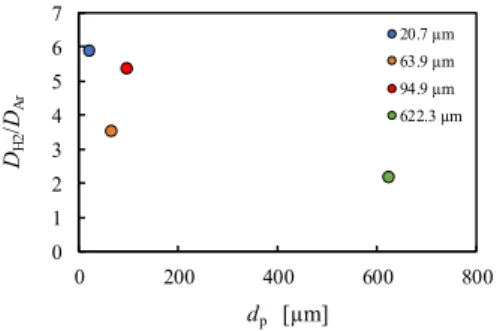
The steady state diffusion was observed for the other particles having different size. Fig. 2 shows the relationship between the particle size and the ratio of the apparent diffusion coefficient of hydrogen to argon. As the particle size increased, the ratio of the diffusion coefficients decreased, and approached unity. This is considered to be due to the fact that the rate of viscous flow is larger for large pores (large size of particles) even when the pressure drop is same. The cause of this is unclear, but it may be caused by a slight pressure difference. However, it is considered that non-equimolar diffusion under isobaric conditions occurs in the large pores such as several hundred micrometers.
References
[1] T. Graham, Phil. Mag. J. Sci., 2, 175–190, 269–276, 351–358 (1833) [2] A. F. Mills, Int. J. Heat Mass Tran., 50, 5087–5098 (2007)
[3] C. Bao, Z. Jiang, X. Zhang, J. Power Sources, 310, 32–40 (2016) [4] T. Kai, Kagaku Kogaku Ronbunshu, 43, 271–280 (2017)
Department of Chemical Engineering, Kagoshima University, Kagoshima 890-0065, Japan
Fig. 1 Temporal change of the ratio of intrinsic
diffusion coefficients of H2 to Ar through the
packed bed with 63.9 µm particles
0 1 2 3 4 5 0 50 100 150 200 DH 2 /D A r Time [min] Run 1 Run 2 Run 3 Run 4 Graham’s law
Fig. 2 Effect of packed particle size on the ratio
of the apparent diffusion coefficients of H2 to Ar
0 1 2 3 4 5 6 7 0 200 400 600 800 DH 2 /DA r dp [µm] 20.7 µm 63.9 µm 94.9 µm 622.3 µm