Semantic parsing with a domain ontology
著者
DUMONT Corentin
学位授与機関
Tohoku University
B5IM2034
Master’s Thesis
Semantic parsing with a domain ontology
領域オントロジーを用いた
セマンティックパージング
Corentin DUMONT
March 24, 2017
Graduate School of Information Sciences Tohoku University
A Master’s Thesis
submitted to System Information Sciences, Graduate School of Information Sciences,
Tohoku University
in partial fulfillment of the requirements for the degree of Master of Information Sciences
Corentin DUMONT Thesis Committee:
Professor Kentaro Inui (Supervisor) Professor Yoshifumi Kitamura
Professor Tetsuo Kinoshita
Semantic parsing with a domain ontology
領域オントロジーを用いた
セマンティックパージング
*Corentin DUMONT
Abstract
Using restricted domains in question answering (QA) allows to build an ontol-ogy of the domain that can be used with by a semantic parser to improve the performance of a QA system. However, building an ontology and a semantic parser can be costly and usually require a large amount of annotated data that may not be available for specific domains. Our work is a case study on how to build a semantic parser and a domain ontology with very low resource for the video game Minecraft.
We show that the creation of a semantic parser and the ontology it is based on can be done with a very low amount of expert manual annotations, facilitated by the use of automatically collected data from the web, and that fairly good per-formance can be obtained. Thus, as a contribution, this case study is a first step in solving the common problem of building a QA system in a restricted domain from very low resource and low manual effort.
Keywords:
Knowledge acquisition, Ontology, Semantic parsing, Question Answering
*Master’s Thesis, System Information Sciences, Graduate School of Information Sciences,
Contents
1 Introduction 1
2 Case study: Minecraft 3
2.1 Minecraft . . . 3
2.2 Why Minecraft? . . . 4
3 Collect data about Minecraft 7 3.1 Knowledge corpus . . . 7
3.2 Question corpus . . . 8
3.2.1 Can the questions be answered by the knowledge corpus? . 11 3.3 Minecraft Ontology . . . 12
3.3.1 Can our meaning representation express enough information? 16 3.4 Dataset . . . 18
3.5 Conclusion on the data collection . . . 20
4 Semantic Parsing 22 4.1 Instance classification . . . 23
4.1.1 Word Embedding . . . 23
4.1.2 Models for Instance Classification . . . 25
4.1.3 Tuning of Hyper-parameters . . . 29
4.1.4 Experimental results for Instance Classification . . . 32
4.1.5 Conclusion on Instance classification . . . 34
4.2 Relation classification . . . 35
4.2.1 Dependency Embedding . . . 35
4.2.2 Models for Relation Classification . . . 37
4.2.3 Tuning of Hyper-parameters . . . 39
4.2.4 Experimental results for Relation Classification . . . 41
4.2.5 Conclusion on Relation classification . . . 44
4.3 Crowd-Sourcing . . . 45
5 Question Answering 47 5.1 Knowledge graphs and question graphs . . . 47
6 Conclusion 51
Acknowledgements 53
Appendix 57
A Question Answering: example of logical reasoning on knowledge
List of Figures
1 Interaction between players and NPCs in current video games . . 1
2 The final goal of our work, a natural language QA system . . . . 2
3 A snapshot of Minecraft . . . 3
4 Entity types and actions in Minecraft . . . 3
5 Text and structured data in the websites used for knowledge ex-traction . . . 7
6 Extraction of Minecraft knowledge from websites . . . 8
7 Instances of the Ontology . . . 12
8 Example of instance: Ore (entity) . . . 13
9 Relations of the Ontology . . . 14
10 Example of relation: Weapon (non-assertion) . . . 15
11 Annotation tool . . . 19
12 Semantic Parsing . . . 22
13 Syntactic tree of the sentence “A block a gold is a type of ore that can be mined with any pickaxe” . . . 23
14 Embedding of the word “ore” . . . 24
15 DCS tree of the phrase “block of gold” . . . 24
16 Formula of the VecDCS embedding vector of a syntactic sub-tree 25 17 Two phrase embedding models . . . 25
18 Distance between ’diamond block’ and ’block of diamond’ . . . . 26
19 Flat SVM model for instance classification . . . 27
20 Improvement: Hierarchical SVM model for instance classification 28 21 Distance threshold tuning for the StringSim model . . . 30
22 Hyper-parameters tuning for the Flat SVM model . . . 30
23 Hyper-parameters tuning for the Hierarchical SVM model . . . . 31
24 Confusion matrix of instance classification with the Flat SVM model 34 25 Embedding of a syntactic dependency unigram . . . 36
26 Embedding of a syntactic path . . . 37
27 SVM model for relation classification . . . 38 28 Improvement: SVM model with constraints for relation classification 39 29 Hyper-parameters tuning for the Relation Classification models . 40
30 Confusion matrices of relation classification using dependency bi-grams features without constraints (left) and with constraints (right) 43
31 Example of crowd-sourcing annotation with CrowdFlower . . . 46
32 Example of yes/no question graph and the corresponding assertion graph . . . 48
33 Example of question-word question graph and the knowledge graph of its answer . . . 49
34 Question graph . . . 57
35 Axiom . . . 57
36 Piece of knowledge . . . 58
List of Tables
1 A summary of the knowledge database . . . 9
2 Example of factoid and non-factoid questions . . . 10
3 Examples of similar questions written . . . 10
4 A fact (the first type) representing a subsumption between entity classes. . . 15
5 A fact (the first type) about causality between events. . . 16
6 Facts (the second type) on properties of single events. . . 16
7 Experimental results for Instance Classification . . . 33
8 Precision and recall for Instance Classification . . . 33
9 Experimental results for Relation Classification . . . 41
10 Precision and recall for Relation Classification . . . 42
11 Impact of the syntactic information quality on Relation Classifi-cation performance . . . 44 12 Relation Classification performance on crowd-sourcing annotations 47
1 Introduction
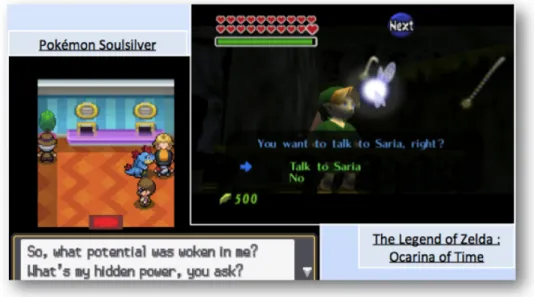
The initial motivation of this work is to improve the interaction between the players and Non-Player Characters (NPCs) in video games. As in Figure 1, in current video games, interaction between the player and the NPCs is very limited in the sense that the player cannot ask his own questions. Indeed, the game will often propose several possible questions or choices to the player, who can only choose among them.
Our final goal is to develop a natural language question answering system that
Figure 1: Interaction between players and NPCs in current video games would make possible a real interaction between the player and the NPCs. Such a system, as shown in Figure 2, would allow the player to ask about anything in English about the content of the game, and make the NPCs able to answer in natural English to any question of the player as long as it is about the content of the game.
Unlike many QA systems that are designed to answer real world questions [1, 2], the final goal of this research is to build a system that can answer questions using the logic specific to the game, which may not be identical to the logic in the real world. For our study, we choose a popular game called Minecraft, whose openness provides a great liberty for players, which guarantees a large number of possible
Figure 2: The final goal of our work, a natural language QA system
questions to ask about the game, and yet the presence of a specific logic that limits the actions of players. We are interested in this problem setting because it provides a testbed for combining Natural Language Processing with advanced logical inference techniques.
Our final system should be able to access knowledge about the content of the game, so we need to collect this knowledge. It should also understand the content of this knowledge and the players’ questions in order to construct a relevant answer, so we need to build a semantic parser that will extract the meaning from English sentences by finding the important instances and the relations that link these instances together. Finally, it has to answer the questions by constructing relevant answers from the knowledge it has about the game using logical inference techniques.
As a whole, our work is a case study on how to build a Semantic Parser (and in the end, a complete Question Answering system) from very low resource in the restricted domain of a video game.
2 Case study: Minecraft
2.1
Minecraft
Figure 3: A snapshot of Minecraft
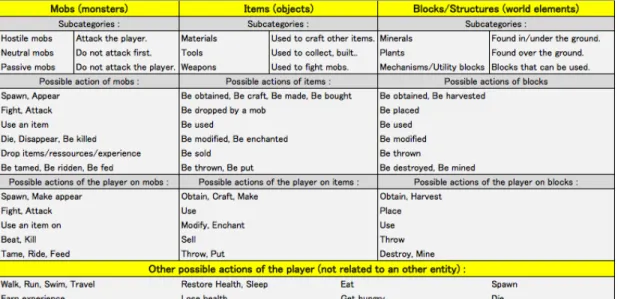
Figure 4: Entity types and actions in Minecraft
Minecraft (Figure 3) is a sandbox video game, which means that the player is free to choose the actions he wants to execute, and the order of these actions. However, as all video games, the number of possible actions is limited. The
main occupation of the player in Minecraft is to survive in a world populated by monsters, by finding resources (e.g. mining minerals, growing plants, etc.), to create structures, items and weapons (i.e. crafting them with the collected resources by following recipes) and beating monsters using crafted weapons and items to protect the created structures and earn experience and new items, in order to continue to develop.
The different entities of the game follow a hierarchy. Entities can be divided into Structures, Mobs (monsters), and Objects, which are divided into Items (for example used to fight) and Blocks (used to build Structures), and so on. The player can interact with these entities, or make independent actions. These actions and interactions are summarized in the Figure 4.
Minecraft players usually ask about: properties of entities,
How many health point does a iron golem have? (100)
relations between entities,
What is a cake composed of? (milk, sugar, egg and wheat)
or conditions and effects of actions.
What pickaxe is needed to break a diamond block? (iron pickaxe or
diamond pickaxe)
How can I get a door? (craft door, find door in village)
The knowledge needed to answer most of Minecraft players’ questions are avail-able on several websites dedicated to Minecraft that are often written by players themselves.
2.2
Why Minecraft?
Why did we choose Minecraft for our case study?
The liberty of the player guarantees a large number of possible questions to ask about the game, but the game follows nonetheless a logic that can be learned by a QA system to increase its ability to understand the meaning of the questions. In other words, Minecraft players are likely to ask non-trivial and difficult ques-tions like:
What is the best way to obtain Obsidian?
To answer this question, we need to know about all the different ways to obtain
obsidian, and we need to compare these methods, which is not possible if we do
not understand them. However, the strict logic that rules the game makes these difficult questions possible to answer by an automatic QA system, contrary to such questions in the real world. For example, thanks to this strict logic, in the following sentences:
The player kills a wolf with a ???.
an automatic system can deduce that ??? can only be replaced with sword,
pick-axe, axe or shovel. This kind of logic can be used to resolve ambiguities.
Our final goal is to build a QA system that can translate a question asked by players to a series of queries about the entities and actions in the game, and find a relevant answer in the knowledge database among all the information about these entities and actions, possibly by combining several pieces of knowledge together to answer difficult questions.
Since Minecraft is a popular game, we expect that we can find abundant data from the Web. Furthermore, Minecraft has been the domain for other works on artificial intelligence [3, 4], and not only in natural language processing (NLP). So choosing Minecraft as a domain can make our work more valuable and have a better impact.
There have been many efforts done to restrict the domain of the QA task and pur-sue some advanced reasoning. The Todai Robot Project [5] restricts the domain to university entrance exam questions. Other research includes solving algebra word problems [6] and instructing robots [7]. As a complement to these previ-ous works, we believe the using of an open world video game as the domain has several merits. Firstly, the logic in a video game is simpler than the real world, which means that it can be handled readily. Therefore, this domain may pro-vide a convenient testbed for integrating logical inference techniques into NLP systems, such as the logical inference using dependency-based compositional se-mantics [8]. Secondly, despite the rather simple rules, open world video games provide enough liberty for players, and their popularity attracts people to ask many questions about them, including creative and fun questions that can be
solved only by completely understanding the rules and logically combining them. Therefore, we expect the domain to be interesting and challenging as well.
3 Collect data about Minecraft
3.1
Knowledge corpus
A knowledge database is extracted from three different wiki-like websites1. These
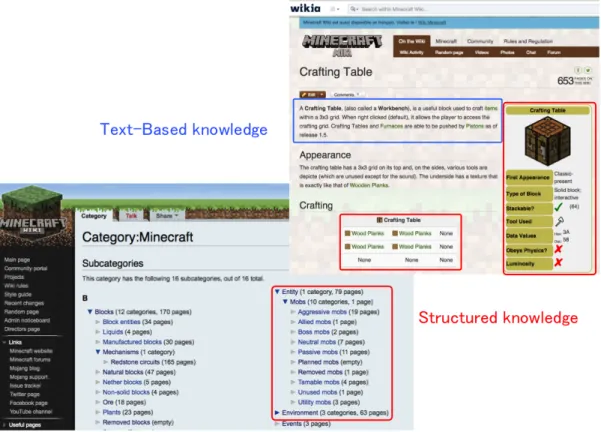
websites are constituted of pages describing an entity or a concept of the game. Similar to those from Wikipedia, the web-pages can be divided into two parts, namely the structured data such as infoboxes, tables, or web-pages hierarchy, and unstructured data such as natural language texts (Figure 5).
Figure 5: Text and structured data in the websites used for knowledge extraction We preserve the structures of infoboxes and tables in our extraction, and sep-arate structured and unstructured data. As a result, we obtain a database
com-1www.minecraft.gamepedia.com
www.minecraft.wikia.com www.minecraftguides.org
posed of 1063 unique text files, organized in 51 folders and sub-folders to regroup related objects (see Table 1 for details).
To improve the quality of the extracted data, we defined extracting rules for each of the 3 websites. The main purpose of these rules is to extract separately structured and unstructured data, to remove useless information and to avoid extracting segments of sentences that loose their meaning out of context (see Figure 6)
Figure 6: Extraction of Minecraft knowledge from websites
3.2
Question corpus
A corpus of questions and answers has been created on the basis of posts extracted from quiz websites2. 754 questions have been collected from different websites,
and 544 of them have been extracted with their answer.
Then, we manually selected 100 relevant questions. For our purpose, it is impor-tant that the questions deal with facts inside the game, and not facts that are outside the game (e.g. questions about the creator of the game, the programming language used, etc.).
2www.quizlet.com
www.allthetests.com www.gamefaqs.com
F olders Num b er of Files Description Blo cks 154 En vironmen t’s blo cks DB-Gamep edia En tit y 72 Mobs (Monsters) (from minecraft.gamep edia.com) Items 161 Ob jects used b y the pla yer Others 183 Gamepla y, History , etc. T otal: 530 files Blo cks 200 DB-Wikia Items 167 (from minecraft.wikia.com) Main 23 Imp ortan t ob jects/en tities Mobs 56 T otal: 392 files Blo cks 101 Minerals, Plan ts, etc. Brewing 34 Recip es of p otions Building 7 F arming 7 DB-Guides Items 77 F o o d, T o ols, W eap ons, etc. (from minecraftguides.org) Main 10 Summaries of sub-folders Mini-Games 25 Mobs 27 T utorials 30 T otal: 300 files T otal: 1063 unique files (1222 extracted files) T able 1: A summary of the kno wledge database
Factoid questions:
What Item should I use to tame a Wolf? Are Spiders Hostile?
Non-factoid questions:
What is the best way to spawn the two different types of Golem?
Is it interesting to kill the Ender Dragon?
Table 2: Example of factoid and non-factoid questions
We selected both factoid and non-factoid questions (see Table 2), and tried to include as much language variety (vocabulary and grammar) as possible in the reference to the concepts of the game. For each selected question, we wrote about nine questions with the same meaning but asked differently, or with a close or related meaning (Table 3).
0 Where do you find a Mushroom?
1 How do you obtain a Mushroom?
2 How do I get a Mushroom?
3 Where can I get a Mushroom?
4 Where can I obtain a Mushroom?
5 What is a way to get a Mushroom?
6 How to get Mushrooms?
7 Where do I find Mushrooms?
8 Where are Mushrooms located?
9 Where can Mushrooms be found?
Table 3: Examples of similar questions written
This way, we obtained a corpus that can be used for handling language vari-ations in the QA task. We finally obtained a corpus of 1684 questions, among which 928 has been written on the basis of 100 relevant questions.
3.2.1 Can the questions be answered by the knowledge corpus?
From the questions that have been extracted from quizzes websites, we can dis-tinguish 3 types of questions. Some questions are not relevant, because they deal with some facts external to the game itself, or because they contain a mistake:
What is the name of the famous yellow duck who plays Minecraft on YouTube? (YouTube is external to the game.)
What are the 5 types of wood? (There are actually 6 types of wood.)
Some questions can be “easily” answered with the knowledge database. This is the case when the answer is clearly written in the database (for example a numeric value in a table). The questions that can be “easily” answered are often factoid questions:
How many hearts does a Giant have? (The answer, 50 hearts, is
written in the infobox of the Giant.)
This kind of question can be answered simply by locating the place where the answer is written in the database. However, some questions can be answered only by computing the answer using crossed information. This is the case of non-factoid questions, which can be considered as “difficult” to answer:
What is the best strategy for finding diamonds? (To answer this
ques-tion, the system has to find all the different ways to find diamonds and evaluate the efficiency of each method. This evaluation is chal-lenging because the criteria for a good strategy are not stated in the question.)
In our data, the relevant questions are rare (about 2%), whereas the non-factoid questions are quite common (about 20%), which provides a good motiva-tion for a QA system to handle complicated quesmotiva-tions.
However, answering non-factoid questions implies reasoning, i.e. logic inference on different pieces of information contained in the knowledge database, which can only be done on a structured database. This is why we defined the ontology of a meaning representation, which is used to structure the natural sentences of the database to their logical form. The challenge is to balance the complexity
of the meaning representation, as it must be simple to take advantage of the simple logic of the game, but must be expressive enough so that it can be used to structure all the useful information.
3.3 Minecraft Ontology
Our ontology defines two types of classes to represent the instances in Minecraft and the relations that links these instances together.
The Instance classes regroup Minecraft Entities and Events (Figure 7).
Figure 7: Instances of the Ontology
Entity classes include all Structures, Objects (e.g. Blocks, Items, etc.) and Mobs that the player can interact with. The ontology defines the list of 496 Entities and their hierarchy (e.g. the Minecraft Entity “Stone” is a subclass of “Natural Block”). The list of entities and their hierarchy is constructed by checking named entities appeared in our QA corpus and using the hierarchy of web-pages of the Gamepedia website. This list is supposed to have high coverage. We have regrouped some concepts that are usually used by players as different ones but are actually the same objects in the game. For example, both “chicken” and “chick” are represented by the same Minecraft Entity class Chicken, and are considered as two variations of this class. The regrouping is done because these
entities have similar interactions with the player and other entities, and has been mainly done automatically by using the infoboxes of the Gamepedia website that lists the possible variations of entities.
Event classes are used to represent events or actions in the game. We make the list of Event classes by considering possible operations by the player and checking questions asked in our QA corpus. We tried to minimize the number of Event classes by regrouping some events that can be expressed as the same actions linked to different Minecraft Entities. For example, both the actions sleep and eat are regrouped into the event use, because “sleeping” and “eating” are equivalent to “using” the Minecraft Entities bed and food, respectively. There is currently no hierarchy between event classes, except a common root EVENT class, but the fact that entities and events are regrouped under instance classes and used simi-larly by our classification models would make very easy to add an event hierarchy in the ontology.
Besides the hierarchy, each instance class is further defined in the ontology (ex-ample in Figure 8).
Figure 8: Example of instance: Ore (entity)
The Relation classes represent a link between two instances. The ontology defines the list of 54 relation classes and the constraints that define what instances classes can be linked using each relation class. Relation classes are divided in
assertion relations (or factual relations, we will use “_” at the beginning of the name) and non-assertion relations (see Figure 9). While assertion relations are used to express a piece of information (e.g. property of an instance, or causality link between to events), non-assertion relations are used to express the semantic link between two instances that appear in the same piece of information (e.g. in the sentence “The player can kill a wolf with a golden sword”, the “golden sword” is the weapon used to “kill”, so the event “kill” is linked to the entity “golden sword” by the relation “weapon”.)
Figure 9: Relations of the Ontology
Each relation class is further defined in the ontology (example in Figure 10). We can use a Davidsonian style representation to write knowledge with our ontology. Instances are then associated to a variable name (e for events, x for entities) and Relations are represented by predicates on these variables. For example, an entity x1 dropping an item x2 is represented as
drop(e), dropper(e, x1), dropped(e, x2).
A piece of information can be asserted by a assertion relation of our ontology, but the existence of a set of instances linked by non-assertion relation in the knowledge database also represents a piece of information. In other words, there
Figure 10: Example of relation: Weapon (non-assertion)
are two types of facts. The first type regards the relation between two instances (entities or events), such as a comparison, a subsumption, or a causal relation (effect or condition), expressed by an assertion relation (Figure 4 or Figure 5). The second type describes a single Minecraft Instance in the game by linking it with other instances through non-assertion relations and express for example the properties of an entity or the probability of an event to occur (Figure 6).
Gold is a type of ore. gold(x1), ore(x2)
_type_of (x1, x2)
Table 4: A fact (the first type) representing a subsumption between entity classes. As an example of possible logical inference, the following piece of information is written in our knowledge database:
If a chicken dies while on fire, it will drop cooked chicken.
Then, assuming the system has the following common sense knowledge (axiom):
If an item is dropped, the player gets it.
we can deduce the following:
If a chicken is killed by fire, the player gets cooked chicken.
A system equipped with logical inference ability can thus answer a question such as:
If a chicken dies while on fire, it drops cooked chicken instead of raw chicken.
chicken(x1), kill(e1), f ire(x2), drop(e2),
cooked_chicken(x3), raw_chicken(x4),
killed(e1, x1), weapon(e1, x2),
dropper(e2, x1), dropped(e2, x3),
_ef f ect(e1, e2)
Table 5: A fact (the first type) about causality between events.
Stone can be mined with a pickaxe. stone(x1), mine(e1), pickaxe(x2)
mined(e1, x1), tool(e1, x2)
Bats usually spawn in caves. bat(x1), spawn(e1), cavern(x2),
spawned(e1, x1), in_environment(e1, x2),
Table 6: Facts (the second type) on properties of single events.
How to obtain cooked chicken?
by the inference process described above and responds:
You should kill a chicken with fire.
3.3.1 Can our meaning representation express enough information?
A question will be answerable if the answer is present in the knowledge database (the question is theoretically answerable), and if all the pieces of information that are needed to answer can be represented with our meaning representation. We expect the contents extracted from the 3 complete websites to have a high coverage, so most of the relevant questions are theoretically answerable. The
quality of our QA system will then directly depend on the quantity of relevant pieces of information (that can be used to answer players’ questions) that can be represented with the meaning representation that we defined.
We manually answered 10 questions of our training corpus by locating all the related pieces of information (35 different pieces of information in the database were relevant to answer the questions), and by evaluating the difficulty to answer them using our meaning representation. The preliminary analysis of the results allows us to draw some conclusions.
Firstly, all the pieces of information that are related to a question are not neces-sary to construct a satisfying answer. In our annotations, only 40% of the pieces of information were necessary. The main reason for that is that most of these pieces of information bring details that are not compulsory to construct a relevant answer.
Secondly, in its entirety, the knowledge database is not highly redundant (we have chosen websites with complementary information). In our annotations, more than 60% of the pieces of information were written only once. However, if we only consider the pieces of information that were absolutely necessary to construct rel-evant answers, about 70% of them were redundant and sometimes appeared in both text and tables (already structured data), what should be an advantage in the structuring process of the knowledge database. Nonetheless, we will have to care about the recall of the translation process not to loose essential information. Thirdly, for 30% of the annotated questions, information contained in natural sentences and information contained in tables had to be combined in order to construct a relevant answer. So the final QA system will have to be able to com-bine different types of information together. This may be part of future works, as our study focuses on structuring textual information through semantic parsing. Fourthly, the meaning representation can only represent the information in a single sentence, and even by solving the co-reference problem with the Stanford core NLP tool, we sometimes loose or misunderstand important information by removing the context of the sentence. In particular there is a risk to generalize some facts that are only true in a specific context that is not specified in the sentence. As the pages of the websites we used for the knowledge database are
divided into sections, we believe that this problem can be at least partially solved by using the names of these sections to solve some further co-references and lacks of context. This problem may also be part of future works.
Eventually, 30% of the annotated questions were not answerable with the knowl-edge database alone because some pieces of information, necessary for the infer-ence process that lead to an answer, were not written in the database. These pieces of information are axioms that are obvious for human readers but that have to be taught to the QA system. For example, the question
How do I obtain an Enchantment Table?
can not be answered with the knowledge database, unless the QA system is told that:
When the player craft an object, the object is obtained by the player.
Indeed, if the crafting recipe of the Enchantment Table is written in the database, it is not explicitly written that the player will obtain this object by following this recipe. These axioms will probably have to be taught manually, but fortunately, the simple logic of Minecraft should restrict a lot the number of such axioms to about 10 axioms.
3.4
Dataset
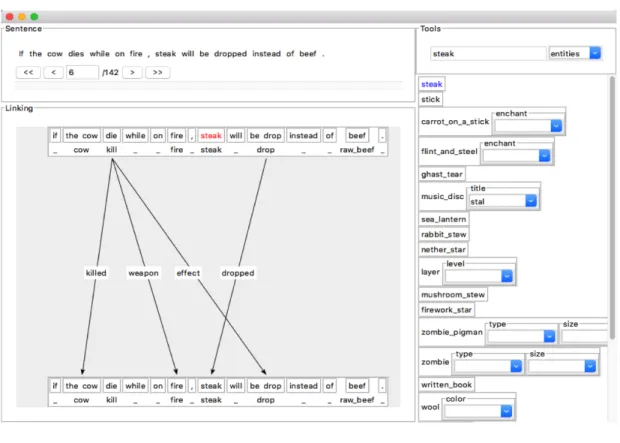
Finally, to finish with the collection of data about Minecraft, a semantic parser for Minecraft has to be trained to recognize instances and relations in sentences. So we built a training dataset by annotating instances and relations in sentences about Minecraft (sentences from the text of the knowledge corpus we extracted). For example, when annotating the sentence:
If the cow dies while on fire, steak will be dropped instead of beef.
we annotate the instances by putting the labels cow, kill, fire, steak, drop, raw_beef (which are instances of our ontology) on the groups of words that stand for these instances in the sentence. Then, for each pair of instances that are related by a relation of our ontology, we put a label corresponding to the relation, for example
and drop.
We can represent these annotations with a Davidsonian style: instance annotations:
cow(x1), kill(e1), f ire(x2), steak(x3), drop(e2), raw_beef (x4)
relation annotations (non-assertions):
killed(e1, x1), weapon(e1, x2), dropped(e2, x3).
relation annotations (assertions):
_ef f ect(e1, e2).
To do this annotation easily, we developed a specific annotation tool that in-tegrates the ontology (see Figure 11). s it contains the ontology, this tool can
Figure 11: Annotation tool
process and to ensure that the annotation respects the ontology constraints. Using this tool, we manually annotated 301 samples of instances (142 positive examples and 159 negative examples) and 485 samples of relations (266 positive examples and 219 negative examples).
Furthermore, we also created 6471 automatic samples of instances (positive exam-ples only) from the anchors contained in the extracted knowledge corpus. Indeed, such as Wikipedia, the 3 websites we extracted knowledge from contain a lot of hyperlinks that lead to an other page of the same website, called anchors. These anchors then link a fragment of text to the title of an other page. If the title of the page pointed by a hyperlink can be identify as the name of an instance class in the ontology, the fragment of text that holds the hyperlink becomes a positive example for this instance class, and can be added to the training dataset.
3.5
Conclusion on the data collection
In this section, we first have described a knowledge database and a question an-swering corpus related to the video game Minecraft. We have shown that even for low resource domains, data can be extracted from the web, by designing adapted extracting rules.
We saw that the extracted structured data can be used to make the definition of an ontology easier.
And we saw that the textual data can be used to create a training dataset for a semantic parser, and that this training dataset can be completed automatically with instances samples by using websites anchors. We will show in the following section on semantic parsing that we can also use textual data to train embedding models that we will use to improve the performance of the semantic parser.
Our final goal is to use the collected data to build a system that can answer questions using the logic specific to the game. A lot of research has been done on the answering of real world questions using Freebase [1, 2] or Wikipedia [9]. Datasets for these tasks usually favour systems that do simple queries of facts on the knowledge database [2]. As the complexity of the questions increases, answering the questions usually becomes considerably difficult [9], due to the vast complexity of the real world. Our purpose is to show that in restricted
domains with a strict logic, such as video games, even difficult questions can be addressed, and this by using only a very limited quantity of annotated resource. This will be the point of the following sections.
4 Semantic Parsing
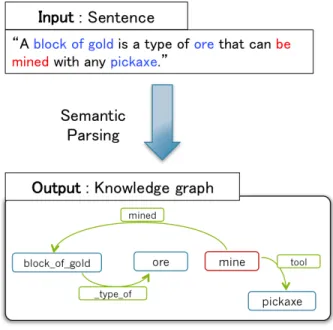
In the context of our study, semantic parsing is a process that take a sentence as input and outputs a knowledge graph that represents the meaning of the sentence (see Figure 12).
Figure 12: Semantic Parsing
The knowledge graph is composed of instances (the nodes) and relations (the edges) that belong to the ontology that we defined previously.
The knowledge graph is constructed in two steps, the instance classification that generates the nodes (in red and blue), and the relation classification that generates the edges (in green).
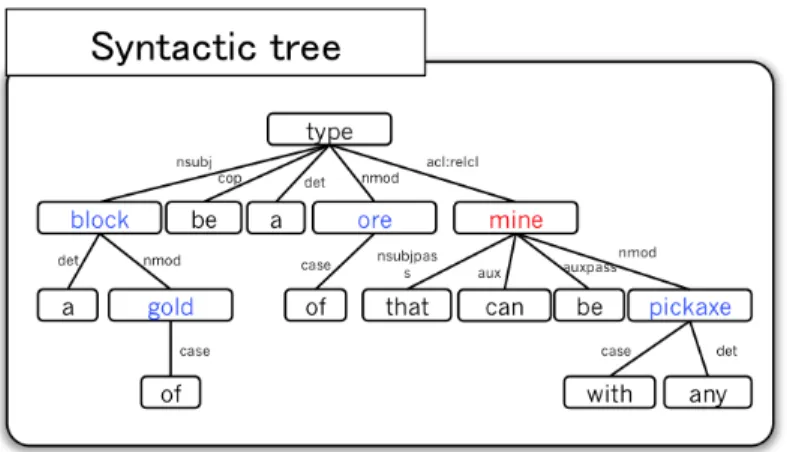
There is an other process called syntactic parsing that, like semantic parsing, generates an output graph (the syntactic tree, see Figure 13) from an input sentence, but, contrary to semantic parsing, this graph does not represent the meaning of the sentence but its syntax. Nodes are the words of the sentence, and edges are the syntactic dependencies between these words.
We can notice a similarity between the knowledge graph and the syntactic tree. Thus, our idea was to use the information contained in the syntactic tree as a base for the semantic parsing. In particular, using the words (nodes of the syntactic
Figure 13: Syntactic tree of the sentence “A block a gold is a type of ore that can be mined with any pickaxe”
tree) in the instance classification step, and the syntactic dependencies (edges of the syntactic tree) in relation classification step.
The syntactic parsing process does not depend on a domain ontology; it has been largely studied in the past and performing syntactic parsers have been released by NLP researchers [10, 11]. So we can easily apply existing syntactic parsers to our work, and use syntactic trees in our semantic parsing.
4.1
Instance classification
Instance classification is the classification of a phrase (a group of words) into an instance class from the ontology. So we need to extract features to classify from phrases. Word embedding has been shown to produce non-sparse and effective features to represent the meaning of words [12].
4.1.1 Word Embedding
Therefore, we trained a word embedding model using as a training corpus the knowledge corpus extracted before, which is a corpus of words sequences specific to Minecraft, with the skip-gram model of the Word2Vec library [13]. We obtain a model that produce similar vectors for words with a similar meaning in the context of Minecraft.
Figure 14: Embedding of the word “ore”
calculated as the average vector of the embedding representation of all words in the phrase.
The challenging point is to create, from a word embedding model, a model that embed correctly the meaning of a phrase. Our Word2Vec based phrase embed-ding model does not include the different importance of the words in natural language (e.g. in “a baby villager”, the word “villager” is more important to catch the meaning of the instance described than the word “baby”). This differ-ence between the importances of each word in a phrase is visible in the syntactic tree that represents this phrase. The most important word is the root of the tree, which is specified by its children nodes, and deepest nodes have least importance. In other words, it could be interesting to include, in the embedding of a phrase, the syntactic pattern followed by the words, which is a quite difficult task [14]. However, more specifically, we can keep an information on the syntactic relations between the words by using the VecDCS library [15]. In this method, the embed-ding representation of a phrase is calculated using the DCS tree representation of the phrase that can be obtained from the syntactic tree (Figure 15).
Figure 15: DCS tree of the phrase “block of gold”
And the VecDCS embedding of the phrase can be calculated from the individual embedding vectors of the different nodes of the DCS tree by the formula given in Figure 16.
Therefore, we also trained a VecDCS model for Minecraft, using the extracted knowledge corpus. We dispose of two different phrase embedding models that
Figure 16: Formula of the VecDCS embedding vector of a syntactic sub-tree
can be use to produce features for instance classification (Word2Vec model and VecDCS model).
Figure 17: Two phrase embedding models
Our experiment in instance classification will, then, also be a way to study the performance of each embedding model (the VecDCS model being expected to produce more effective features).
4.1.2 Models for Instance Classification
We defined two baseline models for the instance classification step. The first one uses a string similarity method (we refer to it as StringSim). It does not use embedding models to classify words. We just compare the words of the phrase to classify with the names of every instance classes in the ontology, and chose the closest instance class as the prediction for the phrase. To calculate the string
similarity between two phrases (the name of an instance class of the ontology is also a phrase/group of words), we use a combination of the Levenshtein distance and the Hungarian algorithm (an alignment algorithm) to align words.
In details (see Figure 18), we create a matrix with as many rows as there are words in the first phrase and as many columns as there are words in the second phrase. We add an additional row and an additional column that correspond to the empty word (so that we can align a word on the empty word and have a different number of words in the two groups). Then we fill the cells of the matrix with the Levenshtein distance between words of the two phrases. Finally, we use a variation of the Hungarian algorithm to find the alignment of words that minimize the sum of the distances. The variation allows aligning any number of words (include no word) on the empty word. The result of this Hungarian algorithm on the constructed matrix is the distance between the two phrases (see Figure 18). If all words are aligned on the empty word (the cost of creating a word is smaller than the transformation of a word of the other group to this word), then there is no similarity between the two phrases and the distance in set to infinite.
Figure 18: Distance between ’diamond block’ and ’block of diamond’
Note that even if the distance is infinite for distant phrases, we can fix a finite upper limit on the acceptable distance between a phrase to classify and the names of classes. Over this limit, or threshold, even if a class name is the closest to the
phrase among all classes, the phrase will not be classified with this class. This threshold is the only parameter of the StringSim model.
The second baseline, Flat SVM model (Figure 19), uses the simple Word2Vec embedding model to extract features from a phrase, and we classify the features with a multi-class RBF kernel SVM classifier that outputs one of the 508 instance classes of the ontology, or null if the group of words does not represent an instance.
Figure 19: Flat SVM model for instance classification
This model uses a C-SVC RBF kernel SVM (support vector machine) classifier implemented in the LIBSVM library [16] (this is also the library that we used for the other models using SVM classifiers in this work). This classifier is defined by two parameters called c (for cost) and gamma (that defines the kernel function of the classifier). Hence, the training of the Flat SVM model depends on the these two hyper-parameters c and gamma.
During the training, for each class, we use positive and negative training samples. The positive samples of a class are the positive examples of the training dataset for this class and the negative samples of a class are the negative examples (not an instance) of the training dataset and the positive examples of the other classes. Then, we defined an improved model called Hierarchical SVM model (Fig-ure 20). This is an improvement of the Flat SVM model in which we integrate the ontology’s hierarchy of instances. We still use a phrase embedding model to extract features from phrases. But we do not classify the features with one multi-class SVM classifier. We classify features recursively, following the ontol-ogy’s hierarchy, using one binary RBF kernel SVM classifier for each instance class. To classify a phrase, we check at first if it belongs or not to the ENTITY class and to the EVENT class, which are the two roots of the instances hierarchy, using their respective binary classifiers. If and only if it is predicted as belonging
to a class, we check the belonging to the children classes (object, version, etc.) and continue recursively. If the phrase doesn’t belong to any children class, the recursion ends and the phrase is classified as the last predicted class. Note that we can obtain several predictions using this process. However, we can rank the several predictions by outputting the probabilities for each binary classifier’s pre-diction. The probability of a prediction is defined as the geometric mean of the probabilities output by each binary classifier in the recursion. For example, in Figure 20, the probability of the prediction as pickaxe is:
P (Entity_336_pickaxe) =
(P (EN T IT Y )∗ P (object) ∗ P (item) ∗ P (tool) ∗ P (pickaxe))1/5
Figure 20: Improvement: Hierarchical SVM model for instance classification As for the Flat SVM model, this model uses C-SVC RBF kernel SVM classifiers, so the training depends on two hyper-parameters c and gamma. Furthermore, as we output the probabilities of binary classifiers’ predictions, we can define a threshold on the probability to decide if yes or no a phrase belong to a class. We can define a local threshold (we will refer to it as threshold) that must be respected by the binary classifiers’ predictions at each step of the recursive
prediction, and a global threshold that must be respected by the geometric mean of all probabilities on the whole prediction (we call it cumulative threshold, and will refer to it as cumul for short). Then the training of the Hierarchical SVM model depends on 4 hyper-parameters: c, gamma, threshold and cumul.
During the training, for each class, we use positive and negative training samples. The positive samples of a class are the positive examples of the training dataset for this class and for all the descendent classes in the ontology’s hierarchy. The negative samples of a class are only the positive examples of the sibling classes and the direct parent classes, except for the roots of the hierarchy (ENITITY_0 and EVENT_0) for which the negative samples are the negative examples (not an instance) of the training dataset.
4.1.3 Tuning of Hyper-parameters
We tuned the hyper-parameters for each model by comparing their performance in terms of F1-score (micro and macro values) on the training dataset for different values of the hyper-parameters and by choosing the values that lead to the best performance. While the StringSim model’s performance is measured using the whole dataset for testing, the other models have to be trained, so we measured their performance through a 2-1 cross-validation (2/3 training and 1/3 testing).
The results of the tuning for the StringSim model (Figure 21) shows that the distance threshold, when set to a small value (strict similarity), can be useful to increase the precision of the classification (ensure that the predictions are correct). However, small values of the threshold decrease the recall of the classification, because it penalizes the frequent classes that have a high lexical diversity. The values of threshold = 1 (strict similarity) and threshold = 4 (soft similarity) for the threshold have been kept for this baseline to do a comparison between the several instance classification models.
For the Flat SVM model, we tuned c and gamma together by comparing the performance of the model for different couples (c, gamma) (Figure 22).
We kept the values (c = 10000, gamma = 0.1) to optimize the performance. For the Hierarchical SVM model, we made the assumption that we can tune c,
Figure 21: Distance threshold tuning for the StringSim model
Figure 22: Hyper-parameters tuning for the Flat SVM model
same part of the model3 and it is far easier to tune couples of hyper-parameters
than tuples of 4 hyper-parameters. Then we tuned c and gamma first for de-fault values of (threshold = 0.5, cumul = 0.5), and tuned threshold and cumul afterwards with the best values for c and gamma (Figure 23).
From the results of the tuning for the Hierachical SVM model, we first chose
3The validity of this assumption is not evaluated in this study and should be part of future
Figure 23: Hyper-parameters tuning for the Hierarchical SVM model
(c = 10, gamma = 1) to optimize the micro F1-score (the performance on fre-quent classes of the ontology). We can notice that these values are not optimal in term of macro F1-score (performance giving importance to rare classes), but the loss on macro F1-score when optimizing micro F1-score is lower than the loss on the micro F1-score in the case where we optimize the macro F1-score. Furthermore, the value that is usually used for gamma is the inverse of the num-ber of features used in the classification. As we use only one feature, which is the normalized embedding vector of a phrase, this value of gamma = 1 was ex-pected to be optimal a priori. Then we tune the threshold and the cumul for (c = 10, gamma = 1). The couple (threshold = 0.75, cumul = 0.9) gives the best performance for micro-F1-score and one of the best macro F1-score. Note that the tuning is not done in the region threshold > cumul, because in this case, by def-inition of the cumulative threshold, any prediction that respects the local
thresh-old at each step must necessarily respects the cumulative threshthresh-old, so cumul is not a relevant hyper-parameter anymore. The diagonal threshold = cumul then gives the result of the tuning for the threshold hyper-parameter alone. On the contrary, when threshold < cumul, a phrase can be classified as an instance class even if the prediction from a binary classifier was low at some step of the recursion as long as the whole probability is high. Finally, we kept the values (c = 10, gamma = 1, threshold = 0.75, cumul = 0.9). These values will be used for the Hierarchical SVM model independently of the phrase embedding model used to produce the features to classify, which is an other strong assumption that would need to be verified in future works.
4.1.4 Experimental results for Instance Classification
We used the training dataset built before to train models (except StringSim that does not require training), and to test them through a 2-1 cross-validation. We calculated the micro F1-score and the macro F1-score for each model. Results are presented in Table 7. The micro F1-score can be considered as the performance of the model on frequent classes and the macro F1-score gives the same importance to frequent and rare classes, so the difference between micro and macro F1-scores gives an idea of the difference of performance between frequent and rare classes. By comparing the two baselines (StringSim and Flat SVM model), we can see that the Flat SVM model, that uses embedding features is more performing on frequent classes, because frequent classes have more lexical diversity, and then classifying the meaning of words is better than classifying the surface of words. However, the Flat model uses only one SVM classifier for more than 500 classes, and as a result, rare classes are not correctly learnt even if this model has the best macro precision. This can be seen through its very low recall in Table 8, or by looking at the confusion matrix of the classification in Figure 24.
But if we compare the Flat SVM model with the Hierachical SVM model when using the Word2Vec phrase embedding model, we can see that we make a large improvement on rare classes by using the hierarchy of instances, as the gap be-tween micro and macro F1-score largely decreases. Still, it is not sufficient to
Model Micro F1 Macro F1 strict StringSim 0.423 0.810 (threshold = 1) soft StringSim 0.574 0.765 (threshold = 4) Flat SVM Model 0.719 0.556 (Word2Vec embedding) Hierarchical SVM Model 0.791 0.761 (Word2Vec embedding) Hierarchical SVM Model 0.869 0.855
(VecDCS embedding + context features)
Table 7: Experimental results for Instance Classification
Model Macro Precision Macro Recall
strict StringSim 0.929 0.719 (threshold = 1) soft StringSim 0.715 0.823 (threshold = 4) Flat SVM Model 0.955 0.392 (Word2Vec embedding) Hierarchical SVM Model 0.801 0.724 (Word2Vec embedding) Hierarchical SVM Model 0.896 0.817
(VecDCS embedding + context features)
Table 8: Precision and recall for Instance Classification
beat the String Similarity baseline in term of macro F1-score.
However, we could improve the performance of the Hierachical SVM model by changing the embedding model used to extract features from the phrase to clas-sify. Instead of using the phrase embedding model based on Word2Vec word embedding alone, we use a combination of it with the more elaborate phrase embedding model based on VecDCS word embedding. The phrase embedding
Figure 24: Confusion matrix of instance classification with the Flat SVM model
model based on VecDCS is used to extract a feature vector from the phrase to classify, and the phrase embedding model based on Word2Vec is used to extract a feature vector from the context of the phrase. To do so, we apply the Word2Vec phrase embedding model on the bag of words constituted with the words located at the nodes of the syntactic tree that are directly adjacent to at least one node that is part of the phrase to classify. The concatenation of these two vectors of features is used to classify the phrase. In this case, we use gamma = 0.5 as hyper-parameter, as we use two different set of features. With this model, we obtain the best performance for both micro and macro F1-scores. And if we look at the Table 8, we can see that the good performance of the Hierarchical SVM model is due to a good balance between precision and recall.
4.1.5 Conclusion on Instance classification
As a conclusion on instance classification, we have shown that:
• Word embedding models are useful in the classification of frequent instance classes with high lexical diversity.
• Using the ontology’s hierarchy is useful to learn to classify correctly rare instance classes.
• We can use elaborate features (VecDCS embedding features and context features) to obtain the best performance on the instance classification task.
4.2 Relation classification
Relation classification is the classification of the syntactic paths of a syntactic tree into relation classes from the ontology. Similarly to what we saw in the section on word embedding, convert syntactic paths to their vector representation could be an efficient way to produce features to classify with a SVM model.
4.2.1 Dependency Embedding
We need an embedding model for syntactic paths that will produce similar vector representations for similar paths. The question is then, what are similar paths? As syntactic paths are sequences of words and syntactic dependencies, similar paths will be similar sequences, so it is logical to begin by embedding the elements that compose the sequences: words and syntactic dependencies. We already have a word embedding model, so we need to train a dependencyembedding model that will produce similar vectors for similar dependencies. Contrary to words, for which we can find synonyms, each dependency has a distinct syntactic role. How-ever, some dependencies can be closer than others, such as advcl : when (when condition) and advcl : if (if condition), which are closer than advcl : when and
advcl : to (consequence, or reversed condition). We can also notice the
similar-ity between single dependencies and bigrams of dependencies (e.g. nsubj and
nsubj_xcomp−1), so it can be useful to be able to embed both unigrams and bigrams of dependencies.
To embed a dependency, or a bigram of dependencies, we used the skip-gram model implemented in the Word2Vec library (syntactic paths being composed from both words and dependencies, making our dependency embedding vectors similar to word embedding vectors simplify the implementation of the syntactic path embedding model). Training such a model only needs a corpus of depen-dencies sequences (in other words, syntactic paths), so we parsed a part of the
knowledge corpus we extracted before with a syntactic parser, and constituted a corpus of syntactic paths. We produced two syntactic dependency embedding models, the first one embedding dependency unigrams, the other one embedding dependency bigrams. For the second one, when constructing the training corpus of syntactic paths, we divided dependency sequences by bigrams, in order to train the embedding model on bigrams of dependencies.
Figure 25: Embedding of a syntactic dependency unigram
To construct a syntactic paths embedding model from a word embedding model and a syntactic dependency embedding model, we begin by dividing the path into two sequences, the sequence of words and the sequence of dependencies.
We calculate the embedding vector of the sequence of words by simply calculat-ing the average vector of the embeddcalculat-ing representations of all the words in the sequence (the order of the sequence is not used). For the sequence of depen-dencies, we calculate the average vector of the embedding representations of all dependency unigrams in the path using the first embedding model (the order of the sequence is not used), or of all dependency bigrams in the path using the second embedding model (the order of the sequence is important here).
Then we concatenate the embedding representation of the sequence of dependen-cies and the embedding representation of the sequence of words to obtain the embedding representation of the path.
We finally dispose of two syntactic path embedding models, one that uses dependency unigram embedding and does not encode the order of the sequence, and an other that uses dependency bigram embedding and then integrates the order of the sequence of dependencies in the syntactic path. If our purpose is similar to the syntactic path embedding done in the work of M. Roth and M. Lapata in 2016 [17], the technology used to construct the model in different. It would then be interesting to compare both approaches in a future work.
Figure 26: Embedding of a syntactic path
In our syntactic path embedding models, we also added the possibility not to consider the words in the syntactic path, in which case the path embedding models only embed the sequence of dependencies (unigrams or bigrams).
4.2.2 Models for Relation Classification
First, we created a baseline that uses one binary SVM classifier for each relation of the ontology, including the root RELATION of all relations (see Figure 27). After extracting the features from the syntactic path we want to classify with our path embedding model, we begin by testing if the path represent or not a relation of our ontology by classifying it with the root RELATION binary classifier. If the root relation’s classifier prediction is positive, we test for each relation class in the ontology if the path belongs to the class or not by using the respective binary SVM classifiers (the classification is then similar to the Hierarchical SVM model for instances in the case of events that have no other hierarchy that the common root). In the example of Figure 27), only the ingredient relation class is predicted positively.
During the training, for each class, we use positive and negative training sam-ples. In the case of the root relation binary classifier, we use all positive examples of the training dataset as positive samples, and all negative examples of the training dataset as negative samples. However, for any other class, the positive samples are the positive examples of the training dataset for this class and the negative samples are the positive examples of the other classes. Using a classifier for the root relation as a first step of the classification instead of testing directly all the relation classes is a way the reduce the number of predictions done by SVM classifiers, and it allows to train relation classes with less negative samples,
Figure 27: SVM model for relation classification
as the non-relation paths are eliminated by the root classifier at the first step. We built an improvement of the previous model, by integrating the ontology’s constraints into the model (see Figure 28). Indeed, constraints provide useful information when classifying a relation, so we added a constraints verification step at the top of the model. In other words, before classifying the features of a syntactic path between two entities, we check what relation classes are possible candidates for the relations between these two instances. In the example of Figure 28, a relation between “crafted” and “wood planks” cannot be _effect or type_of, but only crafted or ingredient. So it is theoretically useless to check if the syntactic path belong to other classes than crafted and ingredient.
As for the baseline, during the training, for any class except the root, the positive samples are the positive examples of the training dataset for this class, however the negative samples are only the positive examples of the other classes for which this class was also a candidate. The constraints verification step then allows to reduce the number of negative samples even more, which speeds up the training.
For each of the two models, we can use either the unigram-based syntactic path embedding model or the bigram-based syntactic path embedding model to pro-duce the features to classify, and for each embedding model, we can consider or not the words of the syntactic paths. In the following section, we will compare both models, but also the difference in performance for each model depending on
Figure 28: Improvement: SVM model with constraints for relation classification
the syntactic path embedding model that is used to extract features.
Such as the Hierarchical SVM model for instance classification, both relation clas-sification models use C-SVC RBF kernel SVM classifiers, so the training depends on two hyper-parameters c and gamma. Furthermore, we output the probabilities of binary classifiers’ predictions, so we can define a threshold on the probability to decide if yes or no a syntactic path belongs to a relation class. And as the prediction is done in two steps (root classifier and relation classifier), we defined a local threshold (threshold) that must be respected by any binary classifier, and a global threshold that must be respected by the geometric mean of the probabil-ities at the two steps of the prediction (we call it cumulative threshold, cumul). Then the training of both models depends on 4 hyper-parameters: c, gamma,
threshold and cumul.
4.2.3 Tuning of Hyper-parameters
As for the instance classification Hierarchy SVM model, we made the assumption that we can tune c, gamma independently from threshold and cumul. We also made the assumption that the tuning can be done only ones for both models as
the difference is in the constraints verification step and not in the SVM classifiers. Then we tuned c and gamma first for default values of (threshold = 0.2, cumul = 0.2), and tuned threshold and cumul afterwards with the best values found for c and gamma.
Figure 29: Hyper-parameters tuning for the Relation Classification models From the results of the tuning, we first chose (c = 10000, gamma = 0.5) to optimize both micro and macro F1-score. Then we tune the threshold and the
cumul for (c = 10000, gamma = 0.5). For both micro and macro F1-scores, the
couple (threshold = 0.1, cumul = 0.1) gives the best performance. Note that
threshold = cumul means that cumul is a useless hyper-parameter as it will
always be respected. Indeed, the geometric mean of two probabilities that must be higher than threshold will also be higher than threshold, and then higher than cumul. This is also the reason why the tuning is not done in the region
0.1, cumul = 0.1).
4.2.4 Experimental results for Relation Classification
We used the training dataset built before to train and to test our relation clas-sification models (through 2-1 cross-validation). The result of this experiment in presented in Table9.
Model Micro F1 Macro F1
SVM Model 0.496 0.447
no constraints, dependency unigrams
SVM Model 0.501 0.456
no constraints, dependency bigrams
SVM Model 0.767 0.789
with constraints, dependency unigrams
SVM Model 0.792 0.791
with constraints, dependency bigrams
SVM Model 0.702 0.638
with constraints, words and dependency bigrams
Table 9: Experimental results for Relation Classification
This experiment confirms the positive impact of using constraints of the on-tology in the relation classification model. Indeed, using constraints reduces the number of possible labels, so it also reduces the number of possible classification errors. The improvement is largely visible by comparing the confusion matrices of the models without and with constraints (Figure 30)
An other interesting result is that using a constraints verification step in the model implies that we do not need to train the binary SVM classifiers by using the samples of other relation classes as negative samples if the two relations do not link the same instance classes. This results in a faster training, as we reduce the number of negative samples that are necessary.
We can also observe that using the bigram-based syntactic path embedding model to extract the features slightly increases performance, which shows that the order
Macro Macro
Model Precision Recall
SVM Model 0.444 0.450
no constraints, dependency unigrams
SVM Model 0.474 0.440
no constraints, dependency bigrams
SVM Model 0.884 0.713
with constraints, dependency unigrams
SVM Model 0.871 0.725
with constraints, dependency bigrams
SVM Model 0.862 0.506
with constraints, word and dependency bigrams
Table 10: Precision and recall for Relation Classification
in the sequence of dependencies is important.
However, using both the words and the syntactic dependencies of the path to clas-sify in the features is less performing than using the dependencies only. This can be explained by two factors. First, we are considering here the constrained SVM model in which the number of candidates in the classification in very limited. Such a small number of possible candidates may explain that the dependencies alone are sufficient to make the distinction between these few candidates, and it may be the reason why performance does not increase when using the words of the path. Secondly, we are working with very low resource, and our training set is small. Then, there may be enough samples to learn the typical syntax used by each relation, but not enough to learn the diversity of words that can be used with this syntax. A further study with a larger training dataset might show some improvements in using words in the syntactic paths classification, but as our pur-pose is to work with low resource, this result encourages to develop models that use the information of words more efficiently, without a need to increase the size of the training dataset.
Looking at the Table10, we can see that the main weakness of our relation clas-sification models is the low recall of the process. As we are working with low
resource and few training samples, making improvements on the recall without increasing the number of costly expert annotations would be valuable. We will see in the next section how we can increase the size of the training dataset with-out doing expert annotations of relations by using crowd-sourcing.
Figure 30: Confusion matrices of relation classification using dependency bigrams features without constraints (left) and with constraints (right)
We made a second experiment to show the impact of the quality of the syntactic information that is classified. We saw that our relation classification models classify syntactic paths that are obtained from sentences with syntactic parsers. In this experiment, we use the same relation classification model (SVM model with constraints, using either dependencies unigrams or bigrams, but not words) and the same training dataset, but we use two different syntactic parsers to obtain the syntactic paths from which we extract the features to classify (see Table 11). The two parsers we use are the Stanford Parser [10] and the Parsey McParseface Parser [11]; the last one have been shown to achieve state-of-the-art performance on the syntactic parsing task.
As a result, we observe a significant difference in the performance of the relation classification model, with better performance when using the Parsey McParseface parser to obtain the syntactic paths. This is mainly due to the fact that even a small difference in the syntactic tree of a sentence can lead to big changes in the syntactic paths and make them more difficult to classify correctly with our relation classification models. Therefore, using a syntactic parser that avoid
Model Micro F1 Macro F1 SVM Model
with constraints, dependency unigrams 0.767 0.789 (Parsey McParseface Parser)
SVM Model
with constraints, dependency bigrams 0.792 0.791
(Parsey McParseface Parser) SVM Model
with constraints, dependency unigrams 0.731 0.774 (Stanford Parser)
SVM Model
with constraints, dependency bigrams 0.774 0.784 (Stanford Parser)
Table 11: Impact of the syntactic information quality on Relation Classification performance
mistakes has a significant positive impact on the relation classification model’s performance.
4.2.5 Conclusion on Relation classification
As a conclusion on relation classification, we have shown that:
• A dependency embedding model can be trained from the extracted corpus (after parsing it with a syntactic parser) and allows to classify syntactic paths.
• Using the ontology’s constraints increases performance and speed up the training.
• Using dependency bigrams instead of unigrams, and then taking into ac-count the order of the dependencies in the syntactic path slightly increases performance.
performance, which shows that we must re-think the way we are using the word information in the path classification.
• The quality of the syntactic information that we classify in the Relation classification step has a significant impact on performance.
4.3 Crowd-Sourcing
We saw in the previous sections that working with low resource and small train-ing datasets implies a low recall in the classifications. If we have been able to generate automatically a lot of instances samples to train the instance classifica-tion models by using the anchors of the websites we used to extract knowledge about Minecraft, we do not dispose of such a way to generate easily and cheaply training samples for the relation classification yet. This results in a quite low re-call in the relation classification step of the semantic parsing. One solution is to use crowd-sourcing to obtain cheap annotations made by non-expert annotators on the web to increase the size of the training dataset for relation classification. However, annotating relations between two instances in a text is a difficult task that requires knowing the characteristics of each relation class in the ontology. To make non-expert annotators to realize such an annotation, we need to simplify the annotation task. What we did is that for each relation sample to be anno-tated, we generated automatically a short list of propositions in natural language (English) that are easy to understand for human annotators. When annotating the relation between two already automatically classified instances, we begin by building the list of all possible relation class that can be used to link these two instances together. These lists are always rather short, between 1 and about 5 candidates, by construction of the ontology. Then, after having shown the sen-tence to the annotator, we show him, for each possible relation class, an English proposition that asserts that the relation is true in the context of the sentence and ask him to choose the only proposition that is true (the ontology is designed in a way that there is always at most only one relation between two instances). In the case where there is no relation between the couple of instances (this is a negative sample), the annotator has the possibility to answer that none of the propositions is true. We also ask to the annotator to confirm that the instances