Journal of the American Heart Association
ORIGINAL RESEARCH
Effect of Luseogliflozin on Heart Failure With
Preserved Ejection Fraction in Patients With
Diabetes Mellitus
Kentaro Ejiri , MD, PhD; Toru Miyoshi , MD, PhD; Hajime Kihara, MD, PhD; Yoshiki Hata, MD, PhD; Toshihiko Nagano, MD, PhD; Atsushi Takaishi, MD, PhD; Hironobu Toda, MD, PhD; Seiji Nanba, MD, PhD; Yoichi Nakamura, MD, PhD; Satoshi Akagi, MD, PhD; Satoru Sakuragi, MD, PhD; Taro Minagawa, MD, PhD; Yusuke Kawai, MD, PhD; Nobuhiro Nishii, MD, PhD; Soichiro Fuke, MD, PhD; Masaki Yoshikawa, MD, PhD; Kazufumi Nakamura, MD, PhD; Hiroshi Ito, MD, PhD; for the MUSCAT-HF Study Investigators*
BACKGROUND: Effects of sodium- glucose cotransporter 2 inhibitors on reducing hospitalization for heart failure have been re-ported in randomized controlled trials, but their effects on patients with heart failure with preserved ejection fraction (HFpEF) are unknown. This study aimed to evaluate the drug efficacy of luseogliflozin, a sodium- glucose cotransporter 2 inhibitor, in patients with type 2 diabetes mellitus and HFpEF.
METHODS AND RESULTS: We performed a multicenter, open- label, randomized, controlled trial for comparing luseogliflozin 2.5 mg once daily with voglibose 0.2 mg 3 times daily in patients with type 2 diabetes mellitus suffering from HFpEF (left ven-tricular ejection fraction >45% and BNP [B- type natriuretic peptide] concentrations ≥35 pg/mL) in a 1:1 randomization fashion. The primary outcome was the difference from baseline in BNP levels after 12 weeks of treatment between the 2 drugs. A total of 173 patients with diabetes mellitus and HFpEF were included. Of these, 83 patients were assigned to receive luseogliflozin and 82 to receive voglibose. There was no significant difference in the reduction in BNP concentrations after 12 weeks from baseline between the 2 groups. The ratio of the mean BNP value at week 12 to the baseline value was 0.79 in the luseogliflo-zin group and 0.87 in the voglibose group (percent change, −9.0% versus −1.9%; ratio of change with luseoglifloluseogliflo-zin versus voglibose, 0.93; 95% CI, 0.78–1.10; P=0.26).
CONCLUSION: In patients with type 2 diabetes mellitus and HFpEF, there is no significant difference in the degree of reduction in BNP concentrations after 12 weeks between luseogliflozin and voglibose.
REGISTRATION: URL: https://www.umin.ac.jp/ctr/index.htm; Unique identifier: UMIN000018395.
Key Words: B-type natriuretic peptide ■ diabetes mellitus ■ heart failure ■ sodium-glucose cotransporter 2 inhibitor
F
or the past 2 decades, a better prognosis was able to be achieved than was previously possible in patients with heart failure with reduced ejec-tion fracejec-tion (EF) because of the advent of guideline- based medicine and device therapy. However, theeffectiveness of these therapeutic agents has not been clarified in heart failure with preserved ejection fraction (HFpEF) in clinical trials.1–4 Furthermore, re-cent guidelines suggest no effective medication for HFpEF.5,6
Correspondence to: Toru Miyoshi, MD, Department of Cardiovascular Medicine, Okayama University Graduate School of Medicine, Density and Pharmaceutical Sciences, 2-5-1 Shikata-cho, Kita-ku, Okayama 700-8558, Japan. E-mail: [email protected]
Supplementary Materials for this article are available at https://www.ahajo urnals.org/doi/suppl/ 10.1161/JAHA.119.015103 *A complete list of the MUSCAT-HF Study Investigators can be found in the appendix at the end of the article.
For Sources of Funding and Disclosures, see page 10.
© 2020 The Authors. Published on behalf of the American Heart Association, Inc., by Wiley. This is an open access article under the terms of the Creative Commons Attribution-NonCommercial-NoDerivs License, which permits use and distribution in any medium, provided the original work is properly cited, the use is non- commercial and no modifications or adaptations are made.
JAHA is available at: www.ahajournals.org/journal/jaha
See Editorial by Silva Enciso
J Am Heart Assoc. 2020;9:e015103. DOI: 10.1161/JAHA.119.015103 2
Ejiri et al Effect of SGLT2 Inhibitor on HFpEF
Sodium- glucose cotransporter 2 (SGLT2) inhibitors, which are antidiabetic drugs for promoting urinary glucose excretion, have been suggested to reduce hospitalization for heart failure in patients with type
2 diabetes mellitus in recent randomized controlled trials.7–9 Recently, a randomized study showed that dapagliflozin decreased worsening heart failure in pa-tients with heart failure and a reduced EF, regardless of the presence or absence of diabetes mellitus.10 SGLT2 inhibitors are being studied in large trials for HFpEF, but no detailed data on the effects of SGLT2 inhibitors in HFpEF have been obtained.
To investigate whether an SGLT2 inhibitor has preventative effects on heart failure beyond glucose- lowering effects in patients with HFpEF, we prospec-tively compared luseogliflozin and alpha- glucosidase in the MUSCAT- HF (Management of Diabetic Patients with Chronic Heart Failure and Preserved Left Ventricular Ejection Fraction) trial. We compared the drug efficacy of luseogliflozin (an SGLT2 inhibitor) with voglibose (an alpha- glucosidase inhibitor), which have established safety for cardiovascular events11 as control agents. BNP (B- type natriuretic peptide) was used as the index of the therapeutic effect in pa-tients with type 2 diabetes mellitus and HFpEF. This study aimed to determine the therapeutic effect of this SGLT2 inhibitor on HFpEF in patients with type 2 diabetes mellitus.
METHODS
The data that support the findings of this study are available from the corresponding author upon reason-able request.
Study Design
Details of the study design have been published previ-ously12 (Data S1 through S3).The MUSCAT- HF trial was a multicenter, prospective, open- label, randomized controlled trial for assessing the effect of luseogliflozin (2.5 mg once daily) compared with voglibose (0.2 mg 3 times daily) on left ventricular load in patients with type 2 diabetes mellitus and HFpEF. The change in ratio of BNP concentrations after administration of the study drug from baseline was used as a surrogate biomarker for heart failure (Figure S1 and Table S1). This study was approved by the Okayama University Graduate School of Medicine, Density and Pharmaceutical Sciences and the Okayama University Hospital Ethics Committee, as well as the ethics committee of each participating center. The investigation conforms with the principles outlined in the Declaration of Helsinki. This trial was registered in the University Hospital Medical Information Network Clinical Trial Registry (UMIN000018395).
Members of the steering committee also de-signed the study and are responsible for its conduc-tion. Significant adverse events that occurred within 30 days after final administration of the study drug
CLINICAL PERSPECTIVE
What Is New?
• The MUSCAT-HF (Management of Diabetic Patients with Chronic Heart Failure and Preserved Left Ventricular Ejection Fraction) study is the first prospective, multicenter, open-label, randomized controlled trial to investigate the drug effect of an sodium-glucose cotrans-porter 2 inhibitor, luseogliflozin, on BNP (B-type natriuretic peptide) concentrations as the pri-mary outcome compared with an alpha-glu-cosidase inhibitor, voglibose.
• We found that BNP concentrations decreased after initiation of either luseogliflozin or voglib-ose; however, there was no significant dif-ference in the degree of reduction in BNP concentrations after 12 weeks for luseogliflo-zin and voglibose (percent change, −9.0% versus −1.9%; ratio of change with luseogliflo-zin versus voglibose, 0.93; 95% CI, 0.78–1.10;
P=0.26).
What Are the Clinical Implications? • Our findings support no clear evidence of the
effect of sodium-glucose cotransporter 2 in-hibitors in reducing BNP concentrations at 12 weeks in patients with type 2 diabetes mel-litus with heart failure with preserved ejection fraction and a requirement of further investiga-tions including ongoing larger randomized con-trolled trials.
Nonstandard Abbreviations and Acronyms
BNP B-type natriuretic peptide
EF ejection fraction
eGFR estimated glomerular filtration rate
ESC European Society of Cardiology
E/e′ ratio of early mitral inflow velocity to mitral annular early diastolic velocity
HFpEF heart failure with preserved ejection fraction
MUSCAT-HF Management of Diabetic Patients
with Chronic Heart Failure and Preserved Left Ventricular Ejection Fraction
SGLT2 sodium-glucose cotransporter 2
or after 30 days with a suspicion of association with the study drug, as well as all pregnancies, were im-mediately reported to the steering committee and the sponsor by the investigators, in accordance with the guidelines for good clinical practice.
Participants
Patients aged ≥20 years with requirement of additional treatment for type 2 diabetes mellitus, despite ongoing treatment, and HFpEF were eligible for participation. HFpEF was defined as a left ventricular EF ≥45%, BNP concentrations ≥35 pg/mL, and any symptoms, such as shortness of breath, orthopnea, and leg edema. The criterion of BNP concentrations was based on the fact that the definition of chronic heart failure accord-ing to the European Society of Cardiology guidelines includes BNP concentrations ≥35 pg/mL.13 Patients with BNP concentrations <35 pg/mL; treatment with alpha- glucosidase inhibitors, SGLT2 inhibitors, gli-nides, or high- dose sulfonylurea; renal insufficiency (estimated glomerular filtration rate [eGFR] <30 mL/ min per 1.73 m2); a history of severe ketoacidosis or diabetic coma within 6 months before participation; poorly controlled type 2 diabetes mellitus (hemoglobin A1c >9.0%); and hypertension were excluded (see full exclusion criteria in Data S1). All participants provided written informed consent before participation. Study candidates were assessed for eligibility within 4 weeks before enrollment.
Interventions and Study Procedures
Patients fulfilling all criteria who provided written in-formed consent to participate in this study were en-rolled and subsequently randomized (1:1) to receive luseogliflozin (2.5 mg once daily) or voglibose (0.2 mg 3 times daily) in addition to their background medica-tion. Luseogliflozin is an SGLT2 inhibitor, which has 1600- fold selectivity of SGLT2 to SGLT1,14 and is cur-rently approved or marketed in Japan, but not in North America and European countries. Randomization was performed using a computer- generated ran-dom sequence web response system. Patients were stratified by age (<65 years, ≥65 years), baseline hemoglobin A1c values (<8.0%, ≥8.0%), baseline BNP concentrations (<100 pg/mL, ≥100 pg/mL), base-line renal function (eGFR ≥60 mL/min per 1.73 m2, <60 mL/min per 1.73 m2), use of thiazolidine (yes or no), and presence or absence of atrial fibrillation and flutter at screening.
Laboratory data, ECGs, echocardiography, and patients’ vital signs, body weight, and waist circum-ference were evaluated at 4 and 12 weeks after initi-ation of study treatment. Safety and tolerability were assessed during the treatment period. After 12 weeks, expansion of follow- up for an additional 12 weeks was
continued in patients who agreed. If a patient’s glyce-mic control worsened after 4 weeks, the investigator increased the dose of allocated treatment (luseogli-flozin 5 mg once daily or voglibose 0.3 mg 3 times daily) and other specific antidiabetic drugs, except for sulfonylureas. Investigators were also encouraged to treat all other cardiovascular risk factors according to the local standard of care. Under the following circum-stances, the investigators evaluated the data and pa-tient’s vital signs: (1) discontinuation of study treatment; (2) dose increase of specific treatment for heart failure; (3) initiation of new treatment for heart failure; and (4) withdrawal from the study. The permitted medications for treatment of heart failure included angiotensin- converting enzyme inhibitors, angiotensin receptor blockers, beta- blockers, diuretics, and mineralocorti-coid/aldosterone receptor antagonists.
Outcomes
The primary outcome of this study was the change in ratio of BNP concentrations after 12 weeks of treat-ment from baseline. The main safety outcomes were adverse events, including major adverse cardiovascu-lar events, hypoglycemic adverse events (requiring any intervention), and urinary tract infection. Major adverse cardiovascular events included cardiovascular death, acute coronary syndrome, hospitalization for heart fail-ure, and stroke. Details of the main safety outcomes are shown in Data S3. The main secondary outcomes of this study were the differences in the following pa-rameters between 12 weeks and baseline: the ratio of early mitral inflow velocity to mitral annular early dias-tolic velocity (E/e′), left ventricular EF, body weight, and hemoglobin A1c values. Further exploratory analysis is listed in Data S1. We also conducted analyses of exploratory clinical outcomes, including changes in systolic blood pressure, heart rate, eGFR, NT- proBNP (N- terminal pro- BNP) concentrations, high- sensitivity C- reactive protein concentrations, the ratio of early to atrial mitral inflow velocity, mitral annular early diastolic velocity, left atrial diameter, left atrial volume index, and left ventricular mass index.
Statistical Analysis
We estimated that the change in ratio of BNP concen-trations in the luseogliflozin group would be 30% lower compared with that in the voglibose group according to previous studies of the effect of renin–angiotensin– aldosterone system inhibitors on heart failure.15–17 The standard deviation of the natural logarithmic transfor-mation of BNP was estimated as 0.83 on the basis of a previous study.17 A minimum of 172 patients (86 pa-tients per group) were required to provide 80% power with a 2- sided α level of 0.05 by the Student t test between 2 groups. With 10% of patients estimated to
J Am Heart Assoc. 2020;9:e015103. DOI: 10.1161/JAHA.119.015103 4
Ejiri et al Effect of SGLT2 Inhibitor on HFpEF
withdraw from participation during the study period, the final enrollment target was set at 190 patients (95 patients per group).
Efficacy analysis was performed according to the treatment to which patients were randomly assigned based on the intention- to- treat analy-sis. The primary outcome analysis was based on analysis of covariance for the change in ratio of BNP concentrations after 12 weeks from baseline. Adjusted covariates included the assigned treat-ment (luseogliflozin, voglibose), baseline age (<65 or ≥65 years), baseline hemoglobin A1c values (<8.0% or ≥8.0%), baseline BNP concentrations (<100 or ≥100 pg/mL), baseline renal function (eGFR ≥60 or <60 mL/min per 1.73 m2), use of thiazolidine at baseline, and presence or absence of atrial fibril-lation and atrial flutter at baseline as stratified fac-tors of randomization. A similar method was used to analyze the secondary outcomes. Furthermore, the same analysis as that for the primary outcome was performed for the change in ratio of BNP con-centrations after 4 and 24 weeks from baseline as sensibility analyses. For safety analysis, the primary population was all patients who received at least 1 dose of study drug. Analysis of safety outcomes (major adverse cardiovascular events, hypogly-cemia, and urinary tract infection) was performed using the Cochran–Mantel–Haenszel test with the same stratification factors as those for the primary outcome. The consistency of drug effects was ex-amined across 6 prespecified subgroups as strat-ified factors of randomization and the presence or absence of prior atherosclerotic cardiovascular events. All comparisons and analyses were 2- sided with P<0.05 considered statistically significant. All statistical analyses were performed using IBM SPSS Statistics 24 (IBM, Armonk, NY) and Stata/SE 15.1 for Mac (StataCorp, College Station, TX).
RESULTS
Study Population
Between December 2015 and September 2018, a total of 173 patients from 16 hospitals and clinics had been screened for this study. A total of 169 patients were en-rolled in this study. Of these patients, 86 were assigned to receive luseogliflozin and 83 to receive voglibose. Three (1.8%) patients did not receive any doses of a study drug and were prospectively excluded from all analyses. The safety analyses included a total of 166 patients. A total of 165 patients, with 83 in the luse-ogliflozin group and 82 in the voglibose group, who had BNP measurements assessed at least once were included in the efficacy analyses (Figure 1). High study drug adherence was observed in each hospital visit
among the study population; the mean administra-tion rate was 96.8% (luseogliflozin: 98.3%, voglibose: 95.2%).
The baseline characteristics of the patients are shown in Table 1. The baseline variables were sim-ilar between the luseogliflozin and voglibose groups, except for the patients’ age because the majority of patients included in the study were aged ≥65 years. The mean age was significantly younger in patients in the luseogliflozin group than in the voglibose group (P=0.017). The rate of male sex was 66% and 59%, and the rate of patients with prior atherosclerotic cardiovascular disease was 59% and 62% in the lu-seogliflozin and voglibose groups, respectively. The majority of patients had mild heart failure symptoms at baseline. A total of 160 (97%) patients were classi-fied as New York Heart Association class II, with no significant difference between the 2 groups. There was no significant difference in baseline medications between the 2 groups. More than half of the patients of this study were treated with specific heart failure treatment drugs, such as angiotensin- converting enzyme inhibitors, angiotensin receptor blockers, and beta- blockers. Mineralocorticoid receptor an-tagonists were used in almost 20% of the patients. Antidiabetic medication was administered in 103 (62%) patients.
The mean systolic blood pressure and heart rate were not significantly different between the 2 groups. At baseline, the median BNP concentration was 63.7 (interquartile range, 46.8–115.8) versus 75.1 pg/mL (interquartile range, 42.4–120) and the median NT- proBNP concentration was 203 (interquartile range, 123–389) versus 200 pg/mL (interquartile range, 121– 502) between the luseogliflozin and voglibose groups, respectively. No significant differences were observed in any cardiac- related or other biomarker concentra-tions and echocardiographic parameters between the 2 groups.
Among all patients, the proportions of a left ven-tricular mass index ≥115 g/m2 for men or ≥95 g/m2 for women, left atrial volume index >34 mL/m2, e′ <8 cm/s, and E/e′ ≥13 were 21%, 53%, 94%, and 39%, respec-tively. The baseline echocardiographic parameters were similar between the luseogliflozin and voglibose groups.
Primary Outcome
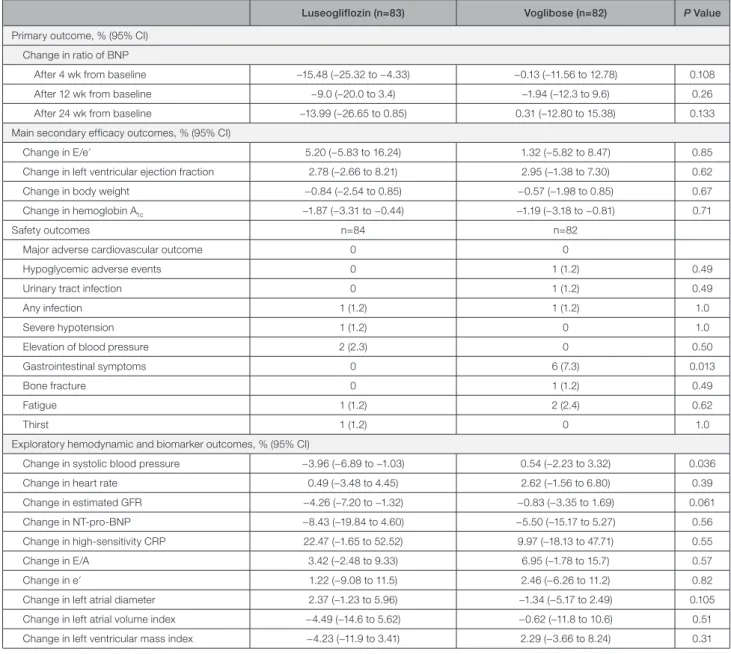
BNP concentrations decreased over time in the lu-seogliflozin group. A consistent decrease in BNP concentrations in the luseogliflozin group was ob-served after 4 and 24 weeks from baseline (Table 2). However, there was no significant difference in the reduction in BNP concentrations after 4 or 12 weeks compared with baseline between the 2 groups. The
ratio of the mean BNP value at week 12 to the base-line value was 0.79 in the luseogliflozin group and 0.87 in the voglibose group (percent change, −9.0% versus −1.9%; ratio of change with luseogliflozin versus voglibose, 0.93; 95% CI, 0.78–1.10; P=0.26) (Figure 2).
Secondary and Safety Outcomes
The change in E/e′, left ventricular EF, body weight, and hemoglobin A1C levels after 12 weeks in the lu-seogliflozin group were not significantly different from those in the voglibose group (Table 2). The main safety outcomes, including major adverse cardiovascular events, hypoglycemic adverse events, and urinary tract infection, were not significantly different between the groups (Table 2). No significant difference was ob-served in other adverse events between the groups. However, the rate of gastrointestinal symptoms in the voglibose group was significantly higher than that in the luseogliflozin group (P=0.013). Exploratory hemody-namic and biomarker outcomes are shown in Table 2. No significant differences were observed in the change in heart rate, eGFR, NT- proBNP concentrations,
high- sensitivity C- reactive protein concentrations, E/A, e′, left atrial diameter, left atrial volume index, and left ventricular mass index between the groups. However, a significantly greater reduction in systolic blood pres-sure after 12 weeks compared with baseline was ob-served in the luseogliflozin group than in the voglibose group (P=0.036).
Subgroup Analyses
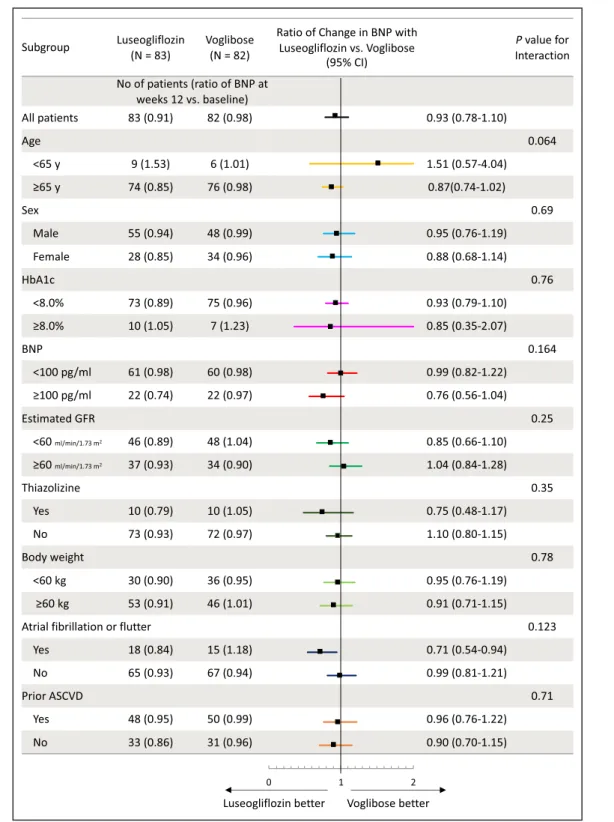
No statistical significance was observed in the interac-tion between the effect of study drugs and prespeci-fied patient subgroups (Figure 3).
DISCUSSION
The MUSCAT- HF study is the first prospective, multi-center, open- label, randomized, controlled trial to inves-tigate the drug effect of an SGLT2 inhibitor, luseogliflozin, on BNP concentrations as the primary outcome com-pared with an alpha- glucosidase inhibitor, voglibose. We found that BNP concentrations decreased after initia-tion of either luseogliflozin or voglibose. There was no
Figure 1. Study flow diagram.
BNP indicates B- type natriuretic peptide.
J Am Heart Assoc. 2020;9:e015103. DOI: 10.1161/JAHA.119.015103 6
Ejiri et al Effect of SGLT2 Inhibitor on HFpEF
significant difference in the degree of reduction in BNP concentrations after 12 weeks for luseogliflozin and voglibose. There were no significant differences in the main secondary and safety outcomes, except for gas-trointestinal symptoms, between the groups.
Some randomized controlled trials reported that SGLT2 inhibitors robustly reduced cardiovascular ad-verse events, including hospitalization of heart failure, in patients with diabetes mellitus.7–9 In an exploratory analysis from DECLARE- TIMI 58 (Dapagliflozin Effect on Cardiovascular Events–Thrombolysis in Myocardial Infarction 58), hospitalization for heart failure in patients with heart failure with reduced EF (<45%) at baseline was significantly reduced, while this reduction in hos-pitalization for heart failure was not observed in pa-tients with HFpEF.18 A recent randomized trial showed that dapagliflozin decreased worsening heart failure in patients with heart failure with reduced EF, regard-less of the presence or absence of diabetes mellitus.10 However, the benefit of an SGLT2 inhibitor in patients with HFpEF on hospitalization for heart failure remains unestablished. This study specifically focused on pa-tients with HFpEF using BNP concentrations. Although BNP was a surrogate end point for heart failure, use of the primary outcome of the change in ratio of BNP con-centrations after 12 weeks of treatment from baseline was a strength of this study. Additionally, selection of participants to clearly target patients with HFpEF was
Luseogliflozin (n=83) Voglibose (n=82) P Value Echocardiographic parameters
Left ventricular ejection fraction, % 57±9.4 58±9.4 0.41 ≥50% 53/73 (73) 52/65 (80) 0.31 E/A 0.77±0.21 0.85±0.29 0.094 e′, cm/s 5.4±1.5 5.6±1.8 0.66 <8 cm/s 68/71 (96) 61/66 (92) 0.40 E/e′ 13.0±4.5 13.3±5.6 0.67 ≥13 24/71 (34) 30/66 (46) 0.163 Left atrial diameter, mm 42.0±7.4 42.5±7.9 0.69 Left atrial volume index,
mL/m2
37.9±16.3 38.4±13.5 0.84 >34 mL/m2 35/68 (52) 32/59 (54) 0.76
Left ventricular mass index, mL/m2
93.0±23.2 91.3±27.5 0.71 ≥115 g/m2 for men or
≥95 g/m2 for women
15/70 (21) 13/63 (21) 0.91 Data are presented as mean±standard deviation, n (%), or median (interquartile range). ACE indicates angiotensin- converting enzyme; ARB, angiotensin- receptor blocker; BNP, B-type natriuretic peptide; CRP, C- reactive protein; E/A, ratio of early to atrial mitral inflow velocity; E/e′, ratio of early mitral inflow velocity to mitral annular early diastolic velocity; GFR, glomerular filtration rate; MRA, mineralocorticoid receptor antagonist; NT- proBNP, N- terminal pro- B- type natriuretic peptide; and NYHA, New York Heart Association.
Table 1. Continued
Table 1. Baseline Characteristics of the Patients
Luseogliflozin (n=83) Voglibose (n=82) P Value Age, y 71.7±7.7 74.6±7.7 0.017 Median (interquartile range) 72 (67–78) 75 (70–79) 0.027 >60 y, n (%) 77 (93) 80 (98) 0.152 Male, n (%) 55 (66) 48 (59) 0.31 Body weight, kg 64.6±12.7 63.5±13.1 0.57 Body mass index, kg/m2 25.4±4.3 25.3±4.4 0.85
Waist circumflex, cm 92.6±11.4 91.1±12.1 0.45 NYHA class, n (%) 0.44 I 0 0 II 79 (96) 81 (99) III 3 (4) 1 (1) IV 0 0 Duration of diabetes mellitus, mo 72 (22–130) 72 (36–138) 0.90 Prior diagnoses, n (%) Hypertension 72 (89) 64 (79) 0.087 Hyperuricemia 20 (25) 24 (30) 0.48 Cardiovascular disease 48 (59) 50 (62) 0.75 Dyslipidemia 65 (80) 61 (75) 0.45 Chronic kidney disease 29 (36) 27 (33) 0.74 Hepatic disorder 9 (11) 3 (3.7) 0.072 Atrial fibrillation or flutter 18 (22) 15 (18) 0.59 Medications, n (%)
ACE inhibitor or ARB 51 (61) 47 (57) 0.59 Beta- blocker 53 (64) 47 (57) 0.39 MRA 19 (23) 20 (24) 0.82 Loop diuretic 19 (23) 19 (23) 0.97 Hydralazine 5 (6.0) 5 (6.1) 0.98 Antidiabetic medication 53 (65) 50 (61) 0.74 Hemodynamic parameters
Systolic blood pressure, mm Hg 131±17 128±14 0.168 Diastolic blood pressure, mm Hg 71±11 71±10 0.52 Heart rate, bpm 69±13 70±12 0.53 Laboratory data Hemoglobin A1c, % 7.0±0.7 6.9±0.8 0.52 Hemoglobin, g/dL 13.5±1.6 13.1±1.6 0.114 Hematocrit, % 41.4±4.8 40.4±4.2 0.159 Blood urea nitrogen,
mg/dL 17.7±5.5 19.1±6.0 0.119 Serum creatinine, mg/dL 0.94±0.30 0.96±0.29 0.70 Estimated GFR, mL/min per 1.73 m2 60.6±19.4 56.8±16.5 0.185 BNP, pg/mL 63.7 (46.8–115.8) 75.1 (42.4–120) 0.87 NT- proBNP, pg/mL 203 (123–389) 200 (121–502) 0.70 High- sensitivity CRP, mg/L 0.91 (0.41–1.79) 0.73 (0.25–1.66) 0.48 (Continued)
an advantage of this study. Under this specific study design, this study showed no significant effect on the change in BNP concentrations from baseline with an SGLT2 inhibitor compared with an alpha- glucosidase inhibitor.
We consider that there were various factors that reduced the effect of an SGLT2 inhibitor in this study. First, the majority of patients who were enrolled in our study were at low risk. Almost all patients had New York Heart Association class II symptoms and low BNP levels at baseline. Only 23% of patients were receiving a loop diuretic at baseline, and had rela-tively lower use of angiotens converting enzyme in-hibitors or angiotensin- receptor blockers at baseline.
Additionally, a total of 40% patients did not have prior atherosclerotic cardiovascular disease. Previous re-ports have shown greater effectiveness of SGLT2 in-hibitors in patients with prior myocardial infarction or a high risk of atherosclerotic cardiovascular disease than in those without these conditions.19,20 Therefore, patients without these conditions may have had less effectiveness of SGLT2 inhibitors in this study. Second, in our study, luseogliflozin and voglibose re-duced BNP levels by 9.0% and 1.9%, respectively, but this difference was not significant. One explana-tion for this lack of significance is that this study was not sufficiently powered for moderate differences that were actually observed. With a power of 80%
Table 2. Outcomes of the Patients in the 2 Groups
Luseogliflozin (n=83) Voglibose (n=82) P Value Primary outcome, % (95% CI)
Change in ratio of BNP
After 4 wk from baseline −15.48 (−25.32 to −4.33) −0.13 (−11.56 to 12.78) 0.108 After 12 wk from baseline −9.0 (−20.0 to 3.4) −1.94 (−12.3 to 9.6) 0.26 After 24 wk from baseline −13.99 (−26.65 to 0.85) 0.31 (−12.80 to 15.38) 0.133 Main secondary efficacy outcomes, % (95% CI)
Change in E/e′ 5.20 (−5.83 to 16.24) 1.32 (−5.82 to 8.47) 0.85 Change in left ventricular ejection fraction 2.78 (−2.66 to 8.21) 2.95 (−1.38 to 7.30) 0.62 Change in body weight −0.84 (−2.54 to 0.85) −0.57 (−1.98 to 0.85) 0.67 Change in hemoglobin A1c −1.87 (−3.31 to −0.44) −1.19 (−3.18 to −0.81) 0.71
Safety outcomes n=84 n=82 Major adverse cardiovascular outcome 0 0
Hypoglycemic adverse events 0 1 (1.2) 0.49 Urinary tract infection 0 1 (1.2) 0.49 Any infection 1 (1.2) 1 (1.2) 1.0 Severe hypotension 1 (1.2) 0 1.0 Elevation of blood pressure 2 (2.3) 0 0.50 Gastrointestinal symptoms 0 6 (7.3) 0.013 Bone fracture 0 1 (1.2) 0.49 Fatigue 1 (1.2) 2 (2.4) 0.62
Thirst 1 (1.2) 0 1.0
Exploratory hemodynamic and biomarker outcomes, % (95% CI)
Change in systolic blood pressure −3.96 (−6.89 to −1.03) 0.54 (−2.23 to 3.32) 0.036 Change in heart rate 0.49 (−3.48 to 4.45) 2.62 (−1.56 to 6.80) 0.39 Change in estimated GFR −4.26 (−7.20 to −1.32) −0.83 (−3.35 to 1.69) 0.061 Change in NT- pro- BNP −8.43 (−19.84 to 4.60) −5.50 (−15.17 to 5.27) 0.56 Change in high- sensitivity CRP 22.47 (−1.65 to 52.52) 9.97 (−18.13 to 47.71) 0.55 Change in E/A 3.42 (−2.48 to 9.33) 6.95 (−1.78 to 15.7) 0.57 Change in e′ 1.22 (−9.08 to 11.5) 2.46 (−6.26 to 11.2) 0.82 Change in left atrial diameter 2.37 (−1.23 to 5.96) −1.34 (−5.17 to 2.49) 0.105 Change in left atrial volume index −4.49 (−14.6 to 5.62) −0.62 (−11.8 to 10.6) 0.51 Change in left ventricular mass index −4.23 (−11.9 to 3.41) 2.29 (−3.66 to 8.24) 0.31 Data are presented as 95% CIs or n (%). BNP indicates B- type natriuretic peptide; CRP, C- reactive protein; E/A, ratio of early to atrial mitral inflow velocity; E/e′, ratio of early mitral inflow velocity to mitral annular early diastolic velocity; GFR, glomerular filtration rate; and NT- proBNP, N- terminal pro- B- type natriuretic peptide.
J Am Heart Assoc. 2020;9:e015103. DOI: 10.1161/JAHA.119.015103 8
Ejiri et al Effect of SGLT2 Inhibitor on HFpEF
and a sample size of 86 per group, we could statis-tically detect up to a 30% difference between the 2 groups. Underpowered analysis is susceptible to a type II error. The effect size of a reduction in BNP concentrations in this study was lower than we ex-pected, probably attributable to patients with mild heart failure.
In this study, HFpEF was defined as a left ven-tricular EF ≥45%, BNP concentrations ≥35 pg/mL, and any symptoms. This definition was modified ac-cording to the 2012 European Society of Cardiology (ESC) heart failure guidelines.13 The cutoff of the EF for definition of HFpEF in other clinical trials varied from 40% to 50%.1,4,21,22 The 2012 ESC heart fail-ure guidelines stated that patients with HF and an EF ≥50% are considered as having HFpEF, while pa-tients with an EF ranging from 35% to 50% repre-sent a “gray area.”13 The 2013 US guideline stated that HFpEF included an EF >40%.5 Based on these documents, we recruited patients with an EF ≥45% as HFpEF. With regard to the relevance of structural heart disease, a comprehensive echocardiographic examination was recommended at enrollment in the study. We checked the presence of structural and functional echocardiographic measures as listed in the 2012 ESC heart failure guidelines.13 Patients who had at least 1 of these measurements, including left ventricular hypertrophy, left atrial enlargement, and left ventricular diastolic dysfunction, comprised 97% of the study population. Therefore, we consider that almost all of the study population fulfilled the diag-nostic criteria of HFpEF in the 2012 ESC heart failure guidelines.13
Our study showed a reduction in BNP concen-trations in the luseogliflozin group at 4 weeks, which suggested that SGLT2 inhibitors reduce cardiac load immediately after their introduction. Further, luseogliflozin significantly reduced systolic blood pressure compared with voglibose. However, echo-cardiographic parameters of left ventricular systolic or diastolic function (eg, left ventricular EF and E/e′) were similar between the groups. Interestingly, the left atrial volume index and left ventricular mass index appeared to be reduced after luseogliflozin, but this was not significant. Our research group has reported that an SGLT2 inhibitor ameliorated car-diac hypertrophy and fibrosis in hypertensive rats that were fed a high- fat diet.23 Some studies have also shown that SGLT2 inhibition improves arterial stiffness and achieves lowering of blood pressure in patients with diabetes mellitus.24–26 From the results of subgroup analyses, luseogliflozin use tended to be higher in patients with an older age, BNP levels >100 pg/mL at baseline, and atrial arrhythmia (atrial fibrillation or flutter). We consider that these patients’ characteristics are representative of heart failure with left ventricular diastolic dysfunction. Therefore, selectively using SGLT2 inhibitors might be benefi-cial for such patients with severe left ventricular di-astolic dysfunction or cardiac afterload, even those with HFpEF. Further detailed studies are required, including ongoing randomized controlled trials.27–29
This study has several limitations. First, this study was not blinded and was an open- label study. Second, the primary outcome of this study was the change in BNP concentrations after 12 weeks of treatment from baseline. This was a surrogate end point, and the follow- up duration was short. Third, the predefined sample size of 190 was not achieved. We started the study, which was designed to be conducted for almost 2 years, for the enrollment period from December 2015. However, the study population did not reach a number required for sufficient statistical power during the pre-specified enrollment period. Therefore, we extended the enrollment period to 3 years until September 2018. Unfortunately, the study included only 169 patients. We could not continue enrollment of new patients be-cause of a shortage of funds. Fourth, there were more patients with mild heart failure in this study than ex-pected. Therefore, differences between study groups might have been diminished. Furthermore, the effect of luseogliflozin on BNP levels in patients with diabetes mellitus and HFpEF might have been overestimated, and the sample size calculation might not have been sufficient for estimating differences between the study groups. Finally, the latest definition of HFpEF in the ESC heart failure guidelines has changed since 2012. In the 2016 ESC heart failure guidelines,6 patients with a left ventricular EF ranging from 40% to 49% are
Figure 2. Change in BNP concentrations.
No significant difference was observed in the reduction in BNP concentrations after 12 weeks compared with baseline between the two groups. The ratio of the mean BNP value at week 12 to the baseline value was 0.79 in the luseogliflozin group and 0.87 in the voglibose group (percent change, −9.0% vs −1.9%, ratio of change with luseogliflozin vs voglibose, 0.93; 95% CI, 0.78–1.10;
P=0.26). BNP indicates B- type natriuretic peptide.
newly defined as HF with midrange EF. On the basis of the latest ESC heart failure guidelines,6 24% of patients with a left ventricular EF of <50% in this study did not fulfill the definition of HFpEF.
In conclusion, in patients with type 2 diabetes melli-tus and HFpEF, initiation of luseogliflozin does not sig-nificantly reduce BNP concentrations over a 12- week follow- up compared with voglibose.
Figure 3. Subgroup analyses of the change in BNP concentrations.
Data on the change in ratio of BNP concentrations from baseline to 12 weeks with each treatment according to subgroup are shown. ASCVD indicates atherosclerotic cardiovascular disease; BNP, B- type natriuretic peptide; GFR, glomerular filtration rate; and HbA1c, hemoglobin A1c.
J Am Heart Assoc. 2020;9:e015103. DOI: 10.1161/JAHA.119.015103 10
Ejiri et al Effect of SGLT2 Inhibitor on HFpEF
APPENDIX
The MUSCAT- HF Study Investigators
Kentaro Ejiri (Tamano City Hospital and Okayama University Graduate School of Medicine, Density and Pharmaceutical Sciences); Toru Miyoshi, Kazufumi Nakamura, and Hiroshi Ito (Okayama University Graduate School of Medicine, Density and Pharmaceutical Sciences); Hajime Kihara (Kihara Cardiovascular Clinic); Yoshiki Hata (Minamino Cardiovascular Hospital); Toshihiko Nagano (Iwasa Hospital); Atsushi Takaishi (Mitoyo General Hospital); Hironobu Toda (Okayama East Neurosurgery Hospital and Okayama University Graduate School of Medicine, Density and Pharmaceutical Sciences); Seiji Namba (Okayama Rosai Hospital); Yoichi Nakamura (Specified Clinic of Soyokaze Cardiovascular Medicine and Diabetes Care); Satoshi Akagi (Akaiwa Medical Association Hospital and Okayama University Graduate School of Medicine, Density and Pharmaceutical Sciences); Satoru Sakuragi (Iwakuni Clinical Center); Taro Minagawa (Minagawa Cardiovascular Clinic); Yusuke Kawai (Okayama City Hospital); Nobuhiro Nishii (Yoshinaga Hospital and Okayama University Graduate School of Medicine, Density and Pharmaceutical Sciences); Tetsuya Sato and Soichiro Fuke (Japanese Red Cross Okayama Hospital); Masaki Yoshikawa and Hiroyasu Sugiyama (Fukuyama City Hospital); Michio Imai (Imai Heart Clinic); Naoki Gotoh (Gotoh Clinic); Tomonori Segawa (Asahi University Hospital); Toshiyuki Noda (Gifu Prefectural General Medical Center); and Masatoshi Koshiji (Gifu Seiryu Hospital).
ARTICLE INFORMATION
Received October 28, 2019; accepted May 13, 2020.
Affiliations
From the Department of Cardiovascular Medicine, Okayama University Graduate School of Medicine, Density and Pharmaceutical Sciences, Okayama, Japan (K.E., T. Miyoshi, H.T., S.A., N.N., K.N., H.I.); Department of Internal Medicine, Tamano City Hospital, Okayama, Japan (K.E.); Department of Internal Medicine, Kihara Cardiovascular Clinic, Asahikawa, Japan (H.K.); Department of Cardiology, Minamino Cardiovascular Hospital, Hachioji, Japan (Y.H.); Department of Internal Medicine, Iwasa Hospital, Gifu, Japan (T.N.); Department of Cardiology, Mitoyo General Hospital, Kanonji, Japan (A.T.); Department of Internal Medicine, Okayama East Neurosurgery Hospital, Okayama Japan (H.T.); Department of Cardiology, Okayama Rosai Hospital, Okayama, Japan (S.N.); Department of Cardiovascular Medicine, Specified Clinic of Soyokaze Cardiovascular Medicine and Diabetes Care, Matsuyama, Japan (Y.N.); Department of Internal Medicine, Akaiwa Medical Association Hospital, Okayama, Japan (S.A.); Department of Cardiovascular Medicine, Iwakuni Clinical Center, Iwakuni, Japan (S.S.); Department of Internal Medicine, Minagawa Cardiovascular Clinic, Gifu, Japan (T.Minagawa); Department of Cardiovascular Medicine, Okayama City Hospital, Okayama, Japan (Y.K.); Department of Internal Medicine, Yoshinaga Hospital, Okayama, Japan (N.N.); Department of Cardiovascular Medicine, Japanese Red Cross Okayama Hospital, Okayama, Japan (S.F.); Department of Cardiology, Fukuyama City Hospital, Fukuyama, Japan (M.Y.).
Acknowledgments
We thank Tetsutaro Hamano, MS, for his assistance in the study’s design and statistical analysis.
Sources of Funding
This work was supported by Novartis Pharma K. K.
Disclosures
Dr Miyoshi received a trust research/joint research fund from Novartis Pharma K. K. Dr Nishii is affiliated with the endowment department of Medtronic Japan. Dr Ito received a trust research/joint research fund from Novartis KK. The remaining authors have no disclosures to report.
Supplementary Materials Data S1–S3 Figure S1 Table S1 References 15–17 REFERENCES
1. Pitt B, Pfeffer MA, Assmann SF, Boineau R, Anand IS, Claggett B, Clausell N, Desai AS, Diaz R, Fleg JL, et al. Spironolactone for heart fail-ure with preserved ejection fraction. N Engl J Med. 2014;370:1383–1392. 2. Cleland JGF, Bunting KV, Flather MD, Altman DG, Holmes J, Coats
AJS, Manzano L, McMurray JJV, Ruschitzka F, van Veldhuisen DJ, et al. Beta- blockers for heart failure with reduced, mid- range, and preserved ejection fraction: an individual patient- level analysis of double- blind ran-domized trials. Eur Heart J. 2018;39:26–35.
3. Cleland JG, Tendera M, Adamus J, Freemantle N, Polonski L, Taylor J. The perindopril in elderly people with chronic heart failure (PEP- CHF) study. Eur Heart J. 2006;27:2338–2345.
4. Massie BM, Carson PE, McMurray JJ, Komajda M, McKelvie R, Zile MR, Anderson S, Donovan M, Iverson E, Staiger C, et al. Irbesartan in patients with heart failure and preserved ejection fraction. N Engl J Med. 2008;359:2456–2467.
5. Yancy CW, Jessup M, Bozkurt B, Butler J, Casey DE Jr, Drazner MH, Fonarow GC, Geraci SA, Horwich T, Januzzi JL, et al. 2013 ACCF/AHA guideline for the management of heart failure: a report of the American College of Cardiology Foundation/American Heart Association Task Force on Practice Guidelines. Circulation. 2013;128:e240–e327. 6. Ponikowski P, Voors AA, Anker SD, Bueno H, Cleland JGF, Coats AJS,
Falk V, Gonzalez-Juanatey JR, Harjola VP, Jankowska EA, et al. 2016 ESC guidelines for the diagnosis and treatment of acute and chronic heart failure: the Task Force for the diagnosis and treatment of acute and chronic heart failure of the European Society of Cardiology (ESC). Developed with the special contribution of the Heart Failure Association (HFA) of the ESC. Eur Heart J. 2016;37:2129–2200.
7. Zinman B, Wanner C, Lachin JM, Fitchett D, Bluhmki E, Hantel S, Mattheus M, Devins T, Johansen OE, Woerle HJ, et al. Empagliflozin, cardiovascular outcomes, and mortality in type 2 diabetes. N Engl J
Med. 2015;373:2117–2128.
8. Neal B, Perkovic V, Mahaffey KW, de Zeeuw D, Fulcher G, Erondu N, Shaw W, Law G, Desai M, Matthews DR. Canagliflozin and car-diovascular and renal events in type 2 diabetes. N Engl J Med. 2017;377:644–657.
9. Wiviott SD, Raz I, Bonaca MP, Mosenzon O, Kato ET, Cahn A, Silverman MG, Zelniker TA, Kuder JF, Murphy SA, et al. Dapagliflozin and cardio-vascular outcomes in type 2 diabetes. N Engl J Med. 2019;380:347–357. 10. McMurray JJV, Solomon SD, Inzucchi SE, Kober L, Kosiborod MN,
Martinez FA, Ponikowski P, Sabatine MS, Anand IS, Belohlavek J, et al. Dapagliflozin in patients with heart failure and reduced ejection fraction.
N Engl J Med. 2020;382:973.
11. Chiasson JL, Josse RG, Gomis R, Hanefeld M, Karasik A, Laakso M. Acarbose treatment and the risk of cardiovascular disease and hyper-tension in patients with impaired glucose tolerance: the STOP- NIDDM trial. JAMA. 2003;290:486–494.
12. Ejiri K, Miyoshi T, Nakamura K, Sakuragi S, Munemasa M, Namba S, Takaishi A, Ito H. The effect of luseogliflozin and alpha- glucosidase in-hibitor on heart failure with preserved ejection fraction in diabetic pa-tients: rationale and design of the MUSCAT- HF randomised controlled trial. BMJ Open. 2019;9:e026590.
13. McMurray JJ, Adamopoulos S, Anker SD, Auricchio A, Bohm M, Dickstein K, Falk V, Filippatos G, Fonseca C, Gomez-Sanchez MA, et al. ESC guidelines for the diagnosis and treatment of acute and chronic heart failure 2012: the Task Force for the diagnosis and
treatment of acute and chronic heart failure 2012 of the European Society of Cardiology. Developed in collaboration with the Heart Failure Association (HFA) of the ESC. Eur Heart J. 2012;33:1787–1847. 14. Washburn WN, Poucher SM. Differentiating sodium- glucose co-
transporter- 2 inhibitors in development for the treatment of type 2 dia-betes mellitus. Expert Opin Investig Drugs. 2013;22:463–486. 15. Rousseau MF, Gurne O, Duprez D, Van Mieghem W, Robert A,
Ahn S, Galanti L, Ketelslegers JM. Beneficial neurohormonal pro-file of spironolactone in severe congestive heart failure: results from the RALES neurohormonal substudy. J Am Coll Cardiol. 2002;40: 1596–1601.
16. Tsutamoto T, Wada A, Maeda K, Mabuchi N, Hayashi M, Tsutsui T, Ohnishi M, Sawaki M, Fujii M, Matsumoto T, et al. Effect of spirono-lactone on plasma brain natriuretic peptide and left ventricular re-modeling in patients with congestive heart failure. J Am Coll Cardiol. 2001;37:1228–1233.
17. Solomon SD, Zile M, Pieske B, Voors A, Shah A, Kraigher-Krainer E, Shi V, Bransford T, Takeuchi M, Gong J, et al. The angiotensin recep-tor neprilysin inhibirecep-tor LCZ696 in heart failure with preserved ejection fraction: a phase 2 double- blind randomised controlled trial. Lancet. 2012;380:1387–1395.
18. Kato ET, Silverman MG, Mosenzon O, Zelniker TA, Cahn A, Furtado RHM, Kuder J, Murphy SA, Bhatt DL, Leiter LA, et al. Effect of da-pagliflozin on heart failure and mortality in type 2 diabetes mellitus.
Circulation. 2019;139:2528–2536.
19. Furtado RHM, Bonaca MP, Raz I, Zelniker TA, Mosenzon O, Cahn A, Kuder J, Murphy SA, Bhatt DL, Leiter LA, et al. Dapagliflozin and car-diovascular outcomes in patients with type 2 diabetes mellitus and pre-vious myocardial infarction. Circulation. 2019;139:2516–2527. 20. Zelniker TA, Wiviott SD, Raz I, Im K, Goodrich EL, Bonaca MP, Mosenzon
O, Kato ET, Cahn A, Furtado RHM, et al. SGLT2 inhibitors for primary and secondary prevention of cardiovascular and renal outcomes in type 2 diabetes: a systematic review and meta- analysis of cardiovascular outcome trials. Lancet. 2019;393:31–39.
21. Yusuf S, Pfeffer MA, Swedberg K, Granger CB, Held P, McMurray JJ, Michelson EL, Olofsson B, Ostergren J; Investigators C. Effects
of candesartan in patients with chronic heart failure and preserved left- ventricular ejection fraction: the CHARM- Preserved Trial. Lancet. 2003;362:777–781.
22. Redfield MM, Anstrom KJ, Levine JA, Koepp GA, Borlaug BA, Chen HH, LeWinter MM, Joseph SM, Shah SJ, Semigran MJ, et al. Isosorbide mononitrate in heart failure with preserved ejection fraction. N Engl J
Med. 2015;373:2314–2324.
23. Kimura T, Nakamura K, Miyoshi T, Yoshida M, Akazawa K, Saito Y, Akagi S, Ohno Y, Kondo M, Miura D, et al. Inhibitory effects of tofogli-flozin on cardiac hypertrophy in Dahl salt- sensitive and salt- resistant rats fed a high- fat diet. Int Heart J. 2019;60:728–735.
24. Heerspink HJ, Perkins BA, Fitchett DH, Husain M, Cherney DZ. Sodium glucose cotransporter 2 inhibitors in the treatment of diabetes mellitus: cardiovascular and kidney effects, potential mechanisms, and clinical applications. Circulation. 2016;134:752–772.
25. Chilton R, Tikkanen I, Cannon CP, Crowe S, Woerle HJ, Broedl UC, Johansen OE. Effects of empagliflozin on blood pressure and markers of arterial stiffness and vascular resistance in patients with type 2 dia-betes. Diabetes Obes Metab. 2015;17:1180–1193.
26. Cherney DZ, Perkins BA, Soleymanlou N, Har R, Fagan N, Johansen OE, Woerle HJ, von Eynatten M, Broedl UC. The effect of em-pagliflozin on arterial stiffness and heart rate variability in subjects with uncomplicated type 1 diabetes mellitus. Cardiovasc Diabetol. 2014;13:28.
27. Anker SD, Butler J, Filippatos GS, Jamal W, Salsali A, Schnee J, Kimura K, Zeller C, George J, Brueckmann M, et al. Evaluation of the effects of sodium- glucose co- transporter 2 inhibition with empagliflozin on mor-bidity and mortality in patients with chronic heart failure and a preserved ejection fraction: rationale for and design of the EMPEROR- Preserved Trial. Eur J Heart Fail. 2019;21:1279–1287.
28. Dapagliflozin evaluation to improve the LIVEs of patients with preserved ejection fraction heart failure. (DELIVER). Available at: https://clini caltr ials.gov/ct2/show/NCT03 619213. Accessed May 10, 2020.
29. Dapagliflozin in preserved ejection fraction heart failure (PRESERVED- HF). Available at: https://clini caltr ials.gov/ct2/show/NCT03 030235. Accessed May 10, 2020.
Supplemental Material
Data S1. Study protocol.
Prospective Comparison of Luseogliflozin and Alpha- glucosidase on the Management of Diabetic Patients with Chronic Heart Failure and Preserved Ejection Fraction I. Summary of study plan
The MUSCAT-HF trial was a multi-center, prospective, open-label, randomized controlled trial to assess the effect of luseogliflozin compared with voglibose on left ventricular load in patients with type 2 diabetes mellitus (T2DM) and heart failure with preserved ejection fraction (HFpEF).
II. Background of study plan
Recent randomized controlled trials showed that sodium glucose cotransporter 2 (SGLT2) inhibitors reduced all-cause mortality, cardiovascular mortality, and hospitalization of heart failure in type 2 diabetes compared with placebo. These results indicated that SGLT2 inhibitors may be effective in lowering glucose levels and reducing cardiovascular events, particularly in patients with heart failure. Given that these trials were not specifically designed to investigate the effect of SGLT2 inhibitors in heart failure patients, no detailed data on their effects in heart failure were obtained.
III. Study plan
1. Purpose
The aim of this study wasto evaluate the efficacy of luseogliflozin, an SGLT2 inhibitor,
compared with voglibose, an alpha-glucosidase inhibitor, using brain natriuretic peptide (BNP) as the index of therapeutic effect in patients with T2DM and HFpEF. The results of this study will support a novel strategy for the treatment of heart failure using an SGLT2 inhibitor, independent of its glucose-lowering effects.
2. Study population
The planned sample size of this study was 95 patients per group (190 patients in total). The recruitment of study patients was planned to take place from September 2015 to September
2018. Patients aged 20 years with T2DM (hemoglobin A1c [HbA1C] 9.0%) and HFpEF
(left ventricular ejection fraction 45%) needing additional treatment for T2DM despite the ongoing treatment are eligible for participation. The key inclusion and exclusion criteria are detailed in Table 1. Given that the definition of chronic heart failure according to European Society of Cardiology guidelines includes BNP 35 pg/ml, patients with BNP <35 pg/ml was
excluded from this study. Study candidates were assessed for eligibility within 4 weeks prior to enrolment.
Inclusion and exclusion criteria Inclusion criteria
1) Diagnosis of T2DM and left ventricular ejection fraction >45% with current or previous symptoms of heart failure (dyspnea on effort, orthopnea, or leg edema)
2) Inadequately controlled T2DM in patients who have received diet and exercise therapy, a lifestyle modification program, and hypoglycemic medications based on standard guidelines of the Japan Diabetes Society
3) Age >20 years
4) Provision of written informed consent prior to participation Exclusion criteria
1) BNP <35 pg/ml
2) Use of alpha-glucosidase inhibitors, SGLT2 inhibitors, glinides, or high-dose sulfonylurea
3) Renal insufficiency (eGFR <30 ml/min/1.73m2)
4) Left ventricular ejection fraction <45%
5) History of severe ketoacidosis or diabetic coma within 6 months prior to participation 6) Serious infection or severe trauma, or perioperative patients
7) Type 1 diabetes mellitus
8) Poorly controlled T2DM (HbA1c >9.0%)
9) Uncontrolled hypertension (systolic blood pressure >160 mmHg)
10) History of stroke, myocardial infarction, or severe cardiovascular disease with hospitalization within 6 months prior to participation
11) Women who are pregnant or breastfeeding 12) Allergy to either investigation product
13) Other medical reason at the investigator’s discretion
T2DM, type 2 diabetes mellitus; BNP, brain natriuretic peptide; SGLT2, sodium/glucose cotransporter 2; eGFR, estimated glomerular filtration rate; HbA1C, hemoglobin A1C 3. Consent
1) Written informed consent is needed to be received.
2) If patients do not have ability of judgment, informed consent cannot be received. Informed Consent Form
1 Purpose
2 Efficacy and side effect 3 Alternative treatment options 4 NO disadvantage by rejection 5 Withdrawal rights
6 Ethics
4. Interventions
1) Voglibose: subjects who receive voglibose (2.5 mg once daily)
2) Luseogliflozin: subjects who receive luseogliflozin (2.5 mg once daily) 5. Methods
Patients fulfilling all criteria who provide written informed consent to participate in this study were enrolled and subsequently randomized (1:1) to receive luseogliflozin (2.5 mg once daily) or voglibose (0.2 mg three times daily) in addition to their background medication. Randomization was performed using a computer-generated random sequence web response system. Patients were stratified by age (<65 years, ≥65 years), baseline HbA1c (<8.0%, ≥8.0%), baseline BNP (<100 pg/ml, ≥100 pg/ml), baseline renal function (eGFR ≥60
ml/min/1.73 m2, <60 ml/min/1.73 m2), use of thiazolidine or not, and presence or absence of atrial fibrillation (AF) and flutter (AFL) at screening.
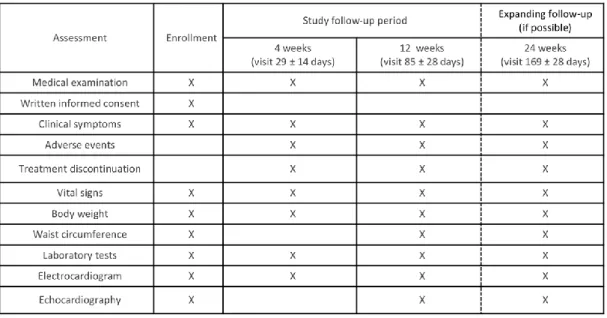
Assessments during the study period are listed in Figure 1. Laboratory data, electrocardiogram, echocardiography and patients’ vital signs, body weight, and waist
circumference, were evaluated at 4 ± 2 weeks (visit 29 ± 14 days) and 12 weeks (visit 85 ± 28 days) after initiation of study treatment. Safety and tolerability were assessed during the treatment period. The primary outcome of change in BNP compared with baseline was evaluated at 12 weeks (visit 85 ± 28 days) and patients were followed up for an additional 12 weeks (visit 169 ± 28 days) after the end of treatment. If a patient’s glycemic control worsens after 4 ± 2 weeks, the investigator could increase the dose of allocated treatment (to
luseogliflozin 5 mg once daily or voglibose 0.3 mg three times daily) and other specific T2DM drugs, except for sulfonylureas. Investigators were also encouraged to treat all other cardiovascular risk factors according to local standard of care. Under the following
circumstances, the investigator must evaluate the data and patient’s vital sign: 1)
discontinuation of study treatment; 2) dose increase of specific treatment for heart failure; 3) initiation of new treatment for heart failure; 4) withdrawal from the study. The permitted medications for the treatment of heart failure included angiotensin-converting enzyme inhibitors, angiotensin receptor blockers, beta-blockers, diuretics, and
mineralocorticoid/aldosterone receptor antagonists. 6. End points
Assessments during the study period are listed in Figure 2. Primary outcome
The primary outcome of this study was the difference in BNP after 12 weeks (visit 85±28 days) of treatment between the luseogliflozin and the voglibose groups, defined as the difference in logarithmic BNP change calculated as follows:
(*) BNP proportional change = BNP (at follow-up)/ BNP (at baseline),
(†) Logarithmic BNP change = logarithmic BNP (at follow-up) – logarithmic BNP (at baseline),
In other words, (*) = exponential (†).
Furthermore, we calculated the ratio of BNP change rate
(‡) The ratio of BNP proportional change (the luseogliflozin group to the voglibose group) = (*) (in the luseogliflozin group)/(*) (in the voglibose group),
(§) The difference of logarithmic BNP change = (†) (in the luseogliflozin group) – (†) (in the voglibose group),
In other words, (‡) = exponential (§) Secondary outcomes
The key secondary outcomes of this study were the differences in the following parameters between the luseogliflozin and the voglibose groups:
1) Ratio of early mitral inflow velocity to mitral annular early diastolic velocity (E/e') 2) Left ventricular ejection fraction
3) Body weight 4) HbA1c
The difference in E/e' and HbA1c between the groups was defined as the difference in logarithmic E/e' and HbA1c using the same calculation as for BNP. The difference in body weight and left ventricular ejection fraction was defined as the difference between those parameters at follow-up and at baseline. Further exploratory analysis is listed in exploratory analysis section.
Safety outcomes: including, but not limited to:
• clinical laboratory tests, vital signs, 12-lead electrocardiogram (ECG), physical
examination, and the use of rescue medication
• Adverse events including major adverse cardiovascular events (MACE),
hypoglycemic adverse events (requiring any intervention), and urinary tract infection. Safety was assessed based on adverse events reported throughout the study, clinical
laboratory tests, vital signs, 12-lead electrocardiogram, physical examination, and the use of rescue medication. Prespecified adverse events included MACE, hypoglycemic adverse events (requiring any intervention), and urinary tract infection (details listed in Outcome definitions for adverse events section)
Discontinuance criteria Withdrawal
criteria 1) Inadequate glycemic control after administration of the study drug
2) Suspect of adverse side effects of the study drug 3) Frequent hypoglycemia
4) Onset of adverse cardiovascular event†
5) Declaration of withdrawal from the study by the participant 6) Turning out of misunderstanding of all criteria for eligibility after enrollment
7) Pregnancy after enrollment
8) Lower adherence for administration of the study drug (< 70%) 9) Assessment of inadequate for the study by the attending doctor
†Cardiovascular
event 1) Addition of heart failure treatment drugs as follows;
angiotensin-converting enzyme (ACE) inhibitors, angiotensin receptor blockers (ARB), beta-blockers, diuretics, and aldosterone antagonists 2) Hospitalization of heart failure
8. Study period
Between December 1, 2015 and March 31, 2019 9. Statistics
Sample size and power calculation
The primary hypothesis of this study was that the SGLT2 inhibitor luseogliflozin could reduce cardiac load in patients with T2DM and HFpEF. Therefore, the primary outcome was the difference in change in BNP from baseline to 12 weeks between patients receiving luseogliflozin or voglibose. As of the start of recruitment in September 2015, no
interventional study of the effect of SGLT2 inhibitors on heart failure in patients with T2DM had been reported. Therefore, we had estimated that BNP change rate in the luseogliflozin group would be 30% lower as compared with that in the globose group according to previous
studies of the effect of renin-angiotensin-aldosterone system inhibitors on heart failure 15-17.
The standard deviation of the natural logarithmic transformation of BNP was estimated at
0.83, in reference to the PARAMOUNT study17. A minimum of 172 patients (86 patients per
group) is required to provide 80% power with a two-sided ɑ level of 0.05 by Student’s t-test on the ratio of BNP change rate between the luseogliflozin and voglibose groups. With 10% of patients estimated to withdraw from participation during the study period, the final enrolment target was set at 190 patients (95 patients per group).
Analysis plan
In the efficacy analysis, the primary population comprised the Full Analysis Set (FAS),
defined as all randomized patients who received one dose of study drug and were followed up at least once. Patients with no BNP data and patients who withdrew or discontinue treatment was excluded from the FAS. Missing values at 4, 12, and 24 weeks were replaced by the last observed value for that variable (last observation carried forward). In the primary outcome analysis, baseline observation carried forward analysis was also performed. Efficacy analysis was performed according to the treatment to which patients are randomly assigned, based on the intention-to-treat analysis. The primary outcome analysis was based on an analysis of covariance (ANCOVA) (α = 0.05, level of significance) for the ratio of BNP change rate in the FAS. Adjusted covariates included the assigned treatment (luseogliflozin, voglibose), baseline age (<65 or ≥65 years), baseline HbA1c (<8.0 or ≥8.0%), baseline BNP (<100 or ≥100 pg/ml), baseline renal function (eGFR ≥60 or <60 ml/min/1.73 m2), use of thiazolidine or not at baseline, and presence or absence of AF and AFL at baseline as stratified factors of randomization. Furthermore, BNP change rate, ratio of BNP change rate, and 95% confidence intervals were calculated. The same ANCOVA analysis as for the primary outcome was
performed for the ratio of BNP change rate at 4 weeks and 24 weeks between the two groups. Prespecified subgroup analyses were performed on the primary outcome using
ANCOVA (covariates: assigned treatment and BNP at screening) in the following subgroups: baseline age (<65 or ≥65 years), baseline HbA1c (<8.0 or ≥8.0%), baseline BNP (<100 or ≥100 pg/ml), baseline renal function (eGFR ≥60 or <60 ml/min/1.73 m2), use of thiazolidine or not at baseline, baseline body weight (<60 kg, ≥60 kg), and presence or absence of AF and AFL at baseline. Furthermore, exploratory analysis on the primary outcome was performed in subgroups based on blood pressure, heart rate, waist circumference, cardiovascular risk factors (hypertension, T2DM, hyperuricemia, family history, and smoking), alcohol
consumption, regular medication, and serum lipid levels (details listed in exploratory analysis section).
The key secondary outcomes, difference in E/e', left ventricular ejection fraction, body weight, and HbA1C at 12 weeks between the luseogliflozin and voglibose groups, were analyzed using the same ANCOVA as for the primary outcome. Subgroup analysis for the key secondary outcomes was performed in the same subgroups as for the primary outcome
analysis. The following secondary outcomes was also analyzed using the same analysis plan: E/e', left ventricular ejection fraction, body weight, and HbA1C at 4 and 24 weeks; and exploratory parameters at 4, 12, and 24 weeks.
For the safety analysis, the primary population was the Safety Analysis Set (SAFETY), defined as all patients who receive at least one dose of study drug. Although patients who withdrew without receiving study drug will be excluded from SAFETY, other patients who withdrew for any other reason was included. The safety analysis was performed according to the treatment administered to patients in practice, based on the as-treated
performed using the Cochran–Mantel–Haenszel test with stratification factors of age (<65 or ≥65 years), baseline HbA1c (<8.0 or ≥8.0%), baseline BNP (<100 or ≥100 pg/ml), baseline renal function (eGFR ≥60 or <60 ml/min/1.73 m2), use of thiazolidine or not, and presence or absence of AF and AFL at screening.
All comparisons were planned, and the analyses was two sided With P values <0.05 considered statistically significant. All statistical analyses were performed using IBM SPSS Statistics 24 (IBM, Armonk, NY) and Stata/SE 15.1 for Mac (StataCorp, College Station, TX). The statistical analysis plan was developed by the principal investigator and a biostatistician prior to the completion of patient recruitment and database lock. Exploratory analysis
Further exploratory analysis in this study was planned for such parameters. 1) Blood glucose
2) Lipid metabolism [total cholesterol, high density lipoprotein, triglyceride, small dense low-density lipoprotein and Malondialdehyde-modified low density lipoprotein] 3) Blood pressure
4) High sensitive CRP
5) Adiponectin, microalbuminuria
6) Urinary 8-hydroxy-2' –deoxyguanosine 7) Estimated GFR
10. Data management and analysis
Members of the Steering Committee also designed the study and were responsible for its conduction (details listed in Study organization section). Significant adverse events (SAEs) occurring within 30 days after final administration of the study drug or after 30 days with a suspicion of association with the study drug, as well as all pregnancies, was immediately reported to the Steering Committee and the sponsor by the investigator, in accordance with GCP.
11. Ethical consideration
All participants provided written informed consent before enrolling.
This study was conducted according to the principles expressed in the Declaration of Helsinki.
This study was approved by the Okayama University Graduate School of Medicine, Density and Pharmaceutical Sciences and the Okayama University Hospital Ethics Committee, as well as the ethics committee of each participating center. Trial registration: UMIN Clinical Trials Registry (UMIN-CTR), UMIN000018395,
bin/ctr_e/ctr_view.cgi?recptno=R000021301 12. Methods of plan change
When needed, investigators made a discussion and decision of plan change.
Brain natriuretic peptide, N-terminal brain natriuretic peptide, adiponectin, small dense low-density lipoprotein, malondialdehyde-modified low low-density lipoprotein, high-sensitive C-reactive protein, microalbuminuria, urinary 8-hydroxy-2' –deoxyguanosine
These parameters were measured in a central laboratory (SRL, Inc. Hachioji, Tokyo, Japan). White blood cell, red blood cell, platelet, hemoglobin, hematocrit, aspartate aminotransferase, alanine aminotransferase, lactate dehydrogenase, blood urea nitrogen, serum creatinine, uric acid, serum sodium, serum potassium, serum chloride, total cholesterol, high density
lipoprotein, triglyceride, total protein, albumin, blood sugar, glycohemoglobin These parameters were measured in each institution.
Data S3. Outcome definition of adverse events
Major adverse cardiovascular events (MACE) include cardiovascular death, acute coronary syndrome, hospitalization of heart failure, and stroke.
• Cardiovascular death
The cause of death will be determined by the principal condition that caused the death, not the immediate mode of death. Clinical Events Committee (CEC) members will review all available information and use their clinical expertise to adjudicate the cause of death. All deaths not attributed to the categories of cardiovascular (CV) death and not attributed to a non-CV cause are presumed CV deaths and are part of the CV mortality outcome. Death certificates or summaries, if possible, including the date of death and other relevant details, will be provided for all patients who have died. However, if a death certificate is the only information available for review in addition to the patient data in the clinical trial database, the CEC may decide not to use this information as cause of death if another etiology appears more plausible. The following definitions will be used for the adjudication of fatal cases: Sudden cardiac death. Death that occurs unexpectedly in a previously stable patient and includes the following:
• Witnessed and instantaneous death without new or worsening symptoms
• Witnessed death within 60 minutes of the onset of new or worsening cardiac
symptoms
• Witnessed death attributed to an identified arrhythmia (e.g., captured by
electrocardiogram or witnessed on a monitor by either a medic or paramedic)
• Subject unsuccessfully resuscitated from cardiac arrest or successfully resuscitated
from cardiac arrest that dies within 24 hours without identification of a non-cardiac etiology
• Un-witnessed death with no conclusive evidence of another, non-CV, cause of death
(i.e. presumed CV death).
Sudden death attributable to acute myocardial infarction (MI) (MI type 3). Sudden death occurring up to 14 days after a documented acute MI (verified either by the diagnostic criteria outlined for acute MI or by autopsy findings showing recent MI or recent coronary thrombus) where there is no conclusive evidence of another cause of death. If death occurs before the biochemical confirmation of myocardial necrosis can be obtained, adjudication should be based on clinical presentation and ECG evidence.
Death attributable to heart failure or cardiogenic shock. Death occurring in the context of clinically worsening symptoms and/or signs of congestive heart failure (CHF) without evidence of another cause of death.
New or worsening signs and/or symptoms of CHF include any of the following:
• New or increasing symptoms and/or signs of heart failure requiring the initiation of,
or an increase in, treatment directed at heart failure or occurring in a patient already receiving maximal therapy for heart failure
• Heart failure symptoms or signs requiring continuous intravenous therapy or oxygen
administration
• Confinement to bed predominantly because of heart failure symptoms
• Pulmonary edema sufficient to cause tachypnea and distress not occurring in the
context of an acute MI or as the consequence of an arrhythmia occurring in the absence of worsening heart failure
• Cardiogenic shock not occurring in the context of an acute MI or as the consequence
than 1 hour, ack of response to fluid resuscitation and/or heart rate correction, and judged to be secondary to cardiac dysfunction and associated with at least one of the following signs of hypoperfusion:
1. Cool, clammy skin
2. Oliguria (urine output <30 mL/hour) 3. Altered sensorium
4. Cardiac index <2.2 L/min/m2
Cardiogenic shock can also be defined in the presence of SBP ≥90 mmHg or for a time period <1 hour if the blood pressure measurement or time period is influenced by the
presence of positive inotropic or vasopressor agents alone and/or with mechanical support <1 hour. The outcome of cardiogenic shock will be based on CEC assessment and must occur after randomization. Episodes of cardiogenic shock occurring before and continuing after randomization will not be part of the study outcome. This category will include sudden death occurring during an admission for worsening heart failure
Death attributable to stroke or cerebrovascular event. Death occurring up to 30 days after a stroke that is either attributable to the stroke or caused by a complication of the stroke. Death attributable to other CV causes. Death must be caused by a fully documented CV event not included in the above categories (e.g. dysrhythmia, pulmonary embolism, or CV
intervention). Death attributable to an MI that occurs as a direct consequence of a CV investigation/procedure/operation will be classified as death due to another CV cause. Non-CV death
Non-CV death is defined as any death not covered by cardiac death or vascular death. The CEC will be asked to determine the most likely cause of non-CV death. Examples of non-CV death are pulmonary causes, renal causes, gastrointestinal causes, infection (including sepsis), non-infectious causes (e.g., systemic inflammatory response syndrome), malignancy (i.e., new malignancy, worsening of prior malignancy), hemorrhage (not intracranial),
accidental/trauma, suicide, non-CV organ failure (e.g., hepatic failure) or non-CV surgery. • Acute coronary syndrome
ACS includes MI and unstable angina. MI (non-fatal)
The term MI should be used when there is evidence of myocardial necrosis in a clinical setting consistent with myocardial ischemia. Under these conditions, any one of the following criteria (A to C) meets the diagnosis for myocardial infarction.
A. Spontaneous MI (type 1)
To identify a type 1 MI, patients should demonstrate spontaneous symptoms of myocardial ischemia unprovoked by supply/demand inequity, together with ≥1 of the following criteria:
• Cardiac biomarker elevation: Troponin is the preferred marker for adjudicating the
presence of acute MI. At least one value should show a rise and/or fall from the lowest cut-point providing 10% imprecision (typically the upper reference limit for the troponin run per standard of clinical care). Creatine kinase-MB is a secondary choice of marker to troponin; a rise in CK-MB above the local upper reference limit would be consistent with myocardial injury.