第 巻 第 号 抜 刷
年 月 発 行
A preliminary trial to the historical survey and
view of the present authors fundamental research
for effects of plant-origin drugs on infectious
diseases with special attention to Chagas
disease caused by the obstinate protozoa,
Trypanosoma cruzi in Guatemala, Central America
A preliminary trial to the historical survey and
view of the present authors fundamental research
for effects of plant-origin drugs on infectious
diseases with special attention to Chagas
disease caused by the obstinate protozoa,
Trypanosoma cruzi in Guatemala, Central America
Jun Maki
*Hiroshi Sakagami
**Armando Caceres
***Isao Tada
****Foot Note : This work has been done with the invaluable advice and cooperation
by Drs. H. Sakagami, A. Caceres and Isao Tada as above shown. The investigation in Guatemala, Central America, or the project study shown as one of the most intensive reviews in this paper, was carried out under the supervision by Professor Isao Tada(Kyushu University)with the support by Japan International Cooperation
*Department of Infectious Diseases, College of Pharmaceutical Sciences, Matsuyama University, Ehime Prefecture, Japan
**Division of Dental Pharmacology, Meikai University School of Dentistry, Skado, Saitama Prefecture, Japan
***Department of Biological Chemistry, Faculty of Chemical Sciences and Pharmacy, San Carlos University, Guatemala, Central America
Agency. It would have been impossible to achieve the completion of the investigation in Guatemala without the cooperation with the following researchers, Drs. Vivian Matta, Tetsuo Yanagi, Federico Nave, Carlos Monroy, Amarillis Saravia and Ana Lucia Valle.
Summary
The present authors have been interested for many years in the possible scientific utilization of plants in Asian, African and Latin-American countries for the promotion of health, especially anti-parasitic effects of extracts from traditional medicinal plants as shown in this report. Not a few areas are endemic with infectious diseases in the countries, where excellent synthesized drugs are not available because of their high prices for their living standard and difficulties in public transportation. They cannot help utilizing traditional medicinal plants.
Among others much attention has been paid to parasites and medicinal plants in Guatemala, Central America. The protozoal infection with Trypanosoma cruzi is still nowadays one of the obstinate and intractable diseases there. This country is rich in nature and traditional cultures including Spanish one. The inhabitants with difficulties in purchasing modern synthesized medicine and in daily-life transportation have so far utilized medicinal plants for their treatment of diseases. No excellent drugs againstT. cruzi have been developed because of rather a kind of indifference by advanced scientists and drug companies to such kind of infectious diseases in underdeveloped countries with few exceptions. It seems that there is a way to overcome this situation by making the best of traditional herbs in endemic areas and countries.
Encouraged by this idea, the present authors surveyed ethnobotanical and bibliographical information, showing that about species of plants native to Central America are expected to be effective against any kinds of parasites.
Through the process described below, candidate plants were chosen to be tested. Trypanocidal studies have been carried out as follows.
First, the distribution of Chagas disease in Guatemala was described. Second, extracts for screening were prepared for the assay.
Third, trypanocidal activity of the extracts was examined in vitro.
Forth, the trypanocidal effectiveness was tested using mice infected with T. cruzi.
Fifth, anti-insect vector(triatomine)assay, pharmacological and toxicity tests with analysis were mentioned.
And finally, the promising drugs are thought to be the extracts from Neurolaena lobata and Tagetes lucida as a sound conclusion.
The other anti-parasitic efficacy and effectiveness for the promotion of health have been studied using many kinds of plant-extracts from various coutries. These assays have been carried out by the present authors in Japan as well as Guatemala as shown in the text and tables in this paper.
要
約
世界を見回すと,今日でも住民たちが寄生虫に悩んでいる国と地域が多いの に改めて驚く。その中には現在でも,かつての日本のように,寄生虫対策に もっぱら伝承の生薬を用いているところもある。価格や輸送システム,その他 の地理的,政治的,経済的事情等の問題もあり,優良医薬品の入手が難しいの かもしれない。しかも現地産生薬では実験科学的実証性を欠いており,それら が真に効果を有するのか,又はあるとした場合どの程度のものなのか,はなは だ覚束ない。 このように伝統的な生薬には改善すべき余地が残る。しかし本来の欠所を補 うことで現地産生薬の利用価値が一段と高まるはずだ。現在では優れた合成の 抗寄生虫薬が世界的に確立されつつあるが,それらに薬剤耐性の現われる可能性も低くない。したがって,そのような流行地の生薬に価値あるものを見出し ておくことは地球市民全体にとって朗報となる。 現地産薬用植物に期待をかけて検討をおこなってきた本著者らは,史的に以 上のテーマを振り返ることで,今後の展望も含め考察する。とりわけ,中米グ アテマラの例に注目する。同国では治療困難な寄生原虫症,シャーガス病(ク ルーズトリパノゾーマ症)を始めとして種々の寄生虫が人々を苦しめてきた。 これらが原因で死の転帰をとることも珍しくない。 シャーガス病はグアテマラにおいて,基本的生活にも困難をきたしているよ うな山間部村落を中心に広く分布するが,慢性疾患であることから,あまり顧 みられないことも珍しくない。現地産植物でひろく寄生虫に有効とされるもの は,グアテマラなどの中央アメリカに 種近くもあることが筆者らの文献調 査でわかった。これらのアルコール抽出物の本虫に対する効果の検討を行う価 値があると考えられ,実践してきた。in vitro(試験管内)及び in vivo(感染 マウス)における試験で,ある程度期待出来る植物が見つかっている。 以上のように,中米グアテマラを舞台にした現地産薬用植物活用による感染 症対策において,同国と日本との間で共同研究の進 がみられた。 薬用植物は合成化合物と並んで医療・健康増進に重要であることは言うまで もない。このテーマで,著者らは長い間関心をいだき,それぞれの立場より研 究を進めてきた。今後とも海外と日本において地道な努力と各方面との共同体 制により,植物起源の優れた医薬品の開発を目指して研究を継続したい。 CONTENTS
Ⅰ.General introduction, Materials and Methods
Ⅱ.Ethnobotanical studies with special emphasis on those in Guatemala Ⅲ.Trypanocidal studies in Guatemala
.Endemicity of Chagas disease byTrypanosoma cruzi in Guatemala .Promising plants to be studied
.Preparation of extracts for screening .In vitro trypanocidal assay
.In vivo trypanocidal assay
.Anti-triatomine(vector ofT. cruzi)assay .Pharmacological and toxicity tests with analysis
Ⅳ.Studies on anti-parasitic and other efficacy of various plant-extracts from Asian, African and Latin-American coutries
.Studies in Guatemala .Studies in Japan Ⅴ.A tentative conclusion Ⅵ.Acknowledgements Literature cited
Ⅰ.General Introduction, Materials and Methods
The present author et al. have been interested in biological, physiological and biochemical activities of extracts from plants.∼ ) Among them, a special emphasis
has been placed on the scientific utilization of plants in Asian, African and Latin-American countries for the promotion of health, especially anti-parasitic effectiveness of extracts from traditional medicinal plants.
For example, the protozoal infection with Trypanosoma cruzi is still nowadays one of the obstinate and intractable diseases in Guatemala, Central America. The present view is mostly based on the research in Guatemala)# ∼
(Appendix ). This is shown in the following II and III. The papers thought to be important are repeatedly cited here in the present article.
The start of the present study in Guatemala was first discussed among the present author et al. in the year of , when the th anniversary of the
“discovery of America by Columbus”was celebrated. They have been thinking over the possibility of opening a new era. Parasitic diseases have been controlled in Guatemala, Central America. They had remembered what happened years before.
It is their dream that people can control the infectious diseases by new drugs identified in plants, leading to the establishment of the good environment. This would be a heritage for all the people.
Previous reports have proposed and discussed what a Guatemalan-Japanese dream is.) The dream is to overcome tropical diseases including intractable
parasitic diseases as Chagas disease with the modern science and technology exploiting potential natural products. In the project they have started to devote themselves to make this dream come true. They have just begun working for the establishment of the basis for the control of incurable tropical diseases, especially Chagas disease. However, there seem to be two approaches for the establishment. One is by the pharmaceutical scientists specializing in medicinal plants and pharmacognosy which makes plans to control tropical diseases. The other is by the medicinal scientists and clinicians who intend to control the diseases by utilizing natural products.
Maki and Caceres,)majoring pharmaceutical sciences and tropical medicine,
especially medical parasitology have been expected to play a role in the experimental treatment of Chagas disease. In the hope of realizing the Guatemalan-Japanese dream in a desirable harmony of both sides, the present author et al. would like to describe the approaches in this research note. The approaches from the viewpoint of pharmaceutical and medical sciences should go hand in hand still nowadays.
A bibliographical study has been carried out with special emphasis on papers published by the present authors. Most of the descriptions in the text are based on the information from the JICA Report in the Literature cited,)# ∼(Appendix )
among which papers thought to be of importance to the present preliminary report are directly indicated in the text.
Ⅱ.Ethnobotanical studies with special emphasis on those
in Guatemala
Central America is the geographical and cultural region where the famous Maya Empire flourished for several centuries. The influence of Atlantic and Pacific Oceans with their rich lowland rainforest, and the high lands is noteworthy. These represent the last portion of the Sierra Madre that is the determinant factor for the biodiversity of the region. It includes more than different species per km . Since the opening of the New World to the colonial times, its richness and diversity became evident. For this reason, several expeditions were sent to search, document and collect the plants of medical importance in North and South America. However, comparatively little was studied about it by the European naturalists. The most important sources of the natural history of one of the Central American countries, or Guatemala published in colonial times are the books by Fuentes and Guzman( − ) and Ximenez( :“Historia Natural del Reino de Guatemala”)cited in the JICA Report as )# , . Much the same or a similar method is employed for the citation as below, though direct indications of authors and their achievements are not always shown.
During the thcentury several books and articles have been published about the
medicinal utilization of plants in Guatemala. However, unfortunately, botanical identification is lacking in most of the cases. The main source that can be used for establishing the materia medica in the Central-American region comprises the work by Aguilar-Giron, and other researchers. Since , Caceres and his coworkers at the Center for Central-American studies on Appropriate Technology have been collecting information from the literature and ethnobotanical surveys on the plants popularly used in Guatemala for the treatment of diseases. They have compared the Maya medicine with Chinese one in an attempt to revalidate and transfer these
therapeutic resources to rural areas( :“Informe del Primer Taller sobre Botanica Medicinal Guatemalteca”).
From the information so far obtained, the preliminary data bank on the medicinal plants used by the population has been published. According to them, at least plants are utilized for the treatment of infectious diseases( : Caceres, Giron & Freire : Plantas de uso medicinal en Guatemala, vol. ). From these areas, more than plants have been studied to validate their anti-infective effectiveness in vitro.
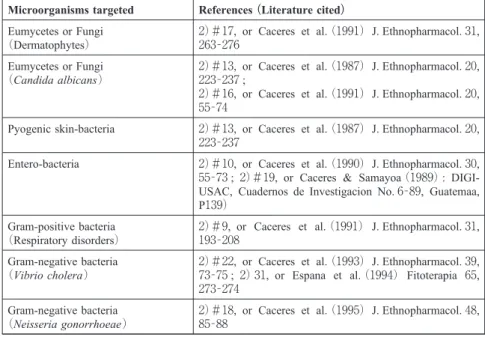
The result showed that about % of the properties could be demonstrated in vitro. As listed in Table , the important data on the effectiveness against the
Microorganisms targeted References(Literature cited) Eumycetes or Fungi
(Dermatophytes)
)# , or Caceres et al.( )J. Ethnopharmacol. , −
Eumycetes or Fungi (Candida albicans)
)# , or Caceres et al.( )J. Ethnopharmacol. , − ;
)# , or Caceres et al.( )J. Ethnopharmacol. , −
Pyogenic skin-bacteria )# , or Caceres et al.( )J. Ethnopharmacol. , −
Entero-bacteria )# , or Caceres et al.( )J. Ethnopharmacol. , − ; )# , or Caceres & Samayoa( ): DIGI-USAC, Cuadernos de Investigacion No. − , Guatemaa,
P )
Gram-positive bacteria (Respiratory disorders)
)# , or Caceres et al.( ) J. Ethnopharmacol. , −
Gram-negative bacteria (Vibrio cholera)
)# , or Caceres et al.( )J. Ethnopharmacol. , − ; ) , or Espana et al.( ) Fitoterapia ,
− Gram-negative bacteria
(Neisseria gonorrhoeae)
)# , or Caceres et al.( )J. Ethnopharmacol. , −
Table . Studies in Guatemala on effects of extracts from various plants on several species of microorganisms※
※from JICA Report)except for the information on T. cruzi. They have been published mostly in Journal of Ethnopharmacology.
following infectious pathogens are mostly included in Journal of Ethnopharmacology.
Contrary to the information from Table listed below, few studies have been carried out on the anti-parasitic effects of plant-origin drugs in Guatemala, except the studies on the activity against one of the most important protozoal venereal diseases, Trichomonas vaginalis infection( )# , or Morales ) and the roundworm Ascaris lumbricoides( )# , or Morales in the JICA Report).
In addition to the screening for the possible efficacy against these microorganisms and infectious pathogens(Table ), some pharmacological and clinical studies have been carried out, particularly in the demonstration of the following effectiveness.
Diuretic effect : )# , or Caceres et al.( ) J. Ethnopharmacol. , − .
Anti-inflammatory effect : )# , or Caceres et al.( )J. Ethnopharmacol. , − ; )# , or Caceres et al.( ) J. Ethonopharmacol. , −
.
Healing effect : )# , or Caceres & Lopez( )Fitoterapia , − .
Anti-candial effect : )# , or Giron et al.( )J. Ethonopharmacol. , − .
Although, the infrastructure and equipments in University of San Carlos (USAC), Guatemala have not been enough to carry out an ideal chemical elucidation of active principles. In cooperation with researchers in University of
Washington, USA, the chemical structures of the anti-fungal activity of Solanum nigrescens(cited as )# in the JICA Report)and Brysonima crassiflolia(cited as )# in the JICA Report)have been demonstrated.
Briefly speaking, Guatemala located in the tropical zone is a mountainous country. Several ecological and cultural circumstances coexist there to make the country of tremendous interest for medical and pharmaceutical scientists.
One is that a wide variety of parasitic diseases including incurable ones are rampant such as malaria, Chagas disease, Onchocerca volvulus and Leishmaniasis[ )# , or Cosenza & Kroeger, UNaH, P ; )# , or Orellana :“Indian Medicine in Highland Guatemala”P )].
The other is the abundance and diversity in medicinal plants which have been traditionally used for maladies from the Maya times. Drugs from indigenous trees and grasses play an important role still nowadays in the treatment of parasitic infections among Guatemalan people. Such kind of drugs have advantages in their supply, availability and the price.
However, there are some problems in utilization of crude drugs. Among the first is the problem that a great part of the natural resources are being exhausted quickly. The percentage of the area covered with forests has been much reduced than before. Now the percentage in Guatemala is no more than %, whereas it was % years ago. The urgent need in the present situation is the domestication of useful medicinal plants so that they do not disappear for good.
At the same time lies one pivotal thing. Almost all the medicinal drugs have hitherto been administered to patients based on empiricism or popular beliefs. With the exception of quinine from Cinchona spp. as an antimalarial drug and ascaridol from Chenopodium ambrosioides as anti-A. lumbricoides drug( )# ), there is no scientific evidence that supports the safety of the use of plant-origin drugs against parasites. The efficacy of so-called medicinal drugs should be scientifically
validated for the desirable and reasonable administration of the drugs to patients. It goes without saying that no effective drugs should not be administered.
The scientific evaluation of plant-derived drugs in anti-parasitic effectiveness is impossible without ethnobotanical information. The present authors(Maki & Caceres, )surveyed the available ethnobotanical literatures.) These describe
medicinal plants believed to be useful for the treatment of parasitic infections. This report describes Central American plants of possible utility in the elimination of parasites.
The ethnobotanical information has been collected on the possible medicinal drugs popularly used in Central American region against parasites. At least species of plants were found to be used or believed to be effective against parasites there.) A detailed review was prepared in regard to scientific name, popular name,
parts used, spectrum of attributable activity against parasites such as ameba, leishmanial, malaria, trichomonas, nematodes, trematodes and cestodes. It is hard to describe the exact species of the parasites because most of the expelled worms are recognized usually by inhabitants not parasitologists. And others are responsible for elephantiasis, sarcoptidosis, myiasis and so on. Summing up, they are classified into categories. The first group is for the plants used for the treatment of infections with protozoal parasites. The second group is for the plants used for the purpose of expelling helminth parasites. And the third group is the plants used for the other parasitic infections such as ecto-parasites.
These drugs which are believed to have anti-parasitic efficacy are worthy of being examined in their scientific validity by comparison of experimental (medicated)and control(non-medicated)groups. In this way the spectrum of the effective crude drugs should be clarified. Some of the drugs may be turned out to be non-effective, while others may be demonstrated to be as effective as modern synthesized drugs or to exceed modern drugs. It is desirable to find plant-origin
drugs or leading molecular structures which are better than modern medicine, not only in their efficacy and spectrum, but also with less adverse effects. Modern synthetic drugs are more or less inaccessible to the people in the rural regions and their cost is high. If plant-origin drugs with high efficacy and without any severe side effects are readily available to inhabitants living so remote from the towns, it would be no exaggeration to say that it be the welfare and well-being for them.
Ⅲ.Trypanocidal studies in Guatemala
.Endemicity of Chagas disease byTrypanosoma cruzi in Guatemala
Chagas disease is the common ailment in rural areas. It is restricted to the New World, namely Continental America and a few Caribbean islands(cited in the JICA Report as )# ). Twenty-four million people are presumed to be infected in the area. Depending the geographic area, most of the cases remain infected during the life without developing any symptoms(cited in the JICA Report as )# , ). The disease was first reported in Guatemala by Richenow( ). During the period of to , Renalver(cited in the JICA Report as )# ) defined the endemic area which included departments of the southeastern parts of the country, describing the vectors of the disease(Rhodnius prolixus, Triatoma dimidiate and T. nitida)and the rate of the house infestation( ∼ %). Since , the Department of cyto-histology of the Faculty of Chemical Sciences and Pharmacy, University of San Carlos, has been studying several aspects of the disease. Two main lines of research have been conducted, one being on epidemiology of the disease and the other on the transmission of intrauterine infection.
Entomological and serological studies were conducted as epidemiological work. The first study showed that .% of the inhabitants in the endemic zone were tested to be positive. In the second study, it was demonstrated that % of
blood-bank donors were serologically positive. Particularly in Chiquimula, .% of the people showed a positive reaction. In the third study, no significant changes occurred in samples from the endemic zones taken in ( .%)and those collected in the same villages in − ( .%), although important changes in housing facilities took place due to the earthquake which affected large parts of the country in . The fourth study showed that the group of cardiac patients from the endemic areas, ( %) had positive antibody titers by serologic methods.
This disease is mostly endemic in South and Central American countries. However, it is rather an orphan disease, since few studies to define the strategies for the control have taken place in the region. JICA Project study started to take measures in its control after demonstrating a number of patients suffering from this infectious disease in Santa Maria Ixhuatan where most of the people live still nowadays in mud houses.
Triatomes which burrow in the mud walls of the houses during the daytime and emerge at night to feed on human blood, should be controlled in Ixhuatan for the prevention of the people from further infection. At the same time patients should be treated with suitable chemotherapeutics. At present, the drug of choice is nifurtimox(Lampit!). This is available in Guatemala. This drug is said to be
highly toxic with a variety of side effects such as neuropathies, rash, gastro-intestinal and psychiatric disturbances followed by anorexia and weight loss. Few people are able to complete the long course of chemotherapy recommended for this drug. In a recent review it is evident that few drugs against T. cruzi are being experimented or used successfully, except for nifurtimox and allopurinol, though a relatively large number of drugs against African trypanosomiasis and leishmaniasis are reported(cited in the JICA Report as )# ). A promising drug is allopurinol, a drug being developed on the theory of a selective toxicity. T. cruzi
synthesize purines through salvage pathway, though mammalian hosts synthesize them mainly de novo. This is where a selective toxicity is expected to generate. Another possibility seems to be that the disease might be treated with extracts from plants indigenous to Guatemala. In this country, many kinds of plants have been believed to be effective for the curement of maladies and utilized among the inhabitants as mentioned above.
For this reason, the authors have surveyed many literatures so as to find any information on medicinal plants believed to be useful for patients with Chagas disease. However, in vain, no information on them has been obtained so far. On the other hand, about plants have been listed to be effective against many kinds of parasites.
.Promising plants to be studied
There still remains the possibility that extracts effective against T. cruzi might be discovered in other plants. However, the present authors, Maki & Caceres)
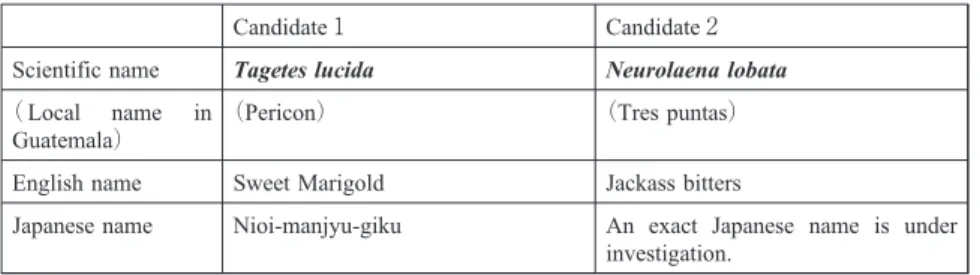
have decided to start screening tests of the plants listed. Especially they are interested in plants popularly used for malarial treatment. For the in vitro and in vivo tests in anti-T. cruzi activity, the two plants, Tagetes lucica and Neurolaena lobate were selected. These plants are explained in the JICA Report.) However,
they are cited here briefly in Table as follows.
Candidate Candidate
Scientific name Tagetes lucida Neurolaena lobata ( Local name in
Guatemala)
(Pericon) (Tres puntas)
English name Sweet Marigold Jackass bitters
Japanese name Nioi-manjyu-giku An exact Japanese name is under investigation.
Height of the herb ∼ cm About m Notes on general appearance and morphological characteristics of the herb
This perennial herb is erect, high with few branches and aromatic. Dried materials are resinous and gummy.
This is a kind of herb with the stout, angled and hairy stem. It has sometimes a few branches.
Leaf Leaves are of opposite type. These are stemless and rather oblong.
Leaves are alternate, stemless, rather oblong, and irregularly toothed. Flower Yellow, the rays are mm long. Small and yellow without rays. Seeds − mm long, grooved with pappus
− mm long
Black, . mm long with whitish pappus
Geographical distribution
Areas from Mexico to Northern Central America, , ∼ , m abve the sea level
Indigenous to thickets and waste places from Yucatan to northern Venezuela, ∼ , m above the sea level
Traditional utilization in Guatemala
It is said that decoction, infusion or tincture of the leaves and flowers have been used by local inhabitants in Guatemala for the treatment of spasmodic pains, diarrhea, gastritis, malaria and rheumatism.
Reportedly, infusion of the leaves have been used locally for pain, nervous weakness, anemia, diabetes, low blood pressure, malaria(studied using murine malaria Plasmodium berghei)and chronic ulcers. Examples of the
major ingredients and components
The leaves and and floweres are abundant in essential oil (e. g. limonene, anetol), alkaloids, coumarins, flavonoids, glycocides, leucoanthocyanines, saponins, tannins, polyacetylene, tiophene derivatives and acidic resins.
The leaves contain sesquiterpene lactones, germacranolides(neurolein B, lobatine A and lobatine B), many kinds of flavonoids such as derivatives from quercetagetine, kampherols and luteolines, and thymol derivatives.
Efficacy studied Enterobacteria, gram-positive bacteria and C. albicans
Carminative, diuretic, febrifuge, spasmolytic and tonic
Pharmacology Depression of the central nervous system, hypo-tensive activity and efficacy against spasm were studied.
Hypoglucemic activity and possible efficacy against Sarcoma experimentally in mice and rats were studied.
References cited in the JICA Report
)# , , , , , , , , , ,
.Preparation of extracts for screening
The plant material was kindly provided by Farmaya Laboratory(Guatemala City), which had collected them from organically cultivated fields and shade-dried ; voucher samples had been prepared for botanical confirmation and have been stored in its herbarium for further references.
From each of the plant drugs three kinds of extracts were prepared in a medium size percolator adapted by the present authors. The extract was obtained from powdered dry material, first with volumes of CH Cl and then with volumes of EtOH by percolation at room temperature for hours. Another test material was extracted from an equal amount of dry plant with water at ℃ by infusion during hours with agitation, followed by paper filtration.
The extract was concentrated first in a rotavapor under a reduced pressure and with a temperature less than ℃, and then by the final desiccation dehumidification in a drying chamber.
.In vitro trypanocidal assay
Laboratory strain(Telahuen)is maintained in mice. It is cultivated in LIT medium and diluted with fetal bovine serum to the trypomastigote density of × parasites/ml. The in vitro trypanocidal activity is determined by the adaptation of the techniques described by Cover & Gutteridge( : Trans. Roy. Soc. Trp. Med.
Hyg. , − )
Trypanocidal activity is evaluated by the semi-quantitative method using an inverted microscopy or counting in Neubauer chamber by comparison with culture medium and allopurinol.
A completely randomized design is performed. Each assay is consist of groups of microplate wells. T. cruzi is inoculated in LIT medium. The suspension contains × ∼ × parasites/ml.
The experimental and control groups are consist of the following No. ∼ . No. : Six wells withT. cruzi in LIT medium, normal control for the growth
cycle of the parasite
No. : Six wells withT. cruzi inoculated with allopurinol as a reference drug No. : Six wells withT. cruzi inoculated with µg/ml of plant extract to be tested No. : Six wells withT. cruzi inoculated with µg/ml of plant extract to be tested
The assay is measured with non-viable microorganism rate in each well hours after treatment administration. The wells should be preliminarily observed one hour after the treatment administration to avoid any acute toxic effect.
The rate of non-viable microorganism is considered to be the anti-protozoan activity. It is assumed that all the wells are under the same conditions before treatment administration.
The use of the concentrations of the plant extract is based on the fact that this study is a screening of anti-protozoan activity. According to the previous papers on preliminary tests, the dose-response curve showed the tendency of reaching a plateau at high concentrations.
The suspensions of T. cruzi epimastigotes were donated by Department of Protozoology, Institute for Tropical Medicine, Nagasaki University, Japan. A mouse harbouring trypomastigotes was supplied by the coworkers, Drs. Vivian Matta and Carlota Monroy. Trypomastigotes were collected from the blood of the mouse killed by cervical dislocation. The suspension containing trypomastigotes was centrifuged at , rpm to obtain the supernatant. This was then centrifuged again at , rmp. The resultant precipitation fraction was confirmed to contain trypomastigotes under the microscope.
.In vivo trypanocidal assay
The methodology is an adaptation of previously described methods(cited in the JICA Report as )# , and ). Twelve mice are inoculated with strains ofT. cruzi isolated in Guatemala. After hours, g/kg of extract is administered by the oral tube(nasogastric cannula). The experiment includes controls to which allopurinol in water is administered. A blood sample of . ml is obtained every other day and parasitemia is quantitated microscopically. Survival rate after days is evaluated.
.Anti-triatomine(vector ofT. cruzi)assay
This is also important for the comprehensive and integral approach towards the struggle against vectors of Chagas disease.
The vector is cultivated by standard procedures. The activity is determined by the topical application method described in the report. It is carried out in fourth instar of the vector, Triatoma infestans nymphs in a randomized setting.
.Pharmacological and toxicity tests with analysis
In addition to the assay of the extracts in trypanocidal activity carried out in Guatemala, other pharmacological properties such as microbial, anti-inflammatory, diuretic, analgesic and spasmolytic ones, are worthy of investigation. These are studied using rats. The acute toxicity is evaluated in mice by an established procedure. These are followed by the chronic toxicity test, and mutagenic and teratogenic studies. The results are analyzed by standard methods.
Ⅳ.Studies on anti-parasitic and other efficacy of various
plant-extracts from Asian, African and Latin-American countries
.Studies in Guatemala
The present authors have been interested in the scientific utilization of plants on earth for the promotion of health as above mentioned. It is true that importance has been attached to parasitic diseases so far. The present authors should promote the research so that the studies might hopefully help to establish the basis for the control of the incurable parasitic diseases in Guatemala and other countries.
So far the present authors have rather been concentrated in the study on experimental chemotherapy of trypanosomiasis. Useful natural products are interesting against other important parasites, namely, malaria, leishmaina, Onchocerca volvulus and Taenia solium. These parasites would hopefully be treated with extracts from medicinal plants in Guatemala and other countires.
Some natural products might be effective also for the treatment of virus infections, for instance that of dengue fever. To prevent inhabitants from these infections, it is important to control the vectors which bring the parasites. Such natural products that would be useful, available by the people, at low cost and without any severe side effects should be identified.
Based on lines of ethnobotanical information, medicinal plants should be scientifically examined in the efficacy against a wide variety of what are responsible for tropical or parasitic diseases mentioned above. When effective drugs are discovered in the laboratory, an immunological study is necessary so that the immune-diagnosis might help to judge the cure and prognosis of infected animals.
The other desirable activity is a cooperative study. It is of great concern to the present authors that medicinal plants of established effectiveness in a scientific way are utilized by rural people. A close survey should be necessary from the viewpoint
of human ecology. It is regrettable that the Guatemalan nature including useful medicinal plants is threatened and even being exhausted as mentioned above. The present authors heartily wish that human ecological studies might play an important role in stopping this sad tendency. We have to preserve this heritage for the coming generations.
.Studies in Japan
It is pivotal to find useful plant-origin drugs against not only tropical and parasitic diseases but also other infectious diseases such as those caused by the bacteria and the virus(Table ). In Japan, for instances, the components of the medicinal plant Angelica shikokiana have been found to have anti-HIV activity. )
Alkaline extracts from Sasa senanensis, and the pine-seed shell have been
Parasites targeted(classification) Literatures cited in this paper
Brugia pahangi(nematode) ★ ∼ ), )
Angiostrongylus cantonensis(nematode) )and a preliminary paper※ Trichinella spiralis(nematode) )
Trichuris muris(nematode) ), ) Hymenolepis nana(cestode) ), ), ) Schistosoma japonicum(trematode) ) Trichomonas vaginalis(protozoa) )
Trypanosoma cruzi(protozoa) )except for the studies in Guatemala Table . Studies in Japan on effects of extracts from various plants on several species of
parasites except for those shown in JICA Report)
★A series of the studies was started with the non-medicinal-plant substances listed as follows. Aoki, Y., Fujimaki, Y., Mitsui, Y., Kimura, E. & Maki, J. : Experimental studies on filariases : in vitro effects of substances on the movement and microfilarial production by adult Brugia pahangi(in Japanese)Proceedings of Cooperative studies in Institute for Tropical Medicine, Nagasaki University(“糸状虫症の化学療法に関する研究”’ ,長崎大学熱帯医学研究所『共
同研究報告集』) − ( )
※A preliminary study was carried out to show in vitro efficacy of Mexican-plant extracts against A. cantonensis. Maki et al.( ): Research Journal of Fukuoka University , − .
demonostrated to have a biological activity such as prominent antiviral one. ∼ )
Sakagami et al.( ))found that substances with only % of orally
administered high molecular weight lignin-carbohydrate complex(LCC) are incorporated into the blood, demonstrating the low bioavailability. In thought of this fact, in vivo tests of such kind of substances are worthy of their further investigation in the possible effects on pathogens, though it is essential to establish the most effective administration route and drug-delivery system.
Abe et al.( )) found an important fact. Pre-treatment with
lignin-carbohydrate complex(LCC) from the pine cone of Pinus parviflora(Sieb. et Zucc.)protected infant mice from Hymenolepis nana(cestode)infection, though the mechanism was undefined. The anti-parasite activity of LCC exceeded that of neutral polysaccharide of pine-cone extract(Fr.Ⅰ and Ⅱ), low molecular weight glucan(Schizophyllan), water-insoluble glucan purified from Alcaligenes faecalis var. myxogene IFO (TAK)and the carboxyl methyl glucan of TAK(CM-TAK), suggesting the involvement of lignin structure for the expression of anti-parasite activity.
Since LCC activated the gene expression of dectin- , mannose recetor, )any
stimulation of this receptor may also be contributing in the expression of anti-parasite activity.
Limited digestion experiments demonstrated that antiviral activity was derived from lignin portion(=phenylpropenoid polymers), but not that of carbohydrate. )
This was confirmed by the papers using synthetic lignin that does not contain carbohydrate showed slightly higher anti-influenza virus activity )and anti-HIV
activity. , )
Highly polymerized tannis showed some anti-HIV activity but not so potent as LCC, whereas condensed tannins and flavonoids were essentially inactive. )
Ⅴ.A tentative conclusion
The present authors have been interested for many years in the possible scientific utilization of plants in Asian, African and Latin-American countries for the promotion of health, especially anti-parasitic effects of extracts from traditional medicinal plants as shown in this report. They do not believe that their goal and dream can come true without the global cooperative work. Their efforts should always be made fresh and motivated. The continuation should be with the balance between the tradition and the modernization before an ideal completion.
Ⅵ.Acknowledgements
The present authors, Maki and Caceres wish to express their sincere gratitude to the researchers in University of San Carlos, Drs. Jorge Perez Folger, Erika BEHRENS, Maria Isabel DELEON, Fabiola MEZA and other researchers.
JICA members, Drs. Kazuki OGATA, Yoichi MINAMISHIMA, and other researchers are gratefully acknowledged for their guidance and cooperation.
Literature cited
)Maki, J., Kondo, A. & Yanagisawa, T. : Effects of alcoholic extract from Ma-Klua (Diospyros mollis)on adults and larvae of the dwarf tapeworm, Hymenolepis nana in mice and
on the infectivity of the eggs. Parasitology , − ( ).
)Maki, J. & Caceres, A.(# ∼ ): Preliminary studies on the effects of plant-origin drugs against parasites, especially Trypanosoma cruzi in Guatemala, JICA Report : Investigation of Tropical Diseases in Guatemala( )
)Caceres, A., Maki, J. & Lopez, B. : Actividad tripanocida in vitro de plantas de uso medicinal en Guatemala(nota). Enfermedades Tropicales en Guatemala , − ( ) )Maki, J., Ito, Y., Yanagi, T., Kanbara, H., Tada, I., Minamishima, Y., Minematsu, T., Ogata, K. & Caceres, A. : A literature search for ethnobotanical information on plants traditionally used for the treatment of parasitic diseases in Guatemala and other Central American countries(a
minireview), Japanese Journal of Tropical Medicine & Hygiene , − ( )
)Maki, J. : Search for new anti-parasitic drugs-Parasites and medicinal plants in Guatemala, Central America(in Japanese)(新しい抗寄生虫薬を求めて−中米グアテマラの寄生虫症と 薬用植物), Journal of Japanese Society of Hospital Pharmacists ( ), − ( ) )Caceres, A., Lopez, B., Maki, J., & Tada, I. : Anti-Trypanosoma cruzi activity of extracts from native medicinal plants used in Guatemala for protozoal infections(a minireview), Japanese Journal of Tropical Medicine & Hygiene , − ( )
)Zhang, Y., Maki, J., Du, J. & Ito, Y. : In vitro effects of decoction from five species of Chinese plants against Trichomonas vaginalis. Japanese Journal of Tropical Medicine & Hygiene , − ( )
) Maki, J., Kofi-Tsekpo, M. W., Fujimaki, Y., Mitsui, Y., Ito, Y. & Aoki, Y. : Non-effectiveness of Azadirachta indica(Neem tree)leaf extract against the larvae of Angiostrongylus cantonensis and Trichinella spiralis. Tropical Medicine , − ( )
)Aoki, Y., Fujimaki, Y., Mitsui, Y., Kimura, E., Terada, M. & Maki, J. : Studies on chemotherapy of filariases : clinical and experimental studies for the improvement of the method of diethylcarbamazine administration(in Japanese), Proceedings of Cooperative Studies in Institue for Tropical Medicine, Nagasaki University, − ,(“動物モデルを用いた糸状虫症の
化学療法に関する研究”’ 年長崎大学熱帯医学研究所『共同研究報告集』)( )
)Aoki, Y., Fujimaki, Y., Mitsui, Y., Terada, M., Maki, J. & Kimura, E. : Antifilarial and antischistosomal activity of traditional medicines used in tropical areas(in Japanese)Proceedings of Cooperative Studies in Institute for Tropical Medicine, Nagasaki University − ,(“熱帯地 域で使用される伝統薬の抗糸状虫・抗住血吸虫作用”’ 長崎大学熱帯医学研究所『共同
研究報告集』)( )
)Aoki, Y., Fujimaki, Y., Terada, M., Maki, J. & Kimura, E. : Studies on chemotherapy of filariases : In vitro effect of extract from Vernonia amygdalina on Brugia pahangi(in Japanese), Proceedings of Cooperative Studies in Institute for Tropical Medicine, Nagasaki University, −
,(“熱帯地域で使用される伝統薬の抗糸状虫・抗住血吸虫作用”’ 長崎大学熱帯医学研
究所『共同研究報告集』)( )
)Aoki, Y., Fujimaki, Y., Terada, M., Maki, J. & Kimura, E. : Anti-filarial action of traditional drugs from species of plants in Africa(in Japanese), Proceedings of Cooperative Studies, Institute for Tropical Medicine, Nagasaki University,(“熱帯地方で使用されている伝統薬の抗
糸状虫・抗住血吸虫作用”’ 長崎大学熱帯医学研究所『共同研究報告集』) − ( )
)Aoki, Y., Fujimaki, Y., Khunkitti, W., Ohta, F., Maki, J., Kimura, E. & Horii, Y. : Anti-filarial activity of extracts from traditional medicinal plants utilized in the tropical zone, with special emphasis on that in Thailand(in Japanese), Proceedings of Cooperative Studies in Institute for Tropical Medicine, Nagasaki University,(“熱帯地方で使用される伝統薬の抗糸状
虫作用”’ 長崎大学熱帯医学研究所『共同研究報告集』) − ( )
)Aoki, Y., Fujimaki, Y., Oda, T., Ohta, F., Maki, J., Kimura, E. & Horii, Y. : Anti-filarial action of traditional drugs from plants in Guatemala,Proceedings of Cooperative Studies in Institute for Tropical Medicine, Nagasaki University,(“熱帯地方で使用される伝統薬の抗糸状
虫作用”’ 長崎大学熱帯医学研究所『共同研究報告集』) − ( )
)Caceres, A., Gonzalez, S., Tada, I. & Maki, J. : Antibacterial and antifungal activity of native plants used in Guatemala for the treatment of protozoal infections(a minireview)Japanese Journal of Tropical Medicine & Hygiene , ( )
)Caceres, A., Lopez, B., Gonzalez, S., Berger, I., Tada, I., & Maki, J. : Plants used in Guatemala for the treatment of protozoal infections. I. Screening of activity to bacteria, fungi and American trypanosomes of native plants. Journal of Ethnopharmacology , −
( )
)Maki, J. & Ito, Y. : Fundamental studies on the experimental chemotherapy of mice infected with Trichuris muris for the development of successful treatment and control of Trichuris trichiura and trichuriasis (note). Collected Papers on the Control of Soil-transmitted Helminthiases , − ( )
)Maki, J., Kuwada, M., Kojima, H., Sakagami, H., Ogata, K., Garcia, N., Matta, V., Caceres, A. & Tada, I. : A social pharmaceutical approach with traditional medicines for the control of parasitic diseasesin Central America. Japanese Journal of Social Pharmaceutical Sciences ,
− ( )
)Maki, J., Kuwada, M., Akahane, H., Sakagami, H., Ogata, K., Garcia, N., Matta, V. Caceres, A. & Tada, I. : Traditional and scientific utilization of medicinal plants for the treatment of infectious diseases by microorganisms and parasites in the Mayan Civilization Region. Japanese Journal of History of Pharmacy , − ( )
)Maki, J., Kojima, H., Kuwada, M., Ito, Y., Caceres, A., Meza, F., Matta, V. L., Nave, F., Ogata, K., Tabaru, Y. & Tada, I. : An international cooperative study for the treatment and control of Chagas disease with scientific utilization of local medicinal plants(research note). Journal of Japan Association for International Health ( ), − ( )
)Maki, J. & Ito, Y. : Studies on anthelmintic effect of extract from Embelia ribes and other substances againstTrichuris muris of S-isolate in B . BR mice(note)Collected Papers on the Control of Soil-transmitted Helminthiases , − ( )
)Abe, F., Nagafuji, S., Yamauchi, T., Okabe, H., Maki, J., Higo, H., Akahane, H., Aguilar, A., Jimenez-Estrada, M., & Reyes-Chilpa, R. : Trypanocidal Constituents in plants . Evaluation of some Mexican plants for their trypanocidal activity and active constituents in Guaco, roots of Aristolochia taliscana. Biological Pharmaceutical Bulletin ( ), − ( ) )Okayasu, H., Suzuki, F., Satoh, K., Shioda, S., Dohi, K., Ikeda, Y., Nakashima, H., Komatsu,
N., Fujimaki, M., Hashimoto, K., Maki, J. & Sakagami, H. : Comparison of cytotoxicity and radical scavenging activity between tea extracts and Chinese medicines, In Vivo , −
( )
)Fujimaki, Y., Kamachi, T., Yanagi, T., Caceres, A., Maki, J. & Aoki, Y. : Macrofilaricidal and microfilaricidal effects of Neurolaena lobata, a Guatemalan medicinal plant, on Brugia pahangi, Journal of Helminthology , − ( )
)Maki, J., Maruyama, S., Sakagami, H. & Kuwada, M. : Azadiracta indica, a tropical medicinal plant with possible utility for the treatment of parasitoses, Kitasato Medical Journal, , −
( )
)Maki, J., Sakagami, H., Kuwada, M., Caceres, A., Sekiya, H. & Tamai, E. : Infections with gastrointestinal parasitic helminthes indigenous to Japan and their treatment historically studied in an attempt to control the diseases in countries where they are still rampant( )The Jomon to Edo periods, Japanese Journal for History of Pharmacy , − ( )
)Maki, J., Sekiya, H., Sakagami, H., Kuwada, M., Tamai, E. & Caceres, A. : A growing need for international cooperative studies to establish medicinal-plant therapy against obstinate and biohazardous nematodes in the tropical and subtropical areas and in Japan, Japanese Journal of Social Pharmacy, , − ( )
)Maki, J., Sekiya, H., Nishioka, R., Sakagami, H., Kuwada, M., Caceres, A. & Tamai, E. : International cooperative studies on possible treatment of intractable nematodes and other pathogens with plant extracts, Journal of International Health , ( )
)Tokuhiro, S. et al.(徳弘慎治,矢野弘子,長瀧 充,Jarilla Blanca, Tiu Wilfred, 宇田幸 司,鈴木智彦,牧 純,吾妻 健): Phosphagen kinase originating in arginine kinase of Schistosoma japonicum as the possible target by new anthelmintics(in Japanese : アルギニンキ ナーゼより進化した Schistosoma japonicum ホスファーゲンキナーゼの新規抗寄生虫薬ター ゲットとしての可能性), Recent Advances in Medical Sciences : Parasites and their Human and Animal Hosts(edited by S. Uni & I. Kimata), − ( )
)Sakagami, H., Matsuda, T., Satoh, K., Ohtsuki, S., Shimada, C., Kanamoto, T., Terakubo, S., Nakashima, H., Marita, Y., Ohkubo, A., Tsuda, T., Sunaga, K., Maki, J., Sugiura, T., Kitajima, M., Oizumi, H. & Oizumi, T. : Biological activity of SE- , granulated powder of Sasa senanensis Rehder leaf extract, In Vivo , − ( )
)Sakagami, H. et al., Maki, J., Watanabe, K., Kitajima, M., Horiuchi, M., Jia, J., Oizumi, H., & Oizumi, T.(坂上 宏等,牧 純,他): Effect of Sasa health containing tooth paste on oral environment-Relationship between halitosis and bacterial number on the tongue(ササヘルス配 合歯磨剤の口腔環境改善効果:口臭と舌細菌数の相関), New Food Industry, ( ), −
( )
中島秀喜,須永克佳,津田 整,牧 純,吉原正晶): Biological activity and future prospect of alkaline extract of pine seed shell(松の実殻アルカリ抽出液(SPN)の生物活性と今後の 展望), New Food Industry ( ), − ( )
)Sakagami, H. et al.(坂上 宏,佐藤和恵,金本大成,寺久保繁美,中島秀喜,牧 純, 白瀧義明,三間 修,斎田圭子): Biological activity and future prospect of Angelica shikokiana(Makino)(in Japanese, イヌトウキの生物活性と今後の展望), New Food Industry
( ), − ( )
)Sakagami, H., Asano, K., Yoshida, T. & Kawazoe, Y. : Organ distribution and toxicity of lignin. In vivo : − ( )
)Abe, M., Okamoto, K., Konno, K. & Sakagami, H. : Induction of antiparasite activity by pine cone lignin-related substances. In vivo : − ( )
)Kushida, T., Makino, T., Tomomura, M., Tomomura, A. & Sakagami, H. : Enhancement of dectin- gene expression by lignin-carbohydrate complex from Lendinus edodes extract(LEM)in mouse macrophage-like cell line. Anticancer Res : − ( )
)Sakagami, H., Kushida, T., Oizumi, T., Nakashima, H. & Makino, T. : Distribution of lignin carbohydrate complex in plant kingdom and its functionality as alternative medicine. Pharmacol
Ther : − ( )
)Sakagami, H., Nagata, K., Ishihama, A., Oh-hara, T. & Kawazoe, Y. : Anti-influenza virus activity of synthetically polymerized phenylpropenoids. Biochem Biophys Res Commun :
− ( )
)Nakashima, H., Murakami, T., Yamamoto, N., Naoe, T., Kawazoe, Y., Konno, K. & Sakagami, H. : Lignified materials as medicinal resources. V. Anti-HIV(human immunodeficiency virus) activity of some synthetic lignins. Chem Pharm Bull : − ( )
)Lai, P.K., Oh-hara, T., Tamura, Y., Kawazoe, Y., Konno, K., Sakagami, H., Tanaka, A. & Nonoyama, M. : Polymeric phenylpropenoids are the active components in the pine cone extract that inhibit the replication of type- human immunodeficiency virus in vitro. J Gen Appl Microbiol : − ( )
)Nakashima, H., Murakami, T., Yamamoto, N., Sakagami, H., Tanuma, S., Hatano, T., Yoshida, T. & Okuda, T. : Inhibition of human immunodeficiency viral replication by tannins and related compounds. Antiviral Res : − ( )
Appendix for Literature cited )# ∼ .