The New English:
New Thinking, New Teaching, New Outcomes
平 成 26 年度鳴門教育大学小学校英語教育センターシンポジウム基調講演
Nancy Dalcortivo
The New Jersey Japanese School
1. Introduction
Japanese English teachers can consider a new English class-one in which teachers think differently about English as a subject. This new thinking should lead to new teaching and new outcomes in the classroom. Those new outcomes will show themselves as students who are more communicative in English.
2. Classroom Goals
The ultimate goal of an English classroom is to develop communication in English. Short range goals consist of planning fun and interesting lessons and making students feel comfortable using English.
3. Comparing First Language Learning to the Current Style of Teaching English in the Japanese Classroom
When children learn their first language, they have a great deal of exposure to that language. But, in Japan, and in the Japanese classroom, there is limited exposure to English. Teachers can provide students with more English exposure in the classroom.
Children learning their first language learn through conversation, but in Japanese schools, students are taught mainly through the grammar-translation method. Teachers can choose activities that provide students with opportunities to communicate in real conversations in the classroom.
Children did not learn their first language in a set order. Teachers in Japan use a set curriculum to teach English. Of course, teachers need a
they gradually learn to play harder songs. And while they have to study some theory to learn to play the piano, they have to actually use the piano to practice and improve. This is also true of learning English. It is important for students to study English, but they also must use their English to practice and improve. Teachers can teach English as a living language-something to use and practice.
The four areas of English, listening, speaking, reading, and writing, can be thought of as the ingredients of a cake. Each individual ingredient comes together to make a delicious cake. The four areas of English work together when people communicate. Teachers can plan activities that bring these areas together.
5. New Teaching: Providing Motivation
There are many things teachers can do in the classroom to provide motivation for their students. Teachers can give their students a small
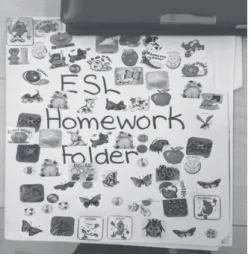
reward, such as a small sticker, when their students complete their homework. Homework does not have to be graded. Students can receive credit for completing their homework, whether accurate or not. As long as the students have shown effort, then they can be given credit for homework. Students can have an English homework folder to transport their homework to and from school. Students’ stickers can be placed on the folder. Seeing the sticker collection grow will remind students that they are doing a good job in English class.
Teachers can play classroom games where students must speak English to win. In this board game, Smiles and Clovers, shown here, if students land on a smile, they must say
something about themselves. If they land of a clover, they must ask their partner a question. This can also be adapted for students who are at the single word level. Students can name a picture when they land on a smile. When they land on a clover they can point to a picture and ask, “What’s this?” In games like this, it is recommended
Figure 1. ESL homework folder
Figure 2. Smiles and Clovers game
curriculum, but flexibility can be planned into the lessons so teachers can use time for conversation that is student directed. Flexibility in the curriculum allows teachers to revisit concepts taught when they arise in natural conversation.
Children learned their first language little by little, and they experimented with their new language. Many Japanese students want to speak English perfectly right away. This can lead to frustration. Teachers can help their students through feelings of frustration and can teach in a step-by-step fashion so students can experiment with their English in gradual levels of difficulty. Teachers can try to mimic first language learning as much as possible because when children learn their first language, they learn to communicate.
4. New Thinking
Teachers can think of their role in the classroom as a coach. A coach guides, encourages, and supports his/her team members. This new thinking translates into new teaching. If teachers think of their role as a coach, then they can do the following:
have a warm and friendly attitude
create a relaxing atmosphere in the classroom have a sense of humor
remind students it takes time to learn a language.
When their students attempt to speak English or even repeat after the teacher, teachers can encourage their students by saying, “Good job!” or “Good English!” Using these phrases will help students to relax and let them know that any attempt at speaking English is encouraged. This is very important, especially in very beginning stages of learning English.
Teachers can encourage their students to use the phrases “I don’t know” or “I don’t remember” in conversation. This is something that teachers might not want their students to say in a class such as Math or Science, but in an English class during a conversation, it is perfectly acceptable. In fact, learning to say those phrases helps students to become more communicative. People often use these phrases in general conversation. For example, the English teacher might ask his/her students about what they did over the weekend. Students might respond by saying “I went shopping” or “I watched TV.” Some students may have forgotten what they did. Those students can respond with “I don’t remember.”
Teachers can think of English as a performance subject. Learning a language can be compared to learning to playing the piano. When people learn to play the piano, they first learn easy songs. After much practice,
they gradually learn to play harder songs. And while they have to study some theory to learn to play the piano, they have to actually use the piano to practice and improve. This is also true of learning English. It is important for students to study English, but they also must use their English to practice and improve. Teachers can teach English as a living language-something to use and practice.
The four areas of English, listening, speaking, reading, and writing, can be thought of as the ingredients of a cake. Each individual ingredient comes together to make a delicious cake. The four areas of English work together when people communicate. Teachers can plan activities that bring these areas together.
5. New Teaching: Providing Motivation
There are many things teachers can do in the classroom to provide motivation for their students. Teachers can give their students a small
reward, such as a small sticker, when their students complete their homework. Homework does not have to be graded. Students can receive credit for completing their homework, whether accurate or not. As long as the students have shown effort, then they can be given credit for homework. Students can have an English homework folder to transport their homework to and from school. Students’ stickers can be placed on the folder. Seeing the sticker collection grow will remind students that they are doing a good job in English class.
Teachers can play classroom games where students must speak English to win. In this board game, Smiles and Clovers, shown here, if students land on a smile, they must say
something about themselves. If they land of a clover, they must ask their partner a question. This can also be adapted for students who are at the single word level. Students can name a picture when they land on a smile. When they land on a clover they can point to a picture and ask, “What’s this?” In games like this, it is recommended
Figure 1. ESL homework folder
Figure 2. Smiles and Clovers game
Some classes, such as Science and Social Studies, can be taught. Teachers can create a display of books and items labeled in English.
During a lesson, teachers can point something out in class without spending too much time teaching the concept and can then “move on” (continue on with the lesson). For example, in one English class, students had to describe fruit using two adjectives-color and shape. One student wanted to use three adjectives-color, shape, and size. While this was not part of the lesson, the teacher took a few minutes to explain how to use the word “and” in a series. After explaining the concept, the student repeated after the teacher, and then the teacher continued on with the original goal of the lesson.
7. New Teaching: Replacing Isolated Drills with Meaningful Context
There are many things teachers can do to provide English lessons in a meaningful context. Songs can help to develop vocabulary, learn sentence structure, and learn the rhythm of English. They can also be used to develop phonics (sound-symbol correspondence) skills. Teachers can give a copy of a song to each student and have the students sing it at every English class. Once students know the song fairly well, teachers can ask students to point to words. Teachers can also point out various sounds of letters in words in the song.
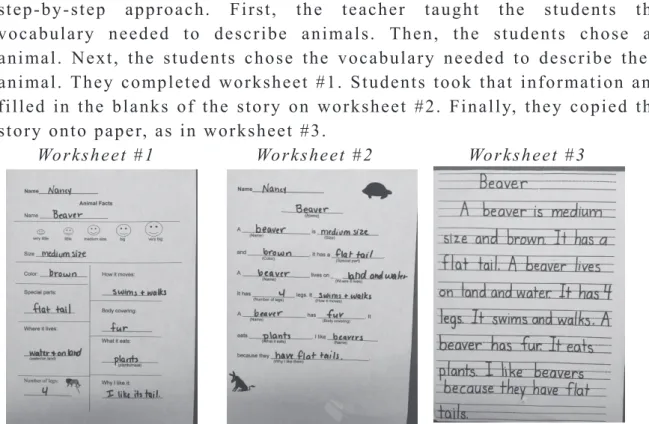
One teacher taught vocabulary through meaningful context in a step-by-step approach. First, the teacher taught the students the vocabulary needed to describe animals. Then, the students chose an animal. Next, the students chose the vocabulary needed to describe their animal. They completed worksheet #1. Students took that information and filled in the blanks of the story on worksheet #2. Finally, they copied the story onto paper, as in worksheet #3.
Worksheet #1 Worksheet #2 Worksheet #3
Figure 5. Example worksheets
that teachers practice the language needed for the game before playing. In very large classrooms, teachers can make enough copies of the game so students can play in groups of two to four students.
Teachers can also give students grades for participation. If students answer a question or offer an opinion, teachers can give students an A in class participation for the day, even if the students’ English was not accurate. The emphasis here is on participation and communication, not accurate English. As students become more competent in English, the criteria to earn an A can change to challenge the students while still encouraging them to speak English.
6. New Teaching: Providing for Plenty of Exposure
There are many things teachers can do to provide more exposure to English in the classroom. Teachers can label everything in the classroom. This includes things like the power cord, the window, and the ceiling, so words can be seen all over the classroom. Teachers can be creative. One teacher had a cup for sharp
pencils and a cup for dull pencils. She labeled the cups “sharp” and “dull.”
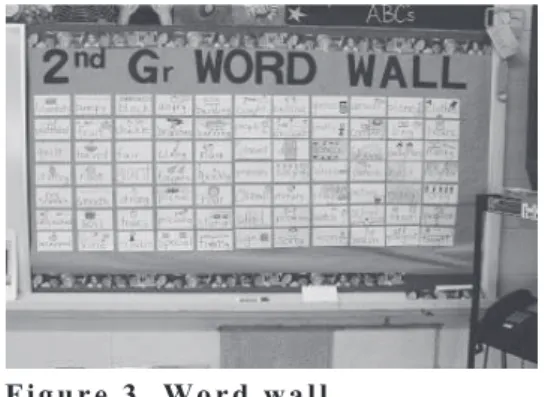
Teachers can make word walls. A word wall is an area on the wall where words are posted to serve as a reference for communicating. If teachers include pictures on the word wall, students can see the word and the picture together.
Teachers can have a library of English books, CD’s and DVD’s for students to bring home. This is something that takes time to develop but is very valuable. Signs, magazines, food boxes, and clothing labels can be displayed in the classroom. Students can be
invited to bring items with English words on them. These displays can be changed from time to time. The items on these displays do not have to be “taught.” They are there for students to look at and enjoy.
English does not have to be limited to the English class. Teachers can greet their students in English every morning, or say “Good-bye” to them every afternoon.
Figure 3. Word wall
Figure 4. English reference library
Some classes, such as Science and Social Studies, can be taught. Teachers can create a display of books and items labeled in English.
During a lesson, teachers can point something out in class without spending too much time teaching the concept and can then “move on” (continue on with the lesson). For example, in one English class, students had to describe fruit using two adjectives-color and shape. One student wanted to use three adjectives-color, shape, and size. While this was not part of the lesson, the teacher took a few minutes to explain how to use the word “and” in a series. After explaining the concept, the student repeated after the teacher, and then the teacher continued on with the original goal of the lesson.
7. New Teaching: Replacing Isolated Drills with Meaningful Context
There are many things teachers can do to provide English lessons in a meaningful context. Songs can help to develop vocabulary, learn sentence structure, and learn the rhythm of English. They can also be used to develop phonics (sound-symbol correspondence) skills. Teachers can give a copy of a song to each student and have the students sing it at every English class. Once students know the song fairly well, teachers can ask students to point to words. Teachers can also point out various sounds of letters in words in the song.
One teacher taught vocabulary through meaningful context in a step-by-step approach. First, the teacher taught the students the vocabulary needed to describe animals. Then, the students chose an animal. Next, the students chose the vocabulary needed to describe their animal. They completed worksheet #1. Students took that information and filled in the blanks of the story on worksheet #2. Finally, they copied the story onto paper, as in worksheet #3.
Worksheet #1 Worksheet #2 Worksheet #3
9. New Teaching: Balancing a Lesson
It is important to note that while there are many creative ways to create opportunities for English communication in class, there is still a place for workbooks and drills. It is important to have a balanced lesson, consisting of the right blend of communication activities and drills.
There are four parts to a balanced English lesson: Open Communication-Free conversation practice Direct Instruction-Mini-lessons, rote drills
Thematic work/Textbook work-Meaning emphasized Game playing/Review activities-For review or informal
presentation.
The amount of time spent on each section is flexible. Sometimes it may be necessary to omit a section, and other times it may be necessary to focus on only one section for the entire class period.
Open Communication (5-10 minutes): The goal of this time is to
practice real conversation. Teachers can allow the students to guide the conversation, if possible. This is a time to speak as much English as possible. During this time, teachers can encourage their students to develop their ability to use gestures and draw pictures to help them communicate instead of relying on Japanese.
The calendar is a good springboard for communication. It can be used to discuss birthdays, school events, and holidays. Students can recite a short speech that talks about the day of the week, the date, and the weather. Teachers can ask students questions about special events or birthdays after the speech. With large groups, after this is done as a whole class a few times, students can break into groups of four to complete this activity.
The following as an example of a calendar speech:
Today is Friday. Yesterday was Thursday. Tomorrow will be Saturday. It’s January 2, 2014. It’s cloudy and cold. It’s winter.
An alternate activity is to have conversation questions on question cards. Open Communication time can be used to ask students questions. Teachers can teach the whole class two to three questions. Then, in subsequent lessons, students can be divided into groups to practice the questions. When students are comfortable with these questions, the class can be taught as a whole again to learn more questions.
Showing students funny pictures can also help to stimulate conversation. Teachers and students can enjoy looking at a picture and Videos provide meaningful context in action. Teachers can choose
short videos where it is possible to tell what is going on by the actions. The following is a procedure to use videos to teach English:
Before class, develop vocabulary that is evident in the video. Create a picture dictionary as shown here.
In class, before viewing the video, explain what happens so students have an idea of the plot.
Watch the video all the way through without interruption. Then discuss the story using as much English as possible. Distribute the picture dictionary and go
over it with the students.
Watch the video again. Point out the new vocabulary.
Stop the video from time to time and discuss.
Practice target vocabulary. Role-play.
Watch the video a final time. Instruct students to listen for target vocabulary.
Another option for watching the video a final time is to watch the video with the sound off. Then talk about the video using as much English as possible.
8. New Teaching: Using Technology in Class and for Homework
Technology is a wonderful way to provide for more exposure to English. There are many websites and apps to use if technology is available. Not all of them are designed specifically for English language learning. The following are a few websites that can be used in the classroom: www.breakingnewsenglish.com www.englishcentral.com www.weblist.me/lets-practice-english http://pbskids.org/video www.eslgamesplus.com www.education.com www.starfall.com www.readingteacher.com www.galacticphonics.com Figure 6. Vocabulary scaffolding
9. New Teaching: Balancing a Lesson
It is important to note that while there are many creative ways to create opportunities for English communication in class, there is still a place for workbooks and drills. It is important to have a balanced lesson, consisting of the right blend of communication activities and drills.
There are four parts to a balanced English lesson: Open Communication-Free conversation practice Direct Instruction-Mini-lessons, rote drills
Thematic work/Textbook work-Meaning emphasized Game playing/Review activities-For review or informal
presentation.
The amount of time spent on each section is flexible. Sometimes it may be necessary to omit a section, and other times it may be necessary to focus on only one section for the entire class period.
Open Communication (5-10 minutes): The goal of this time is to
practice real conversation. Teachers can allow the students to guide the conversation, if possible. This is a time to speak as much English as possible. During this time, teachers can encourage their students to develop their ability to use gestures and draw pictures to help them communicate instead of relying on Japanese.
The calendar is a good springboard for communication. It can be used to discuss birthdays, school events, and holidays. Students can recite a short speech that talks about the day of the week, the date, and the weather. Teachers can ask students questions about special events or birthdays after the speech. With large groups, after this is done as a whole class a few times, students can break into groups of four to complete this activity.
The following as an example of a calendar speech:
Today is Friday. Yesterday was Thursday. Tomorrow will be Saturday. It’s January 2, 2014. It’s cloudy and cold. It’s winter.
An alternate activity is to have conversation questions on question cards. Open Communication time can be used to ask students questions. Teachers can teach the whole class two to three questions. Then, in subsequent lessons, students can be divided into groups to practice the questions. When students are comfortable with these questions, the class can be taught as a whole again to learn more questions.
Showing students funny pictures can also help to stimulate conversation. Teachers and students can enjoy looking at a picture and
classroom should be fun because teachers will have planned interesting and stimulating lesson in a relaxing environment. Students should be more communicative because they will have had much more practice in communication.
talk about it using as much English as possible.
During Open Communication time, teachers can do things to help students communicate. They can use pictures and gestures. When asking a question, they can give their students a choice for the answer. For example, if the teacher asks “What day is it?” and the students do not know the answer, the teacher can say “Is it Monday or Saturday?” Students can figure out the answer because of the obvious wrong choice. Teachers can also ask their students to help one another. Japanese can also be used, if necessary.
Direct Instruction (10-15 minutes): This is the time to focus on rote
memory drills, such as the days of the week, months of the year, flashcards, and workbook pages. Although this is a time when teachers teach explicitly, teachers can still try to incorporate conversation into the lesson. For example, teachers can ask their students questions, in English, about the workbook pages and talk about the pictures on the pages. They can also give instructions in English.
Thematic work/Textbook work (15-20 minutes): In this section of
the lesson, meaning is emphasized. Concepts are taught using conversation. This is the time to do the things that are required in the curriculum or to complete activities related to a relevant theme. For example, as Sports Day approaches, teachers can choose to teach a theme about sports. Teachers can pick activities that are centered around that theme. They can read a book about sports, give students a picture dictionary about sports, and have students complete worksheets on sports.
Game playing/Review activities (5-10 minutes, or if time permits):
Games provide a fun way to review concepts previously learned. They also provide a way to learn something informally. If there is a fun game to play, and students have not learned the material yet, they can learn the information through the game. In this case, teachers can tell the students that they have not learned the information yet, and they will learn it as they play.
Games that emphasize production can be chosen. Rules of games can be changed for this purpose. For example, when playing Bingo, “Silent Bingo” can be played. In this game, the teacher is silent and holds up the card, and students say the word or identify the picture.
10. New Outcomes
If teachers change their thinking about English as a subject, and if they change their teaching to include communicative activities in a meaningful context, then there should be new outcomes. The English
classroom should be fun because teachers will have planned interesting and stimulating lesson in a relaxing environment. Students should be more communicative because they will have had much more practice in communication.