Southeast Asian Studies, Vol. 19, No.1, June 1981
IncolD.e Levels and Basic Needs of Rubber SlD.allholders
in Traditional Villages in Malaysia
*SHAHORAN bin Johan Ariffin** and Walter E.
J.
TIPS***Introduction
As it has been found to be the case in many developing countries, in Malaysia there is a wide gap between urban, in-dustrial centres and the traditional agri-culture-oriented villages. In many of these, subsistence-level agriculture still prevails, despite the steadily growing gross national product of the country.
The present paper looks into the rubber smallholders' villages, both owner-tappers and so-called 'shared' or employed tappers will be considered. The attitudes as they are reflected in expenditure patterns and some key socio-economic parameters are studied to provide a baseline against which we will assess the past rural development effort. This baseline will also provide insights in how various aspects of socio-economic life are linked together.
Recently, a so-called basic needs approach has been proposed to replace strategies for rural development based on general
para-*
This paper is adapted from an advanced di-ploma thesis, MARA Institute of Technology, Dept. of Town and Regional Planning, Malay-sia. The responsibility lies with the authors and not with the department.** Project Orang Asli, Federal Town Planning Department,
Jalan
Young Kuala Lumpur, Malaysia*** Formerly Lecturer, Dept. of Town and Regional Planning, Malaysia. Reprint Address: Gemeen-testr. 47, B-3200 Kessel-La, Belgium
meters such as per capita GNP [Streeten et al. 1978]. The search for a basic needs vardstick is now on. The present paper may indicate how traditionally well-es-tablished parameters such as income levels are actually related to various aspects of basic needs.
Objectives
This paper envisages to investigate the various aspects of life in rubber-tapper villages. The income levels and a number of economic, agricultural and sociological variables of 113 rubber smallholders, both owner- and shared tappers [Wilson 1967], of the villages Kg. Batu Melintang, Kg. J alan Kachu and Kg. Dusun M uda in the state of Perak have been studied.
Possible ways to improve on the existing level of rural development and standards of living will be investigated by use of the relationships between various aspects of the socio-economic structure of this type of traditional villages. The income level in per capita household terms can be related to aspects of basic needs fulfilment such as food expenditure, the educational level of children, availability of water supply, hous-ing conditions, etc.
The main factors investigated are rubber yield per acre (0) and per capita household
Methods
The analytical techniques employed here are similar to the work of Abdullah bin 5epien [1979]. The Pearson correlation coefficient obtained in the Standard Pack of the Hewlett-Packard 97 is used to test for significant, linear associations between the yield, the per capita household income and the various other factors. Significance levels are according to Snedecor and Cochran [1976].
The data were collected in 1979 in three adjoining villages near Tapah (Perak), III
Income (i). Some 26 other variables are studied: household SIze (81), smallholder's age (52), spouse's age (53), smallholder's education (54), spouse's education (55), smallholder's expenence (56), spouse's experience (57), number of children (58), children's education index (59), technical knowledge (510), extension visits received (511), status of the smallholder (512), distance to the holding (513), type of the holding (S14), size of the holding (SIS), members employed (SI6), family out-migration (817), children still schooling (518), smallholder's awareness of rural development programmes (519), food ex-penditure (820), water exex-penditure (821), electricity expenditure (522), children's
edu-cation expenditure (523), (824), home facilities furniture (526).
housing condition (S25) and home
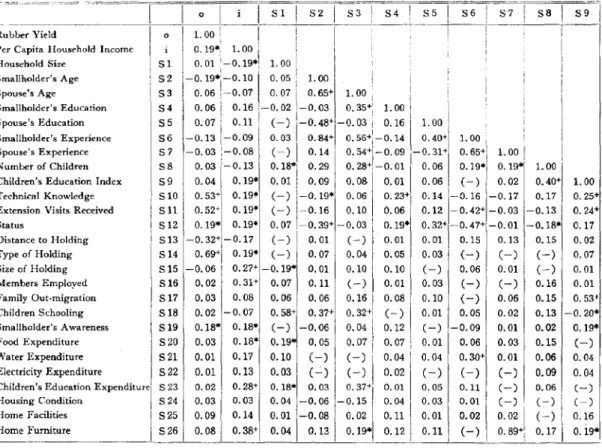
Table 1 Correlation Matrix of Socia-economic Variables of Rubber Smallholders (N =113)
I ! I I I I 1.00 ' 0.40+ 1. 00 0.17 0.25+ -0.13 0.24+ -0.18* 0.17 0.15 O. 02 (-) 0.07 (-) 0.01 0.16 O. 01 0.15 0.53+ 0.13 -0.20* 0.02 0.19* 0.15 (-) 0.06 0.04 0.09 0.04 0.06 ( - ) (-) (-) (-) 0.16 0.17 0.19" , o
i
s
1 Is
2Is;;
I S 4 ! S 5I
S 6 ! S 7.! s
8I
S 91 - ---_.~----~---+---:---;---;-/ 0 1 . 0 0 1I
i I, i 0.19* 1. 00i
'
!51 0.01 '-0.19*: 1.00: : 52 -0.19*: -0.10 'I 0.05! 1. 00 i iI
53 O. 06 :- O. 07 O. 07 I 0.65+ 1. 00 : I54 0.06i
0.16,-0.02 !-0.03 0.35+: LOa! , I I ' i I ,S5 0.07i 0.11, (-)1-
0. 48+1'-0.03i 0. 16 11.00 56 -0.13 [-0.09 0.03, 0.84+ 0.56+,-0.14 0.40+ 1.00,I
I 57 -0.03 :-0.08 (-)I
0.14 0.54+1-0.09 1 -0.31+ 0.65+: 1.00I 58 0.03 1 '-0.13 0.18*i 0.29 o.28+!-0.01 0.06 0.19*1 0.19*'1 59 \ 0.04 0.19* 0.01i 0.09 0.081 O. 01 O. 06 (-) O. 02 I 510 0.53+ 0.19* (-) j-0.19* 0.06 0.23+ 0.14 -0.16 -0.17 i 511 , 0.52+ 0.19* (-) 1-0.16 0.10I 0.06 0.12 -0.42+-0.03!
512 1 0.19" 0.19* 0.07 -0.39+ -0.03 'I 0.19* 0.32+ -0.47+ -0.01 !5131-0.32+-0.17 (-) I 0.01 (-) 0.01 0.01 0.15 0.13 514 0.69+ 0.19* (- ) O. 07 O. 04 O. 05 O. 03 (- ) ( -) 515 -0.06 0.27+ -0.19* O. 01 0.10I
0.10 (-) 0.06 O. 01 816 0.02 0.31+ 0.07 0.11 (-) 0.01 0.03 (-) (-) 817 O. 03 O. 08 0.06 O. 06 0.16I
O. 08 0.10 (-) 0.06 !818 O. 02 -0.07 0.58+ 0.37+ 0.32+: (- ) O. 01 0.05 0.02 819 0.18" 0.18* (-) -0.06 0.04i 0.12 (-)-0.09 0.01 820 O. 03 0.18* 0.19" O. 05 0.07i
O. 07 O. 01 0.06 O. 03 521 0.01 0.17 0.10 (--:-) (-)I
0.04 0.04 0.30+ 0.01 S 22 0.01 0.13 0.03 ( - ) ( - ) 0.02 ( - ) ( - ) ( - ) S 23 0.02 0.28+ O. 18" 0.03 0.37+' 0.01 0.05 0.11 (-) 824 0.03 0.03 0.04 1 -0.06 -0.15 0.04 0.03 0.01 (-) S 25 0.09 0.14 O. 01 -0. 08 O. 02 0.11 0.01 0.02 0.02 I, 826 0.08 0.38+ O. 04 0.13 0.19" 0.12 0.11 (-) 0.89+: Distance to Holding Type of Holding Size of Holding Members Employed Family Out·migration Children Schooling Smallholder's Awareness Food Expenditure Water Expenditure Electricity Expenditure I ChiIdren's Education Expenditurel Housing ConditionHome Facilities I Home Furniture
Rubber Yield
Per Capita llousehoid Income Household Size Smallholder's Age Spous.e's Age Smallholder's Education Spouse's Education Smallholder's Experience Spouse's Experience Number of Children Children's Education Index Technical Knowledge Extension Visits Received
Status
Significance Level:
*
5 percent, + 1 percent Note: (-) ill-fit of dataSHAHORAN l.A. and W. E ..1. TIPS: Income Levels of Rubber Smallholders in Malaysia.
order to minimize variations of factors not accounted for in the analysis, such as soil types and other environmental factors.
Results and Discussion
Results are arranged first under the various parameters, secondly the relation-ships will be discussed, and finally some possible strategies for rural development improvements will be touched upon.
Results for the Various Variables
Significant correlations between factors can be read from Table 1.
Rubber Yield (0)
Rubber yield is measured here as total latex output per acre per month in the local
katis (1 kati=0.60 kg). This commercially significant rubber yield represents the main source of income for the rubber small-holders. The total number of tapping days in our study area was found to be about twenty, which corresponds to other sources [Freestone 1974; Swift 1965; Syed Husin 1975]. The average yield amounts to 105.95 katis (s.d. 33.94) per month.
Per Capita Household Income (i)
The per capita household income in our study area IS 46.72 Malaysian ringgit
(s.d. 37.86). Although the range is quite great, it is safe to say that we are dealing with poor families, because the Economic Planning Unit (Prime Minister's Depart-ment of Malaysia) defines the poverty line
S10 Sl1 S12 S13 514 S15 S16 517 S18 519 520 521 522 S23 524 525 526 1. 00 I 0.42+1 1. 00 I 1 0.47+ 1 " 0. 12 11. 00I -0.09,-0.42+ 0.17 1.00 0.21 *, 0.87* O.19*i 0.10 1.00 0.12! 0.04 0.19* 0.07 0.03 Ii 1. 00 (-) i (- ) 0.01 0.01 0.01 I[ 0.02 0.17i 0.15 0.18 (-) 0.04 0.02 1.00 0.18*1 0.17 0.03 (-) 0.01 0.04 0.13 1.00 0.20~i 0.23+ 0.29+ 0.24+ 0.19*1 0.01 0.01 0.18* 1. 00 'I' 0.04 i (- ) 0.07 ( - ) 0.03 I' 0.07 0.07 0.32+ ( - ) 1. 00 (-)! (- ) 0.10 ( - ) 0.01 0.04 0.02 11I ( - ) i 0.01 1.00 0.03I 0.01 0.14 ( - ) ( - ) II (- ) 0.02 0.06' 0.01 0.07 0.32+ 1. 00 0.03 0.03 0.09 0.03 ( - ) 0.08 0.01 0.25+ 0.01 0.10 0.64+ 0.04 1. 00 (- ) 0.01 0.09 ( - ) 0.39+1' 0.01 ( - ) 0.03 0.02 O. OS 0.09 0.11 O. OS 1. 00 0.01 ( - ) 0.18* 0.01 0.13 - O. 26+ ( - ) ( - ) ( - ) (- ) 0.01 0.07 0.05 ( - ) I 0.18* 1. 00 ~_0._0_1.1-.-0_'_07-,-_0_'0_1-l.-_0._13- L _O_.0_6-,-_0._1_4_--L-O_._OS--C-_(_-_)---L_0._0_2..L--0_'_04-L_O_.0_8--L-_0._19_•..L--0_'_03-'---_0_.°_5...1-_°._48_+1.--1_.0_0
to be at M$ 46.73. If we would exclude all non-rubber income such as remittances from children, and base the figure on the productive activities alone, the per capita household income would be much lower. Household Size (Sl)
The average household size in the study area is 5.36 (s.d. 2.85), whereas it is 5.6 for the nation [Government of Malaysia 1976]. This suggests that there is a high rate of migration because the average number of children is about 6 (see below). In any case, the government rural midwife did report a poor response to the family plan-nmg programmes.
Smallholder's Age (S2)
The average age for the smallholders is about 50 years (s.d. 12.44 years). A breakdown confirms findings of Abdullah bin Sepien [1979]; only about 5 percent are below 35 years old, others were mostly above 45 years old.
Spouse's Age (S3)
Although, the husband IS the prime
source of income for the household in Malaysia, in many instances the spouse is required to take over from her husband, thus her age and tapping experience need to be considered. The average age of the smallholder's wives in the study area IS
about 43.5 years (s.d. 9.17). Smallholder's Education (S4)
This factor, recorded as the number of completed years of formal schooling, is of increasing importance in the more tech-nologically sophisticated rubber production improvement programmes.
The average number of years of formal schooling completed by each smallholder
is 3.45 (s.d. 1.37 years). Spouse's Educal'ion (S5)
The spouse's education IS 1.69 years of
formal schooling on average, with great variability (s.d. 1.91).
Smallholder's Tapping Experience (S6) The smallholders have approximately 25 years of tapping experience (s.d. 11.62). This information is important because less experienced tappers, e.g., tend to damage the trees resulting in less rubber yield. However, after a certain experience level is reached (or with careful inexperienced tappers) more experience will not lead to higher rubber yield. On the contrary, older, although very experienced, tappers tend to be less productive due to old age. Spouse's Tapping Experience (S7)
On average, spouses have 17.55 years of tapping experience (s.d. 9.74 years). Based on an average age of 44 years, this suggests that most of the spouses started work quite late, about eight years after getting married, if the age of eighteen is still the marrigeable age, as Firth [1943] observed.
Number of Ch,,'ldren (S8)
Table 2 displays the breakdown of the number of children per family in the study area. Over 68 percent of the smallholders has more than four children. The average number of children per family is 5.6 (s.d. 2.58). This is typical for the rural areas in Malaysia, where, in spite of somewhat lower standards of health care [Meerman 1979] the average number of children is significantly higher than in urban areas. Children's Education Index (S9)
Since there is no direct measurement possible, we have constructed an index as
SHAHORAN J.A. and W. E.J. TIPS: Income Levels of Rubber Smallholders in Malaysia
~~~~~~ ~ .
-Table 2 Number of Children of Smallholders Number of Number of % Children Smallholders ~ ~ ' " -0 4 3.6 1 - 2 7 6.2 3 - 4 25 22.1 5 - 6 22 19.5 7 - 8 32 28.3 9 -10 18 15.9 11 above 5 4.4
follows: a child attending primary school, lower secondary, completing upper secon-dary, or attending tertiary level education is scored 1, 2, 4 or 5, respectively; obtaining certificates, a diploma or a degree at lower secondary, upper secondary or higher level is valued by 1, 2 or 3 points respectively. The total score for all children is called the children's education index. We found a value of 7.62 with very high variability (s.d. 6.31).
Our findings contradict Abdullah bin Sepien [1979J, in that less educated vil-lagers do not necessarily give less attention to the education of their children.
Smallholder's Technical Knowledge (S10)
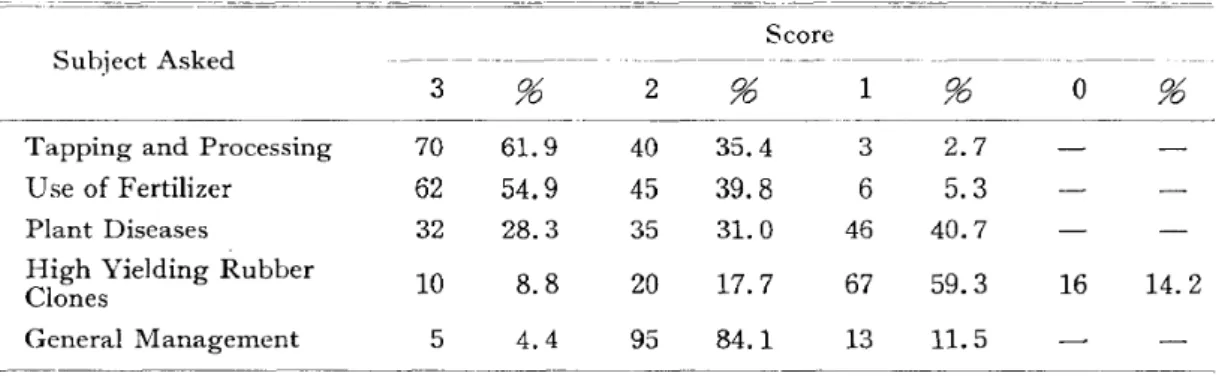
Questions on five simple technical aspects of their profession, scored from three to
zero points have been asked. The questions relate to the proper tapping and processing procedure, fertilizer use, plant diseases, high yielding rubber varieties, and holding management. A total of all scores is made. In the study area, the smallholders' main sources of technical knowledge are the visits of extension officers of the Rubber Industry Smallholders Development Au-thority (RISDA), the Agriculture Depart-ment and the officers of the Rubber Re-search Institute of Malaysia as well as publications and more informal sources existing in the village (radio, television, relatives, etc.). Average scores are quite low, eight to be precise, with breakdowns as in Table 3.
Extension Visits Received (511)
The extension visits come from the above named sources. On average the small-holders received 2.42 extension visits yearly (s.d. 2.22). This can be considered too low to achieve any significant acceptance of new techniques, since Mohinder Singh [1978J has stressed that only frequent visits and constant persuasion and guidance will convince the smallholders to take risks which are rather great in proportion to their earnings. The villages in 1Vlalacca, reported
100.0 113
Total
Table 3 Smallholders' Knowledge of Five Technical Aspects of Rubber Farming ----~---~-~--~-~ -~--~-~~--~---~--~._-~----_.=====~~=
Score
Subject Asked - - _ . _ - - _ . _ - ~ - ~ - - - _ .- ~--- - - - ~
-3 % 2 % 1 % 0 %
Tapping and Processing 70 61. 9 40 35.4 3 2.7
Use of Fertilizer 62 54.9 45 39.8 6 5.3
Plant Diseases 32 28.3 35 31. 0 46 40.7
High Yielding Rubber 10 8.8 20
17.7 67 59.3 16 14.2
Clones
on by Abdullah bin Sepien [1979] are much better off, with their six extension visits a year. The reason may well be that more than 40 percent of the land under rubber consists of old holdings where guid-ance will not make much difference, unless the smallholders are convinced to replant their land with high-yielding rubber trees. Status of the Smallholder (S12)
Some of the factors determining the status of a person in the Malay community are age, personal qualities, religious roles, education, occupation and wealth [Syed Husin 1975]. In addition, we have also collected data on the roles a person plays in political or rural institutions.
In our study, being an ordinary member or holding a leadership post in any agri-cultural organization is scored 2 and 3 points respectively, membership and leadership in non-agricultural organizations is scored 1 and 2 points respectively.
On average the smallholders scored 1.83 points (s.d. 1.61 points), testifying to their limited involvement with institutionalized community life. Most smallholders are members of the Village Welfare Organi-zation, and thirty of them are receiving aid from RISDA in their replanting scheme.
The suggestion that more active indi-viduals tend to produce more rubber (cor-relation S12-0) contradicts the finding made by Afifuddin [1973] for padi farmers in Kedah.
Distance from Home to Holding (S13) In tropical areas, especially when the road condition is poor, and when motor-bikes or even bicycle-owning smallholders are few, the distance from home to working
place becomes an important factor in the productivity of the tappers. In addition, most of the tappers in our study are above fifty years old, and thus, spend a consider-able amount of their energy on the journey to work. We found an average distance of 1.40 miles (s.d. 1.02 miles) from home to holding, but 45 percent of the tappers travel more than 1.5 miles.
Type of Smallholding (S14)
A three point score was given for govern-ment subsidized replanted holdings, whereas all other holdings were given one point.
Less than the 60 percent of the small-holders are operating newly planted high yielding holdings. This resulted in a 2.20 score (s.d. 2.13) reflecting comparatively low acceptance of the replanting programme which was started in the sixties in the study area.
Size of Smallholding (S15)
Uneconomic size of smallholdings has always been identified as one of the major factors affecting the rubber productivity. Due to the muslim law of inheritance, which makes fragmentation almost unavoidable, there are now over 50,000 smallholdings of a size smaller than 5 acres [Mohinder Singh 1978]. In our study area, the average size is only 2.49 acres (s.d. 2.31
acres).
Number of Household Members Employed (S16)
This is the number of household members working In any full-time occupation. About two members of each family are working outside (s.d. 0.66). About 70 percent of the households have children who work outside, mostly as labourers and
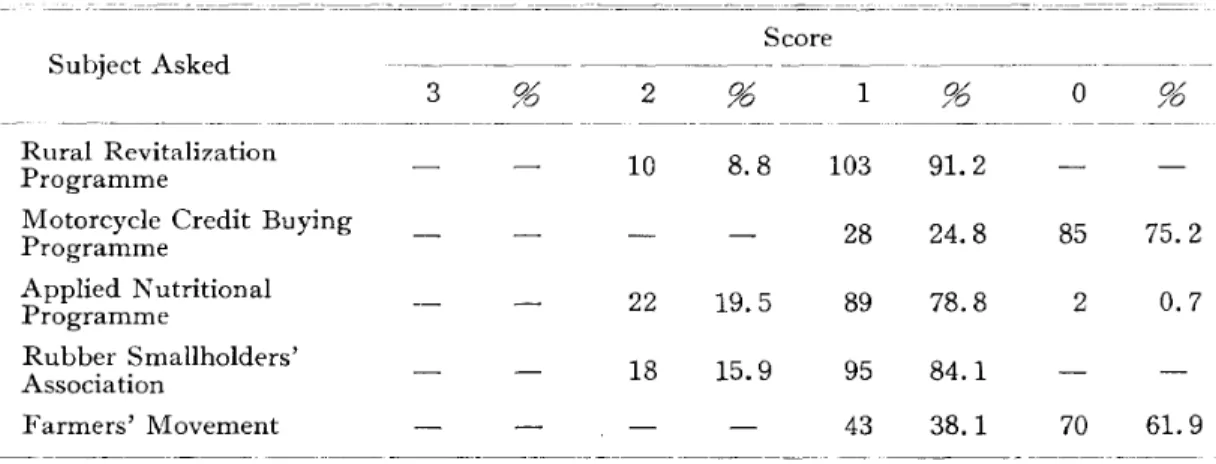
cleri-SHAHORAN J.A. and W. E.]. TIPS: Income Levels of Rubber Smallholders in Malaysia Table 4 Smallholders' Awareness of Rural Development Programmes
-Subject Asked 3 % 2 % Score 1 %
o
96 Rural Revitalization ProgrammeMotorcycle Credit Buying Programme Applied Nutritional Programme Rubber Smallholders' Association Farmers' Movement 10 22 18 8.8 19.5 15.9 103 28 89 95 43 91. 2 24.8 78.8 84.1 38.1 85 2 70 75.2 0.7 61. 9
Table 5 Expenditure Breakdown for the Average Rubber Smallholder
Rural Revitalization Programme, the Ap-plied Nutritional Programme (which is con-cerned with a multi-departmental effort on a selected village during one year), the Rubber Smallholders' Association, the Motorcycle Credit Buying Programme and the Farmers' Movement (a general new approach towards intensifying local rural development projects), have been scored for each smallholder (see Table 4). After pool-ing the scores, the average score is 4.97 points (s.d. 2.17 points); out of a maximum of 15, this is indeed low. Especially recent programmes are not known, and the benefits of others seem to be ignored.
Food Expenditure (S20)
Expenditure on food poses a heavy toll
Food Water % 69.98 1.12 1. 90 6.08 20.92 100.00 s.d. 69.56 1.12 3.28 13.10 138.67 263.94 184.71 2.95 5.01 16.05 55.22 Amount Spent Monthly Commodities Total Household Income Electricity Education Residual Amount
make use of five selected rural devel-opment programmes may shed some light on the actual improvements gov-ernment efforts can bring about. On a scale of 3 to 0, the knowledge on the cal staff in government departments. Most wives are working on the holdings.
Fami~'V Out-migration (SI7)
One of the most striking features of many developing nations is the net out-migration to the urban centres, of younger people more particularly. In our study area, the age group from 20 to 35 years made up only 16 percent of the total population. On average three members of the family have left the home (s.d. about 2), and judging from the population pyramid, they have left the village.
Number of Children Schooling (SI8)
Children attending school directly affect the expenditure pattern of the family, they also influence the attitudes of their parents. On average two family members are still attending school at the expense of the smallholder.
Smallholder's Awareness of Rural Development Programmes (S19)
on most of the household budgets (see Table 5): nearly 70 percent of the household income goes to food.
Water and Electricity Expenditure (S21 and S22)
Although 70 percent of the sample fami-lies had piped water at their disposal, most families still rely heavily on the rivers present in the area, especially because they provide high quality, unpolluted water. This low water expenditure is matched by a low expenditure on electricity, also in spite of the fact that 80 percent of the families have access to the commodity. Thus, it looks that a large number of families are, apart from their financial constraints, traditionally-minded and do not make excessive use of·modern facilities (see Table 5).
Expenditure on Education (S23)
Although Malaysia possesses an elaborate free primary school system, the study reveals that a considerable amount (6 percent) of the household income is spent on informal school fees, books, writing materials, uni-forms and 'pocket money' for school-going children. Meerman [1979] even reports the figure to be 13 percent of the household's Income. The difference between these two figures may be explained by the fact that
rural schools cost less. Housing Condition (S24)
An index has been constructed by scoring various aspects of the housing condition (points between brackets) according to: -year of completion of the dwelling: after
1969 (3), from 1969 till 1957 (2), before
independence (1) ;-type of house: brick (4), half brick and half timber (3), timber (2), or bamboo or attap (1) ;-roof material: tiles (4), asbestos (3), zinc (2), attap (1). Because the house is traditionally the most valued material possession, the villagers tend to put much emphasis on the overall housing condition and maintain their dwell-ing well.
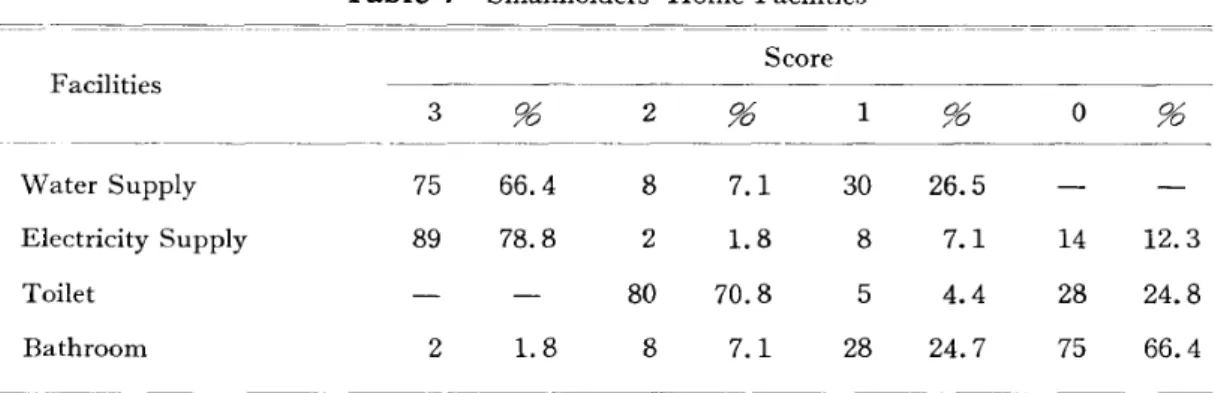
Scores are summarized in Table 6. The average score amounts to 5.74 points (s.d. 1.06) out of a maximum of 11 points. Home Facilities (825)
Again we have constructed an index by scoring certain aspects (points between brackets): -water supply: own piped water (3), access to piped water (2), well or spring water (1); -electricity supply: own cable (3), generator or battery (2), none or gasoline lighting (1); -toilet: flush toilet (3), other approved by local authority (2), access to any of the preceding (1); -bathroom: bathroom with house
SHAHORAN J.A. and W. E. J. TIPS: Income Levels of Rubber Smallholders in Malaysia
Table 7 Smallholders' Home Facilities Score Facilities 3 % 2 % 1 96 - - - _ .- - - ~ - - - _ .__.. -~~---_._---Water Supply 75 66.4 8 7.1 30 26.5 Electricity Supply 89 78.8 2 1.8 8 7.1 Toilet 80 70.8 5 4.4 Bathroom 2 1.8 8 7.1 28 24.7 - - - ~ . _ - - - - -
---o
%
14 12.3 28 24.8 75 66.4together (3), outside unattached bathroom (2), open place for bathing (1).
An average score of 7.86 out of a maXI-mum of 12 is obtained (s.d. 2.49). Detailed scorings can be found in Table 7. Most striking is that only about 9 percent of the households have an attached bathroom, while the majority still uses the river.
Home Furniture (S26)
The index constructed to measure this is based on one point each for radio, television, refrigerator, dining table, settee or other piece of furniture, with an addi-tional point given if the device consumes electricity.
The score is on average 3.53 points (s.d. 2.61 points) only.
Conclusions: Relationships between Factors Following the results of the correlation analysis, several broad conclusions can be drawn here. First, the positive association between rubber yield and the per capita household income, suggests that by increas-ing the rubber yield, the household income per head could be increased considerably. This is an important point which needs serious attention because the average in-come from rubber alone has been shown to
comprise only 65 percent of the total income. The remainder, which is supplied by other family members, is not likely to increase much.
Before embarking on any form of corrective measures, one important question needs to be answered first: Is the rubber yield which serves as the basic livelihood for the smallholders in the study area below that which is expected of an average, optimally-producing, smallholder?
Abdullah bin Sepien [1978] noted that the average rubber output per acre for the Malay smallholders in three Federal Land Development Authority settlement schemes was about 140 katis per acre, while that of their Chinese colleagues was 165 katis per acre. According to the district's RISDA office [Shahoran 1980], the average smallholding which has been replanted with high yielding rubber trees is capable of producing an output of between 8 to 12 katis per acre and per day. Taking the average of 20 tapping days, this means 160 to 240 katis per acre and per month.
The situation in the study area shows that the average rubber yield for all the smallholders is only about 106 katis per acre and per month. This is lower than
the rubber yield obtained by the average smallholder in the FELDA schemes and certainly much lower than the yield sug-gested by RISDA. The average output for holdings not replanted is less than 75 katis per acre and per month. But, even the smallholders operating a replanted holding in our study area did less well than what is expected: 118.83 katis per acre and per month on average.
Thus, it is clear that, given the right conditions, and with proper corrective measures, the ruhber yield can undoubtedly be increased. Therefore, the traditional approach of trying to increase incomes is still valid.
In this regard, the absence of users of piped water may shed some light on one of the arguments of proponents of basic needs in attacking the insufficiency of the tradi-tional approach, namely that consumers are not sufficiently knowledgeable about health and nutrition, and will therefore not spend incremental incomes wisely or effi-ciently (see Hicks [1979]). Thus, later corrections in the preference rankings of the people would be necessary.
Secondly, both the output of rubber per acre and the total household income for the average smallholder could be increased substantially if (1) he has acquired enough technical knowledge, (2) he is aware of the opportunities that are contained in various rural development programmes which could help him to improve his socio-eco-nomic standing, (3) he participates in the various organizations which could offer him assistance and advice on how to im-prove his rubber yield and further
supple-ment his Income from rubber and (4) he owns or operates a holding planted with a high yielding rubber species. Similar observations were made by Abdullah bin Sepien [1979], Bhati [1971] for padi farmers and Afifuddin [1973].
Thirdly, the yield tends to be bigger for the younger smallholder and if the distance to the place of work is shorter. Thus, we could improve the accessibility which could help to technically 'shorten' the journey to work. In this way, the older tappers will have more energy left to work on the holding. This conclusion also tends to pinpoint the weaknesses in the present method of tapping and processing which impose a heavy toll on the older and less energetic smallholders.
The fourth conclusion that can be drawn, has significant implications for the policy of land ownership. The negative associ-ation between the household per capita income and the size of the holding suggests that those who are able to work on a larger smallholding have an advantage.
The fifth point is that the educational level of the children and the general level of living conditions depend considerably on the smallholder's income. Thus, by im-proving the income of the smallholders, the factors which depend on it can also be improved.
Lastly, the results tend to suggest that, given the present income, a reduction in the household size could possibly amount to pushing the household income per capita above the poverty line.
These various correlations and their pattern of dependence are shown
dia-SHAHORAN J.A. and W. E.J. TIPS: Income Levels of Rubber SmaIlholders in Malaysia
grammatically in Fig. 1.
- POSITIIE CORREl.TlDI - - -- IIIIEUE CDRREUTIOI
Fig. 1 Interdependence Network of Factors
Possible Corrective Strategies
The possible courses of action to improve income and conditions of living in the vil-lages of the type studied here, will by necessity be kept within the context of the present rural development policies and strategies. They are based on our findings (see Fig. 1) in the previous paragraphs together with on-the-ground observations. Four main courses with an immediate implementation feasibility are identified.
If rural development is understood to epcompass the broader goals of rural involvement or participation, a more resil-ient and progressive peasantry, more wide-spread welfare and greater equality, the mobilization of rural people by institutions or organizations more geared to local interests, must be promoted. Mohd. N oor Ghani r1977] suggested that a more knowledgeable smallholder will be able to make better decisions in order to secure a higher yield. A large number of re-searchers (e.g., Huffman [1974] and Mohinder Singh [1978]) have pointed out that the lack of education is the greatest drawback In transferring SCIence and
technology to rural areas, because they involve learning capabilities, which in our modes of production seem to be even more problematic due to old age of the potential recipients.
We identified the pnme need of the smallholders in the study area as a need to increase productivity. Although there are at least three organizations (the Village Development and Security, the Village Welfare Organization and local political organizations) active in the village, none of these is production-oriented. However, there is scope to extent their activities into this area of concern. The Village De-velopment and Security Committee for instance serves as an important link between the village and the government. It plays a vital role III communicating demands
upwards to the district office [Shahoran 1980]. It also serves as an instrument in mobilizing the energy of villagers in self-help projects. Although this study has
I '
,.
I \ \ \G
/ f I f I~
G
Course 1: Promotion of Smallholders'
Participation in Rural and Other Agri-cultural Organizations and Extension of Their Scope
Promotion of rural participation is es-pecially important l--ecause the improve-ment of such factors like status (812), awareness (819), and even to a certain extent, the smallholder's technical knowl-edge (SI0), the types of smallholding (814) and the number of extension visits received (Sl1), are heavily dependent on such co-operation. These factors, in their turn, strongly impinge on the standard of living of the smallholder and his family.
not done a thorough evaluation of these vanous organizations, the situation IS
known sufficiently to state that these bodies have not been of much help in guiding the villagers towards a better standard of living.
We might also wonder what has happened to the Farmers' Movement and more importantly to the Rubber Smallholders' Association; their existence is totally ig-nored in the village [ibid.]. Nevertheless the government has been intensifying its activities. The Rubber Smallholders' As-sociation for instance offers a range of ac-tivities for its members, all of which could help them to improve their standard of living. Among these are the provision of rubber-mangles and other processing equip-ment, credit facilities, inland fish-rearing help, bulk selling of rubber products to warrant higher prices, etc. The Farmers' Movement offers an almost similar range of services.
Course 2: Intenszjicatz'on of the Govern-ment's Agricultural Extension Programmes This course of action offers remedies to reduce the disadvantages caused by age (S2), distance to holding (SI3), and in a way, the household size (SI) and the size of the holding (SIS).
Two possible areas of improvement may be identified: (1) efforts in advisory and supervisory services and (2) intensification of rubber replanting and diversification programmes.
RISDA is the mam agency providing extension service. Unfortunately, RISDA is a young agency and it is facing a lack of
competent extension officers. Mohd. Nor and Chong [1976J revealed that RISDA had only 800 extension workers in 1976,
but only 250 were trained in extension service according to Yirth [1977J. Ac-cording to the local RISDA office, a person-nel problem is faced in the study area. Thus, it is not a surprise that only two extension visits on average are received in the study area yearly. This is way below other states, e.g., Malacca where an average of six visits is received [Abdullah 1979]. Since the analysis shows that technical knowledge, extension visits, smallholder's awareness and types of smallholding, are all correlated with each other, and in turn all these are positively correlated with rubber yield and the per capita household income, the intensification of the extension service must be an improvement.
As for the second point, the study shows that at least 40 percent of the small-holdings are still planted with low yielding rubber trees with an average productivity per acre not more than 75 katis per month. This is certainly a very low amount con-sidering the productivity of replanted holding. Thus, intensification of the re-planting schemes may also be beneficial. However, the slowness in replanting is a nation-wide problem III Malaysia
[Shahoran 1980J. The main reason is the reluctance of the smallholders to face a gestation period of up to seven years before production can be started [z'bz"d.J
Course 3: Improvement in the Method of Rubber Tapping and Processing
SHAHORAN ] .A. and W. E.]. TIPS: Income Levels of Rubber Smallholders in Malaysia
Increase the income from the holding directly. This course of action will greatly depend on the success of the first course, because education and awareness are among the basic ingredients for the transfer of science and technology to the rural areas.
In spite of fifty years of Malaysian research on natural rubber and in spite of extensive new technology development for rubber industry, rubber smallholders are still the largest group of poor people: 'In 1975, they accounted for about 28 per-cent of the 835,000 households living in poverty In Malaysia' [Mohinder Singh 1978].
Many of the new technologies, e.g., the ethrel stimulation, have not produced the expected results. Especially, the rubber tapping and processing methods have not changed and it becomes clear that no substantial and genuine effort has been done to change the traditional method of tapping [Shahoran 1980J. Considering such mod-ern technology would facilitate rubber production, increase output, minimize the disadvantages caused by the small size of the holdings and long distance to the place of work, efforts towards this change are urgent.
Course 4: Improvement zn Accessibility
to the Smallholdings
Distance was found to be negatively correlated with rubber yield. In addition, most smallholders are older people with less energy to travel, and who do not possess motorized vehicles to travel. There-fore, the importance of accessibility as a basis for efficient operation of any activity
needs little further elaboration here. In the study area, most smallholdings are only accessible by small paths going through difficult unlevelled terrain with uncleared undergrowth. An improvement In the accessibility will help to increase pro-ductivity, and is therefore, crucial.
In fact, one of the reasons highlighted by the local RISDA office for the poor reception of the replanting scheme is the poor accessibility of a number of holdings in the district [ibid.]. Thus, literally as well as symbolically, roads towards a better future are urgently required.
Acknowledgements
We would like to thank the editors of the journal for helpful comments, Mr. R. Clemmens, Mr. P. Ghysels, the Belgian Development Co-operation Office and Prof. Dr. M. Anselin for help in many ways.
References
Abdullah, b. Sepien. 1978. Technical and AIlo-cative Efficiency in Malaysian Rubber Small-holdings. Ph. D. Thesis. The Australian National University.
- ----. 1979. Effects of Some Management Proxies and Sociological Factors on Produc-tivity of Rubber Smallholdings in Malaysia.
Southeast Asian Studies 17(1): 58-84. Afifuddin, Hj. O.197.3. The Commercial Farming
Behaviour and Attitudes of Farmers in the lIIUDA Scheme. Muda Agricultural De-velopment Authority. Publ. No. 21. 2nd Ed. Alor Star, Kedah.
Bhati, U. N. 1971. Economic Determinants of Income on Irrigated Padi Farms in Tanjong Karang, West Malaysia. Ph.D. Thesis. The Australian National University.
Firth, R. 1943. Housekeeping among Malay Peasants. London: London School of Eco-nomles.
Freestone, C. S. 1974. The Southeast Asian Village--A Geographic, Social and Eco-nomic Study. London: G. Philip & Sons.
Hicks, N. 1979. Growth vs Basic Needs: Is There a Trade-off? World Development 7: 985-994.
Huffman, W.E. 1974. Decision Making: The Role of Education. American Journal of Agricultural Economics 55(1): 86-97.
Malaysia, Government of Malaysia. 1976. Third
hfalaysia Plan 1976-1980. Kuala Lumpur: The Government Printer.
Meerman, J. 1979. Public Services for Basic Needs in Malaysia. World Development 7:
615-634.
Mohd. N oor Ghani. 1977. Socioeconomic and Attitudinal Factors in Eradicating Poverty among Rubber Smallholders. Seminar-cum-Workshop on Modernisation of Rubber Smallholdings. Kuala Lumpur: RRIM and RISDA.
Mohd. Nor; and Chong, K. Y. 1976. RISDA and the Rubber Smallholders of Malays'la.
Proceedings of the RRIM Planters' Confer-ence. Kuala Lumpur.
Mohinder Singh, M. 1978. Obstacles in the Appli-cation of Science and Technolog)' for Rural Development in Malaysia. Seminar Dasar dan Strategi Negara mengenai Sains dan Teknologi untuk Pembangunan. Kuala
Lumpur: Ministry of Science, Technology and Environment.
Shahoran, b. J ohan Ariffin. 1980. Rural Develop-ment Strategies. A Case Study of Kg. Batu Melintang, Jln. Kachu and Dusun Muda. Advanced Diploma Thesis. Shah Alam: Dept. Town and Regional Planning, Mara Institute of Technology.
Snedecor, G. W.; and Cochran, W. G. 1976.
Statzstical Methods. 6th Ed. Ames: Iowa
State University Press.
Streeten, P.; and Burki, S. J. 1978. Basic Needs: Some Issues. TiVorld Development 6(3):
411-421.
Swift, M. G. 1965. Malay Peasant Society in Jelebu. London: Athlone Press.
Syed Husin, Ali. 1975. Malay Peasant Society and Leadership. London: Oxford University Press.
Wilson, P.J. 1967. A Malay Village and Malay-sia. New Haven: HRAF Press.
Yirth, Suhaimie. 1977. Masalah Pembangunan Socio-ekonomi Pekebun Kecz1 Getah.
Seminar-cum-Workshop on Pemodenan Pekebun Kedl. Kuala Lumpur: RISDA and RRIM.