Agricultural Rituals and Rice Cultivation in Negeri Sembilan:
A Reconstruction from Oral History
Tsuyoshi KATo*
I Introduction
One day a few years ago I was having afternoon tea with an old woman in a village near Sri Menanti. \Ve were talking about her childhood memories. At one point she told me with feeling: "When I was a little girl, this whole valley used to be so beautiful during the planting season. It was all green as far as the eye could see. Then as the harvesting season approached, the colour turned to yellow.. . We had such a good view of the entire valley in the clear night of the bright moon, for the rice fields and surrounding areas were kept neat and tidy. We could even see the lights of Sri Menanti in the distance, which was more than one batu (one mile) from here."
Apart from the Minangkabau ancestry of most of its inhabitants, N egeri Sembilan was indeed often associated with extensive rice cultivation along many of its valleys. Hill, for example, provides a map showing the widespread distribution of valleys under rice cultivation, which he drew by checking through travelogues and other documents of the nineteenth century (see the map between pages 120 and 121 in Hill [1977]). Favre, Gray and Newbold, all early
Euro-*
110. IMJI], The Center for Southeast AsianStudies, Kyoto University
pean visitors to N egeri Sembilan in the first half of the nineteenth century, refer to a plain "in great part occupied by paddy fields," "a high state of [rice] cultivation," and "a very extensive and well cultivated sheet of rice-ground" in the areas they travelled [Favre 1849: 158; Gray 1852: 370; Newbold 1968: Appendix 65].
Evidently rice cultivation was not simply a matter of livelihood in N egeri Sembilan. Gullick notes: "Although there is evidence from as late as the seventeenth century that little padi was then grown in Negri Sem-bilan, it had by the end of the nineteenth century become an occupation hallowed by tradition and esteemed for more than purely economic reasons" [Gullick 1951: 45]Y To substantiate his statement, he then quotes an observation made in 1887 by M. Lister, a British colonial officer stationed in the pre-sent Kuala Pilah area:
In the inland State of Sri Menanti a man's wealth is calculated by his paddy fields and buffaloes: cessation from cul-1) I want to indicate here that Gullick does not provide any reference to support his statement "there is evidence from as late as the seven-teenth century that little padi was then grown in Negri Sembilan." Almost all the references cited at the end of his article come from the late nineteenth century [Gullick 1951: 55].
Note that "Negri" is an old spelling of "Negeri."
tivation of his fields is a source of shame not only to him but to his tribe [loco c#.].
In the same vein, Hill, after noting com-mercial orientation in N egeri Sembilan ag-riculture in the late nineteenth century, concludes:
Rice-growing, however, was not abandoned in favour of more remunerative crops, as happened in Lower Perak; tradition was too strong for that [Hill 1977: 139].
Swift, who conducted research in Jelebu in the mid-1950s, relates an agricultural ceremony performed before the planting season, then comments:
the ceremony underlines the impor-tance of rice and rice cultivation to the village, removing it from the level of an ordinary activity which anyone may carry out or not as he feels fit [Swift 1965: 42].
He characterizes the essence of this agri-cultural endeavor removed from an ordinary activity as "the moral value of rice culti· vation" [loco Ct~.].
How different these observations are from the present situation! As of 1985 only twenty-seven percent of the total sawah (wet rice fields) in N egeri Sembilan were actually planted with rice, and fifty-five percent were completely abandoned.2> All the indications are that the percentage-of the cultivated
2) The total area of sawah in N egeri Sembilan, whether cultivated or not, was 14, 131 hectars in 1985. The figures quoted here are derived from the Agricultural Office of Negeri Sembilan and cited in Mat Khalil [1986: 6].
sawah has declined further since then. This development is surprising as well as puz-zling. According to the matrilineal adat (a body of social etiquettes, customs and tradition) of N egeri Sembilan, or Adat Perpatih, sawah constitute one of the most important components of harIa pusaka adat or ancestral property. This presumably engenders a socially abiding committment to rice cultivation.
My long-range research interest in rural N egeri Sembilan is precisely to understand the seemingly drastic social change, epito-mized by the declining significance of rice cultivation, which has been taking place in the village since around the turn of the century. As a first step in this direction, I want to explore what village life was like before the 1920s when rubber smallholdering began to assume economic prominence in N egeri Sembilan. More specifically, I want to understand the social and cultural mean-ing of rice cultivation to Malay villagers in N egeri Sembilan when the planting of rice was still "hallowed by tradition" and "the moral value of rice cultivation" was still evident. For this purpose I shall focus on agricultural rituals or ceremonies. The importance of rice cultivation and the ex-istence of elaborate agricultural rituals are but two sides of one coin. To study agri-cultural rituals is to appreciate the agri-cultural meaning of rice cultivation.
There is a fair body of literature on Malay agricultural rituals, including O'Sullivan [1886: 362-365], Blagden [1896: 7-12], Abdullah [1927: 310-313] and Winstedt [1961a: 39-55] as major primary references, Uno [1944] and Endicott [1970]
as representative works based on secondary sources, and Skeat [1984: 218-249] as a comprehensive writing incorporating pri-mary as well as secondary materials. These contributions notwithstanding, research experience in N egeri Sembilan makes me realize how little we actually comprehend of the rhythm and texture of everyday village life which rice cultivation and agricultural rituals helped weave in the past. J hope this paper will serve to fill this gap.
II Research Procedure
My preliminary field research was con-ducted in N egeri Sembilan in November 1986, February 1987 and from January to February 1988, for a total duration of about eleven weeks. I spent most of my time in the district of Kuala Pilah, the selection of which as my research site was rather for-tuitous. I wanted to stay in one of the cultural centers in N egeri Sembilan but not in the district of Rembau, which has been relatively well studied (cf., N orhalim Hj. Ibrahim [1977], Peletz [1983] and Stivens [1985]). In addition, the fact that I had a personal introduction to a couple of villages in Kuala Pilah induced me to work in this district.
Initially I stayed in a village in the mukt."m
or subdistrict of Sri Menanti for four weeks, at the same time spending a considerable amount of time in a nearby village. I also frequently visited the district office of Kuala Pilah and other district-level government offices, in search of basic information rele-vant to the understanding of the general c0nditions of the district, e.g., statistics, the
working of local administration and devel-opment projects. In the villages I was mainly interested in collecting oral histories in order to write a social history of a N egeri Sembilan village, and accordingly I talked to older people, asking about their life experiences, childhood memories and old stories they had heard from their parents or grandparents.
My experience during this period was valuable in many respects. I was exposed to various aspects of village life. My talks with older people alerted me to some key historical events and changes as well as major village social practices, into which inquiry should probably be made in more detail in attempting to reconstruct a social history of any N egeri Sembilan village. Some examples of historical changes are the increasing visibility of Chinese on the village scene since around the turn of the century and the spread of smallholder rub-ber cultivation after the 1910s. Examples of old social practices are agricultural ritu-als and the close interplay between adat and Islam observed, for instance, in both adat and Islamic rituals.
Not surprisingly, I also encountered some difficulties during the initial stage. Other than tribulations of a personal nature, there were two difficulties in carrying out research in rural N egeri Sembilan. Firstly, I became aware of the acute shortage of data accu-mulation at the government offices. It turned out to be next to impossible to obtain basic statistics from the early 1980s, let alone from the 1950s or 1960s. Secondly, I found it difficult to locate a "village" or that elusive Malaysian term "kampung" in
Tabie 1 Basic Data on Villages in Inas (1986)
the old Kuala Pilah-Tampin trunk road, in the north to the town of Kuala Pilah via the recently built Inas-Senaling road, and in the west to the district of Rembau by the road opened twenty years ago, Inas was relatively isolated from the outside world until the mid-1960s. Surrounded on three sides by hills and mountains, Inas is situ-ated in a V-shaped valley where the river J elai flows from west to east with the Inas, a main tributary, joining it from the north-west. It used to be only through the eastern outlet that the Inas valley was ap-proachable from outside. This cul-de-sac ecological situation, as one villager com-mented to me, had apparently inculcated in the Inas people a strong sense of self-awareness and we-consciousness. The underdog role they had to play against the larger and more powerful neighboring luak of Johol had been another factor enhancing the solidarity of Inas people.
Inas was a small luak in area and popu-lation. Probably because of this, it has escaped the fate of other luak which have been broken into many administrative vil-lages. Now encompassed by Mukim Johol, Inas consists of two administrative villages, Gatingjlnas and DIu Inas. The basic data, as of 1986, pertaining to the two administrative villages of Inas are shown
Gating/lnas DIu Inas
Sri Menanti within a relatively well-defined socio-historical backdrop. Villages in Sri Menanti used to belong to one luak (adat
district) or another but questions about luak nowadays fail to elicit much responses, even from village elders. It is likely that because Sri Menanti houses the palace of the Yang Dipertuan Besar of N egeri Sembilan, raja of the state, the villages in
the mukim had been exposed to strong outside influences since the beginning of the British rule and that the luak lost its importance at a relatively early stage of colonial history. The combined effect of these difficulties was that I lacked a solid basis from which to start my historical narrative of the village.
After some deliberation, I decided to shift my research site from Sri Menanti to Mukim Johol, specifically to Inas. Inas was attractive to me because Lewis, an American anthropologist, studied it thirty years ago and wrote an excellent, detailed ethnography [Lewis 1962]. According to her description, Inas maintains, or at least maintained in the late 1950s, a strong sense of belonging to one luak.
Inas is located in the southern part of the district of Kuala Pilah. It lies 26 kilometers from the town of Kuala Pilah via the Kuala Pilah-Tampin trunk road and 134 kilometers to the southeast of Kuala Lumpur.
Luak Inas was once ruled by Penghulu [Luak] Inas with the title of Johan Pahlawan Lela Perkasa Setiawan. He was the final authority in political and adat matters before the extension of British control in 1887. Although now connected in the east to
Population IHouses Sawah Rubber
Total land area
1,469 320 1,470 ha 2,940ha 5,489 ha 519 140 328ha 499ha 1, 438ha
in Table 1. The data were supplied by the district office of Kuala Pilah.
Altogether I spent about five weeks m Gating/lnas, one week in February 1987 and four weeks in February 1988. As in Sri Menanti, I mainly talked to older people in Gating/I nas and, to a lesser extent, in Vlu Inas. Other than conversations with elders in casual meetings, I held non-structured interviews with fourteen older people, predominantly males. The majority of them, some eight people, were in their seventies and three in their eighties or above. Their ages are based on their birth certificates (sura! beranak), self-declarations, estimates derived from local historical events or combinations thereof.3>
Questions m my interviews centered around their life histories. Agricultural rituals were one of the main concerns m the interviews. As sometimes happens, the information some gave on agricultural ritu-als contradicted that of others and even that given to Lewis thirty years ago. This is inevitable in a way, since major agri-cultural rituals disappeared in Inas about fifty years ago.
3) Birth certificates were issued by the British colonial government. It is not clear when the issuance started in the district of Kuala Pilah. Mohamad Yusoff, born in the Alor Gajah area in 1912, says that "Laws had already been passed that all births and deaths should be reported to the nearest police station" when he was born [Mohamad Yusoff 1983: 1]. Among the elders I interviewed in Inast the oldest person who claimed to have had a birth certificate stated that his certificate in-dicated his birth year as 1909. Examples of local events useful for historical bench marks were the opening of a vernacular primary school in Inas around 1905 and the admission of girls to the school in 1928.
In the following description I mainly rely on two sources of information. One is the background paper on Inas prepared by Haji Layar bin Atong, ex-schoolmaster and longtime village head of Gating/lnas. After I had conveyed my research interest in his village in late November 1986, he volun-tarily visited some fifty village elders and compiled a detailed monograph on Luak Inas. One section refers to agricultural rituals. The other source of information is my interview with two men: an elder in his mid-seventies, who is originally from
J
ohol but married an Inas woman around 1930; and his son-in-law, in his mid-fifties, a native of Inas. In both cases, either their father or grandfather was a pawang (magician) deeply involved in the practice of agricultural rituals. They told me that they used to hear many stories about the rituals from their father or grandfather in their childhood. They gave the most self-assured answers to my questions on agri-cultural rituals.These two sources, Haji Layar's mono-graph and the two men I interviewed, were not only very well informed in their own right, in fact far better informed than the others, but their expositions of agricultural rituals by and large tallied with each other. This was so despite the fact that the two men had not been interviewed by Haji Layar. Major discrepancies between the two sources and those between them and the other sources will be discussed later in relevant places. Before going further, I want to note here my special indebtedness to the work of Lewis [1962], which initially at-tracted my attention to the agricultural
rituals discussed here.
m
The Beginning of the Planting SeasonThe villagers I interviewed were unani-mous in explaining that the planting season was timed by the arrival of the rainy season. Most of them say that the preparation of rice fields began in July or August. Evi-dently, however, there are different opinions on the exact timing of land preparation. Lewis, for example, was told that agricul-tural activities generally started in August or September [z"bz"d.: 260], while an agri-cultural report of 1939 maintains that "Prep-aration of sawahs commences in April-May [in N egeri Sembilan]" [Padi Planting Methods in Malaya 1939: 54].
Similar inconsistencies are also pointed out by Hill for late nineteenth-century Negeri Sembilan [Hill 1977: 129]. He considers the possibility that the planting season might have been determined accord-ing to the Islamic lunar calendar, which advances about eleven days every year against the solar calendar. In fact, a report from late nineteenth-century Malacca relates that the agricultural season in this area usually started in Zulkaedah or Zulhijah, the eleventh or twelvth month in the Islamic calendar [Muhammad Ja'far 1897: 286]. The significance of planting in Zulkaedah and Zulhijah is that harvesting would be completed by Ramadan, the ninth month in the calendar, in the following year; thus, villagers could be prepared for Ramadan, the fasting month, and the Hari Raya Puasa celebration to end the fast with a full
granary.
In addition to possiWe historical variations and climatic fluctuations, these inconsis-tencies, as Hill indicates [1977: 129], seem to be attributable to the fact that there is a relatively even spread of annual rainfall in N egeri Sembilan and that the agricultural cycle may start practically at any time of the year. Although Hill rejects the possi-bility of the Islamic calendar influencing the timing of the planting season [lac. czl'.], it is nevertheless possible that it was referred to in a negative rather than positive sense, in order to avoid land preparation or har-vesting in the fasting month.
1. Pawang and K eramat
. The beginning of the planting season was marked by a ritual called mz"nta doa
dz' hulu sungaz", "to pray at the headwaters" (Table 2). Appointed by Penghulu Inas, the officiant of this ritual, who actually decided the yearly timing of the planting season, was the pawang.
The pawang, here translated as magician, is different from the dukun or healer. Al-though the terms "pawang" and "d ukun" are often used interchangeably in daily conversation, according to the adat in Inas, there should be only one pawang in the luak, while there can be several dukun. The pawang, a male, is appointed by Peng-hulu Inas, the highest adat authority in Luak Inas; but anybody, male or female, may be regarded as a dukun as long as he or she is believed to possess magical knowledge and expertise to cure illness. Some villagers add that the pawang may only be appointed from among members
of a particular lineage. In Inas, there has been no pawang in this sense for many years. Lewis noted this void during her stay thirty years ago: "Although four or five men claim to be Pawang, and one or two have sizable followings, not one among them is universally recognized by district inhabitants as having the requisite skill and knowledge" [1962: 72].
According to one adat expert, there were traditionally five major duties of the pawang in Inas. Namely, he was:
1. to head the special rituals to safe-guard the regalia of Penghulu Inas, 11. to be a guard against evil spirits when the adat rituals were performed at the residence (Balai Penghulu) of Penghulu Inas,
iii. to attend, with his magical power, to Penghulu Inas, his deputy (Datuk Ben-tara
J
antan) and the female adat head of Luak Inas (Datuk Bentara Batina), especially when they fell ill,iv. to make az"r tawar hawar (magical rice water to ward off a plague) when Inas was threatened by an epidemic, and
v. to preside over the community-wide agricultural rituals such as mz"nta doa dz' hulu sunga-i, beratzD falan, tekach-i
and berpuar (these rituals will be ex-plained later).
Sheehan and Abdul Aziz, in their expli-cation of the adat of Kuala Pilah, more squarely relate the pawang's function to rice cultivation. They state: "In each luak is appointed one pawang for the supervision of the agricultural calendar" (my translation from Malay) [Sheehan and Abdul Aziz
1936: 220]. It is evident that unlike the dukun, who dealt (deal) with the wellbeing of individual villagers, the pawang was more concerned with the welfare of the luak as a whole.
The community-wide agricultural rituals usually took place at four locations in Inas, namely, Lubuk Bungo, Bukit Radau, Batu Tiga and Batu Tangga, each of which had a keramat or a sacred object of mystical significance, e.g., a tomb, tree or rock.4) There are other keramat in Inas but, as will become clear shortly, these four are the most important in the ritual sphere.
Lubuk Bungo is located on the upper reach of Sungai J elai and demarcates the western boundary of Luak Inas. Bukit Radau, on the other hand, is at the head-waters of Sungai Inas and deliniates the northern boundary of the luak. Batu Tiga is situated near the confluence of Sungai Jelai and Sungai Tnas, while Batu Tangga is a little further downstream of the con-fluence of Sungai Jelai and Sungai Johol. The latter marks the eastern boundary of Luak Inas. Clearly these keramat occupy four cardinal points along the rivers which flow through Luak Inas.
2. Mz'nta Doa di Hulu Sungai
The ritual of minta doa di hulu sungai was carried out before the preparation of rice fields. The ritual sites most frequently mentioned are Lubuk Bungo and Bukit Radau. It also took place at Batu Tiga and Batu Tangga [Lewis 1962: 63-64]. The crucial point of the ritual seems to have been that the villagers who cultivated
rice fields along a particular river were to participate in the ritual performed at its headwaters.
On an appointed day, villagers gathered a t the designated keramat, each with cooked food for ritual offerings and a small amount of rice seeds. The pawang burned incense
(kemenyan) and chanted incantations asking
for enough water and for the protection of rice during the coming planting season. He blessed the rice seeds with incense smoke, tepung tawar (magical rice water or
rice flour mixed with water) and charms in order to protect them from evil spirits. The seeds were to be brought back to individual households and mixed with other seeds for seedlings.5>
It was believed that certain natural signs observed at the keramat before sowing were omens for good harvests in the coming planting season. For instance, it would be a good harvest if one heard the crowing of chickens at Bukit Radau, the roaring of water rapids at Lubuk Bungo or the sound of fighting argus pheasants (burung kuau)
in the forests near the settlements.
3. Beratz"b Jalan
The minta doa ceremony was followed by the beratib jalan orratib jalan. "Beratt:b"
or "ratib" means to recite a prayer, in this
case, specifically"La Ilaha ila Allah" (There
is no God but Allah).
''J
alan" literally5) Rituals similar to the minta doa di hulu sungai were known as the bersemah, or to make offerings, in Sri Menanti [Azizah Kassim
1966: 40] andangkat niat,or to make a vow, in Jelebu (my interview with Undang Jelebu in November of 1986). Concerning the pas-sage which seems to refer to the angkat niat, see Swift [1965: 41-42].
means a road or walk. Thus, beratib jalan may be understood to signify "reciting the holy prayer while walking." This ritual was performed once every three years.6> The pawang and mosque officials presided over the beratib jalan, which was held on three consecutive nights. On the first night, the procession of villagers marched from Lubuk Bungo to Batu Tiga; on the second night, from Bukit Radau to Batu Tiga; and on the third night, from Batu Tiga to Batu Tangga.
The ritual was initiated at Lubuk Bungo by the pawang, together with the mosque officials and a small group of villagers. The pawang burned incense and chanted the proper incantations. The procession, accompanied by the beatings of small gongs
(canang), started from Lubuk Bungo and
proceeded towards Batu Tiga, stopping at each house along the route. In front of the house, woven mat had been laid on the ground, and on it were placed food, incense, tepung tawar (magical rice water) and so on. After performing the proper rituals for the house and household members, the pawang and mosque officials partook of food. Then a representative of the house-hold joined the beratib jalan and the pro-cession moved on to the next house. The crowd multiplied as the ritual progressed, and while marching, the people kept chant-ing "La ilaha ila Allah." By the time the procession reached Batu Tiga, not to mention Batu Tangga on the third night, the sound 6) This information is based on the monograph prepared by Haji Layar. However, the two men (the elder and his son-in-law) stated that the beratib jalan was performed every year.
of chanting voices and the beating of gongs must have been deafening.
At Batu Tiga, the procession stopped for the night. There was a ritual feast (kendur-i) there. The pawang prayed at the end of the kenduri for the safety of the community as well as of the rice during the coming planting season. The same rituals were repeated on the second and third nights.
The purpose of the beratib jalan was obviously to expel from the luak all the evil spirits, which might inflict ill on the nce or the people. It was usually followed by the ritual ofpagar kampung or fencing the village. The pawang performed a spe-cial ritual in the house compound of, for example, Penghulu Inas. He created an imaginary fence around the compound through the power of magical rice water. 7) The beratib jalan corresponds to what Lewis describes as khat£b jalan [1962: 67-68]. Al-though the two are similar in the ritual proceedings, their purposes are different. The khatib jalan is explained as a ritual of exor-cism performed when Inas was threatened by an epidemic. while the villagers I inter-viewed related the beratib jalan to agriculture. In one of my casual conversations with older people in Inas, an old woman did tell me that the beratib jalan was a ritual of exorcism against an epidemic. I also heard a similar explanation in a village in Sri Menanti. Ac-cording to this explanation, the beratib jalan tended to be held after Zulhijah, the month of pilgrimage-making; cholera, often referred to as "orang baz"k" (good person) in conver-sation so as not to antagonize it, was some-times brought back by the pilgrims from Mecca. In hindsight, these explanations may have been referring to "beratib" rather than "beratib jalan." "Beratib," considered to be a mystic exercise, means to repeat the phrase "La Ilaha ila Allah" for religious enlighten-ment [ef., Mohamad Said 1982: 12-13]. It was usually carried out in a surau (prayer house) or sometimes in a mosque. I was told in a different context in Sri Menanti
By repeating this ritual at several strategic locations in Inas, the pawang in .fact tried to keep out all the evil spirits which had been expelled from· Inas by the beratib jalan.7>
At the minimum, three days of abstention
that a special beratib was performed when an epidemic threatened. According to some villagers in Inas, a ritual of exorcism of the same nature was the ceremony of air tawar hawar or making magical rice water to ward off a plague. For a description of air tawar hawar in Rembau, though it is not referred to as such, see Winstedt [1934: 97]. I want to point out here that similar confusion con-cerning beratib jalan also exists in the Kuantan area of Riau, Sumatra. Kuantan is mainly inhabited by descendants of ancient Minangkabau migrants. I carried out research in one of the villages in Kuantan for a month between December 1984 and January 1985 (see Kato [1986]) and recently had a chance to revisit it for several days. In this visit, I asked a few village elders about beratib jalan for an off-chance possi-bility that they may have had a similar prac-tice. To my great surprise, their answers were positive. However, as in Kuala Pilah, there were two different interpretations of the ritual. One group explains it as the most potent ritual to ward off an epidemic, while the other relates it more closely to agriculture. Both groups add that the ritual was concluded by floating a mock sail-boat (lancang) made of a banana tree trunk down the K uantan-Indragiri, which was received by the down-stream village with the beratib jalan; the ritual was repeated among the villages which bordered on each other. This part of the ritual obviously reflects the importance of the river as a means of transportation/communi-cation in the Kuantan area. One elder, who was in fact the only one relating the beratib jalan to agriculture, gave me an interesting interpretation. He said that the beratib jalan usually took place during the hot, dry season when rice began to mature. It was the time when the water level of the K uantan-Indragiri and its tributaries went down. People drank a lot of water and often got sick. It was also the crucial time to guard ripening rice from damage. Thus, according to him, the beratib jalan was performed annually during the dry season to protect both the people and the plants from illness.
(pantang tz"ga harz) followed the pagar kampung. During this time, people might not spill blood, warm banana leaves over a fire (melayurkan daun plsang) to make them
supple enough, for example, for wrapping sweetmeats, or invite people into their houses. The preparation of rice fields (turun ke sawah) began only after the abstention or panlang was over.
IV Sowing Seeds and Transplanting There were no community-wide agricul-tural rituals for a few months after the pagar kampung, but two major household-based rituals were held: the first before the broadcasting of rice seeds into the nursery, the second before the transplanting of seedlings.
. The rice seeds blessed in the minta doa ritual were taken home and mixed with other seeds for seedlings. When the seeds . were ready for sowing, they were mixed with herbs (e.g., cekor and jerangau) and
the bark of certain trees (e.g., jerz'ng and petat.) with an appropriate incantation. These
mixtures were considered to be obat padl
or rice medicine.
The seeds mixed with obat padi were taken to the nursery, where the ritual called
tanam setambun (planting a setambun) was
performed. First the nursery was magically cleansed, then a branch of the setambun tree (Baccaurea parviflora), decorated at
home with ketupat on the night before the
ritual, was planted in the middle of the
8) This ritual was also called membuat ketupat,
or to make ketupat [Lewis 1962: 306]. Ketupat are cakes of sticky rice cooked in small bags made of braided coconut leaves.
nursery.S) The rice seeds were blessed with magical rice water and by the recitation of an invocation. The invocation was as follows according to Winstedt [1961a: 47]:
Rice-paste without speck! I'll get gold by the peck!
I charm my rice crushed and in ear! I'll get full grain within the year.9)
The broadcasting of the first handful of seeds was accompanied by the chanting of a different invocation, after which the re-maining seeds were sown. The tanam setambun was concluded by a small feast, with people eating, among other things, the ketupat from the setambun branch.
The seedlings became ready for trans-planting in forty to forty-four days. First, only seven small bundles of seedlings were uprooted from the nursery and transplanted into a rice field in a ritual, involving an invocation and the sprinkling of magical rice water, that preceded actual transplant-ing. The invocation, again according to Winstedt [z·bz·d.: 48], was as follows:
o
Langkesa! 0 Langkesi!9) It is not clear in which part of Negeri Sembilan Winstedt collected the invocation quoted here. Azizah Kassim cites one from the Sri Menanti area, of which the Malay version more or less corresponds to the Eng-lish translation of Winstedt. For comparison, I cite here the Malay version: "Tepong tawar tepong jadz' [jatz?]/Dapat emas berka#-katt'/ Aku menepong tawar beras padt'/Sudak ben'sz' maka menjadi" [Azizah Kassim 1966: 41]. I later quote three more invocations from the writing of Winstedt. Each time I also cite, for comparison, the Malay versions from the writing of Azizah Kassim.
Spirits of the field ye are four! Counting me we are five! Hurt not nor harm my child!
Break faith and ye shall be stricken By the iron that is strong,
By the majesty of Pagar Ruyong, By the thirty chapters of the Quran. Allah fulfil my curse!10)
The seven bundles of seedlings and leaves of pinang (areca nut) were transplanted alternately to form a small circle. These seedlings were considered to contain
semangat padi (rice soul), which would give life to the seedlings transplanted later. It is not clear what this ritual of transplanting is called. According to one villager, it is called "ambit hari obah" or to choose a day of transplanting.
The transplanting of the other seedlings was resumed in seven days, or in at least three or five days according to some vil-lagers, after the first seven bundles had been transplanted. About a month later, weeding (merumput) of sawah took place, usually for the only time.
V illagers had to observe many taboos in order to ensure the steady growth of rice. Lewis, for example, notes: "a guest could not be invited to eat, but must simply be served; uncooked rice could not be left in the kitchen; wood could not be cut in the kitchen etc." [Lewis 1962: 308]. The list
10) The Malay version is "Hat' lengkeso, hai lengkes1:jDia berempat, berlima dengan kami/ Jikalau dz·-rosak dib£nasakan anak kamz"/ Jikalau dz'-rosak berubah setz'a kami/Dz"-makan besi kami-lah engkaujDi-timpa daulat Pagar Ruyong/Dz'-timpa Quran tz'ga puloh jus-Ian engkaujKabulkan Allah S.W.T." [Azizah
Kassim 1966: 42J.
can be expanded by examples from the Sri Menanti area. Azizah Kassim mentions taboos against burning coconut shells
(tempurung) for cooking and fights among siblings [Azizah Kassim 1966: 43]. Unfor-tunately, it is not clear from these writings how long the taboos had to be observed.
The growth of rice followed certain stages. "Ten days after the young rice has been transplanted it recovers its fresh green col-our; in thirty days the young shoots come out; in the second month it increases more and more, and in the third it becomes even all over. After three months and a half its growth is stayed" [Muhammad ]a'far 1897: 300-301]. "In the fourth month, the grains [more properly, panicles] begin to swell, in the fifth they emerge and in the sixth they ripen" [Lewis 1962: 308]. The rice in the fourth month was calledpadi bunting (preg-nant rice). At this stage, just like a preg-nant woman, it was believed to cravekantan (Phaeomeria speciosa) whose flowers were (are) used for cooking. Accordingly, a shoot of kantan was planted in the rice field [loco ci't.l
V Toward Harvesting
The time between weeding and harvesting was a slack period (masa diam). Women, the main cultivators of rice, engaged in such activities as weaving bags and mats, making atap (roofing-thatch), and collecting firewood and mushrooms, ferns and other edible plants in the forest. Two more rituals were held as the harvesting season came in sight.
1. Tekachi
Around the fifth month after transplant-ing, the ritual called tekachi was performed. It combined elements of rituals, games, plays and entertainments.
The tekachi, whose literal meaning is not clear, was held once every three years just as the beratib jalan was. It consisted of three types of games all of which were supposed to recount the power of the pawang against evil spirits when people initially tried to open a settlement in Inas.
According to legend, the pawang once started cutting trees in Inas with the in-tention of opening the jungle to create a new settlement. On the following day, however, all the trees he had cut were up again in their original places. This went on for many days.ll> Finally the pawang proposed to Penghulu Inas and other colo-nists that he would try to meet the forest spirits (puaka penunggu). He would ask them to be kind and let the colonists make a new settlement in the forest, covering all lands within earshot of a cock's crow; in return they would let the forest spirits control the lands beyond.
The pawang, after this proposal was ac-cepted, went out to search for forest spirits. Eventually they met and exchanged riddles. At the end, the pawang asked:
High mountains, who piles them high? Deep ravines, who digs them deep? Sharp thorns, who makes them sharp?
11) Similar stories associated with the opening of a new settlement are also found in Luak Uiu Muar and Luak Johol [Tomizawa 1984: 142, 149, n. 11].
Downstream water, who makes it flow?12)
The forest SPIflts failed to come up with the answer which was God (Allah). The pawang then proposed to the forest spirits that they make peace with each other and play games for appeasement. Thus was born the ritual of tekachi.
All the games in the tekachi were played at night, on alternate days in the large fields located in the areas associated with Lubuk Bungo, Bukit Radau or Batu Tiga. With his magical power the pawang officiated and presided over the games.
The first game was played by two teams of four, six or eight men. One team played attackers, the other defenders. The de-fenders had to protect their territory, espe-cially the palm-frond flags (panjl) hoisted
in it. The attackers challenged the de-fenders by shouting at them "Masuk matz", keluar matz"o Eh, ha, tangkapJ" or "Enter [into your territory] I die, get out I die. Eh, ha, catch me!"
When there was an encounter between the two sides, some sort of wrestling ensued. After an attacker was pinned down, he was asked "Matt" atau tz"dak?" or "Dead or not?,"
meaning did he give in or not. If the answer was positive, he was let go and was out of the game. Jf not, he was subjected to further mistreatment, like having his ears pulled or even a beating. Sometimes an attacker was set upon by two or three defenders, having his arms and legs pulled in different directions and finally being
12) In Malay, "Gunung #nggt" stapa mengambusnya
/Gaung dalam st'apa menggalinya/Duri /ajam stapa merautnya/Atr hiHr stapa mengelaknya?"
thrown to the ground. Needless to say, more than one defender did not dare descend on a single attacker before the number of attackers had thinned out; otherwise their flags might be snatched away by the other attackers. It was a matter of pride for an attacker, even if caught, not to give in easily in front of the cheering audience, which included young women. The attackers won if they snatched away the flags, while the defenders won if they "killed" all the attackers. In either case, the losing team was considered to be "dead" or "killed." Depending on the number of teams represented in the entry, the first game could be repeated on a number of times.
The older of the two men whom I relied on as one of the main information sources actually participated in the tekachi in Inas in the mid-1930s. According to him there were practice sessions of "wrestling" for several days prior to the tekachi ritual. Before the game started, the participants also put on a body lotion made of boiled
pulut leaves, which made their bodies slip-pery.13) Audiences numbered a few hundred, and the games, including the second and third types, could go on from around eight to twelve or one 0'clock at night.
Evidently the first game was the most exciting part of the tekachi ritual. When asked about the tekachi, most of the vil-lagers I interviewed only mentioned this part but not the rest of the games. Lewis also refers only to this aspect of the ritual [1962: 68-70]. However, the second and third types of games were symbolically no 13) Pulut here probably meanspulut-pulut which
refers to various mucilaginous plants.
less important than the first.
After the first game, the second game started. People formed a large circle in the middle of the field, enclosing a space considered to be a pond. Those who had been "killed" in the first game played fish in the pond, while one of the winners III the first game played the fisherman.
The people who formed the circle were regarded as trees or plants in the forest. The fisherman first walked around the circle and asked the "trees" "Essense of what [tree]?" or "Teras apa?" The "tree" an-swered what tree it was. The fisherman responded to the answer with a proper characterization of the tree mentioned in order to curry favor with the tree. The exchanges between the two sides went on, for example, as follows:
"Essence of kenanga (Canangz'um odoratum)" "Fragrant"
"Essence ofpenak (Balanocarpus maxz'mus)" "Hard"
"Essence of merombong (Timonius wallichz'anus?)" "Durable as fence posts" "Essence of leban (Vztex pubesccns)"
"Capable of being made into a plough" "Essence of kemuncup (Chrysopogon
acz'culatus)" "Impossible to cut down."
After this, the fisherman started fishing in the pond, which was protected, so to speak, by the forest. He used ketupat, cooked rice in a small package, as a bait at the tip of a palm frond. He went about the pond pretending not to see the fish just as fishermen cannot usually see their prey. The fish, meanwhile, from time to time
startled the fisherman by suddenly snarling or shouting at him. All through these actions the fisherman was expected to be a jester enticing the audience to laugh. Finally the fisherman, instead of catching fish, was stung by the spike of a catfish, rolling all over the ground in agony. He tried his best to solicit attention and sympathy of young women in the audience.
The game of fishing was followed by another game in which an eagle's attack on chickens in a cage, i.e., the circle of people, was played out. With the help of the pawang, the "hen" drove off the eagle and succeeded in protecting her chicks. The game was supposed to portray the magical power of the pawang who, if unable to win in water or to protect the fisherman, could still triumph over evil spirits in the air.
The whole tekachi ritual was concluded by singing the song of peace-making be-tween people and the forest spirits. In the song, the people tried to tell the spirits that although they often went into the forest, they had no intention of doing harm. As Lewis mentions, a ritual feast was probably held upon the conclusion of the tekachi [1962: 68], but I failed to check on this point in my interviews.
The tekachi ritual clearly depicted the conflict between the pawang and other people on one hand and, on the other, the forest spirits who resided in the forests and might have worked evil against humans and plants (e.g., rice). In the ritual; the pawang came out victorious or at least proved strong enough to draw a peace agreement from the spirits.
2. Berpuar
When the nee grains started to turn yellow, the ritual of berpuar was held. It was performed once every three years to-gether with the beratib jalan and tekachi. The berpuar is perhaps the most famous agricultural ritual in N egeri Sembilan, having been mentioned in several works [Blagden 1896: 8; Abdullah 1927: 310-313; Winstedt 1917: 249; 1934: 100-101; 1961a: 39-43; 1961b: 23; Wilkinson 1925: 30]. However, there are some discrepancies between these descriptions and the infor-mation I obtained in Inas.14)
14) The most significant discrepancy concerns the timing of the berpuar. Winstedt explicitly relates the berpuar ritual to the beginning of the planting season. He states: "The pur-pose [of the berpuar] was to expel all evil influences from the fields before planting" [Winstedt 1917: 249]. However» in his other writings [Winstedt 1934: 100-101; 1961a: 39-43J» he only intimates that the ritual, not identified as berpuar, is held before the plant-ing season. Blagden's statement [1896: 8] is not as positive as that of Winstedt quoted above. Nevertheless, since the short passage referring to the berpuar is contained in a paragraph which starts with the sentence "At planting there are also ceremonies," it can be assumed that the berpuar was performed be-fore or at planting. Abdullah, whose descrip-tion of berpuar is most informative, is not specific about its timing. The passage on the legendary origin of the berpuar reads as if the ritual had been initiated sometime before harvesting [Abdullah 1927: 311]. How-ever, since he says "Everybody [in the pro-cession of berpuar] had to walk in the wet rice-fields" [loco cit.], one may also conclude that the sawah was not planted yet at the time of berpuar. It may be worthwhile pointing out that the most detailed description of berpuar by Winstedt [1934: 100] is very similar to one by Abdullah [1927: 312]. As for Inas, the villagers I interviewed were unequivocal that the berpuar took place before /
The name "berpuar" comes from puar (Adz"nobotrys erianthus) or wild ginger. Its branches play an important role in the ritual. The purpose of the berpuar was to protect ripening rice from evil spirits in the sawah. The ritual was very similar to the beratib jalan: it lasted for three days; the pawang and villagers made a procession from Lubuk Bungo to Batu Tiga on the first day, from Bukit Radau to Batu Tiga on the second day, and from Batu Tiga to Batu Tangga on the third day; and while in the procession, they beat small gongs and shouted "Hua, Hua, Hua" in order to scare off evil spirits. The berpuar ritual was different from the heratib jalan in that the former was performed during the daytime, it featured mock fighting, and an elaborate feast was held on the third day.
For the ritual, the villagers who had rice fields along the processional route were to plant, at the "head" of their rice field, three branches of puar plant decorated with ketupat, cooked bananas, etc. In the ritual they were to throw other puar branches toward the middle of the rice field as if they were stoning evil spirits which might destroy the rice.
The third and last day of the ritual was called "mati puar." A buffalo, ideally a pink or albino buffalo (kerbau bala), was slaughtered at Dingkir, a settlement in the vicinity of Lubuk Bungo. Its head was '\. harvesting although a few of them put it before rather than after the tekachi. Lewis also mentions that the berpuar was held about five months after planting [1962: 64]. In either case, this discrepancy in timing is mystifying, particularly since Winstedt states that he actually saw the ritual in Johol around 1915 [1917: 249].
sent to Lubuk Bungo for the feast of spirits. Half of the meat was cooked for a feast at Dingkir while the other half was sent down for another feast at Seberang
J
elai, a set· tlement downstream of the confluence of SungaiJ
elai and Sungai Inas.In the morning of the third day a mock fight of children took place. Two groups of children, facing each other across a river, threw aroid (keladi) fronds at the "enemy" on the other side. In the afternoon it was the turn for adult men; they threw puar branches instead. There was no symbolism suggesting that one side stood for evil spirits and the other for humans. Rather, the whole point of the mock fights seems to have been to show men's braveness to evil spirits.
The final mock fight in the berpuar was waged across the river by throwing shredded pieces of the skin of the slaughtered buffalo. The entire ritual was concluded by an incantation by the pawang and the feast. Three days of abstention, similar to one in the beratib jalan, followed thereafter.IS)
In essence, the beratib jalan, tekachi and berpuar share a similar intent. Gullick's observation on Malay rituals in general applies here too. He states:
Running through the different rituals is the single theme. At intervals, a village felt the need to rid itself of the evil influences which might accumulate and attack the community or its basic 15) Abdullah [1927: 311-312], Winstedt [1934:100] and Lewis [1962: 64-65] maintain that the mock fighting took place prior to the final day of the ritual. They also mention that the feast was held after the abstention, rather than before.
foodstuff [Gullick 1987: 318].
Causing illness to the people or damage to the plants was the most obvious manifesta-tion of the existence and potency of evil spirits. Through various rituals, the vil-lagers tried to forestall their attack and, in the process, strengthened communal solidarity.
VI Tumbuk Kalang, Maling-maling
and Harvesting
Harvesting ensued about three weeks after the berpuar, and was preceded by two popular activities in Inas. One was to make
empz"ng or "rice flakes"; the other to set up maling-maling, which were a sort of windmill.
Young rice grains are roasted in the husk, then pounded in a mortar and later win-nowed. Flattened rice grains, shaped some-what like oatmeal, are called emping and eaten with palm sugar (gula enau) and grated coconut or coconut milk. Emping was considered a great delicacy, especially in the days when western-type sweetmeats such as biscuits were not readily available. It was also often eaten for breakfast.
The process of making emping is called
mengempz"ng. Mengemping was often ac-companied by a ceremony or performance called tumbuk kalang. "Tumbuk" means to pound, while "kalang" indicates bundles of rice stalks laid under the mortar to make the pounding sound more booming [Mohd Said 1984: 26]. Tumbuk kalang evidently used to be very popular in N egeri Sembilan
[zoz"d.: 26-27; Mohamad Yusoff 1983: 46-47].
Two types of mortar (lesung) may be used for mengemping. One is lesung z"ndzR or lesung kakz", a mortar with a foot-operated pestle; the other is lesung tanggan, a mortar with a hand-held pestle. The former is more efficient but the latter is supposed to make tastier emping. The latter also can accommodate kalang, which the former can not because the mortar is buried in ground. It is lesung tanggan that was used for tumbuk kalang.
The aim of tumbuk kalang was not so much to make emping but to show off people's dexterity and coordination in using a number of pestles and producing melo-dious tunes while pounding the rice in the mortar. Usually two, three, or even four people took part in tumbuk kalang using different-sized pestles.
The atmosphere of a tumbuk kalang is well captured by Mohamad Yusoff, a native of the Alor Gajah area, in his autobiography:
As soon as the padi was transferred from the frying pan into the mortar, a number of girls dressed in their best would compete with one another to pound this roasted padi, each with a narrow pestle, made of hardwood and of different lengths. Each pestle produced a different tone when it struck the roasted padi in the mortar....
Some of the girls were so adept that instead of pounding the roasted padi they brought down their pestles on the side of the mortar. The resonance pro-duced by hitting the side of the mortar with the pestle was melodious and when variations were produced, the result was
not unlike the gamelan music of the Balinese. As many as four girls could take part in the pounding that could [be] heard a kilometer away [1983~ 46-471 There were well-known melodies for tum-buk kalang, which were often accompanied by singing and sometimes even dancing. Some examples are "Kambing berlaga" (Butting goats), ''Janda beranak sa/u" (The divorcee has [only] one child) and "Hulan panas di tengah hart' (It rains in the middle of the fine day) [Mohd Said 1984: 30].
According to an old woman in Inas, tum-buk kalang was usually organized by neigh-boring houses at one of their compounds. Villagers attended the occasion in their best dress, either to play and compete in the tumbuk kalang, to work in the kitchen or just to watch. It generally took place at night, ideally on a night with a bright or full moon. It could go on well past mid-night, long after the actual mengemping was over. The ceremony was concluded with a feast of freshly made emping.
Differently from Mohamad Yusoff's ac-count, some elders in Inas told me that tumbuk kalang was usually performed by older women and sometimes men also par-ticipated. Nevertheless, in N egeri Sembilan of bygone days, unmarried girls or anak dara were seldom allowed to go out of the house until their marriage; and tumbuk kalang, as well as such ritual occasions as tekachi and berpuar, provided rare oppor-tunities for them to go out, be part of the audience, and to see and be seen by the young men. I was told that many loves-at-first-sight were born and many hearts
broken on these occasions.
The season for tumbuk kalang fell during and after harvesting. However, mengemping with le~ung indik could
start after the
ber-puar ritual. Though the sound of foot-oper-ated pestles was not as melodious as that of tumbuk kalang, it, together with the taste of emping, must have raised the spirit of the villagers and their anticipation of the coming harvest.
Harvest time was initiated by a household-based ritual to invite seman gat padi or the rice soul back home. Usually a woman performed this rite. Only seven stalks of rice were cut for semangat padi. The woman approached the chosen rice stalks, with her head covered with a white cloth. She may not let her shadow fall upon the designated rice stalks. After the sprinkling of magical rice water, an invocation was chanted, as follows:
Soul of my child, Princess Splendid! I sent you to your mother for six months,
to receive you growing tall in the seventh month.
The time is fulfilled, and I receive you. I told you to sail to the sea that is black, the sea that is green, the sea that IS blue, and the sea that is purple, To the land of Rome, to India, China,
and Siam.
N ow I would welcome you up into a palace hall,
To a broidered mat and carpet.
I would summon nurses and followers, Subjects and soldiers and court dignitaries
for your service;
ducks and geese, buffaloes and goats and sheep with all their din.
Come, for all is ready! I would call you hither,
Soul of my child, Princess Splendid! Come! my crown and my garland!
flower of my delight!
I welcome you up to a palace-hall, To a broidered mat and carpet. Soul of my child, Princess Splendid! Come! I would welcome you! Forget your mother and wet-nurse. White and black and green and blue and
purple! get ye aside!
Brightness of genie and devil begone! The real brightness is the brightness of
my child [Winstedt 1961a: 50].16)
The tum: (harvesting knife) used for
cut-ting the stalks had to be held hidden in the hand lest semangat padi took flight.
16) The Malay version is "Ha~'semangat anak-ku Maharaja ChahayajA ku kir~'mpada ~'buawal enam bulanjKetujoh ku sambut naz'kjSampaz' perjanjzan ku sam but naz'kjK u suroh belayar Iaut MtamjK a-laut MJau, Iaut biru, ka-laut ungujKa-benua Rom, ka-benua KeHngj Ka-benua China, ka-benua St:am.jAku nak sambut ka-atas anjong z'stanajK a-atas tz1am perhzasan permaidanzjA ku suroh chad indong
pengaseh pengz'n'ngjChari ra'ayat balaj
Temenggong, bendahara, kuchang, laksamanaj Menchari kuda, gajah, itek, angsajKerbau, kambz'ng dan bid2.jBerh~'mpuntimbun gegak gempitajMad ka-sz'ni chukup lengkapj A ku nak panggz1-mu man'.jHaz· semangat anak-ku Ma-haraja ChahayajMart:-lah enche', marz' tajokj Man' enche', marz' malazjlbu nak sambut-mu naik ka-anjong is/anajK a-alas tz"lam perhiasan permat:danz·.jHai semangat anak-ku Maharaja ChahayajMari-lah enche' nak sambu/jJangan
bersehkan ~'ndong pengaseh-mu.jHai sabun
puteh, sabun hztamjSabun hijau, sabun biru, sisir sa-belahjChahaya yang sa-benar chahaya anak-ku" [Azizah Kassim 1966: 43-44].
After being cut, the seven stalks were wrapped in a white cloth, put into a small woven bag and brought back home as semangat padi. The semangat padi was hung inside a granary called rumah kepok.
A kepok was a large cylinder made of tree
bark, inside which unhusked rice was stored. The kepok were placed in their own "house"
(rumah) on stilts which in turn was placed
in the house yard.
Several days after the cutting of seman gat padi, harvest proper began. A tuai was used again for harvesting. Harvested rice stalks were piled in heaps (lungguk) at home
or in the granary. Eventually all the grains were separated from the stalks by foot-trampling (meng£rik), winnowed and stored
in the kepok. The semangat padi was then mixed with the newly stored rice in order to protect the newly harvested rice from evil spirits and to make it last long. No particular measures were taken against rats in the granary other than rattraps and cats. In addition to the tumbuk kalang, the fixing of maling-maling was another practice which increased the merriment and joy of harvest time. The maling-maling, a sort of windmill, consisted of a light wooden blade with bamboo "flutes" attached to both ends. The blade was fixed at the end of the bamboo pole in such a way that it could swing to face the prevailing wind. As the wind blew, the blade whirled and the bam-boo "flutes" whistled. The maling-maling was partly for entertainment, but was also to let people know the strength and direction of the wind. One old woman also told me that the maling-maling was supposed to encourage the wind to blow.
Let me quote a passage on the maling-maling from the autobiography of Mohamad Yusoff, through which I initially learned of its existence:
When winnowing depended on natural winds the people erected windmills in almost every valley. In those days there were as many of these windmills as there were valleys to be seen. With the numerous windmills in the valleys, and each producing a different sound from the attached flutes, the villagers learned to distinguish one windmill from another [1983: 49].
The maling-maling were of different sizes. They were sometimes fixed in the house compound for the sheer fun of it. The building of a large maling-maling and its fixing required a special ritual and a feast [cf., loco cz"t.].m
After harvesting was over, there could be kenduri makan beras baru or a household-based ritual feast to eat new rice. As a community-wide ceremony the kendurz" kesyukuran or the feast of gratitude was held. It took place at the sacred places or keramat in Inas, foremost at Lubuk Bungo, Bukit Radau and Batu Tiga. The pawang again presided over the ritual. Villagers gathered together, for example, at Lubuk Bungo with food, safron rice, sweetmeats and boiled eggs. These were offered to the village guardian spirits at the keramat. The pawang burned incense and offered the prayer of gratitude. The offerings were eaten by the participants at the end of the ceremony. If any nz"at or vow had been
made in the minta doa ritual at the begin-ning of the planting season, for example, to hold an elaborate ritual feast of gratitude if the harvest was good, and if the wish had been realized, the vow had to be ful-filled at an opportune time.
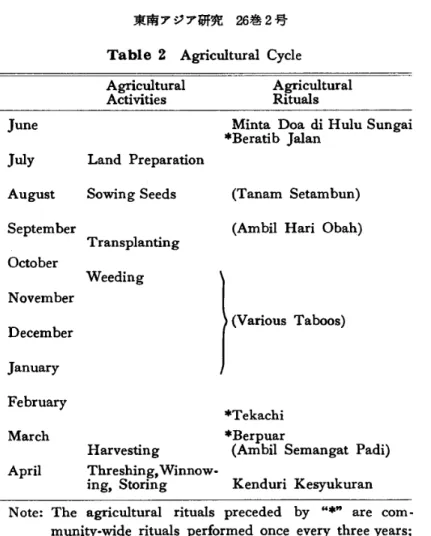
Thus ended one cycle of rice cultivation in Inas. Table 2 recaptures the rough outline of this cycle. It used to take at least forty to forty-four days to raise seed-lings for transplanting and another six months for transplanted seedlings to ripen for harvesting.18) Assuming that land
prep-17) I have not so far come across any reference to maling-maling, sometimes called baHng-baling, other than in the autobiography of Mohamad Yusoff. However, Logan mentions observing bulu perz'ndu or bulu rz'but in Naning and Rembau [Logan1849: 35-37, 404]. This consisted of a bamboo pole with a perpen-dicular slit made in each section above a certain height. One pole could have 14to 20 notes and produce varying melodies depending on the strength of the wind. According to Isabella Bird who travelled Malaya in 1879,
one of "many old but harmless superstitions" among the Malays was a belief "that rude '.!Eolian harps' hung up in trees will keep the forest goblins from being troublesome" [Bird 1967: 354]. "....Eolian harps" were most probably bulu perindu (see "buloh perindu" in Wilkinson [1959: 163]). It is possible that the maling-maling had the same "pedi-gree" as the bulu perindu. A contraption similar to maling-maling also existed in K uantan, Sumatra. It was called kz'ndr-kindr. According to a story I heard during my short visit to Kuantan in June 1988,
it was used for scaring off birds from the rice fields. It usually consisted of two-crossed blades, sometimes with bamboo "flutes" at-tached to their ends.
18) Muhammad Ja'far also .states that it took six months after transplanting for rice to be ready for harvesting [1897: 292]. Nevertheless, when I asked some Inas elders to specify the agricultural calendar, they usually allowed only five months between transplanting and harvesting. It is possible that "six months" means "over six different months:' not "for six months."
Table 2 Agricultural Cycle Agricultural
Activities June
July Land Preparation
Agricultural Rituals
Minta Doa di H ulu Sungai *Beratib Jalan
August Sowing Seeds (Tanam Setambun) September Transplanting October Weeding November December January
(Ambil Hari Obah)
(Various Taboos) February March April *Tekachi *Berpuar
Harvesting (Ambil Semangat Padi)
Threshing,Winnow-ing, Storing Kenduri Kesyukuran Note: The agricultural rituals preceded by "*" are
com-munity-wide rituals performed once every three years; those in parentheses are household-based rituals; and the remainder are community-wide rituals performed every year.
aration started in July as in Table 2, the harvesting season fell about March of next year. It meant that the villagers were involved in rice cultivation, though admit-tedly not continuously, for about nine months of the year, and probably even longer. Writing on rice cultivation in late-nineteenth century Malacca, Muhammad ] a'far says: "The seedlings have to remain in the nur-sery for at least forty or forty-four days from the time of sowing, before they are sufficiently grown: it is best to let them remain till they are about seventy days old" [1897: 299]. This observation may well have been applicable to Inas, a luak rela-tively close to Malacca.
In addition' to this possibility, we also should consider time spent in clearing water channels and building or repairing small dams before land preparation, and in thresh-ing, winnowing and storing rice after har-vesting. All in all, even ten months of the year might not be an unreasonable figure as the amount of time required of Inas villagers to be involved in rice cultivation in one way or another. It is this long committment as well as the rich sociocultural interpolation hitherto described that made rice cultivation something special to the villagers.
VII Conclusion
The completion of the agricultural cycle marked but the beginning of new kinds of activities in Inas. After harvesting the wedding season began. Such entertainments as kite-flying, top-spinning, bird-catching and hunting, all engaged in by men, were pursued in earnest.
The cattle, kept in pens until harvesting, were let into the rice fields. They ate grass along river banks and field bunds, and rice stalks and fallen rice grains in the fields. They also kept the grass in the rice fields from growing taller. Their dung, according to some elders, enriched the soil for the following planting season.
Special reverence for rice was maintained even after the planting season was over. When a relatively large quantity of rice was taken from the granary, a simple but special ritual was performed to placate the semangat padi [Lewis 1962: 309]. I was also told that padi could not be taken on just any day of the week lest the supply be used extravagantly. There were proper days for taking out padi (e.g., Thursday) and improper days (e.g., Friday). When scooping husked rice out of a gunny sack in the house, one had to do so kneeling on the floor to show proper respect to rice.
The sawah meant to the villagers much more than simply a place for rice cultivation. In addition to wells and springs, streams along the rice fields were often used for bathing and washing. Water was carried home from there in bamboo tubes (per£an or tukil) for cooking and drinking.
The rice fields also provided the villagers with things other than rice. When flooded, the fields teemed with fish: belut (eel), haruan (mudfish), puyu (Anabas scandens) , semz'lang (catfish) and sepat (Tr£chopodus).
As well as fishing by usual methods like trapping, the villagers often dug a fish hole
(lubuk £kan) at the edge of the rice field.
During the dry season, fish were trapped in the water remaining in these holes, and villagers only had to bail them out
(mem'm-ba). From the rice fields and surrounding areas they could also collect sz'put sawah (sawah snails). There were many edible plants around the sawah, for example, the acquatic herb kelavar (Monochor£a vag£nal-is) , spinach-like kangkong (Ipomoea aquatz'ea) , tangkz's (not yet identifiable) and paku or fern.
Rice cultivation to Inas people was like water is to fish. It was so much part of their life that it was more than a livelihood; rice cultivation was a way of life, a way of belief, a way of existence. Yet this old world of Inas no longer exists: it has gone irrevocably.
The first sign that the old world was vanishing was the disappearance of agri-cultural rituals such as beratib jalan, tekachi and berpuar. This happened, according to some elders, in the late 1930s. Thereafter came the Japanese occupation and the Emer-gency; and in neither period was the social situation conducive to the revival of elaborate agricultural rituals. There are signs that some of the household-based agricultural rituals survived until the late 1950s [Lewis 1962: 305-311]. Yet the introduction of new rice varieties in the mid-1960s rendered
even these rituals less meaningful. As one elder told me, these new varieties, which have not been handed down from earlier generations, do not have any semangat padi. The introduction of new agricultural ma-chinery and the availability of new forms of entertainment made tumbuk kalang and maling-maling obsolete. (New agricultural machinery, incidentally, also made cooper-ative activities in agriculture rather super-fluous.) Pesticide killed off the fish and snails. Instead of green rice fields, one now sees many uncultivated rice fields in Inas, as in most other villages in N egeri Sembilan. In the village near Sri Menanti mentioned at the beginning of this paper, the old woman can no longer see the lights of Sri Menanti even on a clear night, because her view of the valley is now blocked by shrubs and thicket growing in and around the unattended rice fields.
The beginning of these dramatic changes goes back, in my opinion, to the introduction of rubber. The full impact of the new economic activity was felt in Inas during the "coupon period," the period of the second rubber restriction scheme in the latter half of the 1930s: exactly the time when the major agricultural rituals began to disap-pear. The description of this process, how-ever, is beyond the scope of this paper. Suffice it to say that the seeds of sawah terbz"ar or abandoned rice fields, a serious problem in contemporary N egeri Sembilan, were sown when rice cultivation ceased to be a way of life and instead became a means of livelihood.
Acknowledgement
Many people helped me carry out field research in Negeri Sembilan. I would particularly like to express my sincere gratitude to Azizah Kassim of Universiti Malaya, the late Kassim bin Ma'aleh of Kampung Merual, Sri Menanti, and Haji Layar bin Atong, Sulaiman bin Kudin and Haji Ishak bin Yusof, all of Inas.
Bibliography
Abdullah, Dato' Sedia Raja. 1927. The Origin of the Pawang and the Berpuar Ceremony.
Journal of the Malayan Branch of the Royal A s-iat-ic Society 5 (Part II): 309-313.
Azizah Kassim. 1966. Sains, Magic dan Rasio-nalisma Di-Kalangan Masharakat Melayu Seri Menanti. B. A. thesis, Jabatan Pengajian Melayu, U niversiti Malaya.
Bird, Isabella L. 1967. The Golden Chersonese:
Travels in Malaya in 1879. Singapore:
Oxford University Press. (Originally pub-lished in 1883.)
Blagden, C. Otto. 1896. Notes on the Folk-lore and Popular Religion of the Malays. Journal
of Ihe Stra-ils Branch of the Royal As-iatt"c
Society 29 Ouly): 1-12.
Endicott, K. M. 1970. An Analys-is of Malay
Mag-lc. Singapore: Oxford University Press.
Favre, P. 1849. A Journey in the Menangkabau States of the Malay Peninsula. Journal of Ihe Ind-ian Archipelago and Eastern As-ia 3:
153-16l.
Gray, Charles. 1852. Journal of a Route Over-land from Malacca to Pahang, Across the Malayan Peninsula. Journal of the Indian
ArcMpelago and Eastern As-ia 6: 369-375.
Gullick, J. M. 1951. The Negri Sembilan Econ-omy of the 1890's. Journal of the Malayan
Branch of Ihe Royal As-ial'z"c Sodety 24 (Part
I): 38-55.
- - - . 1987. Malay Sodety -in the Late
Nine-teenth Century: The Beginm'ngs of Change.
Singapore: Oxford University Press.
Hill, R.D. 1977. Rz'ce in Malaya: A Study -in
Hz'storical Geography. Kuala Lumpur:
Oxford University Press.
Kato, Tsuyoshi. 1986. The Koto is Created with