Southeast Asian Studies,Vol. 24, No.2, September 1986
Problem Soils in Southeast Asia
A Study of Floral Composition of Peat Soil
in the Lower Batang Han River Basin of Jambi, Sumatra
SUPIANDI Sabiham* and FURUKAWA Hisao**
Abstract
Pollen diagrams have been prepared of three sections of peat soil deposits from differ-ent localities on the coastal swampy land of J ambi in order to study the vegetational change from the basal clay to the present-day forest. The age of peat soil deposits was determined by 14C dating of peat layers.
The existence of arboreal and non-arboreal pollen types in the main portion of the peat soil deposits in the study area indicates the change from fern association in the bottom layer to the swamp forest in the upper layer. However, the floral composition of these soils indicates a difference in environment between the center zone and the zone transitional to the coastal zone. In the center zone of the Kumpeh area, the peat swamp was inundated by fresh water in all layers, which are characterized by an abundance of ferns in the bottom layer, by many kinds of arboreal pollen types in the upper layer, and by a uniform pollen type between these layers. In the center zone of the Tanjung area, the peat swamp was inundated by fresh water in the upper layer and brackish water in the bottom layer. In the zone transitional to the coastal zone the peat swamp was inundated by brackish water in all layers. The floral composition of peat soil inundated by brackish water is mostly derived from mangrove vegetation.
Peat accumulation in the study area is thought to be related to water inundation during the transgression period.
Introduction
The coastal swampy lands of the lower Batang Hari river basin of Jambi cover more than 12,400 sq. km and comprise 23.2 percent of the land surface of this
*
Faculty of Agriculture, Bogor Agricultural University, Indonesia; Faculty of Agriculture, Kyoto University, Kitashirakawa, Sakyo-ku, Kyoto 606, Japan**
11JI1
?\.it.
The Center for Southeast Asian Studies, Kyoto Universitypart of J ambi Province. The soils in this area consist generally of alluvial soil and peat soil.
Since 1974, the first author has been involved in research into the development of tidal swamp lands of
J
ambi and South Sumatra Provinces to study the ecology of coastal swampy areas. In 1983, he researched peat soil deposits in the Kumpeh,Tanjung and Berbak Delta areas of
J ambi, and the results were submitted as a M. S. thesis to Kyoto University [Supiandi 1985]. Now the authors are
Fig. 1 Location of the Area Studied (after Supiandi[1985]) interested in the pollen content of peat soil
deposits in connection with their research into the floral composition of peat soil ia the lower Batang Hari river basin of
J
ambi, Sumatra. The location of the study area is presented in Fig. LPeat swamps in this area are mostly of the woody-peat type, having acid reaction and a wide range from eutrophic to oligotrophic peats [t"bt"d.]. These peat soils have been deposited since the terrestrial soils on the Pleistocene terrace were trans formed into fluviatile swampy soils. Soepraptohardjo and Driessen [1976] suggested that the swampy area located between the vaguely defined river levees became successively covered with mangrove and swamp forest vegetation, which built up thick, dome-shaped forma-tions of ombrogenous lowland peat.
The objective of this paper is to describe
o 50. 100 150 200km
0.5 to 2.0 km along the transects in order to study the stratigraphy and geo-morphology of these areas. To study the fossil pol-len in connection with the history of plant com-munIties, samples were collected from layers at several observation points using the sub-sampling method, for which two-centimeter-thick samples were taken from each soil 5'
O'
Java Sea
Ft'eld Study
The planned study area was plotted on the sheet of Series 1501 (G) Jambi-Sumatra map (1 : 250,000) in order to decide the location of transects through distinct vegetation types and to plan soil borings along the transects of up to six meters in depth. The study area consists geographi-cally of the Kumpeh, Tanjung, and Berbak Delta areas. These areas were surveyed by the authors from October 9 to November 22, 1983 with the assis-tance of 10 laborers. Ob-servations and measure-ments on soil properties were made at intervals of
Materials and Methods
the vegetational change from the basal clay to the present-day forest of the study area on the basis of pollen analysis. The stratigraphy and geomorphology of the study area are also presented in order to distinguish the peat accumulations.
105' ~EngganO ~ The AreiJ StUdied 100' ~Sipora North
h
N Pagai~:.ssau lsi.SUPIANDI, S. and FURUKAWA, H.: Floral Composition of Peat Soil in Jambi, Sumatra
Fi~. 2 The Location of the Transects and Soil Sampling for Pollen Analysis and Carbon Dating
Fi~. 3 The Stratigraphy and Geomorphology of the Study Area in Cross-section from Bangso to Simburnaik (after Furukawa and Supiandi [1985])
Laboratory Expert'ment The fossil pollen grains and spores in the soil sam-ples were investigated by pollen analysis in order to reconstruct the floral com-position. The Erdtman method [Brown 1960J, which was modified by Takeoka (Kyoto Prefec-tural University), was used for extraction of fos-sil pollen in the soil sam-ples. For reference, mod-ern pollen samples were collected from the Her-barium Bogoriense. The modern pollen was ex-tracted by the Jimbo method [ibt'd.J, For this study, we also used the other references of pollen and spore types described by Anderson and Muller [1975J, Huang [1972J and
Kremp and Kawasaki
[1972].
sample in plastic pipes at 10-centimeter levels in ver-tical sequence. To study the age of peat soil depos-its, samples were collected from layers at different observation points. Fig. 2 shows the soil sampling sites.
LEGEND
T-3: Transect No.3 of the Kumpeh Area. • ; Soil Sampl\n'i T-2: Transect NO.2 of the
Tanjung Area. T-I: Transect NO.1 of the
Berbak Delta Area. Berhala Strait
~ Terrestrial Soil 63Clay Deposits Alternating
with Fine Sand
I. Kumpeh River; 2. Bangso Village; 3. Rantau Panjang Village: 4. Batang Hari River; 5. Dendang River; 6. Telukbuan Village; 7. Batang Hari River; 8. Lambur. Village; 9. Simburnaik Village.
~ Delta Topset [2;J Mud Clay \ \
"
\"
\ \2~.
5. o , ~ Peat SoilEJ
Sand BeachIBIII
Pleistocene TerraceGeneral Description of the
Study
Area
Stratigraphy and Geomorphology
The area under investigation is situated in eastern
J
ambi, Sumatra and is bounded on the north by the Berhala Strait, on the west by the Batang Hari and Dendang rivers, and on the east and south by the Batang Berbak, Batang Hari and Kumpeh rivers (Fig. 2). This area forms part of the eastern coastal plain of Sumatra, which was previously located on a Pleistocene terrace. The stratigraphy and geomor-phology of the study area in a cross-section from Bangso village (near to the Kumpeh river) to Simburnaik village (near to the sea) were described by Furukawa and Supiandi [1985] (Fig. 3). The five zones and 15 stratigraphic types distributed successively from inland to the coast in this area were as follows below.1. Zone transitional to the middle reaches. Terrestrial soils have developed on the (1) low terrace, (2) meandering scars, and (3) natural levee along the Kumpeh river. 2. Central zone covered by swamp forest. This area is mostly (4) peat-capped terrace. During the post-Glacial period, when the sea level rose, the terrace surface with terrestrial soils is supposed to have been transformed into fluviatile swampy lands. Ombrogenous peat plains were then developed, sometimes exceeding six meters. The periphery contains an admixture of fluvial deposits from the meandering river course. (5) Natural levees are less devel-oped along the Batang Hari river,
consisting of imperfectly drained clay soils which are generally derived from terrestrial soil.
3. Zone transitional to coastal zone. (6) Successive terrestrial soils have devel-oped from fluvial deposits on the terrace surface. (7) Mangrove deposits directly covering the terrace surface are most widely distributed. (8) Another sedimen-tary phase indicates mangrove to have intruded much later on the peat-capped terrace. (9) The natural levees have developed along the streams which flow through former mangrove deposits. (10) Former beach ridges often outcrop.
4. Coastal zone with fish-bone channel networks. This area has been exploited by local people. (11) Thick sand ridges are advancing offshore, and (12) mangrove deposits have developed on tidal flat. The present surface is covered by humifer-ous clay and sometimes thin peat soil. (13) A narrow mangrove belt covers the present coastline.
5. Remnant hill isolated from the middle reaches. This was an island during the period of high sea level in the past. (14) Hillslopes are covered by brush, rubber gardens and fruit trees. (15) Shallow valley bottoms are utilized for bush-fallow cultivation of wet rice in the rainy season.
The Present Vegeta#on
The vegetation of an area is a reflection of the interaction of several environmental factors. Vegetation types have to be determined since they are directly related to the soil. Thus, the characteristics of the dominant species can be used to predict
SUPIANDI, S. and FURUKAWA, H.: Floral Composition of Peat Soil in Jambi, Sumatra
Table 1 List of Species Found in the Study Area·
Genus
No. Name of Species
Tree Species Location 1. Act-inodaphne macrophylla A. sphaerocarpa 2. Aglaia argentea A. trimera 3. Alseodaphne inszgnis 4. Alstonia pneumatophora 5. Antz"desma spicatum 6. Barringtonia sp. 7. Callophyllum sp. 8. Commersonia bartramia 9. Cratoxyllum sp. 10. Cryptocarya Mcolor 11. Cynometra ramiflora 12. Dacryodes rugosa 13. Diospyros argentea D. buxzfolia D. malabarica D. polyalthzOoides D. ngida D. sub-rhomboidea D. sumatrana 14. Elaeocarpus cf. paniculatus E. glaber 15. Eucalyptus sp. 16. Eugem"a sp. E. acuminatt"sszOma E. clavamyrtus E. clavzflora E. curranit" E. jamboloides E. laxzftora E. zippeHana 17. Euphoria cf. cht"nensis 18. Garcim'a gandz"chandit" 19. Knema conferta K. tomentella 20. Lepisanthes amoena L. tetraphylla 21. M acaranga sp. 22. Myrzstica maxima 23. Nephelz"um sp. 24. Phaenanthus sumatranus
Center zone of Kumpeh area Center zone of Kumpeh area Center zone of Kumpeh area Center zone of Kumpeh area Center zone of Kumpeh area Zone transitional to coastal zone Zone transitional to coastal zone Center zone of Kumpeh area Center zone of Kumpeh area Center zone of Kumpeh area Center zone of Kumpeh area Center zone of Kumpeh area Zone transitional to coastal zone Center zone of Kumpeh area Center zone of Kumpeh area Center zone of Kumpeh area Center zone of Kumpeh area Center zone of Kumpeh area Center zone of Kumpeh area Center zone of Kumpeh area Center zone of Kumpeh area Center zone of Kumpeh area Center zone of Kumpeh area Center zone of Kumpeh area Center zone of Kumpeh area Center zone of Kumpeh area Center zone of Kumpeh area Center zone of Kumpeh area Zone transitional to coastal zone Zone transitional to coastal zone Center zone of Kumpeh area Zone transitional to coastal zone Zone transitional to coastal zone Center zone of Kumpeh area Zone transitional to coastal zone Center zone of Kumpeh area Center zone of Kumpeh area Center zone of Kumpeh area Center zone of Kumpeh area Center zone of Kumpeh area Center zone of Kumpeh area Center zone of Kumpeh area
Genus
Name of Species Location
No.
25. Polyaltlzz'a latenJlora Center zone of Kumpeh area P. longzjolt:a Center zone of Kumpeh area P. subcordata Center zone of Kumpeh area P. sumatrana Center zone of Kumpeh area 26. Pomet£a pinnata Center zone of Kumpeh area 27. Pternandra caerulescens Center zone of Kumpeh area P. rostrata Center zone of Kumpeh area 28. Pterospermum cordzjolt:um Center zone of Kumpeh area 29. Quassiasp. Center zone of Kumpeh area 30. San#ria laevigata Zone transitional to coastal zone
S. oblangifolia Center zone of Kumpeh area S. tomentosa Center zone of Kumpeh area 31. Scaphium macropodum Zone transitional to coastal zone 32. Shoreasp. Center zone of Kumpeh area
S.ovalis Center zone of Kumpeh area 33. Timonius sp. 'Center zone of Kumpeh area 34. Xanthophyllum eurhychum Center zone of Kumpeh area 35. Xylopz'a mayana Center zone of Kumpeh area 36. Zizyphus elegans Center zone of Kumpeh area
Grasses
37. Cyperus platystylt:a Zone transitional to coastal zone 38. Panz'cum incomtum Zone transitional to coastal zone
Shrubs
39. Connarus semicondrus Zone transitional to coastal zone 40. Lasianthus constn:ctus Center zone of Kumpeh area 41. Lucz'naea montana Center zone of Kumpeh area 42. Tarenna fragrans Center zone of Kumpeh area
Herbs 43. Blumea balsamzjera 44. Fimbrzstylt:squinquangulan's 45. Jus#cz'a marit£ana 46. Labz'sia pumila Fern 47. Acros#chum aureum
Zone transitional to coastal zone Zone transitional to coastal zone Zone transitional to coastal zone Center zone of Kumpeh area
Zone transitional to coastal zone • Collected by H. Furukawa and Erizal.
The specimens were identifiedby staff members of Herbarium Bogoriense.
which environmental factors are important in the area.
The vegetation types In the study area
consist of swamp forest vegetation charac-terized by evergreen seasonal forest, of
mangrove forest, and of herbaceous swamp. Mangrove Forest
In some places In the study area, the mangrove forest is rarely or not developed because the inhabitants farmed the lands,
SUPIANDI, S. and FURUKAWA, H.: Floral Composition of Peat Soili~Jambi, Sumatra 2.0 to 2.5 4.0 to 4.5 2.0 to 2.5 4.0 to 4.5 -1.5to -1.0
Nipa sp. The presence of this vegetation
demonstrates that the area frequently influenced by tidal action.
Swamp Forest Vegetation
In the swamp forest of the study area, many important species were found in the center zone. Many kinds of trees and shrubs grow well, making this swamp forest evergreen, tall and profusely-leaved. The zone transitional to the coastal zone was also been covered by swamp forest until recently, and is now being opened by the government.
In some places, the original vegetation of the swamp forest has been cut by local people for logs, so that the vegetation in these spots is now in the process of forma-tion of remainder swamp forest. This situation is characterized by the growth of new species, such as Paspalum commersonz"z"} Stenochlaena pa-Present Position lustrz"s, Cyperus dijfusus and
from MSL* I: l" d .
(Approx. in m) mperata cy tn rzca.
In the area covered by dense forest, many trees species grow well, including K oompassz"a malaccensis, Durio carinatus,
Jack-ia ornata, Tetramerz"stra
glabra, Shorea sp., and Dyera sp. On the peat soil deposits, besides these species, Lz'cuala acutijida may occur in the un-dergrowth.
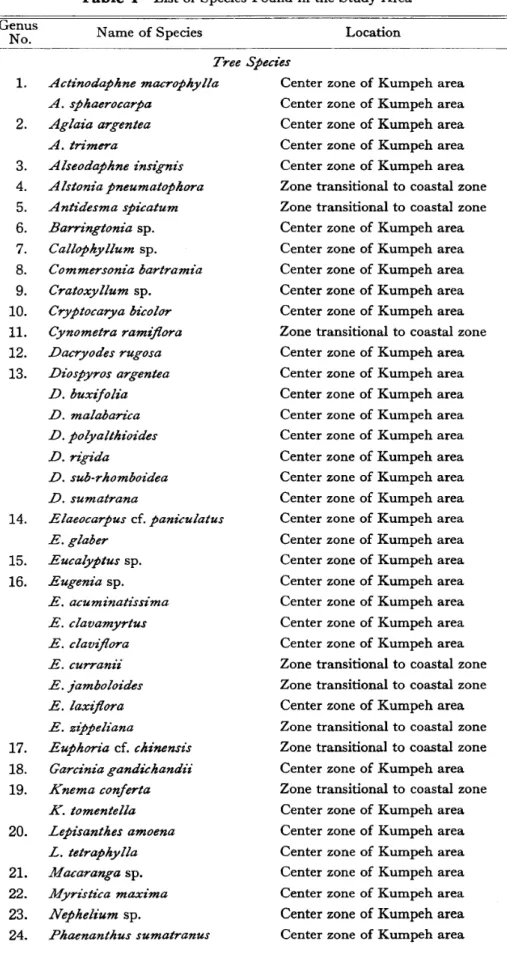
The other species found in the swamp forest of the study area are presented in Table 1. Material and Locality
Charred wood; 7 km Northeast of Pulau Mentaro Charred wood; 7 km Northeast of Pulau Mentaro Depth (cm) 400-450
Center Zone of Kumpeh Area 200-250 Woody peat; 7 km
Northeast of Pulau Mentaro
700-750
The Location of Peat Soil Samples for HC Dating
Sample No. Table 2
Center Zone of Tanjung Area 200-250 Woody peat;3 km North of Rantau Panjang 400-430 Woody peat;3km North of Rantau Panjang
Zone Trans£t£onal to Coastal Zone GaK-11897 335-390 Charcoal; SK-8 Unit II
Dendang I 2.0 to 2.5 GaK-1l893 GaK-11892 GaK-1l896 GaK-11895 GaK-1l894
especially for paddy and coconut. These areas are characterized by the existence of fish-bone-like channel networks. However, in the area along the river estuaries on and behind the levees, where the soil is characterized by soft mud clay which never dries out completely, Rhz"zophora sp. normally dominates. At the margin or where the forest is a little more open, the
fern Acrostichum sp. may occur in the
undergrowth.
In the area near to sea, Avicennia sp. grows well on more clayey and settled soil. In general, this area is mostly inundated during high tides.
In the area along the Batang Hari river, from the Dendang river mouth towards the lower course of Batang Hari river, we found Sonneratia sp., sometimes with
Table 3 The Results of 14C Dating of Peat Soil from the Center Zone and the Zone Transitional to the Coastal Zone
D th f Calculated Rate
Depth Age S ·l~ 0 1 of Peat
(Av. in em) (Years BP) 01 ( am)p e Accumulation em (cm/IOO yr) 6 4 21 6 63 22
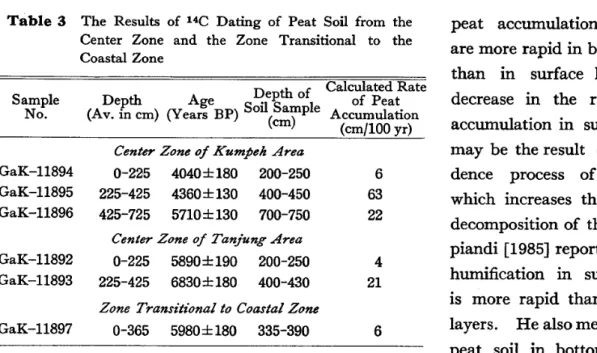
peat accumulation (Table 3) are more rapid in bottom layers than in surface layers. The decrease in the rate of peat accumulation in surface layers may be the result of the subsi-dence process of peat soil, which increases the degree of decomposition of the soil. Su-piandi [1985] reported that the humification in surface layers is more rapid than in bottom layers. He also mentioned that peat soil in bottom layers is very soft due to a high water content, which may hamper the organic matter decomposition.
Floral Composition of Peat Soil Depositsinthe Study Area
To study the floral composition of peat soil deposits it is necessary to analyse the fossil pollen sedimentation in each layer of soil. The most important feature of peat soil deposits to emerge from the study of fossil pollen is that they develop in a strat-ified sequence. As the vegetation continues to grow, the pollen types become buried by further deposits of organic matter and are thus stratified into horizons within the developing peat profile.
Peat soil deposits in the study area were formed under the influences of water inundation and a marine environment. These raise several problems in the inter-pretation of the results of pollen analysis, because some of the fossil pollen types buried in peat soil deposits may have been Sample
No.
Center Zone of K umpeh Area GaK-1l894 0-225 4040±180 200-250 GaK-1l895 225-425 4360±130 400-450 GaK-1l896 425-725 5710±130 700-750 Center Zone of Tanjung Area GaK-1l892 0-225 5890±190 200-250 GaK-1l893 225-425 6830±180 400-430 Zone Transitional to Coastal Zone GaK-1l897 0-365 5980±180 335-390
The Age of Peat Sot"l nepos#s t"n the Study Area
To study the age of peat soil deposits in the study area, several peat soil samples from three profiles were sent for dating by Prof. Kunihiko Kigoshi, Faculty of Science, Gakushuin University, Tokyo. The sam-ples collected from the center zone and the zone transitional to the coastal zone (Table 2) are expected, together with the study of fossil pollen from each layer of peat soil deposits, to yield information on the beginning of peat soil deposition.
The results of
14e
dating of these peat soil layers at various depths shown in the Table 3 indicate that peat soil deposits started to accumulate during the Holocene Period. When the sea level rose, the fluviatile swamps in the study area were formed covering the Pleistocene terrace. It was the organic matter deposited in the bottom layers of these areas that commonly formed the basis of peat swamps.The deposition of peat soils in the study area appears to indicate that the rates of
SUPIANDI, S. and FURUKAWA, H.: Floral Composition of Peat Soil in Jambi, Sumatra
Table 4 The Total of Arboreal and Non-arboreal Pollen
Types from All Sub-samples of Profiles B-8, T-7 and T-24 3 2 3 6 2 3 2 3 2 1 1 2 15
ally
in
composition until the present-day. Discussion of DiagramsTable 4 represents the total of arboreal and non-arboreal pollen types from all sub-samples of profiles B-8 and T-7 (center zone) and T-24 (zone transitional to coastal zone). The results of pollen observation are presented in Figs. 4, 5 and 6a, which are composed in the same way. Microphotographs are given of the most important fossil pollen types (see Plates 1 to 6).
Based on the boring data and fossil-grain observations, peat soil deposits consist of several layers which are characteristic of different environments. This clearly dem-onstrates the vegetational change from the basal clay to the present-day forest. These layers are de-scribed below.
Center Zone
Fig. 4 shows the floral com-position of a peat soil from profile B-8 of the center zone
of the Kumpeh area. The
layer at the depth of 347 to 418 cm is categorized as a transition layer between the basal clay and peat soil deposits. This layer represents the first peaty sedi-ment deposited on the terres-trial soil. It is dominated by non-arboreal types and char-acterized by an abundance of such spore grains asAlsophylla,
Nephrolepis and Asplenium.
This clearly demonstrates the presence of vegetation with Unknown
(%) Depth Total Pollen Types(%)
(em) Grains Arboreal Non-arboreal Pollen Pollen Profile B-8* 0-138 2512 86 13 138-162 700 87 12 162-347 4290 92 6 347-418 1723 31 54 Profile T-7 0-120 2107 80 18 120-220 2069 83 14 220-400 1807 33 65 400-420 424 59 38 420-470 320 27 71 Profile T-24 80-100 361 78 19 100-150 911 89 9 150-227 968 83 14 227-263 126 79 15
*
After Supiandi [1985].brought in by the main rivers or the air. Several places in the study area were inundated by river water overflowing onto the soil surface, and these various pollen types were transported by surface water. Pollen transportation by air into the study area is also possible. These grains may cause considerable confusion because they will be of fossil pollen and will possibly have been derived from quite different vegetation.
We nevertheless carried out a pollen analysis because we believed that the fossil pollen buried by organic matter deposits would elucidate the former situ-ation of the environment. It was found that during the accumulation of organic matter, the vegetation has changed
gradu-Fig. 4 The Pollen Diagram of Profile B-8
The layer at the depth of 162 to 347 cm is cate-gorized as peat soil de-posits with small amounts of mineral material con-tents. Samples from this layer show a decrease in the fossil grains of spores, Pholidocarpus and Ficus, and an increase in arbo-types on the Pleistocene terrace were probably dom-inated by Ficus and fern types. However, after the Pleistocene terrace had been transformed into fiu-viatile swamp by the nse in sea level during the transgression period, the tree species became domi-nated by Pholidocarpus. Ridley [1924] reported that the habitats of Ficus spp. in the Malay Penin-sula are mostly in the upland areas; and in 1925 he reported that the hab-itats ofPhoNdocarpus spp. are mostly in swampy areas.
[ Lophopetalum
Eugenia
( Neesia ( Parkia
real pollen types, which are dominated by Euge-nia. This clearly demonstrates a succes-sion from fern association to swamp forest, which probably started approxi-mately 4,300 years ago. We believe that the environment of this layer was a swampy area, because Ridley [1922] reported that some species of Eugenia grow well in
~IGanua
-~~"i:C==:J----'r
Cyrtostachys = [ Jaclciat=-::J
= [
Anthocephalus [ TenstrOfJmia~Isantiria
ce:::::J [ Campnosperma [ Ctenolophon=
--.====== [ Durio ====;:...-=::::J---'r
Dipterocarpus L:JL:=J [
8hesaIF
f
Cyathocalyx ~I
Quercus!LithocarpusC D [
Stemonuruso
cr==
~
f
Pholidocarpus ~r
Gastanopsis ~I
Palaquium ~ ( Koompassia [ Alstonia=
r
Vatica [ Dryobalanops [ Heritiera o I OncospermaWDI
T0t81 Arboreal Pollen I I ( ShrubsTotal-
[ Total Grasses '" <n•
I
Total Spores ~ ;; co "l.-[ Unknown
fern association. The results of
14e
dating indicate that the lowest peat deposits with fern association probably started to form about 5,700 years ago. Ficus and Pholi-docarpus are more prominent in the arbo-real pollen types. This indicates that be-fore the transgression period the vegetationSUPIANDI, S. and FURUKAWA, H.: Floral Composition of Peat Soil in Jambi, Sumatra
pollen in each layer of this area to be that of tropical oak trees, like the Malayan oak trees reported by Corner [1940]. To name these species correctly, the fossil pollen of oak trees should be investigated In
more detail.
The layer at the depth of 138 to 162cm is char-acterized by clay deposits derived from terrestrial soils. The clay deposits were mixed with small amounts of dull yellow orange (lOYR 6/3) or-ganic matter. In this layer, the samples show a de-crease of Eugenz'a and an increase of other arboreal pollen types, especially
Ganua and Cyathocalyx.
The existence of
Cyatho-calyx in this layer
indi-cates that the mineral soil deposited here is a terres-trial soil, because C.
vir-gatus King grows mostly in upland areas
[Ridley 1922]. Thus the fossil pollen of
Cyathocalyx was probably transported by
water together with the terrestrial soil from the upper part of
Jambi.
The existence ofGanua indicates that this layer was
previ-ously a swampy area. Smythies [1965] reported that the species Ganua motleyana (de Vriese) Pierre ex Dubard in Sarawak is locally frequent in mixed peat swamp forest on shallow peat soil deposits, and
= t Cyathocalyx 4~--~D
I
Ganua=
~---== ICyrtostachys ( Mangifera ---.::==c=:J=-... I Santiria [ Campnosperma=---
(Durio [jL==1I
Vittaria¥(E_i.
( NeesiB ---'::====;o::::::::::Ji:::::::J [Parkiao '
c:=JI
Ficus IDyera --~===t:=J==;:--, IDipterocarpus ~IBhesallLJ?
I
StemonurusD
IAnt~ephawsrl~='IL_'
D
I
Oncosperma ~ (Pholidocarpus I Total IISporesFig. 5 The Pollen Diagram of Profile T-7
o
=--=======
I Castanopsis I Palaquium ~I
Koompassia = I Alstonia u " , - - - I Timonius=
l'latica=
I Dryobalanops I Rhizophora - - - (( Unknown [~
[Jl~::'~eal
8 ~lI:
Pollen (J1 "CD 2 IITotal Shrubs £ ~ ~f1Total - 1IGrasses [II
swampy areas. This layer also demon-strates a decrease in the fossil pollen types of Parkia and Neesia. The fossil pollen of oak trees is also represented in the soil samples of this layer, but some of this fossil pollen is presently difficult to identify correctly. Some species of Quercus were reclassified by Soepadmo [1972] into the genus Lithocarpus. For this reason these species are not listed individually here. However, we believe the oak tree fossil
5. Alstonia
The floral composItIOn of peat soil deposits from profile T-7 of the center zone of the Tanjwtg area, shown in Fig. 5, indicates that in the depth of 420 to 470 cm, Lycopodium, Ste-nochlaena and
Nephrole-pis dominate the fossil
grains. The existence of these spores indicates the presence of vegetation with fern association. This vegetation grows on the Pleistocene terrace, of which the surface is sup-posed to have been trans-formed into fluviatile swampy lands during the post-Glacial period. In this layer Oncosperma is prominent in the arboreal pollen types, which indi-cates inwtdation by brack-ish water during the transgression period. An-derson and Muller [1975] mentioned that the existence ofOncosperma represents a zone lying inland of mangrove vegetation, subject to periodic, non-diurnal inwtdation and where saline influence is less strong.
The layer at the depth of 400 to 420 cm is categorized as a transition layer between the basal clay and peat soil deposits. I t is characterized by a decrease in spore grains and an increase in the number of arboreal pollen types, especially the fossil pollen of oak trees(Quercus or Lithocarpus)
o
, Plate 1 4. Cyathocalyx 2. Lophopetalum 3. Vittaria I. Ganuathe other species (G. coriacea Pierre ex Dubard) is frequent to rare in mixed peat swamp forest throughout Sarawak.
The layer between 0 ahd 138 cm is characterized by peat soil deposits. In this layer, many kind of arboreal pollen types were found. However, the fossil grains ofGanua, Santiria and Stemonurus were more prominent than other fossil grains. This clearly represents the first of the successive stages in the formation of the mixed forest.
SUPIANDI, S. and FURUKAWA, H.: Floral Composition of Peat Soil in Jambi, Sumatra
50 J1 (BOOx)
cooperata Blanco) and L. nt'euwenhuist't' (von See-men) A. Camus (Q.
cle-mentis Merr, Q. ochracea
(Schottky) Merr, Q.
nieu-wenhut'sz't' von Seemen)
were found in peat swamp and/or heath forests. An other scientist [Comer 1940] reported that Quer-cus bennethi Bennett and
Q.grandifrons Lat. were
found ill the lowland swampy forest of Malaya, and that Q. hystrix grows in swampy forest. In this layer (at the depth of 400 to 420 em), the fossil pollen of Stemonurus are also more prominent than the other arboreal pollen types. Stemonurus secun-dijlorus Bl. Bijdr reported by Ridley [1922] grows mostly on river-banks and in low swampy woods. The existence of Stemonurus and Quercus or Lz"thocarpus thus indicates that the area was previously swampy, and this played an important role in the first deposi-tion of peat soils on the terrace surface, which is probably started approximately 6,800 years ago. In this layer, however, the fossil pollen of Oncosperma decreases due to a change of environment to the one with decreased saline influence.
The layer at the depth of 220 to 400 cm is categorized as peat soil deposits. The samples from this layer show a decrease in
the Lithocarpus or Quercus and an increase
7. Eugenia 4. Vatica 2. Campnosperma
o
Plate 2 6. Dryobalanops I. Gluta 3. Mangifera 5. Ouercus/ Lithocarpusand Stemonurus. Soepadmo [1972]
re-ported that Quercus is confined to ever-wet conditions; the genus occurs from sea level to 3,350 m, with a preference for the region between 600 and 1,500 m, in various sorts of primary forest, namely, lowland mixed Dtpterocarp forest and swamp forest (with fluctuating water level). He also mentioned finding Quercus subsericea on rocky seashores in Cave Rachado near Port Dickson (Negeri Sembilan, Malaya) at 0-10 m, facing the mangrove. Other species, such as Lz"thocarpus cooperatus Blanco (Quercus fernandes# Vidal, Q.
pollen types.
The peat soil deposit at the depth of 120 to 220 cm shows a decrease in the Pandanus and Stemo-nurus pollen types and an increase of Eugenia, This appears to indicate a suc-cession from grasses to swamp forest, which prob-ably started approximately 5,800 years ago. The existence of Eugenia indi-cates that, at that time, the area was swampy. This layer also demon-strates a decrease in the Palaquium and Koompas-sia pollen types.
The samples from the depth of 0 to 120 cm show a fairly heterogenous pol-len content. There is a decrease of Eugenia and an increase in the number of arboreal pollen types, indicating the initial stage in the formation of mixed forest.
Zone Trans-itional to Coastal Zone The floral composition of peat soil deposits from profile T-24 of the zone transitional to the coastal zone of the Tanjung area is shown in Fig. 6a, Fig. 6b is a supplement to Fig. 6a which shows in more detail some of the most important fossil pollen, in order to distinguish the floral composition from each horizon of profile T-24.
The soil surface of the area around
o 50 Jl (800x) . . .--.
...
-
...
' 5. Pandanus 7. Schizaea 8. Stenochlaena 9. Asplenium•
•
2. Stemonurus 3. Santiria 4. Salacca 6. Nephrolepis I. Castanopsis Plate 3of the Stemonu?'us and other arboreal pollen types, Non-arboreal pollen types also increase and are characterized by an abundance of the Pandanus. Anderson and Muller [1975] reported that three Pandanus species, namely, P. ande?'sonit', P, ?'t"dleyi and P, sigmoidues, occur in the peat swamp forest of NW Borneo. This clearly represents a different situation from that in the center zone of Kumpeh area, This layer also demonstrates an increase of
SUPIANDI, S. and FURUKAWA, H.: Floral Composition of Peat Soil in Jambi, Sumatra
The existence of these pollen types indicates that the area was once proba-bly covered by mangrove vegetation. These clay deposits are successively terrestrial soils which developed from fluvial deposits on the terrace during the transgression period, so that this area was previously inundated by brackish water.
A peat soil mixed with small amounts of mineral materials at the depth of 150 to 227 cm shows a decrease in the arboreal pollen types ofSonneratia, Oncosperma and· Pholido-carpus and an increase of
Ntpa, Rhizophora and
Lithocarpus or Quercus
pollen types. The exis-tence ofNipa and R hizo-phora pollen types appears to indicate a succession of this area towards a marine environment. The layer between 100 to 150 cm IS
characterized by the dominance of
Rhizophora. In this layer, Sonneratt'a and
Oncosperma again increase, but Ntpa and
Quercus or Lz'thocarpus decrease. This
clearly demonstrates that the area was then still inundated by brackish water.
The floral composition at the depth of 80 to 100 cm, which is characterized by the dominance of Ntpa, that the area was influenced by tidal action. However,
3. Pholidocarpus 9. Graminae 6. Hibiscus 12. Timonius 4. Durio 5. Dryobalanops 10. Planchonia I I. Cephalomappa I. Palaquium 2. Cyrtostachys Plate 4
profile T-24 was covered by mineral materials during excavation of the canal.
In fact, the soil surface is about 80 cm
below the present covering, so that the soil samples for fossil pollen study were col-lected from 80 to 263 cm depth.
The layer at the depth of 227 to 263 cm is characterized by clay deposits with small amounts of plant remains, being gray (7.5Y 6/1) in color and light clay in texture.
In this layer, Pholidocarpus, Oncosperma
and Sonneratt'a dominate the fossil grains.
7. Ouercus/ Lithocarpus 8. Eugenia
I. Ficus 2. Dipterocarpus 3. Oncosperma
to the results of pollen analysis from profiles B-8 and T-7 (center zone) and T-24 (zone transitional to - 'toastal zone), which are
described below.
...
Center Zone
rif
KumpehA rea (Profile B-8)
1. Zone I : peat soil deposit derived from mixed forest; the samples from this layer show a fairly heterogenous polle!'l..content.
2.
Zo~e
II: mineral soil deposit derived from terrestrial soil.Cya-thocalyx and Ganua
pollen types were more prominent than other arboreal pollen types. 3. Zone III: peat soil
de-posit consisting mostly of a uniform pollen type, and characterized dominance of Eugenia pollen
9. Parkia
6. Nepenthes
by the type.
4. Zone IV: mineral soil deposit character-ized by the dominance of non-arboreal pollen types with fern association.
Based on the fossil pollen content, all of these layers are categorized as being formed in a swampy area inundated by fresh water. 0.._. . ."""-....-.;,5,0 J.l (600x) Plate 5 5. Rhizophora 8. Lycopodium 4. Nipa 7. Alsophylla
Rhz"zophora and Sonneratz"a are decreased. When the sea level changed to a few meters lower than at present during the period 3,000 to 1,500 yr BP [Fuji, Lin and Tjia 1971], the marine environment was also changed to the present one, and the Rhz"zophora and Sonneratz'a almost com-pletely disappeared.
Conclusion
Peat soil deposits in the study area can be divided into several layers (zones) according
Center Zone of Tanjung Area (Profile T-7) 1. Zone I: peat soil deposit derived from mixed forest; in this layer many kinds of arboreal pollen types were found.
SUPIANOI, S. and FURUKAWA, H.: Floral Composition of Peat Soil in Jambi, Sumatra I. Koompassia 4. Acrostichum 2. Heritiera 5. Sonneratia Plate 6 3. Anthocephalus 6. Jlex O.
...
50 J.l (600x) '2. Zone II: peat soil deposit consisting mostly of a uniform pollen type, characterized by the dominance of Eugenia pollen type.
3. Zone III: peat soil deposit mostly de-rived from non-arboreal pollen types, and characterized by the abundance of Pandanus.
4. Zone IV: peaty mineral deposit contain-ing mostly Stemonurus and Lithocarpus
or Quercus pollen types.
5. Zone V: clay deposit containing non-arboreal pollen types, characterized by an abundance of fern association. In this layer, Oncosperma is more prominent in the arboreal pollen types.
Based on the fossil pollen content, all of these layers are categorized as being formed in a swampy area. Zone V was previously inundated by brackish water, and Zones I,
II, III and IV by fresh water.
Zone Transitional to Coastal Zone (Profile T-24)
1. Zone I: peat soil deposit derived from coastal swamp forest, characterized by an abundance of Nipa pollen type.
2. Zone II: peaty mineral deposit, also derived from coastal swamp forest, but characterized by the dominance of Rhizophora and Sonneratia pollen types. 3. Zone III: mangrove deposit containing mostly R kizophora, Nipa and Li-thocarpus or Quercus pollen types. 4. Zone IV: also a mangrove deposit.
Based on the fossil pollen content, all of these layers are categorized as being formed in a swampy area previously inundated by brackish water.
r·Vatica = [Timonius
0
[ Gluta~
(GanuaU n = '
[ Mangifera ~ [ Santiria[ j
[ Campnosperma [ Durio [ Anthocephalus 0 [ Vittaria [ EugeniaD
I
Qlleren,fUthoc.",",u==LJ
I
OncospermaP
I
Pholidoco",", o = £ i i 0 ( Palaquium0
u ( Koompassia~
I
Alstonia'U
[ CratoxylonQ
I
Rh;ropho~
9(N'~
\
~NI "6.0 l:b :::J ,~:I
<II8.
Q>....
o' ::l > en <II g iii'....
o' :::J [ [ Total Shrubs.~
Total
Arboreal Pollen_ _ _ _""I••
II
Total Grasses _ _ _ _. .uII
Total SporesII
[ ~--...----!I
Unknown ~n~ ~
Total Arboreal & Non-arboreal Pollen/
/
.\
/'
/
;
\
\~
r
SonneratiaSUPIANDI, S.andFURUKAWA, H.: Floral Composition of Peat Soil in Jambi,Sumatra
•
I
I
•
•
•
•
•
[Ganua•
-
••
I
•
•
.'
[Mangifera •I
• ••
•
•
•
•
•
'~
Santiria•
•
•
•
•
•
•
- I [Campnosperma•
•
-
-
•
•
• I [Eugenia•
rrn
•
•
•
•
·'1
Quercus/ Lithocarpus~
•
I
-
•-
•fIT
(oncospermaI--I
•
-
-
•
• If
Koompassia•
n
•
-
•
• •
•
• ' [Alstonia [ 0'1 Rhizophora '0 (1) n(1) :I....
•
I
I
I
•
•
•
l·fl
N,..,
I
•
•
•
•
I
•
r-
·'1
~onneratia » (I)I ~p~ »(1)::0 ~ III 0 . ~ <D ",' 1II0::r '6' III :::l I :g 5 ,,' g::J. !? ~.g ll> [~I ~~::)-- , , 0 !!.~~::r<D.g I/>»g'
g.i gr- Ql _.ga;"Q1~O I/>0 SL\1 Dl 00;' g [ :::J -Q. 0' ll> :I 'ti l;;Acknowledgements
The authors wish to thank Prof. Dr. M. Takeoka of Faculty of Agriculture, Kyoto Prefectural University for his kind guidance and suggestions throughout the course of this research. They are grateful to Dr. Kuswata and Dr. Soedarsono Riswan of Herbarium Bogoriense for their help in collecting many modern pollen samples for refer-ence.
References
Anderson,
J.
A.R.; and Muller,J.
1975. Palynological Study of a Holocene Peat and a Miocene Coal Deposit from NW Borneo. Revz'ew of Paleobotany and Palynology 19: 291-351.Brown, C. A. 1960. Palynologz'cal Technz"ques. Library of Congress Catalog Card Number. 60-14297. Baton Rouge, La.
Corner, E.]. H.1940. Waysz"de Trees of Malaya. Vol. 1. Singapore: Government Printing Office. pp. 293-305.
Fuji, S.; Lin, C. C.; and Tjia, H. D. 1971. Sea Level Changes in Asia during the Past 11,000Years. Quaternary14: 211-216. Furukawa, H.; and Supiandi, S. 1985. Batan
Hari Gawa Ryuiki Teishicchi no Nogyo Keikan. Sono 1. Chikei to Taisekisojo [Agricultural Landscape in the Lower Batang Hari, Sumatra. Part One: Stratigraphy and Geomorphology of Coastal Swampy
Lands]. Tonan Ajz'a Kenkyu [Southeast Asian Studies] 23(1): 3-37.
Huang, T. C. 1972. Pollen Flora
of
Tat'wan (Including 177 Plates). National Taiwan University. Botany Department Press. 297 pp.Kremp, G. O. W.; and Kawasaki, T. 1972. The Spores of the Pteridophytes. Tokyo: Hiro-kawa Publishing Company, Inc. 398 pp. Ridley, H. N. 1922. The Flora of Malay Penz"nsula. Vol. I. London: L. Reeve & Co., Ltd.
- - - . 1924. The Flora of Malay Pen-t'nsula. Vol. III. London: L. Reeve & Co., Ltd.
- - - . 1925. The Flora of Malay Pen-insula. Vol. V. London: L. Reeve & Co., Ltd.
Smythies, B. E. 1965. Common Sarawak Trees. Borneo Literature Bureau. 153 pp.
Soepadmo, E. 1972. Fagaceae. In Flora Malesiana, general ed. by C. G.G.
J.
van Steenis, Ser. I, Vol. 7(2), pp. 265-403. Leyden: Noordhoff International Publishing. Soepraptohardjo, M.; and Driessen, P. M. 1976. The Lowland Peats of Indonesia, a Challenge for the Future. Peat and PodzoHc So£/s and Their Potential for Agn'culture in Indonesz'a 3: 11-19.Supiandi, S. 1985. A Geomorphological Study of Peat Soils in Jambi, Sumatra. M. S. Thesis. Division of Tropical Agriculture, Faculty of Agriculture, Kyoto University.
![Fig. 1 Location of the Area Studied (after Supiandi [1985])interested in the pollen content of peat soil](https://thumb-ap.123doks.com/thumbv2/123deta/6761835.1692945/2.893.102.595.586.1109/fig-location-area-studied-supiandi-interested-pollen-content.webp)