Journal of t h e Operations Research Society of J a p a n
Vol. 40, No. 1, M a r c h 1997
AN M / G / l QUEUE WITH FINITE POPULATION AND
GATED SERVICE DISCIPLINE
Christos Langaris Apostolos Katsaros
Unzverszty of Ioannzna
(Received November 8, 1995; Revised June 7, 1996)
Abstract A queueing model with finite customer population (an M / G / l / / N model), multiple server vacations and gated service policy is considered. For such a model, the steady state probabilities and the customers' waiting time are analyzed. Numerical results for the mean waiting times are obtained and used to draw conclusions on the system performance and to compare the present model with the corresponding model with exhaustive service. The comparison shows t h a t , under variations on the mean vacation period and on the offered load, the two models behave in completely different ways. This is more apparent in case of large vacation periods and seems to be a consequence of the vacation principle.
1.
Introduction-The model
The present work has been motivated by a, remark made in Takagi
[2].
More precisely, in Takagi [2], an h!I/G/l queueing system with a finite population N, multiple vacations and exhaustive service was studied. The author pointed out that ''it will be challenging t o extend the approach to t,hose systems with gated or limited service policies".Although almost all papers on queues with server vacations concern systems with an infinite population of customers, it is true that in all applications of these models, mainly in computer and communication networks, the number of customers involved is finite.
Our model here can be described as an M / G / 1 queue with a finite population
N.
There are a "source" and a single-server queue and each of the N customers is, at any time, either in the source or in the queue.A
customer in the source arrives to the queue according t o an exponential distribution with parameterA
and is served according to a general distribution with probability density function (p.d.f.) b(t), distribution function(D.F.)
B(t}
and finite mean8.
The service policy is "gated",
i.e., the server serves only the customers that he finds in the queue when he starts serving and after that he departs for a vacation. When the vacation is ended the server either starts serving again or, if the queue is empty, he repeates the vacation. We assume that the vacation time is also arbitrarily distributed with p.cl.f.v ( t ) ,
D.F. V(t}
and finite meanv.
As we mentioned above, a similar model butwith
exhaustive service has been studied in Takagi[2],
while Takine and Hasegawa[3]
have studied an M / G / 1 model with multiple vacations and gated service but assuming an infinite customer population. For a full description of the different service policies, see Takagi [ l ] .For our model, we study in Section
2
the steady state probabilities, while a formula for the Laplace-Stieltjes transform (LST) of the customers7 waiting time is obtained in Section3.
In Section 4 finally, we present some numerical results for the mean waiting time, for various values of the parameters, and use them to compare the model with the corresponding modelswith exhaustive service and wit
h
infinite customer population.2.
System state probabilities
Throughout this work, the customers found by the server in the queue upon commencing service, will be called "primaryi' ~ust~omers, while the customers arriving during the service
period and the following vacation time will be called "secondary" customers.
Let ~ ( f ) be the number of primary customers at the beginning of the service period which is in progress a t time t . We use n ( t ) = 0 if the server is on vacation a t time t. Let also
A,,(()
be the specific number of the primary customer (out of the n(t)) who is in service at time t . Finally, denoteby m
( t
)
the number of the secondary customers in the system a t time t.
Define nowX , f)dx = P r [n(i) = 0, in(t) = r, a-
<
& ( t )
<
x+
dx],
where
S'(^),
& ( t )
is t,he elapsed service time of the customer in service or the elapsed vacation time at t,ime t , respect,ively.By
connecting as usua,l the pr~ba~bilit~ies a t time t with the corresponding quantities a tt
+
d t
and assuming steady state we arrive a ta,nd p(k¥7")(r X ) = lim p(*' "1 (r, X , t), q(r,
a-)
= lirn q(r, X , t).t~1-00 t+00
Equations (2.1) must be solved under the boundary conditions, q(N,
0)
=0,
andz k 3 m ~ (I,, 0) = / p (kim-l) ( r , a-) ~ ( x ) d x , 1 < m < k
0
An M / G / 1 Queue with Finite Population
while the boundary conclitions become
CO
0 )
= z~ ( ~ ? " - l ) ( z ,
X )~ B ( . T ) ,
m = 2 , 3,...,
A-. Solving( 2 . 9 )
in the usual way we obt,ainwhere
F
is a n unknown function. Putting X =0
we arrive a tF ( Y )
=Q ( Y
+
1 , 0 )
and sofinally
where c,. q ( r ,
0 ) .
In a similar waywit,h ( / $ ' = j r n )
p("?"')(r,
0 ) .
Thus to find P ( * ' T ~ ) ( Z , a-),Q ( Z ,
X ) , we have to calculate the q m n -t,it,ies c,..
d$."!m)
for all r ,k,
m.Repla,cing
(2.13)
in(2.11),
using( 2 . 7 )
and equating similar powers of( z
- l ) , we arrivea,t. t,he rna5t'rix equa,tion
where
rf(*>"')=
(
( % " ,
...,
dN+n,_k_l)',
( k ~ )(
W a1mea,ns the transpose of W a)
a,nd the (i,j)^ Welement of the
( N
- n ) X( N
- U ) ma,trixPn
and of the( N
- n ) X( N
-n
-1)
matrixB,,
are given respectively byN - n - 1 - 7
N - 7 1 . - 1 - 7
111
- 12 -1
- 7.B * ( A ( N - n - l
--Q)+
B * ( A ( N
-n,
-i))
with
B*(>)
the I S T ofB ( t ) .
Thus from(2.14)
ancl so for all l<, r f ( * ' J ) =
(d(*'"), 0 , 0 ,
...,
0)'.
From(2.15)
we ca,n obtain alld$*"")
a,s functionsW
(1.1)
136 C. Langaris & A. Katsaros
By observing now that
aservice period starts with k primary customers if and only if
the previous vacation period start
Swith
rsecondary customers ( r
=0,1,2,
..
.,
k) and during
it ( k
- 1,)new customers arrive, we obtain, for all k
=1,2,
...,
N
From (2.161, denot>ing by
V * ( s )
the LST of
wt}, wearrive a,fter manipulations a t
Note here t,hat we ca,n a,lso obtain relation (2.17) directly from (2.4) using (2.12) and
the definition (2.7). In a similar way, using (2.12) and (2.13) in (2.10), we arrive a t
wit,h
in =0 ,
l ,
...
r and the N
XN matrix D ha,s d(k>k)
as its ktIL column, k
=1 , 2 ,
...,
N.
t^Using finally relations (2.15) and (2.17) in (2.19), asnd after ma,nipulat,ions, we obtain
A
where c= (cl,
?2,...,
C N - l ) ,/?=
( h o , ftZ0,
...,
^N0}
and
A is the (./V
-1)
XN
matrix with
r.,
W
elements
( A ) ,
= o,,-ldefined by (2.20), B is the N
X( N
-1) matrix with ( B ) ^
=P,_,
defined
by(2.18), G
(
g l , g2.
..
.,
g w ) is the
N
XN matrix with g l = (1,0,
...,
0)' and
g,,W r., W W rÈ
i - 2
i
= 2 , 3 ,...,
N , equa,l to the first column of the matrix
(P,'' BT)
defined in (2.15).
r=O
Putting now
CO = 1in (2.21), we obtain
C,for a.11 r
=1 , 2 ,
...,
N
-1 (cN
=0) and so,
from (2.17), (2.1.5),
rf?qrn) canalso be obtained for all r , k, m. Using finally these quantities
we
calculate
R
=/'
[ ( l - v(.r))Q(!,
. E )+ ( l
- B ( * ) ) ^ ;
P ( ~ " " ) ( ~ , x ) ] ~ . c
5cT
+ 6 ^
dpm'.
Obviously,
R
must be equal to one and so it is easy to understand (from the form of
(2.21),(2.17) and (2.1.5)) that. to get the final values of er, dy.m) for all
r.k,
m,we have to divide the
previously obtained quantities (for
CO =1 )
by
R.
Finally,
bycomparing equations
(2.121,
(2.13) with the definitions (2.7) and equating similar powers of ( z
-l ) , we can easily obtain
the exact probabilities
q ( r , X )and
( r ,
X )as functions of the known quantities cT, dy,m).
An M / G / l Queue with Finite Population
3. Waiting time process
(FCFS
discipline) Consider t,he probabilities[
-q re,,, ( r , y)dy = liin Pr 7 1 I =
0.
m ( + ) = r , y<
Vo(t)
5
y+
dy] , t-00where
?(/
),V o ( t )
is now the remaining service or vacation time, respectively. Thena,nd using (2.12),
(2.13),
We
have to point out here that, as Takagi [2] also observed, the state of t,he system seen by an arriving customer is different from the state at an arbitrary time and so, for the proba,bilities, a,t the a,rriva,l epochs, we ha,vewhere 7 = (1 -
+
( 1 -V * ( A ) ) &
and for i =1 , 2
Let now
W
be tmhe steady state waiting time in queue (excluding service) of an arbitrary customer and letIlV(.s)
be t,heLST
of the distribution function ofW.
Then we can write138 C. Langaris & A. Katsaros
a,nd so from (3.1)
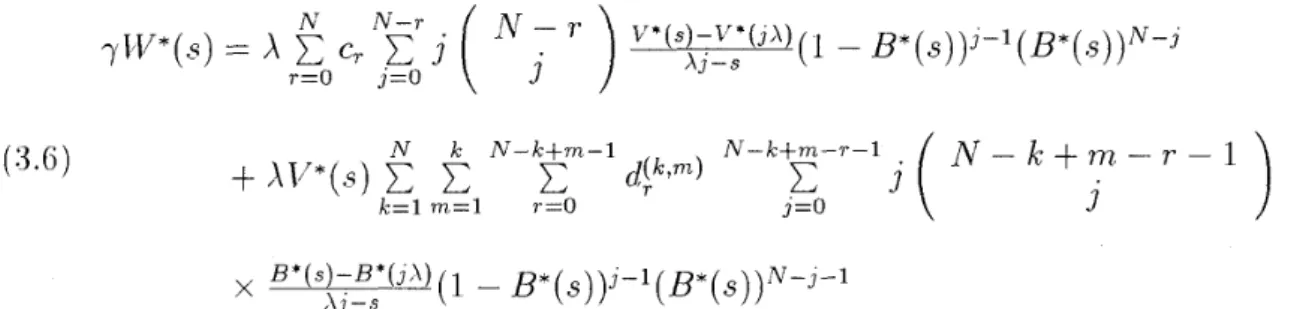
and so I'1fT*(s) is completely known. Finally, by differentiating (3.6)) we obtain the mean wait,ing time E(1V) as
+,,
pi,i
= 1 , 2 , are given by (3.4)4.
Numerical Results-Conclusions
To observe the way in which the customers' mean waiting time is affected when we vary the values of the parameters, and to compare our model with the corresponding models with exhaustive service and with infinite customer population, we present here Table 1.
To coi~st~ruct the Table we denoted by and the mean waiting times in the model of customer population
N
with exhaustive and gated service respectively, and assumed that the service and the vacation times follow exponential distributions with parameters and$
respectively. We usedb
=0.5.
Table 1 depicts values of \V(.) when we increase the offered load p =
N
A
b,
and vary the mean vacation timev.
To obtain values forW?
we have used formula (2.17) in Takagi21 while for the values of W^¡¡ we used, with p =
A
b
now, formulas (2.14a) and (5.24.a) of chapter 2 in Takagi [l].One can observe in the Table that, as it is expected, the values of
W^
are, for all systems, greater than the corresponding values ofW!.).
This difference becomes more apparent for large values ofp
and particularly for large Thus, in case of E = 5, we haveW^
= 4.614,1ff4)
= 5.637 for p = 0.4, while for p =5
the corresponding values are Wj4) = 1.678 andTI/:~)
= 6.266.One can also observe in Table 1 the way in which the models are affected from variations in the vacation periods. A11 interesting observation here is that in the case of gated service and for all the value of
W^
is always increasing with p, a phenomenon that we cannot always observe in the case of exhaustive service. This behavior is a consequence of the vacation principle and is more apparent for large V. In systems with gated service the customers' waiting time always contains a vacation period or a part of a vacation period and so147J')
is always affected from 5. For systems with exhaustive service, when p increases the durat,ion of the busy period increases and the opportunity for a vacation becomes now rare. Thus in an exhaustive service system with largev,
the effect of the vacation, which is large at the beginning (when p is small), is reduced when p increases and it results in smaller values of the mean waiting times. Of course, beyond a certain value of p, this effect is wiped out, and the waiting time starts again to increase with p (see for exampleW?
for-
v
=5).
An observation supporting the previous explanation is that for a very large p,p
=5
for example, the mean waiting times
W^.)
become almost identical for all 5 (the vacation does not affect the models a t all), while for p =5
the differences between the mean waitingAn M / G / 1 Queue with Finite Population 139
times L\/$.) are almost equal to the differences between the corresponding mean vacations
(the models are fully dependent on the vacation periods).
Finally one can observe in Table
1,how the mean waiting times increase when we increase
t3he p o p ~ l a t ~ i o n
size N.
Table 1: Values of the mean waiting time for
b=0.5.
AcknowledgementWe would like to tha,nk Dr
P. Ya,la,mov from Technical University of Russe, Bulgaria, for
his help with the numerica(1 comp~ta~tions.
References
[l]