EFFECTS OF A PLAYER’S AWARENESS OF INFORMATION
ACQUISITION AND ABILITY TO CHANGE STRATEGY IN ATTRITION GAMES
Ryusuke Hohzaki Makoto Tanaka
National Defense Academy Japan Ministry of Defense
(Received July 19, 2016; Revised February 1, 2017)
Abstract This paper deals with a two-person zero-sum (TPZS) attrition game on a network in which attackers depart from a start node and attempt to reach a destination node while defenders deploy to intercept the attackers. Both players incur some attrition due to conflict between them, but the payoff of the game is the number of surviving attackers reaching the destination. We generate a system of models categorized according to various scenarios of the player’s information acquisition (IA) about his opponent and derive linear programming formulations for the equilibria of the models. Comparing the equilibria, we evaluate the values of the situations around the IA in a comprehensive manner.
Keywords: Game theory, attrition game, network interdiction
1. Introduction
This paper deals with a two-person zero-sum (TPZS) attrition game on a network in which attackers depart from a start node and attempt to reach a destination node while defenders deploy to intercept the attackers. Both players incur some attrition due to conflict between them, but the payoff of the game is the number of surviving attackers reaching the desti-nation. We generate a system of models categorized according to various situations of the player’s information acquisition (IA) about his opponent and derive linear programming formulations for the equilibria of the models. Comparing the equilibria, we evaluate the values of the situations around the IA. We explicitly describe the concrete situations of the IA later.
Many mathematical models are available for analyzing attributes of network structures, such as telecommunication networks and similar infrastructures. Network interdiction mod-els, or NIMs, define a research field related to interception or interdiction on networks. If such problems have multiple decision makers, they are called network interdiction games, or NIGs.
In their well-known book Methods of Operations Research, Morse and Kimball [35] first considered the game of an anti-submarine warfare (ASW) operation to intercept the passage of submarines in straits. Their ASW problem is a TPZS game in which ASW airplanes watch for or inspect the passage of submarines. The inspection game was originally developed by Dresher [17] to analyze the effectiveness of arms reduction treaties, as surveyed by Hohzaki [24]. It was not modeled on a network, though.
The inspection game diverged into smuggling games with two competitors, customs and a smuggler. Motivated by serious drug problems in the United States, the smuggling game became popular during the 1980s and 1990s. Thomas and Nisgav [47] developed an
algo-rithm to solve a multi-stage smuggling game. Researchers have discussed the interdiction of smuggling on several different networks. The smuggler is eager to choose safe transportation routes for illegal drugs or other contraband and customs wants to intercept them by setting inspection points. These researchers include Mitchell and Bell [33], Caulkins et al. [14], Washburn and Wood [48], Bakır [6], and Salmeron [42]. Washburn and Wood formulated a TPZS smuggling game as a mixed integer problem from a graph-theoretical point of view. Bakır considered a Stackelberg game of the interdiction of an unauthorized weapon insertion via sea ports or other points.
NIMs provide a different viewpoint from that of graph-network theory. Ford and Fulk-erson [18] and Wollmer [50] analyzed the effects of the destruction of arcs on networks. McMasters and Mustin [32] and Ghare et al. [20] discussed the damage of logistic net-works. Fulkerson and Harding [19], Golden [22], Bayrak and Bailey [9], and Cappanera and Scaparra [13] analyzed an optimal resource allocation problem in shortest-path networks in which the distributed resource changes some attributes of the network, such as arc lengths.
Wood [51] discussed a Stackelberg game on the maximum flow on a network, and Akg¨un
et al. [2] dealt with a Stackelberg game of an interdiction problem with multicommod-ity maximum flows referred to as the multi-terminal maximum-flow network-interdiction problem.
In graph theory, flows are usually assumed to be conserved over a network. However, Lawler [31] and Ahuja et al. [1] developed a theory for generalized flows with losses or gains. NIMs can also be applied to many real-world problems, such as defense against terrorist attacks, maintaining the resilience of infrastructures against various types of attacks, infec-tion control in a hospital, tactical air strikes, chemical treatment of raw sewage, and flood control. There has been much research on these topics.
Church et al. [15], Scaparra and Church [45], and Desai and Sen [16] discussed problems of defending facilities. Bier and Azaiez [11] examined defense of infrastructure networks, which is an internationally serious problem. Salmeron et al. [43, 44] considered a defense game of an electric power grid involving mitigating the damage inflicted by terrorist attacks.
Baykal-G¨ursoy et al. [8] considered a mitigation policy of node investigations and active
patrols after an attacker has damaged nodes on a network.
Assimakopoulos [4] formulated an optimal interdiction problem on an infection network in a hospital. Harris [23] discussed a resource allocation problem in Philadelphia to efficiently prevent HIV infection taking account of the population of drug users. Whiteman [49] and Brown et al. [12] studied military applications of the NIM. Brown et al. proposed a defensive network of anti-ballistic missiles in eastern Asia from a game-theoretical perspective.
Researchers have applied the interdiction game model to patrolling and security prob-lems, although not all of these applications necessarily handle networks. Pita et al. [39] discussed a Bayesian patrolling game with several types of invaders and guards, and in-stalled the game solution in a real security system named ARMOR. Morita et al. [34] and Hohzaki et al. [27] explicitly considered the problem of patrol routing and invasion routing in a facility and discussed a TPZS patrolling game.
NIMs are also important in the field of designing networks with guaranteed reliability. Gibbens and Kelly [21] and Ouveysi and Wirth [37] discussed flexible networks that are re-silient against the deletion of arcs. Alveras et al. [3] and Myung et al. [36] considered designs to protect mobile phone and telecommunication networks against a failure of communica-tion nodes. Kodialam and Lakshman [29] developed a sampling method for inspecting data packets to detect the intrusion of a computer virus or other illegal software. Smith et al. [46] discussed the fortification of a telecommunication network against malicious attacks.
Public transportation systems are likely targets of terrorists and many incidents have actually occurred in European countries. The NIM has been applied to public transportation by Bell et al. [10], who analyzed the vulnerability of physical road networks to terrorist attacks by using game theory, and Perea and Puerto [38], who discussed a secure railway network design against intentional attacks.
Ruckle [40, 41] developed several models of the so-called ambush game, in which the blue team moves across a rectangular lattice area in such a way as to avoid being ambushed by some members of the red team deployed in the area. Baston and Kikuta [7] discussed an ambush game with Blue team starting from two points. This type of interdiction game is sometimes called the infiltration game [5] when considered from the standpoint of the intruder.
Hohzaki and Chiba [25] proposed new models for the interdiction game known as attri-tion game, in which attackers and defenders compete each other on an attriattri-tion network. The attackers depart from a start node and attempt to reach a destination node expecting to keep their initial members untouched during their march. The defenders deploy their members on arcs to intercept the attackers. Through encounters between the attackers and the defenders deployed on arcs, the attacker and the defender incur some attrition according to Lanchester’s linear model of attrition [30]. The payoff of the attrition game is the num-ber of surviving attackers reaching the destination. For this problem, Hohzaki and Chiba developed two models. One is a TPZS one-shot game with no information and the other is a TPZS two-stage game with acquisition of information about players’ opponents. Hohzaki and Sunaga [28] discussed some attrition games with asymmetric information depending on the contents of the obtained information. The basic assumptions of the attrition games discussed by Hohzaki and Chiba, and Hohzaki and Sunaga are similar to each other in terms of the contents of information, timing of IA, and the rule of attrition. Hohzaki and Higashio [26] analyzed games with the attrition ruled by not Lanchester’s linear law but a square law.
In the previous research described above and this paper, we handle two kinds of informa-tion about each player and discuss two-stage games in which one player acquires informainforma-tion about the other. Because of the simplicity of our model, we can enumerate all scenarios of IA situation and evaluate the value of them by comparing the values of their games corre-sponding to the scenarios. First we discussed rational strategies of players when a player acquires perfect or imperfect information about his opponent. The player is able to change his strategy based on the information, otherwise the information would be useless. Specif-ically, we evaluate the value of the information by comparing a game with IA to a game with no IA. The information evaluation was fulfilled mainly by Hohzaki and Chiba [25] and Hohzaki and Sunaga [28]. Secondly, we have to take notice of the importance of whether or not a player knows that his opponent has information about him. The player’s awareness or unawareness of his opponent’s IA makes a difference to the results of the game. When a player is aware of the IA by his opponent, the ability to instantaneously change his strategy is interesting. If the player cannot change his strategy at exactly the time of his opponent’s IA, he has to prepare a rational strategy at the beginning of the game taking account of his opponent’s knowledge of him in the future. These are what we think of concerning the situation of the IA in this paper. We discuss the following aspects concerning the IA situation: the value of awareness or unawareness of the opponent’s IA, and the value of the player’s ability to change his strategy. By synthesizing the result of this paper with the other results of the previous papers, we could accomplish our comprehensive understanding or analysis on the IA. One purpose of this paper is to comprehensively evaluate the values
of various situations related to the IA in an attrition game on a network.
In the next section, we review the basics of the attrition games and their equilibria discussed in Hohzaki and Chiba [25] because some models in the present paper reduce to those models. Especially in Section 2.3, we take an overview on a synthetic configuration of IA models proposed in this paper and the previous papers: Hohzaki and Chiba [25] and Hohzaki and Sunaga [28]. According to the configuration map, we develop and discuss four models with IA by the defender in Section 3, and we consider three models with IA by the attacker in Section 4. We review the results of our seven models in Section 5 and construct a comprehensively structured categories for the values of IA situations to propose an evaluation for not only the contents of information but also the player’s awareness of the IA and the ability to quickly respond to the IA. In Section 6, we use some numerical examples to analyze the values related to IA.
2. Basic Models of Attrition Game and Their Equilibria
Hohzaki and Chiba [25] proposed models of the attrition game between two players, an at-tacker and a defender, on a network. Specifically, they proposed a one-shot TPZS game with no information and a two-stage game with IA about players’ opponents. Before discussing our model with IA, let us itemize notations we will use hereafter and begin with reviewing the original models and the equilibria of Hohzaki and Chiba.
Notation
• G(N, A): An attrition network with a node set N and an arc set A • R0, B0: Initial numbers of attackers and defenders, respectively
• γe: Exchange rate of arc e
• Ω: All paths from the start node s to the destination t • Pi
j: All paths from node i to j
• El: Arcs on path l
• E(1)
l : Arcs on path l in Stage 1
• E(2)
l : Arcs on path l in Stage 2
• Ω(1)
e : The set of paths going through arc e in Stage 1; ≡ {l ∈ Ω|e ∈ El(1)}
• ΩP: The set of paths going through node P
• eΩP: The set of paths having IA node P ; ≡ {l ∈ Ω|Nl = P}
• eN : The set of IA nodes; ≡ {Nl, l ∈ Ω}
• eγl: The maximum exchange rate of arcs on path l in Stage 2;≡ maxe∈E(2)
l
γe
• eel: Arc with the maximum exchange rate on path l in Stage 2; ≡ arg maxe∈E(2)
l
γe
• A(1): The set of arcs that at least a path passes through in Stage 1; ≡∪
l∈ΩE (1) l
• A(2)
P : The set of arcs on paths in Stage 2, with IA node P ; ≡
∪
l∈eΩP E
(2) l 2.1. Basic model of one-shot game and its equilibrium
Let us consider the following TPZS game.
A1. An attrition network G(N , A) is a connected network consisting of a set of a finite
number of nodes N and a set of a finite number of directed arcs A but having no directed cycle. On the network, two players representing an attacker group and a defender group compete against each other.
A2. The attackers depart from a start node s with the goal of reaching a destination node
t. Their initial number of members is R0. The defenders have B0 initial members and
A3. A conflict between x attackers and y defenders on an arc e ∈ A continues until the annihilation of one side according to the attrition model of the so-called Lanchester linear law. The law gives the number of remaining attackers as
max{0, x − γey}. (2.1)
Coefficient γe indicates the relative strength of the defender against the attacker on arc
e and is called the exchange rate of strength.
A4. Both players make their decisions without any information about their opponents.
A5. The payoff of the game is the number of remaining attackers reaching the destination
node t. The attackers want to maximize it and the defenders desire to minimize it. Lanchester deductively derived some attrition laws in combats between two competing groups, such as between air forces or between infantries, from differential equations de-scribing the combat processes. One of these laws is the linear attrition law. It prescribes a linear relationship between attritions of two competing groups, A and B, as follows. Let
a0 and a be the initial number and the present number of A, and b0 and b be the initial
number and the present number of B. In the process of the combat, the attritions of A and
B, a0− a and b0− b, have the linear relation
a0− a = γe(b0− b).
For any fixed exchange rate γe, if a0 − γeb0 ≥ 0, B is annihilated, that is b = 0, with
a0−γeb0 members of A surviving, and otherwise A is wiped out. The expression (2.1) shows
the linear attrition law.
We denote the set of all paths from node s to t by Ω and the set of arcs composing a
path l ∈ Ω by El ⊆ A. A defender pure strategy is denoted by a vector y = {ye, e ∈ A},
where yeis the number of defenders deployed on arc e, which we regard as a real number. y
has its feasible region Y ≡{y|∑e∈A ye ≤ B0, ye ≥ 0, e ∈ A
}
. The attacker pure strategy
is to choose a path l ∈ Ω, but we consider its mixed strategy, which is denoted by a
vector π = {π(l), l ∈ Ω}. π(l) is the probability of taking path l. It has a feasible region
Π ≡ {π|∑l∈Ωπ(l) = 1, π(l)≥ 0, l ∈ Ω}. Using this notation, we will derive the payoff
function of the game.
From Equation (2.1), the total number of remaining attackers moving along a path l is
max{0, R0−
∑
e∈Elγeye}. Then the expected payoff for an attacker’s mixed strategy π and
a defender’s pure strategy y is as follows.
R(π, y) =∑ l∈Ω π(l) max { 0, R0− ∑ e∈El γeye } (2.2)
Because this payoff function is linear in π and convex in y, we know that there exists an equilibrium of π and y from the theory of so-called convex games. Therefore, we derive an
optimal attacker strategy π∗ and an optimal defender strategy y∗ by solving the maximin
optimization and minimax optimization of R(π, y), respectively.
The main result on the equilibrium presented in a previous paper [25] is given in the following theorem.
Theorem 1 (Equilibrium of one-shot attrition game [25]). For the one-shot attrition game
with no information, we are given an optimal defender strategy y∗ by problem (MI′
B) and
as optimal dual variables corresponding to condition (2.5) of (MII R) and (2.3) of (MI ′ B), respectively. (MBI′) min y,ξ ξ s.t. ξ≥ 0, ξ≥ R0− ∑ e∈El γeye, l∈ Ω, (2.3) y∈ Y. (MRII) max π,ρ,λ ( R0 ∑ l∈Ω ρ(l)− B0λ ) (2.4) s.t. ρ(l)≤ π(l), l ∈ Ω, γe ∑ {l|e∈El} ρ(l)≤ λ, e ∈ A, (2.5) ρ(l)≥ 0, l ∈ Ω, π∈ Π.
As we can see from condition (2.3), the defenders adopt an optimal deployment plan to minimize the maximum number of remaining attackers on any path to make the defense tough whichever path the attackers take.
Hereafter, we often use ‘the attacker’ and ‘the defender’ as substitutes for the plural nouns ‘the attackers’ and ‘the defenders’, for the sake of simplicity.
2.2. Two-stage attrition game and its equilibrium
In the two-stage game model, Assumption A4 in Section 2.1 is replaced with the following while keeping other assumptions the same.
B4. At some time after the attacker starts marching, the defender learns the present node
of the attacker and the number of remaining attackers. At the same time, the attacker obtains information about the number of remaining defenders to be positioned
there-after. The IA takes place when the attacker is at node Nl on each attacker’s path l. Nl
is known to players in advance and could be the start node s or the destination node t. Let us call the period before the attacker reaches the IA node Stage 1 and the period after leaving that node Stage 2. The defenders deployed in Stage 1 are not available in Stage 2.
Let us define the players’ strategies for the two stages as follows. For the attacker, the
mixed strategy in Stage 1 is denoted by π = {π(l), l ∈ Ω}, where π(l) is the probability
of taking path l, and the mixed strategy in Stage 2 by πl = {πl(l′), l′ ∈ PtNl}, where Pji
is a set of paths from node i to j and πl(l′) is the probability that the attacker takes path
l′ ∈ PNl
t from IA node Nl given that he takes path l in Stage 1. For the defender, we denote
the deployment plan for Stage 1 by y(1) = {y(1)
e , e ∈ A} and the deployment plan for the
B0−
∑
e∈A y (1)
e remaining members of Stage 2 by y(2) ={ye(2), e∈ A}.
We use El(1) and El(2) to denote the sets of arcs on path l for Stage 1 and 2, respectively.
We also represent the one-shot game in Section 2.1 by Γ(R0, s, B0), where Γ(R, N, B) means
the one-shot game with R attackers starting from node N and B defenders.
An overview of the solution by Hohzaki and Chiba [25] is as follows. If the attacker
2 the number of remaining attackers is R(2)0 (l, y(1)) = max{0, R 0 − ∑ e∈El(1)γey (1) e }, his new
start node is Nl, and the number of available defenders is B
(2) 0 (y(1)) = B0− ∑ e∈A y (1) e . We
simply use R(2)0 and B0(2) unless they confuse our theory, for the sake of simplicity. For the one-shot game in Stage 2, Γ(R(2)0 , Nl, B(2)0 ), Hohzaki and Chiba show that the attrition of
the attackers is given by the product of B0(2)(y(1)) and the optimal value νl∗ of the following linear programming problem.
(Dl2) νl∗ = min νl,λl(l′) νl s.t. νl− γe ∑ l′∈PtNl|e∈E (2) l′ λl(l′)≥ 0, e ∈ A, ∑ l′∈PtNl λl(l′) = 1, λl(l′)≥ 0, l′ ∈ PtNl.
Optimal variables λl(l′) give an optimal attacker strategy πl∗(l′) for Stage 2. Therefore, in
Stage 1 the payoff as a function of attacker path l and defender deployment y(1) is given by
R0− ∑ e∈El(1) γeye(1)− νl∗B (2) 0 (y (1) ).
By adapting the formulation (MBI′) to the payoff function, we have a linear programming
formulation for an optimal defender strategy in Stage 1, y∗(1).
(T1) min µ(1),y(1)µ (1) s.t. µ(1) ≥ R0 − ∑ e∈El(1) γeye(1)− νl∗ B0 − ∑ e∈A ye(1) , l ∈ Ω, y∈ Y.
Please note that the final number of surviving attackers, µ∗(1), is allowed to be negative. A
negative value means the annihilation of the attacker by an over-deployment by the defender and is sometimes called the overkill of the attacker.
Theorem 2 (Equilibrium of two-stage attrition game [25]). We derive an equilibrium of the
two-stage game as follows. After obtaining νl∗ by solving problem (D2
l) for every path l∈ Ω,
substitute νl∗ into problem (T1) and the below-stated problem (V1). The former problem gives
us an optimal defender strategy y∗(1) and the latter one an optimal attacker strategy π∗ for
Stage 1. (V1) max π,η R0− B0 ∑ l∈Ω π(l)νl∗− B0η s.t. ∑ l∈Ω π(l)νl∗− γe ∑ l∈Ω(1)e π(l)≥ −η, e ∈ A(1), η ≥ 0, π ∈ Π.
A(1)is the set of arcs that at least a path of Ω passes through in Stage 1 and Ω(1)e is the set
of paths which pass through arc e in Stage 1, which is represented as Ω(1)e ≡ {l ∈ Ω|e ∈ El(1)}.
After knowing the results of Stage 1 (the attacker’s present node i, the number of surviv-ing attackers R(2)0 , and the number of remaining defenders B0(2)), both players can anticipate their optimal strategies in Stage 2 by solving the one-shot game Γ(R(2)0 , i, B0(2)). As seen as a general property of the equilibrium point, neither player can benefit from deviating from their equilibrium strategy.
2.3. Classification by awareness of IA and changeability of strategy
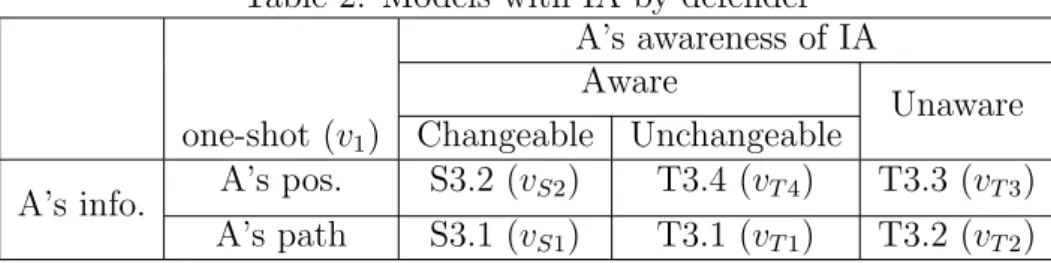
In previous research [25, 28], we analyzed several information contents. For this paper, we also consider the same information contents. As information about the attacker, we take his present position (A’s pos.) and his path (A’s path) at the beginning of Stage 2. For the defender, we consider the number of available defenders (D’s num.) and the detailed deployment of these defenders (D’s deploy.) in Stage 2. Table 1-a shows our classification by information contents. The models in Sections 4 and 5 of Chiba and Hohzaki’s paper [25], where the equilibrium points of the relevant models are given, are herein referred to respectively as ‘C4’ and ‘C5’. These are outlined above in Sections 2.1 and 2.2. ‘S3.1’ indicates Section 3.1 of Sunaga and Hohzaki’s paper [28] and ‘N/A’ means a non-applicable model.
Tables 1-b and 1-c show the models with asymmetric information, that is, those in which the attacker or the defender acquires information on his opponent but the other does not. In addition to the information contents, we add new categories regarding whether the player whose information is acquired (acquired player) is aware of the IA or not, and whether he can or cannot change his strategy at the time of the IA. If he cannot change it, he has to initially prepare for the IA considering that his information will be obtained afterward by his opponent. We must note that the player getting some information (acquiring player) can always change his strategy, though. If not, the information would be useless for the player and the discussion of IA would have no meaning. We assume that the acquiring player knows the acquired player’s awareness or unawareness of IA. Several models have been already solved by Sunaga and Hohzaki, and, as in Table 1-a, these are denoted by ‘S*.*’. Models in the present paper (by Tanaka and Hohzaki) are denoted by ‘T*.*’ according to the section in which each is found. As seen from these filled-in tables, the present work completes the quantitative evaluation of the values of each possible combination of information about players, awareness of IA, and changeability of strategy for attrition games on a network. These factors are thought to seriously affect the results of games in game theory, but it would be generally complicated to evaluate their effects because that would require a lot of comparisons between the related models. However, our attrition game has adequate scope to examine the effects of these factors and their values.
Here before the detailed discussion, let us look at each model of T*.*, which is made by replacing Assumption A4 in Section 2.1 with individual characteristic assumption on IA.
C4. (Model T3.1) On every path l the attacker takes, the defender knows the attacker
path when the attacker is at a pre-determined node Nl. The attacker is aware of the IA
by the defender but cannot change his path. Both players recognize the scenario.
D4. (Model T3.2) On every path l the attacker takes, the defender knows the attacker’s
path when the attacker is at a pre-determined node Nl. The attacker is not aware of
the IA by the defender, and the defender knows that the attacker is unaware.
E4. (Model T3.3) On every path l the attacker takes, the defender knows the attacker’s
The attacker is not aware of the IA by the defender, and the defender knows that the attacker is unaware.
F4. (Model T3.4) On every path l the attacker takes, the defender knows the attacker’s
current position when the attacker is at a pre-determined node P = Nl. The attacker
is aware of the IA by the defender but cannot change his path. Both players know the scenario.
G4. (Model T4.1) The attacker knows the defender deployment when he arrives at a
pre-determined node Nl on any path l. The defender notices the IA by the attacker but
cannot change his deployment. Both players recognize the scenario.
H4. (Model T4.2) The attacker knows the number of defenders available in Stage 2 when
he arrives at a pre-determined node Nl on any path l. The defender notices the IA by
the attacker but cannot change his deployment. Both players recognize the scenario.
I4. (Model T4.3) The attacker knows a deployment of defenders or the number of available
defenders in Stage 2 when he arrives at a pre-determined node Nl on any path l. But the
defender is unaware of the IA by the attacker. The attacker recognizes the defender’s unawareness.
Table 1-a: Classification by the contents of information
A’s info. \ D’s info. None D’s num. D’s deploy.
None one-shot (C4) See Table 1-c
A’s pos.
See Table 1-b two-stage (C5) same as C5
A’s path same as S3.1 N/A
*) N/A: non-applicable Table 1-b: Classification of asymmetric IA for attacker’s information
A’s Awareness of IA Aware
Unaware
Changeable Unchangeable
A’s info. A’s pos. S3.2 T3.4 T3.3
A’s path S3.1 T3.1 T3.2
Table 1-c: Classification of asymmetric IA for defender’s information D’s info.
D’s num. D’s deploy.
D’s Awareness Aware Changeable S3.4 S3.3
of IA Unchangeable T4.2 T4.1
Unaware T4.3
3. Models with Information Acquisition by Defender
Here we deal with several models where only the defender acquires his opponent’s infor-mation. We configure some scenarios of awareness and changeability, that is, whether the attacker is aware or unaware of the IA by the defender and whether the attacker can or cannot change his strategy instantly after the IA in the case that he is aware. The contents of the information are (1) the intended path in Stage 2, and (2) the present node. As seen in Table 1-b, the models with changeability of the attacker’s path (Model S3.1 and S3.2) were already studied by Sunaga and Hohzaki [28] and so we discuss four other models, T3.1–T3.4.
Under models T3.1–T3.4, the IA by the defender is also assumed to occur when the
attacker reaches the IA node Nl by arbitrary path l. We call here the period before reaching
the IA node Stage 1 and the other period, after leaving the node, Stage 2, as in Section
2.2. We also denote a mixed strategy of the attacker by π = {π(l), l ∈ Ω} and the two
deployment strategies of the defender for Stage 1 and 2 by y(1) and y(2), respectively. π and
y(1) have their feasible regions Π and Y , respectively, defined before.
3.1. IA of attacker path and unchangeability of attacker path (T3.1)
If the attacker takes path l, the defender puts all of his B(2)0 (y(1)) = B 0−
∑
e∈A y (1)
e remaining
members on the arc with the largest exchange rate,eel ≡ arg maxe∈E(2) l
γe, in Stage 2 because
the defender knows the unchangeable path l. Therefore, we have the following payoff, that is, the number of surviving attackers, R(l, y(1)), after Stage 2:
R(l, y(1)) = max 0, R0− ∑ e∈El(1) γeye(1)− eγlB0(2)(y (1) ) , (3.1)
where eγl is maxe∈E(2) l
γe. If the attacker uses a mixed strategy π in Stage 1, then we have
the expected payoff R(π, y(1)) = ∑
l∈Ωπ(l)R(l, y
(1)). This is the target function of our
optimization.
First, let us discuss its minimax optimization. From the transformation min y(1)maxπ R(π, y (1)) = min y(1) maxl∈Ω R(l, y (1)) = min y(1){µ | R(l, y (1))≤ µ, l ∈ Ω}
and Equation (3.1), we generate the following formulation for the minimax optimization.
(BPD) min y(1),µ µ s.t. µ≥ R0− ∑ e∈El(1) γey(1)e − eγl B0− ∑ e∈A y(1)e , l ∈ Ω, µ≥ 0, y(1) ∈ Y.
We derive an optimal defender strategy y∗(1) by solving the linear programming problem.
An optimal defender strategy in Stage 2 is the deployment of all available members on arc eel, which is given by yee∗(2)l = B
(2)
0 (y∗(1)), y ∗(2)
e = 0 (e̸= eel).
Let us consider the maximin optimization. From Equation (3.1), the minimization prob-lem miny(1)
∑
l∈Ωπ(l)R(l, y
(1)) is reformulated as the following problem.
min y(1),µ ∑ l∈Ω π(l)µl s.t. µl ≥ 0, l ∈ Ω, µl ≥ R0− ∑ e∈El(1) γey(1)e − eγl B0− ∑ e∈A y(1)e , l ∈ Ω, (3.2) ∑ e∈A ye(1) ≤ B0, (3.3) ye(1) ≥ 0, e ∈ A.
Making dual variables ξl and λ corresponding to conditions (3.2) and (3.3), respectively, we
generate the following dual problem. max ξ,λ ∑ l∈Ω ξl(R0− eγlB0)− λB0 s.t. ξl ≤ π(l), l ∈ Ω, − ∑ l∈Ω(1) e ξl(eγl− γe)− ∑ l∈Ω\Ω(1) e ξleγl− λ ≤ 0, e ∈ A, ξl ≥ 0, l ∈ Ω, λ ≥ 0.
Furthermore, we maximize the optimized value above with respect to variable π to have
a formulation for the maximin optimization of R(π, y(1)). We derive an optimal attacker
strategy π∗ from the linear programming problem.
(BPA) max π,ξ,λ ∑ l∈Ω ξl(R0− eγlB0)− λB0 s.t. 0≤ ξl ≤ π(l), l ∈ Ω, λ + ∑ l∈Ω(1)e ξl(eγl− γe) + ∑ l∈Ω\Ω(1)e ξleγl ≥ 0, e ∈ A, λ≥ 0, π∈ Π.
Theorem 3. In Model T3.1, an optimal defender strategy in Stage 1, y∗(1), is given by solving (BPD) and an optimal one in Stage 2 is yee∗(2)l = B0−
∑
e∈A y ∗(1)
e and ye∗(2)= 0 (e ̸=
eel). We obtain an optimal attacker strategy by solving (BPA). 3.2. IA of attacker path and unawareness of the IA (T3.2)
Similarly to Model T3.1 in Section 3.1, the defender deploys all available members on the arc
eel with exchange rate eγl in Stage 2 after learning the attacker’s path l. On the other hand,
the attacker takes what would be the optimal mixed strategy π∗ of the one-shot game by
solving the problem (MII
R ) because he misunderstands the information scenario and thinks
that the players are playing the one-shot game Γ(R0, s, B0). The discussion above leads
us to the following formulation for an optimal defender strategy y∗(1) in Stage 1, which
minimizes the expected number of surviving attackers.
min y(1) ∑ l∈Ω π∗(l) max 0, R0− ∑ e∈E(1)l γey(1)e − eγlB (2) 0 (y(1))
Adding the feasibility conditions of y(1), we finally have a linear programming formulation
for an optimal defender strategy in Stage 1.
(BPD2) min y(1),µ ∑ l∈Ω π∗(l)µl s.t. µl≥ R0 − ∑ e∈El(1) γeye(1)− eγl B0− ∑ e∈A ye(1) , l ∈ Ω, µl≥ 0, l ∈ Ω, y(1) ∈ Y.
Theorem 4. In Model T3.2, (BP2
D) gives us an optimal defender strategy in Stage 1.
y∗(2)ee
l = B0 −
∑
e∈A y ∗(1)
e and ye∗(2) = 0 (e ̸= eel) is an optimal defender strategy in Stage 2.
The attacker takes an optimal mixed strategy of the one-shot game.
3.3. IA of attacker’s current position and unawareness of the IA (T3.3)
Similarly to Model T3.2, the attacker takes what would be the optimal strategy of the one-shot game, π∗. Let the defender adopt a deployment strategy y(2)P ={y(2)P e, e∈ A} in Stage
2, which depends on his strategy y(1) in Stage 1 and the attacker’s position P from the IA,
by anticipating the attacker strategy π∗. He should limit his deployment of Stage 2 within
the set of arcs on the paths having IA node P in Stage 2, which we denote by A(2)P . A
feasible region of y(1) and y(2)
P is given by YP(1,2) ≡ {(y(1), y(2)P ) | ye(1) ≥ 0, e ∈ A, ∑ e∈A ye(1)+∑ e∈A y(2)P e ≤ B0, yP e(2) ≥ 0, e ∈ A, yP e(2) = 0, e /∈ A(2)P }.
Knowing the attacker’s position P at the beginning of Stage 2, the defender knows that
the attacker took some path belonging to eΩP ≡ {l ∈ Ω|Nl = P}. Then he evaluates the
probability of the attacker’s taking path l ∈ eΩP as π∗(l)/
∑
l′∈eΩP π
∗(l′) and the number of
remaining attackers at node P = Nl in that case as max{0, R0−
∑
e∈El(1)γey (1)
e }. Therefore,
in Stage 2 he must adopt an optimal deployment y(2)P to minimize the following expected
payoff. ∑ l∈eΩP π∗(l) ∑ l′∈eΩP π ∗(l′)max 0, R0− ∑ e∈El(1) γey(1)e − ∑ e∈El(2) γey (2) P e
By adding a new variable µP, the minimization problem above is reformulated into the
following. (BN P ) wP∗(y(1)) = min y(2) P ,µP ∑ l∈eΩP π∗(l) ∑ l′∈eΩP π ∗(l′)µP(l) s.t. µP(l)≥ 0, l ∈ eΩP, µP(l)≥ R0 − ∑ e∈El(1) γeye(1)− ∑ e∈El(2) γey (2) P e, l∈ eΩP, ∑ e∈A yP e(2) ≤ B0− ∑ e∈A y(1)e , yP e(2) ≥ 0, e ∈ A.
According to the path strategy π∪ ∗, the defender acquires an attacker’s position P ∈ eN ≡
l∈Ω
{Nl} by the IA with probability
∑
l′∈eΩP π
∗(l′). Given the position information P , the
defender expects the minimized expected payoff w∗P(y(1)) of (BN P ). Then the defender
minimizes ∑P∈ eN(∑l′∈eΩP π∗(l′))wP∗(y(1)) by his strategy y(1) in Stage 1. Using the optimal
variable µ∗P(l) of problem (BN P ), this minimization problem is written as
min y(1) ∑ P∈ eN ∑ l′∈eΩP π∗(l′) ∑ l∈eΩP π∗(l) ∑ l′∈eΩP π ∗(l′)µ∗P(l).
We combine this problem and (BN P ) as the following formulation. (BN PD) min y(1),y(2),µ ∑ P∈ eN ∑ l∈eΩP π∗(l)µP(l) s.t. µP(l)≥ 0, l ∈ eΩP, P ∈ eN , µP(l)≥ R0− ∑ e∈El(1) γeye(1)− ∑ e∈El(2) γey (2) P e, l∈ eΩP, P ∈ eN , (y(1), y(2)P )∈ YP(1,2), P ∈ eN .
Theorem 5. In Model T3.3, the attacker takes the optimal mixed strategy of the one-shot
game, and the defender rationally takes the plan of y∗(1) and y∗(2)={y∗(2)P , P ∈ eN} in Stage
1 and 2, respectively, by solving (BN PD).
3.4. IA of attacker’s current position and unchangeability of attacker path (T3.4)
We denote a path strategy of the attacker by π and a deployment strategy of the defender by y(1) and y(2) for Stage 1 and 2, similarly to Section 3.3.
The defender assumes a mixed strategy π for the attacker, so given that the attacker’s position between Stage 1 and 2 is P , the probability of the attacker’s having taken path l ∈ eΩP is π(l)/
∑
l′∈eΩPπ(l
′). Therefore, the defender chooses his strategy y∗(2)
P for Stage 2
so as to minimize the expected payoff, as given by the following problem:
min y(2) P ∑ l∈eΩP π(l) ∑ l′∈eΩP π(l ′)max 0, R0− ∑ e∈E(1)l γeye(1)− ∑ e∈E(2)l γey (2) P e
Because the probability that the attacker goes through the IA node P is estimated to be ∑
l′∈eΩPπ(l
′), the expected number of surviving attackers is given by
R(π, y(1)) = ∑ P∈ eN ∑ l′∈eΩP π(l′) min y(2) P ∑ l∈eΩP π(l) ∑ l′∈eΩP π(l ′)max 0, R0− ∑ e∈E(1)l γey(1)e − ∑ e∈E(2)l γey(2)P e = ∑ P∈ eN min y(2) P ∑ l∈eΩP π(l) max 0, R0− ∑ e∈El(1) γeye(1)− ∑ e∈El(2) γey (2) P e . (3.4)
R(π, y(1)) is the expected payoff as a function of the attacker strategy π and the defender
strategy y(1). We derive an optimal attacker strategy π∗ and an optimal defender strategy
y∗(1) by maximin optimization and minimax optimization of the payoff, respectively.
As for the maximin optimization, we transform the minimization of R(π, y(1)) into
min y(1) R(π, y (1)) = min y(1) miny(2) ∑ P∈ eN ∑ l∈eΩP π(l) max 0, R0− ∑ e∈El(1) γeye(1)− ∑ e∈El(2) γey (2) P e
and have the following linear programming formulation with additional feasibility conditions of y(1) and y(2): min y(1),y(2),µ ∑ P∈ eN ∑ l∈eΩP π(l)µP(l) s.t. µP(l)≥ R0− ∑ e∈El(1) γey(1)e − ∑ e∈El(2) γey (2) P e, l ∈ eΩP, P ∈ eN , (3.5) µP(l)≥ 0, l ∈ eΩP, P ∈ eN , ∑ e∈A ye(1)+∑ e∈A y(2)P e ≤ B0, P ∈ eN , (3.6) ye(1) ≥ 0, e ∈ A, yP e(2) ≥ 0, e ∈ A, P ∈ eN , yP e(2) = 0, e /∈ A(2)P , P ∈ eN .
We use dual variables ηP(l) and ξP corresponding to conditions (3.5) and (3.6) to construct
the dual problem. We carry out an additional maximization of the dual problem with
respect to π to obtain a formulation for an optimal attacker strategy π∗.
(BN PA2) max π,η,ξ R0 ∑ P∈ eN ∑ l∈eΩP ηP(l)− B0 ∑ P∈ eN ξP s.t. ηP(l)≤ π(l), l ∈ eΩP, P ∈ eN , (3.7) γe ∑ {l|e∈E(1) l } ηNl(l)− ∑ P∈ eN ξP ≤ 0, e ∈ A(1), γe ∑ {l∈eΩP|e∈El(2)} ηP(l)− ξP ≤ 0, e ∈ A (2) P , P ∈ eN , ηP(l)≥ 0, l ∈ eΩP, P ∈ eN , (3.8) ξP ≥ 0, P ∈ eN , ∑ l∈Ω π(l) = 1, (3.9) π(l)≥ 0, l ∈ Ω. (3.10)
Condition (3.10) is removable from inequalities (3.7) and (3.8). Considering that variable
π appears just in conditions (3.7) and (3.9), and it is acting as an upper bound on ηP(l),
these two conditions can be replaced by the inequality ∑P∈ eN ∑l∈eΩ
P ηP(l) ≤ 1, because we
the final formulation of the maximin optimization. (BN PA′2) max π,η,ξ R0 ∑ P∈ eN ∑ l∈eΩP ηP(l)− B0 ∑ P∈ eN ξP s.t. ∑ P∈ eN ∑ l∈eΩP ηP(l)≤ 1, (3.11) γe ∑ {l|e∈E(1) l } ηNl(l)− ∑ P∈ eN ξP ≤ 0, e ∈ A(1), γe ∑ {l∈eΩP|e∈El(2)} ηP(l)− ξP ≤ 0, e ∈ A (2) P , P ∈ eN , ηP(l) ≥ 0, l ∈ eΩP, P ∈ eN , (3.12) ξP ≥ 0, P ∈ eN .
Let us now discuss the minimax optimization of R(π, y(1)) given by Equation (3.4). We can
rewrite the maximization problem maxπR(π, y(1)) as
min y(2) maxπ ∑ P∈ eN ∑ l∈eΩP π(l) max 0, R0− ∑ e∈E(1)l γeye(1)− ∑ e∈E(2)l γey (2) P e
because the defender strategy y(2)P is essentially changeable adaptively to IA node P in the
formulation. Therefore, we have a formulation for the minimax optimization, as follows. min y(1)maxπ R(π, y (1)) = min y(1),y(2)maxπ ∑ P∈ eN ∑ l∈eΩP π(l) max 0, R0− ∑ e∈E(1)l γeye(1)− ∑ e∈E(2)l γey (2) P e = min y(1),y(2) maxl∈Ω max 0, R0 − ∑ e∈El(1) γeye(1)− ∑ e∈El(2) γey (2) Nle
With a replacement of the maximized value of maxl∈Ω by a new variable µ, we have a final
formulation, from which we derive an optimal defender strategy of y∗(1) in Stage 1 and y∗(2)
in Stage 2. (BN PD2) min y(1),y(2),µ µ s.t. µ≥ R0− ∑ e∈El(1) γeye(1)− ∑ e∈El(2) γey (2) Nle, l ∈ Ω, (3.13) µ≥ 0, (y(1), y(2)P )∈ YP(1,2), P ∈ eN . (3.14)
Theorem 6. For Model T3.4, we are given an optimal defender strategy y∗(1) in Stage 1 and
4. Models with Information Acquisition by Attacker
Here we deal with several models where only the attacker obtains the information from his opponent at the beginning of Stage 2. We generate three models depending on the contents of information, awareness of IA, and changeability of the defender’s deployment plan. As the contents of information, we consider separately (1) the specific deployment of defenders, and (2) the number of available defenders at Stage 2. As seen in Table 1-c, two models with the changeability of the defender deployment were already studied; we here deal with the other three models: T4.1–T4.3. Before the detailed discussion about each model in each subsection, we dare to jump to a conclusion for the sake of simplicity and clarification. Please confirm the validity of the theorem to each model in the subsequent sections.
Theorem 7. An equilibrium of Model T4.1, T4.2 or T4.3 is equivalent to that of the
one-shot game.
4.1. IA of defender deployment and unchangeability of the deployment (T4.1)
The defender has to decide his deployment plan y knowing that his deployment will be exposed to the attacker later. The attacker makes his strategy π not knowing y at the
beginning of Stage 1 but knowing it at the IA node Nl on his path l. With the knowledge
of the defender strategy y, the attacker takes path l∗(2)(y) = arg minl′∈ΩNl
∑
e∈E(2) l′
γeye in
Stage 2. At the end of Stage 1, the number of surviving attackers must be max{0, R0 −
∑
e∈E(1)l γeye}. For an attacker path l and a deployment y, the final number of attackers is
R(l, y) = max 0, R0 − ∑ e∈E(1) l γeye− min l′∈ΩNl ∑ e∈E(2) l′ γeye . (4.1)
An equilibrium point is derived by the minimax and maximin optimization of the expected
payoff R(π, y) =∑lπ(l)R(l, y) by an attacker’s mixed strategy π.
Let us minimax-optimize the expected payoff. From a transformation min
y maxπ R(π, y) = miny maxl∈Ω R(l, y) = miny {µ | R(l, y) ≤ µ, l ∈ Ω}
and Equation (4.1), the following is the final result of the minimax optimization.
(RPD) min y,µ,ηµ s.t. µ≥ R0− ∑ e∈E(1) l γeye− ηl, l ∈ Ω, (4.2) µ≥ 0, (4.3) ∑ e∈E(2) l′ γeye≥ ηl, l′ ∈ ΩNl, l∈ Ω, (4.4) y∈ Y.
From the problem, we are given an optimal deployment strategy y∗. Variable ηl gives us
minl′∈ΩNl
∑
e∈El′(2)γeye.
down as follows. min y,ν,λ ∑ l∈Ω π(l)νl s.t. νl≥ 0, l ∈ Ω, νl≥ R0 − ∑ e∈El(1) γeye− ηl, l∈ Ω, (4.5) ∑ e∈E(2) l′ γeye ≥ ηl, l′ ∈ ΩNl, l∈ Ω, (4.6) ∑ e∈A ye ≤ B0, (4.7) ye ≥ 0, e ∈ A.
By dual variables ρ(l), ξl(l′) and λ corresponding to conditions (4.5), (4.6) and (4.7),
re-spectively, we have the following dual problem: max λ,ρ,ξ R0 ∑ l∈Ω ρ(l)− B0λ s.t. −λ + γe ∑ l∈Ω(1)e ρ(l) + ∑ {(l,l′)|e∈E(2) l′ ,l′∈ΩNl,l∈Ω} ξl(l′) ≤ 0, e ∈ A, ρ(l) ≤ π(l), l ∈ Ω, ρ(l)− ∑ l′∈ΩNl ξl(l′)≤ 0, l ∈ Ω, λ ≥ 0, ρ(l) ≥ 0, l ∈ Ω, ξl(l′)≥ 0, l′ ∈ ΩNl, l ∈ Ω.
By further maximizing the above maximized value with respect to π, we complete the
maximin optimization and obtain an optimal attacker strategy π∗ in Stage 1.
(RPA) max π,λ,ρ,ξR0 ∑ l∈Ω ρ(l)− B0λ s.t. γe ∑ l∈Ω(1)e ρ(l) + ∑ {(l,l′)|e∈E(2) l′ ,l′∈ΩNl,l∈Ω} ξl(l′) ≤ λ, e ∈ A, (4.8) 0≤ ρ(l) ≤ π(l), l ∈ Ω, ρ(l)≤ ∑ l′∈ΩNl ξl(l′), l ∈ Ω, (4.9) ξl(l′)≥ 0, l′ ∈ ΩNl, l∈ Ω, π∈ Π.
An optimal path selection in Stage 2 is to choose path l∗(2)(y) after knowing the defender
We notice that the problem (RPD) resembles the formulation of the one-shot game,
(MBI′). Condition (4.4) is the constraint on the attrition of the attacker on any path l′ in Stage 2. We combine the constraint and condition (4.2) to make the following constraint
for any path l′ going through the IA node Nl. We regard the connection of the paths l and
l′ at Nl as a path l∈ Ω. µ≥ R0− ∑ e∈E(1)l γeye− ∑ e∈E(2) l′ γeye= R0− ∑ e∈El γeye
This condition is valid for any path l ∈ Ω and coincides with condition (2.3). Then we
verify that (RPD) implies (MI ′
B). Reversely we can easily insert valid intermediate variables
ηl satisfying the condition (4.4) in (MI ′
B) and we make sure of the equivalence between the
problems (RPD) and (MI
′ B)
We also confirm that the problem (RPA) is equivalent to (MRII) of the one-shot game.
We get the sum of each side of inequality (4.9) with respect to any path l passing through arc e in Stage 2 and then we have
∑ {l∈Ω|e∈E(2) l′ ,∃l′∈ΩNl} ρ(l) ≤ ∑ {(l,l′)|e∈E(2) l′ ,l′∈ΩNl,l∈Ω} ξl(l′).
To the above sum, we add ρ(l) for path l ∈ Ω(1)e going through the arc e in Stage 1 and use
condition (4.8) to have γe ∑ {l|e∈El} ρ(l) = γe ∑ l∈Ω(1)e ρ(l) + ∑ {l∈Ω|e∈E(2) l′ ,∃l′∈ΩNl} ρ(l) ≤ λ,
which is equal to condition (2.5) in (MII
R). We can easily find nonnegative variables ξl(l′)
satisfying conditions (4.8) and (4.9). Now we complete the proof of the equivalence between problems (RPA) and (MRII).
Finally we have seen that this model is equivalent to the one-shot game in Section 2.1. The optimal solution of (MBI′), y∗, is the best defense against all attacker paths in the sense that it minimizes the maximum number of remaining attackers. Even if the attacker changes his path in Stage 2, an entire path through Stage 1 and 2 is merely an attacker path and
then the deployment y∗ is optimal to any attacker path. In this model, the information
about the defender deployment is not helpful to the attacker at all.
4.2. IA of defender’s remaining number and unchangeability of deployment
(T4.2)
The defender decides his deployment once at the beginning of Stage 1 and the attacker has two chances of choosing paths in Stage 1, and in Stage 2 after knowing the number of remaining defenders at the IA node. We can confirm that the equilibrium of the game is equal to that of the one-shot game in Theorem 1, as follows.
From condition (2.3), the optimal deployment y∗ of (MI′
B) allows the attacker to have
at most ξ∗ surviving members. The optimal attacker strategy π∗ of (MRII) is already known
to be given as an optimal dual variable corresponding to (2.3) and then just ξ∗ attackers
survive on the path l of π∗(l) > 0. Even if the attacker takes any path l in Stage 1 and any
path l′ in Stage 2, the combined path of l and l′ connected at the IA node Nl is also a path
of Ω. Considering these, the optimal attacker strategy π∗ on a set of combined paths is an
optimal response to y∗. The deployment y∗ is also optimal to π∗. The equilibrium of the
4.3. Unawareness of IA by attacker (T4.3)
In this model, the defender is ignorant or unaware of the IA by the attacker. Under this
scenario, the defender would carry out the optimal deployment y∗ of (MBI′) anticipating by
mistake that both players play the one-shot game. The attacker recognizes the defender’s
misunderstanding and chooses a path that brings maxl∈Ωmax
{ 0, R0− ∑ e∈Elγey ∗ e } . As seen in Section 4.2, π∗ of the problem (MRII) is optimal to y∗ and vice versa.
5. Summary of Models and Evaluation of Information Acquisition
5.1. Summary on proposed models
Reviewing Section 4.1–4.3, all models are equivalent to the one-shot game. This means that the information about the defender is useless to the attacker for improving his survivability. Essentially, the optimal deployment of the one-shot game is made in order to cope with every possible path by the attacker in the sense that the maximum number of surviving attackers among all paths is minimized.
In general, even the disclosure of the optimal strategy of a player, A, does not change the optimal strategy of the other player, B, because the B’s strategy is already optimal to the A’s strategy. But whether the optimal strategy of the player A is given by a pure strategy or a mixed strategy make a great difference. If it is a pure strategy, knowing that the strategy was executed by A does not affect to B’s decision making at all because B expected it. However, if it is a mixed strategy, information about what pure strategy was actually taken removes some of the randomness, and thus uncertainty, of the mixed strategy so that the player obtaining that information could improve his behavior to increase his reward. Models T4.1–T4.3 with IA by the attacker are examples of the former case of the defender’s optimal strategy being a pure strategy, whereas models T3.1–T3.4 with IA by the defender are examples of the latter case.
5.2. Evaluation of IA scenarios
We have discussed some attrition games with asymmetric information. In Section 3, the defender obtains information about the attacker, while the attacker does not know anything about the defender for two IA-related scenarios. The first scenario is that the attacker cannot change his strategy even though he is aware of the IA. The second is that the attacker is unaware of the IA. In Section 4, the acquiring side and the side with no information are reversed. We proved that the games with IA by the attacker reduce to the one-shot game and so the value of the information that the attacker gets is zero. Therefore, we will focus on the evaluation of the IA by the defender by comparing the equilibria of our developed models T3.1–T3.4 with those of past models. The information about the attacker is one of the following: the attacker’s path or the attacker’s current position.
Table 2 shows the models with IA by the defender; this table is essentially the same as Table 1-b except that the model of the one-shot game is included for the sake of compre-hensiveness. Also, along with the name of each model, a symbol denoting the game value
of the model is given. vS2, vT 4, and vT 3 correspond to the models with information of the
attacker’s position and vS1, vT 1, and vT 2 correspond to the models with information of the
attacker’s path. v1 is the value of the one-shot game in Section 2.1. A difference between two
values is an indicator related to the value of the information according to the IA scenario, as follows.
• H1 = v1−vT 3, H2 = v1−vT 2: The value to the acquiring player of information acquired
• O1 = v1 − vS2, O2 = v1 − vS1: The value of the information to the acquiring player
when the information is openly obtained and the acquired player can take an action in response to the IA.
• Q1 = vS2− vT 4, Q2 = vS1− vT 1: The value or the effectiveness of a quick response by
the acquired player in the form of changing from an initially prepared strategy to a new strategy just after the IA.
• P 1 = vT 4− vT 3, P 2 = vT 1− vT 2: The value to the acquired player of being aware of the
IA given that he has made preparation for the IA at the beginning of the game.
We call these four types of values hidden value H, open value O, quick-response value Q, and preparation value P . Because H = O + Q + P , the O, Q, and P values are thought to be elements composing the hidden value, H. Let us note that these values are expressed in terms of the number of surviving attackers.
Table 2: Models with IA by defender A’s awareness of IA
Aware
Unaware
one-shot (v1) Changeable Unchangeable
A’s info. A’s pos. S3.2 (vS2) T3.4 (vT 4) T3.3 (vT 3)
A’s path S3.1 (vS1) T3.1 (vT 1) T3.2 (vT 2)
6. Numerical Examples
In this section, we numerically estimate the value of the information and other scenario aspects of IA by examining numerical examples on several attrition networks. For the dependency of an equilibrium on a network, we must pay attention to the concept of cut in network theory, which separates a subset of nodes including the destination node t from one including the start node s, as well as the size of the network, such as its numbers of nodes and arcs.
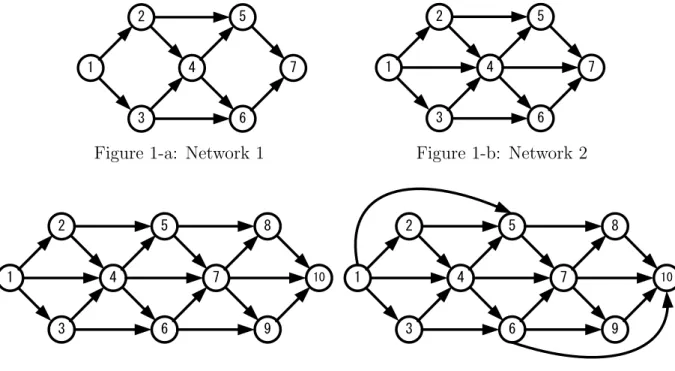
We examine four networks in Figure 1 in our analysis. Nodes are numbered as shown, with the start node always being Node 1 and the destination node being largest numbered
node. The initial numbers of attackers and defenders are set to be R0 = 12 and B0 = 12,
respectively. Network 1 is very simple and the number of arcs included in a cut (the cut size) is 2 to 4. Network 2 is made by adding two arcs to Network 1 and has cut sizes of 3 to 5. Network 3 has more additional nodes and arcs, but the range of cut sizes is the same as that of Network 2. We construct Network 4 by adding arcs (1, 5) and (6, 10) to Network
3, and then the cut sizes are 4∼ 6.
For each network, we set an exchange rate γe for each arc e to be uniformly distributed
from 0.3 to 1.0. The set of paths of the attacker, Ω, is generated by enumerating all routes
from the start node s to the destination node t and an IA node Nl is randomly chosen from
among the nodes excluding s and t for each path l. We generate 10 attrition games for each model on each network and solve them to obtain an average value of the game. Table 3 shows these results, v1, vS1, vS2 and vT 1–vT 4, as well as the corresponding results for H, O,
Q, and P . Cases 1, 2, 3, and 4 are those carried out for Networks 1, 2, 3, and 4, respectively. To analyze the effects of the IA node, we use Network 3 in Case 5 by setting the IA node to be whichever of Nodes 4, 5, and 6 that the path reaches first.
For the sake of comprehensibility, we illustrate Cases 1–4 of Table 3 as bar charts in Figure 2 by type of information: attacker’s present position or path. Green (bright color), red (darkest color), and blue (dark color), which are aligned from top to bottom, indicates the open (O), quick-response (Q), and preparation (P ) values, respectively. The total height
indicates the hidden value. Let us figure out the properties of the values. Case 5 will be discussed further below.
1 3 2 4 5 6 7 1 3 2 4 5 6 7
Figure 1-a: Network 1 Figure 1-b: Network 2
1 3 2 4 5 6 7 8 9 10 1 3 2 4 5 6 7 8 9 10
Figure 1-c: Network 3 Figure 1-d: Network 4
Table 3: Comparisons of game values and values of IA scenarios
v1 Contents vS2 vT 4 vT 3 H1 O1 Q1 P 1 vS1 vT 1 vT 2 H2 O2 Q2 P 2 Case1 7.252 A′s pos. 7.082 5.316 3.946 3.306 0.170 1.766 1.370 N etwork 1 A′s path 4.823 4.823 3.538 3.713 2.429 0 1.284 Case2 9.153 A′s pos. 8.899 8.311 6.226 2.927 0.254 0.588 2.085 N etwork 2 A′s path 6.107 6.070 3.895 5.258 3.045 0.037 2.175 Case3 9.188 A′s pos. 9.036 8.849 5.962 3.226 0.153 0.187 2.887 N etwork 3 A′s path 6.247 6.247 2.841 6.348 2.941 0 3.407 Case4 9.954 A′s pos. 9.602 9.308 5.983 3.971 0.352 0.294 3.325 N etwork 4 A′s path 6.565 6.406 3.359 6.595 3.389 0.159 3.047 Case5 9.123 A′s pos. 9.045 8.191 6.012 3.111 0.078 0.854 2.179 N etwork 3 A′s path 5.124 5.124 2.677 6.446 3.999 0 2.447 0.0 1.0 2.0 3.0 4.0 5.0 6.0 7.0 0.0 1.0 2.0 3.0 4.0 5.0 6.0 7.0 0.0 1.0 2.0 3.0 4.0 5.0 6.0 7.0 0.0 1.0 2.0 3.0 4.0 5.0 6.0 7.0
Case 1 (Network 1) Case 2 (Network 2) Case 3 (Network 3) Case 4 (Network 4)
position path position path position path position path
(1) As explained in Section 2.1, the optimal defender strategy of the one-shot game is constructed to cope with every possible attacker path by intercepting the attacker on the arcs of a cut. The cut size and the exchange rates of the arcs in the cut greatly
affect the defender strategy. The values v1 for Networks 2 and 3 are not so different
because the two networks have similar sizes of cuts. However, the values v1 of Cases 1,
2, and 4 on Networks 1, 2, and 4, respectively, do differ because of their different cut sizes.
(2) As the size of the network becomes larger, the hidden value H2 becomes larger and the difference between the hidden values with respect to whether the information is the attacker’s position or path also becomes larger. The attacker has more options for his path in Stage 2 in the larger networks and the value of information depends on to what extent it decreases the uncertainty of the defender’s estimation regarding the attacker’s decision. If the information is the attacker’s path, then the defender can perfectly anticipate the attacker’s decision.
(3) The open value of the attacker’s position, O1, is small because the attacker prepares an effective countermeasure to the IA, but that of the attacker’s path, O2, is large because the value of the information about the path is still high even though the attacker anticipates the IA by the defender.
(4) The quick-response value, Q2, is almost zero for the attacker’s path. The attacker’s ability to change his path is useless because the new path is anticipated by the defender. (5) Compared to O and Q, we can say that the preparation value, P , is consistently large for both types of information, and therefore the awareness of IA by an opponent and the preparation for the IA are very important.
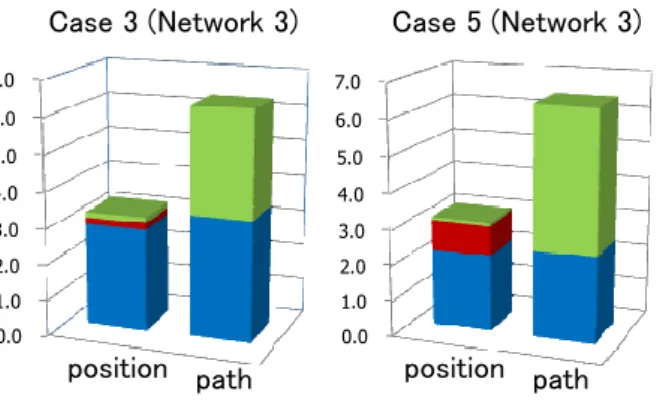
In Case 5, with Network 3, we choose an IA node from Node, 4, 5 or 6 according to which the attacker path arrives at first. This makes the path selection for Stage 2 more flexible on average than in Case 3. Comparing the values between Cases 3 and 5 (see the bar charts in Figure 3), we have the following properties.
0.0 1.0 2.0 3.0 4.0 5.0 6.0 7.0 0.0 1.0 2.0 3.0 4.0 5.0 6.0 7.0 Case 5 (Network 3) Case 3 (Network 3)
position path position path
Figure 3: Comparison of H, O, Q, and P values in Case 3 and 5
(1) In Case 5, the number of paths having the same IA node is more likely to be higher in Case 5 than in Case 3, so even though the defender knows the attacker’s position at the IA node, the attacker has more paths to choose from for Stage 2. This makes the position information less useful to the defender in Case 5, and thus H1 of Case 5 is a little smaller than H1 of Case 3.
In Case 5, with its greater flexibility of path selection, the information of the attacker path has a higher value, and thus H2 of Case 5 is a little larger than H2 of Case 3. Moreover, the value of the path information is still high for the defender even if the attacker is aware of the IA, and so O2 of Case 5 is rather high.