Journal of the Operations Research Society of Japan
Vol. 39, No. 4, December 1996
TAIL BEHAVIOR OF THE STEADY-STATE DISTRIBUTION IN TWO-STAGE TANDEM QUEUES:
NUMERICAL EXPERIMENT AND CONJECTURE
Kou Fujimoto Yukio Takahashi Tokyo Institute of Technology
(Received January 10, 1995; Final February 15, 1996)
Abstract This paper is concerned with the geometric decay property of the steady-state probability x ( n l , n 2 ; i o , i l , i2 ) in a tandem queueing system P H / P H / l Ñ> / P H / l . First we observe results of an extensive numerical experiment and see two types of geometric decay for the tail of the joint queue-length distribution depending on the traffic intensities of the first and second stages. Then, based on the obser- vation, we give a conjecture on the geometric decay property. The conjecture is roughly summarized as follows.
For a given traffic intensity p1 of the first stage, there exists a threshold
p2
for the traffic intensity p2 of the second stage, and if p2 <P2,
then the joint queue-length probability p(nl,
n2) as n ~ , n2--+
00. If p2 > p-i, then p ( n l , n 2 ) decays in a similar manner, but the coefficient G and the decay rates ?71,?72 aredifferent between the cases with n 2 < Gnl and with n 2 >
h
for a certain positive value G. Moreover, the conditional probability of phases y(iOl i l , i2\
n l , n 2 ) = x(ni, n2; io, il_, i2)/p(nll n2) is asymptotically independent of n l and n2 in each case, and hence the steady-state distribution has geometric tail. Equations are also given for determining characteristic valuesp2,
^ l , 112 and G.1. Introduction
Tandem queueing systems are basic models in the queueing theory and have been studied for a long time. However, the stationary state probabilities, or even basic properties of them, are scarcely known except for some simple cases with product form solutions. In this paper, we observe the tail behavior of the stationary joint queue-length distribution in a two-stage tandem queueing system PH/PH/l
--+
/PHI1 with buffers of infinite capacity.In the ordinary one-stage queue P H / P H / c with traffic intensity p
<
1, it is shown t h a t the steady-state distribution has a geometric tail [2, 51. Namely, if we let x(n; io,i\)
be the steady-state probability that there are n customers in the system while the states (phases) of arrival and service processes are iy and i l , thenwhere i;, G, co(zo) and cl (il) are constants, and hence
where indicates that the ratio of both sides tends to 1.
The decay rate i; is given in the following manner. Let T * (S) and
S*
(S) be the Laplace- Stieltjes transforms (LSTs) of the interarrival and service time distributions, respectively, and let W be the unique positive solution of the equationT*
(s)S* (-CS) = 1. Then i; = T* (W).This geometric decay property is very useful, for example, on the computation of the stationary state probabilities and on the discussion of tail probabilities for estimating very small loss probabilities (e.g. less t h a n I O - ~ ) of the corresponding finite queue.
The problem here is to see whether a similar geometric tail property holds or not in two-stage tandem queueing systems.
The marginal queue-length distribution of the first stage clearly has a geometric tail, since the behavior of the first stage is not affected by that of the second stage. Our concern is the tail property of the joint queue-length distribution of the first and second stages or the state probabilities in the steady state.
To see it, we make an extensive numerical experiment though the types of models are limited to simple ones because of the limitation of the sizes of computable models. W e scru- tinize the results and find two types of geometric decay depending on the traffic intensities of the first and second stages. To the authors' knowledge, this fact has never reported so far in the literature. Based on the observations of the numerical results, we give a conjecture on the geometric decay together with systems of equations which determine the parameters in the conjecture. The authors think t h a t the property stated in the conjecture will not only be useful for practical computation or simulation of two stage tandem queueing systems, but also will provide a key t o further theoretical researches for tandem queueing systems.
This paper is organized as follows. In Section 2, we describe our tandem queueing model and present our conjecture on geometric tail of the steady-state distribution. In Section 3,
we explain our numerical experiment briefly. Section 4 presents various numerical results which show the tail properties we conjecture in Section 2. We discuss, in Section 5, some equations which determine parameters used in the conjecture.
2. The Model and the Conjecture
Here we introduce our two-stage tandem queueing model and give a conjecture on the geometric tail. We also show some numerical results which support the conjecture in a variety of cases.
We denote by P H ( a , Q) a phase-type distribution with initial probability vector a and infinitesimal generator Q.
2.1. Two-stage Tandem Queueing System P H / P H / l - + / P H / l
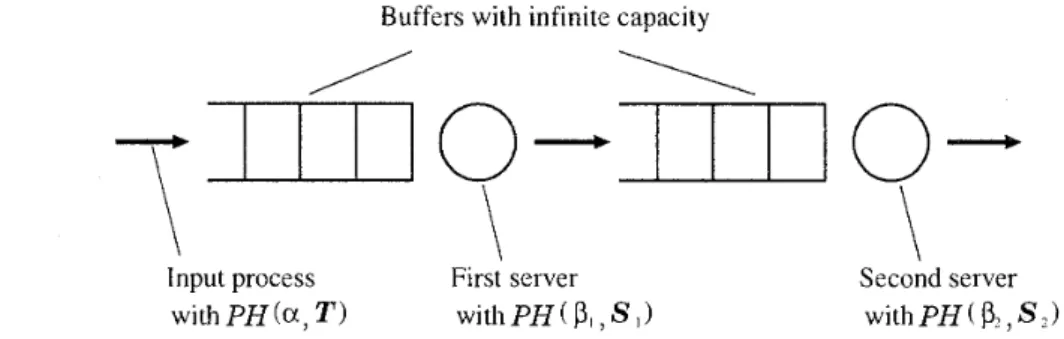
We consider an open, two-stage tandem queueing system (Figure 1). Customers arrive a t the first stage t o be served there, move t o the second t o be served there again, and then go out of the system. The queueing discipline is the ordinary first-in-first-out
(FIFO).
The kth stage (k = 1 , 2 ) has a single server and a buffer of infinite capacity, so that no loss or blocking occurs. Interarrival times of customers are independent and identically distributed (i.i.d.) random variables subjecting t o a phase-type distribution P H(
0
Service times a t the kth stage are also i.i.d. variables subjecting t o a phase-type distribution PH(/3,,, ,Sk). The interarrival and service times are assumed t o be mutually independent.The state of the system is represented by a quintuple ( n l , n2; zo
,
il, i 2 ) , where io is the phase of the arrival process, i k is the phase of the service process a t the fcth stage, and n k is the number of customers in the k t h stage (k = 1 , 2 ) . Then the system behaves as a time-continuous Markov chain.We denote the traffic intensity a t the fcth stage by pk = A//^ where l / A is t h e mean interarrival time and l/^ is the mean service time a t the kth stage (k = 1 , 2 ) . We assume pi, p2
<
1 so that the chain is stable and has steady-state probabilities x ( n l , n 2 ; iy,
i l ,4.
Tail Probabi1Itics of Tandem Queues Buffers with infinite capacity
/
\
\
\
Input process First server with PH ( a , T ) w i t h P H ( P , , S , )
Second server w i t h p H ( P 2 , S 2 ) Figure 1: Two-stage tandem queues
2.2. Geometric Decay Property from the Numerical Experiment and the Con-
jecture
The tail property extracted from the numerical results is roughly summarized as follows. For a given traffic intensity pl of the first stage, there exists a threshold for the traffic intensity p2 of the second stage, and if p2
<
then the joint queue-length probability p(nl, n2) is asymptotically of the geometric formIf
p2>
p2, then p(nl, ni} decays in a similar manner, but the coefficientG
and the decay rates ql, q2 are different between the cases with n2<
anl and with n2>
a n l for a certain positive value a. Moreover, the conditional probability of phases y(io, zi, i2I
n l , n2) =x(nl, n2; io,
h ,
W p ( n l , n2) is asymptotically independent of n l and n2 in each case, and hence the steady-state distribution has geometric tail.To describe the geometric decay property more formally, however, we should clarify the way of making nl and n2 large in (2.1). Here we consider the case in which n1 and n 2 increase on a line n2 = a n l
+
b. To ensure t h a t there exist infinitely many points ( n l , n2) on the line, the coefficient a should be positive and rational and the constant b rational. As extreme cases, we also consider the case in which n1 Ñ oo with fixed n2 and the case inwhich n2 Ñ oo with fixed nl.
The conjecture we make in this paper is formally stated as follows. Conjecture
For fixed p17 there exists a threshold
p2
and the behavior of n2; io, il , i2) is different between the cases p^<
py,
and p2>
p^.1. In the case p2
<
p2,
there exist constants ql, q2, co(io), cl (il), c2 (i2) andG
such thatas n 1 n 2 Ñ) cc on a line n 2 = a n l
+
b with rational a>
0 and b. This asymptoticrepresentation is also valid when n l Ñ oo with fixed n2 and when n 2
+
m with fixed n l .2. In the case p^
>
p^ there exists a positive constant
a
such that the decay rates aredifferent between the cases 0
<
a<
a
and a>
a
for the slope a of the line on which n1 and n2 increase. We denote the two sets of constants corresponding to these two cases as{vl,
q2, co(io), cl(il), c2(i2),G }
and{nl, n2,
co(io), ~ 1 ( i 1 ) ~ ~ 2 ( 2 2 ) ,G}.
(a) When n l , n2 Ñ cc on a line n2 = a n l
+
b with rational a and b such that 0<
a<
a,
528 K. Fujimoto & Y. Takahashi
(b) When nl, n2 Ñ> oo on a line n2 = an1
+
6 with rational a and 6 such that a>
i i ,This asymptotic representakion is also valid when n2
-+
m with fixed nl.3. The constants above are determined by equations given in the latter sections as indi- cated by t,he equation numbers:
71
,
v 2 . . . - (5.3) ^ l ; ^ 2 . . . (5.5)-
p2 . . . (5.6)6
. . . (4.4), (5.7) ck ( i t ) ,ct
(it) ( k = 0, l, 2) . . . (5.8)Unfortunately we do not yet have any equations to determine the values of the m~lt~iplica~tive coefficients G and
G.
On the point, see comments a t the end of Section 5.2.3. Numerical Test for the Conjecture
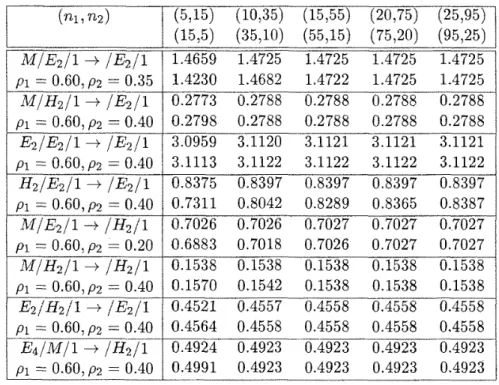
To see if the asymptotic propert,y stated in the conjecture above holds or not, we tabulate the values of the ratios
p(n11 n2) g(% l n2) = p(n17 n 2 ) and g(nl
,
n2) =vY1
v;2
?:17;2
-
in Tables 1 and 2 for eight types of models with selected pair of traffic intensities p2) and selected points (nI, n2) lying on lines n 2 = 4n1 - 5 and n 2 = (n1
+
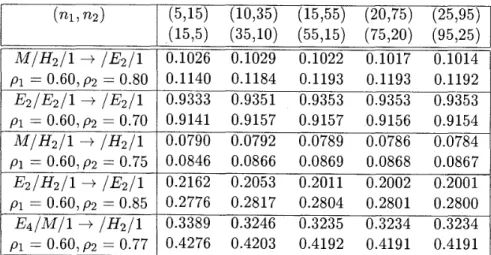
5)/4. All these values are extracted from the results of a numerical experiment described in Section 3.These tables show that each row certainly converges to a positive limit, even though the speed of convergence is much slower in a few cases (see Table 2(b)). In Table 1, the ratios along two different lines seem t o converge t o a common limit in each model. This corresponds to the first statement of the conjecture. In Table 2, these ratios seem to converge t o different limits in each model. This agrees with the second statement of the conjecture. These numerical results support the geometric tail property of the joint queue-length distribution. The asymptotic independence of phases is shown in Tables 4 and 5 in Section 4.3 for a particular model E2/H2/l
-+
/E2/l with p, = 0.6 and p2 = 0.8.The authors tested the conjecture for more than 1,000 cases. There are a small number of cases in which the convergence of g(nl, n2) and/or g ( n l , n2) cannot be judged from the numerical results of p ( n l , n2) with n l , n2
<
100. The authors think that, if we can calculate ~ ( n - \ , n2) for larger nl and n 2 , we will be able to see the convergence numerically. Except these slow converging cases, ginl, n2) and g ( n l , n2) do converge numerically to certain limits in all the cases we tested.3. Numerical Experiment
To see the tail behavior of the joint queue-length distribution, we made an extensive nu- merical experiment for a variety of models. Specifically, we calculated the stationary state probabilities and drew graphs to see the characteristics of the tail behavior. We tested vari- ous types of models with various traffic intensities pl and p2. Among them, for the 8 types of models listed below, we tested systematically with pl = .2, - 3 , .
. . ,
.g and p2 = .2, .3,.. . ,
.g, and saw the changes of the tail behaviors by the tra,ffic intensities in detail:Tail Probabilities of Tandem Queues
Table 1: Geometric decay of ~ ( n ~ , n2): the case py,
<
p^In each model, the upper row represents g(n^, n2) for nl and n2 such that n2 =
+
5 ) / 4 , H I =1 5 , 3 5 , . . . ,95, and the lower row represents it for nl and n2 such that n2 = 4 n 1 - 5 , nl =
5 , 1 0 , . . . .25. The traffic intensities pi and p2 are selected so that p2
pa.
Here, for the two-phase'hyperexponential distribution
(Hy},
we used the one with the density function of the form4 x 1 = ~ . l e - ^
+
O.Se-'"', X>
0.The total number of cases tested exceeds one thousand. For the calculation of the steady- state probabilities, we employed the aggregation/disaggregation method
[3,
41. Since ourmodel has infinite number of states, we have to truncate the state space for both nl and n2 in the calculation. However, in an iteration of the aggregation/disaggregation method.
a new value of x{n1, n2; io, il, iy,} is calculated from the current values of neighboring states x(ni - 1, n2; to, il, i2), x(nl
+
1, n2 - 1; t o , tl, 12) and z(nl, n2+
l; io, il, 82)- Therefore, if wetruncate the state space a t nl = and n2 = we have t o estimate the values of x(vl
+
1, n2 - 1; to, il, 12). 1
5
n;<
v2 and z(nl, v2+
1; zo, i1, ti), 05
nl<
v1. In our experiment,we estimated those values by assuming the geometric decay for these variables, namely, e.g.? x ( f i + 1 , n 2 - l ; i n , z 1 , i 2 ) was estimated as { x ( r l , n ; - 1 ; ~ ~ , i i , i ~ ) } ~ / x ( v ~ - 1 , n a - 1; i o , &
is).
Both of the truncation points v1 and v2 were set to 100 in most of the cases. So the number of states t o be calculated was 40,000 for the models listed above with Poisson inputs, and was 80,000 for ones above with other renewai inputs. This number 80,000 is quite large and, by the authors' experiences, it is very near t o the limit of the size for the calculation of steady-state probabilities of a Markov chain using today's engineering workstations.
The program was written in C and ran on the SONY NWS-3860 workstation. The computational burden is practically
0{N)
withTV
= v1 Xv,,
and it increases rapidly aspi,
--+
1. Table 3 tabulates theCPU
time for the computation ofE2/H2/l
-Ã /E2/l withTable 2: Geometric decay of p ( n l , n^)' the case p^
>
fb
slower convergence models (a) faster convergence models
In each model, the upper row represents g ( n l l n 2 ) for n l and n 2 such that n2 = (ni
+
5) 14, nl = 15,35, . . . , 9 5 , and the lower row represents 3 ( n 1
,
n 2 ) for n l and n2 such thatn2 = 4n1 - 5, n l = 5,10, . . . ,25. The traffic intensities pi and p2 are selected so that p2 >
pg
anda
is near t o 1. ( ^ l l n2) h!l/H2/l -+ /E211 f i = 0 . 6 0 , ~ ~ = 0.80 E 2 / E 2 / 1-+
/ E 2 / l p1 = 0.60, p2 = 0.70 M / H 2 / l+
/H211 pi = 0.60, p2 = 0.75 E 2 / H 2 / 1+
/ E 2 / l pi = 0.60, p2 = 0.85 E 4 / M / l+
/ H f i pi = 0 . 6 0 , ~ ~ = 0.77Table 3: The CPU time for E 2 / H 2 / l à / E 2 / 1 with p, = 0.6 and v1 = v2 = 100 (5,15) (10,35) (15,55) (20,75) (25,95) (15,5) (35,lO) (55,15) (75,20) (95,25) 0.1026 0.1029 0.1022 0.1017 0.1014 0.1140 0.1184 0.1193 0.1193 0.1192 0.9333 0.9351 0.9353 0.9353 0.9353 0.9141 0.9157 0.9157 0.9156 0.9154 0.0790 0.0792 0.0789 0.0786 0.0784 0.0846 0.0866 0.0869 0.0868 0.0867 0.2162 0.2053 0.2011 0.2002 0.2001 0.2776 0.2817 0.2804 0.2801 0.2800 0.3389 0.3246 0.3235 0.3234 0.3234 0.4276 0.4203 0.4192 0.4191 0.4191
This table shows cases in which the convergence is much slower. In each model, the upper row represents g ( n l l n2) for nl and n2 such that n2 = (nl + 5 ) / 4 , n i = 115,135,. . . ,195, and
the lower row represents g{nl, n 2 ) for nl and n 2 such that n2 = 4n1 - 5, nl = 30,35,. . . ,50.
The traffic intensities pl and p2 are selected so that py >
p2
anda
is near to 1. ( ^ l , n2) M / E 2 / 1-+
/E'2/l pl = 0.60, p2 = 0.71 H 2 / E 2 / 1+
/ E 2 / l pl = 0.60, p2 = 0.70 M / E 2 / l--+
/ H 2 / l pi = 0.60, p2 = 0.704. Tail Properties from the Numerical Experiment
The conjecture given in Section 2 is based on a careful observation of the results of the numerical experiments explained in Section 3. Here we show a few results to indicate
how the authors reach the conjecture. By the limitation of pages, we take the case of
E 2 / H 2 / l Ñ> / E 2 / l with pi = 0.6 and p2 = 0.8 as a typical example, and show its tail
properties in detail. We start with observing the ratio of two neighboring joint probabilities of numbers of customers in the steady state.
(115,30) (135,35) (155,40) (175,45) (195,50) (30,115) (35,155) (40,155) (45,175) (50,195) 0.1800 0.1815 0.1829 0.1842 0.1855 0.0700 0.0671 0.0647 0.0627 0.0609 0.0957 0.0952 0.0948 0.0947 0.0946 0.0206 0.0180 0.0160 0.0142 0.0128 0.1360 0.1301 0.1294 0.1298 0.1305 0.1043 0.1047 0.1050 0.1052 0.1055 P2
CPU time [sec.]
0.2 16 0.4 23 0.6 38 0.8 ' 158
Tail Probabilities of Tandem Queues
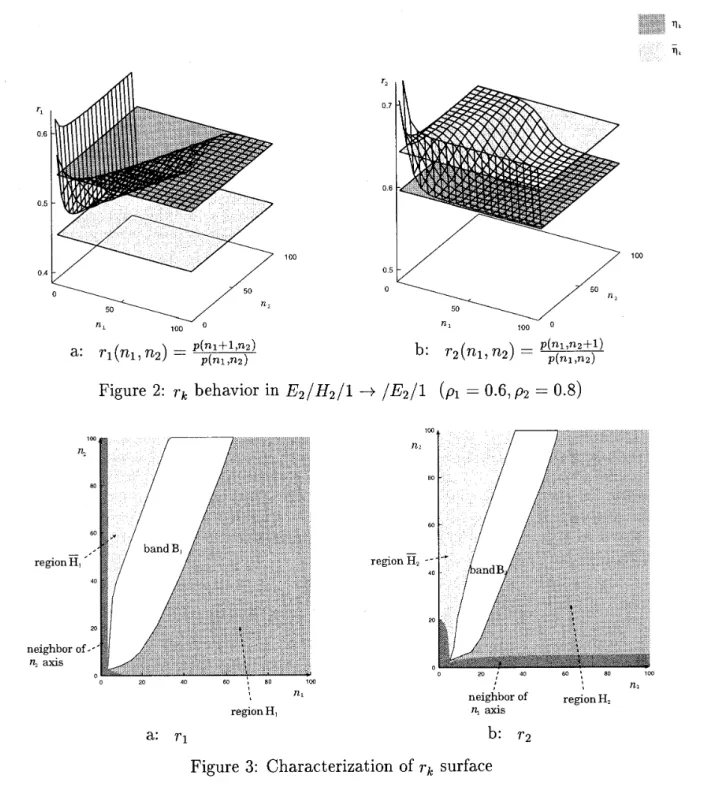
Figure 2: rk behavior in E 2 / H 2 / l
-+
/ E 2 / l = 0.6,pa = 0.8)n1 region H, n2 region Hz 100 80 60 - - 40 20 0 0 20 ,' 40 60 ', 80 100 nl neighbor of region H; n, axis
Figure 3: Characterization of rk surface
4.1. Decay Rates of the Joint Queue-lengths Probability
Let p ( n l , n 2 ) be the joint probability t h a t there exist nk customers in the kth stage ( k = 1 , 2 )
in the steady state. Namely, p ( n i , n2) =
Eio
xi,
x ( n l , n2; zo, i l ,i2).
We are interested in the ratios of neighboring p(ni, n2)'s:Figures 2a and 2b show graphs of r i ( n l , na) and r 2 ( n 1 , n 2 ) . In each figure, the graph
of r k ( n l , n 2 ) is a curved surface represented by a lattice. A dark gray plane indicates a constant qk (ql = 0.543,- = 0.593) and a light gray plane indicates another constant
532 K. Fujimoto & Y. Takahashi
qk
(ql = 0.457,q2
= 0.640). Both of these constants are given as solutions of systems of equations which will be presented in Section 5.In Figure 2a, we see that r l ( n l , n2) is relatively large very near the n2 axis but it is in between Q and
q,
in most of the region of ( n l , n2). Especially r l ( n l , n2) is close t o 77, in aregion in which nl is relatively larger than n2 and it is close to
R
in a region in which n2 is relatively larger than n1 though the latter might not be seen clearly from the figure.Figure 3a shows regions of (nl, n2) in which rl (nl, n2) is close t o ql or Q. In the
dark gray region, labeled Hi, rl (nl, n2) is close t o ql, namely
\ri
(ni, n2) - ql1
<
with = 0.1 X lql -v,\,
and in the light gray region, labeledHI,
rl (nl, n z ) is close toq1,
namely ",) -<
(Here we take the particular value of cl for the convenience of the explanation. We may take a smaller value if we need more accuracy in the subsequent approximations.) The band Bl between H, andHi
represents the region where rl (nl, n2) smoothly changes from q1 - cl to7,
+
cl. We note that the region Hl covers the n1 axis whileH,
does not n2 axis.Similarly, in Figure 2b, we see that r2(nl, n2) is relatively large very near the n l axis but it is in between q2 and
7,
in most of the region of (nl, 72,). Especially r2 (nl, n2) is close to in a region in which nl is relatively larger than n2 and it is close to yi2 in a region in which 71, is relatively larger than ni .Figure 3b shows a decomposition of the nl-n2 plane by r2 (nl
,
n2). The ratio r2 ( n l , n2) is close to q2 in the dark gray region H2, and is close t o in the light gray region IT2. The band B2 represents the region where r2(n1, n2) smoothly changes from q2 - &2 toq2
+
c2where c2 = 0.1 X
[n^
-7,
l.
In this case n2-axis is included in IT2, but nl-axis is not in H2. Figures 3a resembles 3b in some sense. H, mostly coincides with H,, andH,
does with H,. Hence, r l (nl, n2) ss q1 and r2(n1, n2) ss rfc in the region Hln
H2, and rl (nl, n2) ss rjl and r2 (ni, n2) ssT~
in the regionH,
H2,
where "?s" indicates that both sides are approximatelyequal. Hence
The band
B2
lies almost on the same position as Bl, though the band width is a bit narrower. In these graphs, the bands Bl and B2 seem to keep their widths constant. More definitely, they are included in a region {(n,, n2) : an1+ h
<
n2<
a n l+
&}
bounded by two parallel lines with a common slope 6 = 2.28 and segmentsb
= -48 and6
= 26 as shown in Figure 4. The valuea
of the slope will be discussed in Section 4.4 and in Section 5.4.2. Geometric Form of the Joint Queue-length Probability
It seems that p(nl, n2) is written approximately in a geometric form in the nl-n2 plane:
where
G
andG
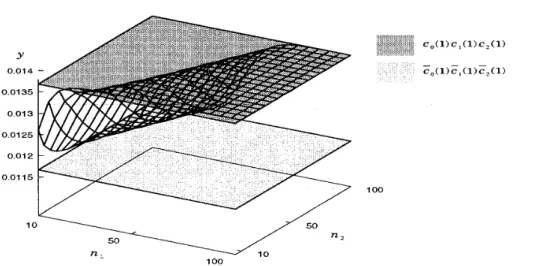
are certain constants independent of n l and no.To justify this from numerical results, we draw graphs of the ratios g(nl, n2) and a n l , n2) defined in Section 2.2. Figure 5a shows t h a t g(nl, n2) almost coincides with a constant
G
= 5.67 X 1oP3 when (nl, n,) H, H,, and Figure 5b shows thatg{ni,
n2) mostlycoincides with a constant
G
= 1.51 x(#
G)
when (n,, n2) E p H 2 . Note that, inthese graphs, we cut the region where n1
<
5 or n2<
5
to make the graphs easier t o see the behavior when nl and n2 are large. Hereafter we will use this convention in all graphs except Figure 9.Tail Probabilities o f Tandem Queues
Figure 4: constraint lines for band Bk
4.3. Approximate Independence of Phases
The individual state probabilities x ( n l , n2; io, i l , i2) satisfy similar properties to those of p(ni, n2) above. Hence it is expected t h a t the conditional probability of phases
almost coincides with a constant in Hi fl H2, and with another constant in
El
D%.
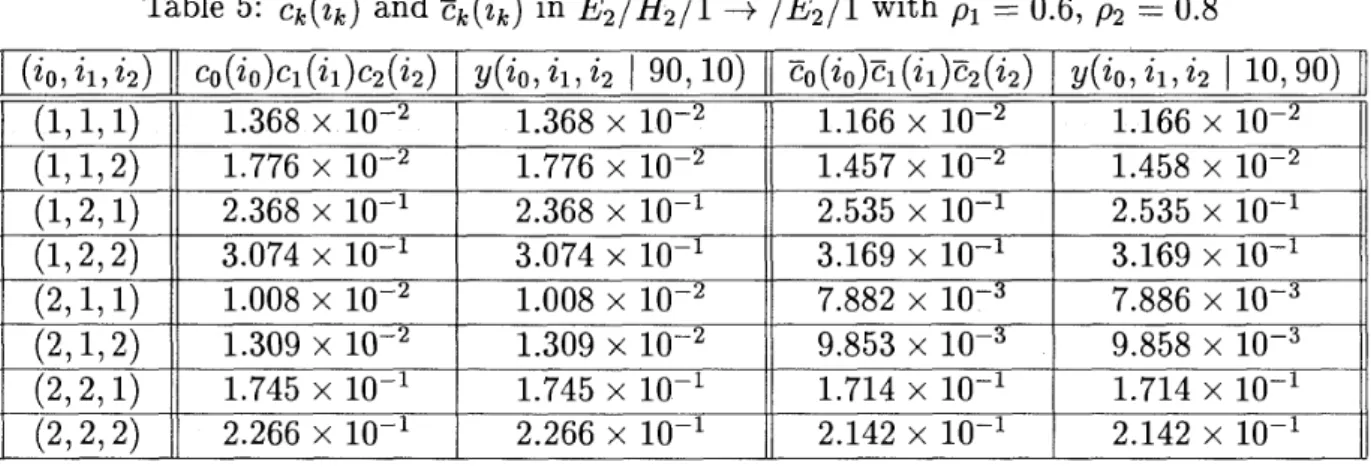
In fact, Figure 6 shows that y (l, l, 1 Inl, n2) behaves like rk (nl, n2). T h a t is, y(io, il, i2 Inl, n2) coincides with a constant c(io, il , i2) in Hlfl
H2, and with the other constant c(i0, il, i2) in -K. Fujimoto & Y. Takahashi
Figure 6: Behavior of y ( l , l , l l n l , n2) in E2/H2/l
+
/E211 with p1 = 0 . 6 , ~ 2 = 0.8 three components:Here co(io) or cO(iO) can be regarded as the asymptotic conditional probability of the phase io
of the arrival process, and ck (ik) or
(h)
(A; = 1 , 2 ) as the asymptotic conditional probability of the phase of the service process a t the A;th stage. This property can be validated by the numerical results of y(io, il, i21
n l , n2) together with the values of ck(ik)'s and Ck(&)'s given by (5.8) in Section 5. The value of them for E2/H2/l-+
/E2/l are listed in Tables 4and 5. It is shown that y(io, il , i2
\
90,lO) almost coincides with ~ ~ ( i ~ ) c ~ ( i ~ ) c ~ ( ~ ) , and t h a t y(io, il, i21
10,90) almost coincides with c ~ ( ~ ~ ) E ~ (i1)c2(i2) for all combinations of (io, il, i2). Note that (90,lO) E Hln
H2 while (10,90) EHl
n
H2.Table 4: cis(ik) and ek(ik) in E2/H2/1
--+
/E2/1 with pi = 0.6, f t = 0.84.4. Variation of Regions and Bands -
Now we shall see how the regions Hk, Hk and the band Bk vary according t o the traffic intensities pl and p2.
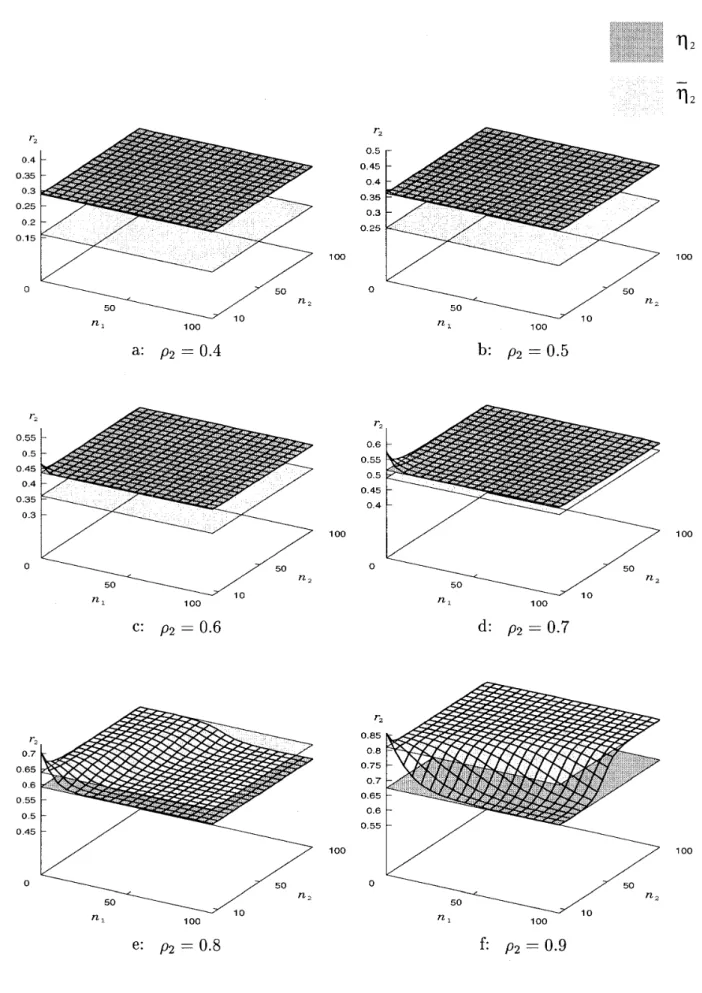
Figure 7 shows the graphs of r l ( n l , n2) for the model E2/H2/l
--+
/E2/l with fixed pl = 0.6 and varying p2 = 0.4 0.9. When p, is small,7,
is far below q1 and r l ( n l , n 2 ) coincides with ql almost on the whole nl-n2 plane. This means that H, covers the whole nl-n2 plane. The larger p2 becomes, the closerv1
comes t oW ,
and when p2 = 0.8 the region-
H, appears.
H,
becomes larger than Hi when p2 = 0.9.Figure 8 shows the corresponding graphs of r2(n1, n2). In these graphs we also see that
H a
appears only when pg = 0.8 and 0.9. Now we shall see the movement of the planes q2 andq2.
When p2 is small, the planeq2
is far below the plane q2. As p2 becomes larger the plane Q becomes closer to the planeTail Probabilities of Tandem Queues 535
K. Fujimoto & Y. Takahashi
Table 5: ck(ik) and ck(ik) in
E2/H2/l
à /E2/! with pi = 0.6, p2 = 0.8becomes to 0.8, the plane
qn
comes above the plane q2, and a t the same time the regionH2
appears. If we denote by&
the value of p2 a t whichm
= Q, this seems t o indicate thatthe region -
H,
disappears when p2 is less thanp,
andH,
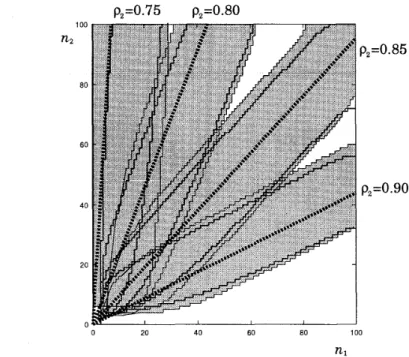
appears when p2 exceeds n2. Hi seems to appear a t the same time as H^. We will see this more in detail. Figure 9 shows the movement of the bands Bl and B2. T h e bands bounded by thin lines indicate Bl for p2 = 0.75 0.90, and those bounded by bold lines indicate B2.It is likely that these behaviors of the bands are related with those of Q and rj^. In Figure 5, both (/(n1, n2) and q(n1, n2) diverge to +oo when they are outside of Hl
n
H2 or-
Hi
n
H2. This indicates that*G2
is greater thanq?1$2
in the region Hln
H2, and that-nl-n2
nl
q2 is greater than$1qg2
in the regionEl
n
H,.
Hence we can guess that the bands Bl and B2 lie on the line determined by
f l $
=-721-n2 ql q2
,
or equivalently,n2 = Onl with 6 = - 1% ??l A71 l 0 ~ % / ^ '
Each broken line in Figure 9 indicates this line for p2 = 0.75 0.90. One can see that the line moves almost together with the bands.
5 . Equations for qk,
G
andThe properties discussed in the previous section are for the specific model E2/H2/l
-+
/ E 2 / l . We can see similar properties in most of cases.
To the authors' knowledge, there are no papers which investigate such tail properties theoretically. However, through the study, they have a strong confidence t h a t the values of rfk and
qk
( k = 1 , 2 ) are given as solutions of some simultaneous equations written with LSTs of interarrival and service time distributions. In this section we present the equations and summarize some basic properties of % and T)),. The assumptions to derive the equations and a brief explanation of the derivation process are given a t the end of this section.Let T*(s) be the LST of the interarrival time distribution
P H ( a , T ) .
Denoting by -T<
0 an abscissa of convergence of T * , the function T*(s) is then defined, positive and convex decreasing on the interval (-T,OO) [l]. Similarly, we denote by S ~ ( S ) the LST ofthe service time distribution PH(f3, S k ) for the A-th stage, and by -Q
<
0 an abscissa of convergence ofS t .
Then SJ,{s) is defined, positive and convex decreasing on the interval 00). When we mention about roots of an equation, we refer only real roots in the domain of the equation and count the number of roots by taking the multiplicity into account. For example, every double root is counted twice.Tail Probabilities o f Tandem Queues
K. Fujimoto & Y. Takahashi
Figure 9: Movement of B1 and B2 in E 2 / H 2 / l
+
/ E 2 / l with p1 = 0.6Consider the simultaneous equations
Let / ( s o ) = T* (s o ) S ;
(-
s o ) . Then f ( s o ) is a convex function of so on (-7, o1), and f ( 0 ) = 1.Hence the equation f ( s o ) = 1 has two roots one of which is so = 0. The derivative of f ( s o )
a t so = 0 is negative since f ' ( 0 ) = T*' ( 0 ) - S;' ( 0 ) = - 1 / A
+
l / p l = - ( 1 - pi) / A<
0. Hence the other root so = W O is positive.For the second equation of (5.1), eliminating sl by the third equation and inserting
so = W O , we have
(5.2) g ( s 2 ) = T * ( w o ) s ; ( - w o - s 2 ) s ; ( s 2 ) = 1.
g ( s 2 ) is a convex function of s2 on ( - g 2 , ul - wo). The equation (5.2) has a trivial root
s2 = 0 , and hence it has one more root s2 = w2. We set w1 = -wo - w2. This triplet
( w ~ , w l , is our desired solution of ( 5 . l), and we let
Since wo is positive, Q is strictly less than 1. Furthermore, is a monotone increasing
function of pl, and q1 $ 0 as pi $ 0 while f 1 as pl
-t-
1.On
the other hand, w2 is negative if p2 is small but it may be positive if p2 becomes large, and hence q2 may exceed 1. n^, can be regarded as a function of both pi and p2. As a function of p2,v2
is monotone increasing and q2 $ 0 as p2 $ 0.nil Probiibjljtics of Tandem Qucuc.s 539
A simila,r argument for the equations (5.1) ca,n be applied t o (5.4). The first equa,tion defined on (-02,7") has two roots, zero and a s . Since p2
<
1,G
is st,rictly nega,tive. By insertings2
=a2
andsl
=-so
- g2 into the left hand side of the second equation, we have an equation fors2
= a 2 . The left ha,nd side of this equation is a convex function, and hence the equation has two roots. One is a trivial rootso
=-a
and we denote the other as s o . We set g, = -go - This triplet(ao,g1,
a)
is the desired solution of (5.4). For this triplet, we set1
Since
cc2
is negative, Q is less t,ha,n 1. Moreover, Q is a monotone increasing function ofp2, and
q2
^, 0 as p2 ^, 0 while Q f 1 as p2 f 1.cco
may take positive or negative value, and hence Q may be grea~ter t,han 1.R
is a function of both pl and p2, and rjl Ñ q1 a,s pl f 1.Using rjk and
qk
above, the slopea
of bands Bk is given by (4.4) in most of the models.In Section 4.4, we defined pi a,s p, a t which q2 = rj2. However, this definition is not suitable in a general situation since such
&
may not be unique. We can show t h a t , for fixed pl, there exists a unique p2 such that(5.6) 71 = v 2 = 772.
This p2 is suitable for
p2.
Whena
is well-defined for all p2 E ((),l) except for the point p2 =p2,
a
is strictly negative for p2<
p^
and is strictly positive for p2>
p2. Further, usuallya
f +m as p2 .Jp2,
anda
4 0 as p2 f 1.Note that 6 in (4.4) cannot be defined for E,/E,/l
+
/E,/l with j = 1 , 2 , . ..,
in whichR
=ql
=pi
andv2
=%
= p;. In this case, a perturbation analysis indicates thatare plausible definitions for these models. For ck (ik)
,
we have the following expressions. element is ck(ik).- - 1 - p 2
P1 - P2
Let ck be the stochastic vector whose ik-th
For zk(ik}i we have similar expressions with G and Q in places of wk and
Q,
respectively.The derivation process of the equations in (5.1) and (5.4) is rather complicated. Here we give basic assumptions for the equations and briefly outline the derivation process. T h e complete derivation process and related discussions will be given in a separate paper.
For (5.1). we assume a geometric decay property for large n l : There exists a constant ql such that
For fixed nl we consider t,he ba,la,nce equation around the state ( n l , n2; to,
G,
i2). We can use (5.9) t,o eliminate x ( n l - 1, *;*.
*.
*)'S a,nd x ( n l+
1, *;*.
* , * ) ' S in the equation so that54 0 K. Fujimoto & Y. Takahashi
the equation contains only x ( n l
,
*;*,
*,
*)
'S. By considering such balance equations for all, .
zo, z l , i2 and n2 = 0 , 1 , 2 , . .
.,
we can show that x ( n l , n 2 ; iO , i l , 2;) takes a matrix-geometric form. If we use a similar technique t o the one in [5], we obtain the relations in (5.1), (5.3) and (5.8). Thus, roughly speaking, if the steady-state distribution has geometric tail in the direction of nl-axis, the decay parameters are given by (5.3).On the other hand, to derive the second and the third equations in (5.4) we assume for large n 2 that there exists a constant Q such t h a t
Furthermore, to derive the first equation in (5.4), we have t o assume t h a t x ( n h n2; io, il , i 2 ) is of the form x l ( n l ;
iQ.
ii)x2(n2, &J. A similar process to the one above leads us to the relations in (5.4), (5.5) andck
version of (5.8). In case of (5.1), the assumption of asymptotic product form is not necessary because instead we can use the fact that the behavior of the first stage is never affected by the second stage.Thus, the above equations for the characteristic constants of the tail probabilities are derived from geometric decay assumptions and some product form assumptions. However, the multiplicative constants G and
G
cannot be obtained in this line of derivation. To get the values of them, we have t o execute some simulations or t o solve the balance equations numerically. In the latter case, if we use the geometric decay property above, we can get the values of them with much smaller computational burden.Acknowledgments
The authors express their sincere thanks t o Professor Naoki M a k i m o t , ~ for giving them valua,ble comments through intensive discussions. They also thank anonymous referees for their helpful suggestions on the revision of the manuscript.
References
[l] Marcel F. Neuts. The abscissa of convergence of the Laplace-Stieltjes transform of a PH- distribution. Communications in Statistics. Simulation and Computation. 13: pp.367- 373, 1984.
[2] Marcel F. Neuts and Yukio Takahashi. Asymptotic behavior of the stationary distribu- tions in the GI/PH/c queue with heterogeneous servers.
2.
Wahrscheinlichkeitstheorieverw. Gebiete, 57: pp.441-452, 1981.
[3] Paul J . Schweitzer. Aggregation methods for large Markov chains. In G. Iazeolla. P. J .
Courtois, and A. Hordijk, editors, Mathematical Computer Performance and Reliability, pages pp.275-286. North-Holland, Amsterdam. 1984.
[4] Yukio Takahashi. A lumping method for numerica,l ca,lculations of stationary distribu- tions of Markov chains. Research Reports on Information Sciences B-18, Tokyo Institute of Technology, June 1975.
[5] Yukio Takahashi. Asymptotic exponentiality of the tail of the waiting time distribution in a PH/PH/c queue. Advances in Applied Probability, 13: pp.619-630, 1981.
Kou FUJIMOTO: [email protected] Yukio TAKAHASHI: [email protected]
Depa,rtment of Mathemat,ical and Computing Sciences Tokyo Institut,e of Technology