On Games And Fairness
Hiroyuki Iida
Japan Advanced Institute of Science and Technology Ishikawa, Japan
Abstract. In this paper we conjecture that the game-theoretic value of a sophisticated two player game is a draw. To discuss the game-theoretic value the concept of fairness in a typical two player game is studied. Fairness comes from the equal or nearly equal winning ratio for White and Black. It implies that for the omniscient players the outcome of a game is a draw, if the game is fair.
Keywords: two player game, fairness, game-theoretic value, initiative
1 Introduction
Fairness or equality is an essential component of games. Without it a game would lose its charm and therefore forgotten in the past. So it is a serious matter to maintain fairness of games as well as attractiveness in the history of games. People understand the importance of fairness in any games without any specific definition.
V.d.Herik et al. (2002) mentioned a concept of fairness. Here, a game is a fair game if its game-theoretic value is a draw and both players have roughly an equal probability on making a mistake. Iida (2004) observed it in term of the evolution of games as follows. Evolution of games reveals a glimpse of what human intelligence has sought in the history, and all the games in different parts of the world are similar in the fact that man plays them while seeking both thrilling and fairness from them. A two player game with a turn to move would be dead if it cannot keep an acceptable balance of the winning ratio for White and Black. Namely, such a game can no longer be fair in the practical sense.
The course of the article is as follows. In Section 2 we present a short survey of the early studies on the game-theoretic value prediction with focus on the advantage of the initiative and the mobility in the initial position of a game. In Section 3 we study the concept of fairness in games and define it from the practical point of view. We then present a conjecture about the game-theoretic value of a sophisticated two player game. Several sophisticated games that were solved are examined in this way. In Section 4 we discuss related issues. Finally, Section 5 gives our conclusions.
2 Games-Theoretic Values and Initiative
In this section we study the game-theoretic value and initiative. First the reasoning of the game-theoretic value and initiative by Singmaster (1981) is introduced. Then experimental observation on the advantage of initiative by Uiterwijk and v.d.Herik (2000) is sketched. The further discussion is made with focus on the relation between the mobility in the initial position and the game-theoretic value (Kita and Iida 2006) .
2.1 Are almost all games the first-player wins?
Singmaster (1981; 1982) showed a reasoning of why first-player wins should abound over second-player wins. The positions in a game with two outcomes, i.e., win and loss, are split up into P-positions and N-positions. In the P-positions (N-positions) the previous (next) player can force a win. For the first player to have a forced win, just one of the moves needs to lead to a P-position. For the second player to have a forced win, all of the moves must lead to N-positions. For games with three outcomes, draws can easily be included in this line of reasoning, stating that first-player wins should abound over draws and second-first-player wins.
2.2 The advantage of the initiative
Uiterwijk and v.d.Herik (2000) distinguished two main concepts valid for many two player games, namely initiative and zugzwang. The initiative was defined as an action of the first player. The notion of zugzwang was adopted from the game of chess. To investigate the impact of the initiative they analyzed the game-theoretic values of a large number of k-in-a-row games or mnk-games and over 200 Domineering games as a function of the board size. The results indicate that having the initiative is a clear advantage under the condition that the board size is sufficiently large.
With respect to the Singmaster’s reasoning v.d.Herik et al. (2002) observed that in relatively many games on small boards the second player is able to draw or even to win. Hence, it is assumed that the Singmaster’s reasoning has limited value when the board size is small. From an investigation of solved games the concept of initiative seems to be a predominant notion under the requirement that the first player has sufficient space to fulfill the goals (Uiterwijk and v.d.Herik, 2000).
2.3 Mobility in the initial position and its influence
Kita and Iida (2006) studied a link between the initiative and the game-theoretic value with a focus on the mobility in the initial position. The results of the exhaustive analysis of possible initial positions and game-theoretic values in the domain of 4x4 reversi show that the game-theoretic value is positively correlated with the mobility in
the initial position. This result indicates that the mobility in the initial position affects the game outcome more strongly than search space or the board size.
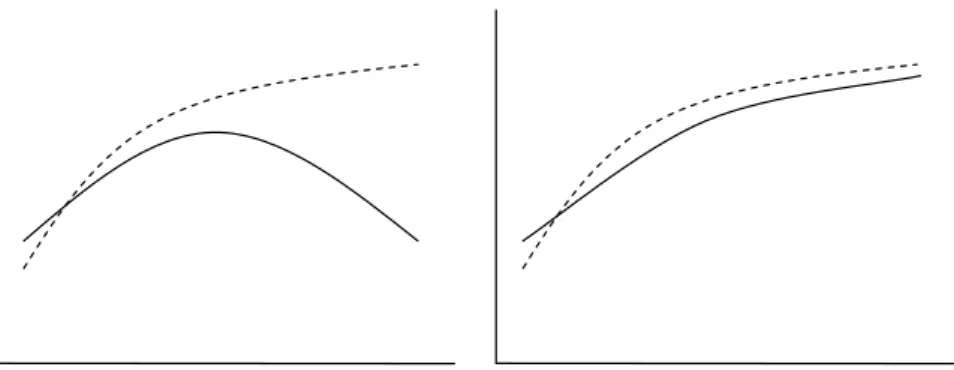
Let us show, in Figure 1, a predicted relation between the ratio of the game-theoretic value and search space, and between the game-game-theoretic value or score if exists and search space (Kita, 2007). As search space grows, the ratio of games to be ended in the game-theoretic value increases, whereas the score difference once increases and then starts to decrease. This implies that as search space grows, the game-theoretic value gets closer to the draw. On the other hands, as the mobility in the initial position becomes greater, the ratio of games to be ended in the game-theoretic value increases, and the score difference also increases.
Figure 1. A model of the change of the wining ratio (broken line) and score (solid line) as a function of search space (left) and the mobility in the initial position (right).
3 Game’s Fairness and Its Outcome
In this section we define fairness of a two player game where it has a turn to move. Then we make a conjecture on the game-theoretic value of a sophisticated game. To examine the conjecture, we present the game-theoretic values of several solved games where they are thought to have been sophisticated in a long history.
3.1 Definition of fairness and a conjecture
If the wining ratio for White and Black in a game are significantly different when played by the players of the (nearly) same level, then it seems to be unfair.
Definition [fairness of games]
A two player game is fair if and only if the wining ratio for White and Black is statistically equal or nearly so.
A sophisticated game, which has been survived and selected in a long history, should be fair in the sense of this definition, otherwise forgotten in the past. The definition may correspond to the second part of their definition (v.d.Herik et al. 2002)
that both players have roughly an equal probability on making a mistake.
By the direct reasoning from our definition, we conjecture the following statement. Conjecture [outcome of games]
The game-theoretic value of a sophisticated two player game is a draw.
The conjecture indicates that for sufficiently strong players or even the omniscient players the game-theoretic value of a game must be a draw to maintain fairness. Of course, it requires that a draw must exist in the game. We therefore note that from the sense of fairness it is important to have a draw in a game.
3.2 Are all sophisticated games really a draw?
Checkers has been played in Europe since the 16th century, and a similar game was certainly known to the ancients. Schaeffer et al. (2007) solved checkers. Perfect play byboth sides leads to a draw.
Fanorona is a board game with its roots in Madagascar. It is a descendent derived from
thegame “Alquerque” which might be over 3000 years old. The goal of the game isto
capture all opponent stones. The game is a draw if neither player succeeds (Schadd et al.
2007).
Awari is an ancient African board game that is played worldwide now. The game is a draw when both players play optimally (Romein and Bal 2003).
Nine Men’s Morris is one of the oldest games still played today. Boards have been
found on many historic buildings throughout the world. The oldest (about 1400 BC) was found carved into a roofing slate on a temple in Egypt. Others have been found as widely strewn as Ceylon, Troy and Ireland. Ralph Gasser (1996) solved the game, showing that it ends in a draw with perfect play.
All above results are in agreement with our conjecture. Are there any exceptions? Are all other unsolved sophisticated games such as chess and shogi in agreement with the conjecture?
3.3 Are there any exceptions?
Go-Moku was played as early as 700 A.D. in China. Among the games of the Olympic list, Go-Moku has the simplest rules: two players (Black and White) alternate placing stones on a 15 x 15 squares lattice with the goal of obtaining a line of exactly five consecutive stones of the player’s color. Go-Moku without opening restrictions has been solved, proving that the game-theoretic value is a win for the player to move first (Allis 1994). This result does not fit our conjecture. Why? We reason that in its long history Go-Moku had not been played on 15 x 15 or 19 x 19 (Go board), instead a smaller size board (e.g., 11 x 11) might have been used. In this case the game-theoretic value would be a draw.
Reversi was invented at the 19th century in England. Originally, Reversi did not have a defined starting position. Later it adopted Othello’s rule, i.e., the game begins
with four discs placed in a square in the middle of the grid, two facing Black, others White. Black makes the first move. According to the game-theoretic value prediction (Kita 2007), perfect play byboth sides would lead to a draw.
4 Discussion
Here let us suppose that the conjecture in question is right. Then, we consider two cases. One is that a fair game was created. Another case is that the rules of a game have been elaborated again and again by changing the initial position in order for the game to be a draw. How did they know if the theoretic value of the game was a draw?
The initial position plays an important role as observed from the artistic perspective (Iida 2007a). It is a key factor for maintaining fairness as well as for maximizing its formal beauty. Therefore, it is a serious issue to determine the reasonable initial position among many potential candidates when creating a potentially sophisticated game. Fairness requires a game to be a draw. Other components such as the beauty of the initial position, elegant pathway from the initial position to the ending position, and the beauty of the ending position are to be considered. Apart from fairness, entertaining impact, and judge are also to be considered.
It is interesting to determine a threshold of complexity to guarantee a draw in each sophisticated two player game. As mentioned in Section 2, the initiative is a clear advantage under the condition that search space is sufficiently large; in particular, the mobility in the initial position is high. It implies that each game must have an appropriate search space (board size in many cases) and the number of possible moves in the initial position.
Kita and Iida (2005) studied the game-theoretic value prediction in the domain of Othello. It concerns about the outcome of 4x4, 6x6 and 8x8, but not 10x10 Othello. The second player wins in 4x4 and 6x6 with score 8 discs and 4 discs, respectively. Kita (2007) estimated the outcome of 8x8 Othello as a draw. The game-theoretic value of the 10x10 Othello might be a draw or the first player win. According to Uiterwijk and v.d.Herik (2000), it could be the first player win, where the 8x8 size can be the border (threshold) between the first player win and the second player win. Thus, the outcome would be the first player win in a larger board than 8x8. On the other hand, Kita and Iida (2006) would suggest that it is still a draw. Which is correct?
5 Conclusion
In the early work we mentioned three major aspects of games: competitiveness, entertainment and metaphor in the framework of the model of three masters (Iida 2005). The model reveals three distinct master’s aspects: the master of winning, the master of playing and the master of understanding. The present contribution finds a link between games as metaphor and fairness.
In conclusion we summarize three aspects of games as follows.
battlefield to judge players. For the judgment or strict ranking of players, a game with a sufficiently large option space in which they can exercise their real strength would be desirable. It implies that too much draws are undesirable. In other words, the game outcome should depend on skills of the game.
Thrilling or acceleration in the sense of dynamics during the game’s outcome information changing process is a key factor of the game’s entertainment (Iida 2007b). Clearly, it is more interesting for players to play a game in which the information about the game outcome is not clear until the very end of the game, than to play a game where the outcome is already determined after a few first moves. Therefore, entertainment of games is based on the principle of seesaw games.
A game is often viewed as a metaphor of various things such as economy and life. An important issue is that all participants must feel fair in the game. The game creation and its refinement process in its long history show how the fairness can be realized in games, besides keeping some degree of competitiveness and thrilling. It implies that the game can maintain its attractiveness.
References
L.V.Allis (1994). Searching for Solutions in Games and Artificial Intelligence. Ph.D. Thesis, University of Limburg, Maastricht.
R.Gasser (1996). Solving Nine Men’s Morris. Computational Intelligence, 12:24–41, 1996.
H. J. van den Herik, J.W.H.M. Uiterwijk, J. van Rijswijck (2002). Games solved: Now and in the future, Artificial Intelligence 134:277–311.
H. Iida (2004). Games and Equilibriums, 12th IPSJ-SIG-GI-12, pages 25-32
H.Iida (2005). Master’s Minds in Games, in M.Koyasu, editor, An Innovative Form of Psychology of Art, Seishin-Shobo publisher, pages 28-51. in Japanese
H. Iida (2007a). The Omniscient Play in Games, 18th IPSJ-SIG-GI, pages 39-46 H. Iida (2007b). On Games And Judges, in Intelligence Systems, in press
H.Kita, H.Iida (2005). Theoretical value prediction in game playing, Proceedings of International Workshop on Game Informatics, Taiwan, pages 71-77.
H. Kita, H. Iida (2006). The Advantage of the initiative and possibility in the initial position, 11th Game Programming Workshop in Japan, pages 183-186.
H.Kita (2007). Game-theoretic value prediction in random game trees and backward game tree search. M.Sc. Thesis, JAIST, Japan.
J. Romein, H. Bal (2003). IEEE Computer 36, 26.
M.P.D.Schadd, M.H.M.Winands,J.W.H.M.Uiterwijk, H.J.Van.den Herik and Maurice H.J. Bergsma (2007). Best Play in Fanorona Leads to Draw, JCIS2007, Salt Lake. D. Singmaster (1981).Almost all games are first person games, Eureka 41:33-37. D. Singmaster (1982).Almost all partizan games are first person and almost all
impartizan games are maximal, J. Combin. Inform. System Sci. 7:270-274.
J.W.H.M. Uiterwijk and H.J. van den Herik (2002). The advantage of the initiative, Information Sciences 122(1):43–58.