
近畿大学学術情報リポジトリ
74
0
0
全文
(2) 2. -----. Memoirs of the Faculty of Agriculture of Kinki Univ. 2 (1964). INTRODUCTION In the coastal waters off Japan, the purse seine is pilchard and mackerel fisheries.. 1TI. common use in the sardine,. Though the purse seine is used extensively, there. has been very little researches done on this gear. UNO (1935)1) and INOUE (1954)2) who. inves~igated. We have only the researches of with model nets.. The shape of. the whole net and the tension of purse line were examined at various stages of purs ing for various speeds by them. As the purse seine is used for catching pelagic species, it is desirable that the bottom margin of the net should sink rapidly without any accident.. Also, as this. gea.r is used in areas of complicated tida.l currents, the resistance of the large net often causes net entanglement.. Therefore, basic research on the mechanical characteris. tics of this seine have to be conducted to make clear the sinking behaviour of the bottom margin of the net and to find out the factors causing the entanglement of the webbing during its operation.. Investigations on the purse seine from these two. points of view were conducted by the author. The present paper deals specifically with the mechanical properties and behav iours of a purse seine in working condition.. This paper is divided into four parts.. In the first section, the origin, development and present condition of the purse seine fisheries are traced. described.. In the second part, the fundamental researches on the net are. A simple current meter, the weight of webbing in water, the resistance. of a plane net in a current are treated.. The mechanical behaviours of the purse. seine in action are discussed ·in the third section.. The results of a series of model. experiments of purse seine are given and the theoretical analysis of sinking movement of the lead line is also introduced.. The last section deals with the fishing capaci. ties of purse seines. The writer wishes to express his hearty thanks to Prof. T. KAWAKAMI, D. Agr., of Kyoto University for his kind guidance.. Gratitudes are offered to Emeritus Prof.. M. TAUTl, D. Sci., of Tokyo University of Fisheries and to Dr. T. YOKOTA of the Nankai Regional Fisheries Research Laboratory for their helpful suggestions given in the beginning of this studies.. Thanks are also extended to colleagues of Kyoto. University who made generous assistances in carrying out the model and field experi ments.. To Prof. T. KAWAKAMI and Mr. M. YESAKI, a graduate of British Colum. bia University, grateful acknowledgements are due for their kindness in reading the manuscript before printing.. REFERENCES 1) UNO, M. : The form and the tension on pursing line of a mackerel ringnet. used at Kosait6, Ty6sen, as known by a model experiment. Bu!. lap. Soc..
(3) Y.. IrTAKA:. Studies on the Mechanical Characters of Purse Seine. 3. Sci. Fish., Vol. 4, No.3, 1935, (in Japanese). 2). INOUE,. M. : Model experiments on a sardine ring net. Bul. Jap. Soc. Sci.. Fish., Vol. 19, No.· 9, 1954, (in Japanese)..
(4) Memoirs of the Faculty of Agriculture of Kinki Univ. 2 (1964). 4. PART I 1 OUTLINES OF PURSE SEINE 1. 1 KINDS OF ROUNDHAUL NETS In Japan today, various kinds of fishing gear are used of which roundhaul nets are one type.. The roundhauls are long wall-like nets that are laid out in a circle. around a school of fish in water.. The two ends of the net are brought together, the. bottom is at least partially closed to impound the school, and the net is then pulled aboard the boat.. Under the general classification of roundhauls are included the. lampara net (the "Nuikiri-ami" used along the coast of Kyiisyii, the "Taisibariami" used in the Inland Sea of Seto, etc.) and the purse seine (sometimes called the " Aguri-ami"). There are vanous other nets, the names of which erroneously suggest them to be roundhaul nets.. For example, round lift nets, such as those used to catch bait,. are occasionally called circle nets, but are in no sense roundhauls. depending on how it is set is sometimes also called a circle net.. A gill net. This net is not a. rounhaul as it is not closed at the bottom, it is not pulled aboard the boat as a unit, and it entangles rather than impounds the fish. gill nets used to encircle a school of fish, fishing vessel.. impounding round haul net.. ins~ead. net with fish is hauled aboard the. The net so used, ceases to be an entangling gill net and becomes an. some escapement of fish, feature.. then,. However, there are instances of deep. Failure to close the bottom of the net completely. allows but this inefficiency of gear does not alter its roundhaul. When a net is laid out around a school of fish and is pulled onto a beach of onto a boat, the net is called a beach seine.. In this case, the manner. of use determines the name of the gear rather than the construction of the net itself. As stated above, roundhaul nets are of two basic types, the lampara and the purse seine. A purse seine is a long wall-like net which has no prominent bunt or bag, that is, with very little fullness and with the webbing hanging nearly straight down between the cork and lead lines. uniform mesh size.. The main body of the webbing is usually of. The essential feature of this net is the drawstring (purse line). which is threaded through a series of rings along the bottom of the net below the lead line.. The seine is "pursed" by pulling the drawstring so that the lead line is. bunched or puckered.. This closes the bottom of the net and completely impounds. the catch before the crew begins to pull in the net aboard the fishing boat. lampara has a large central bunt and relatively short wings of large mesh.. The. The loose. hanging of the net allows the lead line to be pulled somewhat in advance of the cork line and this coupled with tbe rapid pulling of the wings tends to close tbe net bottom and the central bunt assumes a scoop-like shape.. There is no pursing device.
(5) Y. IrT.~KA: Studies on the Mechanical Characters of Purse Seine other than the rapid take-in of the lead line as the net is pulled.. 5. The lampara. differs radically from the purse seine in that it has a large central bunt, is not of uniform mesh throughout, and does not have the purse line with rings. There are three types of purse seines in use today in Japan; (1) the one-boat type purse seine, (2) the two-boat type purse seine and (3) the North American-type purse seine.. The construction of these nets is essentially similar, but the landing. portion (fishing bag) of the two-boat purse seine is located in the center while that of the other two is at one end of the net.. These three types of seines also differ in. net size and in the methods of operation. (1) The one-boat purse seine is carried by boats of 50-80 gross tons.. In making a. set, one end of the net is held by a skiff while the net is paid out. by the seine boat at full speed.. After the circle is completed the purse line is retrieved to. close the bottom of the net.. The net is then hauled in from one end to further. confine the captured fish, which can then be easily brailed into the boat. (2) The two-boat purse seine is operated from boats under 50 gross tons. is carried to the fishing ground by two boats lashed side by side.. This net. On the fishing. ground, they quickly separate dropping: the net in the water as they run.. Each. boat describes a semicircle so that the net is laid out to surround the fish school. The bottom of the net is then closed by drawing the purse line, so that the fish are entrapped in the net.· (3) The North American-type purse seine is carried on boats, ranging from 100 to 200 gross tons.. This net is very large and is similar to the purse seine employed. in North America. fishery.. This seine has been used from around 1950 in the skipjack. Even today, there are only about ten of these large seines being used.. The total catches by this type of seine are small and do not compare with the total catches of the smaller one-boat and two-boat purse seines.. 1. 2 ORIGIN OF ROUNDHAUL NETS Which fishing net was first developed by ancient man is not known, but cer-. tainly the 'beach seine is very old.. This seine is merely a wall. of webbing which is. set out parallel or in a semicircle from the shore and then both ends are pulled simultaneously onto the beach.. The oldest Japanese writings, the Koziki (712 A. D. ), the. Nihon syo-ki (720 A. D.), the Wa-my6-sy6 (930 A. D.), etc., refer to the fishings of sardine with a beach seine.. The use of this net is said to have spread to all. parts of the country during the Heianty6 era (794-1191 A. D.). Later, in the Asikaga Sy6gunate era (1334-1573 A. D.), the gillnet, a simple fixed net, the boat seine are thought to have been used.. Since the Tokugawa Sy6gunate days (1603-1867 A. D. ),. towed nets, lifted nets, roundhaul nets, fixed nets, and gill nets are definitely known to have been used. SCOFIELD (1951)1) gives in his publication the history and development of the.
(6) 6. Memoirs of the Faculty of Agriculture of Kinki Univ. 2 (1964). purse seine in California.. He is of the opinion the precursor of the TOundhaul nets. to be the ancient beach seine.. He postulates as follows:. For the beach seine the. sand or mud beds in shallow water serves as the bottom of the net.. In deep water,. however, the fish could dive under the seine and escape but by hanging in more webbing in the middle of the seine a slight envelope (bunt, bag, sack or belly) were added which helped to impound those fishes that entered the bag. is nothing to stop the fish not in the bag from escaping. therefore, upon a good beach and shallow water.. But again, there. Success of this net depends,. In most coastal areas the places. that can be beach seined is pitifully scarce and so the ancients may have tried hauling the seine onto a boat but the fish could escaped under the lower edge of the net and under the boat as the two wings were being pulled aboard.. A deep bag had already. been added on beach seines and it may have been that this suggested making the seine into a large bag with short wings so that it could be at least partially closed when the lead line was taken-in.. This large bag with lead line pulled quickly in. advance of the cork line is the principle used in the lampara type of net.. It seems. very likely that this form of partial closing of the bottom was tried long before the· development of the pursing seine.. It is known that various types of lampara nets. had been used in Japan before the nineteen century.. The "Nuikiri-ami" used along. the coast of Kyusyu, the "Tai-sibari-ami" used in the Inland Sea of Seto, the "Hassaka-ami" used along the coast of Ibaragi and Hukusima Prefectures, are all oldfashion lam para type nets still used today.. The lampara type of net, then, according. to SCOFIELD, was the next stage in development from the beach seine.. Certainly, his. deductions are interesting and appear to be quite sound. The essential feature of the operation of the purse seine iog the purse line which is threaded through a series of rings.. IS. the pursing by pullThe pursing net is. said to have originated in 1826 in the Rhode Island menhaden fishery on the Atlantic Coast of the U. S. A. By 1910, the purse seine was introduced to most parts of the world.. The purse seine was adopted and greatly developed by the California sardine. fishermen (SCOFIELD).. In Japan, the pursing idea is generally said to have been in-. troduced in 1881 from California.. Most of the purse seines used today is a compro-. mise type between Japanese forms (lampara net, "Aguri-ami") and the introduced purse seine. This net is sometimes called "Kairyo Aguri-ami" which can be translated as "Improved Aguri-ami". A roundhaul net which was used for saury in waters off Izu-Hiti-T6. IS. of par-. ticular interest. This was an old-fashioned net, which had purse rings only along the central portion of the bag(see Fig. 1. 1). When the wings of this net had been partly taken-in, the lead line could be quickly hauled in by pulling the ropes attached to the central rings so as to prevent escapement of fish through the bottom of the net. It may be, therefore, that the pursing idea to close the net bottom before pulling the net on board the boat had been independently tried by Japanese fishermen..
(7) Y. IIT.HcA: Studies on the Mechanical Characters of Purse Seine. ·--------No. 670. 161. ===== = ~. 24 J2i). 160. "'lVV'T. = 33. - ------. 7. '! rP.,.;t;.. LuvfJ..({~.<). Nevv>.our 5t'1Ul. 24. 167. 165 120 55'7 --vv-vv"vwv ANvu>.'J'~'i P~...,. Total Length of Lead Line Fig. 1. 1. Net-plane of the Izu-Hiti-To "partially-ringed seine".. 2). 1. 3 PRESENT CONDITION OF THE PURSE SEINE FISHERY IN JAPAN The purse seine is a very common coastal fishing gear in Japan which accounts {or a major share o{ her {ish harvest. According to the statistics o{ 1957, the nations toll of fish and shelUish was about 4.86 million tons Cfable L 1). about 16 % (800 thousand tons) was caught by roundhauls.. O{ this total. Table L 2 shows the. changes in the yearly catches by round hauls {or three years since 1957. It can be seen {rom this table that about 90 % o{ the total catch by roundhauls is caught by purse seines of which about 60% is landed by the two-boat type purse seines.. Also o{. roundhauls other than purse seines the "Nuikiri-ami", a kind o{ lampara net, accounts {or the greatest share of the fish harvest.. TABLE 1.1. CATCHES OF FISH AND SHELLFISH BY THE DIFFERENT FISHING GEAR IN 1957. 8 ). Type of gears. Total Catches (Tons) April of 1957- March of 1958. Trawl Nets Roundhauls Lift Nets. Gill Nets. 1,096,403 799,470 540,150 283,238 703,440. Pole and Hand Lines Long Lines. 400,916. Fixed Nets. 257,145. Beach Seines and Boat Seines. 199,358. 481,556. Miscellaneous Gears for Shell Fishes and Sea Weeds Others Total. 100,343 4,862,089.
(8) Memoir's of the Faculty of Agriculture of Kinki Univ. 2 (1964). 8. TABLE 1.2. CATCHES BY ROUNDHAULS DURING TfIE 3 YEARS, 1957-1959. 4 ) (Tons). Year. One-boat Type Purse Seines. Two-boat Type Purse Seines. 1957 1958. 310,316 286,385. 414,788 400, 734. 38,284 38,364. 36,083 30,942. 1959 1960 (1-7). 370,310 254,635. 420,201 204,922. 36,875 15,546. 26,285. Nuikiri-amis .. In 1959, 3, 163 seiners operated around the coast of Japan.. Other Roundhauls. 12,550. Of these 327 were. one-boat type purse seiners, 968 were two-boat type purse seiners, 274 were "Nui-. kiri-ami" seiners and the remaining 1,594 were other, small roundhaul seiners.. The. fish species sought by the seiners are mainly sardine, horse mackerel, mackerel, boTable 1. 3 shows the catches of species by the different types of. nito, and tuna.. Pl1rse seines in 1959.. It can be seen from the table that the catch of the one-boat. type purse seine is primarily horse-mackerel and mackerel while the predominant catch of the two-boat purse seine is sardine. The purse seine is very efficient for taking pelagic schooling species.. The. recent use of various types of modern electronic devices, such as e~ho sounder, sonar, in locating schools of fish and radio-phone, wireless, rader, to aid in liaison between seiners during fishing operations is greatly increasing the effectiveness of the purse seine.. TABLE 1.3 Species. CATCHES OF SPECIES BY ROUND HAULS IN 1959. 4 ) (Tons). One-boat Type Purse Seines. Sardines 68,175 Horse-Mackerels 222,919 Mackerels 73,475 Yellow Tails 515 Bonitoes 1,841 Tunas 193 Sq\1ids 775. Two-boat Type Purse Seines 261,660 100,011 19,280 3,891 15,188 14,527 864. Nuikiri-amis. Other Roundhauls. 24,644 8,909. 1,595 2,006. 593 3 95 24 71. 625 182 250 310 50.
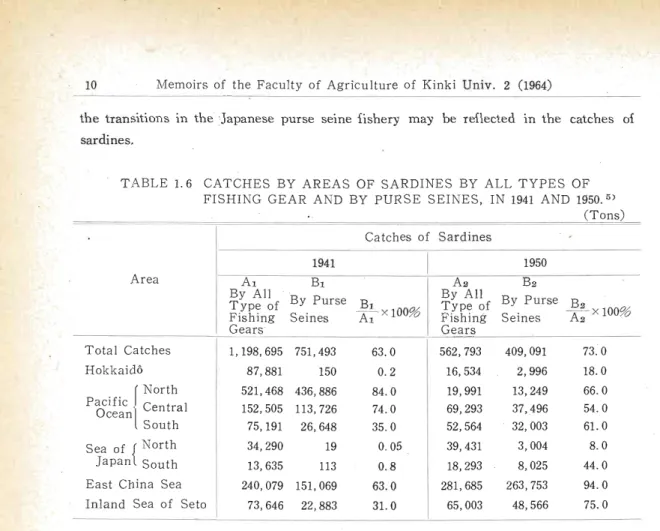
(9) Y.. hTAKA:. TABLE 1.4. Boat Size (Gross Tons). Studies on the Mechanical Characters of Purse Seine. KINDS AND NUMBERS OF ELECTRONIC EQUIPMENT USED BY THE PURSE SEINE FLEET IN 1953. 5 ). Total Number of Boats. Total Powerless Under 10 10-30 30-100. 9. Number of Boats Equipped with Accessory Gears Radio- Net Radar Wireless phone Hauler. Total No. of Boats. Echo Sounder. 9,435. 3,099. 2,406. 595. 333. 1,708. 630. 1,744 3,859. 5 724. 5 701. 6. 937. 1,259. 1,210 1,123. 37 521. 155 623. 4. 2,536. 2 20 274. 37. 37. 31. 37. Above 100. 744 19. 145 474. 915 15. 7. Table 1. 4 shows the kinds and numbers of electronic equipment used by the purse seine fleet in 1957. As the data was collected sometime ago,. the numbers of. these modern fishing aids used at the present is no doubt very much greater. The recent trend has also been for the use of synthetic fiber nettings {or the construction of the purse seine.. The types of synthetic fiber nettings used for mak-. ing purse seines in 1953 is tabulated in Table 1. 5.. Again as the data is quite old,. a census now would show that most of the purse seines used today to be made of synthetic fibers. TABLE 1. 5. NUMBER OF SYNTHETIC FIBER PURSE SEINES USED IN THE VARIOUS AREAS IN 1953. G) A Total No. of Nets. Area Total Hokkaid6 Pacific Ocean. I. North Central South. { North South East China Sea Inland Sea of Seto Sea of Japan. 1,561. B No. of Synthetic Nets. B. X1OO %. T. 1,074. 68.5. 223 270 187. 202 216 144. 90.5 80.0. 45 247 445. 26 231 183. 143. 72. 1. no 57.8 93.5 41. 2 50.3. 1. 4 CHANGES IN THE JAPANESE PURSE SEINE FISHERY The Japanese purse seine fishery has always been closely connected with sardines.. Table 1. 6 shows the catches by areas of sardines by all types of fishing gear. and by purse seines.. It can be seen from the table that before and after World War. II, 60-70% of the total catches of sardines were landed by purse seine.. Therefore,.
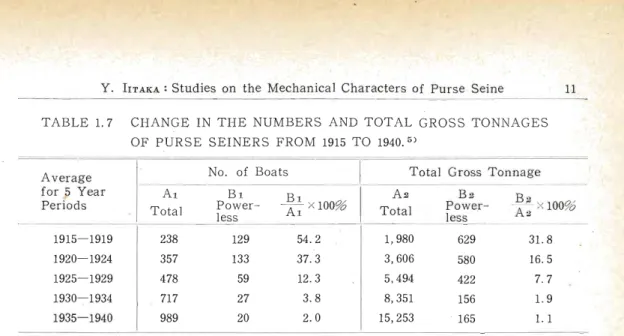
(10) 10. Memoirs of the Faculty of Agriculture of Kinki Univ. 2 (1964) -----------'---. the transitions in the Japanese purse seine fishery may be reflected in the catches of sardines. TABLE 1. 6 CATCHES BY AREAS OF SARDINES BY ALL TYPES OF FISHING GEAR AND BY PURSE SEINES, IN 1941 AND 1950. 5 ) (Tons) '.. ,. Catches of Sardines. 1941 Area. Al BI By All By Purse Type of Fishing Seines Gears·. Total Catches. 1. North Pacific Ce tral Ocean n South Sea of {North Japan South East China Sea Inland Sea of Seto. Bl. ~X100%. 1950. . B2 A2 By All By Purse B·, . Type of A;-x 100% Fishing Seines Gears. 63.0. 562, 793. 409,091. 73.0. 87,881 150 521,468 436,886 152,505 113,726 75,191 26,648 34,290 19 13,635 113. 0.2 84.0 74.0 35.0 0.05. 16,534 19,991 69,293 52,564 39,431. 2,996 13,249 37,496 32,003 3,004. 18.0 66.0 54.0 61. 0 8.0. 0.8. 18,293. 8,025. 240,079 151,069 73,646 22,883. 63.0. 281,685 65,003. 263,753 48,566. 44.0 94.0. 1,198,695 751,493. Hokkaido. I. 31. 0. 75.0. The change in the catches of sardine during the years 1895 to 1945 is shown in Fig. 1. 2.. Table 1. 7. shows the changes in the numbers and total gross tonnage of. purse seines from 1915 to 1940.. In Fig. 1. 2, the sardine catches can be roughly. divided into 3 periods, Meizi era (1895-1912), Taisy6 era (1912-1926), and the SYQwa era up to World War II (1926-1937). 2.0,----------------_--,. / 1·5. ~:<. ~. E: 10. ~. <...J. ~. 05. /,. (/. /. 1925. 1935. 1945. -v---'--------~. M~.oAA.. TWlfOMil.. S'J"Unz.M.O-. . Y"M. Fig. 1. 2. Change in the total landings of sardines from 1895 to 1951. 0).
(11) Y. In'AKA: Studies on the Mechanical Characters of Purse Seine TABLE 1. 7. 11. CHANGE IN THE NUMBERS AND TOTAL GROSS TONNAGES. OF PURSE SEINERS FROM 1915 TO 1940. 5 ). Average for 5 Year Periods. No. of Boats Al Total. Total Gross Tonnage. I. Bl Bl x 100% PowerAl less - - - .. 54.2 129 37.3 133 12.3 59. I. A2 Total. B2 Powerless. 1,980. 629. 31. 8. 3,606. 580. 16.5. ~22 ~< 1009"0 ---. 1915-1919. 238. 1920-1924. 357. 1925-1929. 478. 5,494. 422. 7. 7. 1930-1934. 717. 27. 3.8. 8,351. 156. 1.9. 1935-1940. 989. 20. 2.0. 15,253. 165. 1.1. In the Meizi era the sardine catches were small and quite constant from year to year.. In the second period the catches increased yea.rly.. This increase is attributed. to the introduction of powered vessels which towed the purse seiners to the fishing grounds. During the Sy6wa era still greater increases in the yearly catches were made. Table 1. 7 shows that early in the Sy6wa era engines were begun to be installed in the purse seiners which greatly increased their efficiency.. The great increases in the. catches of sardine is, therefore, attributed mainly to the advent of powered craft. There is,. however, another factor which is thought to have increased in Japan were. the sardine catches by the purse seiners. made of hemp twine or straw cord.. Until late in the Meizi era all fishing nets. At about 1903, a purse seine (" Aguri-ami"). made of cotton twine was first used in waters off Aomori Prefecture. cotton has been used extensively for netting materials.. Since then,. As the cotton differs from. hemp or straw in its properties, such as rigidity and tensile strength, capacities of cotton seine is much superior. catches of sardines shown in Fig.. the fishing. Therefore, the great increa.se of the. 1. 2 was also due to the advent of the cotton. seine. The decline in the catches since 1937 is thought to be due to the drop in the sardine populations.. This opinion is supported by Table 1. 8 which shows that the. degree of decline of catches differed in different waters.. Also, the greater the dis. tance from the spawning grounds (South of Kyusyu), greater was the decline in the sardine catches which strongly suggest a population decrease. the catches of sardines began to increase again.. Fig.. After World War II. 1. 3 shows the cha.nges in the. ca.tches by purse seines and the numbers of seine boats since 1945.. It can be seen. from the figure that the catches increased linearly while the numbers of seine boats since 1950 was constant, though, the numbers of purse seiners above 50 gross tons greatly increased during this period.. This recent increase in the sardine catches is. attributed to the use of synthetic fibers and modern electronic devices such as echo sounders, radio-phones, etc. by the purse seine fleet..
(12) 12. Memoirs of the Faculty of Agriculture of Kinki Univ. 2 (1964) TABLE 1.8. DECLINE IN THE CATCHES OF SARDINES IN DIFFERENT AREAS.O) (Tons) Average Catches for 3 Year Periods. Area Total Catches Hokkaid6 { North Pacific Ce t 1 n ra Ocean South Sea of {North Japan South East. ~hina. Sea. Inland Sea of Seto. ~xI00% A. A 1934-1936. B 1948-1950. 1,491,019. 470,175. 32.0. 368,085. 14,066. 396,049 295,470 78,683 335,344. 16,766 63,401 46,440 28,740 19,943. 3.8 4.2 21. 0 59.0 8.5 51. 0. 39,011 155,306. 227,498. 146.0. 46,508. 53,520. 115.0. ~. J ]. ~. 7 6. I-" 0. ~ x ~. j. 43 2. J ~. '6<..'1 zO. c;l'". 6. 5. ~6 ;"". 3. .)<is. 2. .. ... o 0 ~ ~. l' C!:l. ....., 0. 'l:l. z. /945. TABLE 1. 9. J. ~.". x x. 4. "..~. Fig. 1. 3. ~. 0-. 1955. Y.JUlJL. Showing the changes in the sardine catches by purse seines and the numbers of seine boats since 1945. U). INCREASE IN NUMBERS OF PURSE SEINERS EQUIPPED WITH ECHO SOUNDER DURING THE 4 YEAR PERIOD 1948-1951. 5) Area. Northern Sea of Japan East China Sea North of the Pacific Ocean. 1948. 1949. 1950. 1951. 3 12. 5 48. 9 135 47. 13 151. 10. 117.
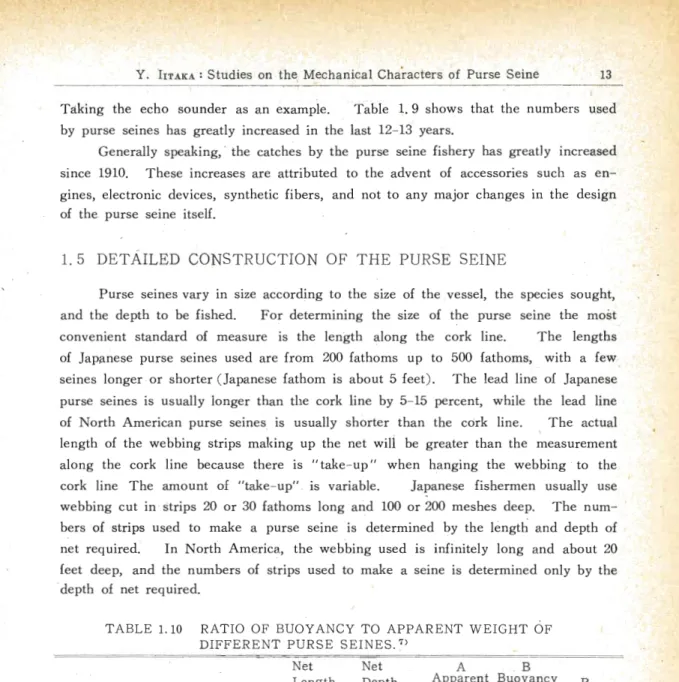
(13) Y.. IrUKA:. Studies on the Mechanical Characters of Purse Seine. Taking the echo sounder as an example.. 13. Table 1. 9 shows that the numbers used. by purse seines has greatly increased in the last 12-13 years. Generally speaking,' the catches by the purse seine fishery has greatly increased since 1910.. These increases are attributed to the advent of accessories such as en-. gines, electronic devices, synthetic fibers, and not to any major changes in the design of the purse seine itself.. 1. 5 DETAILED CONSTRUCTION OF THE PURSE SEINE Purse seines vary in size according to the size of the vessel, the species sought, and the depth to be fished.. For determining the size of the purse seine the most. convenient standard of measure is the length along the cork line.. The lengths. of Japanese purse seines used are from 200 fathoms up to 500 fathoms, seines longer or shorter (Japanese fathom is about 5 feet).. with a few. The lea.d line of Japanese. purse seines is usually longer than the cork line by 5-15 percent, while the lead line of North American purse seines is usually shorter than the cork line.. The actual. length of the webbing strips making up the net will be greater than the measurement along the cork line because there is "take-up" when hanging the webbing to the cork line The amount of "take-up" is variable.. Japanese fishermen usually use. webbing cut in strips 20 or 30 fathoms long and 100 or 200 meshes deep.. The num-. bers of strips used to make a purse seine is determined by the length and depth of net required.. In North America, the webbing used is infinitely long and about 20. feet deep, and the numbers of strips used to make a seine is determined only by the depth of net required. TABLE 1.10. RATIO OF BUOYANCY TO APPARENT WEIGHT OF DIFFERENT PURSE SEINES. 7 ). Type of Seine One-Boat Type Purse Seine for Spanish Mackerel Two-Boat Type Purse Seine for Spanish Mackerel One-Boat Type Purse Seine for Sardine Two-Boat Type Purse Seine for Sardine II. Net Length (in fathoms). Net Depth (in fathoms). 450. 50. 301. 528. 1. 75. 350. 25. 140. 312. 2.23. 226. 40. 159. 258. 1. 62. 205. 40. 115. 231. 2.01. 126. 35. 39. 142. 3.64. 97. 201. 2.08. 110. 2.56. A B Apparent Buoyancy Weight of of Net* Floats (in kg.) (in kg.). 180. 30. One-Boat Type Purse Seine for Sardine Roundhaul Net for Mullet. 277. 40. 140. 30. 42. Roundhaul Net for Dolphin. 106. 20. 29. II. B A. 1. 87. 31. 5. * Weigt in water of webbing, lead line, purse line, and purse rings.. 1. 10.
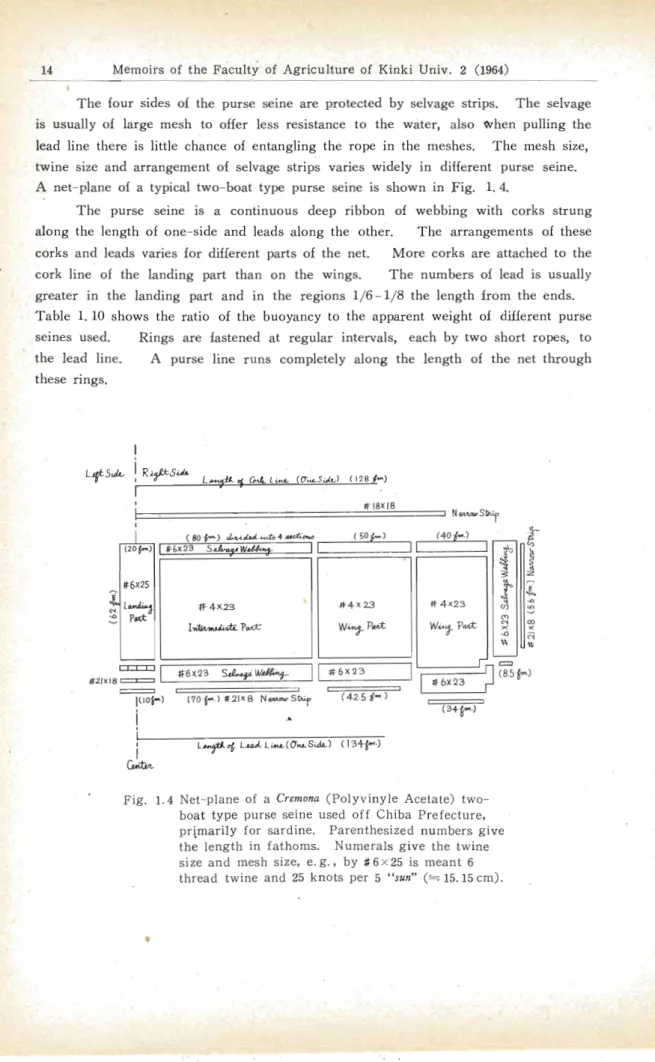
(14) Memoirs of the Faculty of Agriculture of Kinki Univ. 2 (1964). 14. The four sides of the purse seine are protected by selvage strips. IS. usually of large mesh to oHer less resistance to the water, also. lead line there is little chance of entangling the rope in the meshes.. The selvage. ~hen. pulling the. The mesh size,. twine size and arrangement of selvage strips varies widely in diHerent purse seine.. A net-plane of a typical two-boat type purse seine is shown in Fig. 1. 4. The purse seine is a continuous deep ribbon of webbing with corks strung along the length of one-side and leads along the other.. The arrangements of these. corks and leads varies for different parts of the net.. More corks are attached to the. cork line of the landing part than on the wings.. The numbers of lead is usually. greater in the landing part and in the regions 1/6 -1/8 the length from the ends. Table 1. 10 shows the ratio of the buoyancy to the apparent weight of different purse seines used.. Rings are fastened at regular intervals, each by two short ropes, to. A purse line runs completely along the length of the net through. the lead line. these rings.. I Lf-SiA-. ! R~S;A. I I. #' 18Xl8. =================== N"""",,,S~,. ~I. I. ( 80 (20,,"). I.Hx23. r). J-M,o,i.;...;D, +... a::""" 5~w~~1. ",6x25. ~l~ ;:: p..-;t. 'If 4x23. ,. I~"ftI'..o=. ( 5Or). ===:J I. 140;".). I ,-----. ~3. #'4-x 23. If 4x23. w"""} P..d:. W""'} p.,,;t. !'" C'l. x. .<J. ~. L....-. =. L....-. #,2/X. 18~1. 1t6x23. SJ...pIJJJ~. == luor-1.====::======?'. 170r) 1I21X8 N......""'S""f. II. lfox23. = = (425 f-o). I. #' 6x 23. (B.5r. i I. I. I. ~. Fig. 1. 4 Net-plane of a Cremona (Polyvinyle Acetate) lwoboat type purse seine used off Chiba Prefecture, primarily for sardine. Parenthesized number.s give the length in fathoms. Numerals give the twine size and mesh size, e. g., by # 6 x 25 is meant 6 thread twine and 25 knots per 5 "sun" (~15. 15 cm).. t. t. z.
(15) Y.. hTAKA:. Studies on the Mechanical Characters of Purse Seine. 15. 1. 6 REFERENCES 1) SCOFIELD, W. L.: Purse seinsc and other roundhaul net in California (1951). 2) Dai Nihon Suisan Kai: Suisan K6za (1954), (in Japanese). 3) Department of Agriculture and Forestory, Japanese Government: Annual report of catch statistics on fishery and agriculture (1957), (in Japanese). 4) Suisan Kagakfl Sya: Fisheries of Japan (1961). 5) Suisan Kenkyfl Kai: Purse seine fishery and its management (1953), (in Japanese); 6) Suisan Shflh6 Sya: Suisan Nenkan (1960), (in Japanese). 7) MIYAMOTO, H.: Gyogu-gyoh6 Gaku (1956), (in Japanese)..
(16) Memoirs of the Faculty of Agriculture of Kinki Univ. 2 (1964). 16. PART. II. 2 FISHERMEN'S CURRENT MEASURING DEVICE, "SIOMJ.-ITO" 2. 1 INTRODUCTION It is said among purse seine fishermen that· the entanglement 01 net often. occurs when a purse seine is set in waters where there are strong underwater currents.. Therefore, it has been urged that, when using a purse seine, it would be a. great manipulative advantage to know whether or not the water movement seen at the surface persisted, unchanged, down to the depth at which the fish had been located.. If it could, be kno'wn in advance of shooting the net that the currents at "fishing depth" were markedly different from those at the surface, it would be possible to do something to avoid the entanglement of net.. Several means have been proposed by. many fishermen and gear specialists to detect the water movement at the fishing depth. In the Japanese commercial purse seine fisheries, device called' "Siomi-ito" is in traditional use.. a simple current measuring. In Japanese, sio means literally tidal. current, mi means to observe or to detect, and ito means a fine string.. This device. consists of dropping several boulder, sinkers attached to strings of different lengths. Each sinkers is subjected to the current at the depth corresponding to the length of the string.. The tilt of the string at the surface of the sea is determined by the. current velocity and by the length of the string.. By a glance at the tilt angles of. the strings at the surface, an experienced fishermen can infer whether or not it is favourable for seining operations.. Only experienced fishermen are said to be able. to use the device with any degree of accuracy.. However, even they infer errone-. ously at times and the crew suffers the toil of having to entangle the net. Although the detecting of underwater cnrrents is an urgent problem in fishing operations the development of a suitable device for fishing purposes has not yet been investigated scientifically.. The difficulty seems to arise from the fact that the current. velocity at various depth has to be successively measured as a vector quantity.. From. the fisheries point of view, the "Siomi-ito" is an useful tool, on account of its simplicity.. This section deals with the theoretical analysis of how the "Siomi-ito" oper-. ates and suggestions are given for the' construction and manipulation of this device.. . 2. 2 THEORETICAL CONSIDERATIONS It has been well established by many authorities that the normal component of the hydrodynamic force acting upon the string subjected to a uniform current varies proportionally with the square of the sine of the angle between string and stream.
(17) Y.. IrTAKA:. 17 .. Studies on the Mechanical Characters of Purse Seine. and that its tangential component may be negligible as compared with the normal component especially when the angle does no depart very far from 90 degrees. Suppose a spherical sinker which is lowered into water, of homogeneolls and horizontal current U, by a fine flexible string as shown in Fig. 2. 1.. In a system of. rectangular coordinates (X, Z), whose origin 0 is located at a point on the string at the water surface, let the Z-axis be directed vertically downwards and let the X-axis be parallel. to the stream measured positive downstream. Let S be the arc length along the string from the origin to any point P (X, Z) on the string, and let {} be the inclination angle, i. e., the angle between the tangent. z Fig. 2.1. of the string and the Z-axis at this point.. If the weight 01 the string is compensated. by its buoyancy, and the tangential force acting along it is negligible, tension T constant throughout the whole string.. IS. The equation of equiribrium may then be. written as. - T. ~~. =Rsin1. (;. -0). =Rcos1. (). (2.1). R is the drag of the string of unit length when it is placed perpendicularly to the current, that is,. R=kU' ,. (2.2). k being a constant depending only upon the size of th~ string, provided that law for hydrodynamic drag is tenable.. with the condition that (}={}o for S=O, gives. R. 'TS and. = tan(}o. - tan (). NEWTON'S. The integration of this diHerential equation,.
(18) Memoirs of the Faculty of Agriculture of Kinki Univ. 2 (1964). 18. For the case in which the inclination angle. {J. is small, the expressions can be SIm-. plified to (2.3) Next, take the case of a column water with non-uniform current throughout. This column of water is stratified into n sublayers, each of constant thickness L. The current is assumed to be uniform' throughout each layer.. Into this system are. hung n spherical boulders by n strings so that each sinker is suspended in the center of eC'.ch layer. Let. {Ji,o. denote the inclination angle of the string at the water surface. which carries the sinker suspended at the i-th layer and 0, be the inclination angle of the string where the sinker IS attached.. 1£ NEWTON'S law be tenable for the drag. of the sinker, we have {J i~ ~t an. 8 I-oW - K U2 i. K U ,2 ,. ~-T'. (2.4). K is the proportionality constant depending upon the projected area of the sphere and. W its apparent weight, which is assumed for the present purposes to be equal to the tension T of the string, if 8 be small. Applying Eqs. (2.2) , (2.3) and (2. 4) to the first string, we have. -} (kJ +K)U~ =8J.Q. (2.5). Similarly, for the i-th string, we have. kL. ,. ,. --1.' (Ui+Ui+ Subtracting the equation for the i-th string form tha.t for the (i + l)-th string, a reduction formula for U can be obtained, which is:. \ 2 1 (kL \ 2~ _ Y1 (kL T+ K )Ui+1+y T - K J U,:-Oi+1.0-8 i . O =L10i. (2.6). Using this equation, together with Eq. (2.5), the values of Ui may be roughly estimated for each layer in the system by mesuring the diHerences of inclination angles,. L18 i, at the surface of successive strings. If all the strings are not laid on one plane, it is mi.tural to treat all values by decomposing them into two perpendicularly intercepted directions.. 2.3 SOME REMARKS ON THE DESIGN OF SIOMl-lTO In order to reduce the amount of computation's, some expedients on the design of a Siomi-ito are advisable.. Let us consider the case in which. 2K. (2. 7). L=-kThen Eqs. (2.5) and (2.6) are simplified to. 2K 2 -T U'+l. = L18,. ,. (2.8).
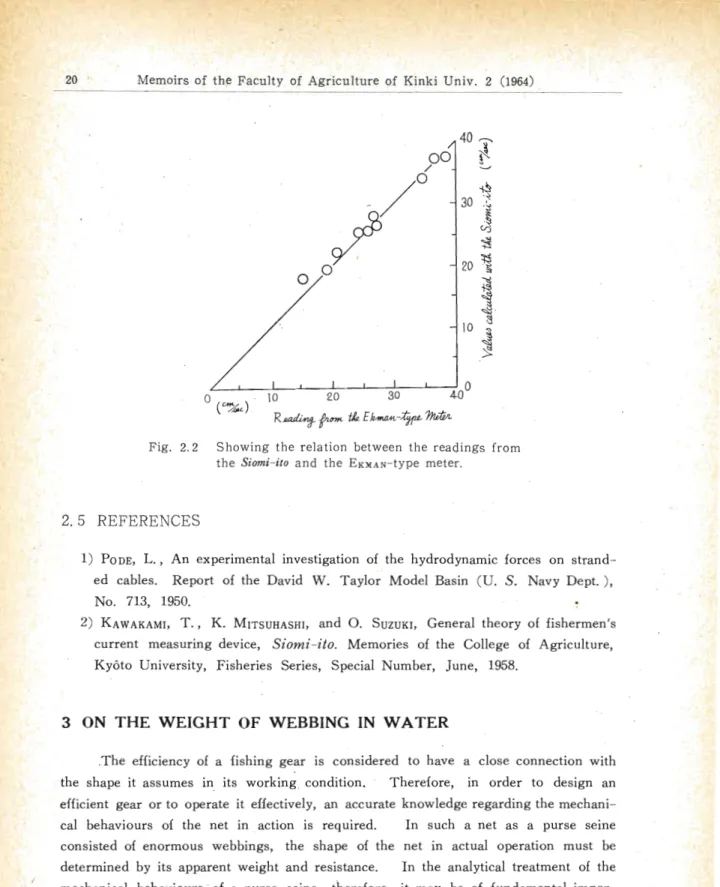
(19) Y.. IrTAKA:. Studies on the r'v1echanical Characters of Purse Seine. 19. In these equations, the values of K and. which makes computation much simpler.. I? are given by ordinary hydrodynamical considerations.. The length L can therefore. be determined by the diameters of the string and the spherical sinker used and T the density of the sinker. With regards to the string, a rope coated with plastic or a braided rope nearly circular in cross-section should be used,. so that the string may be free from the. yawing action which may arise due to the helicoidal pattern of most stranded ropes.. 1). As to the material of string, a fiber of the lQwest density possible should be used in order to balance its buoyancy.. Nylon cord would be recommended from this point. of view.. 2.4 TEST EXPERIMENTS A series of tests in an experimental tank were made with a Siomi-ito designed as follows: the sinker used was a glass sphere of radius r, 0.83 cm. and weight in water (apparent weight W) of 3. 7gm., 80 gauge silk of diameter D, 0.03. em.. was. used for the string. If Cn anb Cn ' are the drag coefficients of the string and sphere when they are normal to the stream and p is the density of water, the numerical values of k and K in c. g. s. units are given by the following equations: 1 k =2 CDPD~O. 7D ,. K=+Cn' p7rr2~ O. 6r. 2. Therefore, the length difference L of string of the present Siomi-ito can be determined by the equation (2.7),. 1. 2r~. L=· O. 7D -.40cm. This Siomi-ito was suspended a uniform current, of velocity U.. In. an experimental tank in which was circulated. From the tilt angle of the string at the surface the. speed of the current was calculated using Eq. (2.8).. The readings obtained with. the Siomi-ito were compared with the results obtained with an EKMAN-type current meter.. The results are summarized in Fig 2. 2.. that agreement between the two results is very good. collaborators. 2. ). It can be seen from this figure In 1.958, KAW AKAMI and his. experimented with a Siomi-ito in the field.. From their findings they. describe in their paper what they believe to be a well designed Siomi-ito.. Although. it is a rough measuring 'apparatus, the Siomi-ito can be an useful gear {or fishing operations or for research in coastal regions on account of it handiness and simplicity of design..
(20) 20 '. Memoirs of the Faculty of Agriculture of Kinki Univ, 2 (1964). Fig, 2.2. Showing the relation between the readings from the Siomi-ito and the EKMAN-type meter.. 2. 5 REFERENCES 1) PODE, L., An experimental investigation of the hydrodynamic forces on strand-. ed cables.. Report of the David W. Taylor Model Basin (U. S. Navy Dept. ),. No. 713, 1950. 2) KAWAKAMI, T., K. MITSUHASHI, and O. SUZUKI, General theory of fishermen's current measuring device, Siomi-ito. Memories of the College of Agriculture, Kyoto University, Fisheries Series, Special Number, June, 1958.. 3 ON THE WEIGHT OF WEBBING IN WATER ,The efficiency of a fishing gear is considered to have a close connection with the shape it assumes in its working condition.. Therefore,. in order to design an. efficient gear or to operate it effectively, an accurate knowledge regarding the mechanical behaviours of the net in action is required. consisted of enormous webbings,. In such a net as a purse seine. the shape of the net in actual operation must be. determined by its apparent weight and resistance.. In the analytical treatment of the. mechanical behaviours of a purse seine, therefore, it may be of fundamental importance to have an accurate measure of the apparent weight of the net.. In the present. section, the author wishes to give a method for the estimation of the weight of webbing in water. Let L be the length of a mesh bar,. D its diameter,. I the length of netting.
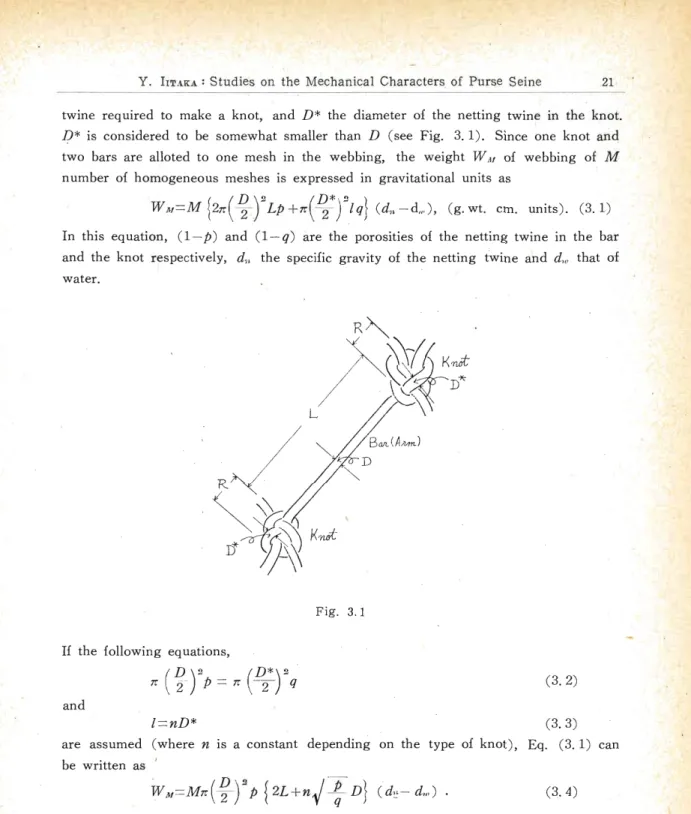
(21) Y.. hT.4.KA:. Studies on the Mechanical Characters of Purse Seine. 21. twine required to make a knot, and D* the diameter of the netting twine in the knot.. D* is considered to be somewhat smaller than D (see Fig. 3.1). Since one knot and two bars are alloted to one mesh in the webbing, the weight WAf of webbing of M number of homogeneous meshes is expressed in gravitational units as. WM=M{2n(~YlLP+n(~*rlq}(d"-d,,,),. (g.wt. em. units). (3.1). In this equation, (l-p) and (1-q) are the porosities of the netting twine in the bar and the knot respectively, d" the specific gravity of the netting twine and d", that of water.. Fig. 3.1. If the following equations, n. :f p=n (D*)2 2 q ( D)2. (3.2). and. l=nD*. (3.3). are assumed (where n is a constant depending on the type of knot), Eq. (3.1) can be written as (3.4). In actual practise, however, the size of a twine is not designated by its diameter, but by the total number S of threads in the twine.. The relationship between' D and. S can be expressed by (where m is a constant),. D=. m.,/S,. (em. unit).. (3.5). In the case where the length of a bar is shorter than about 1. 5 em., the size of mesh is commonly designated in Japan by the numb.er N of knots in length 5 "sun" (==:15.15 cm.).. N:. The following equation, then, gives the relationship between Land.
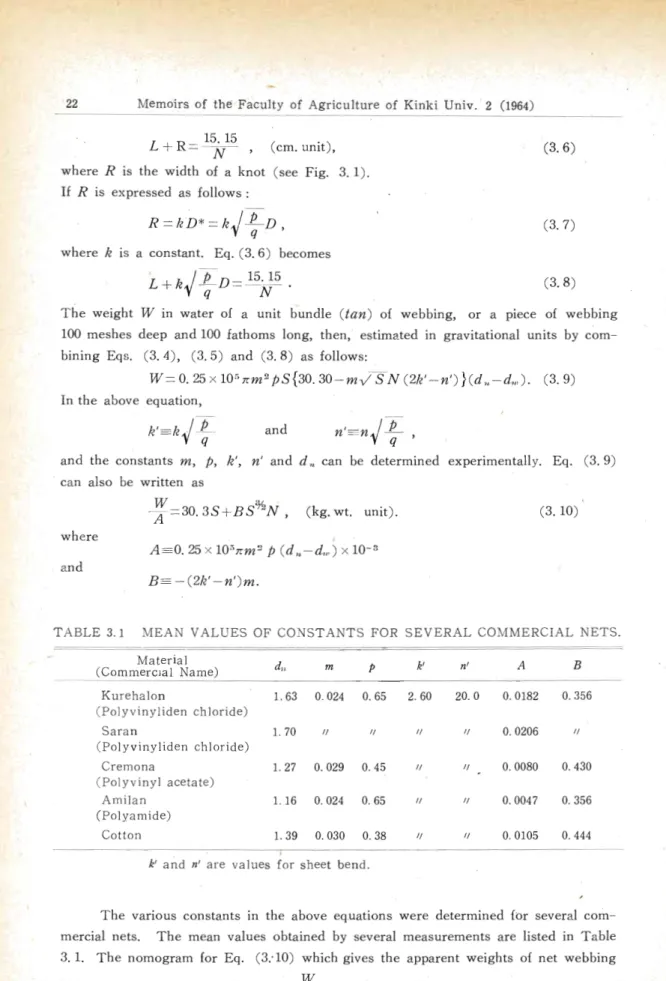
(22) 22. Memoirs of the Faculty of Agriculture of Kinki Univ. 2 (1964). + R=. L. 15 15. iv. ,. (cm. unit),. (3.6). where R is the width of a knot (see Fig. 3. 1).. If R is expressed as follows:. R. =IlD* =k 'V/. pq D ,. (3. 7). where k is a constant. Eq. (3.6) becomes. L+k / P D=~'~'. 'V. q. (3.8). N. The weight W in water of a unit bundle (tan) of webbing, or a piece of webbing. 100 meshes deep and 100 fathoms long, then; estimated in gravitational units by combining Eqs. (3.4), (3.5) and (3.8) as follows: W= O. 25 x 1O"iTm 2 pS{30. 30-mvSN (21l'-n') }(d"-d,,,).. (3.9). In the above equation, and and the constants m, P, k', n' and d" can be determined experimentally. Eq. (3.9) can also be written as (kg. wt.. (3. 10). unit).. where A=O. 25 x 1O"iTm 2 p (d"-d,,,) x 10- 3 and B= - (21l' -n')m.. TABLE 3.1. MEAN VALUES OF CONSTANTS FOR SEVERAL COMMERCIAL NETS.. Material (Commercial Name). dn. Kurehalon (Polyvinyliden chloride). 1. 63. Saran (Pol yvinyliden chloride). 1. 70. Cremona (Polyvinyl acetate) Amilan. 1. 27. m. p. k'. n'. A. B. 0.024. 0.65. 2.60. 20.0. 0.0182. 0.356. /1. /1. /1. 0.0206. /1. 0.029. 0.45. /1. /1. 0.0080. 0.430. 1. 16. 0.024. 0.65. /1. /1. 0.0047. 0.356. 1. 39. 0.030. 0.38. /1. /1. 0.0105. 0.444. /1. (Polyamide). Cotton. k' and n' are values for sheet bend.. The various constants in the above equations were determined for several commercial nets.. The mean values obtained by several measurements are listed in Table. 3. 1. The nomogram for Eq. (3: 10) which gives the apparent weights of net webbing is given in Fig 3. 2,. in which. and. T)=BN..
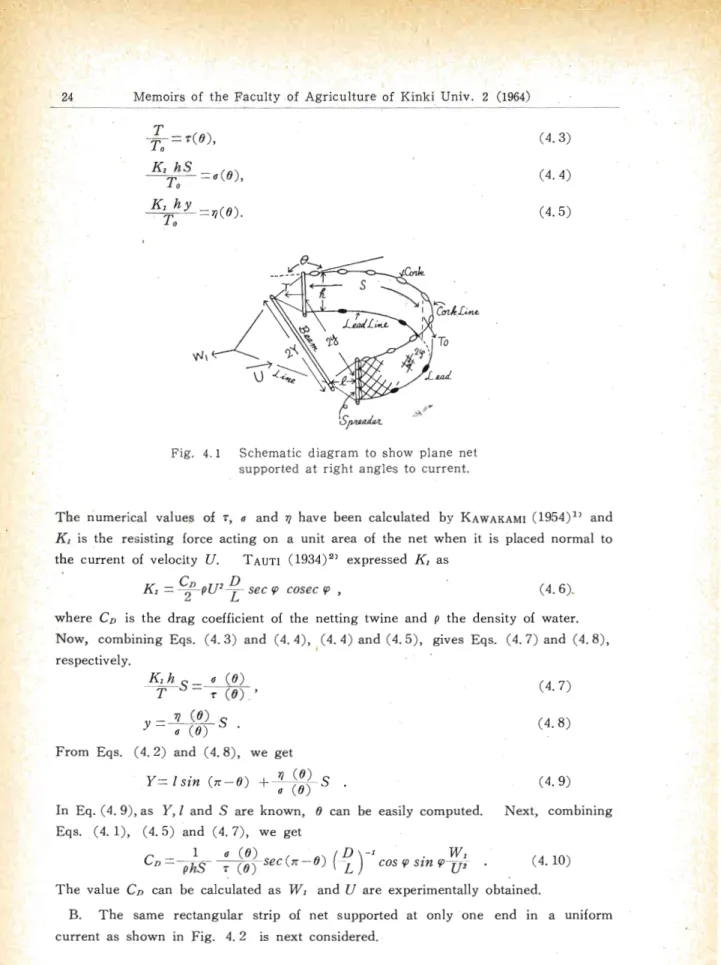
(23) Y.. Studies on the Mechanical Characters of Purse Seine. hTAK.\:. ~. 0. J'. 23. N. 1(. 30. 20·. \. \\l. 40. 60. ~. \~. 1.\). 25. 35. ."l>,. 40. I;!-\\l. I>-. 40. 20 -~). .. _ lj.\o. "'?>. 80. 15. ]00. 10. W(kj.). Fig. 3.2. Nomogram to determine the apparent weights of net webbing.. 4 RESISTANCE OF RECTANGULAR STRIP OF NET IN WATER 4. 1 INTRODUCTION In the analytical treatment of the mechanical behaviors of fishing nets, it may be of fundamental importance to have an accurate measure of the resistance acting on a strip of net.. In this section, the equilibrium configurations of a rectangular strip. of net supported at right angles and parallel to a uniform current are analysed.. The. drag coefficients of netting twine in both cases were experimentally obtained.. 4.2 THEORETICAL CONSIDERATION A.. Suppose a long,. narrow strip of net of constant depth h and length 25 is. supported in a uniform current by a beam of length 2 Y so that the ends of the net are the length of the be~.m apart. by two strings of length ,.. This beam is connected to the ends of the net. Fig 4. 1. shows the arrangement of net and beam.. The. net is homogeneous throughout, woven with netting twine of diameter D and mesh size. 2L. in stretched measure.. A constant amount of slack is allowed on the frame. line so as to make an angle 2cp between two adjacent bars of mesh.. Let l' and To. be the tensions along the net at the end and center of the net, respectively,. W 1 be the resisting force acting on the whole net.. and let. The strip of net will assume a. characteristic configuration irrespective of the current speed.. The shape of the net. can be expressed as follows:. 2 l' cos (,,-0)=W 1. Y-y --,-=sin (n. ,. -0),. (4. 1). (4.2).
(24) 24. Memoirs of the Faculty of Agriculture of Kinki Univ. 2 (1964). T r;;= .. (0),. (4.3). K, hS _ (0) ,. (4.4). K, hy =r;(O).. (4.5). To. -11. To. Fig. 4.1. Schematic diagram to show plane net supported at right angles to current.. The numerical values of ",. and r; have been calculated by KAWAKAMI (1954)1) and. 11. K J is the resisting force acting on a unit area of the net when it is placed normal to the current of velocity U. TAUT! (1934)2) expressed K, as Cn U2 TD =2(1. K1. (4.6).. sec rp cosec rp ,. where CD is the drag coefficient of the netting twine and. (I. the density of water.. Now, combining Eqs. (4.3) and (4.4), ,(4.4) and (4.5), gives Eqs. (4.7) and (4.8), respectively.. K,h S-~. T. y-. (4.7). - .. (0) ,. TJ (0) 11. (0). S. (4.8). From Eqs. (4.2) and (4.8), we get _. .. Y-lsxn (rc-O). r; (0). +~S. (4.9). In Eq. (4.9), as Y, land S are known, 0 can be easily computed. Eqs. (4.1),. Next, combining. (4.5) and (4.7), we get. C n =_1__ ~~sec(rc-O) (p (lhS. .. (0). L. )-' cos rp sin rp WUl. 1 _. (4.10). The value Cn can be calculated as W, and U are experimentally obtained.. B.. The same rectangular strip of net supported at only one end in a uniform. current as shown in Fig. 4. 2. is next considered..
(25) Y.. I[TAKA:. Studies on the Mechanical Characters of Purse Seine. Fig. 4.2. 25. Schemfltic diagram to show plane net supported parallel to the current.. W2=K2 2hS.. (4.12). Then, from Eqs. (4.11) and (4.12), we have 1. (D)-J tan'P/p' W2. (4.13). Cn=P/iS T. As W2 and U are obtained experimentally, the value CD can be calculated.. 4. 3 EXPERIMENTS A series of experiments were carried out in the experimental water tank of circulation type.. The dimensions of the rectangular nets used, are as follows:. h=15 em., 'P 45 0,. 2S=50 em., 28 em. ,. =. 2Y. =. [=9.4 em.. The spreading beam was made of slender bamboo rod, 0.33 em. in diameter.. Nine. spindle-shaped wooden floats were attached at regular intervals to the cork line. The dimensions of each float was about 0.4 x O. 7 x 2.0 (in em. unit). Small spindle-shaped lead pellets weighing about O. 33 grams each were used for sinkers. were attached at regular intervals to the lead line.. Four sinkers. Two spreaders· made of slender. bamboo, 0.33 em. in diameter, were attached to the ends of the net. TABLE 4.1. DIMENSIONS OF THE PLANE NET USED, 'f0 DETERMINE RESISTANCE OF NET WEBBING. Net Mark. Material. Kind of Knot. Diameter of Twine, D (in em.). Length of Bar, L (in em.). 1 2 3 4 5. Cotton. Reef Knot. II. II. 0.091 0.080 0.055 0.082 0.059. 0.886 0.889 0.792 0.974 0.951. II. Saran II. II. *. Sheet Bend II. * polyvinyliden chloride. Value of. DIL. 0.103 0.089 0.069 0.084 0.062. ,.
(26) Memoirs of the Faculty of Agriculture of Kinki. Univ. 2 (1964). 26. The velocity U of. The nets were supported in a uniform current of water.. the current was varied within the range from 8 to 35 em. /sec. so that corresponding REYNOLDS'. number, Re, formed with the diameter of the netting twine amounted to. 60-300. 10. 100. 20. 3050. 20. 0 10. /. 5. /. ,p /. o. t::.. ~'V/. /. ';1r. ~. 3. ). 1 s:. 2. cf'>. i:i. 100. J. 10. /~. N.:t\. ~ 0. o/ . /. I DO. A. 50. 30. /. d'. 12-. §'d. ::!,/ A. / A. N'*2. 20 10. '1. 5 3. ~. Nit.3. 2. /. L-L--_L----L.-'---J. 10. 10. 3050. 20. I. 0 0. 30. s:,g. 20. '0. 1:. 10. /. ~A. 5. , t::.'. / :::>/" A /. 3. 2. 10. 20. 3050 V~17CAi}. 10. U. 20. 1DO. 10. 20 30 50. 70 50. 30. 20. ",14:.. 7. Fig. 4.3. ~~~. '7A £1 S:"'t::.L:. '£1 :::>d. to 50. ~ ~. /. d. /. 3050. 70. /. ~/. f::.. ,0. d:>. f]. I. It. ~·O. 0::/ 0. 20. ,0°. p8. 30. 10. /. d. 90. 50. 3050. 20. 10. 10. '1. 5 3. Ntil5. 2. 3050. (""'/4£<;). Graphs showing the relationship between the velocity, V, of the current and the resisting force of the net webbing. (W, and W2 are the resistance forces of net lying perpendicular and parallel, respectively, to the current.). In the experiments, the resisting force acting on the net webbing lying perpendicular. W". and parallel, W2, to the current was determined for various values of U. The. results are summarized in Fig. 4.3.. The values W, or W 2 were obtained by sub-. tracting W,' or W2' (sum of the resistances of the various accessories such as spreading beam, floats, etc.) from W," or W2" (total resistance acting on the net).. In. order to determine the drag coefficient of the netting twine, the critical angle 0 must In Eq. (4. 9) as Y, I and S are known the relationships. be known in advance. between 0, r; (0) and. q. (0) can be obtained from KAWAKAMI'S tables l. ).. Using these.
(27) Y. IITAKA: Studies on the Mechanical Characters of Purse Seine. 27. tables, the avalue of 0 In the present experiment was estimated to be about 170 degrees (see Table 4.2). TABLE 4.2 0. sin(7r-O). ESTIMATION OF 0. .*. *.. I sin (rr-O) + 1J (f!ls (5 (0). y. 13.5150. 15.4693. 14. 1~.0125. II II. I sin(i-O). 11(0). (5(0). _1J(O)_S (5(0). 1. 9543. 1. 7061. 3. 156. 168°. 0.2079. 169. 1. 7935. 1. 7452. 170. O. 1908 0.1736. 1. 6318. 171. 0.1564. 1. 4702. 1. 7862. 3.353 3.577. 12.4825. 14.8060 14.1143. 1. 8291. 3.838. 11.9150. 13.3852. * obtained from KAWAKAMI'S tables, where. II. "'=45°.. As the value of W, or W, versus U can be gotten from Fig. 4.3, the values of the drag coefficient CD can be obtained using Eqs. (4.11) and (4.13). tion of the value Cn to. REYNOLDS'. number Re thus obtained is shown in Fig. 4.4.. 4. 4. 100. 200. 300. Reo. ~~=:::J':I ~ cP~08, lOa. 200. 0...... 300. Re.. Fig. 4'.4. 300. .200. 100. Re-. 3. The rela-. oo~~~ 100. 200. -. egO. -'_. 300. R<. The relation of drag coefficient CD vs. REYNOLDS' number Re for cotton and Saran twine, compared with that for an infinitely long cylinder.. In these fjgures, the heavy line shows the same relation for an infinitely long cylinder, which has been investigated by many authorities 8l •. Although the drag. coefficient of the netting twine should be exactly the same in cases A and B, apparent value for B was only about 1/4 - 1/5 of A.. the. It seems to the author that the. very small value for B may be ascribed to the wake 01 the netting twine.. The fig-. ures also show that the values for the webbing in the case of A is larger than that for the cylinder,. and that the value for Saran. (polyvinyliden chloride) twine is.
(28) .28. Memoirs of the Faculty of Agriculture of Kinki Univ. 2 (1964). slightly smaller than that for cotton twine.. These differences are thought to be due. to the roughness of the surfaces of cylinder, Saran, and cotton twine.. Moreover, the. cotton net used was woven with the reef knot and the Saran net with the sheet bend. As the reef knot takes a smaller size than the sheet bend, the difference in drag coefficient between Saran and cotton webbings would be greater than that shown by the graphs.. 4. 4 REFERENCES 1) KAWAKAMI, T.: Equilibrium configuration of a rectangular strip of net subjected. to a uniform current. Mem. Col. Agri., Kyoto Univ., Vol. 72, 1955. 2) TAUT!; M.: The force acting on the plane net in motion through the water.. Bul. Jap. Soc. Sci. Fish., Vol. 3, roo 1, 1934.. 3) PRANDTL, L.: Applied Hydro-and Aeromechanics (1934)..
(29) 29. Y. IrTAKA: Studies on the Mechanical Characters of Purse Seine. PART III. 5 MODEL EXPERIMENTS ON THE TWO-BOAT TYPE PURSE SEINE 5. 1 INTRODUCTION In order to manage fihing intelligently, that is, to design an efficient gear and to operate it effectively, it is necessary to have an accurate knowledge of the mechanical patterns of gear in action.. In recent years, underwater television, camera. and other submarine devices have been used to observe the working behaviours of gear.. These devices are very helpful for the design of fishing gear,. solve all the problems.. but do not. It is necessary in most case to make several trial tests to. determine what part of the gear must be adjusted or reformed. very expensive to make a new full-size net for each trial test,. However, as it is it. IS. usually profitable. to experiment with models prior to the design of the full-size gear. Purse seines undergo a marked change in shape during setting and pursing operations.. The speed of this transformation and the maximum depth to which the. bottom margin reaches are important factors in determining fishing abilities of the net. As the purse seine is used for taking pelagic species which are very active,. it is re-. quired that the bottom of the net reaches the required fishing depth as quickly as possible.. When the purse seine is operated in regions of strong underwater cur-. rents, it sometimes happens that the bottom margin becomes entangled.. However,. underwater current may not be the only factor causing the purse seine to be fouled. The fishermen operating in the Sea of Hyuga have urged that in the case of twoboat type purse seines, setting the net into the wind ·or the tide was effective in avoiding net entanglement.. They also report ,that when an entangled net is pulled on. board, some parts of the bottom margin of the net are usually found to be pulled into the purse rings with the purse line.. It is con~idered that the webbing just above. the lead line is most liable to entangle if there exists excess webbing around the purse line.. Therefore, the way in which the purse seine. design of the net may also be responsible for net foulups.. IS. set or defects in the. To analyze the sinking. movement of the, bottom margin of the net and the change in the tension of the purse line during the whole course of pursing, experiments were conducted with a 1/250 scale model purse seine.. To determine the presence of excess webbing around the. purse line, trial tests were made at sea with a 1/10 scale model.. 5.2 DESCRIPTION OF THE ACTUAL GEAR Net entanglement occurs more frequently in regions of irregular coastline where.
(30) Memoirs.of the Faculty of Agriculture of Kinki Univ. 2 (1964). 80. strong currents are common, e. g., the Sea of Hyilga and off Nagasaki.. A typical. two-boat sardine and pilchard purse seine which is used in about 100 fathoms of water in the Sea of Hyilga WlJ,S chosen as the model for these experiments. was made of cotton, and was about 190 fathoms along the cork line.. The net. This seine had. one fish bag, two base wings,. two intermediate parts, two tapered wings and two. tip wings as shown in Fig. 5. 1.. Mesh and twine sizes of the net are illustrated in. TabJe 5.1 and Fig. 5.2.. F. CL. Nat to· Sc.aAA purse seine laid out in a ciI:Cle ready to be pursed, that is, Closed at the bottom. Key: -SB: Seine-scow, LB: Landing Bag, BU: Bunt, BA: Bed (Floor), BW: Base wing, IP: Intermediate Part, TW: Tapered wing, TE: Tip wing, C: Float, CL: Cork line, F: Keg float, L: Sinker, LL: Lead line, B: Bridle, R: Purse ring, PL: Purse line.. FIg. 5.1. TABLE 5.1. PARTICULARS OF THE WEBBINGS OF THE DIFFERENT PARTS OF THE TWO-BOAT PURSE SEINE USED IN THE SEA OF HyOGA.. Portions of the Net. Mark. Th C Mesh Size Lengt h of . read ount (in inches . Depth StrIPS Number of (In numbers) Bar-meas~re) (In meshes) (in fathoms) StrIPS 10 8 6. 1 7,<~ 1% 1 %. 1/. II. II. II. II. 10. 1 %. 100. 20. 1/. II. II. 75 73. II. 1/. II. 72. 20. Landing Bag Bunt Bed (Floor) Base Wing. A B C D. Intermediate Part. E F. II. G. II. Tapered Wing. H I. II. Tip Wing. K. T. Upper 2nd Selvage Lower. 4. 4. %. 100 1/. II. 24 14 45 77. 10. 66 60 49. 6. 1 %. 100. 5. 35. 6. 1. %. 100. 20. 1. II. II. L M N. II. 0. II. II. II. II. 2 II. 100. 12. II. II. II. II. 10. II. 20. II. 10. 3 II. 4 II.
(31) Y.. Studies on the Mechanical Characters of Purse Seine. Ir1:AKA:. P Q. 30 24. 4 4 %. 10 6. R. II. II. II. S T U. 18 21. 3 J/~ 4 %. 50. II. II. II. V W X. 21. 4%. II. II. 1/. II. Y. II. 1 %. Upper 1st selvage Lower. Narrow S tripl> Breast Selvage Triangular Stri p 2). 32 60 55 32 60 55. 1/. .31. II II II. 1/ II. 3 II. II. 50 100-1. 20 10. 1/. 1) These strips are used to reinforce the net. 2) These strips are used to make the net a cup shape.. p ._r-. 1':(8~7. -. _. Q. 20 J5. c:==::. =. ~. t----. B. E. =-. F. C. i==-. p0-. I. J. '=-. 0. r'----. S.. =. ~. _K. F-. N. '--. 1'1. i=-. G- r-H p-. '-. 116. -. I=-. D 1- D. ~. r--. L. A. R 20 : 166. =. =. T 20: 16.8. 0:. ~. Q. . 1£· 84~7.5. Fig. 5.2. Arrangement of webbing of a typical two-boat type purse seine. Capital letters denote the different parts of the net (see Table 5.1). Numbers indicate the ratio of slack; for example by 12: 8-7 is meant that 12 fathoms of webbing is hung to 8-7 fathoms of cork line with the "take-up" divided between stapling the upper selvage to the cork line and lacing the second selvage strip to the first.. The ratio of slack for the principle parts was 20: 15 in the upper part and 20: 16.8 in the lower part, i. e., 20 fathoms of webbing was hung on 15 fathoms of cork line and to 16.8 fathoms of lead line, respectively.. Since the fish bag consisted of. 83 strips of net, each 100-mesh deep, of 1 3/4 to 2-inch stretched mesh, the theoretical stretched depth of this net was approximately 100 fathoms. Almost all the ropes were medium-laid manila ropes of about 5/8-inch in diameter.. Double strips of rope. were used for the cork line and three ropes for the lead line.. The pursing line was. a steel wire about 1/4-inch in diameter.. 9 1/2- inch by 4- inch "Paulownia" Hoats. were strung on the cork line as shown in Table 5.2. weighted about 9-ounce.. .The lead sinkers used each. They were attached to the lead lii-Je as shown in Table 5.3..
(32) 32. Memoirs of the Faculty of Agriculture of Kinki Univ. 2 (1964) TABLE 5.2. ARRANGEMENT OF FLOATS ON THE TWO-BOAT PURSE SEINE USED IN THE SEA OF HYUGA.. Portions of the Net. Length en fathoms. meaSUred) from the Center of Fish Bag. Bag (Half Fish Bag and Base Wing) Intermediate Part. Number of Floats. Estimated Buoyancy (in kg.). 11. 39. 105.3. 15. 50. 135.0. /I. II. II. 54. 118.8. 15. 110.0 129.,6 54.0. II. 11. 2. 41 48 20. Tip Wing. 3.6. 0. Total In Overall. 100.8 201. 6. 292 584. Tapered Wing. TABLE 5.3. II. ----. Base Wing. Length en fathoms. meaSUred) from the Center of Figh Bag 3.4 6.8 16.0 10.0 6.0 8.0 II. In termedia te Part. 4.0 II /I. II. 6.0 10.0 3.0 Tapered Wing. II II II. Tip Wing Total In Overall. 0 788.4 1576.8. ARRANGEMENT OF SINKERS ON THE TWO-BOAT PURSE SEINE USED IN THE SEA OF HYOGA.. Portions of the Net Bag. -----. 2.6 104.8 209.6. Number of Sinkers 37.5. Estimated Apparent Weight (in kg.) 8. 72. 104 65. 12.56 24. 19 15.12. 42 60 64 34 44 48 52 84. 9. 77 13.95 14.88 7.91 10.23 11. 16 12.09 19.54. 130 36 33 24 15. 30.23 8.37 7.67 5.58 3.49. 54. 0. 0. 926.5 1853.0. 215.46 430.92.
(33) Y.. Studies on the Mechanical Characters of Purse Seine. IrTAKA:. 33. 5.3 DESIGN OF MODELS Two models,. 1/250 and 1/10 of full- size, of the gear described above were. constructed using T AUTI'S lawl) of similarity by which the mechanical relation between the model and the -actual net is governed.. Various values ascribed to the _model. and the full-scale net are distinguished hereafter by One prime(') and two primes("), respectively. ( 1). The procedure for the design of models is as follows:. First, define the reduction ratio A of the model as large as circumstances. will permit, (5. 1). where }" is the linear dimension of each section of the net. (2). Next, determine the diameter D and the density p of the netting twine such. that the ratio. D' (p' - p',,,). Dll (plt_ p /J) JI. E. (5.2). 1. has a same 'value throughout the whole net for all corresponding portions of the model and the full-scale net. (3). p," is the density of water.. Then, the length L of the bar of a mesh should be determined so that the. ratio. D'. L'. (5.3). D---;T=r==M has a same value for corresponding parts in the webbing.. The reduction of mesh. size is not necessarily the same as the reduction in the overall size of net. (4). The webbing of the model net is assembled with the same ratio of take-up. or slack for all corresponding parts, as the actual seine net. That is,. <p: where rp (5). IS. = <pH,. (5.4). a half angle between two adjacent bars of a mesh.. With regards to the ropes in the net, the density PI' and the diameter Dr is. chosen so as to satisfy the next relation: (5.5). (6). The tension 1,. acting on the manipulating ropes such as a purse line. IS. obtained by (5.6) .. The buoyancy Ff of the floats and the apparent weight F., of the sinkers of the model are obtained by. F/_F.:_. F" - F" -AE. .f. ( 7). (5.7). ,'t. In the case where the shape of the net changes during the fishing operation as. in the case of the purse seine, the following conditions must be satisfied to maintain.
(34) Memoirs of the Faculty of Agriculture of Kinki Univ. 2 (1964). 34. Let V and t be. the mechanical similarity between the model and the actual net.. the velocity and time, respectively, required to attain a corresponding stage of fishing operation of the seines. V' _ Yz. The next relations, then, should be satisfied:. l7"-£ ,. (5.8). t' -A£-1 r-. (5. 9). The above described constant values {or the two models used are tabulated. In. Table 5.4. TABLE 5.4 A ~\!50. ~io. E. Model. 4 x 10- a. Model. 1 x 10- 1. Values of A2E AE. M. 1. 1. 15. I. I. 1. 4 X 10- a. 1.15. 1 x 10- 1. 7. 11. 6 x 101. 15 X 10- 2. 1. E72 1 1. 07. AE-1. I4. 3. X 108. 7X 19- 2. 5.4 1/250 MODEL EXPERIMENT 5.4.1 DESCRIPTION OF THE MODEL USED The webbing of the model net was woven with cotton thread. of the model net is shown in Fig. 5. 3.. The strip plane. The frame lines and purse line o{ the. model net were of cotton and a Saran (polyvinyliden chloride) twine, respectively. The density of the cotton twine was 1. 39 and that of the Saran twine was 1. 70. Fine quality cork, of density O. 239, was chosen as the material to make the floats. Copper wire (density, 8.93) of adequate length was used {or the leads in this model. Purse rings, O. 4 mm. in diameter, were made of copper wire, O. 36 mm. in diameter.. -~ -. ~. 41'". A. -. B. r-. D. E. c:.. F. C. 127 ".,..,. o ,. 10 !. 20 I. 30 "'" ,. Scab.. Fig. 5.3 Strip plane of the 11250 model seine..
(35) Y.. IrT.1KA:. Studies on the Mechanical Characters of Purse Seine. 35. Forty of these rings were hung to the lead line at regular intervals. The dimensions, arrangements of webbing and accessories of this model net are tabulated in Tables 5. 5 - 5. 7 and Figs. 5. 4 and 5. 5.. TABLE 5.5. PARTICULARS OF THE WEBBINGS USED FOR THE 1/250 MODEL SEINE.. Portion of Mark the Net Bag 1 Bag 2 Bag 3. A B C. Base Wing D Intermediate E Part Tapered Wing F Tip Wing G. TABLE 5.6 Name of Rope. Thread Knot Count (Cotton) 20'S Reef 10. Mesh Size (Bar) measure. Vertical No. of Meshes. Length of Webbing. 0.891cm. 10. 7. 27em. II. 8. 0.842. 6. /I. 6. 0.891. 18. II. /I. II. 4. II. "6. ". " " " II. /I /I. 31. " 6.06. 32. 36.36. 20. 25. 30.30. 14. 3.03. 17 2. Diameter. Length. Cark Line. A'. Cotton. 0..96mm.. 115.1em.. Lead Line 1. B'. II. 2 'I Selvage Line. C' D'. II. Purse Line 1. E' F'. Saran*. G'. Cotton. Bridle. " II. II. 'I. II. * polyvinyliden. E'. I Fig. 5.4. 3. PARTICULARSOF THE ROPES USED FOR THE 1/250 MODEL SEINE. Material. 2. 4. /I. Mark. /I. Horizontal No. of Meshes. 2.06. ". Note Doubled. 86. 7. II. Hl.2. Tripled. 7.9 3.6. "Sekiyama". 140.0. chloride. ~. Schematic diagram to show the arrangement of the ropes..
(36) 36. Memoirs of the FaGulty of Agriculture of Kinki Univ. 2 (1964) TABLE 5.7. ARRANGEMENT OF THE FLOATS AND SINKERS ON THE 1/250 MODEL SEINE.. Portion of the Net. Bag. Cork Line. Lead Line. Mark. Weight of Corks. Mark. Weight of Leads. 0.82t:· wt .. al. a. 0.32g· wt .. bl. 0.23. Length. 10.91 om .. I b. Intermediate Part. 0.52. 9.09. 0.44. 9. 70. 0.27 0.18. 6.06 3.64. 0.26 0.27. 4.85. O. 15 0,19. 2.40. 0.20 0.23. 1/. kl {I. 0.36. 3.64. ml. 0.55. 6.06. nl. 1. 82. 0'. O. 16 O. 14. P'. O. 10. 1/. /I. el. d. 0.46. 1/. gl. 0.43. 1/. /' hi. il j' 1/. Tapered Wing. 0.21. g. h. 4.85. 1. 54. 0. Cl. ?. c. d.. e. 1/. c'. 1/. 0.50. 4. 120m .. d'. c. /. Length. ql. 0.07. rl. 0. 1/. •. 1/. 1/. 1/. 1/. 1. 58. f JI.. --l-~,----!"'--"t~-,~,,,,-,,,,,,,,,. !J'l»'~. Fig. 5.5. Schematic diagram to show the arrangement of the floats and sinkers.. 5. 4. 2 EXPERIMENTAL APP ARA TUS In actual operation the pursing begins as soon as the set is finished. The speed of pursing is rapid at the beginning and becomes slower towards the end, whereas the speed of setting is almost constant.. It .takes about 3 minutes to set the seine and.
(37) Y.. IrT.~KA:. Studies on the Mechanical Characters of Purse Seine. about 13 minutes to haul in the purse line completely.. 37. Therefore, in order to satisfy. Eq. (5. 9) the model seine must be set in about 0.72 seconds and the pursing of the model must be done in about. 3. 1. seconds.. However, model operations in such short. lapses of time are difficult to realize on technical grounds.. For this reason, the. setting and the pursing apparatus were specially designed. The setting apparatus consisted of a circular frame which has 8 small rings at regular intervals, holder lines, and a system of pulleys.. The model net was hung. from the circular frame by the hold~r lines through the small rings.. The circular. frame with net was suspended by the holder lines so that the bottom margin of the net was about 1 em. over the water surface. the model net was "set".. When the holder lines were released. The schematic diagram of the setting a.pparatus is shown. in Fig. 5.6.. _._--- - _. -- ------ --- - ------ ----------Fig, 5.6. Schematic diagram of the setting apparatus with a stroboscopic illuminator.. The pursing apparatus consisted of a 1/8 H. P. drum, and a system of gears and pulleys.. electric motor, a "pursing". The schematic diagram of this apparatus. is shown in Fig. 5. 7. The pursing was done mechanically ata constant speed of 16.5 em. Isec., which was the mean speed of the pursing in the actual operation. Moreover, a stroboscopic illuminator and a tension J;ecorder of the purse line were specially designed for this experiment. The stroboscopic illuminator consisted of a covering box with a rotating shutter disc. in the box.. A 500 Watt spot-light was mounted. The schematic diagram of this apparatus is shown in Fig. 5. 6.. When. the rotating shutter was rotated' at a constant angular velocity, the model net was illuminated at regular intervals.. With this apparatus the sinking behaviour of the net. in successive stages was photographed on a single dry-plate by multiple exposures..
(38) 38. Memoirs of the Faculty of Agriculture of Kinki Univ. 2 (1964). Fig. 5.7. Schematic diagram of the pursing apparatus with purse 1ine tension recorder. Key: --A: Motor,Bl and B2: Worm-gearing, Cl-4: Pulleys, D: Clutch, E: Pursing drum, F: Recording Drum, G: Carriage, H: Spring, I: Pen, ]: Purse line.. The tension recorder consisted of a recording drum, and a carriage with pen. attached to a steel spring. 5.7.. The schematic diagram of the apparatus is shown in Fig.. The drum was rotated at a constant angular velocity by a motor.. pursing was begun the tension on the purse lines,. When the. pulled the carriage along on the. rails recording the change in tension on the purse line during the whole pursing operation on the drum.. 5. 4. 3 EXPERIMENTAL METHODS AND RESULTS 1.. To investigate the sinking movement of the bottom margin of the entire net. the sinking of the lead line was photographed from both the wing side and the bag side.. An example of the photographs obtained is shown in Plate 5. 1.. In this plate,. the 10 horizontal lines shows the lead line in successive stages of descent at regular intervals of time.. Therefore, the depth. was easily calculated. time T,. t,. to which the lead line reaches. In. time t. If L is the maximum depth to which the lead line reached in. then the relation between the non-dimensional quantities tiL and tiT. IS. found to be linear for both the wing and bag parts of the seine, as shown in Fig. 5. 8.. It may be considered that the sinking movement of the bottom margin of a. purse seine is at a uniform rate..
(39) /. Y.. IrTAKA:. Studies on the Mechanical Characters of Purse Seine. Plate 5.1. Photograph showing the sinking movement of the bottom margin of the model seine.. 1.0. 09 08 07 /. j{. /. 06. W~~/:;?. 05. all-. 04. 03 02 01 0. ~;f. J/t l~. 0]. 0.2. 03. /. o1:-- Ba.;r. 04. 05. 06. 07. 08. 09. 10. ?T Fig. 5.8. Showing the relation between the depth of lead line and the time required for lead line to attain that depth.. 39.
(40) 40. Memoirs of the Faculty of Agriculture of Kinki Univ. 2 (1964) To investigate the sinking behaviour of the bottom margin of the seine during. pursing oprations, the model was pursed mechanically at a speed of 16.5 em. /sec. , one half second (I) and (me second (II) after the seine was dropped.. For the full-. scale gear the corresponding times are about 2. 1 minutes and 4.2 minutes, respectively, after the set was started.. During the pursing operation the transformation of the. net was filmed with a movie camera at a speed of 16 frames per second.. An example. of the results obtained is shown in Fig. 5. 9.. .'t~-] 40. 60 .. 80 '(0.5). 2-. '------''-'. (13.0). 50. (140). Fig. 5.9. 54. (15.1). 58. <.) 6·'). 62. (J2,7). 4~. (138). 53. (148). 57. L-(_15_,9_l--':.....J. Transformations of the net. A: wing, B: fish bag, parenthesized figures: corresponding elapsed time for full scale gear (in Minutes), figures: film number since the net was set.. Fig. 5. 10 shows the relation of the values of I and t in the whole course of the operation.. These values are converted to the corresponding st:;'lge of operations. of the full-scale seine.. It can be seen from this figure that the lead line sinks very. rapidly to about 6 meters and then sinks more slowly at a uniform rate.. This initial. rapid sinking of the bottom edge is thought to be due to dropping of the model net. If the linear part of the curve is. from above the water surface to make the "set".. extended backwa~d, this curve intersects the origin, which is to be expected.. From. the figure the following assumptions for the full-scale net may be considered. a) For about 4 minutes after pursing is started, the bottom margin of the fish bag may still continue to sink at a uniform rate. b) The bottom margin of the fish bag may sink to its limit of about 60 meters (40% of the stretched depth L of webing), in about 8 minutes after the set was started. c) If pursing is started 2 minutes after the set. IS. finished, the maximum depth to.
(41) Y.. IrTAKA:. Studies on the Mechanical Characters of Purse Seine. 41. which the bottom margin reaches may only be about 10 meters (7% of L) more than if the pursing is started as soon as the set is finished.. M. 70 60 50. ..e 40 30 20 10. tJ..,.~c1(I). 0. Fig. 5.10. 2.. Relation between the depth I of the bottom margin of fish bag and the time t required to attain that stage. Solid line: maximum depth to which the bottom margin reaches, broken line: depth to which lead line reaches, P (I) and P (II): times when the pursing was begun in the case of (I) and (II), respectively.. To investigate the change of tension in the purse line during pursing opera. tions, t"";o series of pursing experiments were made: the pursing was begun(A) when the bottom margin of the net had sunk completely, and (B) when it was still in the course of sinking.. The results are summarized in Fig. 5.11.. It can be seen from. this figure that in the case of (A) the tension in the purse line begins to increase. sharply as soon as the pursing begins, but in the case of (B) the tension does not increase until the first 1/6 of the pursing process is completed.. After about 1/2 of. the pursing operation is completed the changes of tension in both cases coincide with each other..
(42) 42. Memoirs of the Faculty of Agriculture of Kinki Univ. 2 (1964). XIO~ 3.0. 25 2.0. F. ].5. 10. a Fig. 5.11. 2. 4. 6. 8. t. 10. 12. 14. 16 M",.. Showing the relation between the tension F in the purse line during the course of the pursing operation.. 5.4.4 DISCUSSION AND CONCLUSION From the results of these experiments it is calculated that the bottom margin of seine nets of this type sinks at a speed of about 8 m. Imin. first haH of the pursing operations.. during setting and the. Therefore, when the pursing is started 3 minutes. after the net was set, the depth .of bottom margin of the net is about 16 fathoms (16 % of L, see Fig. 5. 10).. It is co'nsidered that there may exist £1uttered webbing. around the purse line in the early stages of pursing.. On the other hand,. it is. observed that the change of the tension of purse line increases sharply in the early pursing stage (see Fig. 5.11).. These two facts indicate clearly that gear of this. type is susceptible to entanglement in the early stage of pursing. Moreover, although the present experiment was made in static water, the actual fishing operations. IS. usually carried out in disturbed water, so the problem becomes more complicated. In order to decrease the amount of fluttering unstable webbing around the purse line, it will be necessary to accelerate the sinking speed of the bottom margin of the net or to eliminate needless portions of webbing. Recently, owing to the fact that fishing is carried out in deeper water in the Sea of Hyuga, the purse seiners show a tendency to increase the depth of the nets. The depth of the fish bag has been increased from 60 to 80 fathoms during the last three years.. However, judging from the results of. this experiment, this increase in net depth will not only be worthless, but will increase the incidents of entanglement because the increase of the number of strips results in a greater gathering of unstable webbing around the purse line at the beginning of the pursing operation.. Moreover, in the case where the pursing begins while the.
(43) Y. IITAKA.: Studies on the Mechanical Characters of Purse Seine bottom margin is still sinking, the tension in the purse line increases slowly beginning and then sharply.. 43 111. the. On the contrary, when the pursing is begun after the. bottom margin has sunk completely,. the tension increases sharply at first.. The. sudden change of tension in the purse line in the early stage of pursing is undesirable and leads to entanglement, therefore, if it is possible to hasten the sinking of the bottom margin of the net by any means, i't may be an effective means of avoiding the troube.. 5.5 1/10 MODEL EXPERIMENT It may be impossible to obtain detailed information with a small scale model on the presence of any excess webbing around the purse line which may give rise to net entanglement. flexible.. T AUTl'S law assumes that the netting twines of the model are perfectly. It is questionable whether this assumption is fulfilled in such a model as. small as 1/250 of full-scale.. Therefore, in order to investigate this problem of. excess webbing and to check the validity of the assumption that the netting twine of the model are indeed flexible, a relatively large scale model experiment had to be conducted.. Experiments were carried out with a 1/10 model in Maizuru Bay in 1956. and 1957.. 5. 5. 1 DESCRIPTION OF THE MODEL USED The webbing of the 1/10 model seine was made of Saran (polyvinyliden chloride) twine.. The dimensions of the main components of the net are shown in Table. 5. 8 and the strip plane of the model seine is shown in Fig. 5. 12. The edge lines and the purse line of the model seine were made of Saran rope and wire line, respectively. The density and the diameter of the Saran rope used were 1. 70 and O. 514 em., and those of wire 7.78 and 0.411 em., respectively.. For the floats, the sinkers and the. rings the same materials as the actual seine were used.. The numbers and the arran-. gements of these on the model seine are tabulated in Table 5. 9-5. 11.. TABLE 5.8. DIMENSIONS OF THE MAIN COMPONENTS OF THE 1/10 MODEL SEINE. Net Webbing. Rope Name. Length. Cork Line. 30.6 m.. Lead Line. 31. 9. Breast Line. 2.0. .'.. Lpngth Thread Mpsh Size Depth Count (Barof ) (NO. Of) Webbing (20'S) measure Meshes 0.97 em. 0.9 m. 900 A 15 0.5 em. Bag I{ 840 Base Wing B 12 1. 03 I{ I{ Intermediate Part C 6.8 800 6 I{ If Tapered Wing D 5.8 630 I{ I{ Tip Wing 0.4 E 12 350. Diameter. Portion of thp Net. Mark.
図


+7
関連したドキュメント
Thus, in Section 5, we show in Theorem 5.1 that, in case of even dimension d > 2 of a quadric the bundle of endomorphisms of each indecomposable component of the Swan bundle
In this paper, we will apply these methods to the study of the representation theory for quadratic algebras generated by second-order superintegrable systems in 2D and their
An example of a length 4 highest weight category which is indecompos- able and Ringel self-dual, and whose standard modules are homogeneous, is the path algebra of the linear
Conley index, elliptic equation, critical point theory, fixed point index, superlinear problem.. Both authors are partially supportedby the Australian
Theorem 4.8 shows that the addition of the nonlocal term to local diffusion pro- duces similar early pattern results when compared to the pure local case considered in [33].. Lemma
The commutative case is treated in chapter I, where we recall the notions of a privileged exponent of a polynomial or a power series with respect to a convenient ordering,
Here we present a new method to construct the explicit formula of a sequence of numbers and polynomials generated by a linear recurrence relation of order 2.. The applications of
The solution to this problem consists of using an integer number, called control, to encode variable renamings. In a grammar computation, each non-terminal is coupled with an integer
