A Preliminary Survey of Ichthyotoxic Compounds
from Papuan Soft Corals (Coelenterata :
Octocorallia, Alcyonacea)
著者
UCHIO Yasuto
journal or
publication title
南太平洋海域調査研究報告=Occasional papers
volume
21
page range
43-44
URL
http://hdl.handle.net/10232/16751
Kagoshima Univ. Res, Center S, Pal,, Occasional Papers, No. 21, 43 - 44, 1991
Survey Team 2, Report6, The Progress Report of the 1990 Survey of the Research Project, "Man and the Environment in Papua New Guinea"
43
A PRELIMINARY SURVEY OF ICHTHYOTOXIC COMPOUNDS FROM PAPUAN
SOFT CORALS (COELENTERATA : OCTOCORALLIA, ALCYONACEA)
Yasuto UcHIO
Soft corals (Coelenterata, Octocorallia, AIcyonacea) are benthic, sessile, Colonial organisms
which account for a substantial proportion of living biomass and cover, particularly on coral
reefs of subtropical and tropical waters. They are one of the most important groups of
animals and quite common on coral reefs in the Indo-Pacific, specially in a large area
extending from the Great Barrier Reef to Okinawan waters of Japan. In many parts of
these area, a wide variety of alcyonacean soft corals are distributed in the benthic community, Sometimes surpassing the scleractinians (hard corals) in percent cover・
Soft corals are extraordinarily rich and diverse source of secondary metabolites (ScHEUER, 1973), many of which have been found to be bioactive (for example, cytotoxic, antiviral,
antifungal, and antitumoral activities). The majority of these secondary compounds produced
by soft corals belong to the chemical class called terpenes (ScHEUER, 1978), which play important roles to survive in their natural environment・
Soft corals are fleshy in texture and sessile, lacking the ability to flee marine predators.
However, the incidence of predation on this group is low compared with scleractinian (or
hard) Corals which constitute an important food source for some groups of common reef fish, molluscs, asteroid echinoderms (crown-of-thorns), crustaceans and annelids・ Soft corals must therefore possess defensive substances (chemicals) against predation・
As a part of our continuing studies on biologically active secondary metabolites from soft corals (UcHIO et al., 1985 and 1989), preliminary ichthyotoxicity tests were performed
to isolate the active compounds on the collection of soft corals from tropical waters of
Papua New Guinea : Toxicity is an important factor for organisms in defense against predation・ In this report, we describe the results of toxicity tests using common freshwater fish Oryzias
latiDes (the Japanese killifish, Medaka) as.test organism on organic (dichloromethane) extracts of eight soft corals collected from coral reefs of Motupore and Pig islands・ (Coral sampling
was performed between November 21 to December 3 of 1990)
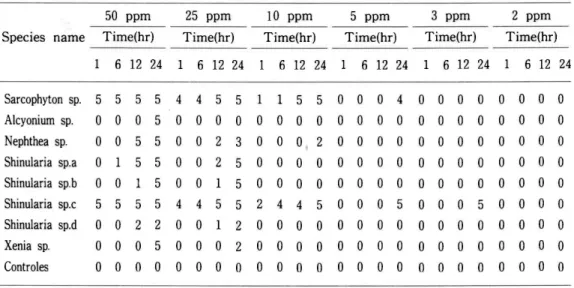
In the ichthyotoxicity tests listed in Table i, all the eight soft coral extracts were found to be toxic at highest concentration of 50 ppm to the test fish. No toxicity was found only ln the extract of AIcyonium sp・ at a concentration ot 25 ppm・ Three toxic samples
at a concentration of 10 ppm were Nebhtea sp., SarlCObhyton sp., and Sinularia sp.C, the latter
two of which were furtheremore found to be toxic at lower concentration of 5 ppm. Both the extracts of SarlCODhyton sp. and Sinularia sp.c killed all fish (a total of 5) in one hour
at the concentration of 50 ppm. Of the eight samples, only the extract of Sinularid sp・c
showed lO0% lethal to five test fish at the lowest concentration of 3 ppm言ndicating the
highest level of toxicity.
In order to isolate and identify organic molecules responsible for these ichthyotoxicity, chemical analyses of eight soft coral extracts are now in progress・
44 Y. UCHIO
Table 1. Ichthyotoxicity data derived from laboratory experiments exposing Oryzias latipes to crude dichloromethane extracts of
soft corals from Papua New Guinea.
Species name Sarcophyton sp. Alcyonium sp. Nephthea sp. Shinularia sp.a Shinularia sp.b Shinularia sp.c Shinularia sp.d Xenia sp. Controles 1 5 0 0 0 0 5 0 0 0 50 ppm